| © 1998 Cetin BAL - GSM:+90 05366063183 - Turkey / Denizli | |||
|
|
|||
|
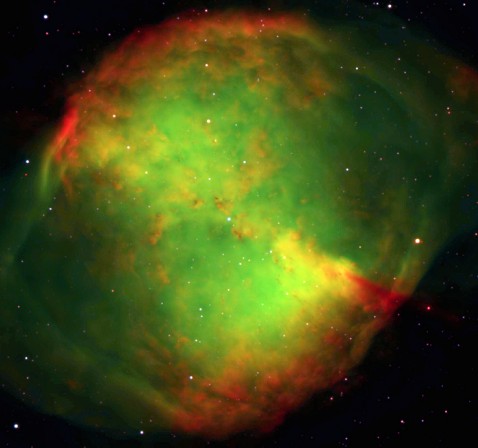
M27 in Hubble Colors
|
||
|
MAPPED COLOR - SII/Ha/OIII LIGHT |
|||

M27 - THE DUMBBELL NEBULA in "HUBBLE" COLORS
Red = SII, Green = Ha, Blue = OIII
|
About this Image: |
|
No, this isn't a Hubble shot. But this image was acquired and processed just like the gorgeous Hubble telescope images that we've come to love. To accomplish this, the image was taken through specialized, narrowband emission line filters. This information was then "mapped" to the traditional red, green, and blue channels of an RGB image. The green portions of the image represent Hydrogen-alpha ionized gases.. Most notably, these gasses extend well outside the Dumbbell itself to form a halo around the outskirts, something that requires very long exposures timesto capture in an amateur image. The color blue represents doubly ionized Oxygen gases, and as you'd expect from a planetary nebula, the heaviest concentration of these gases are around the core area itself. Finally, red represents singly ionized Sulfur gases. While the stars glow heavily in the sulfur wavelength, there is only a light concentration of it in the nebula, mostly throughout the brighter portions.
Such images, while obviously
beautiful, have a real scientific purpose. Because the colors are mapped
specifically to certain gases, it's easy to understand the
concentrations of ionizations and how (where) they interact with each
other. |
DETAILS: Imaged with the 12.5" Truss RC (RCOS Optical Systems) July 20, 2004, using a Precision Instrument Rotator to find the brightest guide star, at f9, with unbinned Luminance, and guided by the AO-7 on a Paramount ME German Equatorial Mount. Camera is an ST-10XME. Luminance is two and one-half hours, with 30 minutes each of LRGB binned 2. All allignment of reduced frames (bias, darks, flats) done in RegiStar. CCDSharp, MaxIm DL, and Photoshop CS with a variety of plug-ins used in the processing. RGB combine ratios were 1:1.1:0.9 using AstroDon TruBalance filters. COMMENTARY: M27 is a bright, well-defined, and popular imaging target in the Constellation Vulpecula. It is a planetary nebula resulting from the demise of a sun-like star through the various evolutionary stages to its present white dwarf status, puffing off its outer atmospheres and bombarding the gases and dusts with high-energy illuminating radiation, causing expanding shock waves. M27 is approximately 800-1000 light-years distant, about 2-3 light-years in diameter.
|
About this Image: |
|
This is an attempt to take
spectral line emission data and use the same techniques as the well-known
European Southern Observatory (ESO) image (see below) taken back in 1998
on the newly constructed 8.2 meter VLT scope. While the above image was
taken with much less aperture, the instrumentation is so sophisticated
in such scopes that it's rather remarkable! Of course, the ESO image
used only 5 minute exposures for each component! |
Location:
Ballauer Observatory
near Azle, Texas
Date: June 24th and 25th, 2005
Seeing:
9/10
Transparency: 2/10 (shot near full moon phase)
Temperature: 69 to 72 degrees F (camera at -15c)
Scope/Mount: 12.5" RCOS RC and Paramount ME
Camera: SBIG STL-6303e astro CCD camera
Filters: Custom Scientific 4.5nm Ha, OIII, and SII spectral
line filters.
Exposure Info: Mapped color image - Ha/OIII/SII - 300:80:120
minutes (20 minute subexposures unbinned))
Processing
Information:
Calibration, Registration, Hot/Cold
Pixel removal, and DDP in MaxIm DL 4. LR Deconvolution on Ha channel in
CCDSharp. Color mapping, cropping, color balance, levels/curves, sharpening,
and noise removal in Photoshop CS.
Exposure Notes: This is a re-mapping of the same color data used in the Hubble colors image. The Ha data is mapped to the red channel, OII to green, and SII to blue. Some H-alpha data (15%) was blended into the blue channel as well to imitate H-beta emissions. Seeing was exceptional, in the 1" arc second neighborhood, but data was taken near a full moon.
Astronomi Nebula Resimler Astrophotography Galaxy Resimler Yıldız Kümeleri
Copyright(c) 2003 - 2005- Çetin BAL -All rights reserved.