| |
1 -BÖLÜM In case of
emergency...
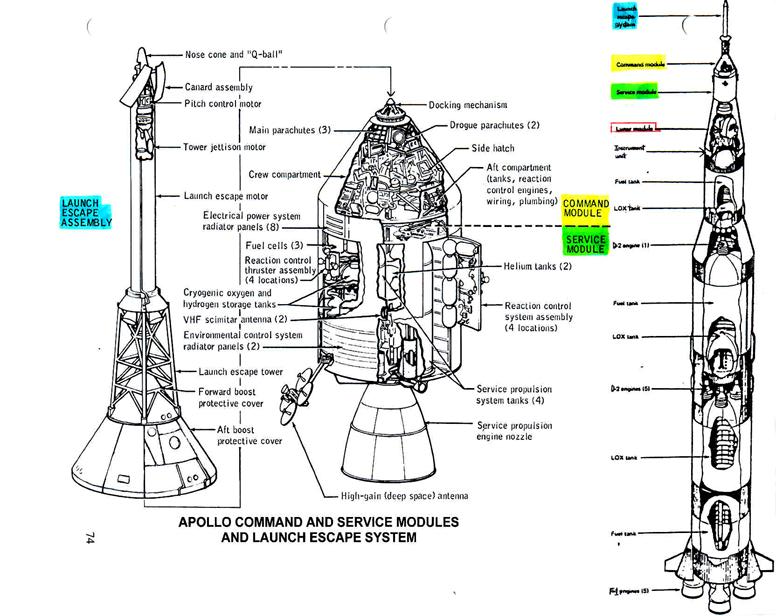
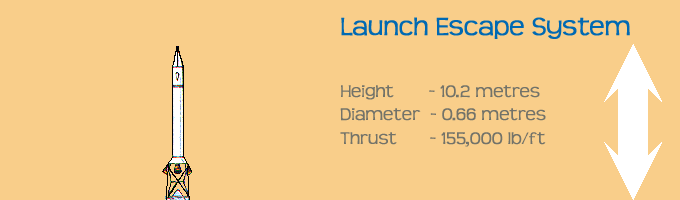
If the rocket blew up before or during the launch, the rocket motors in this
tower powered the command module up and away from the rocket, They lifted
the command module high enough for the parachutes to be able to land the
astronauts safely far from the launch pad.
2 -BÖLÜM
Preparing to land on the moon
Once the rocket was safely on its way to the moon, the Command Module (the
cone shaped bit at the top), where the astronauts sat, detached from the top
of the rocket and pulled the Lunar Module, or LEM as it was nicknamed, out
of the top of the rocket.
There were four doors on the top of the rocket that opened like a flower to
make this easier. The Command Module stays attached until the LEM detaches
to land on the moon.
3-BÖLÜM
Going to the moon
Once the second stage had Used up all its fuel, it would detach from the
next and last stage of the rocket. Between the two stages (and also between
the first and second stages) there was a ring that connected the stages
together called an Interstage. This would drop away and then the engines on
the next stage started to power it upwards again.
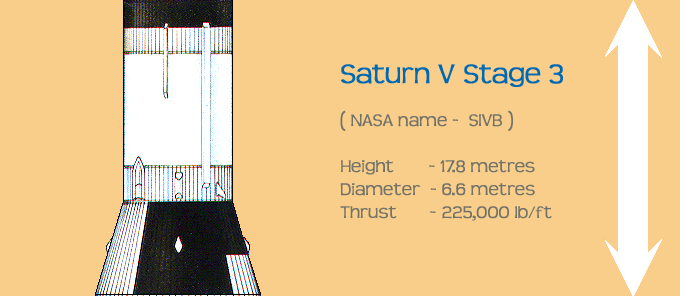
Once they were up in space, the third stage used all its remaining fuel to
blast the command module and lunar module, away from earth, and on to the
moon, a quarter of a million miles away!
4-BÖLÜM
Getting into space
After separation from the first stage, the second stage engines fired up its
engines, and blasted the rocket up to a height of 176 Km - and into space!
By this time, the rocket would be doing over 15,000 miles per hour!
This stage of the rocket used liquid hydrogen and oxygen as fuel. When
filled with fuel, the fuels represented 97% of its weight. The liquid
hydrogen had to be stored at incredibly cold temperatures, and this made ice
form on the outside of the rocket which fell off in chunks as the rocket
launched.
Only six minutes after the engines started, all the fuel would be used up,
the engines stopped, and the second stage would separate from the rocket,
and would fall back to earth.
5 -BÖLÜM
Getting off the ground
The incredibly powerful first stage of the Saturn V rocket was built by
Boeing - the aircraft company famous for making the Jumbo Jet.
At launch time, the first stage weighed over 2000 metric tonnes - about the
same as 12 Jumbo jets!
Most of the weight was fuel - there were two enormous fuel tanks inside the
rocket, the top one for liquid oxygen and the other for RP1 - a special
rocket fuel that is a lot like airplane fuel.
These two fuels were mixed and burned by the rockets engines, at a rate of
nearly 8000 litres every second!
The first stage had not one but five F1 rocket motors - the most powerful
rocket engine ever built. Together these rocket engines produced enough
power to generate all the electricity the whole city of New York uses for
over an hour, and as much noise as 8 million hi-fi stereos!
The first stage took the rocket from the launch pad up to a height of 61Km,
all in the first 2 and a half minutes of the flight. Then it dropped away
from the rocket to fall back to earth - landing in the sea.
Landing on the moon - the Lunar Module
The Lunar excursion module (or LEM as the astronauts called it) was a spider-like
spacecraft designed to land on the moon. The lunar module was pulled out of
the top of the rocket by the command module, and when joined together, gave
the astronauts two tiny rooms to live in on their three day flight to the
moon.

Once in orbit around the moon, two of the three astronauts used the LEM to
fly down to the moon.
The bottom part of the LEM held all the experiments and equipment the crew
would need on the moon, and sometimes even a little car to drive around the
moon in. When it blasted off for the journey home, the LEM left its legs on
the moon!
Getting back to earth - the Command Module

The command module was the top part of the rocket, where the three
astronauts sat at launch. It was the only bit of the enormous rocket that
made it back to earth.
The command module was connected to the service module - a dustbin shaped
unit, that held air and water for the trip, and the powerful rocket engine
that brough them home from the moon.
The bottom of the command module was nearly flat, and made to withstand the
terrible heat that is generated when a space craft drops back down to earth
from space. Finally it would land in the sea, after being slowed down by
three parachutes.
|
|