.....::: Time Travel Research Center © 1998 Cetin BAL - GSM:+90 05366063183- Turkey / Denizli ::.....
COULD YOU EVER BUILD
A TIME MACHINE?
a book in the Could You Ever?
series by David Darling
 |
Contents The Challenge 1. About Time 2. It's Yesterday Once More 3. Shortcuts to the Future 4. Black Holes and Time Tunnels Hands On Glossary |
4. Black Holes and Time Tunnels
 |
|
An artist's idea of what a black hole might
look like against the starry background of our galaxy
|
High in the sky on a clear fall evening is the star group called Cygnus,
the Swan. It is not hard to find. Look for a large pattern of stars in the
shape of a cross, or a swan in flight.
A map of the constellation Cygnus is shown below. On the map, the end of the
swan's tail is marked by a bright star called Deneb. Slightly ahead of Deneb
are three stars in a line. They represent the swan's body and the tips of
its wings. Finally some distance away is a fifth, fairly bright star,
Albireo. It marks the position of the great bird's head.
Now look halfway along the neck of the swan. There is a point on the map
labeled Cygnus X-1. The next time you are outside on a clear, dark fall
evening, locate Cygnus and gaze at the spot where Cygnus X-1 lies. Though
you will not actually see anything, you will be looking at the exact point
in space where scientists believe there may be a black hole.
 |
| The location of Cygnus X-1, thought to be a black hole, in Cygnus the Swan |
Crushed Out of Sight
Black holes are popular subjects in films, as well as in many science
fiction stories. But there is a good chance that black holes really exist in
space. They are places where the pull of gravity is so strong that nothing,
not even light, can escape from them. Once inside a black hole, you could
never come back out the same way. However, it is possible that you could
escape by a different route and arrive at a totally different part of the
Universe. What is more, a journey into a black hole might transport you
through time, either into the far future or the remote past.
 |
|
The Crab Nebula is the remains of a massive
star that blew apart at the end of its life. Though the Crab Nebula does
not contain a black hole, these strange objects may be found in the
supernova wreckage of some other giant stars.
|
How can black holes be made? One way is by the explosion of very heavy
stars. A star that weighs 20 or 30 times as much as the Sun can shine
brightly for only a few million years. Then it blows itself apart. During
this huge explosion, known as a supernova, all the top layers of the old
star are blasted away into space at high speed. However, the core, or
central part, of the star may remain whole.
In a normal, middle-aged star, such as the Sun, the core is the place where
light and heat are made. Here the temperature is incredibly high – many
millions of degrees. The outward pressure of this light and heat prevents
the inward force of gravity from squeezing the core any smaller. For most of
a star's life, these two great forces struggle against one another in an
evenly matched game of tug-of-war. But in a dead star, there is no longer
any light pressure to oppose gravity. As a result, the core is squeezed
tighter and tighter and gets smaller and smaller.
When average-sized stars, such as the Sun, reach the end of their lives,
their cores shrink down to hot balls of squashed matter. These are called
white dwarfs. Then another force, caused by particles of matter becoming too
crowded together, stops gravity from crushing a white dwarf to an even
smaller size.
In bigger, heavier stars, the force of gravity acting on the dead star's
core is much stronger. Even after the supernova explosion has blown away
much of the star's contents, the core that remains may be heavier than the
Sun. If the core is more than three times as heavy as the Sun, nothing can
prevent gravity from crushing the core smaller and smaller. From an original
size of more than 20,000 miles across, the core is squashed in less than a
tenth of a second to a ball only 25 miles across. At this stage, a
tablespoonful of its matter would weigh the same as four billion full-grown
elephants. But gravity squeezes it still smaller. In a fraction of a second,
more than three sun's worth of star material becomes crammed into an
incredibly tiny space. Now it may be no larger than the period at the end of
this sentence.
Within a few miles of the totally crushed star, gravity is so strong that it
will pull in anything that comes too close. And it will allow nothing to
escape, not even a ray of light traveling at more than 186,000 miles per
second. The region around the crushed star is completely black and invisible.
That is why scientists call it a black hole.
The Mystery of Cygnus X-1
 |
|
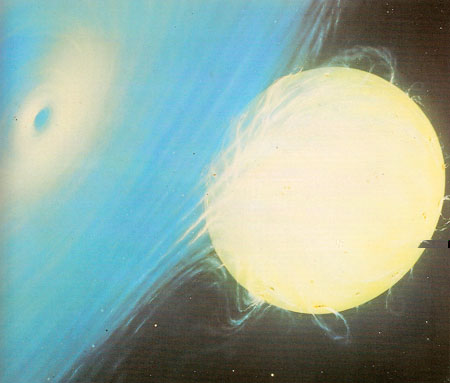
An artist imagines how the black hole in
Cygnus X-1 might look. It lies at the center of the spinning whirlpool
of matter that has been pulled off the large yellow star
|
If black holes are black and invisible, then how can we ever know they
are there? In fact, we cannot, unless there is something nearby that can be
seen and upon which the black hole has a noticeable effect. This is the case
with Cygnus X-1.
From observations made by instruments in space, scientists have discovered
that huge amounts of X-rays – rays that carry a great deal of energy – are
coming from the direction of Cygnus X-1. They have also found that a binary
star lies in the same position as the source of the X-rays. A binary star
consists of two stars that are circling around each other. One of these
stars is much bigger and brighter than the Sun, but it can only be seen
through a large telescope because it is so far away. Astronomers know it is
there because of the "wobbles" it causes in the movement of its giant
neighbor.
From the extent of the wobbles, astronomers think the dark star in Cygnus
X-1 must weigh from five to eight times as much as the Sun. This fact alone
suggests that it is likely to be a black hole. But the X-rays offer still
stronger evidence. Careful studies of the X-rays have revealed that they are
almost certainly coming from a whirlpool of extremely hot gas. This gas,
scientists believe, has been stripped away from the bright giant star by the
gravitational pull of a nearby black hole. Just before it disappears down
the black hole, the gas is heated to more than 18 million °F. At that
superhigh temperature, it gives off an intense X-ray glow.
Into the Black Hole
 |
|
To travel from a point in space and time
A to another point in space and time B, spaceship 1 takes
an ordinary route around the Universe. Spaceship 2, though, takes a
shortcut using a wormhole. If B lies farther back in time than
A, then the journey could only be made through the wormhole.
|
Even before scientists found signs of real black holes in the Universe,
they had studied the mathematics of what black holes might be like inside.
According to their theories, black holes may be like the entrances of
tunnels that join different regions of space and time. These strange tunnels
are called wormholes. At the end of a wormhole is an exit known as a white
hole. By going into a black hole, traveling along its wormhole, and then
coming out the white hole at the other end, a spacecraft might be able to
leap across huge distances of space and millions of years in time.
But two British scientists, Stephen Hawking and Roger Penrose, pointed out
some problems with this wonderful way to travel. For one thing, there seems
to be an energy barrier inside a black hole. No normal object, such as a
spacecraft, could pass through this barrier without being torn to bits. The
two scientists identified a second major problem. It appears that the
wormhole tunnel would instantly squeeze shut if a piece of matter tried to
move along it.
However, in 1988, new results were published by researchers Michael Morris,
Kip Thorne, and Ulvi Yurtsever at the California Institute of Technology.
These showed that a wormhole might be kept open with the help of two round
plates that carried a charge of electricity. The plates would be located on
either side of the "throat" leading into the wormhole. Results from even
more recent research have shown that objects entering a spinning black hole
might also be able to travel through time.
Yet, just because something is possible in theory does not mean it will
quickly, or ever, become fact. We are still not certain that black holes
exist. The evidence for them, though, is strong. If they do exist, then the
nearest one is likely to be many trillions of miles away. Cygnus X-1 is
about 10,000 light-years from Earth. One light-year is the distance that
light travels in a year, or about 6 trillion miles. Cygnus X-1, then, lies
about 60 thousand trillion miles away!
It is possible that there are closer black holes to Earth that we have not
yet found. If they are not members of binary systems, then they would be
extremely hard to detect. Still, it would be surprising if there were a
black hole similar to Cygnus X-1 that was closer than a few hundred light-years
to the Sun. At such a distance, it would be very difficult to reach such an
object. And it would be even harder to use it as a time machine.
Black Holes, Large and Small
Much larger black holes, weighing millions or even billions of times as much
as the Sun, are thought to lie in the center of galaxies. Galaxies are huge
collections of stars arranged in spiral, round, oval, or irregular shapes.
We live in a galaxy called the Milky Way. To explain the unusual amount of
energy coming from the middle of large galaxies, scientists have proposed
the idea of "supermassive" black holes. But these would lie even farther
from Earth than black holes that formed from neighboring stars.
There may also be mini back holes. These may be smaller than a pea but with
the mass, or amount of matter, of a mountain. It is also possible that
scientists will someday be able to create their own tiny black holes in the
laboratory. They might do this by directing extremely intense, pure beams of
light into a tiny pellet of matter. If enough energy could be focused onto
the pellet at one time, it would collapse to form a black hole so small that
it could only be seen under a microscope.
But there is a problem with this plan. Small black holes would tend to rip
apart any object that was sent into them. This would happen because the pull
of gravity on anything approaching a mini black hole would be much greater
at the front of the object than at the back.
In the case of a very large, massive black hole, the difference in
gravitational pull across an approaching object would be much less. The
supermassive black holes that may occupy the center of some galaxies also
appear to be the only kind that human beings might be able to enter and
survive.
Beyond the Light Barrier
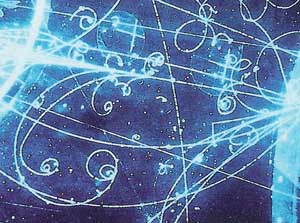
According to Einstein's Special Theory of
Relativity, no object can accelerate up to the speed of light. As an
object goes faster, its mass increases. That makes it harder and harder
to boost its speed further. To reach the speed of light, even a particle
that started out with a tiny mass would require more energy than there
is in the whole Universe. |
The Prospect for Time Travel
Could you then build a time machine? With devices such as cameras and video
recorders, it is already possible to review events from the past.
Researchers are also making progress in learning how humans age and how the
aging process might be slowed. Perhaps within 20 or 30 years, there will be
methods to allow people to live longer. If so, they will see much more of
the future.
Other forms of time travel will probably take longer to develop. It is
unlikely that there will be any crew carrying spaceships that can fly close
to the speed of light by the end of the twenty-first century. But such craft
will be built. Then human beings who travel to the stars will go on journeys
through time. They will leap hundreds, thousands, or even millions of years
into the future during their own lifetimes.
Scientists today do not know if black holes will ever be used as a means to
jump instantly into the remote past or future. The technical problems to be
overcome, even if such journeys are possible, are among the most difficult
imaginable. Yet the people who lived a century ago might have thought of
human missions to the Moon in the same way.
Someday, in some form, the human race is likely to build a machine that can
swiftly travel through time. Where that will lead us to, no one yet knows.
Hiçbir yazı/ resim izinsiz olarak kullanılamaz!! Telif hakları uyarınca bu bir suçtur..! Tüm hakları Çetin BAL' a aittir. Kaynak gösterilmek şartıyla siteden alıntı yapılabilir.
© 1998 Cetin BAL - GSM:+90 05366063183 -Turkiye/Denizli
Ana Sayfa / Index / Roket bilimi / E-Mail / Kuantum Fizigi / Astronomy
/ Time Travel Technology / UFO Galerisi / UFO Technology /