HYDROSTATICS (aerodynamic pressure)
|
|
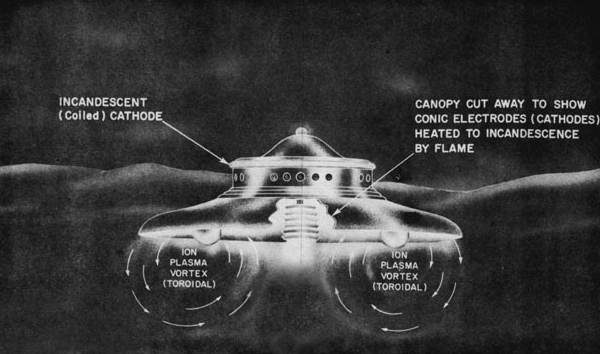
NEW PRINCIPLE OF LIFT "In applying the principles of electrostrictive hydrodynamics (electrohydrodynamics) it is immediately clear to the aeronautical engineer that a large electrode area is required. Just as a sailboat uses a sail, any vehicle utilizing electrohydrodynamic propulsion must employ a large ballistic electrode to integrate the pressure of plasma "winds" to provide lift or forward thrust. These so-called "electric winds" are ion flows, moving at relatively high velocity. The flows may take various patterns determined by: 1) The manner in which the flows are generated, and
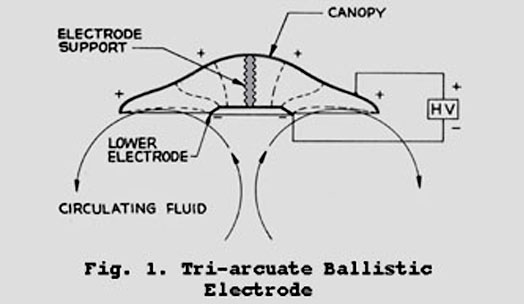
In the case of a large arcuate electrode with a small axial electrode near its focus, the flow pattern is a toroidal vortex, like a whirling smoke ring. This is an effective aerodynamic pattern to produce the desired results. Hydrostatic pressure (or aerodynamic pressure, if one prefers) is exerted against the entire inner surface of the large arcuate electrode [see fig.1 canopy], and the integrated pressure creates a mechanical force which propels the entire structure in one direction."
|
|
|
Taken from the documents on Electrohydrodynamics at the T Townsend Brown family website. "It became clear at this stage that the idealized electrode structure included an anode of bi-arcuate or tri-arcuate shape; in other words, helmet shaped. The cathode, much smaller in size (preferably annular or ring-shaped) is positioned concentrically within the helmet anode and aligned with its rim. Heating the cathode to incandescence greatly increases the plasma density in the region between the two electrodes. Bleeding alkali vapor into the region near the cathode further increases the plasma density. The anode and the cathode are mechanically tied together by a ceramic spacing member. When electrically energized to the limit, just under electrical breakdown, high energy plasma is generated in the region immediately adjacent to the incandescent cathode where the electric field density is greatest. By highly effective electrostriction due to the unique geometry of the field, the plasma is accelerated toward all portions of the concave anodic surface, creating hydrostatic pressure against said surface. It is within this region, extending outward to the periphery of the anode, that the plasma receives its principle acceleration. It is then driven beyond the rim and flows with high velocity in a circuit back to the cathode. The flow pattern takes the form of a toroidal vortex. Contact by convection with the ambient plasma forces the ambient in a direction opposite to that of the hydrostatic pressure acting upon the surface of the anode. This is required for conservation of momentum. It has thus become clear that the arcuate anode experiences a net thrust due to what may be the equivalent to aerodynamic pressure; hence, it becomes a type of airfoil capable of lift. Tests in a vacuum chamber up to 0.001 microns have revealed a
remarkable constancy of this lift with diminishing pressure. Two inter-related
possibilities may provide an explanation: H içbir yazı/ resim izinsiz olarak kullanılamaz!! Telif hakları uyarınca bu bir suçtur..! Tüm hakları Çetin BAL' a aittir. Kaynak gösterilmek şartıyla siteden alıntı yapılabilir.© 1998 Cetin BAL - GSM:+90 05366063183 -Turkiye / Denizli Ana Sayfa / Index / E-Mail / Kuantum Fiziği / UFO Technology / Roket bilimi / UFO Galerisi / Astronomy
|