- Antigravity -
Its Potential Will Be as Great
...as the Electrical Industry
The Biefeld-Brown Effect
Author unknown
Some years ago, Professor Biefeld outlined to his student, Townsend Brown, certain experiments which led to the discovery of the phenomenon now known as the Biefeld-Brown effect. Further, these experiments helped to define the inter-relationship of electrical and gravitational fields. This coupling effect parallels electricity and magnetism.
This means that from the technical and commercial aspects, the Biefeld-Brown effect has potentialities for future development and exploitation at least as great as the present electrical industry -probably much more so!
Consider that electromagnetism is basic to electric generators and motors, power production and distribution, radio, television, radar, telephones, etc., and is indispensibly linked to all forms of commercial and other types of transportation. Then it can be easily seen that the possibility of a parallel development in the electrogravitational phenomena has almost unlimited prospects !!!
The original experiments conducted by Townsend Brown, as suggested by Professor Biefeld, concerned the behavior of a condenser when charged with electricity. The first startling result was that if placed in a free suspension with the poles horizontal, the condenser, when electrically charged, showed a forward thrust toward the positive pole !!! When the polarity was reversed, it caused a reversal of the direction of thrust. The experiment was set up in this manner:
The gravity-control effect of vertical thrust is demonstrated by balancing a condenser on a beam balance and then charging it. Upon charging, if the positive pole is pointed upward, the condenser moves upward. Conversely, if the charge is reversed, and the positive pole is pointed downward, the condenser thrusts down. The experiment is set up as follows:
These two simple experiments demonstrate what is now known as the Biefeld-Brown effect. This then is a method of eventually controlling gravity for man's use.
The intensity or magnitude of the effect is determined by five known factors, namely:
1.) The separation of the plates of the condenser - the closer the plates, the greater the effect.
2.) The ability of the material between the plates to store electrical energy in the form of elastic stress. A measure of this ability is called the 'K' factor of the material. The higher the 'K', the greater the Biefeld-Brown effect.
3.) The area of the condenser plates - the greater area giving the greater effect.
4.) The voltage difference between the plates - the greater the voltage, the greater the effect.
5.) The mass of the material between the plates - the greater the mass, the greater the effect.
It is this fifth factor which is unexplainable from the electromagnetic aspect, and which apparently provides the connection with gravitation.
Now that the basic concept of electrogravitation has been presented in the form of the Biefeld-Brown effect, we can now present the refinements necessary to accomplish the desired goal of a vehicle powered by a gravity-control (antigravity) mechanism.
The Earth creates and is surrounded with a gravitational field which approaches zero as we go deeper and deeper into space. This field 'presses' objects and people towards the Earth's surface, and therefore 'presses our conjectured vehicle to the ground. However, thru the utilization of the Biefeld-Brown effect, our vehicle can generate an electrogravitational field of its own which modifies the Earth's gravity field.
This generated field acts like a wave, with the negative pole at the top of the wave, and the positive pole at the bottom. Our vehicle travels like a surfboard on the incline of a wave that is kept continually moving by the vehicle's electrogravitational generator. Since the orientation of the field can be controlled, the vehicle can thus travel on its own continuously generated wave in any desired angle or direction of flight !
The method of controlling the flight of the vehicle is illustrated by the following simple diagrams showing the charge variations necessary to accomplish all directions of flight:
Townsend T. Brown Patents
* 300,311 - T.T.Brown (Nov. 15, 1928) A Method of and an Apparatus or Machine for Producing Force or Motion
* 1,974,483 - T.T.Brown (Sep. 25, 1934) Electrostatic Motor
* 2,949,550 - T.T.Brown (Aug. 16, 1960) Electrokinetic Apparatus
* 3,022,430 - T.T.Brown (Feb. 20, 1962) Electrokinetic Generator
* 3,187,206 - T.T.Brown (June 1, 1965) Electrokinetic Apparatus
* 3,296,491 - T.T.Brown (Jan. 3, 1967) Method and Apparatus for Producing Ions and Electrically-Charged Aerosols
* 3,518,462 T.T.Brown June 30, 1970 Fluid Flow Control System
Dr. Edwin Saxl - Electrified Pendulum
An interesting experiment conducted by Dr. Edwin Saxl and reported in Nature Magazine seemingly utilized the same connection between electricity and gravity that the Biefeld-Brown effect uses.
In his experiment, Dr. Saxl placed a torque pendulum inside an electrified cage. The cage was electrically charged with voltages varying from 0 to 5000 volts. With these conditions, the period of the pendulum was noted to decrease as the voltage increased.
Since the period of a pendulum is directly proportional to the gravitational constant, the conclusion is that gravity and/or mass was decreased within the statically charged cage.
Biefeld–Brown effect
(Redirected from Biefeld-Brown effect)
This article may require cleanup to meet Wikipedia's quality standards. The
specific problem is: the article seems to be off topic and/or a redundant
description of electrohydrodynamics Please help improve this article if you
can. (May 2014)
The Biefeld–Brown effect is an electrical effect that produces an ionic wind
that transfers its momentum to surrounding neutral particles. The effect was
named by inventor Thomas Townsend Brown who claimed that he did a series of
experiments with professor of astronomy Paul Alfred Biefeld, a former
teacher of Brown who Brown claimed was his mentor and co-experimenter at
Denison University in Ohio.[1][2] The phenomenon was also given the name "electrogravitics"
by Brown based on his belief this was an electricity/gravity phenomenon. The
effect is more widely referred to as electrohydrodynamics (EHD) or sometimes
electro-fluid-dynamics, a counterpart to the well-known magnetohydrodynamics.
Extensive research was performed during the 1950s and 1960s on the use of
this electric propulsion effect during the publicized era of the United
States gravity control propulsion research (1955–1974).
There is renewed focus on the Biefield–Brown effect with the spread in
interest in high-voltage powered experimental flying devices known as
ionocraft or lifters.
Contents
1 Effect analysis
2 Electrogravity
3 Patents
4 References
5 External links 5.1 Biefeld Brown effect electrohydrodynamics
Effect analysis
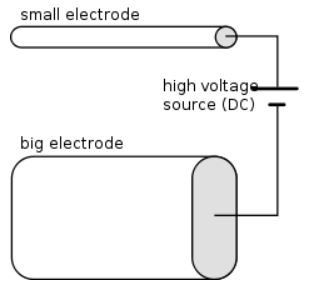
Asymm-capacitor.
The effect is generally believed to rely on corona discharge, which allows
air molecules to become ionized near sharp points and edges. Usually, two
electrodes are used with a high voltage between them, ranging from a few
kilovolts and up to megavolt levels, where one electrode is small or sharp,
and the other larger and smoother. The most effective distance between
electrodes occurs at an electric potential gradient of about 10 kV/cm, which
is just below the nominal breakdown voltage of air between two sharp points,
at a current density level usually referred to as the saturated corona
current condition. This creates a high field gradient around the smaller,
positively charged electrode. Around this electrode, ionization occurs, that
is, electrons are stripped from the atoms in the surrounding medium; they
are literally pulled right off by the electrode's charge.[citation needed]
This leaves a cloud of positively charged ions in the medium, which are
attracted to the negative smooth electrode by Coulomb's Law, where they are
neutralized again. This produces an equally scaled opposing force in the
lower electrode. This effect can be used for propulsion (see EHD thruster),
fluid pumps and recently also in EHD cooling systems.[citation needed] The
velocity achievable by such setups is limited by the momentum achievable by
the ionized air, which is reduced by ion impact with neutral air. A
theoretical derivation of this force has been proposed (see the external
links below).
However, this effect works using either polarity for the electrodes: the
small or thin electrode can be either positive or negative, and the larger
electrode must have the opposite polarity.[3] On many experimental sites it
is reported that the thrust effect of a lifter is actually a bit stronger
when the small electrode is the positive one.[4] This is possibly an effect
of the differences between the ionization energy and electron affinity
energy of the constituent parts of air; thus the ease of which ions are
created at the 'sharp' electrode.
As air pressure is removed from the system, several effects combine to
reduce the force and momentum available to the system. The number of air
molecules around the ionizing electrode is reduced, decreasing the quantity
of ionized particles. At the same time, the number of impacts between
ionized and neutral particles is reduced. Whether this increases or
decreases the maximum momentum of the ionized air is not typically measured,
although the force acting upon the electrodes reduces, until the glow
discharge region is entered. The reduction in force is also a product of the
reducing breakdown voltage of air, as a lower potential must be applied
between the electrodes, thereby reducing the force dictated by Coulomb's Law.
During the glow discharge region, the air becomes a conductor. Though the
applied voltage and current will propagate at nearly the speed of light, the
movement of the conductors themselves is almost negligible. This leads to a
Coulomb force and change of momentum so small as to be zero.
Below the glow discharge region, the breakdown voltage increases again,
whilst the number of potential ions decreases, and the chance of impact
lowers. Experiments have been conducted and found to both prove and disprove
a force at very low pressure. It is likely that the reason for this is that
at very low pressures, only experiments which used very large voltages
produced positive results, as a product of a greater chance of ionization of
the extremely limited number of available air molecules, and a greater force
from each ion from Coulomb's Law; experiments which used lower voltages have
a lower chance of ionization and a lower force per ion. Common to positive
results is that the force observed is small in comparison to experiments
conducted at standard pressure. This is likely[original research?] to be the
result of the massively reduced number of ions produced by the experiment,
although this could also be interpreted to be a different force entirely.
Electrogravity
At one time, Brown believed his devices produced a new field that interacted
with the Earth's gravitational pull, a phenomenon he labeled
electrogravitics. Certain fringe researchers claim that conventional physics
cannot adequately explain the phenomenon.[5] The effect has become something
of a cause célèbre in the UFO community, where it is seen as an example of
something much more exotic than electrokinetics. Charles Berlitz devoted an
entire chapter of his book The Philadelphia Experiment to a retelling of
Brown's early work with the effect, implying he had discovered a new
electrogravity effect and that it was being used by UFOs. Today, the
Internet is filled with sites devoted to this interpretation of the effect.
There has been follow-ups on the claims that this propulsive force can be
produced in a full vacuum, meaning it is an unknown anti-gravity force, and
not just the more well known ion wind, with several researchers (R. L.
Talley in a 1990 US Air Force study, NASA scientist Jonathan Campbell in a
2003 experiment,[6] and Martin Tajmar in a 2004 paper[7]) finding that no
thrust could be observed in a vacuum, consistent with the phenomenon of ion
wind. Campbell pointed out to a Wired magazine reporter that creating a true
vacuum similar to space for the test requires tens of thousands of dollars
in equipment.
Patents:

U.S. Patent 3,120,363 — Flying apparatus — G.E. Hagen
T. T. Brown was granted a number of patents on his discovery:
GB300311 — A method of and an apparatus or machine for producing force or
motion (accepted 1928-11-15)
U.S. Patent 1,974,483 — Electrostatic motor (1934-09-25)
U.S. Patent 2,949,550 — Electrokinetic apparatus (1960-08-16)
U.S. Patent 3,018,394 — Electrokinetic transducer (1962-01-23)
U.S. Patent 3,022,430 — Electrokinetic generator (1962-02-20)
U.S. Patent 3,187,206 — Electrokinetic apparatus (1965-06-01)
U.S. Patent 3,196,296 — Electric generator (1965-07-20)
Historically, numerous patents have been granted for various applications of
the effect, from electrostatic dust precipitation, to air ionizers, and also
for flight. A particularly notable patent — U.S. Patent 3,120,363 — was
granted to G.E. Hagen in 1964, for apparatus more or less identical to the
later so-called 'lifter' devices. Other ionic US patents of interest:
2022465, 2182751, 2282401, 2295152, 2460175, 2636664, 2765975, 3071705,
3177654, 3223038, 3120363, 3130945
References
1.Jump up ^ The present day Denison University claims they have no record of
such experiments being carried out, or of any association between Brown and
Biefeld.Paul Schatzkin, Defying Gravity: The Parallel Universe of T.
Townsend Brown, 2005-2006-2007-2008 - Tanglewood Books, Chapter 13: Notes
from the Rabbit Hole #3: "He Made Things Up" (online excerpts)
2.Jump up ^ alienscientist.com, Biefeld-Brown Effect Controversy, Tajmar ESA
Experiments
3.Jump up ^ NASA CR-2004-213312 Asymmetrical Capacitors for propulsion
4.Jump up ^ Bahder, TB. "Force on an Asymmetric Capacitor" (PDF). Retrieved
9 October 2011.
5.Jump up ^ Mallove, Eugene (September–October 2002). "The "Lifter"
Phenomenon". Infinite Energy.
6.Jump up ^ Thompson, Clive (August 2003). "The Antigravity Underground".
Wired Magazine.
7.Jump up ^ Tajmar, M. (2004). "Biefeld-Brown Effect: Misinterpretation of
Corona Wind Phenomena". AIAA Journal 42 (2): 315. Bibcode:2004AIAAJ..42..315T.
doi:10.2514/1.9095.
Tajmar, M. (2004). "Biefeld-Brown Effect: Misinterpretation of Corona Wind
Phenomena". AIAA Journal 42 (2): 315. Bibcode:2004AIAAJ..42..315T. doi:10.2514/1.9095.
Buehler D.R., Journal of Space Mixing, April 2004, vol. 2, pp. 1–22, "Exploratory
Research on the Phenomenon of the Movement of High Voltage Capacitors".
Space-mixing-theory.com. Retrieved 2010-09-14.
Vassilatos G. (2000). Lost Science. Adventures Unlimited Press. ISBN
0-932813-75-5.
Paul A. LaViolette, Ph.D. (2008). Secrets of Antigravity Propulsion: Tesla,
UFO's and Classified Aerospace Technology. Rochester, Vermont: Bear &
Company. pp. 84–85, 89. ISBN 978-159143078-0.
External links:
Defying Gravity: The Parallel Universe of T. Townsend Brown – authorized
biography on T. Townsend Brown
The Hunt for Zero Point – book by Jane's Aviation editor Nick Cook
[1] – Video of the effect
Biefeld Brown effect electrohydrodynamics[edit]
Blaze Labs Research: What is an EHD thruster? — Introduction on EHD
thrusters, ionocrafts, lifters and lots of related information
NASA: Asymmetrical Capacitors for Propulsion (PDF)
Army Research Laboratory, Thomas B. Bahder:Force on an Asymmetric Capacitor
----------------------------------
Electrogravitics
Not to be confused with Gravitoelectromagnetism.
Electrogravitics is claimed to be an unconventional type of effect or anti-gravity
propulsion created by an electric field's effect on a mass. The name was
coined in the 1920s by the discoverer of the phenomenon, Thomas Townsend
Brown, who spent most of his life trying to develop it and sell it as a
propulsion system. Through Brown's promotion of the idea it was researched
for a short while by aerospace companies in the 1950s. Electrogravitics is
popular with conspiracy theorists with claims that it is powering flying
saucers and the B-2 Stealth Bomber.
Since apparatus based on Browns' ideas have often yielded varying and highly
controversial results when tested within controlled vacuum conditions, the
effect observed has often been attributed to the ion drift or ion wind
effect instead of anti-gravity.[1]
Brown also named this phenomenon the "Biefeld–Brown effect" after his
claimed mentor, Denison University professor Paul Alfred Biefeld.
Contents
1 Origins
2 Claims 2.1 Criticism
3 See also
4 References
5 Further reading
6 External links
Origins
Electrogravitics had its origins in experiments started in 1921 by Thomas
Townsend Brown (USA) (who coined the name) while he was still in high school.
He discovered an unusual effect while experimenting with a Coolidge tube, a
type of X-ray vacuum tube where, if he placed on a balance scale with the
tube’s positive electrode facing up, the tubes mass seemed to decrease, when
facing down the tube's mass seemed to increase.[2] Brown showed this effect
to his college professors and even newspaper reporters and told them he was
convinced that he had managed to influence gravity electronically. Brown
developed this into large high voltage capacitors that would produce a tiny
propulsive force causing the capacitor to jump in one direction when the
power was turned on. In 1929 Brown published "How I Control Gravity," in
Science and Invention where he claimed the capacitors were producing a
mysterious force that interacted with the pull of gravity. He envisions a
future where, if his device could be scaled up, "Multi-impulse gravitators
weighing hundreds of tons may propel the ocean liners of the future" or even
"fantastic 'space cars'" to Mars.[3] Somewhere along the way Brown came up
with the name Biefeld–Brown effect, named after his former teacher,
professor of astronomy Paul Alfred Biefeld at Denison University in Ohio.
Brown claimed Biefeld as his mentor and co-experimenter.[4][5] After World
War II Brown sought to develop the effect as a means of propulsion for
aircraft and spacecraft, demonstrating a working apparatus to an audience of
scientists and military officials in 1952. Research in the phenomenon was
popular in the mid-1950s, at one point the Glenn L. Martin Company placed
advertisements looking for scientists who were "interested in gravity", but
rapidly declined in popularity thereafter.
Instead of being an anti-gravity force, this effect has been found to be
caused by ionized particles exerting a force between two asymmetrical
electrodes that produces a type of ion drift or ionic wind that transfers
its momentum to surrounding neutral particles, an electrokinetic phenomena
or more widely referred to as electrohydrodynamics (EHD).[6]
Claims
Electrogravitics has become popular with UFO, anti-gravity, and government
conspiracy theorists[3] where it is seen as an example of something much
more exotic than electrokinetics, i.e. that electrogravitics is a true anti-gravity
technology that can "create a force that depends upon an object’s mass, even
as gravity does".[7][8] There are claims that all major aerospace companies
in the 1950s including Martin, Convair, Lear, Sperry, Raytheon were working
on it, that the technology became highly classified in the early 1960s, that
it is used to power the B-2 bomber,[3] and that it can be used to generate "free
energy".[9] Charles Berlitz devoted an entire chapter of his book on The
Philadelphia Experiment (The Philadelphia Experiment: Project Invisibility)
to a retelling of Brown's early work with the effect, implying the
electrogravitics effect was being used by UFOs. The researcher and author
Paul LaViolette has produced many self-published books on electrogravitics,
making many claims over the years including his view that the technology
could have helped to avoid another Space Shuttle Columbia disaster.
Nikola Tesla has also been associated with electrogravitics.[9]
Criticism
Many claims as to the validity of electrogravitics as an anti-gravity force
revolve around research and videos on the internet purported to show lifter-style
capacitor devices working in a vacuum, therefor not receiving propulsion
from ion drift or ion wind being generated in air.[3][10] Followups on the
claims (R. L. Talley in a 1990 US Air Force study, NASA scientist Jonathan
Campbell in a 2003 experiment,[11] and Martin Tajmar in a 2004 paper[12])
have found that no thrust could be observed in a vacuum, consistent with the
phenomenon of ion wind. Campbell pointed out to a Wired magazine reporter
that creating a true vacuum similar to space for the test requires tens of
thousands of dollars in equipment.
Byron Preiss in his 1985 book on the current science and future of the Solar
System titled The Planets commented that electrogravitics development seemed
to be "much ado about nothing, started by a bunch of engineers who didn't
know enough physics". Preiss stated that electrogravitics, like exobiology,
is "a science without a single specimen for study".
See also[edit]
United States gravity control propulsion initiative
List of topics characterized as pseudoscience
Woodward effect
References
1.Jump up ^ Stein, W.B. 2000: Electrokinetic Propulsion: The Ion Wind
Argument. Purdue University, Energy Conversion Lab (Hangar #3, Purdue
Airport, West Lafayette, IN 47906)
2.Jump up ^ The Canonical Hamiltonian The Intersection Of Chip Design and
Physics by Hamilton Carter, Thomas Townsend Brown: Part IV of the Holiday
Serial
3.^ Jump up to: a b c d Thompson, Clive (August 2003). "The Antigravity
Underground". Wired Magazine.
4.Jump up ^ Paul Schatzkin, Defying Gravity: The Paraellel Universe of T.
Townsend Brown, 2005-2006-2007-2008 - Tanglewood Books, Chapter 13: Notes
from the Rabbit Hole #3: "He Made Things Up" (online excerpts)
5.Jump up ^ alienscientist.com, Biefeld-Brown Effect Controversy, Tajmar ESA
Experiments
6.Jump up ^ NASA CR-2004-213312 Asymmetrical Capacitors for propulsion
7.Jump up ^ Thomas F. Valone, Progress in Electrogravitics and
Electrokinetics for Aviation and Space Travel - Integrity Research Institute,
Washington DC [1]
8.Jump up ^ activistpost.com, Sunday, April 1, 2012 Electrogravitics – A
Simplified Description, Amaterasu Solar
9.^ Jump up to: a b Chapter Six UFOs and Electrogravity Propulsion, Did
Tesla Discover the Secrets of Antigravity? Cite error: Invalid <ref> tag;
name "bibliotecapleyades.net" defined multiple times with different content
(see the help page).
10.Jump up ^ Thomas Valone, Electrogravitics II: Validating Reports on a New
Propulsion Methodology, Integrity Research Institute, page 52-58
11.Jump up ^ Thompson, Clive (August 2003). "The Antigravity Underground".
Wired Magazine.
12.Jump up ^ Tajmar, M. (2004). "Biefeld-Brown Effect: Misinterpretation of
Corona Wind Phenomena". AIAA Journal 42 (2): 315. Bibcode:2004AIAAJ..42..315T.
doi:10.2514/1.9095.
13.Jump up ^ Byron Preiss (1985). The Planets. Bantam Books. p. 27. ISBN
0-553-05109-1.
Further reading
Thomas Valone, Electrogravitics Systems: Reports on a New Propulsion
Methodology. Integrity Research Institute; 2nd ed edition (November 1995).
102 pages. ISBN 0-9641070-0-7 ISBN 978-0964107007
Thomas Valone, Electrogravitics II: Validating Reports on a New Propulsion
Methodology. Integrity Research Instititue; 2Rev Ed edition (July 1, 2005).
160 pages. ISBN 0-9641070-9-0 ISBN 978-0964107090
Jen-shih Chang, Handbook of Electrostatic Processes. CRC Press, 1995. ISBN
0-8247-9254-8
Nick Cook, The Hunt for Zero Point: Inside the Classified World of
Antigravity Technology. Broadway; 1 edition (August 13, 2002). 304 pages
ISBN 0-7679-0627-6 ISBN 978-0767906272
Paul A. LaViolette, "Secrets of Antigravity Propulsion: Tesla, UFOs, and
Classified Aerospace Technology". Bear & Company, Rochester VT (2008),
Paperback: 512 pages, ISBN 978-1-59143-078-0
External links
Electrogravitics at American Antigravity A page of YouTube talks and
demonstrations by supporters.
UFO How-To Volume II: Electrogravitics Excerpts from the book.
----------------------------------------------------
United States gravity control propulsion
research
(Redirected from United States gravity control propulsion initiative)
American interest in "gravity control propulsion research" intensified
during the early 1950s. Literature from that period used the terms anti-gravity,
anti-gravitation, baricentric, counterbary, electrogravitics (eGrav), G-projects,
gravitics, gravity control, and gravity propulsion.[1][2] Their publicized
goals were to develop and discover technologies and theories for the
manipulation of gravity or gravity-like fields for propulsion.[3] Although
general relativity theory appeared to prohibit anti-gravity propulsion,
several programs were funded to develop it through gravitation research from
1955 to 1974. The names of many contributors to general relativity and those
of the golden age of general relativity have appeared among documents about
the institutions that had served as the theoretical research components of
those programs.[4][5][6] The existence and 1950s emergence of the gravity
control propulsion research have not been a subject of controversy for
aerospace writers, critics, and conspiracy theory advocates, but their
rationale, effectiveness, and longevity have been the objects of contested
views.
Contents
1 Evidence of existence 1.1 Histories
1.2 Contemporaneous literature
1.3 UFO and conspiracy theory literature
2 Theoretical research agencies 2.1 Gravity Research Foundation
2.2 Aerospace Research Laboratories (ARL)
2.3 Research Institute for Advanced Study (RIAS)
3 Aerospace firms
4 Reported breakthroughs 4.1 Experimental 4.1.1 Brown's gravitator
4.1.2 Kaplan's gravity-like impulses
4.2 Theoretical 4.2.1 Forward's protational field
5 Legacies 5.1 Gravity Research Foundation
5.2 Aerospace Research Laboratories (ARL)
5.3 Research Institute for Advanced Studies (RIAS)
6 UFO and conspiracy theories
7 References
8 Further reading
Evidence of existence
Mainstream newspapers, popular magazines, technical journals, and
declassified papers reported the existence of the gravity control propulsion
research. For example, the title of the March 1956 Aero Digest article about
the intensified interest was "Anti-gravity Booming." A. V. Cleaver made the
following statement about the programs in his article:
What are the facts, insofar as they are publicly known, or (as at this date)
knowable? Well, they seem to amount to this: The Americans have decided to
look into the old science-fictional dream of gravity control, or "anti-gravity,"
to investigate, both theoretically and (if possible) practically the
fundamental nature of gravitational fields and their relationship to
electromagnetic and other phenomena – and someone (unknown to the present
writer) has apparently decided to call all this study by the high-sounding
name of "electro-gravitics." Unknown, too – at least unannounced – is the
name of agency or individual who decided to encourage, stimulate, or sponsor
this effort, also in just what way it is being done. However, that the
effort is in progress there can be little doubt, and, of course, it is
entirely to be welcomed.[7]
The gravitics programs had not been evinced by any technological artifacts,
such as the Project Pluto Tory IIA, the world's first nuclear ramjet.
Commemorative monuments by the Gravity Research Foundation have been the
artifacts attesting to the early commitments to finding materials and
methods to manipulate gravity. The endeavor had the resources and publicity
of an initiative, but writers from that period did not describe them with
that term. Gladych stated:
At least 14 United States universities and other research centers are hard
at work cracking the gravity barrier. And backing the basic research with
multi-million dollar secret projects is our aircraft industry.[8]
The writings about the gravity control propulsion research effort had
disclosed the "players" and resources while prudently withholding both the
specific features of the research and the identity of its coordinating body.
Publicized and telecasted conspiracy theory anecdotes have suggested much
higher levels of success to the G-projects than mainstream science.
Histories
Recent historical analysis and reports have attracted attention to the
agencies and firms that had participated in the gravity control propulsion
research. James E. Allen, BAE Systems consultant and engineering professor
at Kingston University, referred to those programs in his history of novel
propulsion systems for the journal Progress in Aerospace Sciences.[9]
Research by Dr. David Kaiser, Associate Professor of the History of Science,
Massachusetts Institute of Technology, manifested the contributions made by
the Gravity Research Foundation to the pedagogical aspects of the golden age
of general relativity.[4] Dr. Joshua Goldberg, Syracuse University,
described the Air Force's support of relativity research during that period.[5]
Progress reports[6] and anecdotes and Internet resumes of former visiting
and staff scientists have been the sources of the history of the Research
Institute for Advanced Study (RIAS). Former aviation editor of Jane's
Defense Weekly, Nick Cook, drew attention to the antigravity programs
through worldwide publications of his book,[10] The Hunt for Zero Point, and
subsequent televised documentaries. Mainstream historical accounts of the G-projects
have been supplemented with conspiracy theory anecdotes.
Contemporaneous literature
Lists of the research institutes, industrial sites, and policy makers along
with statements from prominent physicists were provided in five
comprehensive works that had been published during the early years of the
gravity control propulsion research. Aviation Studies (International)
Limited, London, published a detailed report about those activities by the
Gravity Research Group that was later declassified.[3] The Journal of the
British Interplanetary Society and The Aeroplane published the propulsion
survey and critical assessment of the American gravitics research by the
internationally recognized astronautics historian A. V. Cleaver.[7] The New
York Herald Tribune and Miami Herald published a series of three articles by
one of the world's greatest aviation journalists of the twentieth century,
Ansel Talbert.[11] Talbert's two series of newspaper articles took place in
the midst of the policy-by-press-release era. Neither his nor the writings
that followed the five prominent works from that period, yielded denials and/or
retractions.
UFO and conspiracy theory literature
Gravity control propulsion research had been the subject of widely published
UFO and conspiracy theory literature. The documented testimonies of
whistleblowers edited by Dr. Steven Greer, Director of the Disclosure
Project;[12] anecdotes and schematics by Mark McCandlish and Milton William
Cooper;[12][13] and the reports by Philip J. Corso,[14] David Darlington,[15]
and Donald Keyhoe,[16] famous UFO researcher, have suggested incorporation
of reverse engineering of recovered extraterrestrial vehicles with the anti-gravity
propulsion projects had enabled them to continue beyond 1973 to successfully
manufacture antigravity vehicles. Branches of the military and defense
agencies have denied and refuted such claims.
Theoretical research agencies
Talbert indicated the rationale for the intensified interest in gravity
control propulsion research had stemmed from the works of three physicists.[11]
They were Dr. Bryce DeWitt's prize-winning Gravity Research Foundation essay;[17]
the book Gravity and the Universe by Pascual Jordan; and presentations to
the International Astronautical Federation by Dr. Burkhard Heim.[2][18]
DeWitt's essay discouraged the pursuit of materials that shield, reflect,
and/or insulate gravity and emphasized the need to encourage young
physicists to pursue gravitational research. He opened his essay with the
following paragraph:
Before anyone can have the audacity to formulate even the most rudimentary
plan of attack on the problem of harnessing the force of gravitation, he
must understand the nature of his adversary. I take it as most axiomatic
that the phenomenon of gravitation is poorly understood even by the best of
minds, and the last word on it is very far indeed from having been spoken.
Several articles cited his essay during and after the gravity control
propulsion research period. Within a few years facilities emerged embodying
the theme of DeWitt's call for increased stimuli for research.
Physical principle surveys by Cleaver and Weyl stated the antigravity
research was not based on any recognized theoretical breakthroughs.
Cleaver's skepticism suggested an alternative rationale for establishing
that research was based on a science fiction novel.[7] Weyl charged
publishers with poor journalism; attacked their terminology; and gave the
highest rating for prospective physical principles for gravity control
propulsion to Burkhard Heim's works.[2] Stambler leveled harsh criticisms
against Gluraheff's gravitation hypothesis.[19] Talbert and other authors
listed the following three agencies as the principle facilities that had
conducted the theoretical research:
Gravity Research Foundation
Several articles contained expressions of gratitude for the support to the
gravity control propulsion endeavor by the Gravity Research Foundation.[20][21]
Even though the Foundation was a humble, non-profit organization, its
creator, Roger Babson, used his wealth and influence to mobilize industries;
raise private and government funding; and motivate engineers and physicists
to conduct research in gravity shielding and control.[22] According to his
autobiography: "The purpose of the Foundation is to encourage others to work
on gravity problems and aid others in obtaining rewards for their efforts."[23]
During Babson's lifetime, the Foundation conducted Gravity Day Conferences
each summer; established a library on gravity; solicited essays that
addressed (1.) various prospects for shielding gravity, (2.) the development
and/or discovery of materials that could convert gravitational force into
heat, or (3.) methods of manipulating gravity;[24] and installed monuments
at various universities that cited its antigravity focus.
Aerospace Research Laboratories (ARL)
In September, 1956, the General Physics Laboratory of the Aeronautical
Research Laboratories (ARL) at Wright-Patterson Air Force Base, Dayton,
Ohio, commenced an intense program to coordinate research into gravitational
and unified field theories with the hiring of Joshua N. Goldberg.[5]
Creation by ARL of Goldberg's program may have been coincidental to the
Talbert's disclosures of commitments to gravity control propulsion research.[18]
The precise rationale for creating the program and justifying its budgets
and personnel may never be determined. Neither Goldberg nor the Air Force's
Deputy for Scientific and Technical Information, Walter Blados, were able to
locate the founding documents.[5] Roy Kerr, a former ARL scientist, stated
the antigravity propulsion purpose of ARL was "rubbish" and that "The only
real use that the USAF made of us was when some crackpot sent them a
proposal for antigravity or for converting rotary motion inside a spaceship
to a translational driving system."[25] The December 30, 1957 issue of
Product Engineering closed its report with the following statement:
Nevertheless, the Air Force is encouraging research in electrogravitics, and
many companies and individuals are working on the problem. It could be that
one of them will confound the experts.[26]
During the following sixteen years, its name was changed to the Aerospace
Research Laboratories. The ARL scientists produced nineteen technical
reports[5] and over seventy peer-reviewed journal articles.[27] The Air
Force's Foreign Technical Division,[28] and other agencies,[29] investigated
stories[30][31] about Soviet attempts to understand gravity. Such actions
were consistent with the paranoia of the Cold War.
The funding for the military components of the gravity control propulsion
research had been terminated by the Mansfield Amendment of 1973. Black
project experts,[10] conspiracy theorists,[16] and whistleblowers[12][14]
had suggested the gravity control propulsion efforts had achieved their
goals and had been continued decades beyond 1973.
Research Institute for Advanced Study (RIAS)
The Research Institute for Advanced Study (RIAS) was conceived by George S.
Trimble, the vice president for aviation and advanced propulsion systems,
Glenn L. Martin Company, and was placed under the direct supervision of
Welcome Bender. The first person Bender hired was Louis Witten
internationally recognized authority on gravitation physics.[32] Talbert's
article had announced Trimble's completion of contractual agreements with
Pascual Jordan and Burkhard Heim for RIAS. Subsequent hires yielded a half
dozen gravity researchers known as the field theory group. Sir Arthur C.
Clarke and others stated RIAS' assemble of talent was very qualified for the
task of discovering new principles that could be used to develop gravity
control propulsion systems.[33]
The quest for propulsion through gravity control was vaguely implied in
various publications. Works by Cook and Cleaver summarized statements in the
RIAS brochures. Cook had equated the broad range of RIAS's mission
statements with those of Skunk Works. In 1958, Mallan reported "the control
of the force of gravity itself for propulsion" was one of the unorthodox
goals initiated by Trimble for RIAS.[34]
RIAS was renamed the Research Institute for Advanced Studies during the
sixties when the American-Marietta Company merged with Martin to become the
Martin Marietta Company. The 1995 merger that yielded the Lockheed Martin
Company modified its goals and not its name.
Aerospace firms
Talbert's newspaper series and subsequent articles in technical magazines
and journals listed the names of aerospace firms conducting gravity control
propulsion research. Stambler stated:
It is well known that several major companies in the aviation industry are
working on "anti-gravitational devices." Unfortunately, this is about the
only hard and fast statement that can be made about the subject of anti-gravitics.[19]
The Gravity Research Group indicated those companies had constructed "rigs"
to improve the performance of Thomas Townsend Brown's gravitators through
attempts to develop materials with high dielectric constants (k).[3] Gravity
Rand Limited provided a set of guidelines to help management conduct
research and nurture creativity.[1] Articles about the gravity propulsion
research by the aerospace firms ceased after 1974. None of the companies
featured in those publications had filed retractions. The following is a
list of the aerospace firms that had been cited in the works published from
1955 through 1974:
Bell Aircraft, Buffalo, New York.[11]
Boeing Aircraft.[16]
Clarke Electronics, Palm Springs, California.[11]
Convair, San Diego.[11]
Douglas Aircraft.[3]
Electronics Division, Ryan Aeronautical Company, San Diego.[35]
General Electric.[11]
Glenn L. Martin Company, Baltimore, Maryland.[11]
Gluhareff Helicopter & Airplane Corporation, Manhattan Beach,
California.[11]
Grumman Aircraft.[36]
Hiller Aircraft.[3]
Hughes Aircraft.[16]
Lear Incorporated, Santa Monica, California.[11]
Lockheed Aircraft Corporation.[33]
Radio Corporation.[16]
Sikorsky Division of United Aircraft.[11]
Sperry Gyroscope Division of Sperry Rand Corporation, Great Neck, Long
Island.[11]
Reported breakthroughs
None of the reported experimental breakthroughs published during the 1950s
and 1960s have been recognized by the aerospace community.
Experimental
Brown's gravitator
Various reports indicated Brown's gravitators were the main experimental
focus of the gravity control propulsion research.[3] According to G. Harry
Stine and Intel, research on Brown's gravitators became classified
immediately after demonstrations of 30% weight reductions.[37][38] Thomas
Townsend Brown had obtained a British patent for high voltage, symmetric,
parallel plate capacitors, that he called gravitators, in 1928.[39] Brown
claimed they would produce a net thrust in the direction of the anode of the
capacitor that varied slightly with the positions of the Moon.[40] The
scientific community rejected such claims as products of pseudoscience and/or
misinterpretations of ion wind effects.
Independent research [41] found small amount of lift from Brown's gravitator
based on an inefficient use of ionic propulsion. The devices were named Ion
Lifters or Ionocraft and were reported to be able to lift the empty shell of
a vehicle under ideal conditions, but not the additional machinery required
to generate the electric field. Gravity effects were not found in the
independent research.
Kaplan's gravity-like impulses
In July 1960, Missiles and Rockets reported Martin N. Kaplan, Senior
Research Engineer, Electronics Division, Ryan Aeronautical Company, San
Diego, had conducted anti-gravitational experiments yielding the promise of
impulses, accelerations, and decelerations one hundred times the pull of
gravity.[35] Neither comments nor criticism of the report appeared in
subsequent articles during the period of intensified gravity control
propulsion research (see Section 1 of tractor beam for similar reports).
Theoretical
Forward's protational field
Robert L. Forward, Hughes Research Laboratories, Malibu, described the
theoretical generation of dipole gravitational fields by accelerating a
super-dense fluid through pipes wound around a torus.[42] Such techniques
are far beyond the reach of conventionally available technology.
Legacies
Many of the contributors to general relativity have been supported by and/or
associated with the ARL, RIAS, and/or the Gravity Research Foundation. The
decades preceding the 1955 revelation of the gravity control propulsion
research were a low water mark for general relativity.[43][44] The following
summarizes how the components of that research had stimulated the resurgence
of general relativity:
Gravity Research Foundation
Even though some of the physicists who attended the Gravity Day Conferences
quietly mocked the anti-gravity mission of the Foundation,[45] it provided
significant contributions to mainstream physics.[46] The International
Journal of Modern Physics D has featured selected papers from the Gravity
Research Foundation essay competition. Many have been incorporated with the
collections of the Niels Bohr Library. A few of the Foundation essay contest
winners became Nobel laureates (e.g., Ilya Prigogine, Maurice Allais, George
F. Smoot). Foundation essays have been among the resources graduate students
check for new ideas.[22] Kaiser summarized the Foundation's influence in the
following manner:
Despite the vast conceptual gulf separating Babson from the new generation
of relativists, we are left with intriguing, and perhaps ironic associations:
by organizing conferences, sponsoring the annual essay contests, and making
money and enthusiasm widely available for people interested in gravity, the
eccentric Gravity Research Foundation may claim at least some small amount
of the credit for helping to stimulate the postwar resurgence of interest in
gravitation and general relativity.[4]
Foundation trustee, Agnew Bahnson, contacted Dr. Bryce DeWitt with a
proposal to fund the creation of a gravity research institute.[4][47] DeWitt
had won the first prize for the 1953 essay contest. The proposed name was
changed to the Institute for Field Physics and it was established in 1956 at
the University of North Carolina at Chapel Hill under the direction of Bryce
and his wife, Cécile DeWitt-Morette.[48]
The peer reviewed physics journal, Physica C, published a report by Eugene
Podkletnov and Nieminen about gravity-like shielding.[49] Although their
work had gained international attention, researchers were not able to
replicate Podkletnov's initial conditions.[50][51][52] But, analyses by
Giovanni Modanese[53] and Ning Wu[54] indicated various applications of
quantum gravity theory could allow gravitational shielding phenomena. Those
achievements have not been pursued by the scientific community.
Aerospace Research Laboratories (ARL)
The list of prominent contributors to the golden age of general relativity,
contains the names of several scientists who had authored the nineteen ARL
Technical Reports and/or seventy papers. The ARL sponsored papers were
published in the Proceedings of the Royal Society of London, Physical Review,
Journal of Mathematical Physics, Physical Review Letters, Physical Review D,
Review of Modern Physics, General Relativity and Gravitation, International
Journal of Theoretical Physics, and Nuovo Cimento B. Some of the ARL papers
were written in collaboration with RIAS, the U.S. Army Signal Research and
Development Laboratory at Fort Monmouth, New Jersey, and the Office of Naval
Research. The ARL had provided significant enhancements to general
relativity theory. For example, Roy Kerr's description of the behavior of
space-time in the vicinity of a rotating mass was among those works.[55]
Goldberg concluded: "However, it should be recognized that, in the United
States, the Department of Defense played an essential role in building a
strong scientific community without widespread encroachment on academic
values."[5]
Research Institute for Advanced Studies (RIAS)
The growth of nonlinear differential equations during the fifties was
stimulated by RIAS. One of the leading groups in dynamical systems and
control theory, the Lefschetz Center for Dynamical Systems,[3] was a spinoff
from RIAS. After the launch of Sputnik, world-class mathematician Solomon
Lefschetz came out of retirement to join RIAS in 1958 and formed the world's
largest group of mathematicians devoted to research in nonlinear
differential equations.[56] The RIAS mathematics group stimulated the growth
of nonlinear differential equations through conferences and publications. It
left RIAS in 1964 to form the Lefschetz Center for Dynamical Systems at
Brown University, Providence, Rhode Island.
UFO and conspiracy theories
On May 9, 2001, Mark McCandlish testified on the televised news conference
held by the Disclosure Project, at the National Press Club, Washington, D.C.
He stated gravity control propulsion research had started in the fifties and
had successfully reverse engineered the vehicle retrieved from the Roswell
crash site to build three Alien Reproduction Vehicles by 1981.[57]
McCandlish described their propulsion systems in terms of Thomas Townsend
Brown's gravitators and provided a line drawing of its interior. The diagram
closely resembled the drawing provided earlier in Milton William Cooper's
book. Another Disclosure Project whistleblowers, Philip J. Corso, stated in
his book the craft retrieved from the second crash site at Roswell, New
Mexico, had a propulsion system resembling Thomas Townsend Brown's
gravitators.[14] And, Corso's book featured several gravity control
propulsion statements made by Professor Hermann Oberth.
Soon after the end of the Cold War, a small group of scientists and
engineers openly expressed their desire to use technologies developed by
black projects for civil applications.[58] Dr. Steven Greer formed the
Disclosure Project in 1995 to help those and other research whistleblowers
share their information with and to petition Congress. By 2001, it had
provided reports to two Congressional hearings and had acquired over 400
members from branches of the military and aerospace industry.
During the early 1960s, Keyhoe published excerpts from a letter by Hermann
Oberth that presented explanations for the flight characteristics of UFO's
in terms of gravity control propulsion.[16] Prior to Oberth's letter, Keyhoe
had supported arguments for magnetic forces as the source of propulsion for
UFO's. The letter caused him to search for the existence of gravity control
propulsion research programs. The following is a segment of his findings he
had released in his 1966 and 1974 publications:
When AF researchers fully realized the astounding possibilities,
headquarters persuaded scientists, aerospace companies and technical
laboratories to set up anti-gravity projects, many of them under secret
contracts. Every year, the number of projects increased. In 1965, forty-six
unclassified G-projects were confirmed to me by the Scientific Information
Exchange of the Smithsonian Institution. Of the forty-six, thirty-three were
AF-controlled.
During his press conferences on February 2, 1955 in Bogotá, Colombia, and
February 10, 1955 in Grand Rapids, Michigan aviation pioneer William Lear,
stated one of his reasons for believing in flying saucers was the existence
of American research efforts into antigravity.[59] Talbert's series of
newspaper articles about the intensified interest in gravity control
propulsion research were published during the Thanksgiving week of that year.
References
1.^ Jump up to: a b Gravity Rand Ltd (1956, December). The gravitics
situation. In T. Valone (Ed.). (2001, January, 4th ed.) Electrogravitics
systems: Reports on a new propulsion methodology (pp. 42-77). Washington,
D.C: Integrity Research Institute. ISBN 0-9641070-0-7
2.^ Jump up to: a b c Weyl, A. R. (1957, October). 'Antigravity'.
Aeronautics, 37(2), 80-86. (British Aviation Publications). Weyl, A. R.
(1959a, January). "Knowledge and possibilities of gravity research" (DTIC
No. AD-0830247). W. R. Eichler (Trans.) Weltraumfahrt; Zeitschrift für
Rakententechnik, 9, 100-106 (original work published December 1958). Weyl,
A. R. (1959b, February). Gravity and the prospects for astronautics.
Aeronautics, 59(6), 16-22. (British Aviation Publications).
3.^ Jump up to: a b c d e f Gravity Research Group (1956, February).
Electrogravitic systems: An examination of electrostatic motion, dynamic
counterbary and barycentric control (Report GRG 013/56). London: Aviation
Studies (International) Ltd. In T. Valone (Ed.). (2001, January, 4th ed.)
Electrogravitics systems: Reports on a new propulsion methodology (pp.
11-41). Washington, D.C.: Integrity Research Institute. ISBN 0-9641070-0-7
4.^ Jump up to: a b c d Kaiser, D. (2000). Chapter 10 – Roger Babson and the
rediscovery of general relativity. In Making theory: Producing physics and
physicists in postwar America (Ph.D. dissertation: pp. 567-594). Harvard
University.
5.^ Jump up to: a b c d e f Goldberg, J. M. (1992). United States Air Force
support of general relativity: 1956-1972. In, J. Eisenstaedt & A. J. Kox
(Ed.), Studies in the History of General Relativity, Volume 3 Boston: Center
for Einstein Studies. ISBN 0-8176-3479-7.
6.^ Jump up to: a b Bender, W. W. (1961). RIAS. Baltimore, Maryland: RIAS.
Available from Stan Piet, Archive Director, Glenn L. Martin Maryland
Aviation Museum, P.O. Box 5024, Middle Road, MD 21220.
7.^ Jump up to: a b c Cleaver, A. V. (1957, April–June). 'Electro-gravitics':
What it is – or might be. Journal of the British Interplanetary Society,
16(2, issue 75), 84-94. Cleaver, A. V. (1957, March 15). Something about
electro-gravitics. The Aeroplane, 92(2376), 385-387.
8.Jump up ^ Gladych, M. (1957, July). Spaceship that conquers gravity.
Mechanix Illustrated, 53(7), 98-100, 174, 181.
9.Jump up ^ Allen, J. E. (2003). "Quest for a novel force: A possible
revolution in aerospace". Progress in Aerospace Sciences 39: 1–60. Bibcode:2003PrAeS..39....1A.
doi:10.1016/S0376-0421(02)00049-0.
10.^ Jump up to: a b Cook, N. (2002). The hunt for zero point: Inside the
classified world of antigravity technology. New York: Broadway Books. ISBN
0-7679-0627-6.
11.^ Jump up to: a b c d e f g h i j k Talbert, A. E. (1955a, November 20).
Conquest of gravity aim of top scientists in U.S., New York Herald-Tribune:
Sunday, pp. 1 and 36. Talbert, A. E. (1955b, November 21). Space-ship marvel
seen if gravity is outwitted, New York Herald-Tribune: Monday, pp. 1 and 6.
Talbert, A. E. (1955c, November 22). New air dream-planes flying outside
gravity, New York Herald-Tribune: Tuesday, pp. 6 and 10. Talbert, A. E.
(1955, November 30). Scientists taking first steps in assault on gravity
barrier, The Miami Herald: Wednesday, pp. 1, 2-A. Talbert, A. E. (1955,
December 1). Future planes may defy gravity and air lift in space travel,
The Miami Herald: Thursday, p. 2-B. Talbert, A. E. (1955, December 2).
Engineers Aiming to Flout Gravity, The Miami Herald: Friday.
12.^ Jump up to: a b c Greer, S. M. (2001). Disclosure: Military and
government witnesses reveal the greatest secrets in modern history. Crozet,
Virginia: Crossing Point, Incorporated. ISBN 0-9673238-1-9.
13.Jump up ^ Cooper, M. W. (1991). Behold a pale horse. Flagstaff, Arizona:
Light Technology Publishing ISBN 0-929385-22-5.
14.^ Jump up to: a b c Corso, P. J. (1997). The day after Roswell. New York:
Pocket Books. ISBN 0-671-00461-1.
15.Jump up ^ Darlington, D. (1997). Area 51: The dreamland chronicles. New
York: Henry Holt and Company, Inc. ISBN 0-8050-6040-5.
16.^ Jump up to: a b c d e f Keyhoe, D. (1966, January). I know the secret
of the flying saucers. True, The Man's Magazine, 47(344), 340. Keyhoe,
Donald (1974, December). Aliens from Space - The Real Story of Unidentified
Flying Objects (pp. 39-40). New York: The New American Library. LCCN
73-83597.
17.Jump up ^ DeWitt, B. S. (1953). New directions for research in the theory
of gravitation. Essays on gravity. New Boston, New Hampshire: Gravity
Research Foundation
18.^ Jump up to: a b Cisco, T. A. (2006, February 18). Testing Heim's
theories. New Scientist, 189(2539), 27 [1]
19.^ Jump up to: a b Stambler, E. (1957). "Anti-gravity – fact or fancy?".
Aviation Age 27 (5): 26–31.
20.Jump up ^ Aero News Digest section (March, 1956). Anti-gravity Studies
Booming. Aero Digest, 72(3), 6, 8.
21.Jump up ^ Sladek, J. (2003, February). Science Fiction and Pseudoscience
[p. 16]. Berkshire, United Kingdom: Ansible E-ditions. First published in
the British Science Fiction Association's Vector,62, November/December 1972.
[2]
22.^ Jump up to: a b Mooallem, J. (1889). "A curious attraction". Harper's
Magazine 315: 84–91.
23.Jump up ^ Babson, R. W. (1950). Actions and reactions – An autobiography
of Roger W. Babson (Second revised edition). New York: Harper & Brothers
Publishers, pp. 340-344.
24.Jump up ^ Gravity Awards (1957, March). Science p. 390.
25.Jump up ^ Kerr, R. P. (2007, June 8). Discovering the Kerr and Kerr-Schild
metrics. arXiv: 0706.1109v1 [gr-qc].
26.Jump up ^ Electrogravitics: Science or daydream? (1957, December 30).
Product Engineering, 28(26), 12.
27.Jump up ^ A list of forty papers was disclosed to the author on December
2, 2004 by Dr. Boyko V. Ivanov. Subsequent literature reviews expanded it to
over seventy.
28.Jump up ^ Radzievskiy, V. V. and Kagal'Nikova, I. I. (1964, May 8). The
nature of gravitation. Wright-Patterson Air Force Base, Ohio: Foreign
Technology Division. (NTIS No. AD601762).
29.Jump up ^ Mallan, L. (1959). Russia and the big red lie (Fawcett Book
417). Greenwich, Connecticut: Fawcett Publications, pp. 138-139.
30.Jump up ^ Schwartz, H. (1958, March 2). Russian reports a gravity theory.
The New York Times. P. L-17.
31.Jump up ^ Frisch, B. H. (1965). "How to fall up.". Science Digest 58 (6):
42–46.
32.Jump up ^ Bass, R. W. (2002, Spring/Summer). Some reminiscences of
control and system theory in the period 1955-1960: Introduction of Dr.
Rudolf E. Kalman. Real Time [pp. 2-6]. Huntsville, Alabama: Electrical and
Computer Engineering Department, University of Alabama in Huntsville.
33.^ Jump up to: a b Clarke, A. C. (1957). "The conquest of gravity".
Holiday 22 (6): 62.
34.Jump up ^ Mallan, L. (1958). Space satellites (How to book 364).
Greenwich, Connecticut: Fawcett Publications, pp. 9-10, 137, 139. LCCN
58-001060.
35.^ Jump up to: a b Force (1960). "July 11". Missiles and Rockets 7 (2):
27.
36.Jump up ^ Research section (February 8, 1958). How to 'fall' into space.
Business Week, (no. 1484) pp. 51-53.
37.Jump up ^ Stine, G. H. (1957). "Conquest of space: anti-gravity: power of
the future". Mechanix Illustrated 53 (6): 22–23.
38.Jump up ^ Intel (1956). "Towards flight without stress or strain… or
weight". Interavia 11 (5): 373–374.
39.Jump up ^ Brown, T. T. (1928, November 15). Great Britain Patent No.
300,311.
40.Jump up ^ Brown, T. T. (1929). "How I control gravitation. Science &
Invention in the". Psychic Observer 37: 1.
41.Jump up ^ "Research By Others".
42.Jump up ^ Forward, R. L. (1961, September 11). Practical anti-gravity
still far off. Missiles and Rockets, 9(11), 28-45. Forward, R. L. (1963,
March). Guidelines to antigravity. American Journal of Physics, 31(3),
166-170.
43.Jump up ^ Kaiser, D. (1998). "A ψ is just a ψ? Pedagogy, practice, and
the reconstruction of general relativity, 1942-1975". Studies in History,
Philosophy, Modern Physics 29 (3): 321–338. doi:10.1016/S1355-2198(98)00010-0.
44.Jump up ^ Eisenstaedt, J. (1989). The low water mark of general
relativity, 1925-1955. In D. Howard and J. Stachel (Ed.), Einstein and the
History of General Relativity (pp. 277-292). Boston: Birkhäuser.
45.Jump up ^ Kaiser, D. (1999). Roger Babson and the rediscovery of general
relativity. Fifth International Conference on the History and Foundations of
General Relativity. University of Notre Dame, Indiana.
46.Jump up ^ Witten, L. (1998). Introductory remarks on the gravity research
foundation on its fiftieth anniversary. Presented at the 15th International
Conference on General Relativity and Gravitation. In N. Dadhich and J.
Narlikar (Ed.) Gravitation and relativity: at the turn of the millennium (p.
375). Pune, India: Inter-University Centre for Astronomy and Astrophysics.
47.Jump up ^ Confirmed on April 12, 2004 via private communication with Dr.
David Kaiser.
48.Jump up ^ CWP at physics.UCLA.edu // Cecile DeWitt-Morette at cwp.library.ucla.edu
49.Jump up ^ Podkletnov, E., & Nieminen, R. (1992). A possibility of
gravitational force shielding by bulk YBa2Cu3O7-x superconductor. Physica C,
203, 441-444.
50.Jump up ^ Woods, R. C. (2004). "February 4. Review of claims of
interaction between gravitation and high-temperature superconductors". AIP
Conference Proceedings 669 (1): 1085–1092.
51.Jump up ^ Hathaway, G.; Cleveland, B.; Bao, Y. (2003). "April 1. Gravity
modification experiment using a rotating superconducting disk and radio
frequency fields". Physica C 385 (4): 488–500. Bibcode:2003PhyC..385..488H.
doi:10.1016/S0921-4534(02)02284-0.
52.Jump up ^ Li, N.; Noever, D.; Robertson, T.; Koczor, R.; Brantley, W.
(1997). "August 1). Statis test for a gravitational force coupled to type II
YBCO superconductors". Physica C 281 (2–3): 260–267. Bibcode:1997PhyC..281..260L.
doi:10.1016/S0921-4534(97)01462-7.
53.Jump up ^ Modanese, G. (1996). "August 20). Theoretical analysis of a
reported weak-gravitational-shielding effect". Europhysics Letters 35 (6):
413–418. arXiv:hep-th/9505094. Bibcode:1996EL.....35..413M. doi:10.1209/epl/i1996-00129-8.
54.Jump up ^ Wu, N. (2004). "Gravitational shielding effect in gauge theory
of gravity". Communications in Theoretical Physics 41 (4): 567–572.
55.Jump up ^ Kerr, R. P. (1963). "Gravitational field of a spinning mass as
an example of algebraically special metrics". Physical Review Letters 11
(5): 237–238. Bibcode:1963PhRvL..11..237K. doi:10.1103/PhysRevLett.11.237.
56.Jump up ^ Allen, K. N. (1988). "Undaunted genius". Clark News 11 (1): 9.
57.Jump up ^ Google Image Result for http://www.coasttocoastam.com/timages/page/mark092705a.jpg
at www.coasttocoastam.com
58.Jump up ^ Scott, W. B. (1992). "March 9). 'Black world' engineers,
scientists encourage using highly classified technology for civil
applications". Aviation Week & Space Technology 136 (10): 66–67.
59.Jump up ^ Dolan, R. M. (2002). UFOs and the national security state:
Chronology of a cover-up 1941–1973 [Revised Edition]. Charlottesville,
Virginia: Hampton Roads Publishing Company, Inc. ISBN 1-57174-317-0.
Further reading
Yi, Y. (2004, January). An interview with Jack K. Hale. Dynamical Systems
Magazine (SIAM DSWeb Magazine).[4]