This is the crux of the problem. A parsec is a way of measuring the
distance of objects FROM you, not distances you travel.
The idea of using the Parsec as some standard unit of distance is
insanely stupid, and nobody who actually understands what a parsec is would
ever think of it being used by a galactic empire or even for interstellar
navigation as some standard unit of distance, because that isn’t what it is.
Only fan boys who can’t let the fact that their favourite film said
something hilariously stupid would think that such a mind-bogglingly dumb
idea would make any sense whatsoever.
If you have a galactic empire, or are navigating through interstellar
space, the only standard unit of distance you’re going to use is the light
year, because it is a STANDARD unit of distance that everyone can
measure, and not a RATIO dependent on the distance the observer
moves which will be different for everyone.
And who they hell is going to come up with a standard unit of distance
that is 3.26 light years anyway? That’s just a silly idea. It’s so close to
a light year that you’d just talk in light years. That’s like deciding to
come up with an extra standard unit of distance in the metric system that
equals 2.7 kilometers. Who the hell does that?
You’d have thought the fact that a parsec equated to such an odd numerical
value would have made people think that maybe it’s not what they think it
is….
It’s just a convenient measure of distance we can treat as a unit because
the way we use it relates solely to the distances to stars when observed
from our Earth, where we all live and which moves a pretty set amount
throughout the year. Take away all those factors, and the parsec ceases to
have any coherent meaning as a unit of distance.
There is a final problem with the whole apologetic around the “parsec”
line, and it has to do with hyperspace.
As the argument has been put in one blog, “Traveling at hyperspace is much
more complicated than just pressing a button and going directly from point A
to point B. A ship’s computer has to be programmed with a route to avoid the
known obstacles along that route.”
This completely misunderstands what hyperspace is. You don’t travel at
hyperspace, you travel through hyperspace.
Wormholes – those curious portals to the other side of the galaxy or
universe. More formerly known as an Einstein-Rosen bridge, they
theoretically join two regions of space allowing one to traverse great
distances instead of moving along the fabric of space.
The illustrations below shows this very well. Traveling from A to B in the
conventional sense will get you there in time…
Traveling from planet A to planet B via flat space.
But, fold space by using a wormhole and you now have a much shorter path
to cross to go from A to B.
The new wallpaper shows the mouth of an active wormhole from the point of
view of a gas giant and its habitable moon in a nearby solar system.
In any n-dimensional space, a hyperspace is any n+1 (or more) dimensional
space in which the original n-dimensional space is embedded. Think of a 2
dimensional space, like the surface of a piece of paper, and hyperspace is
the 3 dimensional space it exists in.
Now think of 2 points on that piece of paper. You want to plot a course
between them, but you’ve put some objects between those 2 points. If you
want to travel between them through that 2 dimensional space, you have to
avoid the obstacles.
But if you travel through the hyperspace of 3 dimensional space, you can
plot a course in which you don’t have to think about avoiding those
obstacles at all – so the idea of having to plot a course to avoid objects
that exist only in a dimensional space that you aren’t going to be traveling
through is completely nonsensical.
Un trou de ver est une une étoile qui s'est affaissée sur elle-même ce
qui a donné une singularité. Plus simplement c'est un tunnel où l'on peut
voyager plus vite que la lumière reliant un point A, situé a proximité de la
terre, à un point B, à 10 000 années lumière de la terre (c'est un exemple
). Pour y aller avec un vaisseau sans trou de ver allant a 80 000 km/h (c'est
une image) il vous faudra environ.... d'après mes calculs... plusieurs
millions d'années pour y aller. Mais grâce aux trous de ver ce temps peut
être énormément réduit.
-------------------------------
You can expand this idea to think about a 4 or more dimensional space in
which our 3 dimensional space exists, and the same rules apply when you
travel through that 4 or more dimensional hyperspace – no need to avoid
obstacles that only exist in the 3 dimensional space.
So no, traveling through hyperspace literally IS as simple as
“just pressing a button and going directly from point A to point B” –
that’s the whole freakin’ point of hyperspace!
To claim it’s not that simple is to prove that you really have no idea what
hyperspace is.
The thing is that, in Star Wars, hyperspace doesn’t mean hyperspace – it
just means going really fast, which isn’t what hyperspace means at all.
(There’s also a topological definition of hyperspace, but that’s still
nothing like the hyperspace of Star Wars.)
Seriously, Star Wars fans, I’d have stuck to accepting that Lucas made a
dumb mistake thinking that a Parsec was a unit of time if I were you,
because this new stupid idea where you try to appear clever just proves how
ignorant you are of what a Parsec is, and even what geometry is.
And in fact, if one of the fans had just decided to say that a “parsec”
is a unit of time in the Star Wars galaxy, rather than engage in this
incredible feat of mental gymnastics that fundamentally misunderstands what
a parsec is in astronomy and astrophysics, I’d have been absolutely fine.
Really, I would have been completely OK with that explanation.
After all, they’re in a galaxy far, far away, right? They can have whatever
units of time they want and call them whatever they want – so they can
happily have a unit of time that just happens to be called a “parsec”.
There’s absolutely nothing wrong with that.
Sure, we’d still all know that George Lucas originally wrote the line
because he didn’t understand what a parsec is, but it would be perfectly
acceptable as an answer. Not just because it’s OK for them to have whatever
units of time they want, but because we know that Star Wars isn’t sci-fi –
it’s fantasy.
Similarly with hyperspace. Stop pretending it relates in any way to the
scientific concept of hyperspace, and just accept that this is a fantasy
series where General Relativity and the rules of space-time geometry don’t
exist, and which isn’t using the scientific terms in any way close to what
they actually mean.
The problem only comes when you try to pretend you’re clever, and make it
very obvious that you haven’t got a clue.
Stop pretending Star Wars is sci-fi, because when you do, you make up
ridiculous apologetic arguments for it’s flaws that really just completely
misunderstand and misrepresent science – and that’s why people have
to write blog posts explaining what things like parsecs actually are, after
you butcher their meaning to pretend your favourite fantasy has some
scientific relevance.
Here is the basic gist of hyperspace:
Say you want to get from point A to point B, like going from Earth to Dakara.
Kinda like if you were an ant trying to get across a piece of paper.
If you need to travel in real space which would take hundreds of thousands
of years to get to point B. That is totally out of the picture for us, so
they came up with the subspace theory.
To get from point A to Point B we rip a hole in our space time and drop into
subspace and move in that then rip another hole and drop back in our
dimension. We move in subspace much like we would move in real space except
we can travel at many times the speed of light. That is like switching from
the electromagnetic light spectrum to the microwave spectrum and back again.
And for that ant he would just have to bend the piece of paper and then step
from one edge of the paper to the other edge.
However this is based on what we know right now out side of Stargate.
Shortcut through the universe
The concept of hyperspace ( multi dimensions ) can be used to travel a long
distances in the universe by curving the 4 dimensional space-time. The space-time
separating the two points in universe is curved in a higher dimension so
that the 2 points come close to one another. Thus making the travel in our
universe less time consuming
This concept can be better understood by considering a flatlander ( 2
dimensional being ) living on a rectangular paper. This flatlander can move
only along the 2 dimensional paper ( front, back, left, right ) and cannot
visualize the 3rd dimension ( up, down ). He has to travel from one corner
of the paper to another. He has to travel along the diagonal for this. But
if he can find some technology to curve the paper ( in 3rd dimension-
upwards ) and bring the 2 corners close to one another, then he can walk off
from one corner to another directly and avoid traveling along the diagonal.
Thus his journey becomes shorter.
This concept when extended to our 4 dimensional universe requires the space-time
to be bent in a higher dimension. The energy required to do this is enormous.
We have not yet developed the technology required. This curving of space-time
is similar to the opening of worm holes and like teleporting seen in the
movies. But in reality we are far away from achieving this.
Hyperspace and Wormholes
Light Takes the Shortest Path
But the shortest path in a curved space may not necessarily be a "straight
line". It depends on the geometry of space.
hyperspace = any space with more than three dimensions.
wormhole = a tunnel through hyperspace.
interstellar/intergalactic travel through wormhole may be possible as
it does not violate laws of nature.
A geodesic is a path minimising line connecting two points on a sphere.
Everything falling under gravity is following one of these lines in curved
space-time.
Wormholes, proposed by Einstein and Rosen in 1935 as the Einstein-Rosen
Bridge, and supported by the mathematics of physics and cosmology, is a
hypothetical feature of gravity that could collapse spacetime in such a way
as to connect two disparate regions of space—in effect, circumventing time.
In order to understand this idea of curved space in two dimensions you
really have to appreciate the limited point of view of the character who
lives in such a space. Suppose we imagine a bug with no eyes who lives on a
plane, as show in Figure 6-1. He can move only on the plane, and he has no
way of knowing that there is any way to discover any “outside world.” (He
hasn’t got your imagination.) We are, of course, going to argue by analogy.
We live in a three-dimensional world, and we don’t have any imagination
about going off our three-dimensional world in a new direction; so we have
to think the thing out by analogy. It is as though we were bugs living on a
plane, and there was a space in another direction. That’s way we will first
work with the bug, remembering that he must live on his surface and can’t
get out.
As another example of a bug living in two dimensions, let’s imagine one who
lives on a sphere. We imagine that he can walk around on the surface of the
sphere, as in Figure 6-2, but that he can’t look “up,” or “down,” or “out.”
Now we want to consider still a third kind of creature. He is also a bug
like the others, and also lives on a plane, as our first bug did, but this
time the plane is peculiar. The temperature is different at different places.
Also, the bug and any rules he uses are all made of the same material which
expands when it is heated. Whenever he puts a ruler somewhere to measure
something the ruler expands immediately to the proper length for the
temperature at that place. Whenever he puts any object–himself, a ruler, a
triangle, or anything–the thing stretches itself because of the thermal
expansion.
Spacetime Curvature
The geometry of spacetime may be either flat or curved.
Spacetime may be locally flat but curved on large scales, like the
surface of the earth.
Spacetime may be locally curved although flat or flatter on larger
scales, like a small bump on a road.
What you "see" in three spatial dimension may not correctly reflect
the spacetime geometry (see below).
In general relativity, bodies always follow geodesics in four-dimensional
space-time. In the absence of matter, these geodesics in four-dimensional
space-time correspond to straight lines in threedimensional space. In the
presence of matter, four-dimensional space-time is distorted, causing the
paths of bodies in three-dimensional space to curve in a manner that in the
old Newtonian theory was explained by the effects of gravitational
attraction. This is rather like watching an airplane flying over hilly
ground. The plane might be moving in a straight line through three-dimensional
space, but remove the third dimension-height-and you find that its shadow
follows a curved path on the hilly two-dimensional ground. Or imagine a
spaceship flying in a straight line through space, passing directly over the
North Pole. Project its path down onto the two-dimensional surface of the
earth and you find that it follows a semicircle, tracing a line of longitude
over the northern hemisphere. Though the phenomenon is harder to picture,
the mass of the sun curves space-time in such a way that although the earth
follows a straight path in four-dimensional space-time, it appears to us to
move along a nearly circular orbit in three-dimensional space.
Path of a Spacecraft’s
Shadow Projected onto the two-dimensional globe, the path of a spacecraft
flying along a straight line in space will appear curved
Jedes Quantum bewegt sich ausschließlich geradlinig durch den
Raum. Dabei stellt sich nun die Frage, wie kommt es bei einer Bewegung zur
Änderung einer Richtung?
Zur Änderung der Richtung der Bewegung kommt es, wenn die
Geometrie der Umgebung unterschiedlich stark gekrümmt ist.
Ich spreche auch von der Topografie des Raums, weil dort
Täler zu sehen sind, die überbrückt werden könnten, wie es z.B. die rote
Line anzeigt, was aber auch ‚früheres ankommen’bedeutet.
Ja, es wird leichter verstanden, als detailliert beschrieben.
Beachten Sie dabei aber, dass immer der vorderste Teil des Quantums oder
genauer gesagt, die erste Position, die Richtung, das ‚Zuerst’
bestimmt.
Wenn sich nicht jeder Teil eines Quantums über einem Tal
befindet, dann können sich manche Teile auch auf unterschiedlichem Niveau
befinden und von daher werden manche Punkte früher erreicht. Und weil damit
nun das ‚Zuerst’ beeinflusst wurde, wird es zu einer Änderung der
Richtung kommen. Der Prozess der Krümmung wird in jeden Fall anders
verlaufen als es auf einem ungekrümmten Untergrund der Fall sein würde.
Die kürzeren Strecken verändern den Zeitpunkt der ersten
Ursache, das ‚Zuerst’. Und genau das führt letztendlich zur Änderung
der Richtung der Bewegung. Aber das, was aus bonitistischer Sicht heraus
nur weniger Zeit bedeutet, wurde bisher (2016) noch als Einsteinsche
Zeitdehnung interpretiert.
Before we get into the issue of travel time we need to point out the science
fiction idea of wormholes is rather different to general relativity. There
are several kinds of wormhole metrics known in GR, but they just connect two
asymptotically flat regions of spacetime. If we use a rubber sheet model it
would look something like this:
The wormhole metric tells us the spacetime geometry around the wormhole, but
it does not tell us how, if at all, the regions A and B are connected. The
usual science fiction idea of a wormhole is something like this:
The green bit of the geometry is described by GR, but the red bit is
entirely fanciful. There is nothing in GR to tell us how the two regions A
and B might curve round and meet as shown in the second diagram. This is
entirely the domain of science fiction.
Your question asks us to compare the time taken by travelling through the
wormhole to the time taken for the long way round. The problem is there is
no long way round in any of the wormholes known to us, so your question
cannot be answered.
However we can calculate the time taken for an observer to pass through the
wormhole from region A to region B, so we can decide whether wormholes are
at least in principle a viable way to travel. But there is one more
complication because there are two different definitions of time involved.
Suppose you and I start well away from the wormhole, and we both have clocks.
You head off through the wormhole while I sit back and wait to see what
happens.
I can time your progress with my clock, and this time is called my
coordinate time. You can time your progress with your clock and the time you
record is called the proper time. The complication is that in general our
two times won't agree and in fact they can be wildly different. For example
suppose you were jumping into a black hole rather than a wormhole. Your
clock would record a finite (and short!) time for you to fall through the
horizon and to a messy but quick death at the singularity. However as
measured by my clock you would take an infinite time just to reach the event
horizon and you would never pass through it. The disagreement between our
clocks couldn't be more extreme.
This happens with wormholes as well. Some types of wormholes have a horizon
like a black hole so while you pass through the wormhole in a finite proper
time I would never see you reach its entrance let alone pass through it.
That makes it a pretty useless travel device since you could never go back.
Although it's not strictly speaking a wormhole the Reissner-Nordström
charged black hole behaves in this way.
But other types of wormhole are much more benign. For example consider the
Morris-Thorne wormhole as described in How do spatial curvature and temporal
curvature differ?. Not only does this have no horizon, but it's actually
pretty boring. If you head towards the wormhole with some initial velocity v
then your velocity remains constant and both of us would observe you to pass
through the wormhole much as if you were simply travelling in flat spacetime.
The time you take to get through depends on the scale of the wormhole, which
depends on how much exotic matter we assembled to build it. In principle
this time can be made arbitrarily short.
So while we can't answer the question you asked, we can say that for the
right sort of wormhole the travel time can be short on everyday timescales.
So this wormhole is a perfectly good way for travelling around the universe.
Physics has been invoked both to refute and to support psycho-physical
interactionism, the view that mind and matter are two mutually irreducible,
interacting domains. Thus it has been held against interactionism that it
implies violations of the laws of physics, notably the law of energy
conservation. I examine the meaning of conservation laws in physics and
show that in fact no valid argument against the interactionist theory can
be drawn from them. In defence of interactionism it has been argued that
mind can act on matter through an apparent loophole in physical
determinism, without violating physical laws. I show that this argument is
equally fallacious. This leads to the conclusion that the indeterminism of
quantum mechanics cannot be the physical correlate of free will; if there
is a causally efficacious non-material mind, then the behaviour of matter
cannot be fully governed by physical laws. I show that the best (if not
the only) way of formulating departures from the ‘normal’, physically
determined behaviour of matter is in terms of modifications of the
electromagnetic interactions between particles. I also show that mental
states and events are non-spatial, and that departures from the ‘normal’
behaviour of matter, when caused by mental events, are not amenable to
mathematical description.
I: Introduction
There is another hard problem, in addition to the problem of how anything
material can have the subjective, first-person phenomenology of
consciousness (Chalmers, 1995). It is the problem of how anything material
can have freedom. By ‘freedom’ I mean a person’s ability to behave in a
purposive, non-random fashion that is not determined by neurophysiological
structure and physical law. I do not mean the absence of other determining
factors, as this would render freedom synonymous with randomness.1
I decide to raise my right arm and up it goes. This decision — a mental
event — appears to me to be both the cause of the ensuing physical event and
a causal primary. (A causal primary is an event the occurrence of which is
not necessitated by antecedent causes.) I can think of various reasons for
raising my arm (I may want to catch a ball), and these may involve
antecedent causes (e.g., the ball was thrown in my direction); but if there
is anything that made it inevitable that I should raise my arm, I know
nothing of it.
To be sure, ignorance of an antecedent cause does not prove its
nonexistence. But what does? We can aspire to establish that events of type
C are regularly followed by events of type E. If we succeed,
we are free (are we?) to imagine a hidden string between individual events
such that each event of type C is the cause of an event of type E.
Failure to establish the existence of a type of event C the instances
of which are regularly followed by events of type E, on the other
hand, is not a proof that events of type E lack antecedent causes. It
doesn’t prove anything beyond our ignorance of the antecedent causes of
events of type E. Proving an event a causal primary is an impossible
task. But from this it does not follow that there are no such events. What
does follow is that empirical science cannot aspire to know that an event is
a causal primary. That is why scientists may ignore causal primaries. But
this is no reason for philosophers to dismiss their possible existence.
The absence of causal primaries is often called ‘the causal closure of
the physical world’, where ‘physical’ means ‘non-mental’ rather than
‘governed by the laws of physics’. This causal closure is a trivial
consequence of the lack of scientific interest which results from being
unable to identify causal primaries. What is causally closed is the
scientifically known world, not the world as such. Yet there are many
philosophers who look upon causal closure as an ontological truth and go on
to invoke it as an argument against interactionism, the doctrine that mind
and matter are two mutually irreducible, interacting spheres.
Interactionists as I understand them are motivated primarily by a desire to
make room for free will, the denial of which is both counter-intuitive and
at odds with notions (moral and otherwise) that are central to the fabric of
our active lives. While repudiating the causal closure of the physical world,
interactionists nevertheless shrink from contesting the validity of the laws
of physics, not realizing that this is contingent on the presumption of
causal closure.
That is how we come to witness futile fights between philosophers of mind
who reject interactionism on the ground that it is incompatible with the
laws of physics and, in particular, the law of the conservation of energy,
and interactionists who meekly defend their position, claiming that, by
exploiting the loophole of quantum-mechanical indeterminism, non-material
mind is capable of influencing matter without violating conservation laws.
Both the charge and the defence are misconceived. The law of energy
conservation is either true by virtue of the meaning of ‘energy’, and
therefore is not threatened by interactionism, or it is contingent upon the
causal closure of the physical world, and therefore is no threat to
interactionism. The loophole hypothesis, on the other hand, violates basic
physical laws other than the law of energy conservation.
This should not come as a surprise. To be causally efficacious, mental
events that are causal primaries must make a difference to the behaviour of
matter and thus to the behaviour of its constituent particles. The effects
of such events on the behaviour of particles have to be expressed in the
language of physics, for this is the only language suitable for describing
the behaviour of particles. But the laws of physics presuppose causal
closure and describe the behaviour of matter in the absence of causal
primaries. Hence it follows that the behaviour of matter in the presence of
a causally efficacious non-material mind cannot be fully governed by those
laws.
The hard problem of consciousness and the hard problem of freedom appear
at first sight to be logically independent. To embrace the irreducibility of
consciousness, one need not deny the causal closure of the physical world,
and one need not attribute to consciousness a causal role, as has been
stressed by Chalmers (1997). On the other hand, it is possible to have
physical events interspersed with non-physical causal primaries that lack
subjective properties. Take Eccles’ (1994) theory in which ‘psychons’ in the
mind affect physical processes in the brain. As Chalmers (1997) has pointed
out, the question of whether psychons have any experiential qualities is
irrelevant to the causal story.
But this apparent independence of causality and subjectivity is called
into question every time someone utters the word ‘consciousness’. To see
this, suppose that consciousness is irrelevant to the causal story. Then it
is explanatorily irrelevant to our claims about consciousness: the physical
act of making a judgement about experience is not sensitive to the
experience itself (Kirk, 1996). In other words, there are two mutually
irrelevant kinds of experience, the experienceE that we actually
have and the experienceL about which we make statements. Zombie
philosophers make judgements about experienceL, but it would be
self-contradictory for them to conceive of the distinction between
experienceE and experienceL. These conclusions seem to
constitute a reductio ad absurdum of the supposition that
consciousness is irrelevant to the causal story. Hollywood, it seems, has
got it right: zombies are shuffling affectless brutes, not smart
philosophers of mind (DeLancey, 1996). Taking the hard problem of
consciousness seriously thus appears to make it necessary to take the hard
problem of freedom as seriously.
And so we have more than sufficient reason to address the latter problem
as vigorously as the former has been addressed in recent issues of this
journal and elsewhere. In the present article I will apply myself to the
preliminary task of ‘deconstructing’ physics-based arguments purporting to
prove the nonexistence of freedom. Section II reviews the argument from
energy conservation — the claim that it is inconsistent with the
interactionist doctrine — and the counter-argument that purports to show
that interactionism and free will are consistent with the unbroken reign of
physical law.
Section III refutes the arguments against interactionism that invoke
conservation laws. It begins with an examination of what physicists mean by
‘energy’ and ‘momentum’. The respective conservation laws are shown to be
consequences of these meanings. They are necessarily true whenever ‘energy’
and ‘momentum’ are well-defined concepts. For these concepts to be well
defined, it is however not necessary that the quantities they denote are
conserved everywhere and under all circumstances. If they fail to be
conserved, it can be for either of two reasons. It may be that energy and
momentum are indeed meaningless; the curved space–time of Einstein’s general
theory of relativity provides an instructive example of this possibility. Or
it may be that they are conserved somewhere but not everywhere. Then they
are meaningful even where they are not conserved, as for example where
matter is causally open to a nonmaterial mind.
Section IV refutes the argument purporting to show that quantum mechanics
offers a way of reconciling interactionism with the unbroken reign of
physical law. According to this argument, an intention to act can be
causally efficacious by merely modifying the probabilities associated with
individual quantum events. I show that, on the contrary, an intention to act
cannot be causally efficacious without modifying the statistics of ensembles
of such events. And this is the same as saying that it cannot be causally
efficacious without modifying some physical laws.
Section V shows how the departures from the laws of physics due to non-material
mind can (and must) be formulated in the language of physics. The
appropriate mathematical entity is the electromagnetic four-vector potential
(or, simply, the electromagnetic field). As a summary representation of
possible effects on moving particles that makes no reference whatever to
causes, the electromagnetic field necessarily represents the effects of both
material and non-material causes. Section VI shows that a causally
efficacious non-material mind is not something that exists in space, and
that its action on matter is not amenable to mathematical description.
A more technical discussion of the physics is available (Mohrhoff, 1997).
II: Energy Conservation and the Interactionist Hypothesis
Attempts to address the mind–body problem along interactionist lines have
traditionally been faulted for taking liberties with physical conservation
laws, notably the principle of the conservation of energy (also known as the
first law of thermodynamics). M. Bunge (1980, p. 17) and D.C. Dennett (1991,
p. 35) speak for the prosecution.
If immaterial mind could move matter, then it would create energy; and if
matter were to act on immaterial mind, then energy would disappear. In
either case energy... would fail to be conserved. And so physics, chemistry,
biology, and economics would collapse.
Let us concentrate on the returned signals, the directives from mind to
brain. These, ex hypothesi, are not physical; they are not light
waves or sound waves or cosmic rays or streams of subatomic particles. No
physical energy or mass is associated with them. How, then, do they get to
make a difference to what happens in the brain cells they must affect, if
the mind is to have any influence on the body? A fundamental principle of
physics is that any change in the trajectory of any physical entity is an
acceleration requiring the expenditure of energy, and where is this energy
to come from? It is this principle of the conservation of energy that
accounts for the physical impossibility of ‘perpetual motion machines’, and
the same principle is apparently violated by dualism. This confrontation
between quite standard physics and dualism has been endlessly discussed
since Descartes’ own day, and is widely regarded as the inescapable and
fatal flaw of dualism.
Dualists have taken these strictures to heart. Even Karl Popper, by
proclaiming himself not to be ‘in the least impressed by the danger of
falling foul of the first law of thermodynamics’ (Popper and Eccles, 1983,
p. 564), implicitly acknowledges the danger. From the early days of quantum
mechanics, the strategy of the defence has consisted in claiming that
quantum-mechanical indeterminism allows non-material mental events to act on
matter (specifically the brain) without violating conservation laws.
Eddington (1935) was probably the first to speculate publicly that the mind
may influence the body by affecting quantum events within the brain through
a causal influence on the probability of their occurrence.
More recently H. Margenau (1984) has suggested that the mind may be
‘regarded as a field in the accepted physical sense of the term’, yet not be
‘required to contain energy in order to account for all known phenomena in
which mind interacts with brain’ (p. 97): ‘In very complicated physical
systems such as the brain, the neurons and the sense organs, whose
constituents are small enough to be governed by probabilistic quantum laws,
the physical organ is always poised for a multitude of possible changes,
each with a definite probability’ (p. 96).
Standard axiomatizations of quantum mechanics recognize two kinds of
change: the probabilistic collapse of a quantum-mechanical superposition
which occurs during a measurement, and the deterministic evolution of the
quantum state which takes place between measurements (von Neumann, 1955).
Margenau proposes that the causal efficacy of mind rests on the following
sequence of steps: (i) The relevant physical system develops, in accordance
with the deterministic evolution of states, into a superposition of
alternative states, each associated with a probability. (ii) Mind alters the
physically determined probabilities, possibly by superimposing its own
probability field on the physically determined probability field. (iii) The
resulting superposition collapses to one of its elements in accordance with
the probabilistic change of states. In this way, Margenau argues, mind can
act on the brain without disturbing the balance of energy. D. Hodgson (1996)
likewise invokes the mind’s ability to load the quantum dice.
Seizing on Margenau’s proposal, J.C. Eccles, in collaboration with F.
Beck (Beck and Eccles, 1992; Eccles, 1994), has put forward one of the most
elaborate and specific hypotheses of mind–brain interaction to date. It
capitalizes on the basic unitary activity of the cerebral cortex, exocytosis.
Exocytosis is the emission of chemical transmitters into the synaptic cleft
by a vesicle of the presynaptic vesicular grid, a paracrystalline structure
situated inside the terminal expansion (bouton) of a nerve fibre. It is an
all-or-nothing event, which has been found to occur with a probability of
about one fourth to one third when a bouton is activated by a nerve impulse.
Eccles and Beck assume this probability to be of quantum-mechanical origin.
They cite increasing evidence for a trigger mechanism that may involve
quantum transitions between metastable molecular states, and propose a model
for the trigger mechanism based on the tunnelling of a quasi-particle
through a potential barrier.2 According to their model, during a
period of the order of femtoseconds the quasi-particle is distributed over
both sides of the barrier. One side corresponds to the activated state of
the trigger, the other side to the non-activated state. At the end of this
period exocytosis has been triggered with the aforesaid probability. Eccles
and Beck propose that mental intentions act through a quantum probability
field altering the probability of exocytosis during this brief period.
While the postsynaptic effect due to the change in probability of
exocytosis by a single vesicle is many orders of magnitude too small for
modifying the patterns of neuronal activity even in small areas of the brain,
there are many thousands of vesicles per bouton and many thousands of
similar boutons on a pyramidal cell (the principal type of neuron of the
cerebral cortex), and there are about 200 neurons in the region of a dendron,
the basic anatomical unit of the cerebral cortex (Eccles, 1994, p. 98). The
hypothesis of mind–brain interaction according to Eccles and Beck is that
mental intention becomes neurally effective by momentarily increasing the
probabilities for exocytosis in the hundreds of thousands of boutons in a
whole dendron.
In summary it can be stated that it is sufficient for the dualist-interactionist
hypothesis to be able to account for the ability of a non-material mental
event to effect a changed probability of the vesicular emission from a
single bouton on a cortical pyramidal cell. If that can occur for one, it
could occur for a multitude of the boutons on that neuron, and all else
follows in accord with the neuroscience of motor control (Eccles, 1994, p.
78).
It is reassuring that all of the richness and enjoyment of our
experiences can now be accepted without any qualms of conscience that we may
be infringing conservation laws! (Eccles, 1994, p. 170).
III: Conservation of Energy and Momentum: A Closer Look
Originally, momentum was defined as ‘mass-times-velocity’. It soon became
apparent that (within Newtonian physics) this was a conserved quantity. Then
the special theory of relativity superseded Newtonian physics, and mass-times-velocity
was no longer conserved. By this time, however, the property of being
conserved was accorded much greater importance than the original definition
in terms of mass and velocity. Momentum accordingly was redefined so as to
match its original definition in the low-speed limit, where the two theories
make identical predictions, as well as to retain its status of a conserved
quantity.
But a redefinition that consists in the substitution of one theory-dependent
definiens for another, can only be a halfway stop. It must be
possible to define the definiendum at a more basic level,
independently of the specific principles of either theory and hence in a way
that is valid for both. It indeed soon transpired that the different
mathematical embodiments of momentum in the respective theories of Newton
and Einstein were specific instances of a quantity that could be invariantly
defined for a large class of theories. In 1918 E. Noether discovered a deep
connection between symmetries3 and conservation laws. This exists
in all theories that can be derived from a mathematical expression known to
physicists as the Lagrangian. In all such theories (and these include not
just all experimentally well-confirmed theories to date but all theories
esteemed worthy of consideration by contemporary physicists), a continuous
symmetry4 implies the existence of a locally conserved quantity.5
And one of these locally conserved quantities implied by the
continuous symmetries of the Lagrangian is called ‘momentum’. Thereafter it
was possible to claim that this has always been the true definition, even
when the concept was insufficiently differentiated from its then sole
instantiation, mass-times-velocity.
The same holds true of energy. Both energy and momentum are defined as
conserved quantities. They are conserved by definition. Either they make
sense and are conserved, or they don’t make sense. They don’t make sense
whenever the mathematically described world (or, equivalently, the
Lagrangian) does not possess the symmetries that imply their respective
conservation laws; in other words, whenever the corresponding symmetry
transformations, applied to a mathematical description of a physical
situation, yields not just a different description but a different physical
situation.
The symmetry that gives meaning to ‘momentum’ is known as the homogeneity
of space; it consists in the mechanical equivalence of all locations in
space, or in the fact that every closed mechanical system behaves in the
same way anywhere. The symmetry that gives meaning to ‘energy’ is known as
the homogeneity of time; this consists in the mechanical equivalence of all
moments of time, or in the fact that every such system behaves in the same
way anytime. Translate the coordinate origin in space and/or time, and what
you get is a different description of the same physical situation. This has
the nature of a postulate: differences in the outcomes of identical
experiments performed at distinct locations and/or times are to be ascribed
to the different physical conditions (known or unknown) prevailing at these
distinct locations and/or times, not to these locations and/or times per
se. An instance of the synthetic a priori judgement that
everything that happens has a cause, this postulate has more to do with what
we (investigating humans) make of our experiences than with any particular
experience of ours. If we did not assume the existence of a cause, we would
not look for one; and if we did not assume the existence of physical causes
to explain the spatial or temporal inhomogeneities we observe, we would not
look for such causes but rest content with attributing those inhomogeneities
to space or time per se.
And so it would seem that the homogeneity of space and the homogeneity of
time are a priori certain; that momentum and energy are therefore
always well defined; and that they are always conserved. However, there are
riders to this series of conclusions. Whatever is a priori certain is
so only with regard to our mental constructs. Whether or not these can be
thought of as descriptions of objective reality is another matter. Also,
before anything can be derived from the said homogeneities, they must be
given formal expression within the framework of a physical theory. And there
is no a priori guarantee that this is possible. In fact, there are
reasons to surmize the opposite, as will become apparent in what follows.
There is nothing controversial about the way in which space and time are
rendered manifestly homogeneous (that is, the way in which their
homogeneities find mathematical expression in a physical theory). Either one
introduces a privileged class of coordinate systems (called ‘inertial
systems’) or one lets a mathematical entity known as the metric tensor (or
simply, the metric) do the privileging (by taking a particularly simple form
in the privileged systems). However, what is capable of manifesting
homogeneity also lends itself to the manifestation of inhomogeneities. The
metric needed to manifest the flatness6 of space or space–time
could instead serve to manifest the curvature of a Riemannian space or space–time.
This is the same as saying that the metric texture of space or space–time
offers a handle for the formulation of an interaction law. Matter could act
on matter via the intermediate representation of the metric in much the same
way as electric charges act on electric charges via the intermediate
representation of the electromagnetic field. The curvature at any space–
time point p, determining partly if not fully the motion of matter at
p, could depend on the distribution and motion of matter elsewhere
and at earlier times. It could thus represent a causal influence on the
motion of matter at p due to the earlier distribution and motion of
matter elsewhere.
This a priori possibility is an actual feature of the objective
world. The interaction in question is gravity; the theory just outlined is
the general theory of relativity. Now, gravity appears to be quite
indispensable to the creation of what Squires (1981) has called an
‘interesting world’. Without gravity there would exist no stars, no planets,
nor (for all we can imagine) any sites hospitable to something as
interesting as life. In view of this it might be asserted that curvature is
implied by our own existence, or that since we are here, space–time cannot
be flat.
At any rate, the metric connection lends itself to the manifestation
either of spatio–temporal homogeneity or of gravity. As far as the
description of objective reality is concerned, the choice is not ours but
Nature’s. And Nature has opted for gravity. The metric which could have
offered a handle for the incorporation, in our mental picture of reality, of
a homogeneous space and a homogeneous time, is already used up. From this
and what has been said earlier one might draw the conclusion that in
situations in which gravity plays a significant role, energy and momentum
are undefined. But such a conclusion would ignore that even curved space–time
is locally flat,7 and that, as a consequence, the energy and the
momentum of all non-gravitational fields are locally (as opposed to globally)
conserved. This is sufficient for them to be well-defined. What is ill-defined
in any generic space–time is the gravitational energy/momentum, and hence
the total energy/momentum. The energy/momentum associated with a curved
region of space–time is, strictly speaking, definable only in model space–times
that are flat ‘at the edges’.8
At certain junctures in the history of physics the law of energy
conservation has been called in question. Bohr at one time felt that he had
to renounce it, and not a few particle physicists despaired of it before the
neutrino was proposed and, in due course, discovered. It should not be
supposed that these physicists were unaware of the deep connection between
the conservation laws for energy and momentum and the homogeneity of time
and of space. Rather they were driven to consider the possibility that these
homogeneities were not, after all, respected by Nature. Bohr thought that
the problems facing atomic theory were ‘of such a nature that they hardly
allow us to hope that we shall be able, within the world of the atom, to
carry through a description in space and time that corresponds to our
ordinary sensory perceptions’ (in Honner, 1982). If the feasibility of such
a description cannot be taken for granted, the homogeneity of space and of
time cannot be taken for granted either.
More recently, in connection with the so-called measurement problem in
quantum mechanics, the stochastic generation (and hence non-conservation) of
energy has emerged as a theoretical possibility (Ghirardi et al.,
1986; Pearle, 1989). This amounts to introducing stochastic inhomogeneities
in the ‘flow’ of time, and to redefining energy as the quantity whose
conservation would be implied if those inhomogeneities were absent. If such
a definition is adopted, the view that the conservation of energy is part of
the meaning of ‘energy’, can no longer be entertained.
The situation, then, is this: If the energy conservation law is part of
the meaning of ‘energy’, the interactionist hypothesis cannot imply a
violation of this law. And if physicists can invoke inhomogeneities in the
‘flow’ of time and define energy in such a way that it is conserved only
when and where those inhomogeneities are absent, interactionists can do the
same. The causal efficacy of non-material mind could be based on its
generating similar (but not stochastic) inhomogeneities. As long as there
exists an experimental realm in which mind-generated inhomogeneities are
absent or negligible (and from a physicist’s point of view, given present
experimental limitations, they may well be negligible everywhere), energy
remains well-defined even where matter is causally open to non-material mind.
If no such realm existed, attributing energy to matter would be gratuitous,
since in this case any mathematical expression would do. None could be
tested, because the proof that one has the right expression lies in the
experimental corroboration of its conservation. But if the formula for the
energy associated with matter is testable somewhere, nothing prevents one
from using the same formula everywhere, including where matter is open to
the action of non-material mind and energy is not necessarily conserved.
IV: Interactionism Violates Physical Laws
While the argument from energy conservation does not succeed, the notion
that mental events can influence physical events through the loophole of
quantum-mechanical indeterminism, without in any manner whatsoever
infringing on the deterministic regime of physical laws, is chimerical, as
is shown presently.
Consider a causally efficacious mental event (say, the intention to flex
the right index finger). If this occurs in the mind associated with any
healthy body, the intended action takes place. If the same intention occurs
in the minds associated with an ensemble of healthy bodies, all of those
bodies flex their right index fingers as a result. There is no randomness in
the causal concatenation between intention and intended action. Throughout
the ensemble, the same mental event brings about the same physical event.
Consequently, if the causal efficacy of a mental intention is postulated
to involve modifications of quantum-mechanical probabilities associated with
‘collapsible’ wave functions, these modifications are statistically
significant. In the simplest case in which the modifications amount to the
selection of one out of two possible outcomes in a single collapse, the same
outcome is selected every time the intention occurs. In the Eccles–Beck
model, in which the intended action is the effect of many weak modifications,
accumulated over a large number of collapses, the fact that the same action
is produced every time entails that the individual modifications likewise
exhibit statistically significant trends.
A clear distinction must be maintained between sets of active sites in
the same brain and the statistical ensembles of active sites relevant to the
present discussion. The latter involve different brains or, more precisely,
different instances of identical brains. Consider an ensemble of such brains.
Then consider an ensemble of vesicles such that each vesicle is from a
different brain and all vesicles occupy identical positions in their
respective brains. There are as many such vesicle ensembles as there are
vesicles in each brain. Let us compare two cases. In the first case all
brains are influenced by a certain mental intention; in the second case none
of the brains is influenced by it, other things being equal. What needs to
be compared in particular is the behaviour of each vesicle ensemble in the
two cases. If none of the vesicle ensembles shows
any difference in the percentage of ‘firing’ vesicles, the intention
cannot be causally efficacious. If it is causally efficacious, the intended
effect takes place whenever the intention is present in the minds associated
with those brains, and only then. In this case there must be some vesicle
ensembles for which the percentages of ‘firing’ vesicles differ in the two
cases.
In a word, if single-case probabilities get modified, there are
statistical ensembles whose behaviours get modified. What gets modified is
not merely individual quantum events but the statistics of entire ensembles
of such events. And these statistics, unlike the individual events, are
fully determined by physical laws. Changing them means changing the physical
laws.9 Altering the single-case probabilities associated with
individual measurement-like events without changing the laws of physics is
possible only if the relative frequencies associated with every ensemble of
identical such events remain unaltered. But this is possible only if the
individual modifications of probability are themselves probabilistic.
Suppose that some of the single-case probabilities are increased and some
are decreased such that the overall probability remains unchanged. Then the
laws of physics remain unchanged, but there can be no talk about causation,
mental or otherwise. Whatever ‘causes’ such statistically insignificant
modifications of probability cannot be causally efficacious. To be causally
efficacious, an event must make a difference every time it occurs. It must
make a difference to the behaviour of some ensemble, that is, it must be
statistically significant. The basic tenet of the interactionist position —
causal openness of the material to the non-material mental — thus entails a
violation (that is, an occurrence of modifications) of physical laws.10
Probability distributions, determined jointly by initial conditions
and some quantum-mechanical equation of motion such as the Schrödinger
equation, are altered. One might leave it at that. But one might also wonder
if any such alteration could not be formulated just as well in terms of the
well-known physical quantities that determine probability distributions
during the deterministic phase of their evolution. This is the case, as I
proceed to show.
V: Interactionism without Quantum Collapses
As an illustration of how the altered probability distributions entailed
by the interactionist hypothesis could arise within the formalism that
physicists use to calculate probability distributions, rather than as ad
hoc modifications of the results of the calculations, we will now
consider an open one-particle system. A system consisting of just one
particle obviously cannot accommodate the creation or annihilation of
particle pairs, but it seems reasonable to assume that minds do not cause
either type of event. (The energy needed for pair creation is available in
cosmic rays and high-energy physics laboratories, not in brains. The
antiparticles needed for annihilation events are not normally present in
brains.) We further assume that mental events do not induce particles to
change type. This is tantamount to ruling out the so-called strong and weak
forces as vehicles of mental causation, for it is these that cause type
conversions. (The weak force can for instance convert electrons into
neutrinos.)
The strong and weak forces are unlikely vehicles of mental causation
because both of them are short-range forces. The strong force is confined to
the interior of certain subatomic particles, the mesons and the baryons. A
residue of this force, the so-called nuclear force, is confined (in brains
if not in neutron stars) to the interior of the atomic nucleus, as is the
weak force. None of these forces is effective at the scale of chemical
processes; none therefore is relevant to the chemistry of the brain. The
goings-on inside atomic nuclei have no influence on when neurons fire, or
how likely they are to fire, which is how the causal efficacy of the mind
must make itself felt.
And since the most general formulation of effects on the motion of a
spinless particle already includes the possible effects on a particle with
spin, we can confine our discussion to that type of particle which is
represented by a single wave function (rather than one of those
multicomponent wave functions known as spinors). Such a particle is known as
a scalar particle.
The entire physics of a quantum-mechanical system is formally contained
in a mathematical expression known as the probability amplitude. This
amplitude allows physicists to calculate (at least in principle) the
likelihood with which the system transits from any initial state to any
final state in any given interval of time. The entire physics of a scalar
particle is in fact known if one knows the amplitude associated with how
likely the particle is to travel from point x to point y in
any given time span.
It is a remarkable fact about quantum mechanics that this amplitude (let’s
represent it by the symbol <y|x>) can be calculated by
‘summing over’ (that is, adding up contributions from) all space–time curves
that connect x at the starting time with y at the time of the
particle’s arrival — as if the particle went from x to y by
travelling along every possible path (Feynman and Hibbs, 1965). Each curve
simply contributes a complex number of unit magnitude. Such a number is
fully specified by what is called its phase. The phase of a curve is the sum
of the phases associated with its segments, and this fact makes it possible
to think of the phase of a curve as its length. For an uncharged particle
this mechanical length of a curve in space–time is simply proportional to
the geometric length of the same curve, and the proportionality factor is
simply the particle’s mass.11
Clearly, the only way of influencing the motion of a scalar particle (charged
or uncharged) is to modify the mechanical lengths of curves in space–time.12
This can be done in one of two ways: in the manner of gravity, by
changing the geometric lengths of curves and thereby warping space–time
itself, or by changing the mechanical lengths without changing the geometric
lengths.13 When it is weak
Figure 1. The upper diagram
(A) shows a few of the curves contributing to <y|x>, the
amplitude associated with the probability that a particle initially
located at x is later found at y. By Euclidean standards,
the shortest curve is the straight line c0. The possible effects on
the motion of a particle are mathematically represented by a non-Euclidean
way of measuring lengths. In terms of mechanical lengths, the
shortest curve connecting x and y may be c1,or it may
be c2,or it may be c1 for particles of a certain type and
c2 for particles of a different type.
Diagram B: Because gravity affects all particles alike, its effect on the
mechanical lengths of curves can be thought of as a warping of space-time
itself. The surface with the dip represents space-time. The extra dimension
into which it is warped is not physical; its sole purpose is to make it
possible to visualise the warping of space–time. The dip could be due to a
massive object at its centre. Because of the dip, c0 is no longer the
shortest curve connecting x and y. A classical particle
travelling from x to y will take the shortest curve on either
side of the dip, and this makes it seem as if a force, gravity, were pulling
the particle towards the centre of the dip as it travels around it.
enough to permit a human brain to function normally, gravity plays no
significant role in a region of space the size of a brain, which is why we
only need to consider the latter option.14
As an illustration of the kind of effect caused by changes in the
mechanical lengths of space–time curves, imagine a plane (see fig. 1A). In
it imagine two points x and y and a bundle of curves beginning
at x and ending at y. One of these curves (call it c1)
will have a shorter mechanical length than every other curve. By no means
does this have to be the straight line c0. Next suppose that the
mechanical lengths of all curves are increased in such a way that those of
curves entirely to the left of c1 increase more than those of curves
entirely to the right of c1. As a result, the mechanically shortest
curve will no longer be c1 but a different curve c2 to the
right of c1. One of the effects of altering the mechanical lengths of
space–time curves is thus equivalent to bending the curve of minimum
mechanical length between any two space–time points. (Usually there is just
one such curve, but see fig. 1B for a situation in which the shortest curve
connecting x and y is not unique.)
In the so-called classical limit, in which quantum mechanics degenerates
into classical mechanics, the only contributions to <y|x> that
‘survive’ come from the curve (or curves) of minimum mechanical length. (More
precisely, from curves that are shorter than their nearest neighbours.) This
explains why a classical particle travels from x to y (in the
specified time span) along the mechanically shortest curve (or one of the
mechanically shortest curves) between x and y. What gets bent
are the space–time trajectories of classical particles. But bending the
space–time trajectory of a classical particle is the same as accelerating
the particle, and this is the reason why in classical physics one talks
about acceleration-causing forces instead of modifications of mechanical
lengths.
How does one mathematically represent modifications of the mechanical
lengths of curves that leave the geometric lengths unchanged? The answer is
straightforward: by means of some field.15 This field (let’s call
it A) associates with every infinitesimal curve segment (depending on
both the location and the direction of the segment) the extra bit of
mechanical length that the segment has for a charged particle. (For an
uncharged particle, recall, the mechanical length of the segment is simply
its geometric length times the particle’s mass. Uncharged particles do not
‘experience’ the non-gravitational modifications of mechanical lengths.)
The field A is known to physicists as the electromagnetic vector (or
four-vector) potential. It contains exactly the same information as the
electric and magnetic fields together.16 The electric field is
what bends the projections of classical trajectories on space–time planes
that include a time axis (that is, it accelerates charges in a fixed
direction), while the magnetic field is what bends the projections of
classical trajectories on spatial planes (that is, it accelerates charges in
directions perpendicular to their directions of motion).
The vector potential (equivalent to the electromagnetic field) is thus
the summary representation of all possible non-gravitational effects on the
motion of a scalar particle, including all effects caused by mental events.
Physicists habitually associate the vector potential not only with the way
in which it influences the motion of charged particles but also with a
particular way (given by Maxwell’s laws) in which it is generated by the
motion and distribution of charges. They don’t question (and as physicists,
concerned solely with the behaviour of inanimate matter, need not question)
the assumption that this is also the only way of generating it. But, in fact,
anything —beit physical, mental or whatever — that has a (non-gravitational)
effect on the motion of a particle, necessarily contributes to the
electromagnetic vector potential.17 If a mental event is to
influence the behaviour of the quasi-particle in Eccles’ model of a trigger
mechanism for exocytosis, it must modify the barrier — a potential barrier —
penetrated by the quasi-particle.
When the electromagnetic field was introduced by Maxwell, it was thought
of as the property of a mechanical substrate pervading space. When Einstein
discarded this substrate, the erstwhile property became a physical entity in
its own right. The symbol took on a life of its own; the mathematical
description took the place of the thing described. Today many physicists
believe that reality is mathematical. While the present investigation ought
not to be biased in favour of any such metaphysical claim, it is safe to say
that the empirical reality investigated by science is, first of all, a
complex of mental constructs. (I am not saying that it is ‘nothing but’
mental constructs.) What these constructs have in common, and what
distinguishes them from mere fantasies, is that they are objectifiable, that
is, they are capable of being thought of as features of an objective world.
The vector potential is such a construct (after quantization, at any rate),
and from the role it plays in our account of particle motion it is clear
that it cannot be partial to any particular type of causal agent. It serves
to represent the effects of mental causes just as well as those of physical
causes.
Now that we know that the second manner of modifying the mechanical
lengths of space–time curves is, in actual fact, the way of the
electromagnetic force, we have another reason for dismissing gravity (the
first manner) as irrelevant to mental causation. Considering that exocytosis
is controlled by the influx of Ca2+ ions into a synaptic vesicle
(Eccles, 1994, pp. 149–53), mental causation is likely to be effected
through a modification of the physically determined forces exerted on ions (that
is, on charges), particularly those involved in the propagation of nerve
impulses. But the electromagnetic interaction between, say, two protons is
about 1036 times stronger than their gravitational interaction.
Hence if the mentally generated modification of the force exerted on a
charged particle were of gravitational nature, the mental self would have to
generate an implausibly strong gravitational field (about that many times
stronger than the physically generated one), while it would only need to
generate an electromagnetic field that is weak in comparison with the
physically generated one.
Yet another reason why the electromagnetic interaction is the more likely
vehicle of mental causation is the selectivity of the electromagnetic force.
While this acts on charges only, gravity affects everything. If one wants to
make an ion move through a neutral medium, one had better not also
accelerate the medium, as this would simply cause a congestion; if one tries
to move both the ion and the medium, nothing will move.
However, all said, nothing fundamental stands in the way of the notion
that the mind contributes to any or all of the four fundamental forces,
inasmuch as the weak and strong forces no less than the metric tensor and
the electromagnetic vector potential are simply ways of formulating possible
effects on the behaviour of particles, whether their origin be physical,
mental or whatnot. For reasons indicated above I believe however that the
electromagnetic field is the single most effective vehicle of mental
causation, and that therefore the other possibilities are not worth
considering.
If non-physical causes do indeed contribute to the vector potential, the
well-known dynamical laws of the vector potential (that is, Maxwell’s laws
or their quantum-mechanical counterparts) are violated, in the sense that
they describe some but not all contributions to the vector potential. It is
worth emphasising that there are neither theoretical nor experimental
reasons to rule out such a violation. While empirical evidence of non-physical
contributions to the vector potential may as yet be lacking, absence of
evidence is not the same as evidence of absence. Evidence of absence is not
available because systems in which such contributions might occur are
notoriously complex, difficult to analyse, and no less difficult to
experiment with. It could be argued, moreover, that if the non-physical
contributions to A amounted to a substantial modification of the
physically determined component of A, mind would be able to actuate
matter through a less complex physiology. While the complexity of the body
is no argument against interactionism, it certainly suggests that a non-material
mind cannot cause more than minute modifications of the physically
determined component of A.
As for theoretical derivations of the dynamical law for A, they
tell us no more than what was initially assumed. Because A can be
considered as a quantum-mechanical system in its own right, its dynamics is
known if one knows how to calculate the amplitude for the transition from
any initial field configuration to any final field configuration in any
given time span. As there are contributions to the amplitude <y|x>
from all curves connecting x and y, so there are
contributions to this transition amplitude from all ‘histories’ of the field
A (that is, from all curves in the infinite-dimensional space of
field configurations). And as before, each contribution only depends on the
mechanical length of the corresponding history/curve.
A crucial difference however arises when it comes to finding the correct
mathematical expression for the mechanical lengths of field histories. The
formula for the mechanical lengths of space–time curves ‘experienced’ by a
scalar particle contains the representation of all possible effects on the
motion of a scalar particle. We can be sure that none have been left out. On
the other hand, we can be sure that we have the right formula for the
mechanical lengths of field histories only if all sources contributing to
the field are represented in it, and only if the effects represented by the
field are linked to their causes according to universal mathematical laws.
In order to be able to derive Maxwell’s equations (along with their quantum-mechanical
counterparts) we must therefore assume (i) that the motion of a particle
cannot be affected by anything except the motion and distribution of
particles, and (ii) that the action of particles on particles is amenable to
mathematical description. Hence the argument that mind cannot affect the
behaviour of charged particles because this is governed by Maxwell’s laws,
obviously begs the question.
VI: Mind, Space and Mathematical Description
The aim of this section is to show (i) that mind is non-spatial and (ii)
that the action of a non-material mind on matter is not amenable to
mathematical description. The latter conclusion in fact is a consequence of
the former.
On the interactionist view, mind is non-spatial and, as causal agent,
independent. (‘Independent’ here means that its acts of will are not fully
determined by physiological microstructure and physical law. ‘Non-spatial’
means that the mental cause of an effect on the motion of particles in the
brain does not consist in the spatial distribution and/or the state of
motion of objects in space.) From this it follows that the condition that
the effects represented by the electromagnetic field must be linked to their
causes via universal mathematical laws, cannot be satisfied for the direct
effects of volitions. For one thing, if this condition is to be satisfied,
the causes must be, at the very least, amenable to mathematical description.
Since this is essentially synonymous with spatio–temporal description, they
must have positions in space. For another thing, if the link between a
causal primary in the mind and its physical effect were amenable to
mathematical description, one could write down a Lagrangian for the mind as
causal agent. But if that were possible, this causal agent would be just
another kind of matter subject to just another kind of physical law —
something whose existence neither dualists nor materialists are likely to
endorse. For the dualists, it would be too materialistic; for the
materialists, too dualistic.
It is in fact unnecessary to assume the non-spatiality of the mental, as
is shown presently. If the self were an object in space, it would have to
make sense to talk about the position of the self relative to other objects
in space. Let us see why it does make sense to talk about the relative
positions of particles. Like the non-material self, a fundamental particle
can’t be seen. Its position relative to other material objects can
nevertheless be inferred from its observable effects, for instance from a
trail of droplets in a cloud chamber. But this inference is possible only
because there exists a physical law that relates the position of the
particle to the positions of its effects. Applying our knowledge of this law
to observational data (the positions of the droplets), we can infer the (approximate)
position of the particle. And how did we come to know this law? It is an
extrapolation from regularities observed in the relative positions of larger
charged objects that can be seen.
By the same token, attributing to the self a position appears to make
sense only if there exists a law relating the position of the self to the
positions of observable effects caused by the self. If we knew such a law,
we could infer the self’s position from its effects. But how could we
discover such a law? By observing regularities in the positions, relative to
observable material objects, of larger selves that can be seen? There may be
psychophysical laws (Chalmers, 1995) relating mental states to physical
configurations in the brain, but so far nobody has suggested that these laws
involve the positions of mental states. I suppose that this is because there
simply is no way of making sense of the position of a mental state. Only the
physical effects that the self, ex hypothesi, is capable of producing,
are localizable in space.
Not all theorists of consciousness would agree. M. Lockwood (1989, p.
101), for one, takes special relativity to imply that mental states must be
in space given that they are in time. This conclusion, however, appears to
rest on a too naive identification of two distinct concepts of time. What
‘time’ means in the context of psychological experience is not the same as
what it means in the context of special relativity. Without an in-depth
study of their relation (not offered by Lockwood), only the physical effects
of mental states can be said to necessarily exist in space–time. See Clarke
(1995) for a refutation of Lockwood’s arguments in support of the spatio–
temporal localization of mental events.18
A priori, the modifications of the electromagnetic field
‘experienced’ by certain constituents of the body could be effected in two
ways: the non-material self could contribute to the electromagnetic field as
a separate source, or it could modify the way in which the field is built up
by material sources. However, to act as a separate source, the self would
have to exist in space, and this notion has just been rejected. Hence it
follows that material particles are the only sources of the electromagnetic
field, and that the non-material self can only influence the summary effect
— represented by the electromagnetic field — of the action of particles on
particles.
The causal efficacy of the self thus rests on the causal efficacy of the
particles, or on the ability of the particles to modify their individual
contributions to the electromagnetic field. The causal behaviour of
particles (meaning, the way particles influence each other’s motion, as
distinct from the way particles move) accordingly comes in two modes: a
physical mode which obeys the laws of physics, and a nonphysical mode
through which modifications of the physical mode are effected. But this
means that the only causal agents in existence are the fundamental particles,
and that the non-material self cannot be as non-material as dualists would
have it. Interactionism thus cannot be the last word. The implications of
this, as well as the possible relationship between the self and the body’s
constituent particles, will be explored in another article (Mohrhoff,
submitted).
VII: Summary and Outlook
The following results have been obtained:
(The conservation of energy and momentum is a consequence of the
homogeneity of time and of space. This is warranted for systems that are
causally closed. As to material systems that are open to causal influences
from non-material mind, either energy/momentum is/are ill-defined or there
is no reason why it/they should be conserved.
Assuming that part but not all of matter is causally open to non-material
mind, it makes sense to attribute (non-conserved) energy and momentum even
to physical systems that interact with non-material mind.
The causal efficacy of non-material mind implies departures from the
statistical laws of quantum physics. These departures are capable of being
formulated in terms of modifications, by the conscious self, of the
electromagnetic interactions between particles; and they are more
consistently formulated in this manner.
Because the electromagnetic field is a summary representation of
effects on the motion of particles, the effects caused by mental events
are necessarily among the effects represented by it. It is not that one
cannot formulate the effects of the self in terms of a separate
probability field, to use Margenau’s (1984) term. The point is that this
field would be indistinguishable from a contribution to the
electromagnetic field, which makes it obvious that departures from the
laws of physics are involved. Thinking of the effects of the self as
contributions to the electromagnetic field is preferable for two reasons.
First, it eschews the contentious notion that measurement-like events take
placein the unobserved brain. Second, it leads to a more unified treatment
of causality. There is no reason whatever for having probabilities
determined twice over, once during their deterministic evolution by the
physically determined vector potential, and once at the end through a
superimposed probability field generated by the self.
Quantum-mechanical indeterminism cannot be the physical correlate of
free will. Free will implies departures from the laws of physics.
Mind is non-spatial. There is no point in attributing positions to
mental states and events.
The departures from the physical laws caused by non-physical mental
events are not amenable to mathematical description. It is worth
emphasizing that they are not therefore random. They could be necessitated
by something of a primarily qualitative nature, something that manifests
itself in quantitative, spatio–temporal terms but is not reducible to
these terms.
Although there are no compelling theoretical or experimental reasons why
mental events should not be capable of causing departures from physical laws,
it may remain difficult for interactionists and proponents of free will, at
least for some time to come, to disabuse the contemporary physicist,
biologist, or philosopher of science of the doctrine of physicalism, which
has been a reigning orthodoxy for well over a century. So much was this
doctrine taken for granted, that until recently it was considered as almost
indecorous to waste much thought over the dismissal of its antithesis. Thus,
after stating that ‘very few people any longer suppose that living things
violate any laws of physics (as some thinkers supposed as late as the
nineteenth century)’,19 Hilary Putnam (1992, p. 83) makes known
why this should be so: ‘Physics can, in principle, predict the probability
with which a human body will follow any given trajectory.’ Are we to suppose
that the mountaineer who fell to his death would have been able to choose a
less ruinous trajectory if only Eccles’ hypothesis of mind–brain interaction
had been true?
What interactionists and proponents of free will claim, in effect, is
that the nonmaterial self becomes materially effective by modifying the
electromagnetic interactions between constituents of the body. Not only is
this consistent with the assumption that the trajectory of the body’s centre
of mass is fully determined by physical laws, but also it agrees with our
sense of free will which interactionists wish to take seriously. I decide to
raise my hand and it goes up; but nothing in my experience leads me to
expect that I could alter my trajectory once I have jumped off a cliff.20
Yet there is cause for optimism. If the hard problem of consciousness is
taken as seriously as it now is, the hard problem of freedom is bound to
follow suit. Many researchers in cognitive studies now admit the
irreducibility of consciousness. And most of the philosophers who speculate
about the shape of a fundamental theory of consciousness invoke some form of
panpsychism.21 Yet, with few exceptions, these philosophers still
find it necessary to reduce conscious events to ‘causal danglers’: they
affirm that pain is not reducible to its physical correlate yet deny that it
causes us to pull our hands out of fires. Such a position is inherently
unstable, as Lowe (1995) has pointed out. It is under intense pressure
either to lapse back into materialism (which restores the causal efficacy of
conscious feelings by identifying them with their physical correlates) or to
take the further step of admitting the causal efficacy of consciousness. The
present article has shown that, from the point of view of physics, nothing
stands in the way of taking this long overdue step.
Acknowledgement
I wish to thank Jean Burns for many helpful suggestions.
Notes
[1] I have no
quarrel with compatibilism, the view that free will is compatible with
determinism. My freedom may well consist in being governed by what I
intrinsically am (what the Indian contemporaries of Plato and Aristotle
would have called my ‘self-nature’ or ‘self-law’, svabhava,
svadharma) rather than by universal laws or a combination of universal
laws and randomness.
[2] The microtubule
hypothesis adopted by Penrose (1994) is a membrane-physiological proposal
for this trigger mechanism, as F. Beck (1994) has pointed out. It realizes
the motion of the quasi-particle as the motion of one, or a few, hydrogen
atoms in the membrane.
[3] In physics a symmetry is
both a consequence and an expression of the fact that the mathematical
description of the world is underdetermined by observational data. Just as a
symmetrical figure can be transformed into itself (for instance, by a
rotation), so a mathematical description of the world can be transformed
into a different mathematical description of the same world (for instance,
by a rotation of the coordinate system).
[4] ‘Continuous’ here means
that the corresponding transformation, like a rotation of the coordinate
axes, can be carried out continuously rather than in discrete steps only.
[5] Saying that a physical
quantity is locally conserved is the same as saying that the amount of it
inside any bounded region of space can change (from B1 to B2, say) only if
the difference B2–B1 passes through the boundary of the region.
[6] It will become evident
below that the ‘flatness’ of space(–time) is actually the same as the
mechanical equivalence of locations heretofore called the ‘homogeneity’ of
space(–time).
[7] Reduced to two dimensions
this means that any sufficiently small (infinitesimal) patch of a smoothly
curved surface is approximately (exactly) flat.
[8] This does not mean that
gravitational energy/momentum cannot be approximately defined whenever and
wherever space–time can be considered as approximately flat. If it can, the
departures from flatness can be treated as a gravitational field in flat
space–time.
[9] Measurements on ensembles
of identical quantum-mechanical systems evolving under identical initial and
boundary conditions yield identical distributions of results. Modified
statistical distributions observed on ensembles of identically prepared
systems indicate modified boundary conditions. Modified boundary conditions
can arise from modifications either of the spatial distribution of
environmental matter or of the fields generated by this matter. Modified
boundary conditions given identical such distributions (that is, modified
fields) imply a modification of the physical laws according to which the
fields are generated.
[10] The same violation is
entailed when the non-material self is replaced by a ‘superintelligence’ who,
as F. Hoyle (1983) surmizes, guides the evolution of the cosmos by altering
the probabilities associated with quantum processes.
[11] As is customary among
theoretical physicists, we pretend that some universal constants are equal
to 1.
[12] This is the reason why
homogeneity (or the mechanical equivalence of locations in space–time) is
tantamount to the flatness of space–time.
[13] Admittedly it is
difficult for non-mathematicians to see how the same curve can have
different lengths, a geometric and a mechanical one, and how it can even
have different mechanical lengths for different types of particle. As a
useful analogy, consider all the routes from Zurich to Copenhagen, say.
There are (at least) three ways of measuring their ‘lengths’: in kilometers,
in hours, and in litres of petrol. One route may be the shortest in the
ordinary sense, another route may be the shortest as measured in hours, and
yet another may be the shortest in terms of petrol consumption. It is even
more difficult to see how a particle can behave as if it travelled
simultaneously along all possible curves connecting two locations. It should
however be born in mind: (i) that this is a rather straightforward
description of one of the most successful mathematical formalisms used in
physics; (ii) that there is no reason whatever to expect visualisable models
drawn from everyday experience to be appropriate for dealing with the
extreme limits of human experience; and (iii) that a consistent realistic
interpretation of the formalism is yet to be found, if one can be found at
all.
[14] Further reasons for
dismissing gravity as a possible vehicle of mental causation are given below.
[15] Reminder: mathematical
details can be found in a companion article to this paper (Mohrhoff, 1997).
[16] A pedant would mention
that the experimental phenomenology is in one-to-one correspondence with the
electric and magnetic fields (different fields giving rise to different
observable effects) but not with the vector potential. The latter has extra
degrees of freedom due to that symmetry of the Lagrangian that implies the
conservation of electric charge. The origin of those extra degrees of
freedom is readily seen: if the mechanical lengths of all curves from x
to y are changed by the same amount, the curve of minimum
mechanical length — and with it the physics — remains unchanged.
[17] D. Papineau (1996)
writes: ‘The central problem facing any contemporary dualist is that
twentieth-century science denies any causal powers to unreduced phenomenal
properties. Phenomenal properties differ in this respect from
electromagnetic forces.’ As a matter of fact, they don’t. The effects of
irreducible phenomenal properties on scalar particles are included in the
electromagnetic field.
[18] If one thinks of mental
representations as non-physical properties of conscious organisms, one may
posit a separate non-physical substance as the substrate for those
properties. But there is no need to distinguish between a physical and a non-physical
substance; the same substance can have both physical and non-physical
determinations. It can also have both spatial and non-spatial determinations,
for it is only the spatial determinations that are necessarily in space, not
their intrinsically indeterminate substrate. Nor (since not even the
substrate for physical determinations necessarily exists in space) would a
separate substrate for non-physical determinations necessarily exist in
space. (Even the fundamental constituents of matter do not necessarily exist
in space; there is nothing in the theories or the phenomenology of physics
that would contradict the view that space contains the relative positions of
fundamental particles rather than the particles themselves.)
[19] Among those ‘very few
people’ are the biologists A. Szent-Györgi (1961), W. Elsasser (1966), M.
Delbrück (1986), and Mae-Wan Ho (1993). Their work supports the view that
the behaviour of particles in living systems differs from the behaviour of
the same particles in inanimate objects.
[20] My self has something to
do with the particles constituting my body, not with particles in other
material aggregates. There is thus a clear case for (i) the distinction
between interactions that take place between the particles in my body and
interactions that involve particles outside my body, and (ii) the
supposition that my self is capable of modifying only the former.
[21] For explicit panpsychist
proposals see, e.g., Hut and Shepard (1996), Rosenberg (1996) and Seager
(1995).
References
Beck, F. (1994), ‘Quantum mechanics and consciousness’, Journal of
Consciousness Studies, 1 (2), pp. 253–5.
Beck, F. and Eccles, J.C.
(1992), ‘Quantum aspects of brain activity and the role of consciousness’,
Proc. Natl. Acad. Sci. U.S.A., 89, p. 11357.
Bunge, M. (1980), The Mind-Body
Problem (Oxford: Pergamon Press).
Chalmers, D.J. (1995), ‘Facing
up to the problem of consciousness’, Journal of Consciousness Studies,
2 (3), pp. 200–19.
Chalmers, D.J. (1997), ‘Moving
forward on the problem of consciousness’, Journal of Consciousness
Studies, 4 (1), pp. 3–46.
Clarke, C.J.S. (1995), ‘The
nonlocality of mind’, Journal of Consciousness Studies, 2 (3),
pp. 231–40.
DeLancey, C. (1996), ‘Emotion
and the function of consciousness’, Journal of Consciousness Studies,
3 (5-6), pp. 492–9.
Delbrück, M. (1986), Mind
from Matter? An Essay on Evolutionary Epistemology (Palo Alto, CA:
Blackwell Scientific).
Dennett, D.C. (1991),
Consciousness Explained (London: Allen Lane / Penguin).
Eccles, J.C. (1994), How the
Self Controls Its Brain (Berlin: Springer).
Eddington, A. (1935), The
Nature of the Physical World (London: Dent).
Elsasser, W. (1966), Atoms
and Organism (Princeton: Princeton University Press).
Feynman, R.P. and Hibbs, A.R.
(1965), Quantum Mechanics and Path Integrals (New York: McGraw-Hill).
Ghirardi, G.C., Rimini, A. &
Weber, T. (1986), ‘Unified dynamics for microscopic and macroscopic systems’,
Physical Review D, 34, pp. 470–91.
Ho, Mae-Wan (1993), The
Rainbow and the Worm: the Physics of Organisms (Singapore: World
Scientific).
Hodgson, D. (1996), ‘The easy
problems ain’t so easy’, Journal of Consciousness Studies, 3
(1), pp. 69–75.
Honner, J. (1982), ‘The
transcendental philosophy of Niels Bohr’, Stud. Hist. Phil. Sci.,
13 (1), pp. 1–29 (Letter to Høffding, 22.9.1923, Bohr Scientific
Correspondence, microfilm No. 3, p. 5).
Hoyle, F. (1983), The
Intelligent Universe (London: Michael Joseph).
Hut, P. and Shepard, R. (1996),
‘Turning the hard problem upside down and sideways’, Journal of
Consciousness Studies, 3 (4), pp. 313–29.
Kirk, R. (1996), ‘Review of
Chalmers: The Conscious Mind: In Search of a Fundamental Theory’,
Journal of Consciousness Studies, 3 (5–6), pp. 522–3.
Lockwood, M. (1989), Mind,
Brain and the Quantum (Oxford: Basil Blackwell).
Lowe, E.J. (1995), ‘There are
no easy problems of consciousness’, Journal of Consciousness Studies,
2 (3), pp. 266–71.
Margenau, H. (1984), The
Miracle of Existence (Woodbridge, CT: Ox Bow).
Mohrhoff, U. (1997),
‘Interactionism, energy conservation, and the violation of physical laws’,
Physics Essays, 10 (4), pp. 651–65.
Mohrhoff, U. (Submitted),
‘Consciousness and particles: A Vedantic synthesis’.
von Neumann, J. (1955),
Mathematical Foundations of Quantum Mechanics (Princeton: Princeton
University Press).
Papineau, D. (1996), ‘A
universe of zombies?,’ Times Literary Supplement, 4864 (June
21, 1996), pp. 3–4.
Pearle, P. (1989), Physical
Review A, 39, p. 2277.
Penrose, R. (1994),
‘Mechanisms, microtubules and the mind’, Journal of Consciousness Studies,
1 (2), pp. 241–9.
Popper, K.R. and Eccles, J.C.
(1983), The Self and Its Brain (London: Routledge and Kegan Paul).
Putnam, H. (1992), Renewing
Philosophy (Cambridge, MA / London: Harvard University Press).
Rosenberg, G.H. (1996),
‘Rethinking nature: a hard problem within the hard problem’, Journal of
Consciousness Studies, 3 (1), pp. 76–88.
Seager, W. (1995),
‘Consciousness, information and panpsychism’, Journal of Consciousness
Studies, 2 (3), pp. 272–88.
Squires, E.J. (1981), ‘Do we
live in the simplest possible interesting world?’, Eur. J. Phys.,
2, pp. 55–7.
Szent-Györgi, A. (1961) in
Light and Life, ed. W.D. McElroy and B. Glass (Baltimore: John Hopkins
Press).
To begin, ‘time’ and the fourth dimension are two completely separate
ideas, unlike common belief. Before I begin discussing the fourth dimension,
I want to clear up what ‘time’ actually is. Time is a subjective measurement
created by humans to record, keep track of and plan events occurring in the
universe. If another intelligent race exists elsewhere in the universe,
chances are they have their own measurement of ‘time’, but their ‘second’
would be completely different to ours. Think of how both the imperial and
metric system of measuring distance are both valid ways of doing so, but
have very different intervals. But if these measuring systems did not exist,
that doesn’t mean that distance would suddenly cease to exist. It is exactly
the same with time in relation to the fourth dimension. The fourth dimension
is ‘duration’ – i.e. the opportunity for the unfolding of events to occur,
and time is simply our way of measuring it..
Almost everybody on the planet has come to believe that we exist in a
three-dimensional universe, as that is what we perceive. However, this is
not the case – we exist within the extended idea of the fourth dimension.
I’m going to break it down and create a step-by-step guide to ‘reaching’ the
fourth dimension.
Remember: this description is just a way to help with visualising the dimensions.
First, we start at zero; the ‘zeroth’ (or zero) dimension, which is a point
of indeterminate size. Now, take two zero-dimensional points and connect
them with a line – we have now reached the 1st dimension, length. Now
imagine a series of one-dimensional lines bunched together side by side,
Planck lengths apart. We are left with a two-dimensional plane. Do the same
again but with these two-dimensional planes and we arrive at the third
dimension.
Okay so we’ve reached the third dimension. Surely we don’t need to go any
higher – we exist in a three-dimensional world, don’t we? Short answer: sort
of. As I said earlier, the fourth dimension is the unfolding of events, or ‘duration’.
Without this duration, the universe as we know it would not exist. Of course,
in the absence of duration, the Big Bang would not have happened as it would
not have had the opportunity to. If we, hypothetically, take the universe as
it exists now and view it from the third dimension, we would in fact not be
able to see anything. Light needs an opportunity, this fourth-dimensional
duration, to travel. If it cannot travel, it remains completely static,
meaning there would be no way for our eyes to perceive anything. Similarly,
all universal bodies, from subatomic particles to galaxies, would still
exist but would also, of course, be static; there would be no movement,
interaction or development whatsoever. How could there be without duration?
Because the third and fourth dimensions are so connected (space-time), it
is imperative to explore how the two interact. Physicist Julian Barber, on
the third dimension, suggested: “In my view of the universe, it’s just like
a huge collection of snapshots which are immensely, richly structured.
They’re not in any communication with each other, they’re worlds unto
themselves… In some very deep sense, the universe, a quantum universe, is
static. Nothing changes.”
From this analogy, imagine that these ‘snapshots’ are arranged like frames
(Planck frames) in a flip-book, all one unit of Planck time away from the
next. The fourth dimension is like the hand flipping through the flip-book.
It is the tool to move through these frames to create the apparently
continuous ‘motion’ of duration – what we perceive as the progression of
‘time’.
Conclusion (TL:DR): The fourth dimension is ‘duration’, i.e. the opportunity
for events to unfold. Time is completely unrelated to the fourth dimension –
it is simply our way of measuring it, similarly to how miles measure
distance.
How many dimensions is your world?
There are many things we take for granted. Take, for example, the world
around us. How many dimensions is it? You might say, easy – that’s three, as
in 3D. In a sense (literally) that’s right. We pass every hour of our lives
in a 3D space – at least the one represented by our mind’s eye. We may move
from here to there or perhaps we just sit still, letting time go by. Without
hardly realising it, another dimension has entered the picture – time
itself. At the very least, we see that our lives take place in a world made
up of 3D spatial dimensions plus 1D time. 4D. We know instinctively that if
we stand still on the same spot for long enough, we will age. But what about
if somebody were to tell you that our world is 5D or 11D? And, that the
number of dimensions don’t have to stop there – it is quite possibly ∞D?
Imagining a World with 4 Spatial Dimensions
IMAGINING A 4TH DIRECTION:
Right, now what? Well, now I ask you to stop and try to imagine a 4th
direction, honestly have a go at it for a few seconds… can’t do it? We have
no more directions in the 3rd dimension in which we can expand our hypercube
(obviously), but it can be done in the 4th dimension of spacetime; we call
this a tesseract.
There are several ways of trying to take a perspective on viewing this
expansion, but that would be very difficult to explain in this article. So
instead, I will take a practical approach (that said, it is interesting to
ponder this 4th expansion, and there are some good motion graphics on the
web if you give it a search–like here).
spacial dimensions via instructables
Now then, picture yourself looking down on a piece of paper, and this piece
of paper is home to world existing only in 2d spacetime. Even though the 2nd
dimension exists within the 3rd dimension, these beings would have no idea
you exist because they will have no comprehension of another direction of
space (they couldn’t look up to see you because up is not a concept they can
fathom). It is easy for us to say ‘height’ because we experience height –
remember how difficult it was for you to think of a 4th direction?
If you poked your finger through their world, it would just appear as a flat
disk with no height when viewed from the side. Also, if they were on the
outside of a square with a dot inside, you could quite easily reach inside
that square and pull out the dot. The 2-D beings would have no idea how this
was possible because to them, you just somehow passed the only dimensional
boundaries they know of. You would be able to do this because the 2nd
dimension has a cross-section through our space.
I know that this may be a bit confusing, but it is useful to imagine how a
being that existed in the 4th dimension would appear to us. We couldn’t say
quite for sure how they would look, but I was once told they would look like
‘a bunch of skin blobs’. The 4-D creature would be able to see everything in
our 3 dimensional space because they would exist outside our boundaries – as
well as seeing inside any object.
This would be gruesome, but they would have the power to see inside your
body and remove any one of your organs without ever having to penetrate your
skin. Just as you could remove the dot by pulling it into your dimension,
they could do the same to you (possibly some kind of revenge in a 2-D/4-D
alliance?). Similarly, these creatures may well exist in our own universe
and can live here without detection, but again, we would never be able to
see them, just as 2-D beings could never see us.
Dimensions (physics): What is 1D, 2D, 3D, and 4D?
What is 1d, 2d, 3d, and 4d? How is it easily understood by a beginner?
The first three dimensions are relatively straightforward in our ordinary
experience of geometry.
Length/Distance: One dimensional geometry would be confined to points on a
line. Inches, meters, distinctions of nearer or farther, etc are measures of
distance or length.
Width/Area: Two dimensional geometries are expressed as flat planes which
have length and width but no depth. A shadow is an example of a two
dimensional appearance. 2d shapes are typically measured in square units,
such as cm2
or others like acres.
Depth/Volume: Three dimensional geometries add the dimension of depth or
height so that they describe objects with volume. Volume should not be
confused with weight as two objects can be the same volume but one can be
much heavier than the other. A gallon of mercury is much heavier than a
gallon of milk. 3d measures include cubic units cm3, pints, quarts,
tablespoons, and liters.
Like many people, I grew up thinking of time as 'the fourth dimension'. This
is a notion that can be said to go back before Einstein, as physicists had
already been representing time in formulas as a one dimensional variable, t.
The fourth dimension is the position in time occupied by a three-dimensional
object.
The time-line, like the number-line, is an axis of successive points, but
unlike a ruler the dimension which a clock measures does not persist in our
immediate experience. Instead, we think of time flows or time lines which
move in a linear sequence that than cannot be seen all at once like spatial
locations can be. We infer the passage of time by keeping records and
devices such as timers, clocks and calendars which use units such as years,
hours, minutes, and seconds.
4. Spacetime/Gravity: After Einstein, the concept of time became
inextricably linked with space, resulting in spacetime. Spacetime is a
logical consequence of the constancy of light speed for all observers, and
gravity can be conceived of as distortions in that continuum of universal
public measurement. The Earth's gravity for example, is not a force pulling
objects through empty space, but a feature of spatial and temporal relations
themselves: a consequence of how motion and the speed of light are defined
and translated in different frames of reference.
The laws of physics and the speed of light must be the same for all
uniformly moving observers, regardless of their state of relative motion.
For this to be true, space and time can no longer be independent. Rather,
they are "converted" into each other in such a way as to keep the speed of
light constant for all observers. (This is why moving objects appear to
shrink, as suspected by FitzGerald and Lorentz, and why moving observers may
measure time differently, as speculated by Poincaré.) Space and time are
relative (i.e., they depend on the motion of the observer who measures them)
— and light is more fundamental than either. This is the basis of Einstein's
theory of special relativity ("special" refers to the restriction to uniform
motion).
Einstein did not quite finish the job, however. Contrary to popular belief,
he did not draw the conclusion that space and time could be seen as
components of a single four-dimensional spacetime fabric. That insight came
from Hermann Minkowski (1864-1909), who announced it in a 1908 colloquium
with the dramatic words: "Henceforth space by itself, and time by itself,
are doomed to fade away into mere shadows, and only a kind of union of the
two will preserve an independent reality...
Einstein initially dismissed Minkowski's four-dimensional interpretation of
his theory as "superfluous learnedness" (Abraham Pais, Subtle is the Lord...,
1982). To his credit, however, he changed his mind quickly. The language of
spacetime (known technically as tensor mathematics) proved to be essential
in deriving his theory of general relativity.
The physics of spacetime however, can be considered separately from a model
of time, which is not so much a fourth dimension as it would be an n +1
dimension, where n is any dimension of space. A cartoon might be two
dimensional, but it has a beginning, middle, and end, so that rather than a
fourth dimension, cartoon time is only a third, or 2+1 dimension. It may be
more correct ultimately to think of time or experience as the primordial
proto-dimension through which not only all other dimensions but
dimensionality itself is hosted.
The concepts of 1d, 2d, 3d, and 4d then are really mathematical
abstractions used in modeling any phenomenon which has multiple senses of
order. When applied to physics, they can be seen as three spatially
enumerable vectors and one space-time relativistic vector. With string
theory, there could be several more compactified physical dimensions which
are so small that we cannot detect them. There is the concept of a tesseract
or hypercube which bears the same relation to a cube that a cube does to a
square. An actual tesseract would not be possible to construct with our 3d
bodies, but we can build a 3d representation of it, or draw a 3d
representation of that.
"The Fourth Dimension can refer to time as another dimension, along with
length, width, and depth. This idea of time as a fourth dimension is usually
attributed to the "Theory of Special Relativity" proposed in 1905 by the
German physicist Albert Einstein (1879-1955). However, the idea that time is
a dimension goes back to the nineteenth century, as we see in the novel The
Time Machine (1895) by British author H.G. Wells (1866-1946), wherein a
scientist invents a machine that lets him travel to different eras,
including the future. The Cubists may not have known about Einstein's theory,
but were aware of the popular idea of time travel. They also understood Non-Euclidean
geometry, which the artists Albert Gleizes and Jean Metzinger discussed in
their book Cubism (1912). There they mention the German mathematician Georg
Riemann (1826-1866) who developed the hypercube.
Simultaneity in Cubism was one way to illustrate the artists' understanding
of the Fourth Dimension. In this sense, the Fourth Dimension concerns how
two kinds of perception work together as we interact with objects or people
in space. That is, to know things in real time, we must bring our memories
from past time into the present. For example, when we sit down, we don't
look at the chair as we lower ourselves on to it. We assume the chair will
still be there when our bottoms hit the seat.
Another definition for "the Fourth Dimension" is the very act of perceiving
(consciousness) or feeling (sensation). Artists and writers often think of
the fourth dimension as the life of the mind. - Art History Definition: The
Fourth Dimension
I have thought of the feeling or consciousness as a fifth dimension which
encapsulates the other four. In physics, this dimension is collapsed to a
single point as the 'observer' or 'reference frame'. In my view (Multisense
Realism), this fifth dimension actually transcends dimensionality itself.
MSR proposes that subjectivity and objectivity are ranges along a deeper
continuum of sense and sense-making. Even the notion of dimension itself is
only a sense-making framework which is transcended by direct sensation and
experience. We can describe things like flavors and colors to each other but
they cannot be represented quantitatively.
If there are dimensions to human privacy, they are not as clear cut as the
first four, but could roughly be considered 5. Sensitivity (pain, pleasure
over time), 6. Emotion (feelings about sensitivity), 7. Thought (Ideas which
detach from direct experience), 8. Value (Thoughts, feelings, and sensations
which change behavior). These would be added to the three ordinary
dimensions used to measure public bodies, but those dimensions (length,
width, depth) are only surface dimensions through which private experiences
are made public. Nothing 'lives' in public bodies, it is more like a theater
for the mechanics of persistence and interaction between many layers of
experience on many levels of relative privacy.
An Interesting Dimension 0D 1D 2D 3D 4D IntroductionPosition VectorScalar
Product Next
The First Dimension: Length
Straight Line
The first dimension is length, or x-axis—a straight line, with no other
characteristics.
The Second Dimension: Height
Square
Height, or y-axis, can be added to the length to produce a two-dimensional
object, such as a triangle or square.
The Third Dimension: Depth
Cube
Depth, or z-axis, can be added to the previous two dimensions to produce
objects that have volume, like a cube, pyramid, or sphere. This is the end
of the dimensions that are directly physically perceptible by human beings.
All dimensions beyond the third are theoretical.
The Fourth Dimension: Time
Cube Time
The fourth dimension is the position in time occupied by a three-dimensional
object.
Geometrical Dimensions Point - Line - Square - Cube - Hypercube -... 0D
1D 2D 3D 4D 5D EXTRUSION
Constructing a 4D Corner: creates a 3D corner creates a 4D corner ? 2D 3D
4D 3D Forcing closure:
If a line is 1D, a plane 2D, and the space 3D, how can I imagine the 4th
dimension
The Point
It all starts with the point. We say that the point is in 0D (no dimension).
The Line
To make a line starting from that point we can go in any directions around
it. We than stretch that point into that direction and draw a line between
the two points. We can then say that we had total freedom of movement to
create that line. We would also be drawn to conclude that this freedom of
movement was in a 3D volume. (Spherical coordinate system.)
The Square
Making the square is a similar process but this time we have stay
perpendicular to the previous line. We then stretch the line anywhere around
the original line and draw two extra lines liking the copied points. We had
some freedom of movement to create that square and conclude that this
freedom of movement was in a 2D plane. (Circular coordinate system)
The Cube
Repeating the procedure again will generate a cube. This time our movement
have to stay perpendicular to the squares plane. We then stretch the square
anywhere along a perpendicular line from the plane and draw four lines
liking the copied points. Again, we had some freedom of movement to create
that square. We would conclude that this freedom of movement was on a 1D
line. (Linear coordinate system)
Space and Time
spacetime = 4-D combination of space and time
The dimension of time is related to the dimension of space as distance
= (time) x (speed of light).
Space is different for different observers.
Time is different for different observers.
Spacetime is the same for everyone.
What is a dimension, and how many are there?
As you've probably noticed, we live in a world defined by three spatial
dimensions and one dimension of time. In other words, it only takes three
numbers to pinpoint your physical location at any given moment. On Earth,
these coordinates break down to longitude, latitude and altitude
representing the dimensions of length, width and height (or depth). Slap a
time stamp on those coordinates, and you're pinpointed in time as well.
To strip that down even more, a one-dimensional world would be like a single
bead on a measured thread. You can slide the bead forward and you can slide
the bead backward, but you only need one number to figure out its exact
location on the string: length. Where's the bead? It's at the 6-inch (15-centimeter)
mark.
Now let's upgrade to a two-dimensional world. This is essentially a flat map,
like the playing field in games such as Battleship or chess. You just need
length and width to determine location. In Battleship, all you have to do is
say "E5," and you know the location is a convergence of the horizontal "E"
line and the vertical "5" line.
Now let's add one more dimension. Our world factors height (depth) into the
equation .While locating a submarine's exact location in Battleship only
requires two numbers, a real-life submarine would demand a third coordinate
of depth. Sure, it might be charging along on the surface, but it might also
be hiding 800 feet (244 meters) beneath the waves. Which will it be?
Could there be a fourth spatial dimension? Well, that's a tricky question
because we currently can't perceive or measure anything beyond the
dimensions of length, width and height. Just as three numbers are required
to pinpoint a location in a three-dimensional world, a four-dimensional
world would require four.
At this very moment, you're likely positioned at a particular longitude,
latitude and altitude. Walk a little to your left, and you'll alter your
longitude or latitude or both. Stand on a chair in the exact same spot, and
you'll alter your altitude. Here's where it gets hard: Can you move from
your current location without altering your longitude, latitude or altitude?
You can't, because there's not a fourth spatial dimension for us to move
through.
But the fact that we can't move through a fourth spatial dimension or
perceive one doesn't necessarily rule out its existence. In 1919,
mathematician Theodor Kaluza theorized that a fourth spatial dimension might
link general relativity and electromagnetic theory [source: Groleau]. But
where would it go? Theoretical physicist Oskar Klein later revised the
theory, proposing that the fourth dimension was merely curled up, while the
other three spatial dimensions are extended. In other words, the fourth
dimension is there, only it's rolled up and unseen, a little like a fully
retracted tape measure. Furthermore, it would mean that every point in our
three-dimensional world would have an additional fourth spatial dimension
rolled away inside it.
String theorists, however, need a slightly more complicated vision to
empower their superstring theories about the cosmos. In fact, it's quite
easy to assume they're showing off a bit in proposing 10 or 11 dimensions
including time.
Wait, don't let that blow your mind just yet. One way of envisioning this is
to imagine that each point of our 3-D world contains not a retracted tape
measure, but a curled-up, six-dimensional geometric shape. One such example
is a Calabi-Yau shape, which looks a bit like a cross between a mollusk, an
M.C. Escher drawing and a "Star Trek" holiday ornament [source: Bryant].
Think of it this way: A concrete wall looks solid and firm from a distance.
Move in closer, however, and you'll see the dimples and holes that mark its
surface. Move in even closer, and you'd see that it's made up of molecules
and atoms. Or consider a cable: From a distance it appears to be a single,
thick strand. Get right next to it, and you'll find that it's woven from
countless strands. There's always greater complexity than meets the eye, and
this hidden complexity may well conceal all those tiny, rolled-up dimensions.
Yet, we can only remain certain of our three spatial dimensions and one of
time. If other dimensions await us, they're beyond our limited perception --
for now.
Explore the links on the next page to learn even more about the universe.
Relativity, space, time and gravity
Throughout the development of mechanics and electromagnetism the role of
space and time had been clear and simple. Space and time were simply the
arena within which the drama of physics was played out. Speaking
metaphorically, the principal 'actors' were matter and ether/fields; space
and time provided the setting but didn't get involved in the action. All
that changed with the advent of the theory of relativity.
The theory was developed in two parts. The first part is called the special
theory of relativity, or, occasionally, the restricted theory, and was
introduced in 1905. The second part is called the general theory, and dates
from about 1916. Both parts were devised by the same man, Albert Einstein.
The origins of the special theory of relativity can be traced back a long
way. In 1632, Galileo wrote:
'Shut yourself up with some friend in the main cabin below decks on some
large ship, and have with you there some flies, butterflies and other small
flying animals. Have a large bowl of water with some fish in it: hang up a
bottle that empties drop by drop into a wide vessel beneath it. With the
ship standing still, observe carefully how the little animals fly with equal
speed to all sides of the cabin. The fish swim indifferently in all
directions; the drop falls into the vessel beneath; and, in throwing
something to your friend, you need throw no more strongly in one direction
than another, the distances being equal; jumping with your feet together,
you pass equal spaces in every direction. When you have observed all these
things carefully (though there is no doubt that when the ship is standing
still everything must happen in this way), have the ship proceed with any
speed you like, so long as the motion is uniform and not fluctuating this
way and that. You will discover not the least change in all the effects
named, nor could you tell from any of them whether the ship was moving or
standing still."
Galileo Galilei (1632), Dialogue Concerning the Two Chief Systems of the
World.
In other words, any phenomenon you care to study occurs in just the same way
in a steadily moving ship as in a stationary ship. The underlying physical
laws and fundamental constants must therefore be exactly the same for all
uniformly moving (or stationary) observers. This fact, which dozing train
passengers may accept with gratitude, is the central idea of the theory of
special relativity. Indeed, it is called the principle of relativity. This
leaves one obvious question: how did Einstein gain both fame and notoriety
for promoting an idea that was nearly three hundred years old?
The answer is that a lot of physics had been discovered between the time of
Galileo and that of Einstein. Most notably Maxwell's theory of
electromagnetism had achieved the feat of predicting the speed of light
using fundamental constants of electromagnetism, constants that could be
measured using simple laboratory equipment such as batteries, coils and
meters. Now, if the principle of relativity were extended to cover Maxwell's
theory, the fundamental constants of electromagnetism would be the same for
all uniformly moving observers and a very strange conclusion would follow:
all uniformly moving observers would measure the same speed of light.
Someone running towards a torch would measure the same speed of light as
someone running away from the torch. Who would give credence to such a
possibility?
Einstein had the courage, self-confidence and determination to reassert the
principle of relativity and accept the consequences. He realised that, if
the speed of light were to remain the same for all uniformly moving
observers, space and time would have to have unexpected properties, leading
to a number of startling conclusions, including the following:
Moving clocks run slow. If I move steadily past you, you will find that my
wristwatch is ticking slower than yours. Our biological clocks are also
ticking, and you will also find that I am ageing less rapidly than you.
Moving rods contract. If an observer on a platform measures the length of a
passing railway carriage, he or she will measure a shorter length than that
measured by a passenger who is sitting inside the carriage.
Simultaneity is relative. Suppose you find two bells in different church
towers striking at exactly the same time (i.e. simultaneously). If I move
steadily past you, I will find that they strike at different times (i.e. not
simultaneously). It is even possible for you to find that some event A
happens before some other event B and for me to find that they occur in the
opposite order.
The speed of light in a vacuum is a fundamental speed limit. It is
impossible to accelerate any material object up to this speed.
If these consequences seem absurd, please suspend your disbelief. It took
the genius of Einstein to realise that there was nothing illogical or
contradictory in these statements, but that they describe the world as it
is. Admittedly we don't notice these effects in everyday life but that is
because we move slowly: relativistic effects only become significant at
speeds comparable with the speed of light (2.998 × 10⁸ metres per second).
But not everything moves slowly. The electrons in the tube of a TV set are
one example, found in most homes, where relativistic effects are significant.
One of the first people to embrace Einstein's ideas was his former teacher,
Hermann Minkowski (1864-1909). He realised that although different observers
experience the same events, they will describe them differently because they
disagree about the nature of space and the nature of time. On the other hand,
space and time taken together form a more robust entity:
'Henceforth space by itself, and time by itself, are doomed to fade away
into mere shadows, and only a kind of union of the two will preserve an
independent reality.'
Hermann Minkowski, Space and Time in A. Einstein et al. (1952), The
Principle of Relativity, New York, Dover Publications.
The union of space and time of which Minkowski spoke is now generally
referred to as space-time. It represents a kind of melding together of space
and time, and since space is three-dimensional, and time is one-dimensional,
space-time is four-dimensional. Any particular observer, such as you or I,
will divide space-time into space and time, but the way in which that
division is made may differ from one observer to another and will crucially
depend on the relative motion of the observers.
A very rough attempt at representing diagrammatically this change of
attitude towards space and time is shown in Figure 1. Before Einstein
introduced special relativity, the phrase 'the whole of space at a
particular time' was thought to have exactly the same meaning for all
observers. After Einstein's work it was felt that each observer would
understand what the phrase meant, but that different observers would
disagree about what constituted the whole of space at a particular time. All
observers would agree on what constituted space-time, but the way in which
it was sliced up into space and time would differ from one observer to
another, depending on their relative motion. No observer had the true view;
they were all equally valid even though they might be different.
Figure:1
Figure 1 (a) The pre-Einsteinian view of space and time. Not only are
space and time separate and distinct, they are also absolute. All observers
agree on what constitutes space and what constitutes time, and they also
agree about what it means to speak of 'the whole of space at a particular
time'. (b)The post-Einsteinian view in which space and time are seen as
aspects of a unified space-time. Different observers in uniform, relative
motion will each slice space time into space and time, but they will do so
in different ways. Each observer knows what it means to speak of 'the whole
of space at a particular time', but different observers no longer
necessarily agree about what constitutes space and what constitutes time.
In retrospect, special relativity can be seen as part of a gradual process
in which the laws of physics attained universal significance. The earliest
attempts to understand the physical world placed Man and the Earth firmly at
the centre of creation. Certain laws applied on Earth, but different laws
applied in the heavens. Copernicus overturned this Earth-centred view and
Newton proposed laws that claimed to apply at all places, and at all times.
Special relativity continues this process by insisting that physical laws
should not depend on the observer's state of motion - at least so long as
that motion is uniform. It is therefore not surprising that Einstein was led
to ask if physical laws could be expressed in the same way for all observers,
even those who were moving non-uniformly. This was the aim of his general
theory of relativity.
Einstein realised that many of the effects of non-uniform motion are similar
to the effects of gravity. (Perhaps you have experienced the sensation of
feeling heavier in a lift that is accelerating upwards.) With unerring
instinct he treated this as a vital clue: any theory of general relativity
would also have to be a theory of gravity. After more than ten years of
struggle, the new theory was ready. According to general relativity, a large
concentration of mass, such as the Earth, significantly distorts space-time
in its vicinity. Bodies moving through a region of distorted space-time move
differently from the way they would have moved in an undistorted space-time.
For example, meteors coming close to the Earth are attracted to it and
deviate from uniform, steady motion in a straight line. Newton would have
had no hesitation in saying that these deviations are due to gravitational
forces. In Einstein's view, however, there is no force. The meteors move in
the simplest way imaginable, but through a distorted space-time, and it is
this distortion, generated by the presence of the Earth, that provides the
attraction. This is the essence of general relativity, though the
mathematics required to spell it out properly is quite formidable, even for
a physicist.
The central ideas of general relativity have been neatly summarised by the
American physicist John Archibald Wheeler. In a now famous phrase Wheeler
said:
'Matter tells space how to curve.
Space tells matter how to move.'
Purists might quibble over whether Wheeler should have said 'space-time'
rather than 'space', but as a two-line summary of general relativity this is
hard to beat (see Figure 2). If you tried to summarise Newtonian
gravitation in the same way all you could say is: 'Matter tells matter how
to move'; the contrast is clear.
Figure 2 A highly schematic diagram showing space-time curvature near the
Sun and indicating the way in which this can lead to the bending of
starlight as it grazes the edge of the Sun. (The bending has been hugely
exaggerated for the sake of clarity.) The observation of this effect in
1919, during a total eclipse of the Sun, did much to make Einstein an
international celebrity.
General relativity is a field theory of gravity. At its heart are a set of
equations called the Einstein field equations. To this extent general
relativity is similar to Maxwell's field theory of electromagnetism. But
general relativity is a very unusual field theory. Whereas electric and
magnetic fields exist in space and time, the gravitational field essentially
is space and time. Einstein was well aware of the contrast between gravity
and electromagnetism, and spent a good deal of the later part of his life
trying to formulate a unified field theory in which gravity and
electromagnetism would be combined into a single 'geometric' field theory.
In this quest he was ultimately unsuccessful, but general relativity remains
a monumental achievement.
Amplitude: this is the size of the displacement for
the disturbance. The units for amplitude depend on the type of wave. For a
string, the units would be meters.
Wave speed: if you were to watch one displacement, it
would be moving. The wave speed is the speed (that seems redundant). The
unit for wave speed is meters per second.
Wavelength: this is the distance from one disturbance
to the next measured in meters
Frequency: if you were to count how many waves passed
a stationary point in each second, that would be the frequency (in cycles
per second or Hertz).
Tough question (for me), as the STC concept is not "four-dimensional" in any
sense other than that it uses some strange "time" coordinate to show the
relative "spacetime" location of an event (coordinates x, y, z, time). It is
more a mathematical construct than a "model" of reality. Popular press loves
to use phrases like "time, the fourth dimension," which is misleading at
best.
Einstein envisioned his Universe as a "solid block" (see Block Universe))
where nothing moved (!), that everything that can happen already has
happened (!), and continues to happen (!), past as well as future events
(!). Time, to Einstein, was a virtual "slice" of this block. Here's an
illustration from a SCAM article (Paul Davies, Time — That Mysterious Flow),
visualizing the concept:
A very small "block" cut out of the Universe, where the "rod" is Earth, and
the "stretched slinky" is the moon. Frozen solid for eternity. Our
perception of "flow of time" is said to stem from the idea that the "present
time-slice" is always on the move, with a speed that depends on how fast the
observer on that slice is moving (see any contradiction here?).
To quote Paul Davies (from above linked article): "Nothing in known physics
corresponds to the passage of time. Indeed, physicists insist that time
doesn’t flow at all; it merely is. Some philosophers argue that the very
notion of the passage of time is nonsensical and that talk of the river or
flux of time is founded on a misconception."
Einstein wrote (in a letter to a friend): "People like us who believe in
physics know that the distinction between the past, the present and the
future is only a stubbornly persistent illusion."
Personally, I find Einstein's philosophy of time (called Eternalism)
somewhat hard to swallow, not only because it implies a completely
deterministic Universe (that "free will" is non-existent), but mainly
because the whole idea is preposterous (sorry, Albert!).
Will the frozen block universe model be replaced by the model of the fourth
expanding dimension which exalts photons, quantum mechanics, and time?
The block universe contains no free will nor arrow of time, nor does it
provide a model for the quantum nonlocality and the probabilistic behavior
of a photon.
The model of a fourth dimension expanding at c (Einstein’s dx4/dt=ic) gives
us quantum nonlocality and probability alongside relativity.
IS THE BLOCK UNIVERSE DESCRIPTION OF TIME CORRECT?
"People like us who believe in physics know that the distinction between
the past, the present and the future is only a stubbornly persistent
illusion"
Albert Einstein
Every past or possible future event also has a place like feeling to it.
Time-scape feels like it is a place where it may be possible to go.
This dimension like view of time has spawned numerous science fiction
stories and movies on time travel.
This view of time suggests that dinosaurs are still alive and roaming the
earth in some other time dimensions; it also suggest that there are
multiplecopies of us and the whole universe smeared across multiple
dimensions of time.
In Special Relativity (SR) the block universe view of time arises from an
interpretation of the Lorentz transformation equation known as the Rietdijk–
Putnam argument (or the Andromeda paradox.) By this innovation of SR just
walking on the earth toward or away from the Andromeda galaxy which is
2.5 million light years away we can shift our line of simultaneity so that
our time can be in sync with either past or future of beings living in
Andromeda.
This interpretation of SR suggests that past and future exists as a part of
the block universe. Lorentz transformation is interesting but has not been
proven experimentally and this interpretation of SR cannot be verified. All
of other SR’s predictions of slowing of time, length contraction and gain in
mass with motion can be derived without Lorentz transformation and are
experimentally verifiable.
In the block universe time is laid out as a time-scape similar to landscape
and it is obvious that there cannot be a free will. This has led to some
innovations or variations in the theme of the block universe in which the
future is changeable. If time-scape is already laid out then what causes our
conscious experience to move through this time-scape and why we cannot
willfully move our consciousness anywhere anytime?
The time of the block universe leads to some interesting conclusions. The
universe in its time dimensions should have numerous future civilizations
millions or billions of years more technologically advanced then us. At
least some of these civilizations should be capable of travelling through
the
block universe and we should have seen some evidence for that, unless there
is some law of the universe which prohibits time travel. Block universe
also leads to the possibility of time travel paradoxes like the grandfather
paradox in which a person travels to the past and kills his grandfather
thereby
changing the future so that the time traveler would not exist and thus not
travel to the past to kill his grandfather.
SLOWING OF TIME IN THE BLOCK UNIVERSE
Next time you look at a tall building or a mountain try to visualize that
time is running more slowly even slightly so near the bottom of these
structures
then at the top. The stability of these structures depends on the fact that
space-time is continuous; being slow in time does not lead to lagging behind
and disappearing into the past. Imagine if the bottom of a mountain or a
building vanished into the past.
Theory of relativity predicts slowing of time with motion and gravity. These
predictions have been confirmed in particle accelerators as well as gravity
experiments. If there is a block universe why particles and masses with
slower time do not disappear into the past? In gravitational fields space is
clearly continuous between areas of slower and faster time, going against
the concept of a persistent past dimension.
Black holes with their intense gravity that bring time to a screeching halt
do not disappear from our present into the past. We need to have clarity in
our minds as to what the slowing of time means in a block universe. Does
passage of time mean our consciousness is moving across time
dimensions? Slowing of time without sliding into the past or the future
suggests that time is a process and not a dimension. This may be a
significant point against the block universe view of time when taken
together with other aspects of time described above.
Now you have your finished product. Looks pretty cool, doesn't it? But how
exactly does this two-dimensional image represent a four-dimensional figure?
It goes like this: take a pencil and paper and draw a single point on the
paper. The point is a zero-dimensional entity, meaning it has no physical
definition - no length, width, or height.
Now make a second point and connect it with the first point with a straight
line. The line is a one-dimensional object; it only has one physical
characteristic, which is length.
Draw a second line (one that's as far away from the first as its own length)
at a right angle to the first and connect their vertices (corners or ends),
and you get a two-dimensional square with length and width.
If you could repeat this process by drawing the same square perpendicular to
the first square and connecting their vertices with each other, you would
get a cube with length, width and height - the three dimensions of our
physical world. Of course, it is impossible to draw a 3-D object on a 2-D
paper, so we'll settle for an imperfect "projection" of a cube, drawn by
placing the second square at a 45-degree angle to the first and connecting
them with lines the same length as their sides.
The tesseract you just drew is, essentially, a continuation of this process.
In a manner of speaking, it is an image of what would happen if you were to
draw a second cube perpendicular to the first and connect their vertices.
This is shown in the second picture; the first cube is blue, the second is
red, the purple is where they overlap.
Like I said before, our physical world has three dimensions. These three are
perpendicular (at right angles) to each other. The mysterious fourth
dimension would be perpendicular to all three of these dimensions at once!
But don't even try to imagine it; because we live in a 3-D world, it would
be impossible for us to imagine such a direction, since technically it can't
actually exist. You might as well try to make a square imagine a cube!
Here's an alternative way of thinking about it. If you were to take the six
2-D squares from the third image and fold them in a 3-D way, you would make
a cube. In the same way, if you were to take the eight 3-D cubes in the
fourth image and fold them in a 4-D way, you'd make a tesseract.
Since we can't imagine how a tesseract would actually look in all of its 4-D
glory, all we can do is create a 2-D projection of it, the way we did for
the cube. Some information is lost in the transition, but it's better than
nothing.
A dimension can be either spatial (relating to space) or temporal (relating
to time). Spatially, we’re 3D creatures, but temporally, we’re 1D. So, we’re
in fact already 4D creatures.
Considering your reference to Flatland, I believe you mean a creature that
is spatially one dimensional higher. Then, spatially, they’re 4D creatures.
But just for simplicity’s sake, let’s consider that any dimension I mention
below is spatial.
Now that you’ve watched the video, you have an idea of how a (spatially) 3D
creature perceives a (spatially) 2D creature, and vice versa. You just raise
everything one dimensional higher. For a 4D creature, all of us would appear
differently from how we appear to each other. To its eyes, all parts of our
bodies would be visible: like how we look at a 2D object, the 4D creature
can view us, plus our insides, in all angles at the same time. We would
appear in a rather different shape for that creature. And, just like how we
can easily stick our finger inside a 2D figure, the creature can also fiddle
with every part of our body without breaking us apart; it can directly
interact with our bones without cutting through our skin. So, concealed
properties such as bank vaults and prisons are basically defenseless in
terms of physical guard against such a creature. A 4D creature can easily
steal from a bank without breaking into it, and no 3D confinement will work
against it. In fact, that creature will be literally invisible to us, just
like how a 2D creature can’t see us (because we’re above it, and in Flatland,
there is no direction such as up or down… not that a 2D creature can
perceive such a direction anyway).
And, like how a 2D creature sees us, we will be able to see only a part of
that higher dimensional creature’s body. In fact, that part of its body that
we can see will be 3D for us, just like how only a 2D fraction of us would
be visible to a 2D being.
Additional insight: Because shadows thrown by a 3D object appears to be 2D
to us, it’s just logical to say that shadows of a 4D object should appear to
be 3D. Here’s a good example of the shadow of a 4D hypercube, called a
tesseract:
Zamanda sonsuz geçmişe doğru yol almak sanki içe doğru sonsuzca küçülmek
gibi düşünülebilir.İç içe geçmiş anlar/zaman boyutları! Sonsuz
geleceğe doğru açılmakta sanki dışa doğru sonsuzca büyümek, genişlemek gibi
düşünülebilir... içe ve dışa doğru iç içe büyüyüp küçülen bir mekan
tabirini dördüncü boyutu tarif için kullanabiliriz.
The image shows what the shadow of a tesseract would appear as in a 3D space.
This 3D shadow consists of two nested cubes, with all their angles connected
by lines. In the 4D space, all the lines of the tesseract would have equal
length and all angles right angles. Of course, as 3D beings, we can’t
perceive such a thing.
In other words, we might actually just be shadows of some 4D creatures. Or,
shadows of some shadows of some 5D creatures. Maybe those 5D creatures are
also shadows of some 6D creatures. And maybe those 6D creatures, too, are…
hmm, we shouldn’t be overthinking.
(In string theory, higher dimensions are something much different from what
we’re talking about here, so you might want to check them out).
The most important thing to remember as we're talking about these ten
dimensions is that they're spatial dimensions. Some people get
confused by that word, "spatial" because they think it's intended to only
apply to the third dimension: the length, width and depth of the "space" we
see around us. In fact, some physicists do prefer to use the term "space-like"
when talking about the extra dimensions. No question, when you take a three-dimensional
space and add an additional "right angle" to it, you are entering a realm
which is difficult for us to picture, and it certainly behaves in ways that
are beyond the limitations of 3D space: that's what Imagining the Tenth
Dimension is all about.
Likewise,
some people have difficulty with discussing the first and second dimension.
"How can something with no depth even exist?", they ask. It is a bit of a
mind-bender! We start with a point that has no size and no dimension. We
make a second point some place else, and the line that passes through those
points is a representation of the first dimension. If you can imagine a
third point that isn't on the line you've just created, you have a way of
thinking about the second dimension: a line passing through this new point
and the old line defines a plane. But if the lines you're thinking about are
like pencil lines, which already have a length, width and depth, then you're
really not visualizing the right thing. Do you know what I mean by that?
If I say "imagine you're on a boat in the middle of the ocean", and you say
"I don't own a boat and I hate the water", what does that prove? The concept
of boats and oceans doesn't change whether you're willing to imagine them or
not. Likewise, if I say "imagine something that has length and width and no
depth", and you say "I refuse to imagine that because something that has no
depth can't exist", where have we gotten? Nowhere. But does refusing to
discuss an idea mean the idea doesn't exist? Of course not! We can have a
perfectly good discussion about dragons, which don't appear to exist in our
world, because dragons are an idea which we are capable of describing and
thinking about.
Same
goes for the second dimension. It's not part of our 3D world, it's something
separate, but it's still something we can think about and talk about. In "What
Would a Flatlander Really See?", we looked at the imaginary 2D creatures
invented by Edwin Abbott for a book he published way back in 1884:
"Flatland: A Romance of Many Dimensions". Could Flatlanders really
exist? Perhaps no more than dragons. But we can have a perfectly good
discussion about the
idea of Flatlanders, and what it would be like to live in a world that
has length and width, but no depth. What would it be like to look around you
within that world, where all you can make out is lines all within the same
plane? That is a mind-bending exercise, good food for thought regardless of
whether it would really be possible for some kind or awareness to exist
within such a ridiculously limited frame of reference or not.
Over the next nineentries, we're going to look at each of the dimensions
from the second all the way up to the tenth, and see what kind of a mental
castle we can build for ourselves, one brick at a time. Along the way, I
want you to keep reminding yourself about something called the "point-line-plane
postulate", which uses the same kind of logic as the "line/branch/fold" of
the Imagining the Tenth Dimension project. This postulate is the accepted
method used to imagine any number of spatial dimensions, using the same
repeating pattern:
0 - a Point: Whatever spatial dimension you're currently thinking about,
imagine a geometric point within that dimension. Remember, when we say this
point has "no size", what we really mean it that the point's size is
indeterminate. "Indeterminate" means that any and all sizes you care to
imagine, from the infinitely large to the infinitesimally small, are true
for that point. Let's say that this is a point within "dimension x".
1 - a Line: From the current dimension you're examining, find another point
not within that dimension. An easy way to do that is to imagine the first
point at its largest possible size within the constraints of its own
dimension, and then ask where a different point would be that isn't
encompassed by that first point in its infinitely large state. Once you've
found a second point, draw a line through both points, and now call what
you're looking at "dimension x+1".
2 - a Plane: Again, think of both of those points encompassing their largest
possible version within the constraints of the current dimension, and find a
point that isn't part of what those two points are encompassing. Now you're
thinking about "dimension x+2".
This logic can start from any spatial dimension, and it can be repeated
infinitely: that is, once you've imagined "dimension x+2" you can rename it
"dimension x" and repeat the pattern as many times as you want. Here's an
important thing to remember: if we're not assigning any meaning to the
dimensions we're visualizing, there's no reason to stop at ten. However,
with this project, by the time we've arrived at the tenth dimension, we do
find a way to say that we have arrived at the most all-encompassing version
of the information that becomes reality, or the underlying symmetry state
from which our universe or any other patterns emerge through the breaking of
that symmetry.
And I do hope you'll enjoy the journey as we work our way through this
logical presentation, one step after another.
Actually, the real title of this was going to be “Defining the 4th Dimension
and Beyond, Using Spacial Geometry.” While that sounds incredibly wimpy to
the mathematicians out there, it would surely scare away most average
readers.
But, this was envisioned by a child.
Even though it makes use of Pascal’s triangle, tesseracts, and other
mathematical concepts, it mostly uses reasoning and basic knowledge, as it
came out of a child’s mind. Be assured, it is accessible to everyone.
Be assured also, it has a valid scientific model of the fourth dimension,
along with several cosmological implications that are derived from this
model.
Background
When I was in junior high school (dinosaur era), I was reading science
fiction a lot—something that my teachers didn’t feel was all that useful.
And that sci-fi stuff got me thinking—something else my teachers didn’t feel
was all that useful either. LOL You would think they’d have appreciated that
I was doing some real pondering about the universe, but they wanted me to be
doing more useful thinking… like memorizing dates in history or practicing
looking up log tables.
Much as they tried to entice me with their subordinate clauses and
subjunctive verbs, my mind kept drifting back to the concepts of time and
space, which fascinated me. I was always really good about being able to
wrap my brain around concepts and visualize them, so I started trying to
imagine what a four-dimensional world would look like…and how “time”
factored in (as that was what scientists were theorizing were the properties
of the fourth dimension).
Well, I did it. And when I was done, I had an actual model of the fourth
dimension—along with practical guidelines for defining other higher
dimensions as well.
I now know that one element of my overall concept was already developed
many years before I did mine—it was obscure mathematics, so no one knew much
about it at the time. However, my model went considerably beyond that.
Most importantly, my particular model may yet help science by providing a
base algorithm. I don’t believe there is anything that has been able to
clearly define the fourth dimension, or reliably predict higher dimensions…or
been presented in this way. My model offers the ability to truly visualize a
spatial fourth dimension from several perspectives. Additionally, it does
point toward deriving possible insights into cosmological mysteries.
To make sure you understand the concepts in the specific way that I
developed and used them, I will explain how I got there, so you won’t be
giving me the same funny looks my teachers did. Be assured, it’s still
amazingly simple.
First, you will need to know what a “dimension” is.
The Definition of a “Dimension” NOTE: If you already would know a parallel line and a flatlander if you
saw one, you can skip to Part 3.
We live in and experience a world we see as “three-dimensional.”
Traditionally, that has been defined very much the same way you think of
when you define a box—length, width, height (three dimensions). Although,
the way my model works out, that isn’t the ideal way to view it when
defining multiple dimensions, but we’ll get to that later. Just keep in mind
that in our three-dimensional world, the “volume” we live in has length-width-height,
and we call that: space.
Space, itself, is made up of both one-dimensional and two-dimensional
elements.
A one-dimensional object is a line. Just a line. If we use the box
above as an example, either what we called the “length” or the “width” edges
of it could be considered a one-dimensional object. A one-dimensional object
is any single line—having no physical depth, width, height, or anything else
associated with it—only length. It is just a very, very thin line (mathematical
lines are infinitely thin).
A two-dimensional object only has length and width, and is just
the area on a single “plane” (like a tabletop). For instance, each side (face)
of that box is a plane—a two-dimensional-like surface that defines/outlines
the space of that box. If the sides of that box had no mass, they would be
truly two-dimensional planes.
The size of a plane that would define OUR whole space would be a flat
plane that would extend outward, forever straight, all the way to the end of
our universe…a super-sized side of a box. Of course, scientists really do
have a sense of humor, so they have now confused the issue by informing us
that space may actually be CURVED. We won’t go into that one at this point
since it doesn’t affect our current discussion, but I know there are some of
you out there that love those kind of paradoxes.
Now, when trying to think in universe-sized “spaces,” it gets to be a bit
mind-boggling. In order to define something beyond our own “space,” we have
to define what space is, so we know where it ends—or at least, where it is
NOT. So, how big is space—do we know of something that is outside of our
space?
Well, what we commonly call “outer space”, by cosmological definition, is
still really OUR own, single, 3-D space. Within the context of mathematical
definitions of lines, planes, and spaces, they are considered infinite. A
pure “line” would be assumed to extend to infinity.
The length-width-height where we exist is a single “space”—until we get
to a wall of some kind. Therefore, our solar system, our own Milky Way
galaxy, and all the other galaxies, all the dust and matter…all the way as
far as the eye can see… In fact, the whole universe is the 3-D space in
which we exist—it’s OUR SPACE. Space can be pretty big. LOL
If it can take up the whole universe, then you’re probably wondering how
there can be any place that isn’t our space. Where would the fourth
dimension be hiding? Where do we have to go to get outside our
“space”?
Current cosmology has evidence that our universe may be finite—meaning
there is a limit…a boundary…a definable edge of some kind to our universe.
The way they explain it, there was a “big bang” that exploded, which started
our universe (another point we will discuss later). The matter/energy from
that big bang *IS* our universe—it defines our universe. And ever since then,
the matter/energy has been expanding outward from the center of that big
bang…which means our universe is expanding…which in turn, means our “space”
is expanding. This general concept, as surreal as it seems, is probably
accurate. And except for the little detail that our space, therefore, isn’t
precisely definable (as it is constantly growing), there could very well be
an “out there” that isn’t part of our own universe. That means our three-dimensional
space would exist within something that goes beyond three dimensions.
What would the fourth dimension be? It would logically have to be
something that would include our space—in the same way that our space
includes any lines and planes of the first and second dimensions.
The accepted theory within the scientific community is that “time” is (or
is part of) the fourth dimension. So, going back to that box we started with…
It exists in that space. But if we were to take a picture of the box there
now, and then someone were to remove the box, and then we took a picture of
that same space after it was gone, then we would see how that space would
have been altered by time. That is the general principle of how the fourth
dimension factors into our universe, although there are several variations.
Some current theories embrace parallel universes, as well as alternate
universes. But would that imply there are other big bangs and “universes”?
Possibly. It could also mean a single event that spawned multiple timeframes.
One concept of a “parallel universe” assumes a starting point (e.g. the big
bang), but then at every juncture where there is a possibility to change the
course of an event via “choice,” two paths/threads are started—one where the
path was unaltered, and another where a choice was made, which altered it in
some way. For every choice/change, there would be a different timeline
created for that alternate universe—spawning an infinite number of universes.
Hopefully, I have all of you following along now, as those definitions
are crucial to understanding where this is going.
PART 2
Visualizing Dimensions 1, 2, and 3
It would help a bit if we could try to visualize what it might be like to
exist in another dimension. Seeing things from other perspectives is hard
enough in a familiar world, but we’re trying to visit worlds where we
couldn’t even exist in our physical state. This is a good brain exercise—as
even the futuristic scientists from our favorite sci-fi stories would have
trouble replicating a two-dimensional being.
Here is a common example that allows us to visualize fairly easily how a
two-dimensional world would see a three-dimensional object. This
visualization was made famous in a novella called Flatland,
by Edwin A. Abbot…
Existence in the second dimension would be like living on a flat plane,
where there would be no up-down at all—only sideways. Imagine standing on a
very, very flat piece of land. The initial trouble with imagining this, is
that we couldn’t actually “stand” in a two-dimensional world—we’d all be
pancakes. A true two-dimensional state would be so “squished down” to be
truly, ultimately flat, such that it’s hard to explain how anything could
really even be there. But for the sake of this exercise, we have presence
and vision on that two-dimensional plane.
Now, if a 3-D box were to “visit” our plane, what would we see? Let’s
think about this. The box is comprised of six sides—each one a plane.
Depending on the box’s position, a couple of those planes might be exactly
parallel to our own plane, while the others would be generally perpendicular
to our plane. That means it would appear totally different to us—based on
the orientation of the box when we have our close encounter.
We wouldn’t be able to see up or down, so the only parts we would see are
at our level, where the box intersects our plane.
Imagine that the box is set down into our 2-D world, so the bottom side
of the box (a plane) lined up perfectly with our plane—like when someone
puts a box down onto a table. Then, it would exist in our 2-D world as a
whole plane. It would create a tile-like square where it sat—and only that
square—displacing everything that existed there at the place it intersected.
If a 3-D alien came along and plopped down a box around you, all you
would see of that box would be the lines where your plane intersected the
sides of the box. It would form an outline of a square around you (a two-dimensional
wall), and you’d be trapped. Eek!
On the other hand, if you were outside the area where the box “touched
down,” you would only see the intersection of the box plane with your 2-D
world. That would be a line.
That is how the box alien would look for those of us viewing it in two-dimensions.
If we “two-dimensionals” were then asked what a box (aka cube) looked like,
we would be convinced it looked like just a line or a line-drawn square.
As you can see… it’s all in your point of view (or as Einstein might have
said, “It’s all relative”).
Of course, living in a one-dimensional world would be even worse. Travel
would only be possible along a single, infinitely straight line. It would be
like living in a pipe—where you can’t even turn around. Infinitely boring
Now that you have had some practice “seeing” things from one of the
dimensions as you exist in another, you can now view some of my different
perspectives for visualizing the 4th dimension.
PART 3
Hypothesis and Basis for My Model
Standard Geometry tells us about the properties/rules of points, lines
planes and spaces…
A point has no form, as it is infinitely small.
A line has only length, is comprised of at least 2 points, and is
infinitely long.
A plane has two dimensions (length and width, x,y only), a flat
surface area with no thickness that extends infinitely, and its area is
comprised of points and lines.
A space has three dimensions—length, width, and height (x,y,z), and
its area is comprised of points, lines, and planes.
We also know that…
A minimum of 2 points are needed for a line to exist.
A minimum of 2 lines (parallel or intersecting), or 1 line+1 point,
are needed for a plane to exist.
A minimum of 2 planes (intersecting or parallel) are needed for a
space to exist.
So, if we had a minimum of 2 spaces, what would now exist? (And following
that logic, I wondered what a “parallel” or “intersecting” space would look
like.)
This is how I tried to visualize the 4th dimension. Since the dimensions
already were defined by numbers (and to make it easier on myself so I
wouldn’t have to re-program my brain when thinking this through), I used the
existing numbers. However, a point didn’t have any number, but since it was
infinitesimally small, and since a zero would work for the sequence, I
assigned the “dimension” 0 to a point.
I did feel good when I later found out that the science field had also
decided to adopt that convention. And, it makes this part of the explanation
easier.
Using the dimensional numbers to represent the elements that define each
dimension, we have…
I kept trying to visualize what “Time” would look like to us if we weren’t
trapped in a three-dimensional viewpoint. I also kept trying to visualize
what we would look like to someone in a “time” dimension. But that was too
hard without any hints. I needed some hints.
I got a little farther along when I tried to visualize going from one
space to another. In order to do that, you would have to go through *something.*
Time? Space-time?
To help visualize that part, I went back and thought about pretending I
was that two-dimensional (flat) being, living on a single plane. That plane
would, then, be my entire universe—any other plane would be a different
universe. In order to get from one plane to another, the “something” that I
would have to traverse would be a space. That is because, to get off that
plane, the only direction I could go is “up” or “down”—aka 3-D. Trouble is,
I would not have any knowledge about “up” or “down” because my perspective
is limited within my plane-world. Likewise, in my 3-D world, it’s hard to
imagine a fourth dimensional direction I would need to traverse to get to a
“different” space.
I considered how I would get between any of the other dimensions…
Going between two Points — you would have to travel along a Line.
Going between parallel Lines — you would have to travel on a Plane.
Going between parallel Planes — you would have to travel through Space.
Going between [parallel?] Spaces — you would have to travel across ????
In the process of that, it occurred to me that a space could also be
defined as a whole bunch of planes stacked on top of one-another. Now, I was
getting somewhere…i was starting to think “outside the box.” LOL
So, what is it I would need to traverse to go between spaces? It would be
something that contained a bunch of spaces? That *something* would, of
course, be the 4th dimension, but how could I define it? Like the planes all
stacked up to create a space…what if I were to stack a whole bunch of spaces—what
would it create? What would it look like?
That brought back a very scary image in my mind. When I was a kid, my
grandmother used to drag me to the bank before going shopping, where I would
have to wait in sheer boredom while she visited with the teller. The bank
had one of those heavy green glass tabletops that was just about kid-height.
I remember putting my eyes right up to the edge and looking in. What I saw
was both the most fascinating and the scariest image I have ever seen.
Inside a huge, dark abyss, were an infinite number of reflections of the
glass plane and the hardware holding the glass. It was bottomless and
topless, with the eerie planes stretching out forever. I imagined our spaces
stacked like that, and tried to visualize exactly what a whole bunch of
spaces might form. A table sitting in a 4-D room? A honeycombed hive of 4-dimensional
bees?
For one thing, I just couldn’t figure out how to get a relation to
time out of that. I kept visualizing multiple universes all clumped
together, but there wasn’t a unique time element that was obvious. Sure, you
would take time to traverse them, but it would take time to traverse along
our two-dimensional plane. Time appears to be an inherent property of all
existence, but it could just be the highest level of the first four
dimensions. The scientists were fairly sure time was it, but it still didn’t
feel to me as though time was the main structure for a 4th dimension.
What if there was a space-time dimension that sort of bridged the third
dimension with a fifth (time) dimension? Would that work? Maybe.
PART 4
The Minimal/Triangular Space Model
I thought it might be easier if I could pare down space to a minimal size.
If I could better define what a “space” actually is. So, what is a space?
(I know…”it’s something to a void”…*ew, bad joke*)
Seriously, space is a three-dimensional area. How do you define three
dimensions? One way, of course, is with x, y, and z coordinates But I needed
something much more basic—something that would be the minimal, base
structure of space, and preferably of each dimension.
I thought about the least number of elements needed to create each
dimension.
What would be the least possible number of points needed to define each
dimensional object…
Aha! I was getting closer to something concrete. I could interpolate that
the fourth dimension would be defined with a minimum of 5 points.
Now, I only had to figure out where that fifth point needed to go. Sure,
it wasn’t going to be simple, but I only had to worry about placing one
point, rather than wrapping my mind around a whole stack of spaces.
Where was that point supposed to go? I kept looking at my box and my
stack of spaces. It wasn’t obvious, but I was going to figure it out…it was
only one stupid point…how hard could that be?
When the answer didn’t come instantly, I dabbled a bit with looking at it
from other similar perspectives. For instance, what would a least number of
points *look* like? Maybe that would help me visualize it better.
I sketched a very simple representation for myself that basically looked
like this…
What suddenly hit me was that I was drawing TRIANGLES. And since I was
reducing this down to least elements, the concept of an equilateral triangle
dawned on me. What if this new dimension was easiest to define if EVERYTHING
was equal? In other words, what if, just like in an equilateral triangle,
the spacing of the points were equal, the length of the lines were equal,
the size of the planes were equal, etc.?
This was so simple now, it *had* to be solvable. I was sure I had
something. I kept looking at the three-dimensional equilateral triangle. NOW,
where do I put that fifth point?
I remember staring at it numerous times during school the next day. Where
do I put a point that is equally distant from all other points in an
equilateral tetrahedron? If I put it outside the tetrahedron, some of the
lines and planes would be too long. If I put it on the surface of the it,
some of the lines and planes would be too short. If I put it inside the
tetrahedron (like in the lower right drawing in the diagram above), ALL of
the lines and planes would be too short. There didn’t seem to be any place
left—but I was sure there had to be.
But then something clicked. The only place that was *equally* too short
for all points and planes was the dead-center. What if that center could
somehow burrow in deeper than just our space—poke through to…yup…the FOURTH
DIMENSION?
Aha!!! Okay, now I could plop that point in there—a virtual equilateral
tetrahedron in the fourth dimension—then go back and fill in the rest of my
model.
What would be the least number of elements for any of these definitions?
Least number for each one…
I really had something going. I could easily interpolate that the “magic”
number of spaces for this next dimension would be “5.” I even played a
little by expanding my sequence in order to see if going much farther out
would give me any additional hints or help at all. Just for fun, I also
played with going to “negative” dimensions–wondering if that might apply on
a sub-atomic scale.
Okay, so we have a minimum number of spaces (5) needed to create a 4th
dimension, and my model with the inward-point that poked out into another
universe fit that number series. Wahoo! I would try to draw the fourth
dimension.
What would it actually look like? I was getting an image of the extended
space bulging back out on the “other” side…that is…way inside. Anti-matter
and parallel worlds were popular sci-fi concepts then, and I had a mental
picture of an “anti-space” projection on the other side of that pinhole. I
drew it (it reminded me of a crystalline structure).
Given that I now had a three-dimensional representation of it, I tried to
rationalize what the fourth dimension would really be that would encompass
our real-world universe. It somehow involved poking a hole through our
existing universe.
A new concept, called a “black hole,” was making news at the time. I
realized that the black holes, which crushed everything down to a very small
point—crushing so hard, it could be poking a hole right through to another
“space” in another universe, which would mean that both spaces together
would comprise a fourth dimensional existence. That was it—that was my real-world
visualization. The fourth dimension would, therefore, include whatever was
on the other side of that black hole.
So, was time the fourth dimension? Umm, that didn’t seem quite
right, based on what I was visualizing. I thought it was more likely a time-space,
as the “event horizon” would imply that. It could also be something more
exotic. But this was close enough. I was so excited, I had to share it with
an adult. I had a good enough model with enough supporting evidence, that I
felt confident to tell someone “in authority.”
PART 5
White Holes—Tying It All Together With Some Tantalizing Theories
I was not in the class of the best math teacher at my school, but I needed
the best. So, I went to see her and tell her what I had found and presented
my “time-space” rationale and drawings. However, without really
investigating what I had, she told me I was wrong, and reiterated the wisdom
of that era. I realized I had hit a brick wall, but I also lost confidence
in pursuing it.
I was totally bummed. Based on how it all fit together and seemed so
intuitive, I was still pretty sure I was right. And yet, I didn’t know who
else to go to, and it didn’t seem worth trying to convince anyone else
anyway.
Fast-forward to around 1980. I was watching a “Cosmos” episode, and Carl
Sagan pulls out a tesseract. I had never heard of that before. Whoa!!!!
That’s it! I was right! That’s my model! I was elated…also very upset that I
hadn’t been taken seriously.
But…but…that’s a CUBE. It should be a TRIANGLE! If the model is to work,
it should be represented with triangles, shouldn’t it? But back then, there
wasn’t any World Wide Web, so there was no place to look it up and see what
was known without spending a lot of time in a research library. Not
something I could justify spending time doing if it wasn’t going to add much
to people’s knowledge. The scientists seemed to have been well onto it, so
even if they didn’t have the rest, it wouldn’t be too much longer before
they got there. Once again, I let it go—but this time, it was with the
realization that I really had been on the right track.
Shortly after that, I met my partner, whose background is astronomy and
physics. We discussed it a couple of times, which helped to fill in some
gaps for me about the known universe. During one of those discussions, some
things hit me…
* Are photons a real-world example of dimension 0?
* And What if our “big bang” in this space/universe of ours, is actually a
black hole that imploded in another universe and is now leaking in from
another space/universe—a WHITE hole here?!
* What if all of the black holes we see here have little spaces poking out
into other universes—becoming ‘white holes’ and spawning new spaces? (Note
that my 4-D triangle model creates spaces in the shape of an inverted
triangle within the 4th dimension—a bubble universe).
* And could there be any other spaces ‘intruding’ on the edge of our space?
Although well-versed in astronomy, my partner isn’t a cosmologist, and we
didn’t have easy access to any. So, once again, back onto the proverbial
shelf this project went.
Fast-forward to around 1990. My partner was doing some work at NASA, and
when talking with some researchers about the Hubble Telescope and black
holes, I was now confident enough to present the model to them. They didn’t
think anything much was being done with dimensions and tesseracts at the
time, and seemed enthusiastic about my concepts, but I don’t think they ever
followed through with it, as they never got back to me either way. Yet it
was worth a shot.
On to the year 2000. I met someone who is incredibly strong in both
science and engineering. I showed my model to him. He basically dismissed it
because he had seen it before, “Oh, that’s just Pascal’s triangle.” Not
knowing how Pascal’s triangle could have related to the fourth dimension, I
was confused that he didn’t wonder about that himself and look more
carefully. But, now I was encouraged that my model was based on something
that the mathematical community accepted as a legitimate foundation, and had
a historical background as well. At that time, there wasn’t much online
about Pascal’s triangle, but between the library and the online info, I read
up on Pascal and the “Khayyam triangle” (the early version of it). There
wasn’t much about how it related to the fourth dimension.
40+ Years — I Hope Someone Will Find This Valuable
Unfortunately, that was an intense time in my life, and my personal
situation had to take precedence. Therefore, spending time searching down
someone who might possibly be interested in my little model was not a
rational use of my resources. I kept telling myself that “one of these days,”
even without the help of an expert, I will get some of this info up on the
Web so it could fill in the gaps for those who could make use of it. I had a
bunch of other vital info to get up on the Web “one of these days” too, so,
I was adamant it would eventually happen.
Now it’s 2010. Still didn’t find anyone to assist me privately, but I’m
ready to put my findings up. I wrote out my little “dissertation.” While
doing so, I thought of another analogy to that two-dimensional world. If a
three-dimensional cube would be perceived as a square that is confining the
area within a two-dimensional world, maybe what we see as the edge of our
universe is similar. The boundary of our universe could be our 3-D view of
the fourth dimension. And I could see where that could relate to time, as
time governs the rate of our universe’s expansion.
I checked online to see what was current about the tesseract, and found
there is a bunch more work on it, but not a lot about equilateral triangles.
I then looked up the Khayyam triangle. I see there is now a Pascal’s
Tetrahedron and a lot of other related work. Hmm, I FINALLY was able to get
this all written out for public disclosure, and a bunch of my “revelations”
are already in articles on Wiki. *sigh*
Did I do this in vain? I don’t think so. I looked carefully, and so far,
no one has connected all the dots (pun intended) that bring all these
elements together in one place. And even though there is plenty of math that
goes far beyond what I could ever contribute, I offer the basic theory, and
a visualization of the concepts in a way that hasn’t been done before. Most
importantly, this provides a foundation that contains not only the
definitions and rules for working with dimensions—but the ability to predict
structure and the way to visualize it—on which others can now build. With
the help of this model, what we observe about our universe (on both macro
and micro levels) may be more easily understood.
Q: How can we have any idea what a 4D hypercube or any n-D
object “looks like”? What is the process of developing a picture of a higher
dimensional object?
Posted on May 31, 2011 by The Physicist
A picture of a 3D object is a “projection” of that object onto a 2D page.
Projection to an artist means taking a picture or drawing a picture.
To a mathematician it means keeping some dimensions and “pancaking” others.
So when you take a picture the “up/down” and “left/right” dimensions are
retained, but the “forward/back” dimension is flattened.
Mathematicians, being clever, have formalized this into a form that is
independent of dimension. That is, you can take an object in any
number of dimensions and “project out” any number of dimensions, until it’s
something we can picture (3 or fewer dimensions).
Top: An object in 3 dimensions. To see it, cross your eyes by looking
“through” the screen until the two images line up. Middle: By “projecting
out” the z axis (toward/away) the object is collapsed into two dimensions.
This is what cameras do. Bottom: By projecting out the y axis (up/down)
the object is collapsed again into 1 dimension. This is akin to what a 2D
camera would see, photographing from below.
We’re used to a 3D-to-2D projection (it’s what our eyeballs do). A
4D-to-2D projection, like in the picture above, would involve 2 “camera/eyeball
like” projections, so it’s not as simple as “seeing” a 4D object.
As for knowing what a 4D, 5D, … shape is, we just describe its
properties mathematically, and solve. It’s necessary to use math to
describe things that can’t be otherwise pictured or understood directly.
If we had to completely understand modern physics to use it, we’d
be up shit creek. However, by describing things mathematically, and
then following the calculations to their conclusions, we can get a lot
farther than our puny minds might otherwise allow.
Lines, squares, cubes, hyper-cubes, hyper-hyper-cubes, etc. all follow
from each other pretty naturally. The 4D picture (being 4D) should
be difficult to understand.
For example, to describe a hypercube you start with a line(all shapes are
lines in 1D).
To go to 2D, you’d slide the line in a new direction (the 2nd dimension)
and pick up all the points the line covers. Now you’ve got a square.
To go to 3D, you’d slide the square in a new direction (the 3rd dimension)
and pick up all the points the square covers. Cube!
To go to 4D, same thing: slide the cube in the new (4th) direction.
The only difference between this and all the previous times is that we can
no longer picture the process. However, mathematically speaking, it’s
nothing special.
Answer gravy: This isn’t more of an answer, it’s just an
example of how, starting from a pattern in lower dimensions, you can talk
about the properties of something in higher dimensions. In this case,
the number of lines, faces, etc. that a hyper-cube will have in more than 3
dimensions.
Define
as an N dimensional “surface”. So,
is a point,
is a line,
is a
square, is
a cube, and so on.
Now define
as the
number of N-dimensional surfaces in a D-dimensional cube.
For example, by looking at the square (picture above) you’ll notice that
,
, and
.
That is, a square (2D cube) has four corners, four edges, and one square.
The “slide, connect, and fill in” technique can be though of like this:
when you slide a point it creates a line, when you slide a line it creates a
square, when you slide a square it creates a cube, etc. Also, you find
that you’ll have two copies of the original shape (picture above).
So, if you want to figure out how many “square pieces” you have in a D-dimensional
cube you’d take the number of squares in a D-1 dimensional cube, double it
(2 copies), and then add the number of lines in a D-1 dimensional cube (from
sliding).
.
Starting with a 0 dimensional cube (a point) you can safely define
.
The values of e_N(D) arranged to make the pattern clearer. You can use the
pattern to accurately predict what the cube in the next dimension will be
like.
It’s neither obvious nor interesting how, but with a little mathing
you’ll find that
, where
“!” means factorial. So, without ever having seen a hypercube, you can
confidently talk about its properties! For example; a hypercube has 8
cubic “faces”, 24 square faces, 32 edges, and 16 corners.
The full form of 1D is one-dimensional. The one-dimensional is referred to a
line. Usually, the one-dimensional have only x-axis that can measured with
many factors like Inches, meters, Centi-meter etc.
What is 2D ?
The full form of 2D is two-dimensional. The two-dimension is referred to
several lines that exists on the plane. You can also called it as bi-dimensional
space. 2d shapes have x-axes and y-axes that measured in square units, such
as cm2 or others like acres. 2D can only be viewed from one angle.
What is 3D ?
The full form of 3D is three-dimensional. The three-dimensions is referred
to a visual object that has the appearance of depth and field. 3d shapes
have x-axes, y-axes and z-axes.
Remember, human eye can see only two-dimensions. Don’t get confused about 3d
that why human can see 3d. Actually, it is two-dimensions, because of colors
and angle of viewing point when looking 3D.
What is 4D ?
The full form of 4D is four-dimensional. In four-dimensions the four-dimension
is time and and other three are x-axes, y-axes, and z-axes. The universe is
the best example of 4D.
The four dimensional cube
In math, dealing with more than three dimensions is relatively simple. A
point in two dimensions is simply (x, y), two coordinates, one for left-right
and one for up-down. For three dimensions, we add a coordinate (x, y, z),
and the z coordinate can be thought of as forward-backward, a direction
perpendicular to both our first two coordinates. We can't see any direction
that is perpendicular to all three of our physical dimensions, but that
doesn't stop mathematicians from blithely adding another coordinate (x, y,
z, t). In Einstein's spacetime, t would be time and the two directions would
be past and future. But there are other concepts of a fourth dimension as
well, and although we have a hard time seeing a fourth perpendicular, the
math of it is fairly straightforward.
Here is the method for building a four dimensional cube, known as a
hypercube or a tesseract. They are fun to draw and kind of pretty if done
carefully.
Zero Dimensional VCube (dot)
We start in zero dimensions. Zero dimensions is a single dot, which should
have no height or width. In all the constructions of this nature, the zero
dimensional thing is a dot.
One Dimensional Cube (Line Segment)
To make a one dimensional cube, we take two zero dimensional cubes, two dots,
and connect them with a line segment.
Two Dimensional Cube (Square)
We follow the same pattern to make the two dimensional cube, which is better
known as a square. We take two one dimensional cubes, and connect points to
the corresponding points on the other one dimensional cube. When we went
from zero to one, we didn't have to worry about "corresponding", since there
was only one point on each.
Three Dimensional Cube (Cube, Duh!)
And now we have the three dimensional cube, the thing we just call a cube. (In
the 2-D world of The Simpsons, it is named a frinkahedron, named after the
scientist Professor Frink, since it is a bizarre and imaginary thing only
understood by poindexters.) Two 2-D cubes are connected to each other point
by point.
We now look at a different sequence of objects. Again the figures we get
will be skeletal, in the sense that the construction will give the vertices
and edges of each figure.
In 0 dimensions we have a point. (That is still all there is.)
In 1 dimension, we take the point and move it unit distance, drawing in the
trace path of the vertex, to obtain a line segment.
In 2 dimensions, we take the line segment and move it a unit distance
perpendicular to itself, drawing in the trace paths of the vertices, to
obtain a square.
In 3 dimensions, we take the square and move it a unit distance
perpendicular to itself, drawing in the trace paths of the vertices, to
obtain a cube.
The general figure defined in this way is called a hypercube. If you want to
specify the dimension d, you can speak of a d - hypercube. For example a
cube is a 3-hypercube.
• Now, what statement would define the figure in 4 dimensions? (You may have
problems understanding the statement!)
The first four members of the sequence of figures we obtain will look like
this (we have added some shading for the faces):
How would we picture the 4-dimensional hypercube? Again there are several
options: we could construct a 3-dimensional model, or draw a 2-dimensional
picture.
First of all, look at the picture of the cube above (right). We can ‘see’
that this represents a cube because we know what a 3-dimensional cube looks
like. But really, it is just a 2-dimensional picture. We can think of it as
two congruent and similarly placed squares with corresponding vertices
joined together.
• 1. This might suggest what a 3-dimensional picture of a 4-dimensional
hypercube will look like. Can you describe it?
2. What would a 2-dimensional picture of a 4-dimensioal hypercube look like?
(How many vertices? How are they joined?) Try drawing a couple of pictures.
--------------------------
Cubes in 4 dimensions.
Mathematicians often work with the cube, when describing various physical
situations, and indeed SOMA was first discovered at a mathematical lecture
of space divided in cubes.
One other interesting aspects of the cube is that it is one of the objects
of which we can glimpse the fourth dimension.
We will probably never know if the fourth dimension is anything else than
the brainchild of mathematicians, but investigating the properties of a
fourth dimension makes it a lot easyer for the scientists to describe the
way objects interact here in our 3-D world.
When scientists describe the world and the universe in which we live, they
often have to take the fourth 'Space-dimension' into account. No one can see
this dimension, but just as you can fold a flat two-dimensional piece of
paper into a three-dimensional cube, then the mathematicians can compute
from our 3-D world, into the 4-D so called 'hyperworld'
The mathematical concept of dimensions is actually quite simple. A dot has
no dimension because you cannot move anywhere on it. A straight line has the
dimension 1. because you can move in one direction.- (length wise)
Extending the line at a rightangled direction gives us the sheet, like a
piece of paper, and here we have 2 dimensions.- (length and width)
Accordingly, we can extend the sheet in a direction perpendicular to the
sheet surface in order to get the cube, now with 3 dimensions.- (length,
width and height)
Now, if we take this a step further. Extending the cube in a direction
perpendicular to ALL the existing axes then we enter the hyper space having
4 dimensions.
Let us see how dimensions govern the evolution of a 3-D cube, how
we may view the shadow of a 4 dimensional cube, and how a 4 dimensional cube
will look when it is "unfolded" to our 3-D world.
A point has 1 terminal point (By definition).
Moving a point in a straight line produces a Line with 2 terminal
Points (Corners).
Moving the line along a straight path produces a Square with 4
corners.
The numbers 1, 2, 4, are in a Geometrical Progression where the next
number is then 8.
And indeed, moving the square along a straight path produces a cube with 8
corners.
A logic assumption is then that moving a cube along a straight path will
produce a hypercube with 16 corners. - And so it does.
From this we may deduce the numbers that a 4 dimensional
equivalent of a cube, will have:
Shape
Dimensions
Corners
Edges
Faces
Volumes
Dot
0
1
0
0
0
Line
1
(2)
2
0
0
Sheet
2
4
4
2
0
Cube
3
8
12
6
1
Hypercube
4
16
32
24
8
It is difficult for us to imagine that this should be possible so
let us back up for a short while, and unfold the cube.
When I was in middle school, I read the wonderful little book Flatland by
Edwin A. Abbott. The story is narrated by a square in a two-dimensional
world who encounters a sphere from the third dimension. At first, the square
cannot conceive of a world with higher dimensions, until the sphere uses
simple mathematical reasoning to help the square imagine a cube. For the
sake of clarity, I will retell the story from the point of view of someone
trying to explain what a four-dimensional cube looks like to us.
If we say that a cube is a three-dimensional square, then we might also
imagine that a one-dimensional square is a line segment and a zero-dimensional
square is a point. Now, we can count how many points are required to draw
each of these figures:
The pattern is simple: 1, 2, 4, 8, … Therefore, we can guess that if there
was a four-dimensional cube, it should be made up of 16 points. Similarly,
we can count the number of boundary regions that enclose each of these
figures:
Here, the pattern is 0, 2, 4, 6, … So we should guess that if there was a
four-dimensional cube, it should have 8 cubes that enclose its boundary.
This four-dimensional cube is also called a hypercube, and it has many
different visual representations:
What I found fascinating is that no human being has ever seen a hypercube.
Yet the beauty of mathematics is that it allows us to describe worlds
outside of our experience.
-----------------------------------------
Introduction to Geometry:
Points, Lines, Planes and Dimensions
There is a problem with the spacetime diagram: it only has one explicit
spatial coordinate x. The way the light cone is drawn suggests,
properly, that there is a second spatial coordinate, say y, that
points out of the plane of the figure. But what about the third spatial
coordinate? It has to be perpendicular to the ct axis and the x
axis and the y axis. There is no simple way to draw such a
circumstance.
The following figures indicates one way to approach a representation of
such a four-dimensional object.
We begin with a zero-dimensional object, a point.
We move the point one unit to the right to generate a
one-dimensional line.
Moving the line one unit perpendicular to itself
generates a two-dimensional square.
We move the square one unit perpendicular to itself,
and we represent the three dimensional cube as shown.
Finally, if the moving of the square down and to the
left was used to get from a square to a cube, then we represent moving
the cube perpendicular to itself as moving it down and to the right. The
result is called a tesseract.
In about 1884 Edwin Abbott wrote a lovely little book called Flatland:
a Romance of Many Dimensions; the book has been reprinted many times and
is readily available. In it he imagines a world with only two spatial
dimensions. One of Flatland's inhabitants, named A. Square, became
aware of the existence of a third spatial dimension through an interaction
with a higher dimensional being, a Sphere. He attempts to explain
this third dimension to the other inhabitants of Flatland, which of course
promptly got him put in jail. The difficulties A. Square had in visualising
the third spatial dimension is analogous to the difficulties we have in
visualising a four-dimensional spacetime.
If you’re anything like me, you’ve probably spent a fair amount of time
wondering what is the deal with tesseracts? Just exactly what the heck is a
“four-dimension cube” anyway? No doubt you’ve stared curiously at one of
those 2D images (like the one here) that fakes a 3D image of an attempt to
render a 4D tesseract.
Recently I spent a bunch of wetware CPU cycles, and made lots of diagrams,
trying to wrap my mind around the idea of a tesseract. I think I made some
progress. It was an interesting diversion, and at least I think I understand
that image now!
FWIW, here’s a post about what I came up with…
w = k = t (time)
No promises that this will be coherent, useful, or even interesting, but it
is long. For myself, I find writing (or talking) about a topic helps clarify
it, so this is mostly an exercise for the writer.
The inspiration for this came from a Greg Egan book (Diaspora) that mentions
tesseracts (you run into them in science fiction sometimes; one of my
childhood SF short story collections had a story featuring a tesseract house).
More to the point, Egan mentions that a tesseract is composed of 8 cubes, 24
squares, 32 lines, and 16 points.
That got me wondering what the count table looked like for all those regular
square shapes. (In this case, “square” has more the “right-angle” meaning
than the four-sided shape, although that shape is one of the shapes involved.)
The table below lists the square shape objects along the left and their
component parts across the top. Each row indicates how many instances of the
component shape are in a given object:
Square Shapes
tesseract
cube
square
line
point
(weird)
(volume)
(face)
(edge)
(vertex)
tesseract
1 [1]
8 [8(1)]
24 [6(4)]
32 [4(8)]
16 [2(8)]
cube
1 [1]
6 [6(1)]
12 [4(3)]
8 [2(4)]
square
1 [1]
4 [4(1)]
4 [2(2)]
line
1 [1]
2 [2(1)]
point
1 [1]
(The numbers in square brackets are
factors of the bold numbers.)
I looked at that table for a while trying
to figure out a formula describing the mathematical progressions.
Points were easy. They just double each
row. But lines? What formula gives you 1, 4, 12, 32? Squares are even
worse: 1, 6, 24? I’m not an expert mathematician, so I never came up with
a simple formula that explains the column sequences.
The color coding shows a last attempt. I
noticed the diagonal of identities (light blue). Obviously it takes one
square to make a square. When I factored the numbers as shown I found
another diagonal of identities (light green). That also seemed to give
each column a base number (2, 4, 6, 8). Made me think I was on to
something!
But the progression in the next diagonal (light
yellow) is 2, 3, 4, which is nice and regular, but how did we jump from 1,
1, 1, 1 to that? The next diagonal (light red) was worse: 4, 8. Regular
sequences, sure, but not well-related.
I gave up, because it was clear the
sequences were due to geometry and increasing dimensions, so maybe there
wasn’t a simple formula describing the sequences. Turns out there
is, but I didn’t find it until much later.
§
Next, I considered how to get from a point
to a line, from a line to a square, from a square to a cube, and from a
cube to a tesseract (and on to higher-dimensional objects!).
So start with a point. It has no
dimensions and, thus, no coordinates. The idea of an axis or center point
has no meaning.
Sweep a point through a new dimension (x) to
make a line.
To create a 1D line, “sweep” (that is,
move) the 0D point through a new dimension (call it x).
Sweep it a specific distance, call it
L (for length).
This sweep also generates a second
point in addition to the original starting point.
So, as the table shows, a line is:
1 line and 2 points.
This idea of sweeping a shape
through a new dimension is the basis of creating all these
“square” higher-dimensional shapes.
Sweeping a zero-dimensional point results
in a one-dimensional line.
Sweep a line through a new dimension (y) to
make a square.
To create a 2D square, sweep the 1D line —
along with its 2 points — a distance of L
through a new dimension (call it y).
The new position of the line gives us a
new line.
Sweeping the original line’s 2 points
through y generates 2 new lines (green) and two
new points (bottom).
(This is the same as before; sweeping a
point through x made a line. Here the sweep is
through y.)
So, as the table shows, a square is:
1 square, 4 lines, and 4
points.
Important: Sweeping a
shape includes all of its component parts. Sweeping each part produces new
higher-dimension component shapes in the final shape.
All sweep shapes have components of each
lower-dimensional shape. A line has points, and a square has both lines
and points.
A cube, therefore, will have squares,
lines, and points.
Sweep a square through a new dimension (z) to
make a cube.
To create a 3D cube, sweep the 2D square —
and component parts — a distance of L
through a new dimension (call this one z).
The new position of the square gives us a
new square.
Sweeping the original square’s 4 lines
through z creates 4 new squares (on top, bottom, and both
sides).
Sweeping the square’s 4 points creates 4
new lines (in blue) as well as four new points.
So, as the table shows, a cube is:
1 cube, 6 squares, 12 lines,
and 8 points. (As expected, the cube contains all the
lower-dimensional shapes.)
The process continues to higher-dimensional
shapes, but the dimensions become imaginary since there are only three
axes of freedom in three dimensions. That’s what three-dimensional
means!
So the diagrams are going to get
challenging; some imagination is required to see exactly what they try to
depict. For example:
This diagram tries to show moving a cube through w.
The diagonal (purple) represents w, but this
doesn’t occur in 3D space. To make the diagram more clear, many
component parts are not rendered. (See version below.) The 4D tesseract
is only vaguely implied here.
To make a 4D tesseract, sweep the 3D cube
— and parts — through a fourth new dimension (call it w, for weird).
The new position of the cube gives us a
new cube.
Sweeping the cube’s 6 squares through
w gives 6 new cubes. These cubes are weird! One
of their three dimensions is in w!
Sweeping the original cube’s 12 lines
creates 12 new squares (which are the side faces of the weird cubes), and
sweeping the 8 points creates 8 new lines (plus 8 new points).
So, as the table shows, a tesseract is:
1 tesseract, 8 cubes, 24
squares, 32 lines, and 16 points.
This version shows all 8 lines (purple) created by sweeping the points
of the blue cube through the w dimension. It
also shades in the 12 “squares” created by sweeping the blue lines.
Remember that the blue and red cubes are actually in the same 3D
location! Only w separates them.
Understanding a tesseract requires some
imagination. The diagrams above try to illustrate the sweep through the
purple dimension w, but what really happens?
One observation is that, with regard to
the sweep object, both the old and new share the same dimensional
coordinates. The only difference is that they differ in the new
coordinate — which is fixed to a single, different, value in each.
For example, a line has a set of x-coordinates.
When swept through y to make a square, the new
line has the same x-coordinates. But the original line has one
y-coordinate (for all its points) and the new line has another.
Likewise the cube-creating square has a
set of xy-coordinates. Both the original square and the ending
square share all of them, but each has a different, fixed, z
coordinate.
The traditional way to depict a tesseract. (But, again, the red and blue
cubes actually share the same 3D space!)
Therefore, in a tesseract, the old and new
cubes share xyz-coordinates. They differ only in their w coordinate.
That means,
from a 3D perspective, the
sweep through w doesn’t move the cube!
The traditional diagram of a tesseract
shows a smaller cube inside a larger cube. The large cube is the original
cube, the smaller inner cube is the new cube.
(Or vice versa; works either way.)
The name, tesseract, which comes
from Greek and means “four rays,” comes from the fact that each point has
four lines connecting to it. (Each point of a cube has three; each point
of a square has two; each point of a line has one.)
These more traditional diagrams are
similar to the larger diagrams above, except the red cube is shown inside
the blue cube. Both diagrams “lie” about the red cube!
This rendering highlights (in purple) one of the “cubes” created by
sweeping the outer cube face to the inner one.
The reality is that both the outer and
inner cube are the same size and share the same xyz-coordinates!
In fact, just as all the squares of a cube
are the same shape and size, all the cubes of a tesseract are the same
shape and size.
This applies to the six new “weird” cubes
created by sweeping the six faces (squares) of the original cube through
w.
These six cubes connect a face of the
outer cube to the matching face of the inner cube. The traditional diagram
shows these as truncated pyramid shapes connecting outer and inner faces,
but they are actually square cubes (with the same size as the original
cube)!
They are created by sweeping a 2D square
to make a 3D cube. The difference is that one of the new cube’s dimensions
is in w!
That means, from a 3D perspective, those
six cubes have no thickness in one dimension!
This version suggests expanding the inner cube
to the same size as the outer one. A purple sweep cube is shown being flattened
at bottom.
Start with that traditional diagram and
expand the inner cube to make it the same size as the outer cube.
In the process, the six cubes formed by
sweeping the original cube’s squares decrease until they are
completely flat in one of the 3D dimensions.
The top and bottom cubes become flat in
the up-down (z) dimension. The front and back
cubes become flat in y, and the left and right
become flat in x.
But all six are full-sized cubes with
length in w accounting for the missing x, y, or z,
dimension.
It makes it very interesting to speculate
what might happen if a tesseract actually existed as a house-sized (hollow!)
object.
If there were portals (4D doors!) between
the 8 cubes, what would happen upon stepping from either the inner or
outer cubes (which exist in the x, y,
z dimensions we know) to one of the “flat” sweep
cubes?
Would the portal have to convert the
missing 3D dimension to the w dimension? (Perhaps
that’s a natural translation of 4D doors?)
Or would it be flat in some weird way (like
Abbott’s Flatland)?
From the 3D perspective, occupants of the
sweep cubes would certainly look flat. It’s anyone’s guess what it would
feel like to the occupants!
Even weirder, proceeding from the inner
cube, straight through a sweep cube, to the outer cube (or vice versa)
returns to the same 3D space. Remember that both the inner and outer cubes
occupy the same 3D points! All points inside the tesseract occupy the same
3D space as the cube!
Another odd thing to ponder is what doors
to outside space would be like for the eight tesseract cubes. It’s
especially strange with regard to the six “flat” cubes!
Points on opposite sides diagonally bound a cube.
Another observation about these square
shapes is that whatever their dimensional, two points of that dimension,
on diagonally opposite corners, bound the shape:
two x points bound a 1D line
two xy points bound a 2D square
two xyz points bound a 3D cube
two xyzw points bound a 4D tesseract
The first point is found on the original
shape, while the second point is found on that shape in its new position.
Further, the second point crosses all available diagonals of that shape.
For example, in a cube, if the first point
is on a corner of the original square, the second point is on the diagonal
point of that square in its new position.
The bounding points for a tesseract would
look similar to the diagram shown here for a cube, except that the lower
right point would actually be on the inner cube. The black diagonal line
crosses w as well as x,
y, and z.
Mathematically, these points represent the
minimum and maximum spacial extent of the shape (exactly what we mean by
bounding). The interesting thing is that (with square shapes) it
takes only two points, regardless of the number of dimensions!
§
It’s possible now to construct a formula
for the number of component shapes in an object.
The process of sweeping means this count
of components is affected by more than just the previous amount.
For example, the number of cubes in an
object depends on the previous number, plus any new cubes resulting from
moving an existing cube, plus any new cubes resulting from
sweeping squares.
The count of squares, likewise, depends on
the previous number, plus new ones from moving those, plus new
squares from sweeping lines.
Effectively, as with points, each
component type doubles its members in the new position of the main shape.
Each component type also increases by the next lower component
(in dimension) creating new instances of the higher one through sweeping (lines
create squares, etc).
The result is this:
2Sn + Sn-1
Where S refers
to the current count of a given component shape. The subscripts (n)
index the shapes as shown in the Square Shapes table. The exception is
with points, where n=0. In this case the formula
is just 2S0.
Which shows why the number of points just
grows by a nice factor of two, while the others have more complex
progressions!
For example, given a line (1
line, 2 points), creating a new square involves:
1 square
2(1 line) + (2 points) = 2 + 2 = 4 lines
2(2 points) = 4 points
As the table says. For a cube (given a
square):
1 cube
2(1 square) + (4 lines) = 2 + 4 = 6
squares
2(4 lines) + (4 points) = 8 + 4 = 12 lines
2(4 points) = 8 points
As the table says. The tesseract is left
as an exercise for the reader!
For extra credit, extend the shape-creating
process into the fifth dimension (call it u
for unusually weird). Apply all aspects of the this discussion to
the new shape.
A Tesseract is by definition, a 4-Dimensional cube. Basically, it is an
extension of the 3D cube to one more perpendicular axis, and hence, we need
4 points to determine the position of its vertices.
Consider 4 points taken in the 1-Dimensional space. We bend these points
taking it one dimension higher, creating a square.
With the square, a 2-Dimensional object, we create a higher dimensional
object by bending 6 of these in space: A cube.
Now, if we proceed further, we can create a higher dimensional object by
bending 3D cubes in space. When this is done on 3D cubes, we get a
Hypercube, which you refer to as a Tesseract.
Clearly, as we climb into higher dimensions, the vertices of the objects
require more points to be defined in. Sadly, humans cannot visualize this,
because we were built to "see" only in 3 dimensions. You can visualize one
as seen in this GIF (it is in double rotation), or the video linked below:
Hyperspace
N-Space:
No discussion on hyperspace can be take place without first discussing the
nature of the normal universe or N-Space. For centuries it was
accepted that the universe was made up of three dimensions, length, width,
and depth, later many agreed that a fourth dimension of time also existed,
though the veracity of its existence as dimension has always been debated.
The emergence of superstring theory led theoretical physicists to consider
the existence of up to seventeen dimensions. While the exact number of
dimensions in normal space has never been concretely determined of agreed
upon, it is universally accepted that there are at least three at a minimum
with a maximum finite number N. Therefore normal space is referred to
as N-space by the majority of peoples and the scientific community.
N-space is governed by the laws of quantum, inertial, and relativistic
physics. These three forms of physics have determined the design of
nearly every space craft and system ever built but have also created an
upper limit on a ship’ performance, in particular their top speed.
Relativity set an upper limit on how fast any object with mass could travel,
the speed of light. It also states that the closer an object with mass
comes to the speed of light the more energy it requires, with an upper limit
of infinite energy required to reach light speed. Relativity and
experimentation also showed that there was no way for any object to exceed
the speed of light unless it always existed above light speed, like tachyons.
N Universes:
Prior to the big bang and the formation of the known universe(s) the
universe existed as a perfect multidimensional singularity (the exact number
of dimensions has never been agreed upon or determined but current theory
places an upper limit of 100.) The pre-expansion singularity universe
is often referred to as the S-dot or S-Space. The existence of the S-dot
and the number of dimensions that made it up places the upper limit on the
number of universes created after the Big Bang, and the number of dimensions
that each is composed of. It is therefore theoretically possible that
another universe of N-dimensions exists, but whether or not it is governed
by the same physical laws and the exact nature of its make up have yet to be
determined.
What is known is that at least two universes were created with the Big Bang,
our universe of N-space, and the minimum of N+1 dimensional universe of
hyperspace or simply N+ Space. While the two known universes of N and
N+ Space are separate they are still shown to be effected by one another.
The extent to which the two universes effect one another is not entirely
known however it is known that gravity from both universes effects the other.
The effect of hyperspacial gravitation on N-space has never been fully
determined, but is apparent as it contributes to the expansion of N-Space.
The existence of some form of mass in hyperspace helps account for the mass
missing from N-space not accounted for by Dark Matter. In hyperspace,
the effect of N-space gravitation is more apparent as hyperspace voids form
in the volumes of space in which large enough gravitational masses are
present. This does not appear to be a hard and fast rule however as
will be discussed later.
The exact nature of hyperspace and the physics that govern it have never
been realized, though numerous theories abound. What is known is that
the speed of light in hyperspace appears to be infinite and can be reached
at relatively minimal power in comparison to the infinite energy required in
N-space. Hyperspace is also known to have drifts and currents that
flow throughout it; the composition of the hyperspace ether is unknown, as
is the source of the drift flow. It is also apparent that the distance
between two points in hyperspace is not the same as in N-space, though there
is no accurate way in which to measure this since hyperspace is almost
completely featureless. The best way to demonstrate this is to use the
classic 2-D to 3-D paper model.
Before that however it is necessary to show why hyperspace is the only
practical manner of Faster Than Light travel available by disproving the
fallacy of transwarp drive. To illustrate this take a piece of paper
and mark a point on either end of the sheet, the shortest distance between
these two points is a straight line the length of the paper. To
illustrate space warping roll the paper back upon itself placing the two
points much closer together then they were before. The new shortest
distance will still be a straight line, but by compressing space in this way
the distance in between is much shorter then the unwarped two-dimensional
distance.
This might seem to be a simple process, but the reality of warping space
time is not so simple and while it might be easy to fold a piece of paper in
half, the energy required to warp space time is far more intensive.
This amount of energy must of course also be maintained throughout the use
of the warp drive, and be provided by the craft using the warp drive.
Experimental measurement of space-time warping around planets and stars has
found that the amount of warping is minimal despite the presence of huge
amounts of gravitational and nuclear forces. It is therefore
inconceivable that any spacecraft could generate enough energy to warp space-time
to the degree necessary to make long large FTL space travel possible.
With those insurmountable energy requirements in mind it then comes down to
the realization that in order to travel faster then light one must leave N-Space
altogether. In order to do that however one must cross the dimensional
barrier that separates the two universes, the problem there becomes how to
do so without causing permanent damage to the fabric of space-time.
Just as in space warping though no ship would be able to generate enough
energy to break the space-time barrier that separates the two universes, so
they make no attempt to.
In this case take the paper model, and crush it up into a tight ball, this
is how N-space appears to hyperspace. Now anything outside of the
paper is hyperspace with the two points representing two tears into and out
of hyperspace. Even though the paper is crunched up to the hyperspace
observer the paper space observer still has to take the long straight line
distance between the two points but the hyperspace traveler has numerous
routes available. In the case where the two points are touching the
distance between them in hyperspace is zero, or infinite requiring the
navigator to go Around the Universe and Back Again (AUBA). The paper
is not static however it is constantly shifting to the hyperspace observer,
changing the hyperspatial positions of the tears.
The nature of the existence of the tears means that no energy needs to be
expended on the part of the traveler to open the tears. The energy
needed to open the tears was already expended long before during their
initial formation during the universes expansion. There is also no
need to close the tear, nor is their any risk of the tear closing on its own,
the law of entropy prevents a tear from closing without massive amounts of
energy pouring into it. In the paper example, energy was expended to
draw the dot, and energy would need to be expended again to erase them,
therefore, so long as no more energy is added or removed the tears will
remain open.
Structures and Formation:
The creation of tear requires a massive amount of energy an amount of energy
that cannot be generated by artificial means. During the formation and
expansion of the universe billions of stars were, and still are, being
formed and destroyed. As these massive celestial bodies raced through
the universe they would come close to one another and as they raced past at
high speeds and rotational velocities their gravitational, electromagnetic,
strong and weak nuclear forces tore at each other. In some cases the
two stars would start to orbit one another, but in most the momentum of the
spinning stars was too great to overcome and the stars raced past each other.
That expended energy, while unable to draw the stars into each other, was
not wasted however and ripped at space-time itself, ripping open holes or
tears in the fabric of space time. These tears became the bridges
between N-space and hyperspace that are essential to FTL travel.
During the formation and continued expansion of the universe uncountable
tears were, and continued to be formed throughout the universe.
Tears are not the only spatial anomaly formed when stars pass by one another
however. The directions the stars travel in relation to one another as
well as their spin cause another phenomenon to form instead, bubbles.
Bubbles are different from tears at a very fundamental level, instead of
creating a bridge between the two universes they are a pocket of hyperspace.
These anomalies form in cases where the passing stars do not have enough
energy to tear space-time but instead fold it over onto itself creating a
pocket of hyperspace within N-space. The very nature of hyperspace as
an N+ dimensional universe means that while to an N-space observer they
might appear separate from hyperspace they are in fact very much a part of
the larger whole. If one were able to enter a bubble without bursting
it they would be immediately connected to the rest of hyperspace. In
cosmic terms bubbles are short lived, existing for a far shorter period of
time then tears, from only a few micropulses to a period of millions of
annura as opposed to tears which for all intents and purposes might exist
until the end of the universe.
Bubbles are a far more common occurrence then tears, but for the longest
time were not recognized as being a form of hyperspace. The amount of
energy required to open a tear is so great that it is believed that only the
interaction of massive stellar bodies can ever form them, though there are
experiments to try and form artificial tears. For bubbles this not so,
the energy required to generate even a small bubble low enough that it can
be generated by artificial means. Small bubbles can even be formed
inside the strong gravitational field of a planetary body, the presence of
the gravitational field however destabilizes these bubbles causing them to
rapidly collapse. Naturally occurring bubbles inside of planetary
gravity field are often formed during electrical storms and for centuries
were misunderstood, and accounted for some cases of ball lightening, ELFs,
and Blue Sprites (phenomenon that occur above cloud during lightening storms).
The tears and bubbles did not stay static space however and as the universe
expanded they drifted along with it. Carried along by the
gravitational fields and solar winds of their companion stars the tears and
bubbles drifted throughout the universe. As they drifted through the
universe matter of sufficient relative velocity enter the open tears. As N-space
matter slipped into the hyperspatial ether, it interacted destructively,
resulting in the release of tremendous amounts of energy that began to close
them. Though the tears drifted from their original positions in the
universe, they did not tend to drift far from their companion stars and took
up orbits around them. This proximity to the local stars however
caused a great many tears to close during the great universal expansion as
matter in the local star system fell into them. Most of those that
survived did so by drifting into volumes of space where gravity was either
extremely weak or non-existent.
Null zones exist in two forms: The first is out beyond the strong
gravitational pull of a solar system and its companion satellites, or in
some cases, in deep space far between planets. The others are the true
gravitational null zones that were created as planets formed around their
birthing stars. These null zones exist where the gravitational pull of
celestial bodies come together and cancel each other out. These
maintain stable orbits around their local stars and or planets. The
lack of gravity in these areas make them ideal for tears and has prolonged
their existence as it keeps matter from drifting through them.
Wormholes are another special case of hyperspace, and exist when two tears
in hyperspace are joined together in hyperspace with no measurable
separation between them. What this means in a practical sense, is that
any ship entering a wormhole can travel through it, and in effect hyperspace,
with no form of protection since it never actually enters hyperspace.
Since hyperspace, like N-Space, is in constant flux the tears can and do
eventually separate, resulting in open of two possible outcomes: First
and more commonly, they revert back to normal tears forever drifting through
hyperspace. The second, rarer, option allows for tears that separate
over a long period of time, in universal terms, to create a tunnel of N-Space
through hyperspace. A touching tear wormhole is extremely stable and
will exist as long, if not longer then a normal tear would, assuming the two
tears remain in contact. Tunneling wormholes weaken over time due the
constant interaction between the N-space matter in the tunnel sheath and the
hyperspatial ether. This results in the destabilization of the
wormhole which results in not only the collapse of the wormhole but the
possible closure of the two tears as well.
Mass:
The number of dimensions inherent in a universe are what determine that
universes physical laws. Everything that exists in the universe, ,
from the most basic of elemental particles to the largest and most complex
star, is an N-dimensional object of mass, where N is a finite number.
There are however exceptions to this rule, N- dimensional “objects”. These
objects exist everywhere, have no mass and are produced by any object with
mass that interacts with light, shadows. Shadows are regarded as the
absence of light, and like light have no mass, and it is because of this
fact that they are able to exist in N-Space.
Mass is therefore the key to how any matter, no matter how many dimensions
more or less then N interacts with N-dimensional mater. It is this
understanding of the mass effect that is critical to travel in hyperspace;
an N+ dimensional universe. When matter of different dimensions comes
into each other’s field of influence their own personal gravity will repel
each other. This repulsive force inevitably reduces the energy level
of the matter. When that energy level falls below the level at which
the matter can continue to repel one another, the higher dimensional matter
has the potential to absorb the lower dimensional. In effect,
particles of mass from N-Space repel and or absorb matter from any universe
of N-minus dimensions. The same can be said of hyperspace, which will
absorb or repel any matter that interacts with its own matter of fewer than
N+ dimensions.
Protection and Propulsion:
The value of hyperspace to beings that live in N-space should be obvious at
this point, rapid, if not instantaneous, travel between star systems light-years
apart. As discussed in the previous section however any N-dimensional
matter that enters hyperspace is at first repelled and eventually absorbed
by the hyperspatial ether, destroying it. Therefore, a means of
protecting a starship that enters hyperspace had to be devised that got
around the key of mass. Only massless particles, i.e. light and
radiation, prove immune to destruction in hyperspace. Therefore by
sheathing a craft in massless particles a ship should prove able to traverse
hyperspace.
There are multiple methods by which to protect a ship from hyperspace all of
them rely on sheathing the ship in massless particles, and the most readily
available massless particles are in the form of EM Radiation. The
earliest hyperspace explorers protected their ships by covering them with
massive light emitting panels, but these light panels had to be built and
integrated in such a way that they did not create interference patterns
which would create “holes” in the light barrier. These holes would
allow the hyperspace ether to penetrate the light shield and the
consequences were often disastrous as the ether would engulf and consume the
ship. Once nano-sheet became available in large enough quantities it
became possible to use IR radiation as a shield by shunting waste heat into
the skin of the ship so that it emitted massive amounts of IR radiation from
all across the hull. In this way interference zones were not a problem
but this method was impractical for covert and combat ships as it created an
immediate target for enemy sensors.
The advent of EMT (Electro-Magnetic Torus) fields convinced many that an
effective hyperspace shield had been developed. The opposite proved true
and any ship attempting to enter hyperspace using an EMT field was destroyed
due to the very nature of the field creating periodic gaps around the ship.
The true boon to hyperspace shielding came in the form of the Gravitational
Deflector Field (GDF). It had long been known that gravitational waves
could be used to repel the hyperspace ether but no one had been able to use
them to protect a ship because of the massive power requirements and the
interference zones created by the plate type GDFs used aboard capital ships.
Experimentation revealed that GDF did not have to be high powered in order
to protect a ship from hyperspace, but all the emitters had to be attuned to
avoid the interference zones that spelt disaster to earlier light based
shields. This attenuation ended up requiring massive amounts of power
and in some cases additional integrated shield generators.
Propulsion in hyperspace now becomes a concern as any drive system must not
interfere with the shield and must be made to be effective in N+ dimensional
space. As the laws of inertial physics seem to apply within hyperspace,
a standard N-Space reaction drive would seem ideal, so long as it does not
interfere with the protecting field.
As discussed, when N-space matter first comes into the sphere of influence
of matter within hyperspace the two repel each other. The repulsion
process drains all of the N-space matter’s energy to the point where it can
be captured and absorbed by the N+ dimensional matter. The amount of
energy the matter initially possessed when the absorption began process
dictates how much energy it will discharge in the absorption process, from a
benign emission to a massive release. It is this repulsive force that
keeps the majority of N-Space matter that happens upon a tear from ever even
entering hyperspace. This same process results in any matter ejected
from a ship to be forced back towards their emission source. This same
repulsive force provides the thrust needed to maneuver about in hyperspace.
Therefore a dedicated hyperdrive need not be necessary, so long as the
ship’s N-space drive does not interfere with the hyperspace shield.
Reactionless drives also appear to function in hyperspace. To what
degree is up for debate, as few races use reactionless drives. They
appear slower in hyperspace, though true measurement of speed in currently
impossible.
Perception/Navigation:
The question now becomes what does hyperspace look like and how does one
navigate through it. The answer to the first question is simple,
hyperspace is invisible to an N-Space observer but N-space is still visible
through the tears. So what an observer sees is the tears, an
uncountable number of tears and nothing else. Once in hyperspace every
tear in the universe becomes visible. The light of nearly every star in
the universe fills hyperspace with almost blinding light.
The reason for this is simple. The physiology of N-Space beings prevents
them from being able to anything from a higher dimension. While
hyperspace may be filled with uncounted marvels to gaze upon, they are
invisible and thus hyperspace itself looks like nothing but a great absence
of color.
Some objects within hyperspace are visible to an N-dimensional observer
however and the nature of these objects convinces many scientists that
hyperspace is only an N+1 dimensional universe. These objects appear
N-dimensional but have no detectable mass, they are the shadows of matter
that exists within N+1 hyperspace. Just as two-dimensional shadows in
N-space are not necessarily accurate representations of an N-dimensional
objects appearance, the N-dimensional mass shadows are not usable to
represent the N+1 dimensional matter that produces them.
Mass shadows pose a serious hazard to navigation as has been proven by ships
traveling through hyperspace crashing into something of great mass in
hyperspace that destroys the ship. The crews realized that something
was present because of the mass shadow, but with no idea of the light source
they cannot determine the actual location of object so great care is always
taken around mass shadows, big and small.
In principal navigation through hyperspace ought to be simple enough. Point
one’s ship towards the tear one wishes to exit and fly towards it. The
reality however is not so simple as perception problems soon arrive within
the eyes and brains of N-space beings traveling through N+ hyperspace.
There is no accurate way to measure distances in hyperspace, attempts to do
so never yield the same results and the perspective faults generated in the
brain create curious visual anomalies for the traveler.
The presence of mass shadows also effects the perception of the viewer. The
masses of these objects often enough bend even N-dimensional light to a
degree that will distort the apparent position of an object. A viewer
can see the tear they wish to journey through straight ahead of their ship,
but as they near, they might discover that the need to take a more
roundabout route. This can be for a number of reasons, but is most
often due to the presence of a hyperspatial mass. Other anomalies make
it appear like the tear a ship is searching for is directly in front of the
ship, when the reality is that is located behind another tear, gravitational
lensing distorting its apparent position.
The constant state of flux induced on hyperspace by its erratic ether makes
transiting through hyperspace even more difficult as it causes tears to
drift. During one trip a tear can be immediately adjacent to the
target tear. Drift could send it to an entirely different N+ relative
position later.
The solution to this is the navigation buoys that straddle the tears
transmitting their location in N-Space back into hyperspace for the
traveling ship to discover and home in on. The buoys transmit coded
information into hyperspace using specific radio frequencies as well as
light signals to identify their positions in N-space and hyperspace.
Scanners also transmit data about surrounding tears to the receiving ship in
order to better aide in navigation.
Specially keyed and protected computers aboard hyperspace capable ships
maintain massive data libraries on these buoys and decode their unique
signatures in order to provide the crew with the navigational information
for each buoy. The frequencies on which a buoy operates are tightly
controlled and monitored. This is to prevent interference with or use by as
yet undiscovered races and governments whose own buoys work upon similar
principals.
Time Distortion:
The nature of hyperspace as N+ space makes the measurement of anything
difficult and the measurement of time is no exception. The exact way
in which time flux occurs in hyperspace has never been determined. It
appears however that passing through particularly strong ether streams can
result in even greater time fluctuations. Experimental evidence has
shown that ships traveling through hyperspace experience a reverse of
relativistic time dilation. They will appear to be gone in hyperspace
for only a matter of pulses when to the hyperspace observer they were in
hyperspace for several hects. The reverse is also true but this
phenomenon is rarely seen in hyperspace and is usually only seen in N-space
when encountering bubbles.
On several occasions ships have run into bubbles and disappeared, caught
half in and half out of hyperspace, but did not burst the bubble. The
bubble will eventually bounce the intruding craft back into N-space.
While the crew may have only experienced a few centi-pulses, if they
perceive any time at all, the ship may have disappear for annura to an N-space
observer. These cases of lost time and long term disappearance of
individuals and ships are well documented and are seen not only in deep
space but inside planetary gravitational fields. Also unlike
hyperspace time distortion effects, it is possible to determine the amount
of time a ship will disappear inside a bubble as well as the amount of time
the crew will experience. These figures can be determined based on the
ship’s mass, entry velocity upon impact, strength of the local gravitational
fields, and size of the bubble.
What effect does time dilation have on something trying to cross a black
hole's event horizon? Would that material cross, or would time essentially "freeze"?
An object crossing a black hole’s event horizon, the point of no return,
will simply pass through from its own perspective, unaffected by time
dilation. However, its appearance to outside observers is strongly affected
by the black hole’s presence. Light signals sent from the object at even
time intervals (from the object’s perspective) will be received further and
further apart in time as the object approaches the event horizon. The strong
gravitational field near the event horizon curves space, increasing the
distance light must travel to reach the observer. The curvature and distance
to the observer — and hence the signal’s travel time — approach infinity at
the event horizon, so an outside observer will never see an object actually
fall into a black hole. The object instead will appear to freeze at the
event horizon.
Gravitational
Time Dilation
Speed of Light and Other Things Or How To Locate A GPS Receiver
All GPS satellites are broadcasting a pseudo random string of 0s
and 1s which is known only to the receiver. By figuring the delay between
broadcasted and the received signal, the distance from the satellite can be
calculated by multiplying it by the speed of light. Now this is usually done
for 4 satellites and the position of the GPS receiver can be figured out in
3 dimensions (latitude, longitude,altitude).
Sounds Simple. Wait Time Is Relative !
GPS systems are meant to be accurate within 5 to 8 meters. If you
consider the speed of light (300,000,000 m/s) that means that translates to
a time accuracy of something like 20 to 30 ns. A nanosecond is a billionth
of a second and this matters when it comes to GPS.
GPS satellites contain super accurate clocks onboard called Atomic Clocks
which use decay time of energy levels of individual atoms to be accurate
within 1 ns. So everything seems good then.
Einstein’s Relativity. Time Is Not Same Anywhere.
Remember Interstellar, where the astronauts being close to massive black
hole slowed time so much that a minute there translated to several years on
Earth. Einstein’s relativity shows up when it comes to GPS and without
correcting for it we would never be able to accuracy we have today.
Special Relativity
Special Relativity tells us that ‘the faster we go, time slows down.”
The satellites are in orbital velocities of 14,000 km/hr. Although
this is nowhere near the speed of light this makes the clock on the
satellite tick 7 microseconds slower than a clock on earth per day.
So what does this have to do with general relativity? One of the
predictions of general relativity is that massive objects (like the Earth)
warp space and time. The warpage of time means
that clocks down here on the surface of the Earth (deep down in the
gravitational well), tick slower than clocks carried on
satellites high above the Earth.
General relativity tells us time moves more slowly deep down in the
gravitational well. If you are going to navigate using clock signals from
satellites (GPS) you have to account for this!
General Relativity
Put simply, General Relativity states that ‘closer you are to a massive
object, time slows down’.
The GPS receiver is much closer to a massive object, Earth than the
satellite. Now this makes the Earth Clock tick 45 microseconds slower per
day than the space clock.
Now putting it all together, the total delay is 45-7=38 microseconds.
The Space Clock is always 38 microseconds ahead of the Earth clock per
day.
In conclusion, if these effects are not taken into account, GPS would
stop being accurate after 2 minutes of use. A receiver gets all these
information from all the 4 satellites and works out the delays, relative
times and velocities to give the final location.
LET'S DO THE TIME WARP Relativity causes clocks in motion to tick slower
than stationary clocks (top); clocks that are nearer to a massive object
such as Earth also run slower (bottom).
Using superprecise atomic clocks, scientists have witnessed time dilation —
the bizarre speeding up or slowing down of time described by Einstein’s
theories of relativity. The experiments are presented in the Sept.
Exploring the peculiar effects of Einstein’s relativity is no longer rocket
science. Tabletop experiments at a lab in Colorado have illustrated the odd
behavior of time, a strangeness typically probed with space travel and jet
planes.
Relativity causes clocks in motion to tick slower than stationary clocks
(top); clocks that are nearer to a massive object such as Earth also run
slower (bottom).]
Time-Warping Occurs in Daily Life
Now advances in laser technology and the field of quantum information
science have allowed researchers to demonstrate Einstein’s theories at much
more ordinary scales.
The researchers used two optical atomic clocks sitting atop steel tables in
neighboring labs at the National Institute of Standards and Technology in
Boulder, Colorado. Each clock has an electrically charged aluminum atom, or
ion, that vibrates between two energy levels more than a million billion
times per second. A 75-meter-long optical cable connects the clocks, which
allows the team to compare the instruments’ timekeeping.
In the first experiment, physicist James Chin-wen Chou and his colleagues at
NIST used a hydraulic jack to raise one of the tables 33 centimeters, or
about a foot. Sure enough, the lower clock ran slower than the elevated one
— at the rate of a 90-billionth of a second in 79 years. In a second
experiment the team applied an electric field to one clock, sending the
aluminum ion moving back and forth. As predicted, the moving clock ran
slower than the clock that was at rest.
“It’s pretty breathtaking precision,” says physicist Daniel Kleppner of MIT.
Of course scientists are well aware of these relativistic effects, he notes.
The clocks on GPS devices are also affected by relativity, and appropriate
adjustments are made to keep them working properly.
The experiments have more implications for precision instrumentation than
they do for relativity, notes Chou. But they are a nice reminder that
relativity is always at hand. “People tend to just ignore relativistic
effects, but relativistic effects are everywhere,” he says. “Every day,
people are moving; they are doing things like climbing stairs. It’s
interesting to think about — are frequent flyers getting younger [because
they move so much] or aging faster [because they spend so much time in the
air]?”
This is the heart of general relativity. So how does it work? General
relativity is summarized mathematically by 10 coupled, non-linear, partial
differential equations known as the Einstein Field Equations,
succinctly written as
Fortunately for us, this mathematics can be captured in a simple, two-line
mantra to guide intuition:
Space tells matter how to move.
Matter tells space how to curve.
Espaciotiempo de la Relatividad
General
Hasta aquí el espaciotiempo es el espaciotiempo, el contenedor de la física.
No participa ni interactúa con otros sistemas físicos. Con la Relatividad
General la cosa cambia. La Relatividad General nos dice que la geometría del
espaciotiempo puede cambiar debido a la presencia de energía y flujos de
energía.
Eso se consigue tratando el elemento esencial de la geometría del
espaciotiempo como un elemento físico que tiene dinámica y que interactúa
con otros campos como electrones, campos electromagnéticos, fluídos, ondas,
etc. ¿Qué objeto condensa la información sobre la geometría de un espacio?
Ese objeto es la métrica. La métrica la cosa matemática que nos dice como se
miden distancias, intervalos de tiempo, ángulos, áreas, volúmenes y todas
las magnitudes geométricas. Si representamos la métrica por
, podemos verlo
así:
metric Lo que nos dice la Relatividad General es que la métrica puede
cambiar de una zona a otra del espaciotiempo por la presencia de masas y
energías. Por lo tanto, el espaciotiempo se curvará, se podrá retorcer, se
podrá estirar, se podrá comprimir, etc.
Si estamos en un espacio plano un cuerpo que no esté sometido a fuerzas
seguirá una línea recta.
Pero si nuestro espacio es curvo, porque la métrica cambia de punto a punto
debido a la presencia de energías y flujos de energías, un cuerpo que se
mueva libremente por el espaciotiempo sin estar sometido a fuerzas no podrá
seguir líneas rectas. Dichas líneas no existe, lo que seguirá será curvas
denominadas geodésicas que son las líneas “más rectas” de una geometría en
un espacio curvo.
Otro hecho interesante es que en un espacio curvo, alrededor de un entorno
pequeño de cada punto podemos describir un espacio plano. Es lo que pasa
cuando estamos en una pradera y la vemos plana.
In geometric gravity — general relativity — you can imagine spacetime
like a large, deformable sheet. A particle can move anywhere on that sheet,
so long as it stays on the sheet. In places where the sheet is
flat (“flat space”) the particle moves in an absolutely
straight line.
But what happens if a particle encounters a large depression on the sheet?
The only rule is the particle has to stay in contact with the sheet. It
continues to travel in the straightest line it can, but if its path dips
down into the depression, the direction the particle is travelling is
slightly altered, such that when it emerges on the far side, it is
travelling in a new direction that is not parallel to its original course!
Space tells matter how to move, with its shape.
Far from sources of gravity (edges of the sheet) spacetime is flat, and
objects travel on straight lines. Small masses warp spacetime into a
gravitational well (left dimple), while larger masses make larger
gravitational wells (right dimple). If a particle comes close to a
gravitational well, the curvature of spacetime bends its pathway. If a
particle gets trapped in a gravitational well, the curvature of spacetime
forces it to travel on a closed pathway — an orbit.
How do you curve spacetime? With matter. The large,
deformable sheet of spacetime is dimpled wherever there is a large
concentration of mass; the larger the mass, the larger the dimple. Matter tells space how to curve, with its mass.
The larger the dimple, the larger deflection a particle passing nearby will
feel. This at last, is the long awaited connection to the way we think about
Newtonian gravity — the source of gravity is always matter, as
we expected.
So we have done away with the concept of a “gravitational force field”
and replaced it with the idea of “motion on a curved spacetime.” An
astute reader will ask a pertinent question: if general relativity is
really the way gravity works, why didn’t we discover it first? Where
did Newtonian gravity come from?
Both Newtonian gravity and general relativity make exactly
the same predictions when gravity is weak and speeds are slow.
In fact, mathematically, general relativity looks just like
Newtonian gravity at slow speeds and in weak gravity. These are precisely
the conditions we encounter in the solar system, which is why Newtonian
gravity was discovered first, instead of general relativity!
Space-time geometry
General relativity (see this old post for a very brief introduction) is a
geometric theory of gravitation. From what we know, and even if many
unanswered questions remain (the most fundamental being how to reconcile
general relativity with quantum physics), it is the simplest theory consistent
with experimental data.
At the heart of general relativity lies the notion of space-time. It is
a mathematical model that combines space and time into an interwoven
continuum. Technically speaking, Einstein’s theory describes space-time as a
a (pseudo-riemannian) manifold.
Einstein’s field equation links the density and flux of matter-energy (stress-energy
tensor) and the curvature of space-time:
where
is
Einstein’s curvature tensor and
is the
cosmological constant (which was at first omitted by Einstein in what he
later called the “greatest mistake of his life”).
In absence of matter-energy, space-time is described by a flat pseudo-euclidean
manyfold. More precisely, it is describe by Minkowski’s space-time from special
relativity).
In such space-time, the trajectory of a free (i.e. non-accelerating)
particle is a straight line : the shortest path between two points.
In presence of a source of gravity, space-time is described by a curved
pseudo-riemanian manifold, which solves Einstein’s field equation:
In curved spaces, geodesics are the generalization of the notion of
straight line in flat spaces. Timelike geodesics in general relativity
describe the motion of a inertial particles. In the above illustration, the
rockets’ paths are “straight lines” in a curved space-time.
Geometry of Einstein’s field equation
There are many solutions to Einstein’s field equation, corresponding to
different sets of conditions (assumptions on the distribution of matter-energy
for example). Each solution describes a particular geometry of space-time.
Their dynamics is the cornerstone of relativistic cosmology.
Einstein’s field equation can be written in terms of tensors, or
developed as a system of 10 nonlinear partial differential equations in 4
independent variables. Such a system is very difficult solve. Finding exact
solution usually requires specific physical conditions, sometimes with
simplifying assumptions.
There are two ways to search for these solutions:
fixing the form of the stress–energy tensor and studying the solutions (i.e.
space-time geometries)
fixing some geometrical properties of a given space-time and finding a
matter source that could provide these properties
In the first case, one usually assumes physical conditions, either
observed or simplified ones.
In the second case, there is a wide liberty. For example, one can assume
that the universe is homogeneous, isotropic, and accelerating and try to
realize what matter can support such a structure (dark energy).
Let’s point out a few Einstein’s field equation exact solutions:
Minkowski solution – which describes an empty space-time with no
cosmological constant
Schwarzschild solution –which describes the geometry of space-time
around a spherical mass
Kerr solution – which describes the geometry of space-time around a
rotating object
Reissner–Nordström solution – which describes the geometry around a
charged spherical mass
Kerr–Newman solution – which describes the geometry around a charged,
rotating object
Friedmann–Lemaître–Robertson–Walker solution (or FLRW) – which
describes the universe an homogeneous, isotropic expanding or contracting
fluid. In cosmology, these fluid solutions are often used ascosmological
models. Indeed, this model is sometimes called theStandard Model
of cosmology
De Sitter solution – which describes as spatially flat universe and
neglects ordinary matter. In this solution, the universe is dominated by
the cosmological constant. It is thought to correspond to dark energy in
our universe or the inflaton field in the early universe (seen the
“Inflation” paragraph later on)
Anti-De Sitter solution – which describes a universe with a negative (attractive)
cosmological constant, corresponding to a negative energy density and
positive pressure of the vacuum. Anti-De Sitter (AdS) is best known in for
its role in string and quantum gravity theories, namely through the AdS/CFT
correspondence and the holographic principle (we’ll get on this subject in
a later post of this series on “hidden realities”)
In fact imagination (also called mathematics) is only limited by physics:
one has to ask oneself whether such solution (universe) corresponds to
actually possible physical conditions or not.
Solutions can indeed exhibit causally “suspect” features such as closed
timelike curves or universes with points of separation (“trouser-worlds”,
which are usually ruled out).
Gödel universe is one of them. It describes a universe with a privileged
direction (roughly speaking, a universe with a rotating axis). Among many
strange properties, Gödel’s universe exhibits (a lot of) closed timelike
curves, which would allow some forms of time travel :
In this universe, there is actually no physical way to define whether a
given event happened “earlier” or “later” than another event. Einstein
himself (who knew Gödel very well) wrote: “Such cosmological solutions
[ … ] have been found by Mr. Gödel. It will be interesting to weigh
whether these are not to be excluded on physical grounds.”
Thus, some physicists add “good-sense” conditions. For example, we should
mention Igor Novikov‘s consistency principle. This principle aims to solve
time-travel paradoxes. It assumes either that there is only one timeline, or
that any alternative timelines (such as those postulated by the many-worlds
interpretation of quantum mechanics) are not accessible (event with null
probability).
One could also assume that solutions should be a Lorentzian manifolds, i.e.
smooth manifolds.
But it turns out that solutions which are not everywhere smooth can also be
very fruitful. Which leads to our next paragraph on singularities.
Singularities
A singularity is a location where the curvature of space-time becomes
infinite (for all coordinate systems). In this place, space-time even stops
being a manifold. But infinity is one of the things physicists dislike most:
they usually don’t exist in the observable world. Most of the time,
this is a sign for a missing piece in the theory. Indeed, singularities
occur in extreme conditions, where quantum effects dominate. This is somehow
general relativity crying for help and stopping being relevant. It’s a call
for quantum gravity, a theory we barely have clues about.
This doesn’t stop physicist to tackle this problem. Either in making
semi-classical calculations, building (hopefully consistent) theories from
the ground up … or observing Mother Nature under extreme conditions and
looking for new physics.
Let’s get back first to general relativity and see how it behaves.
Singularities can be found in the Schwarzschild metric, the Reissner–Nordström
metric, the Kerr metric, the Kerr–Newman metric, …
The first step towards a mathematical characterization under which
circumstances general relativity breaks down was achieved in the Penrose-Hawking
singularity theorems. In this set of theorems, Roger Penrose and Steven
Hawking proved that, under very general conditions, singularities in
any general relativity-like theories are ineluctable.
Penrose theorem mostly deals with black holes, whereas Hawking’s deals with
the universe as a whole (Big Bang) and works backwards in time (Big Crunch).
Of course, keep in mind that these theorems arose from general relativity
alone and these results probably break down when quantum physics is somehow
added. Hawking actually revised his own position later on, stating “that
there in fact no singularity at the beginning of the universe“.
Singular objects and singular events
As we have seen, general relativity cannot be used solely to show a
singularity. Because of this, I think we’d rather speak of “singular objects”
and “singular events” – uncanny stellar objects and events – than “singularities”.
These singular objects would be:
Black holes
White holes
Wormholes
And singular events would be:
Big bang
Big rip
Big freeze
Big crunch
Big bounce
We will deal with singular events later on, at the “Relativistic
cosmology” paragraph.
Let’s start with huge beasts: black holes. A black hole is usually
defined as regions of space-time exhibiting extreme gravitational effects,
caused by the collapse of a huge stellar object:
Stars are formed from the collapse of interstellar matter. The
compression caused by this collapse raises the temperature until nuclear
reactions ignite. The collapse comes then to a halt : the outward thermal
pressure balances the gravitational forces and the star reaches a dynamic
equilibrium. When all its energy sources reach exhaustion, the equilibrium
is broken. The star – depending of its initial mass – will either expand or
collapse (again), reaching new states of its evolution. These “stellar
remnants” could then be:
White dwarfs
Neutron stars
Red giants
Red dwarfs
Brown dwarfs
Black dwarfs
Supernovae
… and, of course, black holes
Black holes
The Schwarzschild radius is the radius of a sphere such that, if all the
mass of an object were to be compressed within it, the escape velocity from
the surface of the sphere would equal the speed of light. Once a stellar
remnant collapses below this radius, light cannot escape and the object is
no longer directly visible, thereby forming a black hole. This radius
defines a perimeter called the “event horizon” (more on this later):
The no-hair theorem states that a black hole has only three independent
physical properties: mass, charge, and angular momentum. These properties
are very special since they are visible from outside a black hole. A charged
black hole would then repels or attracts other charges just like any other
charged object.
The simplest static black holes (also called Schwarzschild black holes) have
mass but neither electric charge nor angular momentum. According to the no-hair
theorem, this means that there is no observable difference between the
gravitational field of such a black hole and that of any other spherical
object of the same mass. The popular notion of a black hole “sucking in
everything” in its surroundings is therefore only correct near the
Schwarzchild radius. Far away, the external gravitational field is identical
to that of any other body of the same mass (called quiet region). In between
lies the ergosphere,
where it would theoretically be possible to harness energy and mass from a (rotating)
black hole.
Just like space-time around a static black hole is described by a
Schwarzchild metric
charged black holes are described by the Reissner–Nordström metric
rotating black holes are described by the Kerr metric
black holes with both charge and angular momentum are described by
Kerr–Newman metric
Now, let’s add a little quantum physics to this classical point of view.
Even if nobody really knows how gravity can be incorporated into quantum
mechanics, in the quiet zone, gravitational effects can be weak enough for
calculations to be reliably performed in the framework of quantum field
theory in curved spacetime.
Hawking showed that quantum effects – and contrary to what classical
general relativity predicts – can allow black holes to emit radiations. For
this, one has to think first about the quantum vacuum.
The quantum vacuum is the quantum state with the lowest possible energy.
Contrary to one could expect, it all but a simple empty space. At the
heart of quantum mechanics lies the Werner Heisenberg‘s uncertainty
principle. It is the formalization of the fact it is not possible to measure
simultaneously the value of pairs of quantum variables with certainty. The
standard deviations
of such
conjugated variables
are connected through Heisenberg’s relations:
Applied to Energy and time, it gives :
This means that during a very short period of
times, there will be enough energy
to create
a particle-antiparticle pair that would annihilate shortly after. The
quantum vacuum can then be pictured as being filled with virtual particles
popping into and out of existence :
Following Yakov Zeldovich and Alexei Starobinsky, Steven Hawking and Jacob
Bekenstein imagined a particle-antiparticle (virtual) pair to appear close
to the event horizon of a black hole. One of the virtual pair “falls into”
the black hole while the other escapes:
In order to preserve total energy, this causes the black hole to lose
mass. For an outside observer, it would appear that the black hole has
just emitted a particle : a real photon, produced via the annihilation of
the remaining pair with another virtual (anti-)particle outside of the black
hole. This process (which is in fact much more complex) iscalled Hawking
radiation.
Through this process, a black hole would lose mass and eventually
evaporate. The time for a black hole of mass
to
dissipate is:
This a slow process though, and black holes are huge. For a black hole of
one solar mass, it would take more than current age of the universe…
This radiation is somehow paradoxical, because, as the no-hair state, a
black hole is solely characterized by three external parameters (mass,
electric charge and angular momentum). It means than form the outside, any
information entering inside the black hole is kept stored inside. But as the
black hole eventually evaporates, this information is ultimately lost. This
information paradox ignited a 40 years long and heated debate (and a bet
lost by Hawking in 2004) between renowned physicists Steven Hawking, John
Preskill, Kip Thorne, Gerard ‘t Hooft and Leonard Susskind.
This battle between these friends and colleagues leaded to the holographic
principle (and a later post will be dedicated to it), where the three
dimensions of space could be reconstructed from a two-dimensional world
without gravity – much like a hologram.
A few days ago, Hawking made a communication on that particular subject at
the KTH Royal Institute of Technology.
His idea is that information never actually makes it inside the black hole
:“I propose that the information is stored not in the interior of the
black hole as one might expect, but on its boundary, the event horizon […]”.
His suggestion is that the information about particles passing through is
translated into an hologram that would sit on the event horizon.
Using the holographic principal, one can describe the evaporation of the
black hole in the two-dimensional world without gravity, for which the usual
rules of quantum mechanics apply. This process is deterministic, with small
imperfections in the radiation encoding the history of the black hole.
Holography tells us that information is not lost in black holes, a
priori solving the information paradox.
A paper will be published next month, fully describing the findings.
Although I’m not a great fan of string theories, one shall note that
there are alternative descriptions of black holes which a priori solve the
information paradox, like superstring fuzzballs – where singularity at the
heart of a black hole is replaced by theorizing that the entire region
within the black hole’s event horizon is actually a ball of strings.
As weird as they might be, black holes are not purely theoretical singular
objects. By nature, black holes do not directly emit any signals other than
the Hawking radiation, which is weak and difficult to measure. Nevertheless,
indirect observation is possible because the interact of such massive
objects with its environment (accretion of matter, gravitational lenses, …)
Although we do not fully understand black hole physics (absence or presence
of singularities, Hawking radiation, evaporation, information paradox, …),
there is a full list of candidates.
White holes
White holes possible existence was put forward by Igor Novikov as part of
a solution to the Einstein field equations. A white whole is, roughly
speaking, the opposite of a black hole. According to Sean Carroll : “A
black hole is a place where you can go in but you can never escape; a white
hole is a place where you can leave but you can never go back. Otherwise, [both
share] exactly the same mathematics, exactly the same geometry.”
White hole existence outside equations is nevertheless highly speculative,
though some think the big bang is somehow a while hole.
Some also have proposed that when a black hole forms, a big bang may
occur at the core, which would create a new baby universe that would expands
outside of the parent universe.
There is no known observation corroborating the existence of white holes
and white hole theories are shaky. All this has to be taken with a huge
grain of salt.
Wormholes
Lorentzian wormholes (Einstein-Rosen bridges) are other typical singular
objects. They which describe “shortcuts” connecting two separate points in
space-time (even many light-years apart), different universes, or even different
points in time. In a 2-dimensional surface, a wormhole would appear as a
hole in that surface, lead into a world-tube, then re-emerge at another
location on the 2-dimensional surface with a similar hole. An actual
wormhole would be analogous to this, but with the 3 spatial dimensions. The
entry and exit points would be visualized as spheres in 3-dimensional space. The
possibility of traversable wormholes in general relativity was first
demonstrated by Kip Thorne.
Wormholes lead to many paradoxes and introduce non-linearities at the
quantum level. David Deutsch nevertheless showed that time paradoxes can be
solved within the many-world interpretation of quantum mechanics, where a
particle returning from the future would not return to its universe of
origination but to a another world. String theorist Joseph Polchinski
discovered an “Everett phone” (a theoretical universe-to-universe
communicator) in Steven Weinberg’s formulation of nonlinear quantum
mechanics. Such a possibility (and a scientifically correct visualization of
spherical 3-dimensional wormhole entrance) is depicted in Christopher Nolan‘s
remarkable film Interstellar. But from what we know, there is no observation
corroborating the existence of wormholes, which remains theoretical.
Horizons
Horizons are boundaries in space-time beyond which events cannot affect
an outside observer (and conversely, the observer cannot affect these events).
We have already seen how Einstein’s special relativity defines a causal
structure. If at a given event E (that will be called “present” for the
observer) a flash of light is emitted, it will expend at the speed of light
in the form of a growing sphere. Since nothing can go faster than the speed
of light, this expanding sphere is a boundary beyond which nothing affects
or can be affected by E.
If one tries to visualize this sphere of light in a 3-space where two
horizontal axes are chosen to be spatial dimensions and the vertical axis is
chosen to be time, the expending light-sphere will be represented by an
expending circle, which, as time go, will span a light-cone centered on the
event E :
Relatively to the event E, the light cone will classifies event into
distinct areas:
The green light cone defines the future: events affected by
information emitted at E
The red light cone defines the past: events than can affect the
present
All other events are in the absolute elsewhere: events that cannot
effect or be affected by E
The above classification holds true in any frame of reference. An event
judged to be in the light cone by one observer, will also be judged to be in
the same light cone by all other observers, no matter their frame of
reference.
Now let’s introduce gravity.
Light Deflection and Space-time Curvature
This is a common approach to try to gain some visualization of the
curvature of space-time by a gravitational mass. It starts by depicting
space as a two-dimensional elastic sheet. If a massive ball is placed on
this sheet, it will produce an indentation or curvature. If a smaller ball
is rolled by the larger one, its path will be deflected by the indentation
of the larger ball. While not adequate to depict the curvature of 4-dimensional
space-time, it at least is a start. The bending of light above is greatly
exaggerated.
Einstein's calculations in his newly developed general relativity indicated
that the light from a star which just grazed the sun should be deflected by
1.75 seconds of arc. It was measured by Eddington during the total eclipse
of 1919 and has been reaffirmed during most of those which have occurred
since.
This bending of light can produce a gravitational lensing effect if a
distant galaxy or quasar is closely aligned with a massive galaxy closer to
us. If one galaxy is directly behind another, the result can be a circle of
light called an Einstein ring.
The Curvature of Space
Square, living in two-dimensional Flatland, was astounded to learn there was
a three-dimensional universe that included his world within it. Humans,
since Einstein, have questioned whether our three-dimensional world exists
inside a multi-dimensional universe. Some theories indicate that we do,
while others go beyond that and suggest that we are part of a multiverse
(i.e. that there are many parallel universes in which we exist). It is a
strange and complex picture!
Over 100 years ago, Einstein (1879 – 1955) began to question many things,
including the laws of motion, the concept of time and the nature of gravity.
His work on gravity challenged the notions of Newton (1643 – 1727) that
gravity was a force of attraction that acted instantly at a distance.
Instead, he speculated that the fabric of space could be distorted by the
presence of bodies – in much the same way that the surface of a trampoline
is distorted by a human who jumps onto it. More massive objects, such as
stars, create deep ‘gravity wells’ which affect other bodies that come near.
A ball will tend to roll in a straight line on a flat surface (as in diagram
(a)), but its path will be deflected, or bent, as it approaches the region
near such a well (diagram (b)). It might even become trapped, and roll
around in circles or ellipses around the sides of such wells (like orbiting
planets). Einstein predicted that light itself would be bent by massive
objects near its path. This prediction was verified many years later by
observations of the positions of stars near the edge of the sun taken during
a solar eclipse, compared to observations of those same stars at a time when
the sun was not near their line of sight with the earth.
Space is not just “empty” – but has characteristics that enable it to be
distorted, bent, stretched and rippled – like the surface of a quiet pond of
water. Different locations in space would obey different laws of geometry,
depending on the curvature of space in those locations.
Our universe is a strange and wondrous place. Three-dimensional human beings
are trying to decipher the mysteries of our universe using all of the tools
available to us. We are like Square, living in Flatland, trying to imagine a
universe beyond what our eyes perceive. The tools for our imaginations are
Logic, Physics and, of course, Mathematics.
What is time? If you're a practising physicist, it's a quantity in your
equations, t. This is the variable that you use for one of the four
dimensions of the manifold of space-time, the term coined by mathematician
Hermann Minkowski after Albert Einstein's theories of relativity began to
show that time and space are fungible. And yet we can move freely back and
forth in space but not in time. Why?
In Time Travel, science writer James Gleick reviews the science of time by
focusing (mostly) on the science fiction of time travel. He starts from, and
often returns to, H. G. Wells's The Time Machine, which predates Einstein's
1905 special theory of relativity by a decade. It's a pleasurable romp over
Wells's fourth dimension and polished Victorian machinery; 'golden age'
science-fiction authors such as Isaac Asimov, who provided the templates for
modern treatments of time travel; and the Doctor Who franchise (A. Jaffe
Nature 502, 620–622; 2013). Gleick also explores more highbrow offerings
from writers such as David Foster Wallace and Jorge Luis Borges (who
envisaged time as a “Garden of Forking Paths”), and filmmaker Chris Marker,
whose 1962 sci-fi short La Jetée inspired 1995 time-travel noir 12 Monkeys.
Gleick doesn't exactly wear his knowledge lightly, but he does cram a lot
in, especially in discussions of the physics. Einstein's 1915 general theory
of relativity seems to allow for “closed timelike curves”, paths that start
at one place and time, and end at exactly the same place and time.
Unfortunately, actually creating space-time with such a curve — that is, a
time machine — may be impossible, an idea formulated in Stephen Hawking's
“chronology protection conjecture”. In this, the Universe conspires to make
time machines impossible to build: they require physically impossible states
of matter, or their creation may also generate a black hole around the
machine, making it impossible to access.
Mark Garlick/SPL
A 'wormhole' — a favourite time-travel device.
But even the normal perceived flow of time in one direction is mysterious.
Most of the microscopic equations of physics have a fundamental symmetry:
they can't tell whether time is moving forwards or backwards (mathematically,
they look identical if we replace t with −t). But this is not how we
experience time. We move inexorably from past to future; we remember the
past and have no direct knowledge of the future. One exception to time-reversal
symmetry is thermodynamics, whose second law says that entropy always
increases with time. Astronomer Arthur Eddington opined that this alone is
responsible for the 'arrow of time'. The problem is that the second law is
not really about physics, but probability — and hence knowledge. We know
less about the details of a high-entropy system than a low-entropy one, so
it's harder to extract useful work.
The symmetry of time is also broken in quantum mechanics, which describes a
physical system by its wavefunction, but gives us probabilities, not
definite results. When we make a quantum measurement, we sometimes say that
the wavefunction collapses, a process that has only one direction. But this
is about knowledge, too, in contemporary ways of understanding quantum
mechanics such as the many-worlds interpretation — the idea that every
possible outcome exists out there in the multiverse. When we make a
measurement, we gain information about the system.
Gleick spends some pages on the 'problem of now', the question of how the
equations of physics seem to give us a Universe in which time isn't just one
of four space-time dimensions. Instead, it is special: why do we always live
at a specific moment, only remembering the past and waiting for the future?
The issue nags at many physicists, including me. Sometimes, I'm convinced
that 'now' is a non-problem. Once quantum mechanics and thermodynamics have
given time a direction, 'now' isn't physics, but a combination of time's
arrow with psychology and physiology. The past is what is encoded in our
memories. To a rock, an electron or a galaxy, there is no now. But
occasionally I wonder whether this is sufficient.
Physicist Richard Muller also seems exercised by this conundrum. His Now
attempts to lay out a solution. He starts with a pop-science introduction to
the required physics: the broad theories of relativity and quantum mechanics,
and the specific roles of cosmology and particle physics in our Universe,
such as those of the Higgs boson and its mass-giving field. His
introductions to modern physics are probably too technical for most lay
readers, despite relegating most of the harder maths to a series of
appendices.
Unfortunately, after dispensing with physics, Muller delves into philosophy,
a discussion that hardly rises above the university-bar level. For example,
he takes for granted that free will is not compatible with determinism. This
has been debunked in philosophy, for instance by Daniel Dennett in the 1991
Consciousness Explained (Little, Brown), or this year by Sean Carroll in The
Big Picture (R. P. Crease Nature 533, 34; 2016). Instead, Muller opts for
the manifestly non-scientific idea of a non-physical soul with causal powers
over the quantum-mechanical wavefunction.
This is pretty far-out, but is just a side note. Muller's main thesis is
that the expansion of the Universe “is continually creating not only new
space but new time”. That is a good soundbite, but cosmologists debate
whether the starting point — the idea of creating new space — is itself
meaningful. Since writing the book, Muller has expanded on his ideas more
mathematically, and applied them to this year's observations of
gravitational waves (R. A. Muller and S. Maguire. Preprint at http://arxiv.org/abs/1606.07975;
2016). Kudos to him for proposing an idea that may be testable. Very few
popular or professional physics books bother to make an argument,
summarizing the state of the art instead. Unfortunately, I don't buy
Muller's argument: whether or not 'now' is a non-problem, Muller's idea is a
non-solution in my view.
Both Gleick and Muller want us to realize that time is central to our
experience — that having a now is what constitutes having an experience at
all. Even if travelling into the past is a fantasy, the physics of time
encompasses almost everything that physicists study. Perhaps understanding
its flow will give us a more complete picture of our changing Universe.
Time is the fourth dimension .One cannot
travel back in the 4th dimension .Hence the 'Future Humans' use the
5th dimension in which they can travel from one point in time to another
without taking the long path of travelling back in time.
Just like the 2D paper is bent to get from one point to the other without
travelling along the longer path - This is nothing but travelling in the
third dimension.
Black Holes, Wormholes, and the Origin of a Universe
So often, major progress in science comes when the orthodox paradigm clashes
with a new set of ideas or some new piece of experimental evidence that
won’t fit into the prevailing theories.—Paul Davies[i]
American scientist John Wheeler coined the term black hole in 1969. Black
holes appear black because no light can escape them, otherwise would appear
as any other star.[ii] Light waves emanating from one are unable to escape
its event horizon since the gravity it produces is far too strong. Light
forms an endless corpuscle around its immediate vicinity, forever teetering
on the edge.
Singularities are infinite points in mathematical equations. The singularity
of a black hole is a point of infinite density that draws in then
obliterates anything in its vicinity. Matter, light, and gravity are no
exception to the consequence of its overwhelming power. Spaghettification is
the term physicists use to describe the stretching that would occur to an
object as it approaches a black hole. One could imagine what a person would
resemble as it gets sucked into one: at first, a long, thick strand of
spaghetti. Within a singularity, all three-dimensional physics break down.
Throughout the 1920s and 1930s, Einstein did not accept the notion of a
black hole. It was too bizarre to fit into his commonsense notions of how
the Universe ought to behave. He submitted a detailed paper in defense of
this position. A revision in theory maintained his humility as an imperfect
being, which proves even the most prestigious of scientists can promote
incorrect ideas.
The gravitational field at the singularity of a black hole is so strong it
appears to stop the flow of time. The wave crests of light seem infinitely
long here, disallowing time as a measurable circumstance. Is this
perspective an actual effect on the arrow or flow of time as we measure it
or nothing more than a holographic projection to those outside a black hole
looking in?
For Earth to form a black hole, it would have to be compressed from its
present size to one inch in diameter and for the Sun, from one million miles
in diameter to four miles. The Sun is much denser than Earth.
Supermassive black holes lurk at the centers of galaxies with masses at
millions, perhaps billions of suns. Galactic black holes grow larger as
stars fall into them. It is possible there are more black holes than number
of visible stars in the entire Universe. Some aspects of reality are a lot
stranger than the strangest of fiction, and only a fraction of it is visible
from Earth’s menial perspective.
Rotating black holes might form other strange entities, called wormholes.
Wormholes are theoretical tunnels connecting different regions of space and
time or one universe to another. Like black holes, time has no meaning
inside a wormhole. If a traveler could traverse one and come out at a
distant point within the Universe, no time would have elapsed. The trip
would be instantaneous.
Stephen Hawking believes wormholes might lead out of the Universe altogether
into what he calls a baby universe. Each of these new universes expands into
its own space-time continuum with its own three-dimensional realm, separate
and distinct from any other. Since these new universes are unattainable,
their existence forever remains in the textbooks of philosophy and
theoretical physics, never to be embraced by science.
Hawking is a bit critical toward philosophers and asserts some of them are
“not in touch with the present frontier of physics.”[iii] Regardless of how
they may have treated him in the past, this statement is unwarranted and
unfair. Science has advanced not only because of experimental evidence and
mathematic formulae but also because of the contemplations and ideas of
philosophers over the centuries. Hawking is a bit of a philosopher himself,
dabbling in the fringes of science with his ideas of other universes.
Philosophy lays the groundwork for science. Without it, science halts and
progress stagnates. There can be no science without philosophy no matter the
space or time between each concept.
Philosophers of physics may continue debating issues of relativity and
quantum mechanics, but only because they are aware of how science will
revise these ideas over and again. Experiment and observation are reliable
until one fails to recheck his approach or until more information becomes
available. In rare instances, a scientist will go so far as to “fudge the
data.” Why would a scientist do such a thing? Perhaps there is financial
motivation to receive more research grants or a personal drive to succeed
and not look foolish due to conflicting data.
A possible interpretation for black holes include, but are not limited to,
an Einstein-Rosen bridge as a funnel between two black holes in the same
universe or a black hole and white hole connecting one universe to another.
Quasars are candidates for white holes because they appear as black holes
that expel matter and particles rather than one that pulls them in.
If other universes exist, there would be trillions branching out from ours,
alone, for that is the number of black holes many cosmologists believe
inhabit the Universe. Each of these universes, in turn, branch off into
another trillion, ad infinitum. However large the number, there would never
be enough branching universes to support the many-worlds interpretation for
each possible quantum event. There are not enough black holes or quasars in
a finite Universe to account for an infinite number of possible histories
from which to diverge. (The next section provides a more detailed resolution
to this apparent inconsistency.)
Was the big bang nothing more than a mega-quasar whose black-hole
counterpart was part of a parallel universe? Some physicists refer to these
initial branches as parent universes. A baby universe attached to this one
would result from a black hole in this space-time continuum branching off
into a white hole there. Perhaps particles are added to our Universe in this
manner from a parallel one on a continuous basis. In this model, the big
bang would be a new beginning, not the ultimate one.
Supermassive black holes and quasars at the centers of galaxies may be the
only type of bridges that exist between universes. They could be the source
of a new galaxy spawning in a parallel universe, each related to a galaxy in
this one.
If one considers the general interpretation of a multiverse, one must
consider the possibility of a primordial universe from which all others
spawned. If so, the realm of empty hyperspace must be infinite. A true
vacuum of hyperspace would be the originator of all universes and existence
in its most basic form. It would contain an infinite supply of raw
interdimensional energy fluxing in and out of multi-dimensional existence at
a constant rate.
Physicists theorize elementary particles flux in and out of existence all
the time, which is how the Universe began. This manifestation is implied as
occurring in an already-existing, three-dimensional container. But what are
the properties of the preexisting continuum that would harbor the ability
for fluxes to occur in the first place? Many cosmologists ignore
preconditions of the Universe, including some of those who adhere to
multiverse interpretations. The inability to quantify a potential value
should not dismiss the concept altogether, nor provide reason for ignoring
it.
Perhaps because of some freak mutation, perfect nothingness, over time,
became imperfect, three-dimensional “somethingness.” A portion of true
vacuum became transformed, and a false vacuum appeared as something physical
and chaotic. Multiple dimensions of reality, where once were none, began to
coalesce and take shape.
Multiple universes may exist beyond any realm of observation yet are
observable in the sense they too are three-dimensional. Such universes are
parallel to our own. They harbor a distinct three-dimensional continuum
unobservable from our local perspective. To bridge the observational gap,
intelligent beings might seek a gateway, such as a wormhole, and learn to
traverse it.
The nothingness, or hyperspace between each universe, must exist for there
to be a separation or distinction between one another. Just because
physicists are unable to observe or measure its properties does not mean
this medium is nonexistent. Logic demands a preexisting state to all
universes, before the big bang of any, and within an infinite realm of
hypertime.
Energy transforms itself in all possible manners. Observable energy converts
to mass and mass converts to observable energy since they are different
forms of the same thing. No type of mass or energy disintegrates into thin
air. If this is true on a multi-dimensional scale, then so is the concept of
infinite preexistence.
[i] Davies, Paul; Gribbin, John. The Matter Myth. New York: Simon & Schuster,
1992, p. 23.
[ii] Jeffries, David. Science Frontiers: Black Holes. New York: Crabtree
Publishing Co., 2006, p. 28.
[iii] Hawking, Stephen. Black Holes and Baby Universes. New York: Bantam
Books, 1993, p. 42.
Extra dimensions
Superstring theory implies that there are more than our four dimensions. Our
universe may consist of a wall or membrane that exists in additional
dimensions. The line on the surface of the cylinder (below right) and the
flat plane represent our three-dimensional universe. All known particles and
forces are trapped within that space-except for gravitation. Gravity (red
lines) spreads out in all dimensions.
1.) Warped Extra Dimensions. This theory — pioneered by the
aforementioned Lisa Randall along with Raman Sundrum — holds that gravity is
just as strong as the other forces, but not in our three-spatial-dimension
Universe. It lives in a different three-spatial-dimension Universe that’s
offset by some tiny amount — like 10^(–31) meters — from our own Universe in
the fourth spatial dimension. (Or, as the diagram above indicates, in the
fifth dimension, once time is included.) This is interesting, because it
would be stable, and it could provide a possible explanation as to why our
Universe began expanding so rapidly at the beginning (warped spacetime can
do that), so it’s got some compelling perks.
What it should also include are an extra set of particles; not
supersymmetric particles, but Kaluza-Klein particles, which are a direct
consequence of there being extra dimensions. For what it’s worth, there has
been a hint from one experiment in space that there might be a Kaluza-Klein
particle at an energy of about 600 GeV, or about 5 times the mass of the
Higgs. Although our current colliders have been unable to probe those
energies, the new LHC run should be able to create these in great enough
abundance to detect them… ifthey exist.
Image credit: J. Chang et al. (2008), Nature, from the Advanced Thin
Ionization Calorimeter (ATIC).
The existence of this new particle, however, is by no means a certainty, as
the signal is just an excess of observed electrons over the expected
background. Still, it’s worth keeping in mind as the LHC eventually ramps up
to full energy; almost any new particle that’s below 1,000 GeV in mass
should be within range of this machine.
And finally…
2.) Large Extra Dimensions. Instead of being warped, the extra dimensions
could be “large”, where large is only large relative to the warped ones,
which were 10^(–31) meters in scale. The “large” extra dimensions would be
around millimeter-sized, which meant that new particles would start showing
up right around the scale that the LHC is capable of probing. Again, there
would be new Kaluza-Klein particles, and this could be a possible solution
to the hierarchy problem.
But one extra consequence of this model would be that gravity would
radically depart from Newton’s law at distances below a millimeter,
something that’s been incredibly difficult to test. Modern experimentalists,
however, are more than up to the challenge.
-------------------------
Warped 5-D Space-time
An interesting application of warped 5th dimension has been
developed by Lisa Randall. In this model, the 5th dimension is
located in between two 3-D branes. It is found that the extra dimension is
severely warped in the form of anti de Sitter space with positive curvature
by the presence of positive energy Gravitybrane and negative energy
Weakbrane even though the branes themselves are completely flat. The
strength of gravity depends on the position of the 5th dimension.
As shown in Figure 10ua (in term of graviton's probability function), it can
be very strong on the Gravitybrane but becomes feeble on the Weakbrane where
all the forces and particles in the Standard Model are confined. Only the
gravitons can move anywhere in the branes and in the bulk. This model
Why is gravity so weak? The traditional answer is because the fundamental
scale of the gravitational interaction (i.e. the energy at which
gravitational effects become comparable to the other forces) is up at the
Planck scale of around 1019 GeV - far higher than the other
forces. However, that only raises another question: what is the origin of
this huge disparity between the fundamental scale of gravity and the scale
of the other interactions?
A possible explanation currently gaining ground in theoretical circles is
that the fundamental scale of gravity is not really up at the Planck scale,
it just seems that way. According to this school of thought, what is
actually happening is that gravity, uniquely among the forces, acts in extra
dimensions. This means that much of the gravitational flux is invisible to
us locked into our three dimensions of space and one of time.
As to the correctness of the prediction, that’s another matter. On the
surface, it appears to be dead wrong. There are "obviously" only 3 space
dimensions, not 9. But the situation is considerably more subtle (and
delightful) than this. Perhaps the extra 6 dimensions are simply "small"
enough to have escaped our notice. To see how this might be possible,
imagine that, instead of 3-dimensional beings living in a 3-dimensional
space, we are 2-dimensional beings living in a 2-dimensional space, as shown
in the figure. All of our movements are confined to up-down and left-right;
there is no such thing as forward-backward. One day, a magician arrives who
makes our world 3-dimensional by slightly "thickening" it in the forward-backward
direction. If the additional freedom of motion this affords us were
sufficiently small compared to the size of our bodies, our new freedom would
be imperceptible to our senses. String theorists have in mind something like
10-35 m, which is clearly in the "sufficiently small" category, even for the
most precise experiments we could imagine!
The first figure (left) shows a 2-dimensional being living in a 2-dimensional
space
Moreover, such extra spatial dimensions would be "curled up." In our
previous example, we had only one extra dimension: movement forward or
backward a short distance. If we represent this dimension of movement as a
short line segment, we can curl it up by connecting the two ends of the
segment, thus forming a circle. Now when we move forward, instead of
encountering a boundary – the "end of space" – we simply re-emerge into the
same space from the other end – a finite-sized space, but with no boundary!
With two extra dimensions, we begin with a two-dimensional square instead of
a one-dimensional line segment (see figure). If we connect its front and
back edges, we get a cylinder; then connecting the remaining left and right
edges gives us a torus (donut), as shown.
Curling up a 2-dimensional space into a torus.
Again, we have a finite-sized space with no boundary. With 6 extra
dimensions, there are many ways to curl them up; the figure below attempts
to illustrate the potential complexity.
Again, we have a finite-sized space with no boundary. With 6 extra
dimensions, there are many ways to curl them up; the figure below
attempts to illustrate the potential complexity.
How does one make sense of more
than 3 dimensions of space (a concept often employed in theoretical physics
concepts eg - In string theory)?
Written Jul 26, 2016
A LOWER DIMENSIONAL BEING
CANNOT MAKE COMPLETE SENSE OF THE EXISTENCE OF
DIMENSIONS HIGHER TO HIS WORLD, AT LEAST NOT BY HIS
THOUGHT PROCESS. OF COURSE IT CAN BE DONE
MATHEMATICALLY.
All that I am writing ,
Including the above statement is what I understood
after reading this wonderful book. Hyperspace
by Michio Kaku.
Guys, If you think you have
any chance of reading this book, I would suggest not
to read this answer , since the way he has described
the concepts in his book is far better, than what I
could do. This book introduced me to concepts, I
never imagined of.
Now back to business,
The below examples support my
above statement.
Example 1:
Consider the world of fishes.
( Fishes which cannot jump out of water). Suppose
that we humans are taking a close watch of these
fish. Suppose we decide to lift one of these fishes,
take it out of water and put it back after a few
seconds. For the other fishes inside the water, it
would appear that their friend was somehow carried
out of their world ( their Dimension) by an unknown
entity and put back.
Example 2:
Consider a group of entities
living on a plain surface. Lets call them the
Flat landers. for us Three dimensional beings we
have the following super powers compared to those
Flat Landers.
For them we are Omnipotent:
It doesn’t matter how hard
they try to build their houses. Their houses will
basically be Polygons. For us we can easily see and
hear what they are doing . Suppose that some person
is confined in some plain by a polygon. From Flat
lander’s perspective, it is impossible to escape
from his confinement. However for a 3 dimensional
being it is as easy as the picture shown below.
We can lift him out of anywhere, they try to confine
him, and put him any where else. For the flat landers, It would appear that
the person disappeared from his confinement and reappeared outside, some
sort of a miracle.
2. We can make happen things that looks really
mysterious to folks in the flat lands, but its just the advantage of our
perspective which enables us in doing them.
If we lift a flat lander out of his world, flip him
and put him back to his world, his heart would be in the right side instead
of left. This would seem an impossible act for people in flat land.
Some Other feats possible.
We can reach this conclusion that for a lower
dimensional being, A higher dimensional being may appear to be having God
like Abilities. Is that just Co - Incidence or does that imply something
indirectly. I leave this question for open debate.
Now Let me come back to this question.
Hinton’s Cube( The Tesseract)
Charles Howard Hinton was an English Mathematecian who
devoted his life to develop ingenious methods by which the average person
could see four dimensional objects. Hinton knew the fact that one cannot
visualize four dimensional objects in its entirety. However he reasoned that
it is possible to visualize the cross section of the unravelling of a four
dimensional object.
As an analogy consider the case of flat landers.
For a flat lander , He cannot directly visualize a 3-D
cube. However he can visualize a set of six squares arranged in the form of
a cross, which forms the cube in 3 Dimensions. For the flat lander the
hinges between different squares is rigid. It is impossible for him to
arrange the square into the 3-D cube. However for a 3-D being we can easily
bend the squares in position to form a cube.
For the flat lander it may appear that at first there
were six squares and then it vanished to form a single square.
Similiarly for a 3-D being , we wont be able to
visualize a hypercube in 4-D , but one can unravel a hypercube into its
lower components,which in this case are normal 3-D cubes. In turn we can
arrange these cubes into a 3-D cross- a Tesseract. It is impossible for us
to wrap these cubes to form a hypercube. But for a 4-D being he can easily
place these cubes in position to form the Hypercube. For our Eyes It would
appear that the six cubes disappeared to form a single cube in our
dimensions. The rest is not conceivable to our senses. Salvador Dali’s
painting ‘Christus Hypercubus’ was inspired by Hinton’s cube.
"—And He Built a Crooked House—" by Robert A. Heinlein
is a classic short story in which the protagonist builds a house in the
shape of a 3-D cross. The first day he had planned to start living in that
house an earth quake occurs and the house collapse only leaving a single
cube visible from outside. He thinks that the rest of the house would have
got buried. He enters the house, But to his wonder the house is completely
intact from inside. He tries different rooms and windows in the house to see
unnatural observations. Finally he understands that the tesseract that his
house was, has collapsed and turned into a hypercube, of which only one cube
is part of our world. This story though fiction is really good for
understanding the concept of hypercube and associated possibilities.
Another method to visualize higher dimensional objects is to observe the
shadow that it casts on lower dimensions. For Example a hollow cube appears
to the flat lander as a square within a square. If we rotate the cube in
this condition, for the flat lander it would appear that motions impossible
to his realm is occurring.
Similiarly for a hypercube, Its shadow in the 3-D
world appears to be a cube within a cube. If we rotate the Hypercube, in
this condition, we would see motions which appears to be impossible in our
world.
One other thing that Hinton proposed was that higher
dimensions are smaller than the size of an atom. To prove his statement he
gave this analogy. Consider a room, initially empty, to which smoke is
introduced. So according to Laws of Thermodynamics, these smoke particles
would diffuse across the room evenly. Experiments were conducted to see if
there were small packets where there were no smoke particles. No such
pockets were found and the smoke particles were found uniform throughout the
room. This led to the conclusion that the fourth spatial dimension, if it
exists is smaller than the size of an atom.
Even today, the above concepts are the chief ways in
which professional mathematicians and scientists conceptualize higher
dimensional objects in their work.
This was a modest work to portray what I understood.
All illustrations are from the book Hyperspace. Some pictures I have used
form Google. The story that i mentioned, I have referred Wikipaedia.
If you found this answer interesting, I urge you guys
to read Hyperspace.
It is a curious feature of 4-D space that we can connect
two points in the interiors of two solid 3-D objects without piercing these
objects’ surfaces. The trick is to use ana / kata
motions to get in and out of the solid 3-D objects. If you’re inside a
cubical room and move ana out of it, it’s as if you
had suddenly dematerialized. You don’t go through the walls or the floor or
the ceiling, you move over in the ana direction to a
part of 4-D space where the room doesn’t exist at all.
Connecting interior points without
cutting through the boundary.
So the reason that a 4-D creature can see all of me inside
and out is that such a creature’s “retina” is able to form a completely
detailed model of my body. But this is not really so puzzling or occult a
phenomenon. The human brain is able to mimic such behavior … For do you not
have a detailed 3-D mental image of your right hand? When you think of your
hand you do not necessarily think of just the front or just the back. It is
really possible to have the idea of a 3-D object seen from no particular
direction — or from all directions at once.
We can form especially good 3-D images of transparent
objects such as paperweights, wine bottles, or glasses of water. Here,
unlike with the hand, there is no difficulty in imagining the inside parts.
Holding 3-D images in your mind is definitely something worth doing. Try,
for instance, to think about your house — all of it, seen from no particular
vantage point. Here you are getting close to a higher-dimensional experience.
So a 4-D view of our 3-D world is not totally
inconceivable. But what would it be like to look at 4-D objects? We saw with
the hypersphere in chapter 2 that it is possible to get images of various
3-D cross sections of such a hyperobject, but how are we to combine these
sections into a 4-D whole?
Some people might say at the outset that it is hopeless to
try to think of four-dimensional objects. For how can our 3-D brains ever
hold images of 4-D objects? This argument has some force, but it is not
really conclusive. Drawings use 2-D arrangements of lines to represent 3-D
objects. Why shouldn’t we be able to build up 3-D arrangements of neurons
that represent 4-D objects? More fancifully, perhaps our minds are not just
3-D patterns: maybe our brains have a slight 4-D hyperthickness, or maybe
our minds extend out of our brains and into hyperspace!
I’ll spend the rest of this chapter discussing two of the
simpler 4-D shapes: the hypersphere and the hypercube. We’ll start with the
hypersphere, though if you hate math you might want to skip up to where I
talk about the hypercube.
A sphere of any dimensionality is specified by giving its
center and its radius. In any space, the sphere with center point
0 and radius r is the set of
all points P whose distance from
0 is r. In 2-D space this definition leads to a
circle of radius r, in 3-D space it gives a
traditional sphere, and in 4-D space it gives a hypersphere.
A circle is a 2-D sphere.
The person who really popularized the spiritualist notion
of ghosts from the fourth dimension was Johann Carl Friederich Zöllner
(1834-1882). Zöllner was a professor of astronomy at the University of
Leipzig, the same university where August Möbius made his 1827 discovery
that it would be possible to turn a 3-D object into its mirror image by a
hyperspace rotation, and the same university where Gustav Fechner wrote his
1846 essay “Why Space Has Four Dimensions.” Zöllner got his interest in
spiritualism from an 1875 trip to England, where he visited William Crookes,
inventor of the cathode-ray tube.
Crookes was very committed to spiritualism, and was the
champion of the American medium Henry Slade. When Slade’s stay in England
ended in arrest and conviction for fraud, the medium went to visit Zöllner,
who was eagerly waiting for someone to help him prove that spirits are four-dimensional.
According to Zöllner’s Transcendental Physics of
1878, the experiments were an immediate success.
The first thing Slade did was to tie four simple overhand
knots in a string Zöllner provided. What made this feat so striking was that
the string was originally unknotted, with its ends joined together by a glob
of sealing wax impressed with Zöllner’s own seal. Of course, in reality
Slade undoubtedly managed to switch the strings, but if he had not cheated,
his trick would have been genuinely four-dimensional.
Why? Well, if a spirit could move a little segment of the
string ana out of our space, then it would be, for
all practical purposes, like having a gap in the string so that one could
move it “through” itself to get a knot. Once the string is in the proper
position, you move the displaced segment back kata
to our space and you’ve tied a knot without moving the ends of the string.
That’s one way to do it. An easier way is to tie the knot
first and then seal the ends together. In and of itself, a knotted string
with its ends sealed together does not immediately make one believe that the
knot was tied by a four-dimensional spirit. Zöllner was of course aware of
this, and he designed several interesting tests by which Slade’s spirit
friends could have established lasting proof of their four-dimensionality.
Three of the tests are described in Transcendental
Physics:
Zöllner’s string, before and
after.
1.Two wooden rings, one of oak, the other of alderwood,
were each turned from one piece … Could these two rings be interlinked
without breaking, the test would be additionally convincing by close
microscopic examination of the unbroken continuity of the fibre. Two
different kinds of wood being chosen, the possibility of cutting both rings
from the same piece is likewise excluded. Two such interlinked rings would
consequently in themselves represent a “miracle,” that is, a phenomenon
which our conceptions heretofore of physical and organic processes would be
absolutely incompetent to explain.
2. Since among products of nature, the disposition of
whose parts is according to a particular direction, as with snail-shells
twisted right or left, this disposition can be reversed by a four-dimensional
twisting of the object, I had provided myself with a large number of such
shells, of different species, and at least two of each kind.
3. From a dried gut, such as is used in twine-factories, a
band without ends was cut. Should a knot be tied in this band, close
microscopic examination would also reveal whether the connection of the
parts of this strip had been severed or not.
So the idea was that Slade’s spirits should link the two
wood rings, turn some snail shells into their mirror-image forms, and
produce a knot in a closed loop of skin cut from a pig’s bladder. Did it
work?
Evidence of 4-D ghosts? (Engraving
from J. C. F. Zöllner, Transcendental Physics.)
Seldom happens just that which we, according to the
measure of our limited understanding, wish; but if, looking back on the
course of some years, we regard what has actually come to pass, we
recognize gratefully the intellectual superiority of that Hand which,
according to a sensible plan, conducts our fates to the true welfare of
our moral nature, and shapes our life dramatically to a harmonic whole.
In other words, no. Instead of doing what Zöllner had
wanted, the spirits put the rings around a table leg, moved a snail shell
from the tabletop to the floor beneath the table, and burned a spot on the
bladder band.
Very few scientists were convinced by Zöllner’s
experiments. Although Zöllner himself may well have been an honest man, he
was almost unbelievably gullible — an unworldly scientist easily taken in by
a professional charlatan like Slade. One might think that now, a century
later, scientists could no longer be fooled by cheap conjuring tricks, but
this does not seem to be the case. Just a few years ago, Uri Geller — who is
almost certainly a fraud — was able to obtain the backing and endorsement of
a number of physicists at the Stanford Research Institute. A glance at any
supermarket tabloid makes it clear that the public’s interest in ghosts is
greater than it has ever been.
Where the balls went in
Poltergeist.
Most modern ghost tales do not bring in the fourth
dimension. An interesting exception is Steven Spielberg’s movie
Poltergeist. The 4-D aspect of this movie arises
when balls that are thrown into the closet of one room appear from the
ceiling of another room … indicating a route through the fourth dimension!
There have always been mysterious phenomena, and there
always will be. Yet, as we have often seen that the progress of science has
again and again revealed as natural what former generations held to be
supernatural, it is certainly wholly wrong to bring in for the explanation
of phenomena which now seem mysterious an hypothesis like that of Zöllner,
by which everything in the world can be explained. If we adopt a point of
view which regards it as natural for spirits arbitrarily to interfere in the
workings of the world, all scientific investigation will cease, for we could
never more trust or rely upon any chemical or physical experiment, or any
botanical or zoological culture. If the spirits are the authors of the
phenomena that are mysterious to us, why should they also not have control
of the phenomena which are not mysterious? The existence of mysterious
phenomena justifies in no manner or form the assumption that spirits exist
which produce them. Would it not be much simpler, if we
must have supernatural influences, to adopt the naive religious point of
view, according to which everything that happens is traceable to the direct,
actual, and personal interference of a single being which we call God?
HERMANN SCHUBERT,
“The Fourth Dimension,” 1898
A knot.
A line or string can only be knotted
in 3-D space: no string can be knotted in 2-D space, and no knot will stay
tied in 4-D space. Why not? In 4-D space it is possible to knot a plane. Can
you imagine how?
A flat space with distorted
distances.
Here is a two-dimensional pattern of
lines. Suppose that in 3-D space you were to stretch this surface so that
the distances between each neighboring pair of lines became the same. What
shape would the surface take?
Magic Doors
to Other Worlds
This is a free online webpage edition, Copyright (C)
Rudy Rucker 2016.
Purchase paperback or ebook editions from Dover Publications.
JUST
SOUTH OF BALTIMORE there’s a highway exit labeled “Brooklyn.”
Wouldn’t it be great if the exit led right into New York? Even better,
wouldn’t it be nice to have a special kind of superdoor leading, say, from
your living room to the Tuileries gardens in Paris? Or, most exciting of all,
how about a hyperdoor leading out of your space and into a totally different
universe?
People have always enjoyed thinking about such magical
doors. The perfect symbol of the mind’s freedom from the body’s spatial
limitations, magic doors occur throughout fantastic literature, from Lewis
Carroll to C. S. Lewis to Robert Heinlein. As a rule, writers of fiction
have been very vague about how magic doors might actually be constructed; at
best one hears them explained as “tunnels through hyperspace.” But as it
turns out, modern cosmologists have developed some good ways of thinking
about magic doors (also known as Einstein-Rosen bridges or Schwarzschild
wormholes).
To get the picture, we turn as usual to A Square. Suppose
that Flatland is a plane, and parallel to it is another plane called
Globland. Ordinarily, there is no way that an inhabitant of one of these two-dimensional
universes can get to the other universe. But suppose that somehow a flap of
space from each world has been snipped out, and say that the two flaps are
sewn together. Now the Globbers can visit Flatland, and the Flatlanders can
visit Globland. I quote once again from that imaginary classic,
The Further Adventures of A Square:
Fig. 1. A space strip connecting
Flatland and Globland.
The Other-Door which A Cube constructed was most
singular. I recognize that to a Spacelander the entire Connection appears to
be nothing more than a strip of space stretching from our Land to Globland.
But to us the appearance was of the Other-Door as a frameless, unlinteled
door giving onto wholly new prospects. This, from the front. From the back,
the Other-Door was black Nothingness, a hole in Space. The entire area
behind the Other-Door could be approached only at great risk. For here there
was no Space at all; from here was taken the Space necessary to build the
Way to Globland.
I myself made the journey several times. The Globbers,
though Irregular to the last degree, are a pleasant folk, bucolic and
accommodating. Several of them ventured into our plane land, although for
them the trip was not so easy. Indeed, more than one of them met an untimely
end while traveling the Way from Space to Space. Due to a certain
awkwardness and grossness of Size, the Globbers found it difficult to avoid
brushing against the absolute Nothingness which bounded the Way. And from
Nothingness there is no return.
The problem with the world-to-world hookup illustrated in
figure 1 is the presence of lethal space edges. But there is a much better
way to connect two planes.
After a day’s thought, A Cube reappeared in my study.
Three highly placed Women were visiting me, and the sudden materialization
of the Cube’s cross section sent them into an ecstasy of fear. In their eyes
I was a magician, the Cube my familiar spirit. I was eager to dazzle these
lovely Segments; accordingly I played the wizard’s part.
“Oh, Kitty, how nice it would be if we could only get
through into Looking-glass House! I’m sure it’s got, oh! such beautiful
things in it! Let’s pretend there’s a way of getting through into it,
somehow, Kitty. Let’s pretend the glass has got all soft like gauze, so that
we can get through. Why, it’s turning into a sort of mist now, I declare!
It’ll be easy enough to get through —” She was up on the chimney-piece while
she said this, though she hardly knew how she had got there. And certainly
the glass was beginning to melt away, just like a
bright silvery mist.
In another moment Alice was through the glass, and
had jumped lightly down into the Looking-glass room. The very first thing
she did was to look whether there was a fire in the fireplace, and she was
quite pleased to find that there was a real one, blazing away as brightly as
the one she had left behind. “So I shall be as warm here as I was in the old
room,” thought Alice: “warmer, in fact, because there’ll be no one here to
scold me away from the fire. Oh, what fun it’ll be, when they see me through
the glass in here and can’t get at me!”
LEWIS CARROLL,
Through the Looking-Glass,
1872
I: How now, thou
humble Hexahedron?
CUBE: I’ve thought of a
way to fix it. Square. I’ll pull the Way around into a tube and get rid of
all the edges.
I: ’Tis well. Go then and
do my bidding.
CUBE: What kind of talk is
that?
I: Begone.
CUBE: Look here, you
crummy flat …
I: Godspeed, noble Lord.
CUBE: That’s more like it.
Later.
The apparition vanished, and Una, the loveliest of the
three noblewomen, pressed up to me, her natural sway an intoxicating flutter.
I promised on the spot to escort her to Globland, or, as she chose to call
it, the Astral Plane.
We found the Other-Door quite altered in appearance.
Whereas earlier the Other-Door had appeared as a window to Globland from the
front, and as a region of Nothingness from behind, it was now the same from
every prospect: a lenslike window which seemingly compressed the whole of
Globland to the confines of a Disk. My friend the Cube had in some fashion
contrived to join together the edges of space where heretofore Nothingness
had menaced the world-to-world traveler.
No one had yet ventured through the altered Other-Door.
Desirous of assuring my conquest of Una, I courageously pressed forward to
the mysterious Disk. It gave the strange appearance of a circular Mirror,
such as ornament our Trees at festival time. Peering into it I could make
out smaller and smaller Globbers, ever-dwindling toward the inconceivably
distant central Point. I feared to enter, feared that I might be crushed by
Shrinkage. But Una was vibrating at my side, urging me on with her low,
melodious voice. “Come, Una,” I said, and slid forward into the weird Disk
which somehow contained all of Globland.
Fig. 2. A Square and Una at the
space tunnel’s mouth.
Looking into the inside, she saw several coats hanging
up — mostly long fur coats. There was nothing Lucy liked so much as the
smell and feel of fur. She immediately stepped into the wardrobe and got in
among the coats and rubbed her face against them …
“This must be a simply enormous wardrobe!” thought
Lucy, going still further in and pushing the soft folds of the coats aside
to make room for her. Then she noticed that there was something crunching
under her feet. “I wonder is that more moth-balls?” she thought, stooping
down to feel it with her hands. But instead of feeling the hard, smooth wood
of the floor of the wardrobe, she felt something soft and powdery and
extremely cold. “This is very queer,” she said, and went on a step or two
further.
Next moment she found that what was rubbing against
her face and hands was no longer soft fur but something hard and rough and
even prickly. “Why, it is just like branches of trees!” exclaimed Lucy. And
then she saw that there was a light ahead of her; not a few inches away
where the back of the wardrobe ought to have been, but a long way off.
Something cold and soft was falling on her. A moment later she found that
she was standing in the middle of a wood at nighttime with snow under her
feet and snowflakes falling through the air.
C. S. LEWIS,
The Lion, the Witch, and the
Wardrobe, 1960
The Globbers had appeared quite shrunken and distorted
before we entered the Door. But now, as we pressed forward, they took on
their familiar, albeit Irregular, appearance. Could it be that we had
shrunken to their size? All around us lay the endless expanse of Globland.
Was this really the interior of some magical Disk? My thoughts were
interrupted by Una’s excited cries.
UNA: Oh, look, dear Square,
Flatland is now a Disk itself!
I (turning
to look back): Indeed. Perfect Symmetry prevails. As seen through the
Space Tunnel, Flatland is a Disk in Globland, and Globland is a Disk in
Flatland. All this have I wrought for your pleasure, my Lady.
UNA: It is well, my Lord.
My Husband cannot disturb us here in this enchanted Land.
I: Then let us dally,
fairest Una.
UNA: Freely, my Lord … yet
look into the Disk of Flatland. There slides my Mate, A Hexagon!
I: He is small and puny.
He is an ant.
UNA: But, oh, dear Square,
he waxes as he nears the Disk’s edge!
I (to
a nearby Globber): How now, sirrah, wilst grant me a boon?
GLOBBER: Blub, yubba,
gloop.
I (seizing
him with my Mouth): Just stretch yourself (mmpf) like this (mmpfmmp) and
this, dear friend. And in such wise do curtain our Seraglio.
The deed was done, and Una and I were free to take our
pleasure. My perfect content was marred only by one question: How was it
that passing through the Space Tunnel turned Inside to Outside, and Outside
to In?
Fig. 3. A Globber blocks A
Hexagon’s view of Una’s trans-dimensional tryst.
Looking at the space tunnel from outside the planes of
Flatland and Globland, we can see the answer to A Square’s question. The
throat of the “wormhole,” or space tunnel, is bounded by a circle in either
world. A Flatlander looking at this circle sees light from every part of
Globland … Thus it seems to him that Globland is somehow compressed to fit
inside a circle. By the same token, a Globlander will see light from all
over Flatland as coming from the circular throat of the wormhole.
Now, as we have done so many times before, let’s imagine
raising everything by one dimension. Imagine that there is another 3-D
universe, “parallel” to ours in 4-D space. If we could move
ana through hyperspace we could get to the other
universe. But we find it very hard to move in the fourth dimension. How,
then, could we ever get to the other universe? By traveling through a
hyperspace tunnel, a so-called Einstein-Rosen bridge. What would such a
hyperspace tunnel look like? The entrance to it would look like a sphere
that contained a whole other universe, incredibly shrunken and distorted. If
you dived headfirst into this sphere, you would feel as if you passed right
through it. But then when you looked around you would realize that you were
in the other universe now, and looking back at the hyperspace tunnel, you
would see a sphere that seemed to contain your whole original universe,
incredibly shrunken and distorted.
There is actually a very familiar object that looks just
like the mouth of an Einstein-Rosen bridge: a glass Christmas tree ornament.
Such a spherical mirror reflects, in principle, the entire universe around
it. The farther an object is from the mirror’s surface, the closer its image
seems to lie to the mirror’s center. Of course, if you were looking at the
mouth of a hyperspace tunnel to another universe,
you would not see the mirror image of our universe, you would see what looks
like the mirror image of another universe.
Fig. 4. A collapsing star could
form an Einstein-Rosen bridge.
So far in this chapter we have discussed how one might
travel through hyperspace to other universes, and we have mentioned how this
type of travel might also be useful for finding short cuts from one region
of our space to another. One question we have not touched on yet is whether
or not there really are any other universes.
Is there any way — short of the miraculous intervention of
a higher-dimensional being — that an Einstein-Rosen bridge could actually
come into existence in our cosmos? Yes. If there are indeed some other 3-D
universes parallel to ours, it might be that a sufficiently dense object
could bulge our space out enough to touch another space. And the two spaces
might join together like two soap films that have been brought into contact.
In order to easily illustrate this, let’s just work with a
cross section of two parallel Flatlands. As has been discussed, the presence
of matter causes space to bulge out. Now, just as a woman’s high heel will
dent a rubber mat more than a man’s larger heel, it turns out that
the denser the matter, the greater the space distortion.
If our sun could be compressed to a much smaller size, then it would distort
space much more.
The sun is basically a ball of hot gas. The gravitational
attraction of the sun’s particles for one another works to try to make the
sun smaller. The thermal agitation of the hot gas particles works to try to
make the sun bigger. The two forces balance out with the sun just the size
it is. Eventually, however, the sun will grow cooler. As it cools there will
be less outward pressure, and gravity can work to make the sun get smaller
and denser. This compression heats the sun back up for a while, but
eventually it cools again, and contracts even more.
All stars go through this stepwise contraction process as
they age. Depending on the star’s starting mass, various final outcomes are
possible. If at some point a star contracts too rapidly, it explodes and
makes a nova or a supernova. If the star is not too massive to start with,
it may contract down to form a solid, glowing lump of metal. If it is a bit
more massive, it squeezes down further by collapsing the metal atoms.
Protons combine with electrons to give neutrons, and one gets a
fantastically dense “neutron star.” These stars are made up of a substance
called neutronium, which masses about one billion kilograms per cubic
centimeter.
The contraction is most dramatic if the star’s mass is so
great that even the neutronium ends up getting crushed. In such cases the
star shrinks down to a tinier and tinier volume … possibly even down to
point size! Such super-dense collapsed stars are the “black holes” that one
so often hears about. The reason for the name is that if a star is dense
enough, then its gravitational attraction becomes so powerful that light
cannot escape the star. In other words, a star that becomes dense enough
takes on the appearance of a black, lightless sphere in space — a region
that emits no light at all. Obviously it is difficult to “see” a black hole,
but a variety of indirect observations seem to indicate that there really
are quite a few black holes floating around in space.
A black hole absorbs light.
O f all the conceptions of the human mind from
unicorns to gargoyles to the hydrogen bomb perhaps the most fantastic is the
black hole: a hole in space with a definite edge over which anything can
fall and nothing can escape; a hole with a gravitational field so strong
that even light is caught and held in its grip; a hole that curves space and
warps time. Like the unicorn and the gargoyle, the black hole seems much
more at home in science-fiction or in ancient myth than in the real universe.
Nevertheless, the laws of modern physics virtually demand that black holes
exist. In our galaxy alone there may be millions of them.
The search for black holes has become a major
astronomical enterprise over the past decade. It has yielded dozens of
candidates scattered over the sky. At first the task of proving conclusively
that any of them is truly a black hole seemed virtually impossible. In the
past two years, however, an impressive amount of circumstantial evidence in
the constellation Cygnus designated Cygnus X-l. The evidence makes me and
most other astronomers who have studied it about 90 percent certain that in
the center of Cygnus X-l there is indeed a black hole.
KIP S. THORNE,
“The Search for Black Holes,” 1974
As indicated in figure 4, if a massive star or black hole
distorts space enough, it is possible that an Einstein-Rosen bridge to
another universe could be created. Flying into the right kind of black hole
might pop you out into a different world. The theme of black-hole-as-gateway-to-other-realities
is amusingly used in the Walt Disney movie The Black
Hole. At the end of the movie, the good guys and the bad guys all fall
into a huge black hole. The hole turns out to be an Einstein-Rosen bridge
with two exits: heaven and hell! This type of idea harks right back to the
hyperspace theologians of Abbott’s time.
It is also possible to have a wormhole, or E-R bridge,
which leads back to the same space it starts from. This could be very
important. Here’s why.
The wormhole is a short cut from
A to B.
According to Einstein’s special theory of relativity,
nothing can travel faster than light. This has always been a severe
limitation for conscientious science fiction writers. It takes light four
years to get to Alpha Centauri, our sun’s closest neighbor … And any
conversation or cultural exchange that is riddled with four-year gaps is
going to be pretty dull to read about. If you’re interested in traveling to
another galaxy, the situation is much worse: our nearest galactic neighbor,
the Great Magellanic Cloud, is well over ten thousand light-years away!
SF writers have often avoided this problem by supposing
that (1) our space is folded back on itself, and (2) there are E-R bridges
or wormholes connecting the various folds. By finding the right hyperspace
tunnel, a very long journey can be cut down to manageable size. One of the
first writers to use this device was Robert Heinlein, the father of modern
SF. The analogy is to an ant on a silk scarf. Normally it takes the ant a
long time to crawl from one corner to the other, but if the scarf is all
crumpled, then by leaving the material’s surface the ant can find a short
and direct path through 3-D space.
A hyperspace hop.
Of course, being able to take a desired short cut depends
on there being a usable E-R bridge at the right location. Some SF writers
avoid this problem by having their space travelers
create E-R bridges as necessary. In Piers Anthony’s mind-boggling
Macroscope, the method of travel is to get inside a
large object (say the planet Neptune), use some miraculous ray to make the
object collapse to black-hole size, and then zip through the black hole to
come out somewhere different!
If we could really manipulate the curvature of space at
will, then there would be an interesting alternate way of traveling through
hyperspace. Instead of building a tunnel or wormhole leading to another
space, one could pinch a small hypersphere off our space and just float away.
This could be risky, of course, as you’d have no way of predicting where and
when your little space bubble might meet another universe. But one nice
thing about leaving space by pinching off a closed piece of it is that this
doesn’t leave a hole behind.
Fig. 5. A piece of space pinching
off.
So far in this chapter we have discussed how one might
travel through hyperspace to other universes, and we have mentioned how this
type of travel might also be useful for finding short cuts from one region
of our space to another. One question we have not touched on yet is whether
or not there really are any other universes.
As was hinted at in the last chapter, it is abstractly
possible to treat the gravitational distortion of space as a type of
stretching and shrinking of flat space — as opposed to the bulging out of
flat space into some higher dimensions. Many scientists feel that “curved
space” is just a colorful phrase, and that there really is nothing outside
our three space dimensions. For these somewhat cautious thinkers, the
visible universe is all that exists, and any talk about alternate universes
is just empty dreaming.
Fig. 6. A Square traveling on a
space sphere.
But if we take the fourth dimension quite seriously, then
it seems natural to suppose that there might be other universes. All these
universes taken together make up a much grander entity, variously known as
the cosmos or as super-space. In traditional Christian doctrine, the cosmos
has three parallel layers: heaven, our world, and hell. The theosophists
hold that the cosmos has seven layers, six of these being “astral.” A common
notion in science fiction is that there are endlessly many parallel
universes — with each possible universe existing somewhere. A variation of
this last idea has actually been incorporated into modern quantum mechanics,
and we will return to it in later chapters.
Fig. 6. Parallel worlds.
Probably the least interesting viewpoint on the question
of how many universes there are is that which says: “The whole question is
meaningless. No one has any idea how to detect another universe. Since
statements about other universes cannot be subjected to immediate scientific
testing, these statements don’t really say anything at all.”
Such a viewpoint combines two assumptions: (1)
Seeing is believing, that is, if something is real
we can find a way to observe it; and (2) There’s nothing
new under the sun, that is, we’ve already observed every type of thing
we ever will observe. The first assumption is central to the philosophical
school of logical positivism, a modern outgrowth of traditional British
empiricism. For the positivist or empiricist, the world is basically
equivalent to the sum total of all possible sensory experience. I have no
problem with this — indeed, I will advocate a similar position in part III.
It is the second assumption I object to. No one has yet
found a way to observe the other universes, granted. But this does not
automatically prove that no one will ever find a way
to “see” the other worlds.
People speculated about atoms centuries before there was
any hope of detecting an individual atom. And if no one had ever talked
about atoms, the means to detect them might never have been developed.
Talking about other universes would be a more respectable pastime if we
could already see them. But unless we go ahead and try to imagine ways in
which this might happen, the day will never come. We have already seen that
something like Einstein-Rosen bridges may exist as actual pathways to other
universes. What I want to do now is to think of some other ways in which
these universes might make themselves known.
Just so as not to be lost in a sea of possibilities, let’s
limit ourselves to one fairly reasonable model for the cosmos: four-dimensional
hyperspace with a number of hyper-spheres floating in it. Each of the
hyperspheres makes up a single universe. We might think of these
hyperspheres as being something like bubbles in a fluid; alternatively, we
might think of them as being like planets floating in space. In terms of two-dimensional
beings, we are thinking of a bunch of Spherelands.
-----------------------------------------
Let me go into one final attempt to avoid the implications
of the thermodynamic properties of the universe. This is the speculation
that has been floated in some quarters that perhaps our universe is the baby
of some prior mother universe which has spawned it. And the idea here is
that perhaps black holes are really portals through which energy can tunnel
to some other unobservable universe. As the energy goes into the black hole,
it goes through the worm hole and then is ejected into this other space-time
region.5 The speculation is that, with time, the worm hole gets thinner and
thinner until finally it pinches off and the baby universe becomes a
separate entity in and of itself [see Figure A].
Figure A - Baby universe spawned from a mother universe via worm hole
The idea here might be that perhaps this process has been going on from
eternity past – that our universe is simply the product of some prior
universe which was itself the product of some prior universe, and so on ad
infinitum, so that the universe which began to exist is merely the product
of an infinite series of prior universes, each spawning baby universes
through black hole production.
Could this scenario be extended into the infinite past to avoid an absolute
beginning? Well, sorry – it won’t work. It has been shown to contradict the
laws of subatomic physics, or quantum physics. What physicists have
discovered is that the information that goes into a black hole remains in
our universe. It cannot escape our universe and go to another universe. So
this scenario postulating that this baby universe could pinch off and
thereby isolate the information that went into the black hole into another
world is physically impossible.
This scenario was the subject of a bet between Stephen Hawking and an
American physicist named John Preskill. Preskill held that this scenario is
impossible and that it contradicts the laws of quantum physics, whereas
Hawking was espousing this idea. Hawking, who was one of the last holdouts,
admitted in 2004 that he had lost the bet. Offering his apologies to science
fiction fans everywhere, Hawking admitted there is no baby universe
branching off and the information remains solidly in our own universe. So
once again this attempt to avoid the beginning of the universe through very
speculative cosmological conjectures was shown to be a failure.
--------------------------------
Fig. 8. Hyperspherical universes
floating in hyperspace.
What would happen if the Globber
in Fig. 3. were to choke the throat of the space tunnel down to point size?
Fig. 9. Two spaces merging.
If we are limited to the 3-D hypersurface of our
hypersphere, is there any way in which we can become aware of the other
hyperspheres? One very dramatic way in which this could happen would be if
one of the other universes happened to bump into ours. Imagine what a
Spherelander would see if his space bubble were suddenly to bump into and
join up with another space bubble. The effect would be, in our terms, as if
all the visible stars were to move out toward the horizon, leaving room for
a whole lot of new stars at the zenith! Of course, if the other space was
considerably smaller than ours, the effect would be less dramatic. If a
small hypersphere merges with ours we might perceive this joining-up process
as the occurrence of an unusually bright spot in the sky. Conceivably, the
very distant and very bright light sources known as quasars (for
“quasi-stellar objects”) are spots where small energy-filled hyperspheres
are in the process of joining up with our own hypersphere.
Fig. 10. Quasars?
But are there any less large-scale and less obvious
effects that might point to the existence of other hyperspherical spaces? In
thinking about this question, it is helpful to imagine the situation of a
man blind from birth. Suppose that he takes it into his head that the sun,
the moon, the other planets, the stars, and so on do not exist. Suppose he
insists that space is a vast emptiness containing but one object: the
spherical planet Earth. How might you convince him he is wrong?
An Einstein-Rosen bridge would look
something like a spherical mirror, with the odd property that the world in
the mirror was actually different from the world outside the mirror. Now
imagine an ordinary flat mirror with the property that the world seen in the
mirror is not the same as our world on our side of the mirror. What kind of
connection between two spaces is being described here?
Fig. 11. Blind and stubborn.
Offhand I can think of three approaches: (1) You might
teach him to be sensitive enough to heat radiation so as to “feel” the sun’s
passage across the sky. Or you might couple a telescope to a photocell that
controls the volume of a little buzzer. Moving this telescope around, the
man would learn to perceive the stars as “loud” spots. (2) You could get him
to notice the rise and fall of the tides, and explain to him that this is
caused by the gravitational pull of the moon. (3) You could get him to
notice the various effects of the Earth’s rotation: the equatorial bulge,
the so-called Coriolis force, and the existence of poles. And then you could
argue that if the Earth is really rotating, it must rotate relative to some
other celestial objects.
Let’s consider the higher-dimensional analogues of these
three sorts of ways to notice other worlds.
1. Unless another hypersphere actually touches ours, there
is no way for light to leave its space and come to ours. So we cannot hope
to see it. So far as we know, any other kind of radiation would also be
confined to the 3-D space where it originates. So it does not seem very
likely that any kind of training or equipment can help us “see” the other
hyperspheres. Our position is, after all, really like that of a polygon on a
Sphereland … not like that of a blind man on Earth. And there seems to be no
reason that any one Sphere-land would send radiation to other Spherelands. A
second difficulty here is that even if some higher-dimensional radiation
from other spaces did fall on our space, the radiation would not be focused
at any particular spot. At best, those regions of space that lie nearer to
the other hyperspheres would be observed to have more radiation in them.
2. Gravity is not so much a type of radiation as a
condition of space. It is conceivable that there could be a higher-dimensional
analogue of gravitation, according to which various four-dimensional objects
would distort the hyperspace they float in. Just as the moon’s motion around
the Earth causes a bulge to travel around the Earth’s surface, we can
suppose that a nearby hypersphere might distort the shape of our own
hypersphere. But present-day scientific apparatus is not even sensitive
enough to measure our hypersphere’s radius — let alone “tidal” variations of
the same radius.
3. This approach is probably the most important one. Given
that nonrotating spheres are virtually unheard of in our universe, it seems
rather likely that the hypersphere that makes up our space is itself
rotating. And, as I will now argue, if our space is rotating, then it is
almost certain that there are spaces outside our own. This last move will
not seem immediately obvious: it is based on a fairly unfamiliar notion
called Mach’s principle. Ernst Mach (1838-1916) formulated this principle to
account for objects’ inertia, their tendency to
resist being moved. The point Mach makes is that if an object were totally
alone in empty space, then it would be meaningless to say the object is
rotating or being accelerated. An object alone in empty space would, in
effect, have no inertia, no heft, no resistance to being moved. Therefore,
argues Mach, the fact that an object on Earth has heft is a consequence of
the existence of all the distant stars and galaxies. By the same token, the
fact that we notice the Earth’s rotation is also the result of the existence
of the distant stars. Generalizing Mach’s principle to hyperspace, we
conclude that if we can find evidence that our hyper-spherical universe is
rotating, then we have good reason to believe that there are other universes,
relative to which we are rotating. O.K. Now the
question is this: What kind of evidence for the rotation of our universe
might we hope to find?
Space is made up of
locations; spacetime is made up of
events. An “event” is just what it sounds like: a
given place at a given time. Each of your sense impressions is a little
event. The events you experience fall into a natural four-dimensional order:
north/south, east/west, up/down, sooner/later. When you look back at your
life, you are really looking at a four-dimensional spacetime pattern. So
there is nothing very strange or confusing about spacetime, as long as we
are looking at it from the “inside.”
Looking at spacetime from the “outside” is a little harder:
four-dimensional things are always difficult to visualize. Let us, once
again, think about Flatland. Imagine that A Square is resting alone in an
empty field, and that shortly after noon his father, A Triangle, slides up
to him and then slides off. If we take time to be a third dimension
perpendicular to the plane of Flatland, then we can illustrate these events
by a spacetime diagram as shown in figure 12. Here A Square and A Triangle
are wormlike patterns in spacetime. Their brief encounter at 12:05 is
represented as a bending together of their lifeworms. Nothing really moves
here; this is just an eternal pattern in spacetime. At 12:05 A Triangle is
next to A Square; this is an eternal fact, a fact that can never change.
Try to imagine a picture like figure 12 that
encompasses the entire space and time of Flatland. This vast tangle of worms
and threads would make up what we call the Flat-land
block universe. You could think of making a model of the Flatland block
universe by standing above Flatland and filming the action as the polygons
move around. If you then cut apart the film’s frames and stacked them up in
temporal order, you’d have a good model of part of the Flatland block
universe.
Fig. 12. A region of Flatland’s
spacetime.
Fig. 13. Flatland’s spacetime is
like a stack of film frames.
Before going any further, I should stop to answer a
question that some of you may be asking. If we’re going
to think of time as a fourth dimension, does that mean that all the things
we’ve said about the fourth dimension are really about time? The answer
is no. Just as there is no one fixed direction in
space that we always call “width,” there need be no one fixed higher
dimension that is always called “time.” All our talk about the fourth
dimension has enabled us to think of a variety of higher dimensions: a
direction in which one can jump out of space, a direction in which space is
curved, a direction in which one moves to reach alternate universes. We can,
if we like, insist that the past/future axis of time is
the fourth dimension. And then we pretty well have to say that the
ana/kata axis out of space is
the fifth dimension, and the sixth dimension is
the direction to other curved spacetimes. But there’s no point being so
rigid about it. Nobody goes around saying width is the
second dimension and height is the third dimension.
Instead we just say that height and width are space dimensions. Rather than
saying time is the fourth dimension, it is more
natural to say that time is just one of the higher dimensions.
O.K. So now I’ve made the point that although time is one
of the higher dimensions, there are many other possible dimensions as well.
By the end of this book I’ll be raving, and out-of-it, and saying space is
infinite-dimensional, no doubt. But there’s still a lot more to say about
spacetime and the concept of the block universe.
Many philosophers argue that it is wrong to say our
reality is a block universe. They do not want to represent our past-present-future
universe as a static 4-D spacetime pattern.
They feel that this eternal, unchanging image leaves out
something important: the passage of time.
Of course, the whole reason for introducing the block
universe was to get rid of the passage of time. But how can I say that so
universally experienced a phenomenon is nonexistent?
Wednesday, November 17, 1982
Another day has passed, and here I am trying to claim
that the passage of time is an illusion. What could be more ridiculous? I
remember, about five years ago, visiting my father in the hospital. He was
having heart trouble, and felt depressed. I tried to cheer him up by
explaining the block universe to him, and by pointing out that one’s life is
a permanent unchanging pattern in spacetime. “Rudy,” he said wearily, “all I
know about time is that you get old and then you die.”
It certainly feels like time is
passing; I’d be foolish to argue otherwise. But I want to show you that this
feeling is a sort of illusion. Change is unreal. Nothing is happening. The
feeling that time is passing is just that: a feeling
that goes with being a certain sort of spacetime pattern.
Let me illustrate my thoughts with another excerpt from
that imaginary classic, The Further Adventures of A
Square.
That afternoon my Father came to advise me of my impending
Arrest. Una’s husband had sworn out a Warrant of Complaint. Exhausted from
my morning’s pleasure, I scoffed at the old Triangle’s warnings and sent him
on his way. What need had I to fear the vengeance of flat Polygons? Who of
them could harm me — friend and follower of A Cube?
Filled by the delicious lassitude of passion spent, I fell into a slumber.
In Dream I saw the Sphere again, floating with me in some
Higher Space. His surface glowed with a solemn Luster, and I was seized with
shame at my Vice. Seeking to dissemble, I called out a confident greeting.
I: Hail, lordly Sphere.
Long have I sought you, long have you lingered beyond my ken.
SPHERE: The Cube would
teach you on his own. Space he has taught you, but now that your Death draws
near, I return to teach you Time.
I: Why speak of Death? I
have not sinned!
SPHERE: Ah Square, so
small is your knowing, so great is your baseness. Wouldst lie to me, who
sees All? I see your past, I see your future, and your future is fraught
with Peril.
I: What must I do to
escape?
SPHERE: Ask the villain
Cube, when next you see him. Mayhap he knows some ruse to extend your Span.
But it is all foolishness, your race is Mortal. The teaching I bring to this
Vision is beyond your squalid struggle for more Time. My Teaching is that
Time is Unreal, and Eternity is Now.
I: What kind of Death do
you foresee?
SPHERE: Silence, fool.
Behold!
And there before us I seemed to see a strange and
intricate Form of three dimensions. It was like a Cube, but transparent and
patterned all within. Tubes and Worms and Threads ran from this strange
Cube’s bottom to its top; some of the Tubes were round in cross section,
others were Triangular or Square. The uppermost surface of the Cube looked
familiar to me, and suddenly I realized it was my World.
Fig. 14. A tangled tale.
There slumbered my Square form, there was my Father’s
familiar Triangle, and in the distance cowered a chastened Una. A Hexagon
and an Isosceles were near my sleeping form, evidently bent on Violence.
Only my loyal Father’s intercession was keeping them at bay.
All this I saw atop the Cube. Moving my attention downward
I could trace out the whole tangled history of Love and Hate.
The Isosceles’s Point attracted my notice above all
else, and I begged the Sphere for aid.
I: You will save me, will
you not, most noble Sphere?
SPHERE: Your salvation is
not mine to grant. What is this object that we gaze upon?
I: An ingenious model of
some part of Flatland. There on the top is my sleeping Form, my Father, and
…
SPHERE: What of the Cube’s
interior, Square?
I: You have stacked up
many models of my world, O Teacher. Each plane cross section of the Cube
displays a different instant of my recent (and regretted) Career. It is
indeed a clever Construct, an inspired use of Higher Space.
SPHERE: Suppose I were to
tell you this is no Construct? What you see is a higher level of Reality.
What you see is your Space and Time. This is your World.
I: My Liege is pleased to
be merry. This dead, unmoving Construct is to replace the passionate bustle
of Flatland life? One could as well say that a painting breathes, or that a
statue weeps!
SPHERE: The Teaching is
strange, but it is no Jest. The block you see is a region of Flatland’s
Spacetime.
I: Spacetime, my Lord?
SPHERE: Space plus Time,
thou Dullard. Hear the words of a great Spaceland thinker:
Henceforth space by itself, and time byitself, are doomed to fade away into mere shadows, and
only a kind of union of the two will preserve an independent reality.
Space is a shadow, Time’s passing is an illusion; only Spacetime is real.
Fig. 15. The moving “Now.”
I: Again I must protest, O
Round One. Life consists of change and Motion. Where in this Construct of
Flatland’s Spacetime is there Motion?
SPHERE: You may
imagine the Motion as follows. Suppose that a plane
were to move up through the Cube of Spacetime. Think of the plane as a
moving “Now.” Fix your attention upon it, and you will see your Form dancing
its sorry Jig.
I: You are saying, then,
that my conscious Mind lights up a cross section of Spacetime, and that the
passage of Time is the upward motion of my Mind?
SPHERE: I say no such
thing. There is no motion in spacetime. Your Mind, such as it is, extends
the length of your Span. More truly spoken, the Mind is everywhere, and you
have no Mind at all.
I: I do not understand you,
my Lord.
SPHERE: Nor do I
understand myself.
Fig. 16. Time as the motion of the
mind’s eye.
Thursday, November 18, 1982
The purpose of the last dialogue was to present what the
physicist David Park has called “the fallacy of the animated Minkowski
diagram.” A spacetime diagram such as figure 14 is called a Minkowski
diagram in honor of Russian mathematician Hermann Minkowski (1864-1909), who
was the first to think of drawing such pictures. A Square says that such a
diagram is lacking something: the passage of time. We do not experience
childhood, adolescence, and maturity all at once. We live through one stage,
then the next, then the next, and so on. A Square feels that figure 14 is
just a model, but that the reality would be best
represented by moving an illuminated plane up through the spacetime solid.
First one cross section would be lit up, then the next, then the next, and
so on. In this manner the static Minkowski diagram could be
animated, or brought to life. If we think of the
spacetime diagram as being like a movie, it is as if A Square is saying that
the movie needs to be taken out of the can and projected. If we think of the
diagram as being like a novel, it is as if A Square is saying that the novel
needs a reader who goes through it page by page.
But there are a lot of problems with the notion of an
animated Minkowski diagram. One difficulty is that if we think of a static
spacetime, and then imagine an external Mind, which sort of moves a
searchlight up along it, we have introduced a second level of time: the time
that lapses as the Mind moves its attention through spacetime. Now, if
spacetime is to be everything, then it seems awkward
and wrong to have a second kind of time lapsing external to it. With
something like a novel, this poses no problem: the book incorporates its own
time pattern, and the time it takes me to read the book is something else
entirely. But we do not stand outside the universe like a reader outside a
book; we are in our spacetime.
That’s just my opinion, of course. I have, in fact, met
people who do hold to the belief that spacetime is
something like a novel being “read” by their soul, the “soul” being some
kind of eye or observer that stands outside spacetime, slowly moving its
gaze up along the time axis. I find this unsatisfying.
It is a plant’s nature to grow toward the sun, to bloom,
and to bear fruit. It is a person’s nature to live and love and work. In all
likelihood, there is no big “Answer,” and life has no significance outside
itself. But that’s enough. As Don Juan puts it in Carlos Castaneda’s
A Separate Reality:
I choose to live, and to laugh, not because it matters,
but because that choice is the bent of my nature … A man of knowledge
chooses a path with heart and follows it … Nothing being more important than
anything else, a man of knowledge chooses any act, and acts it out as if it
matters to him.
The idea here is that your life is a whole, and the
overall pattern is what counts. The unexpected kinks in the pattern
correspond to places where you feel yourself to be making a free will
decision.
Some people object very much to this
view. So strong is their belief in the importance of their own free will,
that they feel the future does not exist at all. They may grant that the
past exists, but they feel that the block universe is something that is
growing upward as time goes on. In figure 17 we illustrate this viewpoint,
along with the block universe viewpoint, and the viewpoint that gives
reality only to the present instant.
Fig. 17. Differing world views.
The great advantage the block universe has over the other
viewpoints is that in the block universe there is no objectively existing “Now.”
Nothing is moving in the block universe, and there is no need to try to find
some absolute and objective meaning for the horizontal space sheet that the
other two models depend on.
As it turns out, it is actually
impossible to find any objective and universally acceptable definition
of “all of space, taken at this instant.” This follows, as we shall see,
from Einstein’s special theory of relativity. The idea of the block universe
is, thus, more than an attractive metaphysical theory. It is a well-established
scientific fact.
Tuesday, November 23, 1982
Today I want to draw a lot of Minkowski diagrams:
pictures of spacetime. To make things easier, we’ll think of space as a one-dimensional
line, and we’ll think of objects as points moving back and forth on this
line. The spacetime trail of a dot is called the dot’s
world line. In figure 18 we see five different sorts of world lines.
A represents a motionless point, and
B represents a point that moves steadily to the
right. C is a dot that starts out motionless but
then begins moving faster and faster to the right. D
makes an excursion to the right and then comes back to his starting point.
E is in a steady state of right-left oscillation.
If we say that the fourth dimension
is time, then it is possible to construct a hypersphere in space and time.
How?
Fig. 18. Various kinds of motion.
It is really a bit misleading to say that
A is motionless, and B is
moving to the right. If A and B
are actual people, say astronauts floating in empty space, then all they can
really be sure of is that they are moving apart from each other.
Fig. 19. Three descriptions of the
same state of affairs.
Since it is impossible to make marks on the fabric of
space, there really is no such thing as absolute motion. The only kind of
motion one can hope to observe is the motion of one object relative to some
other object. This is the content of Einstein’s principle of relativity:
“The laws by which the states of physical systems undergo change are not
affected, whether these changes of state be referred to the one or the other
of two systems of coordinates in uniform translatory motion.” In formulating
his theory of space and time, Einstein makes one other assumption, the
principle of the constancy of the speed of light: Whenever someone measures
the speed of light, he or she will always come up with the same value
c (= 29,979,245,620 centimeters per second ≈ one
billion miles per hour). These two assumptions have strong empirical support.
Taken together, they lead to a number of surprising consequences.
Usually, in drawing Minkowski diagrams, one adopts a
system of units so that the path of a light ray is represented by a 45° line.
Light moves at about one billion miles per hour, so the idea is to mark off
the space axis in units of billions of miles and mark off the time axis in
units of one hour.
Time Travel
and Telepathy
This is a free online webpage edition, Copyright (C)
Rudy Rucker 2016.
Purchase paperback or ebook editions from Dover Publications.
WHY
DOES TRAVEL have to be so hard? The perfect vehicle is easy to
imagine: a sort of automobile with some special buttons on the dash. Get in,
punch the code numbers of where and when you want to be, turn the ignition
key, and — presto — there you are in 1920s Paris, on
the Great Plains before the pioneers, on the moon, or even in another galaxy.
People have long dreamed of such a freedom from the
fetters of space and time. In one Grimm brothers fairy tale, the young hero
gets hold of a “wishing saddle” Get on the saddle, say where you want to be,
and instantly you are there. Science fiction writers variously call this
teleportation, instantaneous matter transmission, hypertravel, or FTL travel,
where FTL stands for Faster-Than-Light.
Closely related is the idea of time travel, the ability to jump back to the
past or forward to the future.
Will time travel and FTL travel ever become a reality?
Will the final conquest of time and space ever be ours? Speaking practically,
the question is what sorts of physical phenomena might conceivably make time
travel and FTL travel possible. Not much is really known here, but there is
some chance that by manipulating very massive systems — such as black holes
— we could perhaps distort space and time in such a way as to permit the
kind of spacetime leaps that time travel and FTL travel call for. Another
path toward such travel may lead through quantum mechanics, with its hints
that at the deepest level of reality, time and space do not really exist at
all. If one could somehow manage to repeatedly tune in and out of the
spacetime framework, one could end up anywhere and anywhen at all. But no
one has any idea of how actually to do this.
Fig.. Quantum mechanics?
After such tempting speculations, it is a little
surprising to learn that most scientists reject the ideas of time travel and
FTL travel. Even though no one has ever tried to carry out tests of a time
machine, most scientists are confident that such tests would fail. Is this
just blind prejudice?
Not really. The problem with time travel is that it leads
to physical paradoxes, to contradictions in the fabric of reality. And most
scientists feel that our world is too logically put together to allow the
occurrence of direct contradictions. The reasons for rejecting time travel
and FTL travel are thus of an a priori nature:
Contradictions cannot occur in the world, time travel and FTL travel can
lead to contradictions, therefore there is no such thing as time travel or
FTL travel in our world.
This is a subtle argument, and well worth considering in
some detail. First of all, what is really wrong with having a contradiction
in the world? Don’t contradictions happen all the time? I want a hamburger,
and I don’t want a hamburger. A photon is a particle, and a photon is a wave.
A zebra is white, and a zebra is black.
These are contradictions of a sort, but not really
unbearable ones. The fact that I both want and don’t want a hamburger points
only to the fact that “I” am a conglomerate of conflicting desires. A photon
is never observed to be both particle and wave at the same instant. A zebra
is black and white, but in different stripes.
Fig.. Yes and no.
Although our world may appear to have some contradictions
in it, these contradictions can ordinarily be resolved by making a finer
distinction. But what about an absolute contradiction? What about some
concrete, specific fact A for which both
A and not-A are true? Here are two examples of what
I call yes-and-no paradoxes in time travel.
1. At age thirty-six, Professor Zone suffers a temporary
psychosis. During his period of madness, he murders his beloved wife Zenobia.
He is found not guilty by reason of insanity, but, stricken with remorse, he
decides to devote all his energies to undoing his wrong. He hopes somehow to
go back and change the past. On his fiftieth birthday, Zone finally
completes his work: the construction of a working time machine. He gets in
the machine, travels back some fourteen years, and goes to look in the
window of the house where he and his dear wife used to live. There is his
poor Zenobia, and there is that mad killer, Zone-36. Zone-50 had hoped to
arrive early enough to talk some sense into Zone-36, but the crucial moment
is already at hand! Zone-36 is stalking Zenobia, a heavy pipe wrench raised
high overhead! Without stopping to think, Zone-50 aims his bazooka and
shoots mad Zone-36 through the heart. The Paradox:
If Zone-36 dies, then there can be no Zone-50 to come back and kill Zone-36.
If Zone-36 does not die, then there will be a Zone-50 to come back and kill
Zone-36. Does Zone-36 die? Yes and no.
Fig.. Professor Zone.
2. On Monday the Beagle Boys steal Uncle Scrooge’s new
time machine. They use it to pop into the future and find out who will win
the big horse race on Wednesday. It’ll be Ole Plug, a hundred-to-one shot!
Back on Monday they wonder how to get enough money to bet. All they have is
one lousy dollar, and the minimum bet is two bucks. “I’ve got it.” Beagle
Boy 22-03-46 grins. “On Thursday we’ll send one of our two hundred
greenbacks back to Tuesday. That way on Wednesday we’ll have the two
smackers to put on Ole Plug!” Tuesday, sure enough, a dollar bill appears in
their hideout. Wednesday Ole Plug wins, just as they knew he would, and the
Beagle Boys all go out to celebrate. Unfortunately, they overdo it a bit,
and on Thursday they’re down to one lousy dollar again. “O.K.,” says
22-03-46, “time to send this dollar back to Tuesday!” “Forget it,” answers
young 2308-69. “I’m taking this dollar to buy a can of beans.” 23-0869
snatches the bill away from 22-03-46, and leaves. TheParadox: Since the dollar appeared Tuesday, they
must have sent it back from Thursday. Yet, when the time comes, they
don’t send it back. Do they send a dollar back?
Yes and no.
These paradoxes are, on one level, little more than
amusing intellectual games. One tends to feel there is always some way to
weasel out. What if Zone-50 actually went to the wrong house? What if
22-03-46, worried about the paradox, manages to get a dollar on Friday and
then sends it to the Tuesday Beagle Boys? But you
can’t always be sure of lucking out. Time travel can lead to irreconcilable
paradoxes. I’d like now to present a nice, clean version of such a paradox,
in terms of a Minkowski diagram.
Fig. . Two SF dreams.
Keep in mind that in these spacetime diagrams, the
horizontal direction is space (Lineland, strictly speaking), and the
vertical direction is time. World lines involving time travel and FTL travel
would look something like the diagrams in figure 20. In each case I have
used a dotted line for the part of the world line that represents the “jump.”
I do this to suggest that such jumps, if at all possible, would probably be
done by somehow moving out of normal spacetime to travel through some higher
dimension. A second point worth making here is that if you are going to
time-travel to your own past, it is wise to do it while you are in motion.
Otherwise you may jump to a place occupied by your past self, and there
could be a nasty explosion. So the time traveler in figure 20 is moving
slowly to the right both before and after his jump. (We will assume that the
time machine jumps back to the same position, relative
to the laboratory, that it jumps from.)
Fig. 20. A two-minute jump back.
Now for the paradox. Suppose that I build a small time
machine capable of transporting itself two minutes back in time. Around
11:55 A.M. I set it slowly rolling to the
right on my laboratory bench, and with a timer switch set to initiate the
jump at 12:01. I sit there watching, and at 11:59 there are suddenly two
time machines on my bench: M, the one that has not
yet jumped, and M*, the one that has jumped back
from the future. For two minutes both machines are there, and then at 12:01
the timer switch goes off and M disappears. After 12:01 I am left only with
M*, which is really a later version of
M.
Fig... Two time machines.
So far, so good. Now we introduce the paradox. Suppose
that for safety reasons my time machine M is
equipped with a sonar device to make sure that the laboratory bench is clear
before any jump takes place. If M senses any other
object on the bench with it at 12:01, then it overrides the timer switch and
refuses to jump. Now repeat the experiment. What happens?
I suppose a suicide who holds a pistol to his skull
feels much the same wonder at what will come next as I felt then. I took
the starting lever in one hand and the stopping one in the other, pressed
the first, and almost immediately the second. I seemed to reel; I felt a
nightmare sensation of falling; and, looking round, I saw the laboratory
exactly as before. Had anything happened? For a moment I suspected that my
intellect had tricked me. Then I noted the clock. A moment before, as it
seemed, it had stood at a minute or so past ten; now it was nearly half-past
three!
I drew a breath, set my teeth, gripped the starting
lever with both hands, and went off with a thud. The laboratory got hazy
and went dark. Mrs. Watchett came in, and walked, apparently without
seeing me, towards the garden door. I suppose it took her a minute or so
to traverse the place, but to me she seemed to shoot across the room like
a rocket. I pressed the lever over to its extreme position. The night came
like the turning out of a lamp, and in another moment came tomorrow. The
laboratory grew faint and hazy, then fainter and ever fainter. Tomorrow
night came black, then day again, night again, day again, faster and
faster still. An eddying murmur filled my ears, and a strange, dumb
confusedness descended on my mind.
H. G. WELLS,
The Time Machine, 1895
If M* appears at 11:59, then it
will still be around at 12:01, and M will sense it
with its sonar. If M senses M*,
then M will refuse to make the jump. And if no jump
takes place, then M* does not appear at 11:59.
If M* does not appear at 11:59,
then the bench will be clear at 12:01, and M will
make the jump as planned. If M makes the jump, then
M* appears at 11:59.
Conclusion? M* appears at 11:59 if
and only if M* does not appear at 11:59. Now, one of
the two alternatives must actually happen: either M*
appears or it doesn’t. But we have just proved that if either alternative
happens, then the other alternative happens as well. So
M* appears on the laboratory bench at 11:59, and M*
does not appear on the laboratory bench at 11:59. Does
M* appear? Yes and no.
It is very hard to imagine a world in which such a
logically contradictory state of affairs is possible. Since the existence of
a time machine can lead to such a contradiction, many scientists feel that
time machines are logically impossible.
Further, it is possible to show that any FTL travel
machine can be adapted to become a time machine. The argument, which we
briefly mentioned in the last chapter, hinges on what Einstein dubbed the
relativity of simultaneity. Loosely speaking, the idea is that once you
travel faster than light, you are in fact traveling into the past relative
to some observers. Once this is accomplished, you can change your speed in
such a way as to end up in your own past. In other words, an FTL traveler
can return from his trip before he leaves — and this is time travel.
Since FTL travel leads to time travel, and time travel
leads to logical contradiction, many scientists feel it is also possible to
rule out FTL travel by a priori reasoning.
How strong are these arguments, really? Returning to our
“disproof” of time travel, there seem to be three kinds of loopholes. (1)
What if there were time machines, but no one ever used them to produce
contradictions? Perhaps some kind of “Time Police” might be recruited to
prevent such experiments. Or maybe the cosmos would, in the interest of
self-preservation, strike dead anyone about to perform a paradoxical time
travel experiment! (2) Maybe there can actually be contradictions in the
fabric of reality. It is, perhaps, not completely
impossible to think of an M* that both appears and
does not appear. Maybe contradictions are rare, but not totally ruled out.
After all, there is a sense in which the very existence of our world is a
contradiction: for how could something come from nothing? (3) Perhaps there
is some more refined sense of the word exist under
which something could manage both to exist and not exist. If there were many
parallel universes, for instance, then we could have M*
existing in some and not existing in others. The simplest solution along
these lines would be to postulate that a time machine always travels to the
past of some world other than the world it starts out in. Paradoxes arise
only if you go into your own past and do something
like smothering your own grandfather in his cradle. If you kill some poor
baby in a parallel world, no contradiction comes up.
Fig. 21. “Time travel” to another
universe.
If we redraw our two-minute time machine paradox in terms
of parallel worlds we get figure 21. When the machine jumps back in time, it
also jumps over to a different sheet of spacetime, as indicated. In a
situation like this, all you would see would be the disappearance of your
“time machine” at 12:01. You’d probably never see the machine again — though
if it was programmed to do further jumps it might conceivably reappear in
your laboratory at some future time. Most science fiction writers use this
notion of parallel universes to avoid the paradoxes of time travel. Strictly
speaking, of course, travel to a parallel world is not time travel at all.
Fig.. The three freedoms.
It is interesting to put into one diagram the three kinds
of “special travel” that appear over and over in science fiction tales: time
travel, travel to alternate worlds, and FTL travel. These correspond to
three mutually perpendicular types of motion. The great popular appeal of
these kinds of travel is that they promise freedom from the fetters of the
human condition. Time travel sets one free from the blind juggernaut of
time, free from fruitless nostalgia. FTL travel frees one from the obstinate
tyranny of physical distance, from the dull necessities of actual travel.
Travel to alternate worlds frees one from having to occupy any fixed
position in society, and frees one from having to accept the world as it is.
At the deepest level there is really not that much psychological difference
among the three sorts of travel; each provides a magical escape from the
here-and-now-and-how. Rationally, we all know that we can change our lives
if we really want to: you take a vacation, you find a new job, you sell your
house and move. But making a big change is so hard. How much easier it would
be to just get in a machine and push some buttons!
So far we have discussed only one basic type of time
travel paradox, the yes-and-no paradox. There is another, less vicious kind
of time travel paradox, the closed causal loop. Here
are two examples.
Fig.. Which came first?
--------------------------------------------
1. An inventor is in his laboratory, struggling to assemble a working time
machine. Suddenly there is a flash of light, and a man from the future
appears, riding a lovely time machine. “I’m an historian,” says the man from
the future. “I want to interview you, as you are the inventor of the time
machine.” “But I don’t know how to build one yet,” replies the inventor. “I
don’t know if I’ll ever get it right.” “Well, here,”
says the helpful historian, “just look my time machine over, and build
yourself a copy of it.” Who invents the time machine?
2. In 1969 the childless yet kindly Goodcheese couple find
a baby girl on their doorstep. They name her Cynthia and raise her like a
daughter. Cynthia shows an incredible aptitude for physics and earns her Ph.D.
from Cal Tech at age nineteen. She falls in love with Randy Crassman, a
young biologist deeply involved with cloning research. Foundations shower
money upon them. Cynthia constructs the world’s first time machine, and
Randy manages to get one of Cynthia’s cells to grow into an exact copy of
baby Cynthia herself. A conservative faction takes over the government and
rules that the cloned baby must be destroyed. Tearfully, Cynthia puts the
baby into her time machine and sends it back to 1969. The baby, as chance
would have it, lights on the doorstep of the childless yet kindly Goodcheese
couple. Where did Cynthia really come from?
A simple “laboratory” example of a closed causal loop
would be the following. One morning I come into my laboratory and putter
around, cleaning off my workbench. At 11:59, to my surprise, a small two-minute
time machine appears on the bench. To test if it really works, I set it to
jump back two minutes at 12:01. At 12:01 it disappears.
In figure 22 we can see the loop very clearly. There’s no actual
contradiction here, but it’s certainly a weird situation. At first one may
be tempted to think of the little time machine as circling around and around
the loop. This temptation should be resisted! If we stick to the spacetime
viewpoint, we do not have to imagine that anything in figure 22 is actually
moving. There is simply a circular loop here, a
circle with no beginning and no end.
Such closed causal loops are not ruled out in modern
physics. Far from it! According to quantum mechanics, empty space actually
seethes with little matter / antimatter loops. The idea is that energy, such
as is carried by a photon of light, can be briefly converted into mass, and
then reconverted back into energy. At a given point, one might have an
electron and a positron emerging out of nothing, only to bump back into each
other and disappear.
Fig. 22. A closed causal loop.
The reason we might think of this as a closed causal loop
is that a positron is sometimes thought of as an electron that goes backward
in time. A positron, I should explain, is a particle
with exactly the same mass, spin, size, and so on, as an electron. The only
difference between the two is that the electron carries a charge of
minus one, and the positron carries a charge of
plus one. These matched particles are said to be a
matter / antimatter pair because whenever an electron and a positron get
close to each other they disappear in a flash of light. This process is
called mutual annihilation. The other side of the
coin is that whenever you create an electron out of nothing, you also have
to create a positron at the same time. This process is called
pair production.
Fig. 23. A pattern in the mass-energy
dance.
The kind of process illustrated in figure 23 is known to
happen very commonly. If we look at it in terms of the “moving Now”
viewpoint, it seems a little surprising that the electron and positron
manage so neatly to appear and disappear together. But according to
physicist Richard Feynman, one can take a spacetime viewpoint and regard the
positron as an electron that is traveling backward in time. From this
standpoint we simply have a nice little closed causal loop.
The notion of a particle “moving backward in time” is not
really taken too seriously by the physicists. It is more a mathematical
fiction than an actual phenomenon. No physicist, as far as I know,
entertains hopes of using a beam of positrons to somehow send signals into
the past. But once you start thinking in these terms it is hard to stop.
What would it be like to actually live part of one’s life backward in time?
A few years ago I wrote a very short story in which the heroine goes around
a “corner in time.” Here it is, complete with Minkowski diagram:
Fig.. Diagram for “A New
Experiment with Time.”
A NEW EXPERIMENT WITH TIME
The first thing the citizens of Bata notice is a greasy
place in the street. A fat man slips on it. Bill Stook comes down in the
yellow pickup with the smashed fender and throws on a bucket of sand.
Let us imagine an Intelligence who would know at a given
instant of time all forces acting in nature and the position of all things
of which the world consists; let us assume, further, that this Intelligence
would be capable of subjecting all these data to mathematical analysis. Then
it could derive a result that would embrace in one and the same formula the
motion of the largest bodies in the universe and of the lightest atoms.
Nothing would be uncertain for this Intelligence. The past and the future
would be present to its eyes.
Here is a picture illustrating how
FTL travel can lead to time travel to one’s own past. The traveler goes from
A to B to C, B
being an event on the world line of a distant galaxy
that is moving away from Earth at half the speed of light. Explain how the
paths AB and BC both can be
regarded as pure FTL trips.
The idea is that the galaxy’s bump is on a line directly
between us and the quasar. Light from the quasar to us can travel along two
alternative shortest paths: one around either side of the galaxy’s big space
bump. This splitting of a quasar’s image was definitely ob-served in 1979. (See
Frederic Chaffee, “The Discovery of a Gravitational Lens,”
Scientific American, November 1980.) The phrase
“gravitational lens” is an exciting way of expressing the fact that space
curvature can bend light. It is amusing to think of a vast supertelescope
based on gravitational lenses millions of miles across.
Three bumps in a row, and two
shortest paths.
Top view of the two paths.
----------------------
Two kinds of singularity.
A point-sized mass can be most simply represented as a
sharp cusp in space. Alternatively, one might imagine this cusp to be pulled
all the way out to infinity.
-------------------------------
A geodesic on a sphere is a so-called great circle, that
is, a circle, such as the equator, which is as big as possible. Relative to
the sphere’s surface, the equator is “straight” because it bends neither
north nor south. A smaller circle, such as the Arctic Circle, can be seen to
bend on the surface of the sphere and is not regarded as a geodesic.
Virtual image of an antipodal
star.
One natural explanation of a massless star would be to
say that space is hyperspherical, and that the massless star is the virtual
image of a real star at the opposite end of the universe. Unfortunately,
even if space really is a hypersphere, we are not likely to actually observe
any such “fake stars.” The problem is that space is marred by medium-scale
irregularities that will prevent the perfect focusing of the star’s light
rays at the point furthest away from the star. Another difficulty is that
space contains clouds of dust here and there, dust which will absorb most of
a star’s light long before the light makes it halfway round the universe.
Were it not for these two problems, we would in general expect to find a
virtual image of any observed star at a diametrically opposite spot in the
sky — provided, of course, that space really is hyperspherical.
---------------------------
A curved space with natural
distances.
We would get something like this: a square surface with
a peak in the middle. The first and second pictures are two different ways
of representing the same fact: there is more space toward the middle of this
surface than one would ordinarily expect to find.
------------------------------
An infinitely distant hole in
space.
The space near the hole is stretched up into an endless
“chimney.” No Flatlander ever gets to the end of the chimney; no Flatlander
ever slides into the hole.
---------------------------------------
This is the type of connection represented in figure
112, although the holes in the spaces could be eliminated. The image is of a
strip of space joining two distinct spaces together. The strip could, of
course, be made very short by bulging the spaces down to meet each other at
the surface of the mirror. (Keep in mind here that just as a mirror in our
space is a piece of a plane, a mirror in Flatland is a piece of a line.)
This kind of link between spaces is exactly what Lewis Carroll deals with in
Through the Looking-Glass. Marcel Duchamp was also
obsessed with the notion of mirrors as doors to alternative universes. He
was struck by the fact that a point approaching a mirror has the choice, in
principle, of either breaking through the mirror and continuing in normal
space, or of moving out of our space and into the alternate space we see
inside the mirror. Thus, for Duchamp, a mirror represented a sort of
railroad switch where one chooses between two spaces: real space and mirror
space. See Linda Dalrymple Henderson, The Fourth
Dimension and Non-Euclidean Geometry in Modern Art, 1983.
A link between two worlds.
A very vivid way to enhance the illusion that a mirror is
a door into another world is to get a flashlight and go up to a mirror in a
dark room. The laws of optics are such that if you shine the flashlight into
the mirror, the image looks exactly as if the flashlight beam goes through
the mirror and into a dark room on the other side of the mirror.
--------------------------------------------
The idea of a beacon that lasts all the way around time
would lead to difficulties. If it drifted away from Earth never to return,
then there would be, it seems, endlessly many of them out there, as a
consequence of the one launch! This seems nonsensical. The situation is
particularly vicious if we suppose that B1
sends out a signal that can inhibit the launch of B0.
A yes-and-no paradox!
One becomes infinite?
More thought is required. Let us look at the individual
particles that make up the beacon. If the universe really repeats itself,
then it must be that each particle returns — at the end of each cycle — to
its starting position. The world lines of particles are thus like rubber
bands looped around the spacetime cylinder.
Now say that we are in such a circular-time universe, and
say that we have built a durable radio beacon. The beacon has the form of a
thick tangle of “bands” reaching around spacetime. Now, since we assembled
the beacon — as opposed to just finding it — it must
be that all of the beacon’s component particles are going to end up back on
Earth: as ore, as glass fragments, and so on. Therefore, we can logically
conclude that in a circular-time universe, any ship we build and launch into
space must eventually crash back onto Earth … so that its particles can be
assembled back into the ship to be launched! It is, in other words,
impossible to build a truly indestructible object if
time is circular! For anything you build must in time disintegrate into
pieces so that you can “again” build it.
--------------------------------------------
This fact is illustrated in two dimensions by a toy that
was popular a few years ago, the Etch-A-Sketch. The underside of the Etch-A-Sketch’s
glass screen is covered by some silvery dust. Turning the knobs moves a
stylus under the screen, and the stylus scrapes off dust, leaving dark
trails. The left-hand knob moves the stylus in the left / right direction,
and the right-hand knob moves the stylus in the up / down direction. If one
twists the two knobs at the same time, one can draw any two-dimensional
curve at all.
It is not too hard to imagine a three-dimensional Etch-A-Sketch
that would, let us say, move a brightly flaring sparkler about in a dark
room. As the image of a sparkler stays on the retina for a few seconds, one
could thus have the experience of seeing three-dimensional curves generated
by twiddling three different knobs: left / right, up / down, and back /
forth.
Speaking of sparklers, there is a nice picture inside the
cover of the Rolling Stones album Black and Blue. It
is a time exposure of the five Stones waving sparklers. Bill Wy-man traces a
flat, tightening spiral. Ronnie Wood produces a messy figure eight. Charlie
Watts slowly and patiently draws a big letter O.
Keith starts out high and lets the sparkler fall in a tired zigzag. And Mick
… Ah, Mick … Mick traces the only truly three-dimensional curve in the group:
a complex rodeo pattern of swoops and loops. Waving sparklers in the dark is
a good way to really savor our space’s three-dimensionality.
Fig. 4. Two degrees of freedom on
a curved surface.
Another way of expressing all this is to say that motion
in our space has three degrees of freedom. At any
instant, a bird has three essentially different ways to alter its flight:
speed up / slow down, wheel left / wheel right, climb / dive. Although we
can wave our sparklers with just as much freedom, we cannot really move our
bodies around in this way. Someone hiking in the hills moves up and down
with the roll of the land … Yet in terms of control, he has only
two degrees of freedom: forward / backward, and left
/ right. One can, of course, jump up and down a bit, but because of gravity,
the effects of this are more or less negligible.
The point I am making here is that in terms of degrees of
freedom, motion on the Earth’s bumpy surface is basically two-dimensional.
The surface itself is a curved three-dimensional object, granted. But any
motion that is confined to this surface is essentially a two-dimensional
motion. It could be that mankind’s perennial dream of flight is a hunger for
more dimensions, for more degrees of freedom. The average person only
experiences three-dimensional body motion when he or she swims underwater.
Driving a car involves sacrificing yet another degree of
freedom. One speeds up or slows down (possibly even reversing direction),
but that’s all. The road itself is a space curve in three-dimensional space,
but motion that is confined to this particular curve is basically one-dimensional.
I landed on all fours … There was a sort of floor
about a yard below the plane of Flatland. When I stood up, it was as if I
were standing waist-deep in an endless, shiny lake. My fall through the
Flatlanders’ space had smashed up one of their houses. Several of them
were nosing at my waist, wondering what I was. To my surprise, I could
feel their touch quite distinctly. They seemed to have a thickness of
several millimeters …
I was standing in the middle of a “street,” that is
to say, in the middle of a clear path lined with Flatland houses on either
side. The houses had the form of large squares and rectangles, three to
five feet on a side. The Flatlanders themselves were as Abbott has
described them: women are short Lines with a bright eye at one end, the
soldiers are very sharp isosceles Triangles, and there are Squares,
Pentagons and other Polygons as well. The adults are, on the average,
about twelve inches across.
The buildings that lined my street bore signs in
the form of strings of colored dots along their outer walls. To my right
was the house of a childless Hexagon and his wife. To my left was the home
of an equilateral Triangle, proud father of three little Squares. The
Triangle’s door, a hinged line-segment, stood ajar. One of his children,
who had been playing in the street, sped inside, frightened by my
appearance. The plane of Flatland cut me at the waist and arms, giving me
the appearance of a large blob flanked by two smaller blobs — a weird and
uncanny spectacle, to be sure.
RUDY RUCKER,
“Message Found in a Copy of Flatland,” 1983
The next evening A Square and his wife are comfortably
sealed up in the safety of their home, when suddenly a voice out of nowhere
speaks to them. And then, a moment later, a circle appears in the confines
of their tightly locked house. It is A Sphere, come to teach A Square about
the third dimension.
Fig. 14. A Circle appears in A
Square’s locked room.
Reasoning by analogy, you can see that a four-dimensional
creature would be able to reach into any of our rooms or cubbyholes, no
matter how well they are sealed up. A four-dimensional creature could empty
out a safe without cracking it, for the safe has no walls against the fourth
dimension. A four-dimensional surgeon could reach into your viscera without
breaking your skin. A four-dimensional creature could drink up your Chivas
Regal without ever opening the bottle!
Fig. 15. Liquor thief from the
next dimension.
If only you had the muscles to twitch part of your arm up
into the fourth dimension, you could reach in “around” the window at
Tiffany’s and take out the biggest diamond on display. This
would not be done by somehow having your arm turn
into gas or a ray of light. The heist would be done by having your arm move
up through the fourth dimension. The diamond would be brought out by lifting
it up into the fourth dimension to get “around” the sheet of glass.
Fig. 16. The perfect crime.
Returning to A Square, there he is, locked in his house,
talking to what seems to be a circle, another two-dimensional creature. The
Sphere objects to this flat characterization of himself:
“I am not a plane Figure, but a Solid. You call me a
Circle; but in reality I am not a Circle, but an indefinite number of
Circles, of size varying from a Point to a Circle of thirteen inches in
diameter, one placed on the top of the other. When I cut through your
plane as I am now doing, I make in your plane a section which you, very
rightly, call a Circle. For even a Sphere — which is my proper name in my
own country — if he manifest himself at all to an inhabitant of Flatland —
must needs manifest himself as a Circle.
“Do you not remember — for I, who see all things,
discerned last night the phantasmal vision of Lineland written upon your
brain — do you not remember, I say, how when you entered the realm of
Lineland, you were compelled to manifest yourself to the King, not as a
Square, but as a Line, because that Linear Realm had not Dimensions enough
to represent the whole of you, but only a slice or section of you? In
precisely the same way, your country of Two Dimensions is not spacious
enough to represent me, a being of Three, but can only exhibit a slice or
section of me, which is what you call a Circle.”
Fig. 17. A Sphere moves through
Flatland.
The Sphere proceeds to demonstrate the third dimension by
moving through A Square’s plane, just as A Square had moved through Lineland
for the king. What A Square sees is a point that turns into a circle. The
circle swells to a certain maximum size, then shrinks back to a point, which
disappears. His great difficulty is in thinking of all these different
circles as existing all together in the form of a sphere.
Pause for a moment and try to imagine four-dimensional
space. It is right next to you, but in a direction you can’t point to. No
matter how well hidden you may be, a four-dimensional creature can see you
perfectly well, inside and outside.
Fig. 18. A hypersphere moves
through our space.
What would you see if, right this moment, a four-dimensional
hypersphere were to pass through the space near your head? Reasoning
strictly by analogy, you would expect to see first a point, then a small
sphere, then a bigger sphere, then a small sphere, and then a final point
that disappears. Visually, it would be much the same as seeing a balloon
that is first blown up and then deflated. Next time you have a balloon in
hand, you might even try smoothly blowing it up and letting the air back out.
That, basically, is what you would see if a hypersphere passed through the
space of your room. A sphere is a three-dimensional stack of circles; a
hypersphere is a four-dimensional stack of spheres.
But it is very hard to see how to stack things up in a new
dimension. A Square, far from believing that he has seen the cross sections
of a sphere, shrieks, “Monster, be thou juggler, enchanter, dream or devil,
no more will I endure thy mockeries,” and rams his hardest right angle
against A Sphere’s cross section.
------------------------------------------
Copyright (C) Rudy Rucker 2016.
IMAGINE
that you have been lifted up into hyperspace. What would our world look like
from this vantage point? To begin with, note that our 3-D space would cut
4-D hyperspace into two regions, just as a 0-D point cuts a 1-D line in two,
a 1-D line cuts a 2-D plane in two, and a 2-D plane cuts a 3-D space in two.
(By the way, we speak of a point as zero-dimensional,
0-D, because someone whose entire space is limited to one point has
no degrees of freedom in his or her motions.)
Fig. 26. An n-dimensional space
cuts an (n + 1)-dimensional
space in half.
What shall we call the two regions of hyperspace
determined by our space? Charles H. Hinton has suggested the words
ana and kata, to be used
more or less like the words up and
down. Just to have something to think about, we
might think of heaven as lying ana above our space,
and hell as lying kata below. A 4-D angel expelled
from heaven would tumble through our space like a man falling through
Flatland: an exciting moment of grotesque, incomprehensible cross sections
splitting and merging and falling about!
Fig. 27. Man falling through
Flatland.
Let us take a certain plane — for instance, that
which separates the surface of Lake Ladoga which surrounds us, from the
atmosphere above it, in this quiet autumn evening. Let us suppose that
this plane is a separate world of two dimensions, peopled with its own
beings, which can move only on this plane …
Let us suppose that, having escaped from behind our
Schlusselburg bastions, you went for a bathe in the lake.
As beings of three dimensions you also have two
dimensions which lie on the surface of the water. You will occupy a
definite place in the world of shadow beings. All the parts of your body
above and below the level of the water will be imperceptible to them, and
they will be aware of nothing but your contour, which is outlined by the
surface of the lake. Your contour must appear to them as an object of
their own world, only very astonishing and miraculous. The first miracle
from their point of view will be your sudden appearance in their midst. It
can be said with full conviction that the effect you would create would be
in no way inferior to the unexpected appearance among ourselves of some
ghost from the unknown world. The second miracle would be the surprising
changeability of your external form. When you are immersed up to your
waist your form will be for them almost elliptical, because only the line
on the surface surrounding your waist and impenetrable for them will be
perceptible to them. When you begin to swim you will assume in their eyes
the outline of a man. When you wade into a shallow place so that the
surface on which they live will encircle your legs, you will appear to
them transformed into two ring-shaped beings. If, desirous of keeping you
in one place, they surround you on all sides, you can step over them and
find yourself free from them in a way quite inconceivable to them. In
their eyes you would be an all-powerful being — an inhabitant of a higher
world, similar to those supernatural beings about whom theologians and
metaphysicians tell us.
N. A. MOROSOFF,
“Letter to My Fellow-Prisoners in the Fortress of
Schlusselburg,” 1891
---------------------------------------
Just as man’s Flatland cross section could be a number of
irregular shapes with skin boundaries, a hyperbeing’s cross section in our
space might be a bunch of bobbing globs of skin-covered flesh. Some of the
blobs might have things like teeth or claws! Being “picked up” by a
hyperbeing would probably involve a bunch of globs closing in on you like
cross sections of a hand’s fingers.
Once you are out in hyperspace, you can get some very
strange perspectives on those you left behind. Consider how Flatland looks
to us: we can see all four sides of A Square, and we can see every detail of
innards. By the same token, a 4-D creature should be able to look down at me
and, at one glance, see every square inch of my skin, the inside and outside
of my stomach, the convolutions of my brain, and so on.
Fig. 28. Woman menaced by a
creature from the fourth dimension.
But how, you may ask, could a 4-D person “see” all sides
of a 3-D object at once? A human being’s retina is a two-dimensional disk of
nerve endings. By analogy, we would expect a 4-D creature’s retina to be a
three-dimensional sphere of nerve endings. My seeing A Square consists of
the excitation of a square-shaped pattern of nerve endings in my retina. A
4-D creature’s “seeing” me would consist of the excitation of a person-shaped
pattern of nerve endings in the little ball of his retina. Each point in A
Square’s body sends a light ray up to a single point in my retina. Each
point in my body sends a light ray ana to a single
point in the 4-D creature’s retina.
What is interesting to notice here is that no matter which
direction of our space the original four-foot displacement from
0 is taken in, the additional three-foot
ana motion gives a point exactly five feet away from
0. So if we take all the points on a four-foot
sphere around 0 and then move
ana three feet, we will get a displaced sphere of points all belonging
to the five-foot hypersphere around 0.
Now we can see why the full hypersphere consists of a
series of spheres, spheres that grow smaller as one moves
ana or kata from the space
where the center lies. Taken together, this family of spheres makes up a
three-dimensional “hypersurface,” analogous to the two-dimensional surface
of a sphere. The hypersurface of a hypersphere is a curved 3-D space located
in 4-D space.
This is an important concept because many scientists
believe that the space of our universe is in fact the hypersurface of a very
large hypersphere. Let’s try to understand it a little better.
First of all, shouldn’t the hypersurface of a hypersphere
be four-dimensional, not three?
Not really. Consider the surface of an ordinary 3-D sphere such as the
planet Earth. Although the surface is certainly curved in three dimensions,
someone limited to the surface has only two degrees
of freedom in moving: east/west or north/south. A Flat-lander sliding around
on a 3-D sphere’s surface still feels himself to be in a 2-D space. It’s
just that this space somehow curves back on itself.
Now think of a little hyperfly who can move in hyperspace,
but who has to stay exactly five feet from the point 0.
If the fly starts out five feet away from 0 in our
space then it has basically three kinds of motion open to it: east/west or
north/south (around a five-foot sphere centered on 0
in our space) or an ana/kata motion (combined with a
motion toward 0 to keep the distance at five feet).
We’ll come back to the hypersphere later, but now it’s
time to look at the hypercube.
The hypercube, also known as the
tesseract, is probably the best-known 4-D geometrical pattern. It arises
in the following way:
See if you can complete this table:
Fig. 33. From point to cube.
There wasn’t much to the machine. All great things are
simple, I suppose. There were three trussed beams of aluminum at right
angles to each other, each with a cylinder and plunger, and, from them,
toggles coming together at a point where there was a sort of “universal
joint” topped by a mat of thick rubber. That was all…
So Banza stepped on the rubber mat and Bookstrom
instructed him.
“Move this switch one button at a time. That will
always raise you a notch. Look around each time until you get it just right.”
With the first click Banza disappeared, just as
people vanish suddenly in the movies. Cladgett groaned and squirmed and then
was quiet. With another click Banza reappeared, and in his hand was a pair
of old-fashioned pince-nez spectacles, moist and covered with a grayish
film. He held them toward Cladgett, who grabbed them and mumbled something.
“Can you imagine,” breathed Banza, “standing in the
center of a sphere and seeing all the abdominal organs around you at once?
Something like that, it seemed, not exactly either. There above my head were
the coils of the small intestine. To the right was the cecum with the
spectacles beside it, to my left the sigmoid and the muscles attached to the
ilium, and beneath my feet the peritoneum of the anterior abdominal wall.
But I was terribly dizzy for some reason; I could not stand it very long,
much as I should have liked to remain inside of him for a while —”
MILES J. BREUER,
“The Appendix and the Spectacles,” 1928
Start with a point and move it one unit to the right. This
produces a one-dimensional line segment. Now move the line segment one unit
down the page, producing a two-dimensional square. If we move the square one
unit out of the page we get a three-dimensional cube.
Now, we can’t really fit a three-dimensional object into
the two-dimensional confines of this page. The standard convention, which we
have used above, is to represent the third dimension as a direction diagonal
to the first two. What if we were to use the other
diagonal direction as the fourth dimension? If we move our image of the cube
one unit in this “fourth dimension,” we get a picture of a four-dimensional
hypercube.
Fig. 34. The hypercube.
This figure is fun to look at … It has a certain mandala-like
quality. If you are interested in drawing your own, note that the figure can
be produced by constructing a square on each of the inner edges of a regular
octagon. A regular octagon can be obtained by tearing down a
STOP sign or, preferably, by dividing a
circle into eight equal slices.
The hypercube arises as the “trail” of a cube moving in
four-dimensional space. A cube arises as the “trail” of a square moving in
three-dimensional space. Any given cube can be generated in three different
ways, depending which of three possible pairs of opposite squares are
thought of as being the “start” and “finish” positions. The hypercube
includes four pairs of cubes. Can you see them all?
The Chief Circle decides to let his wife execute A Square
… She’s a bloodthirsty segment, ready and willing to cut poor Square in half.
Our hero is shackled in a heavy box with one opening. The Queen surges
forward, her sharp end aglitter. She thrusts her point into the box’s small
opening, thrusts again, and thrusts once more for good measure. But when
they open the guillotine box, A Square is as good as new. What happened?
To understand what happened, we should start thinking of
the space of Flatland as being somewhat like a rubber sheet or, even better,
something like a huge unbreakable soap film. If A Cube seizes a piece of
Flatland’s space and pulls up, then he can stretch a bit of the space to be
bigger than one would expect. And this is just what he did. Cube grabbed the
bit of space inside the guillotine box and stretched that space for all he
was worth. The Queen’s twelve-inch body was not long enough to reach over
the “space bump” and get to A Square. Here is how it seemed to Square (I
quote again from the imaginary Further Adventures of A
Square):
Fig. 7a. A Cube stretching
Flatland’s space.
If my account of what happened is confused, I can only
say that this confusion reflects what I and my Countrymen all felt.
The Cube called out to me from Space as the Guillotine
Box was fastened around me. Laughingly, he urged me to be composed and of
good Cheer. In my unhappy state, this seemed a frivolous, and even an
unkind, request.
As the Queen approached, a curious tension thrilled
through all my Being. The Box around me seemed to take on more spacious
Dimensions. Somehow the hole in the Box’s wall grew so deep that the
Queen’s thirsty point could not attain to my trembling flesh.
Women’s sharp Stingers are all but nerveless, and the
Queen was not cognizant of her failure. Crying out that the Execution was
accomplished, she withdrew. An Isosceles busied himself with the opening
of the Box.
But before this was achieved, I was again whirled about
my central Axis. My noblest Archetype, the Cube, had now restored me to my
original Orientation. As I babbled my thanks, he took yet one more Measure,
did one fateful Deed that has ensured my safety from that day on. He
reached into the foul Circle’s body and crushed the Tyrant’s heart.
Fig. 7b. Lumpy space.
The point of this story is that if we think of space as
being made up of a continuous aether jelly, then it becomes meaningful to
speak of stretching or distorting space. Although, as Einstein stresses, we
must not think of space as made up of particles, it is meaningful to think
of space as having bumps and undulations. There is no absolute sense in
which one might say that a given bump is moving this way or that, but one
can certainly notice how the bumps move relative to each other.
Bumps in space (spacetime,
strictly speaking) can be used to explain gravitational attraction.
Einstein’s 1915 general theory of relativity incorporates a theory of
gravity that can best be understood as saying that (1) Matter and energy
distort space, and (2) The distortions of space affect the motions of matter
and energy. Aether, or space, thus serves as the medium for transmitting
gravitational effects. Mass affects space, space affects mass. Let’s see how.
We must imagine that the space around any massive body is
stretched. The denser the mass, the greater the stretching. A good image for
this is of a cue ball resting on a rubber sheet. A sheet sags down around
the ball. Or we could think of a helium balloon under the sheet, making it
sag up (as drawn in figure 7c). The “up” or “down” doesn’t matter here; the
point is just that the presence of matter stretches space.
Fig. 7c. A massive body makes a
bump in space.
Now let’s try to see how the curvature of space affects
the motion of particles in space. A particularly clear-cut example arises if
we let our moving particle be a photon, a tiny piece of light.
Fig. 7d. The shortest path from
A to B.
Ordinarily we think of light as traveling along straight
lines. But if space is curved, there is no such thing as a
really straight line in space. Nevertheless, light
does travel along the straightest possible lines.
Equivalently, we can say that a light ray from point A
to point B will always go along the
shortest possible path from A
to B.
If there is a big bump in space between
A and B, then the shortest
path will not be directly over the bump. The shortest path will be the path
that compromises between going right over the bump and looping way out
around it. This is easy enough to understand if, in figure 7d, we think of
A and B as villages
separated by a mountain. The natural, shortest trail between the two is
along the wavy line.
So gravity can be explained by assuming that matter curves
space. But why should matter do this? Why should matter curve space?
One explanation is that space curvature is what matter
is. William K. Clifford first proposed this theory
in an 1870 paper called “On the Space Theory of Matter":
I hold in fact
That small portions of space
are in fact of a nature analogous to little hills
on a surface which is on the average flat; namely, that the ordinary laws
of geometry are not valid in them.
That this property of being curved or
distorted is continually being passed on from one portion of space to
another after the matter of a wave.
That this variation of the curvature of
space is what really happens in that phenomenon which we call the
motion of matter, whether ponderable or ethereal.
That in the physical world nothing else
takes place but this variation, subject (possibly) to the law of
continuity.
Fig. 8d. Three bits of matter in
space.
This is a very interesting view of matter, a view that the
contemporary physicist John Wheeler has called
geometrodynamics. Traditionally, people thought of matter as a solid
substance floating in empty space. But under the geometrodynamic viewpoint,
space is not really empty and matter is not really solid. Space is an aether,
a continuous substance that is curved in higher dimensions. And matter is a
sort of patterning in the aether.
This idea is intellectually satisfying because it
represents the completion of a dialectic triad. Before we had as
thesis the concept of solid matter, and as
antithesis the concept of utterly empty space.
Matter versus space; something versus nothing. The
synthesis is to regard space and matter both as a continuous aether
substance: when the aether is flat it looks like empty space, when it is
sharply curved it looks like matter. The old thesis and antithesis are
simply different aspects of the higher synthesis!
Clifford’s notion of building up matter out of pure curved
space was a very bold step forward. A few years earlier, William Thomson had
taken a partial step in this direction. Rather than taking matter to be
higher-dimensional “bumps” in aether or empty space, Thomson proposed that
matter is made up of three-dimensional vortex rings in the aether.
A “vortex ring” is something like a smoke ring, a circle
of substance that swirls around and around on itself. Thomson’s theory was
inspired by Hermann von Helmholtz’s 1857 proof that in a perfect fluid, any
whirlpools or vortices must be centered on lines that either go out to the
boundaries of the fluid or curve back on themselves to make circles. In
watching the water drain out of a bathtub, one often observes a vortex line
of the first type: a wobbly, threadlike whirlpool running from the water’s
surface to the drain below. The funnel of a tornado is a similar example of
a vortex thread. Now if the vortex thread bends back on itself to make a
circle, one gets a vortex ring. The remarkable thing about vortex rings is
that they consist of a closed-off region of the underlying fluid. This can
be seen in watching a smoke ring. For a while at least, a smoke ring does
not gain or lose any air … It consists of the same smoky air circling around
and around on itself.
IN
THE LAST CHAPTER we briefly mentioned the idea that space can be
curved, curved by bulging it out into the fourth
dimension. We looked at two kinds of space curvature: the medium-scale
curvature associated with gravitational attraction, and the small-scale
curvature that may account for matter. Now we are going to talk about the
large-scale curvature of space taken as a whole.
To make quite clear what is meant by this talk of
different “scales of curvature,” consider the following. On the large scale,
we say that the surface of the Earth is curved into the shape of a sphere —
a sphere that bulges a bit at the equator. On the medium, human-sized scale,
we notice that the Earth’s surface is covered with hills and valleys. And on
the small scale, the Earth’s surface breaks into individual rocks and clods
of dirt.
Fig. 88. Medium-scale curvature.
Now, once again, when I speak of the
small-scale curvature of space, I am thinking of tiny bumps or bubbles
or vortices that might conceivably be the same as elementary particles of
matter. When I talk about the medium-scale curvature of
space, I am referring to the planet-sized and galaxy-sized space humps
that, according to Einstein, account for the effects of gravitational
attraction. And now, when I talk about the large-scale
curvature of space, I am asking about the overall shape of our universe.
Fig. 89. What is the shape of
space?
In cosmology the reliance on physical simplicity,
pure thought and revealed knowledge is carried well beyond the fringe
because we have so little else to go on. By this desperate course we have
arrived at a few simple pictures of what the Universe may be like. The
great goal now is to become more familiar with the Universe, to learn
whether any of these pictures may be a reasonable approximation, and if so
how the approximation may be improved. The great excitement in cosmology
is that the prospects for doing this seem to be excellent.
P. J. E. PEEBLES,
Physical Cosmology, 1971
What is the shape of space? Is it flat, or is it bent? Is
it nicely laid out, or is it warped and shrunken? Is it finite, or is it
infinite? Which of the following does space resemble more: (a) a sheet of
paper, (b) an endless desert, (c) a soap bubble, (d) a doughnut, (e) an
Escher drawing, (f) an ice cream cone, (g) the branches of a tree, or (h) a
human body?
Questions about the overall shape of space belong to the
science called cosmology. I love cosmology: there’s something uplifting
about viewing the entire universe as a single object with a certain shape.
What entity, short of God, could be nobler or worthier of man’s attention
than the cosmos itself? Forget about interest rates, forget about war and
murder, let’s talk about space.
The ancients seem usually to have thought of our universe
as bounded. Either the Earth itself actually had edges, or the Earth was to
be thought of as a ball floating inside a large crystal sphere on which the
stars were hung. But to a modern thinker, the notion of a universe with
edges is almost inconceivable.
Fig. 90. A finite, bounded
universe.
What would it be like to come to a place where space stops?
Think of a black doorway opening onto Nothingness. Any object that passes
through the doorway simply ceases to exist. Beyond the door there is no
aether, no space to sustain an object’s structure. Such a “door into Nothing”
is perhaps a little bit like a star that has collapsed to form a black hole.
Maybe there are such doors scattered here and there in our universe. But
still, we feel that such doors do not exist on any extremely large scale …
We do not think that our space, taken as a whole, has edges. In other words,
we believe that our space is unbounded.
Fig. 91. A hole in space.
Fig. 92. Three types of 1-D space:
finite and bounded, infinite and unbounded, finite and unbounded.
Where the sun’s rays grazing the earth in January pass
off and merge into darkness lies a strange world.
Tis a vast bubble flown in a substance something like
glass, but harder far and untransparent.
And just as a bubble blown by us consists of a
distended film, so this bubble, vast beyond comparison, consists of a film
distended and coherent.
On its surface in the course of ages has fallen a
thin layer of space dust, and so smooth is this surface that the dust slips
over it to and fro and forms densities and clusters as its own attractions
and movements determine.
The dust is kept on the polished surface by the
attraction of the vast film; but, except for that, it moves on it freely in
every direction.
And here and there are condensations wherein have
fallen together numbers of these floating masses, and where the dust
condensing for ages has formed vast disks.
At first blush, one is inclined to think that if space is
unbounded, then it must be infinite as well. But this is not the case. In
one dimension, a circle is an example of a line that
is finitely long, yet has no ends. You can walk round a circle forever. The
surface of a sphere, such as Earth, is an example of a two-dimensional space
that is finite and unbounded. In a famous 1854 lecture, “The Hypotheses
Which Lie at the Foundations of Geometry,” Bernhard Riemann first suggested
that something similar is also possible for three-dimensional
space:
In the extension of space-construction to the
infinitely great, we must distinguish between
unboundedness and infinite extent. The
unboundedness of space possesses a greater empirical certainty than any
external experience. But its infinite extent by no means follows from this.
If we ascribe to space constant curvature, then space must necessarily be
finite provided this curvature has ever so small a positive value.
Riemann is suggesting here that our space may be the 3-D
hypersurface of a 4-D hypersphere. Back in chapter 3 we talked about what
hyperspheres look like from the outside. Now we want to try to imagine what
a hypersphere looks like from a point on its hypersurface. We turn, of
course, to A Square. What would it be like for the Flatlanders to live not
on a plane but on the surface of a 3-D sphere?
Although no line on a curved surface
is really straight, some lines are straighter than
others: straighter in the sense of being shortest paths. Such straightest
possible lines are called the geodesics of the
surface. What kinds of lines do you think are geodesics on a sphere!
Most cosmologists assume that any one region of our
universe is more or less like any other region. This assumption is known as
the cosmological principle. There is no over-whelming
body of evidence for the cosmological principle. People just like it because
it makes things simpler. But now suppose the cosmological principle is wrong.
Suppose that there is a single most important object in our universe — a
unique mammoth object that is very much more massive than anything else. If
you combine this supposition with the assumption that space curves back on
itself like a hypersphere, what kind of universe do you get? Can you draw a
FlatlandISphereland-style
picture of such a space?
On one side of the room I found a bench lined with
scientific instruments, most notably a stand-mounted binocular microscope.
Trembling a bit in my excitement, I set the microscope up next to the
wonderful sphere.
I will present the facts as succinctly as possible. The
world which I have discovered is a two-dimensional film curved into the
shape of a sphere some five meters in circumference. The inhabitants of this
world — which I call Sphereland — are small polygonal dots, with an average
width of one-tenth millimeter. Their space is thus of a circumference equal
to some 50,000 body lengths. By way of comparison, note that 50,000 human
body lengths comes to 100 kilometers.
Before long, I learned to read the “lips” of the
Spherelanders, and to understand their language. As Abbott has reported,
they are under the impression that they are living in an infinite plane! It
is easy enough for us to imagine walking 100 kilometers, but the fact of the
matter is that no Spherelander has ever made the journey “around” space.
There are good reasons for this. If we recall that the
surface area of a sphere is given by the formula E2
/ π, where E is the sphere’s equatorial
circumference, then it is easy enough to calculate that Sphereland has space
to accommodate less than one billion of its citizens, even were they to be
packed edge to edge. So far as I can estimate, the actual population of
Sphereland numbers some fifty million souls. Thus, each of the Spherelanders
has at his or her disposal an amount of empty space but twenty times that of
his or her body — the equivalent, in our terms, of a low-ceilinged prison
cell just long enough to lie down in.
Fig. 95. Arnold Klube.
Sphereland, in short, is extremely crowded. The entire
space is filled with bodies and buildings. The crooked little lanes are as
packed with life as any Far Eastern bazaar. Thieves and murderers are
everywhere, and to travel any great distance is a virtual impossibility.
Days passed into months, and still I hovered over
Sphereland, attentive as an idle god. I found on the workbench certain tools,
apparently designed for manipulating the little creatures’ space.
Upon experimentation, I learned that the space of
Sphereland is not quite two-dimensional after all. It has a definite, though
all but imperceptible, thickness. Using some special tweezers and a small
cutting frame, I was actually able to take out and examine bits of the space.
In one case, I lifted out a certain Square, turned him over, and set him
back.
The altered Square’s appearance was such that his fellows
sought to destroy him. I rescued him and annihilated his chief oppressor.
The Square is quite devoted to me now and believes, having seen certain
objects which I thrust into his space, that I am a Cube.
You decide to go visit the other person with the flare.
You leave your flare behind, just floating there, and push yourself through
the empty space by means of a little hand-held jet you happen to have handy.
Your flare and the other person’s flare stay immobile … but now he’s running
away from you! He — or is it she? — is upside-down relative to you, and no
matter which way you go, he (or she) changes direction to keep you from
getting any closer. Could the other person be some sort of mirror image?
Fig. 98. A Square sees a ghost
image.
Yes. Think of A Square on the surface of a small sphere.
We assume that the Sphereland light rays move around the spherical space in
great circles. What we can notice in figure 98 is that all the light rays
that start out from Square’s body recross each other at the opposite side of
the sphere. This means that Square will see a bunch of images of pieces of
his body over on the other side of the sphere, and as it turns out, these
images will fit together to make a ghost image of himself, upside-down and
mirror-reversed.
To continue. You decide to go look at the other person’s
flare. It floats there, blazing away, but when you reach out to touch it you
find that nothing is there. Why? Because the “other flare” is in fact a
virtual image of your real flare. It is a ghost image formed at the place
where all the light rays from your real flare cross each other.
Curiouser and curiouser. After returning to your flare you
decide that it’s getting too cramped in your spacesuit. You take out a
tremendous rubber balloon, crawl inside it, and begin filling it up with air
from your tank. You’ve brought the flare along, so the balloon is all lit up
inside. It’s nice to be inside the balloon and not to have to see the weird
ghost images of the flare and yourself. You take off your suit and loll
against the balloon’s gently curving wall. The tank next to you is hissing
away, and the balloon is growing.
One can make the circumference smaller by bending the
surface toward itself, or one can make the circumference larger by bending
the surface in two different directions.
If you make a fist you will notice some roughly
hemispherical bumps where your knuckles are. Pause for a moment and think of
the freckles of your skin as being 2-D galaxies in a “Flatland” whose space
is the surface of your skin. A galaxy located near your knuckle bumps might
have inhabitants who believe that space is spherical. A galaxy in the
“saddle” between two knuckle bumps might have citizens who feel that space
is stretched into a pseudospherical pattern. And the little folks living in
the flat expanses of your forearm might take space to be a plane.
Fig. 110. Your skin is an
irregularly curved 2-D space.
In this chapter we have looked at three kinds of 3-D space:
flat space, hyperspherical space, and hyperbolic space. What these three
kinds of space have in common is that each of them is, on the large scale,
uniformly curved. No one region of space is essentially different from any
other. But we should keep in mind that the simplifying assumption that our
space is of constant curvature might very well be false. The shape of space
may be stranger than we thought.
------------------------------------------------
Two points to watch when you are drawing this
tilting of hypersurf
Second, if one follows the usual convention of drawing light lines at 45o,
then the angle of the observer's worldline to the vertical will be the same
as the angle of the hypersurface of simultaneity to the horizontal.
Concepts in Spacetime
Having established the basics of spacetime in previous discussions, we
can now turn our attention to some of concepts used describe spacetime.
First, we possibly need to reflect on the fact that spacetime is a 4-dimensional
union of the classical concept of 3-dimensional space plus absolute time, as
inferred by the Galilean transforms.
So what new concepts emerge
from the union of space and time into a single 4-dimensional continuum?
Possibly, the key issue to consider is the concept of the ‘spacetime
interval’, which we shall initially, and possibly misleading, describe
as the ‘distance’ between two events in 4-dimensional spacetime. We
might also try to visualise this ‘distance’ in terms of the diagram
below, which plots ‘time interval [t]’ on the vertical axis and
‘spatial distance [d]’ on the horizontal axis, where the different units
of [t] and [d] are unified via the relationship [d=ct] with [c] being the
speed of light.
So, with reference to the diagram above, event [A] at the origin of the
axes is separated in spacetime from events [B] and [C]. Just by way of
general observation, we may note that the time component of the
‘distance’ between [A-B] is greater than its spatial component. In
contrast, the spatial component of the ‘distance’ between [A-C] seems
to be greater than its time component. However, in contradiction to what the
diagram might suggest, the axial components of time [t] and space [d] do not
combine in some form of vector addition analogous to Pythagoras’ theorem.
Therefore, the following bullets will try to clarify some of the basic rules
that do apply:
The spatial distances [d] is still constructed from its 3-dimensional
[xyz] components via [d2=x2+y2+z2],
i.e. this aspect does conform to Pythagoras’ theorem.
However, the ‘spacetime interval [s]’ is a 4-dimensional
measure that is defined by [s2=t2-d2],
where the square of the components [t] and [d] are subtracted, not summed.
In essence, the diagram above is a simplistic example of a 2-dimensional
spacetime diagram, which features the ‘light-cone’ formed when
plotting [c] in terms of a series of time [t] versus distance [d] values.
While it is not possible to fully illustrate 4-dimensional spacetime, we can
extend the previous diagram by extending the representation of space along
the x-axis to the xz-plane, while still retaining time along the vertical
axis. In the 3-dimensional spacetime diagram below, the path of 3
chronological events, i.e. [-A, A, +A] are shown, where [-A] represents some
event in the past, which is able to affect [A] because it originates within
the past light cone. In a similar fashion, [A] is able to affect [+A] in the
future, because [+A] is inside the light cone of [A]. Typically, the speed
of light is normalised to [c=1], which then allows an offset in space to be
equate to an offset in time, where [c] acts as a conversion factor between
the units of distance and the units of time. On this basis, anything
travelling at the speed of light [c] moves along the surface of the light
cone at an angle 45o to the origin.
However, the purpose of the diagram is to try to further illustrate some
of the spacetime concepts at work. By way of a reference, let us assume that
the red-orange dots, in the diagram above, corresponds to a clock travelling
a distance of 3 light-years in 5 years at a constant velocity [v=0.6].
Relativity tells us that the time on the moving clock [+A] must be slower
than a stationary clock that remains at [A]. However, if we generalise this
statement, it means that any path through spacetime must conceptually carry
its own clock, which measures the `proper time [τ] ` in the frame of
motion. The proper time [τ] on our moving clock can also be
calculated using the following equation:
[1] c2τ2 = c 2 t
2 – (x 2 + y 2 + z 2 )
However, [1] can be simplified even further in the context of the
previous 2-D spacetime diagram by restricting the spatial dimensions to just
[x] and normalising [c=1]:
[2] τ = √(t 2 – x 2 )
While [2] is easier to work with, especially when trying to draw diagrams
restricted to two-dimensions, i.e. [x] and [t], it is still equivalent to
the Lorentz transform shown below, although this is not always immediately
obvious:
[3]
Rather than going through the mathematical derivation to prove the
equivalence of [2] and [3], we might simply plug in the figures from the
diagram into both equations and compare the results. Let us start with [2]:
When we turn our attention to [3], we immediately realise that we need to
know the velocity [v]. However, in this example, the velocity [v=0.6c] and
so we might realise that by plotting the values of [t] and [x] on the
spacetime diagram allows a line to be drawn from the origin, which creates
an angle with the axis. By definition, the slope of this line corresponds to
the velocity [v=x/t], which is also reflected in the ratio [v/c]. As such,
it points to the geometric solution of [2], implicit in [3]:
[5]
Therefore, [2] and [3] both determine the proper time [t], i.e. the time
on our moving clock [+A], which would register 4 years as opposed to the 5
years on the stationary clock at [A].
Higher dimensional objects
This article shall give you your first glimpse at a 4-dimensional object.
Wait! Is that even possible? How does one look at a 4-D object in this world?
Didn’t the previous article explain how one cannot see the higher-dimensions
in a lower-dimensional world?
Correct, you won’t really see the 4th dimension; but I can still show what
it would look like in this world. Just like you can see a 2-D photograph of
a 3-D object you can see a 3-D visualization of a 4-D object.
First things first, let me explain how we arrived at the conclusion of how a
4-D object would look like. Obviously no one has ever seen a 4-D object, so
this is pretty much theoretical (but interesting!).
0-D and 1-D objects
0-D object
Start off with a 0-dimensional object – a point (shown in red). It has (obviously)
1 point only. No edges and no surfaces (or planes).
Points : 1
Edges : 0
Planes : 0
1-D object
To create a 1-dimensional object out of this, we take two of the 0-dimensional
objects and join them with an edge (shown in green). This 1-dimensional
object now has 2 points, 1 edge and 0 planes.
Points : 2 (2 X 1 points from each 0-D object)
Edges : 1
Planes : 0
2-D object
Now to form a 2-dimensional object, we take two of the 1-dimensional objects
we created earlier (shown in red), and place them side by side. We use 2 new
edges (shown in green) to join the end points of the objects.
This 2-D object now encloses a new plane within it (shown in blue).
Points : 4 (2 X 2 points from each 1-D object)
Edges : 4 (2 X 1 edge from each 1-D object + 2 new edges)
Planes : 1
3-D object
Continuing the same trend, we now take 2 of the 2-D objects created earlier
(shown in red) and place them one over the other (at a little distance from
each other).
This time, we add 4 new edges (shown in green) to join the points of the 2-D
objects. In addition to the 2 planes we initially had from the 2-D objects,
the new edges now enclose 4 new planes (shown in blue). If the initial
planes formed the floor and ceiling of the box, these 4 new planes form the
wall.
Points : 8 (2 X 4 points from each 2-D object)
Edges : 12 (2 X 4 edge from each 2-D object + 4 new edges)
Planes : 6 (2 X 1 plane from each 2-D object + 4 new planes)
4-D object
This is how we arrive at the formation of a 4D cube (it’s not called a cube
though).
We take two of the 3-D objects (shown in red & blue) and place them one
inside the other. We use 8 new edges (shown in green) to connect the points
of the inner object to the outer object. What do we get?
Finally, a 4-D object! Note that the 8 new edges we added now form an
additional 12 new planes (click here to count the 12 new planes formed)
This 4-D object is very commonly known as a ‘hypercube’ or ‘tesseract’. It
is simply a 4-dimensional cube.
Points : 16 (2 X 8 points from each 3-D object)
Edges : 32 (2 X 12 edge from each 3-D object + 8 new edges)
Planes : 24 (2 X 6 plane from each 3-D object + 12 new planes)
Surprisingly, physicists are slowly figuring out how
to scientifically test many of the oldest questions of mankind. As is
usually the case, last century’s science fiction is this century’s science.
Superstrings, M-theory, other universes, infinite space-time, and additional
dimensions are all popular areas of scientific research in modern physics.
Much of this research grew out of Albert Einstein’s general relativity. But
before there was Einstein, there was Georg Bernhard Riemann.
Riemann’s essay, “On the Hypotheses Which Lie at the Foundation of Geometry,”
introduced the mathematics of additional space dimensions on June 10, 1854
before the faculty of the University of Göttingen. Albert Einstein went on
to think of time as an additional space-time dimension. It is questionable
whether Einstein could have ever developed special relativity without
Riemann’s contribution.
In the decades following Riemann’s seminal work, popular culture brought
forth all kinds of ways of thinking about additional space dimensions. The
fourth dimension influenced the work of Fyodor Dostoyevsky, H.G. Wells, and
Oscar Wilde. Lewis Carroll, a mathematician whose real name was Charles L.
Dodgson, even incorporated the idea of a mathematical gateway to another
dimension into his writing about Alice in Wonderland for children.
Although H.G. Wells, even before Einstein, popularized the idea in 1894 that
time was the fourth dimension, Jean d’Alembert had considered time as the
fourth dimension as early as 1754. A.T. Schofield in 1888 argued that God
resided in the fourth dimension, whereas Arthur Willink maintained in 1893
that only infinite-dimensional space was worthy of God.
Linda Dalrymple Henderson said it like this, “The fourth dimension had
become almost a household word by 1910…. Ranging from an ideal Platonic or
Kantian reality – or even Heaven – the answer to all of the problems
puzzling contemporary science, the fourth dimension could be all things to
all people.”
Thirty years after Reimann’s essay, Edwin Abbot wrote his fictional
Flatland: A Romance of Many Dimensions by a Square. Abbot’s Flatland is
inhabited by flat geometric shapes like lines, squares, polygons, and
circles. Since Flatland is totally flat and inhabited by two-dimensional
shapes, the third dimension is totally imperceptible to them.
One day, Lord Sphere visits Mr. Square, but since Mr. Square can only
perceive two-dimensions, Lord Sphere appears as a circle that changes in
size. Since the concept of an additional dimension is impossible for Mr.
Square to understand, Lord Sphere peels Mr. Square from his two-dimensional
surface and allows him to experience the exotic nature of three dimensions.
In the third dimension, everything changes shape, appears, and disappears
because Mr. Square can only perceive two-dimensional “slices” of three-dimensional
objects.
In order to illustrate this point, consider a sphere being lowered through a
two-dimensional plane. Any Flatlanders witnessing the descent would
initially perceive the sphere as a point that became a circle. The circle
would grow increasingly in size and then similarly decrease in size until it
became a point again and disappeared.
A three-dimensional sphere descending
through a two-dimensional plane could be perceived only in two-dimensional
circular slices that increased and then decreased in size (Revision by Yoeli
Kaufman of an Illustration by Robert O’Keefe in Michio Kaku’s book,
Hyperspace)
A three-dimensional person could imprison a Flatlander
simply by drawing a square, circle, or oval around him. If the three-dimensional
person peeled Flatlander off the surface of his two-dimensional world, any
two-dimensional friends would perceive his sudden departure as a
disappearance into thin air. The Flatlander would reappear out of thin air
if the three-dimensional person placed him back on his two-dimensional world.
Flatlander disappearing from two-dimensional space (Revision by Yoeli
Kaufman of an Illustration by Robert O’Keefe in Michio Kaku’s book,
Hyperspace)
Flatlander disappearing from two-dimensional space (Revision by Yoeli
Kaufman of an Illustration by Robert O’Keefe in Michio Kaku’s book,
Hyperspace)
If a three-dimensional being descended through a two-dimensional plane, a
Flatlander would perceive two strange geometric figures (shoes) that changed
into two circle-like shapes (legs) that grew in size until they became two
smaller circles (arms) accompanied by a larger circle (torso) that grew
smaller (neck) and then larger (head) before disappearing at a point at the
crown of the head.
It doesn’t take much of an imagination to extrapolate the experiences of Mr.
Square to our Torah discussion. If a four-dimensional or even an infinite-dimensional
“supernatural” Being, let’s say, wanted to reveal His “glory” to the
children of Israel, they would have been able to perceive only three-dimensional
sections that would have changed in size and shape as the Being passed in
and out of their three dimensions.
Science attempts to study what is real. Either God is a myth or He is more
real than anything we know in our three dimensions of space. It is
inevitable as science becomes more and more influential in our worldviews
that we incorporate scientific concepts into our ever-evolving attempts to
understand the divine.
I am not claiming that God inhabits another dimension or that He in any way
is explained by the above examples of how a “being” from a higher number of
dimensions would be perceived in a lower number of dimensions. I am only
saying that it “might” be true, nothing more or nothing less.
I do propose that if our species survives for another ten thousand years,
our primitive notions about reality will be considered little more that
scratches on the walls of a twenty-first century cave. None of us will make
any progress if we continue sitting in our cave doing nothing more than
bemoaning the darkness. Not satisfied with sitting in the darkness, I am
only “feeling my way” in a weak attempt to find a doorway or opening that
might lead to light.
Does the present really exist?
October 6, 2016 · by Mekhi · in Physics,
Science. ·
Firstly a warm welcome to all new followers; we were fortunate enough to
be featured on WordPress Discover recently which gave a wonderful flurry
of new support. We endeavour to stay in touch and interact with as many of
you as possible; and hope that science and mathematics continues to be an
area of interest for everyone. The pool of human knowledge is after-all
our most valuable asset, which we share collectively.
Now for our second
exploration of time (if you missed the first you can find it here). The
theory of relativity is our best theory of the macroscopic world. The
theory of Special Relativity was introduced by Einstein in 1905 brought
about a wide range of insights into the nature of reality including length
contraction, time dilation, a universal speed limit of the speed of light
and the relativity of simultaneity. It is the latter that shall interest
us today.
Recall the familiar light beam on a train thought experiment? If not you
can see a detailed explanation of it here. In brief; a beam flight is
emitted from a bulb placed in the middle of the carriage on board a train
– which is moving with a steady speed away from the platform. Due to the
fixed, universal speed of light the observer on board the train will see
the flashes of light hit the back and front of the carriage at the same
time. This is because he is in the same reference frame
as the train – relative to the observer on board, the train is stationary.
However the observer watching from the platform will see light hit the
back of the carriage before the front – as the light has (according to the
observer on the platform) less distance to travel to reach the back of the
carriage because the back of the carriage is also moving forwards
in the direction of the bulb from his perspective. This is the relativity
of simultaneity, the event ‘the light beam hits the back of the carriage’
occurs simultaneous with different things for the different observers. In
a moment the on-board observer calls ‘now’ the beam hits the back and
front simultaneously. In a moment the off-board observer calls ‘now’ the
beam just hits the back. Now in our ordinary perspective of the universe
and time there is a common, universal ‘now’ which we see as a cosmic wide
present moment and during which we all agree on what is happening in that
instant. Special relativity throws this intuitive notion out the window.
What is happening ‘now’ becomes a judgement call made by an observer
depending on their position and velocity in the universe. Believe it or
not this is what special relativity is telling us about the nature of time
– and seeing as it’s our best theory of the macroscopic world – we should
take its implications seriously.
Now the reason we don’t have such disagreements about what’s happening
‘now’ with our neighbours is because such effects only cause discrepancies
with signals of very high speed i.e. the light beam or on
extremely large distances – we’re talking intergalactic. So sadly you
can’t put down your lateness to meeting a friend as a consequence of the
differing idea of ‘now’ (though this would be the best excuse i’d ever
heard). Here is the famous Andromeda Paradox by mathematician Roger
Penrose that extends this phenomena to the judgement of events very far
away. The argument uses the tool of the Spacetime diagram as an aid but I
will try and explain it without a such a concept in this post.
There are two people walking past each other in the street. One is
walking in the direction of the Andromeda galaxy, and the other is walking
away. Now the technical terminology for what comprises now for a
certain observer is the set of events that lie on their ‘plane of
simultaneity.’ A plane of simultaneity is in essence the collection of
events that comprise the three-dimensional universe for that particular
observer, in their experience of the present moment. For example I am
sitting here in my room typing this, I see the curtain blowing in the wind,
the noise of the birds, a shooting star crossing the night sky – all these
events lie on my plane of simultaneity. However, for other observers
moving at different velocities to me our planes of simultaneity differ
slightly. The velocities are not big enough to cause an difference over
what we regard as happening ‘now’ in the local vicinity but if
you extrapolate these planes far far out, out to intergalactic distances
the slightest movement left or right can cause the observer’s three-dimensional
universe to have differing content. This is all part of the big idea of
spacetime. (A post of spacetime and spacetime diagrams coming soon)
Back to the paradox – so for the observer walking towards the galaxy the
events in occurring in Andromeda on their plane of simultaneity may be
hours or days or weeks in advance of that for the observer walking away.
If on Andromeda they are planning an invasion on Earth, for the observer
walking away they may still be planing but for the observer walking
towards they may already have left!
Now I know you must be thinking but these observers can’t possible
receive signals from such inter-galactic distances or ‘see’ what’s going
on in the first place to have the evidence to compare. But this is the
beauty of thought experiments and the basis of theoretical physics. This
is what the theory tells us about the nature of time when extrapolated to
boundaries beyond the ability of our tiny human probes, and seeing as this
theory has been stood the test of all our experiments so far we should
take its wider consequences seriously.
The fundamental axiom of Special Relativity is that no
reference frame is preferable over any other. As such no observer has the
right to claim his experienced present moment is the ‘real’ now.
Therefore if there is no distinguished, cosmic, fundamental ‘now’
we can no longer clearly divide events into past and future, using the now
as the unambiguous barrier. Time and its once rigid tenses begin to
disintegrate and crumble beneath us. The once solid passage of time and
the idea of a cosmic now moving ever forwards and clearly bringing future
events to present and present events to past is no more. Each observer has
their own set of present events that they consider to be make up the three-dimensional
universe. But each is different and thus with these multiple
different three-dimensional universe we reach the conclusion that the
universe is four-dimensional. Now four dimensions are
very hard to imagine or visualise so for the sake of our human brains
imagine the analogy but with one dimension less. The universes of the
observers are like different two-dimensional slices or cross sections
through a three-dimensional block or cube.
The four dimensions of this block are the three of space and the one of
time and within this four-dimensional block universe are all the events
that ever existed, exist or will exist. The block universe theory states
all events from the birth to the death of the universe and everything
in between ‘pre-exist’ in the block. There is now cosmic now but only a
present plane of simultaneity from the perspective of observers who float
through the block. All events behind the floating observer are regarding
as past from them, all ahead as future and as the observer floats through
his life he cuts slices through the block, parallel to his trajectory
which represent his present set of affairs.
So there we have it, the nature of time according to Special Relativity
and the four-dimensional block universe theory. No fundamental passage of
time, no cosmic-wide now just perspectives of three-dimensional beings in
a four-dimensional block. If that doesn’t blow your mind, I don’t know
what would. Although, the theory does give me some weird sort of
comfort and it seems to have done for Einstein as well as he said to his
friend after the death of her husband “now he has departed from this
strange world a little ahead of me. That signifies nothing. For those of
us who believe in physics, the distinction between past, present and
future is only a stubbornly persistent illusion.”
I hope I managed to convey this theory and it’s consequences with some
clarity – confusion around such a counter-intuitive subject is of course
to be expected. There are however theories that try to salvage the
fundamental passage of time and universal present moment even in light of
the theory of Special Relativity… In fact I wrote my thesis on this topic
with the conclusions the present moment does after all exist! I’ll let
you in on my thoughts on that reassuring idea in the future.
The constancy and finiteness of the speed of light provides some very
interesting questions regarding simultaneity. For example, consider the
diagram below:
Figure 1: Flatland Photoshoot
The camera lies above Flatland and is taking a series of photographs (like
a video camera). In order to get a spacetime representation of the scene,
one could stack the individual photographs. If stacked on a tabletop with
the pictures facing up, time is also in the 'up' direction.
Figure 2: Photograph Spacetime
The key idea here is that, since the square is farther from the camera
than the triangle, it takes longer for light to get from the square to the
camera than from the triangle to the camera. What this means is that the
light entering the camera contains photons that left the triangle a time t
ago, and photons that left the square a time t' ago. Since the square is
farther than the triangle, t' is greater than t. In other words, when the
camera takes a snapshot of the scene, the camera's image of the square is an
older image than the camera's image of the triangle. Pictures do not show
the square and triangle at the same time!
There are two ways to get slices of simultaneity from the stack of
photogrpahs shown above. It has already been shown that each photograph
contains an image of the triangle and an older image of the square.
We imagine our worldline in this spacetime diagram. Then, as David Park
wrote, "our consciousness crawls along our worldline as a spark burns along
a fuse" (in J.T. Fraser et al., eds., The Study of Time, pg. 113). As
it crawls up our worldline we discover new slices of spacetime.
Postle included a continuous block of spacetime between the two different
ways of slicing it. Quantum Mechanics calls into question whether such a
concept is valid.
Imagine we take one of the piles of frames of the movie and shuffle it.
The correlation between our consciousness and what it perceives remains the
same. So -- would we notice any difference? I don't have any good way to
approach a discussion of this question, but it is one that has fascinated me
for years.
Louis de Broglie wrote a famous commentary on the worldview of the theory
of relativity:
"In space-time, everything which for each of us constitutes the past, the
present, and the future is given in block, and the entire collection of
events, successive for us, which form the existence of a material particle
is represented by a line, the world-line of the particle .... Each observer,
as his time passes, discovers, so to speak, new slices of space-time which
appear to him as successive aspects of the material world, though in reality
this ensemble of events constituting space-time exist prior to his knowledge
of them." -- in Albert Einstein: Philosopher-Scientist, pg. 114.
The View From Outside
Einstein's idea -- later demonstrated by experiment -- that space and time
are relative provoked a revolution in science. No longer were space and time
independent of the things in them. In fact, neither are space and time
independent of each other -- they form a "continuum," an inseparable mesh.
This "space-time continuum" -- our universe -- has four dimensions (length,
width, height and duration). Objects do not move through space and time;
they extend, unmoving, through the space-time continuum.
Flatland
Since it is not easy to visualize four dimensions, scientists have often
imagined a fictional two-dimensional world to compare to our own.
Imagine a two-dimensional world -- much like a flat sheet of paper. On
this sheet are little two-dimensional people. These 2D people have only
two-dimensional senses; they can see their world, but not above or below.
Everything in their world has length and width, but no height.
Now imagine that time is our flatlanders' third dimension (what would
normally be height). The 2D person experiences himself as moving through
time, but someone who could see the third dimension -- time -- would see
him as a fixed, unchanging shape, like a series of snapshots connected
together.
,
Our space-time universe may be something like this. From a view outside
time, everything that ever happened or will happen may be eternally frozen
like a sculpture.
Mathematical truths
In elementary school we learn basic truths of geometry: parallel lines never
cross, and so forth.
One thing that is not mentioned in geometry class is that these truths are
not necessarily true in our universe. Two perfectly straight, parallel lines
could cross in our universe. Why? Our space-time continuum has a geometry
different from the one taught in elementary school.
Imagine a flat wooden board. If you have a ruler, you can start at one spot
on the board, and draw straight lines with your ruler, to make a grid
pattern. The grid would form perfect squares.
Now imagine that the board isn't flat -- it's been left out in the rain too
many times, and is now warped. Now, if you try to make a grid on it with
your ruler, you won't be able to make perfect squares, because the wood is
warped up and down. Your "straight lines" are straight on the wood, but
because the wood itself is curved up and down, your straight lines curve up
and down too.
Our universe is like this -- warped and curved. In fact, what we call
gravity is a warping of space-time. Objects normally travel in a straight
line if left alone, but the planets travel in a curved path around the sun.
Why? The sun's mass warps the space-time around it. The planets are
travelling in a straight line -- but that straight line is curved in space-time
itself.
Gravity warps not only lines in space, but time as well -- the stronger
gravity is, the slower time goes! This effect has been measured on earth. A
highly accurate clock at the top of a mountain (where gravity is weaker)
will run faster than the same type of clock at the bottom of a mountain (where
gravity is stronger).
Reality revisited
Not only are space and time relative to how fast you are going, but they
form an inseparable, warped, four-dimensional mesh that doesn't play by the
rules of elementary school geometry.
Time doesn't work according to common sense. There is no such moment "now"
valid for the entire universe. Whether things happen "at the same time" is
simply a point of view. The entire space-time continuum -- containing all
moments of time -- is entirely present.
What does this mean for human concepts like cause and effect, when past and
future are one inseparable whole? For free will? Why do we experience
ourselves as moving through time if we're not really doing so? It seems that
science's answers have only given birth to more questions.
The tools of transformation optics were readily taken from those of
Einstein’s theory of general relativity, where gravitational fields actually
induce a warping and distortion of space and time. With this connection, it
was quite natural for researchers to ask whether various types of
astrophysical phenomena, both real and hypothetical, could be simulated for
light using exotic optical materials.
In 2007, the most spectacular of these possibilities was proposed* by a
group of researchers from the U.S., the U.K. and Finland. They suggested
that it is possible to use transformation optics to design an optical
wormhole — a tunnel for light between distant points in space! A longtime
staple of science fiction stories, such wormholes (also known as Einstein-Rosen
bridges) would provide a hidden tunnel for light that allows it to travel
from one region to another. At first glance, as we will see, this would
seem impossible, as a wormhole is an extra-dimensional region of ordinary
space, and we can’t add extra dimensions to our three-dimensional space just
by the use of weird materials. Or can we? It turns out that it is not only
possible, but that the construction is far simpler than you might imagine.
But what is a wormhole? The name comes from the actual holes that worms
burrow through apples, as might appear below.
If you were an insect that lived entirely on the surface of the apple, a
wormhole presents a definite advantage for travel: the path through the
wormhole from A to B is much shorter than the path along the outside of the
apple. Similarly, if wormholes actually exist in our universe, they could
present a shortcut between distant points in space, which is why they are
especially attractive for use in science fiction.
Travel through a wormhole would likely be an exceedingly strange
experience, however. Let us restrict ourselves to a world that is wholly
two-dimensional at first, such as presented in the classic 1884 book
Flatland, and take a closer look at such two-dimensional wormholes.
An illustration of one is shown below. To emphasize the two-dimensional
nature of the world, I chose Pac-Man as a resident.
First of all, it can be seen that we can enter the wormhole from any
direction in two-dimensional space. That is, Pac-Man can approach it from
North, South, East or West, and enter it. The view ahead of him as he
approaches the wormhole will be strange indeed; if he approaches the
entrance from the direction between the two, he will actually see his own
rear-end! The picture below shows how a ray of light emanating from his rear
could be seen at his front.
The situation is even more potentially bizarre, as is best illustrated
within the hole itself. When Pac-Man is inside, he lies on the surface of a
long cylinder. Because light will travel a full circle around the
circumference of the cylinder, he will actually see an infinite number of
exact duplicates of himself, doing exactly the same thing that he is doing,
on either side! Even more surprising, he can play catch with himself,
throwing a ball to one of these images, and catching it from the other side.
The easiest way to imagine constructing a wormhole for Pac-Man is to use
two flat sheets of paper. Take one sheet and cut two circular holes out of
it; take the other sheet and tape two edges together to form a tube. Now
tape the two edges of the two to the two circular holes, leaving no gap, and
you will crudely get Pac-Man’s wormhole illustrated above.
A similar construction can be done for a wormhole in three-dimensional
space by analogy, although it is much more difficult to visualize the result.
For the 2-D case, we start with a plane and cut out two circles from it;
for the 3-D case, we start with a volume and cut out two spheres
from it. For the 2-D case, we connect the two holes with a three-dimensional
cylinder formed from a surface; for the 3-D case, we connect the two
spherical voids with a four-dimensional cylinder formed from a
volume!
If this is a hard concept to grasp, don’t worry too much about it right
now! More important for our discussion is the question of how to create a
virtual 3-D wormhole for light. Here we run into what appears to be an
insurmountable problem, as can be seen by considering the 2-D wormhole model
constructed above. Using the construction above, we see that we have to
create the model in three-dimensions; that is, a 2-D wormhole seems to
require 3-D space to make it. By analogy, it would seem that the creation
of a 3-D wormhole requires working in 4-D space! Since we live in a world
of only three dimensions, it would seem at first that it is impossible to
make a wormhole using transformation optics.
Uzay/zamanda kestirme yollar fikri bir bilim kurgu senaryosu gibi gelebilir.
Fakat solucan delikleri ile ilgili fikirler Einstein'ın hesaplamalarından
türetilmiştir.Solucan deliği boru hattı/tüneli evrenin farklı noktaları
arasında bizlere daha kısa yollar sunabilir. En kısa yol ve uzun yol kavramı
evrenin geometrisi ile ilgilidir. Uzay/zamanda bir sapma bu yolları
uzatabilirde kısaltabilirde.
Three-dimensional space
We must be familiar with the three-dimensional space, we all live in a three-dimensional
space.Three dimensional space with length, width and height.
However, I want to use another way of thinking to express the three-dimensional
space, only in this way can we advance to a higher dimension.
Well, now we have a newspaper. There is an ant on it. We will let the Ant
King as "two-dimensional creature", I move in the two-dimensional paper. If
you want him to climb to the other side from the side of the paper, then you
need to walk through the entire paper. But we put this piece of paper up?
Become a cylinder, a three-dimensional space in the object; then the ant you
just need to walk through the joint position, to reach the destination. (right!
Is the legend of the wormhole) in other words, the two-dimensional space
curved, get the three-dimensional space, we can express this.
Again, in this diagram, the ants disappear from the A point, B point appears,
you think, that is, the meaning of curl to generate a new dimension!
Well, start to burn the brain stage!
In the first three dimensions, we can simply understand the growth, width
and height. So how do we understand the four-dimensional space?
Four dimensional space
D more than three dimensional, what is it? Is time!
Torus: The Shape of Creation
The torus, or donut shape, is the latest physicists' conception of the shape
of the universe. The actual shape of this universe is impossible to
represent or imagine but the torus is a close analogy. A torus can be formed
by taking a square and gluing the opposite sides together to form a doughnut.
Shown in the picture to the left. The equivalent to this in 3 dimensions is
doing this same process but with a cube.
If you exist on the surface of torus, it seems flat locally just like the
surface of the Earth. If one were to walk in any direction for long enough
they would end up back where they began. This is similar to computer games
in two dimensions where the spaceship goes off one side of the screen and
returns on the opposite side.
This same mathematical form occurs everywhere in the natural world, from
electromagnetic fields to galaxies, from atoms to apples.
In mathematics, a HYPERSPHERE is a sphere having more than three dimensions.
Since the early twentieth century, physicists have used this idea of a
higher-dimensional sphere to describe a universe in which time is the fourth
dimension.
Today, cosmologists say that the universe of relativity and quantum physics
can best be understood when seen as a torus, or donut shape. A universe
containing black holes, white holes and "wormholes" conforms best to this
model. And a torus has the same formula (2pi2r3) as the HYPERSPHERE.
As a model of the universe, the HYPERSPHERE shows how things emerge in time
and are enfolded back into fabric of the universe.
The HYPERSPHERE also shows how all things in the universe are interconnected,
even when they appear to be separate from one another. If you isolate point
a from point b in this diagram with cut c, the two points can still be
connected--without crossing the cut--by going through the center:
The vortex, which is a section of the torus, occurs throughout the natural
world – from tornados, whirlpools and electromagnetic fields to the
formation of galaxies. And the torus shape is not limited to vortices. An
apple, a tree, even a human being all share this same "toroidal" topology.
(tornado, apple, magnet, tree)
With the recent box office success of the film ‘interstellar’ many people
are excited about the prospects of wormholes as a means for interstellar
transport. Although there is currently no evidence that such exotic objects
exist in nature, it is possible that they could be artificially created,
perhaps from versions of higher dimensional string theory and engineering of
the fundamental space-time foam. Wormhole research is today an exciting
subject with dozens of papers published in peer reviewed journals every year,
but it is worthwhile to be reminded of its origins - and it starts from a
surprising place.
In 1915 Albert Einstein published his General Theory of Relativity, his
description of gravity that neatly defines how objects will attract one
another and affect the space and time around them. Many years later the
American physicist John Wheeler would coin the phrase “space tells matter
how to move, and matter tells space how to curve”. Einstein described
gravity as a manifestation of space-time curvature. General Relativity is a
continuous field theory in contrast to the particle theory of matter which
led to quantum mechanics.
Einstein was also involved in the development of quantum mechanics, the
theory that describes sub-atomic particles. But he was not entirely happy
with its inherent uncertainties and probabilistic character. So in 1935 he
worked with Nathan Rosen to produce a field theory for electrons, using
General Relativity. His paper was titled “The Particle Problem in the
General Theory of Relativity” and was published in Phys.Rev.48, 73. Einstein
and Rosen were investigating the possibility of an atomistic theory of
matter and electricity which, excluding discontinuities (singularities) in
the field making use of no other variables other than the description (metric)
of general relativity and Maxwell's electromagnetic theory. One of the
consequences was that the most elementary charged particle was found to be
one of zero mass.
In the end, what they produced was something quite original. They started
with the equations for a spherically symmetric mass distribution, already
used for black holes, and known as the Schwarzschild solution. They
performed a coordinate transformation to remove the region containing the
curvature singularity, a discontinuity in space curvature implied by black
holes and similar phenomena. The solution was a mathematical representation
of physical space by a space of two asymptotically flat sheets (negative
infinity to positive infinity) connected by a bridge or a Schwarzschild
wormhole with a ‘throat’. This connects the two sheets and, by analogy, two
separate parts of the real, three dimensional, universe.
Now this was not a traversable wormhole, for that we had to await the
arrival of physicists John Wheeler in the 1950s and Kip Thorne in the 1980s.
In 1987, with the encouragement of Carl Sagan for his novel “Contact” (later
a feature film) Thorne and his colleague Michael Morris, were able to
construct a mathematical description, a metric, to describe a spherically
symmetric and static wormhole with a real, finite, circumference. This had a
coordinate decreasing from negative infinity - out in minimally-curved space
- to a minimum value where the throat was located and then increasing from
the throat to positive infinity - in a different minimally-curved space.
This solution has the distinctive feature of having no event horizon -
unlike a black hole. The Thorne and Morris paper was titled “Wormholes in
Space-time and their use for Interstellar Travel: A Tool for Teaching
General Relativity” and was published in American Journal of Physics, Volume
56, issue 5, May 1988. This paper helped to establish wormhole research as
new area of academic enquiry.
Since then many papers have been published, and indeed astronomical
surveys
have been conducted, to examine the furthest stars and galaxies in
search of
natural wormholes. None have yet been identified. But remember the
origin of
this field of research, the Einstein-Rosen Bridge was not a
traversable
wormhole and it wasn’t the author’s intention to produce one but
they did
produce the first mathematical description of a wormhole. They
should be
remembered for this. In science research often produces something
quite
unexpected with implications reaching far beyond the original
intentions of
the
researchers.
He presents a conventional scientific viewpoint
of physics in explaining the universe. It covers subjects from quantum
physics to Einstein’s theory of relativity and introduces all the
mathematics that, for the sake of readability, I avoided in this paper.
I will try to explain things in an approximate way to communicate basic
concepts. I do this with apologies to mathematicians and physicists who find
Sir Penrose’s book an easy read.
Beyond 4-Dimensions Einstein thought in visual pictures. He was uncomfortable with ideas
dealing with more than his visual four dimensions. I call this Einstein's
Horizon. The well-known subjects of quantum mechanics and string theory go
beyond Einstein’s visualization horizon. They both use different ideas about
dimensions beyond four. Neither of these subjects can describe the mechanism
of quantum entanglement.
The mathematics must go in a different direction beyond Einstein’s Horizon
to explain quantum entanglement. The dimensions must include complex numbers.
I will start there.
Complex Numbers
I will avoid mathematical equations. However, it is necessary to review the
concepts of imaginary numbers because they are fundamental to the whole idea
of going beyond Einstein’s Horizon.
I didn’t run across complex numbers, numbers made up of real and imaginary
parts, until I was an undergraduate in college. Now, they are taught in
junior high school. Although they are still a mystery to many–those who
“hate math”–they are useful as a mathematical convenience in describing and
analyzing things.
A complex number has a real and imaginary part. It is written in the form
of: a + ib where “a” and “b” are real numbers and “i” is the square root of
(-1).
“a” and ”b” can be added, subtracted, multiplied, and divided like normal
numbers. A complex number can be viewed as a point in two dimensional space,
generally called the complex plane.
I won’t try to give you a course in complex numbers. But, they are part of
most people’s belief systems of being acceptable scientifically. Either you
have had enough mathematics to be comfortable with equations with complex
numbers, or you have heard of them as being part of the acceptable ideas of
mathematics
A Theory of Higher Dimensions
Most people, including researchers in other fields such as medicine, are
happy with a 4-dimensions. To go beyond Einstein’s Horizon one must
understand the ideas of higher dimensions.
I hope to provide a roadmap to an understanding of higher dimensions which
will allow you as well as technically trained people to understand how
quantum entanglement works. I wouldn’t claim that I am an expert at many
subjects to be visited on that road. First, however, we need to conceptually
transport our thinking from a 4-dimensional world to one of higher
dimensions.
Need For More Dimensions
In the 4-dimensional physics world, there is no explanation for transfer of
information in quantum entanglement. Brilliant mathematicians, Elizabeth
Rauscher, and R. L Amoroso, came up with a simple solution: add more
dimensions to the physics. In their landmark paper (which is included in the
“Rauscher/Amoroso page of this site), they built on the work of Einstein’s
math teacher, Herman Minkowski to go beyond Einstein’s Horizon. I will
discuss how Minkowsky’s work provides a bridge of belief between the 4-dimensional
belief world and one in which “outlaw experiences” such as quantum
entanglement are “lawful.”
Minkowski Space
Herman Minkowski was born in Lithuania in 1864 and became Einstein’s
mathematics teacher at Zurich Polytechnic. After Einstein’s graduation, he
was familiar with Einstein’s work from their contact in the post graduate
work Einstein was doing at Zurich Polytechnic. After Einstein published his
paper on Special Relativity, few people were aware of it. There were some
problems with reconciling Einstein’s Special Relativity with all the
independent, similar work going on in mathematics around 1905. Minkowsky was
one of the first people to grasp the importance of Einstein’s theory in
1907, two years after it was published. He proceeded to expand the
mathematics around the theory and sell it to other mathematicians. In 1908,
Minkowsky advocated considering time as a fourth dimension.
Some people say that he nearly hijacked development of the ideas of
relativity because he thought the ideas were too important to be left to
physicists such as Einstein. He is quoted as saying about relativity to
another physicist, “It came as a tremendous surprise, for in his student
days Einstein had been a lazy dog. He never bothered about mathematics at
all.”
In Minkowsky’s 4- dimensional space definition, there is something that
creates difficulty for people like Einstein that like to visualize
geometries. The fourth dimension, time, is an (mathematically) imaginary
dimension that is measured in terms of the square root of (-1).
Einstein initially rejected Minkowsky’s mathematic approach as too
complicated. I conjecture that he rejected it because it was beyond his
visualization horizon.
The basic idea of dimensions is shown in the above diagram. Mathematically,
a point in space can have no dimensions. Drag the point through space in one
direction, call it the x direction, and it becomes a straight line of one-dimension.
Then, drag the line in a direction perpendicular to the x direction, call it
the y direction, and you produce a two-dimensional rectangle. Drag the
rectangle in a direction perpendicular to the two-dimensional plane, call it
the z direction, and you have a three-dimensional box. This is all easy to
visualize within Einstein’s Horizon.
Next, add time as a dimension. If a bullet were
shot through the box, we could represent its path as a line with time ticks
along the path. Then, we would have visualized four-dimensions. That is also
easy. However, four-dimensions are really created by dragging the three-dimensional
box through a time dimension. That is harder to visualize. But, one can be
comfortable with the time-ticked line in a three dimensional space if you
have worked with geometry enough to understand that it is a three-dimensional
representation of slices through a four-dimensional space. All this sort of
visualization is on the edge of what humans can do, the edge of Einstein’s
visualization horizon.
Mathematicians are not bound by what can be visualized. They work with
equations and are perfectly comfortable defining all sorts of abstract
spaces of any number of dimensions. String theory, initially used twenty-one
dimensions, although no one had any idea how to visualize them.
When Minkowsky called time another dimension, in extending Einstein’s
relativity, he threw in a twist. To make his mathematics agree with other
mathematician's work in the area of relativity he had to make time an
imaginary dimension: in his equations t was multiplied by “i” which as
explained in a preceding section, is the imaginary square root of (-1).
This is beyond my horizon. I can’t visualize “imaginary time.” What is it?
I speculate that when Einstein saw Minkowsky’s equations which dealt with
imaginary time, it was beyond Einstein’s Horizon. That’s why he rejected
Minkowsky’s approach as too difficult to understand.
Eventually, he adopted Minkowsky’s 4-dimensions of space-time. That shift
was important in allowing him to eventually come up with General Relativity.
However, his horizon was limited to these four dimensions.
Since then, people have talked about 4-dimensional space-time and called it
Minkowsky space. There are diagrams presenting visualizations of Minkowsky
space. However, they are somewhat difficult to understand and unnecessary to
the reasoning I am following.
Quantum mechanics moved beyond 4-dimensional spacetime and Einstein refused
to go there and accept the theories. String theory, which came after
Einstein’s time, moved beyond 4-dimensional spacetime. Neither of those can
explain quantum entanglement. Another extension beyond 4-dimensional
spacetime is needed. To convince scientists whose thinking is also limited
to Einstein’s Horizon, the extension needs to done in a way to be compatible
with Quantum Mechanics, Classical Physics, Electromagnetism, and Relativity.
Those Who Have Gone Beyond Einstein’s Horizon
As we have mentioned before, string theory is beyond Einstein’s Horizon. The
media tells us that string theory is one of the ultimate quests in physics.
Edward Witten, a theoretical physicist at the Institute for Advanced Study
at Princeton, coalesced competing string theories into something he called
M-theory. Some of his peers rank him as the greatest living mathematician
and sometimes greater than Einstein or even Newton. He was on Time
Magazine’s list of 100 most influential people of 2004. He, like a great
number of other mathematicians seem to have gone in a direction that can’t
explain “outlaw” phenomena like quantum entanglement. Some critics who point
to the lack of experimental evidence to support string or M-theory, quip
that the theories are no more than a very complicated version of sudoko.
Elizabeth Rauscher is a mathematician and physicist that didn’t go down the
rabbit hole after string theory. Some of her peers call her a female
Einstein. However, unlike Einstein whose major accomplishments were only
early in his career, she has had a long career and her accomplishments
continue to grow. She had published more than 260 papers over more than
forty years, many of which were on subjects off the mainline of physics. Her
2008 paper, with Richard Amoroso, included in this site goes beyond
Einstein’s Horizon.
Why Pick An 8-Dimensional Minkowski Space?
Most people who do not read a lot about physics may not realize how many
different models and theories there are about reality: Loop Quantum Gravity,
lattice approaches, Euclidean Quantum Gravity and Twistor Theory, to mention
a few described in the peer-reviewed literature of physics. On the internet,
you can also find hundreds or maybe thousands of self-proclaimed quantum
physicists and other assorted people who have read physics and made up their
own theory of how things work.
The 8-dimensional complex Minkowski space has been shown to be consistent
with our present understanding of the equations of Newton, Einstein,
electromagnetic theory and the foundations of quantum mechanics, It is
advocated by credential academics in peer-reviewed journals. It has been
under consideration for explaining “outlaw” phenomena for over two decades.
For instance, in 1983, Elizabeth Rauscher extended Maxwell’s equations into
complex 8-dimensional Minkowsky space. In 2002, Elizabeth Rauscher and
Richard Amoroso further described Maxwell’s equations in terms of complex 8-dimensional
Minkowsky space.
This 8-dimensional complex Minkowski space seems to encompass the major
theories of “lawful” physics:
Newtonian mechanics that we all learned in high school physics,
Maxwell’s equations that describe electromagnetics,
Einstein’s Relativity, and
Standard Quantum Mechanics.
If quantum entanglement can be explained in terms of complex 8-dimensional
Minkowski space, they can be considered “lawful.” I will first describe the
8-dimensional Minkowsky Space in metaphorical terms.
A wormhole is an object that links two different
regions of spacetime - Einstein’s theory of special relativity tells us that
space and time are not separate, but that time is simply another dimension
of four-dimensional spacetime. This means that under extreme conditions
(e.g. if something is moving extremely quickly or if it’s in a very strong
gravitational field), these space and time dimensions can get mixed up.
Compared to stationary onlookers, time can slow down and objects can get
smaller.
The standard picture of wormholes and portals that we see in sci-fi and
fantasy are of gateways that you can step through and instantly emerge at a
different point in space(time). In ‘reality’ (inverted commas as we don’t
really know if wormholes could actually exist), wormholes are extended
objects - a wormhole big enough to travel though will likely be many
kilometres across, distorting the spacetime around it for many hundreds /
thousands of kilometres. The inside of the wormhole will also be pretty
extended - you would not be able to simply walk through and instantly emerge
the other side.
This is because we think that wormholes take the form of a sort of
‘double-ended black hole’. Einstein’s theory of General Relativity tells us
that all objects in the Universe distort the spacetime around them: how
large this distortion is depends on how ‘compact’ or dense the object is.
The image below demonstrates how different objects in space bend spacetime.
A star like our Sun will bend spacetime a bit, however this effect is quite
small – the light from a star passing just past the edge of the Sun on its
way to us will be deflected by about 1/2000 of a degree.
Neutron stars form when larger stars collapse at the ends of their lives.
They are about 1 or 2 times as massive as the Sun, but have a radius of only
around 10km. This means that they are incredibly dense – if you took all the
people on the Earth and squashed us all down so that we were the same
density as a neutron star, we’d all fit within a ping pong ball. Their
gravity will therefore distort the spacetime around them much more than the
Sun does.
Illustration 2: An illustration showing how spacetime is distorted by
different astronomical objects. Image from sciencenews.org
Finally, a black hole is a region where spacetime has become so distorted
by gravity that the very fabric of the Universe collapses down to a single
point or ‘singularity’. The gravitational forces about this point are so
strong that nothing - not even light - can escape. In the image above, you
can see that we can picture the spacetime bending into a bottomless pit.
You can imagine a wormhole to be like two black holes glued together just
before the point where spacetime collapses to a singularity: it becomes
extremely distorted, but instead of pinching off into a single point, it
instead flares out again, emerging at a different region of spacetime.
Illustration 3: An illustration of the spacetime around a wormhole.
For Wikipedia Creative Commons.
Wormholes were first predicted as a mathematical solution of Einstein’s
theory of general relativity just a year after it was first published.
However, just because the maths says they could occur, doesn’t mean that
they actually exist in nature. Most of the mathematical models for wormholes
are incredibly unstable and completely impractical for the kind of travel
we’d hope to use them for. The maths also has very little to say about how
they could actually form. So, while there is nothing we know of currently
that says they couldn’t exist, there’s nothing that says they definitely do
exist either.
It is possible (and indeed very probable) that there exists some physics
beyond our current understanding. With a different model of how gravity
works, or with some form of exotic matter, it is possible that wormholes
could form and remain stable. But that wouldn’t necessarily mean that we’d
be able to travel through them…
As mentioned above, wormholes link different regions of spacetime. These
regions may be at different points in the same universe or, if multiple
universes indeed exist, could be in different universes. If there was a
wormhole near enough to the Earth that we could travel there in a reasonable
length of time, and the wormhole exit point happened to be near enough to
another planet, then we could use it to travel to another planet.
In order for us to be able to travel such wormholes, they would need to
be:
Stable enough for us to pass through without it collapsing around us (some
solutions are incredibly unstable to small perturbations, and we need it
to be stable enough for a great big spaceship to pass through)
The environment in and around the wormhole must be safe enough that we
can pass through it unscathed (i.e. it’s no good if we’re ripped apart by
tidal forces!)
Short enough that would could get through in a reasonable length of
time (i.e. the journey time must not take many lifetimes)
These conditions impose quite a stringent set of constraints on the
possible wormhole models. In order for such wormholes to be possible, we
require gravity to behave quite differently from how it is predicted to do
so by general relativity and / or for the existence of something physicists
like to call ‘exotic matter’ (a type of matter with weird properties that is
not currently described by the Standard Model of particle physics).
Neither of these things are completely beyond the realms of possibility -
many physicists believe that a large part of the Universe is made up of dark
energy which has the weird properties needed to hold open a wormhole. In the
future, we could develop technology that would allow us to harness this to
build our own wormholes to other planets or even other universes. There are
also currently a number of theories of ‘alternative gravity’ that have
different predictions from general relativity. With further study of these
theories and observations of objects with strong gravitational fields (including
gravitational wave detections using telescopes such as LIGO), we may find
that one of these models is more consistent with our observations of the
Universe than general relativity.
Similarly however, it could be possible that an improved understanding of
physics rules out wormholes entirely. We just don’t know.
Note too that in the diagram the film shows a ball moving from one corner
of the screen to the other. However, in the three dimensional stack, the
ball now follows a three dimensional path through space-time. In four
dimensional space-time, objects which we see moving in time through three
dimensional space are following a four-dimensional path through space-time.
On space-time diagrams, paths you draw represent objects moving through
space as time passes, but we'll see more about that later in the chapter.
Further, consider an event such as "the ball reaches the far corner of
the screen." That is a single event--it occurs at one moment in time and at
one particular place in space. On our diagram, it is a single point (it is a
spot represented by the ball which is on the upper most frame in the stack).
Any single event which occurs is represented by a single point on a space-time
diagram.
And so, a space-time diagram gives us a means of representing events
which occur at different locations and at different times. Every event is
portrayed as a point somewhere on the space-time diagram.
Now, because of relativity, different observers which are moving relative
to one another will have different coordinates for any given event. However,
with space-time diagrams, we can picture these different coordinate systems
on the same diagram, and this allows us to understand how they are related
to one another.
The theme of the 2008 Busan Biennale, "Expenditure", is based on Georges
Bataille's notions of consumption and excess as principle agents of the
creative process, hence irony and paradox become key elements in this
process. This is not a calculated approach to reason but an immeasurable
area, one that is created via the internal experience without any
guarantee of a result or conclusion. “Voyage without Boundaries " is an
exhibition that explores Bataille's notion of surplus and energy as an
agent of the creative process, which is not easily understood or defined.
Sea Art Festival as a part of 2008 Busan Biennale runs under the title "Voyage
without boundaries"
“Voyage without Boundaries " symbolizes a journey towards some unknown
space. Modern concepts of travel are encapsulated in a linear Euclidean
space: one that has a concrete beginning and end. Great ocean voyages of
the past to today's travel in our global village follow routes based in
some concept of space starting from some beginning to some end point. As
much as Euclidean concepts have been forced to change with discoveries
in non- Euclidean geometry, so space and knowledge are not arrived at by
a linear and defined journey, but by experiential observation.
Intellectual voyages that discovered the lands of the non-linear and non-Euclidean
have validated the artistic voyage in a unique way. This new voyage
allows us to transcend those epic voyages of the past and their historic
inevitabilities of exploitation and rule. "Voyage without Boundaries" is
an artistic exploration that goes beyond the conventional wisdom of time
and space, and allows us to form voyages of our own that have no defined
inevitabilities.
This work aims to unite the examination of the wisdom of time and space
and idea of global village. But it also includes the fears, wishes and
fantasies. In this work are 3 themes linked: wormholes, mandalas and the
story of the hollow and inhabited earth, which was considered a
scientific theory until the 19th century.
The wormhole is a metapher which comes from the image of a worm, bitting
his way right through an apple.
A wormhole therefore connects 2 sides of 1 space, with a tunnel. 2
places that lie on 2 different sides of the earth (e.g. Busan - NYC)and
geographically are far away from each other, seen to converge through
modern technology and globalisation, just as through a wormhole between
them exists. I would like to create such wormhole with my work.
Through the hole, which starts in Busan, you can see other cities all
over the world, their houses and people, who also look through it.
You would also be able to see the sky and therefore into the infinity,
the cosmos. It is a connection between two cities but further more it is
also a connection of the infinity lying on both sides of the world.
There is no beginning and no ending, just two perspectives. Travelling
with the means of wormholes, although theoretically possible, is going
to remain a dream. The surplus of energy needed will probably never be
avaible.
The word mandala means circle, ring or plate. Originally the mandala was
used to illustrate the world. Nowadays it is used to express something
mental into something visual. The implementation is said to guide to an
higher mental concentration. The Ego, in the buddhist sence, the origin
of all suffering, is to be overcome and finally all earthly and material
thinking exceeded.
Bataill was fascinated by the buddhist ideas.
The order of houses, trees etc. are to remind of such mandalas and their
centralised order.
The theory of the hollow earth was scientifically approved until 19th
century and had many great representatives like Edmund Halley (17TH
century) from the Royal Society of Science. The Theory said, that the
earth is hollow and that there were manholes lying at the poles. Many
tried to find there manholes, there are several travellreports and
articles abouts them. Some claimed to have reached the middle of the
earth, some place with its own sun.
The place was said to be inhibited by people living on an higher step of
civilisation. This ideal of a society is similar to our modell of a
global village or to the new better society in terms of Bataille...or it
could be even one of his experiments.
Todays search after the life in space is a continuation of this yearning.
Of Wormholes, Hollow Earth and Mandalas by Navina Sundaram
A bridge and a mound of sand and the sea lapping the shore and the
original instinct to dig into the ground, to burrow, to ferret and to
see what is on the other side.
Where is that other side? Did Alice fall through a wormhole when she
fell into her Wonderland? Yet the Einstein-Rosen bridges had not in
general relativity been realised when Lewis Caroll sent his Alice
hurtling through time and space. „All time is eternally present. In my
beginning is my end“. So maybe those space time tubes acting as short
cuts between vast distances existed long before they were discovered by
man.
Journeying on time-travel, the nomads of imagination plunging into a
hollow earth to find new civilisations not at the other end but at its
very centre, the unending yet futile search for a better, for an other
humanity. The entry into brave new worlds or utopias, and what does it
mirror? "Hollow men" and women in a wasteland, "headpieces filled with
straw"? A Kingdom where the sun never sets? With its religious, if you
will, Christian overtones of theopolitics and theoeconomics and
theocolonialism making a perfect metaphor for, and dovetailing neatly
into, the other present day Empire of globalisation, of the New World
Order, where the dance around the golden calf of Christian lore now
metamorphosed into a chase of the golden deer of Capital, this shy
creature, wary of social justice, and always ready to run –away from
responsibility, from rooting. Its golden and silver dung dropping
through global wormholes and cyber tunnels that span the globe and
connect the world – virtual and real - on which the sun never sets.
Electronic data gathered by cyber coolies, sitting in miniscule cubicles,
for cyber lords. Is this connectivity - all these hotlines and call
centres in Calcutta or Ougadougou? And is this productivity, all this
outsourcing to China or Rumania? Or is this all just a subtler form of
slavery?
One man’s gasoline is another man’s hunger. Globalisation gone mad.
Reflections, spitting images, digitally pixelled beamed illusions or
Maya?
And the nomads of imagination now soaring -bound by no boundaries –to
create art, for instance, ancient mandalas made with a crushed sand of
precious or semiprecious stones. To labor for days tracing intricate
patterns only to erase it on completion. Chanting Tibetan monks on one
side of the world sweeping their mandala into a jar and pouring it into
water, into the stream, the river, the sea. In my end is my beginning.
And on the other side of the world Navajo American Indians also
destroying their sand painting, their work of labour, before dawn to
maintain harmony. Only the impermanant is permanent. This is the
ultimate luxury in the Bataille sense of the word: the creation of art,
and with its erasure the destruction of riches – a wasteful expenditure
which cannot be accounted for by the principle of gain.
Come a storm, come the tide, the work is reclaimed and incorporated into
the cycle of life or it is released through the cosmic hole. Thus the
voyage without boundaries may begin. And on the wind swept shores of
Busan one hears the creakings of self-mockery.
One of the first points to make as we begin discussing space-time
diagrams is that we are treating time as another dimension along with the
three dimensions of space. Generally, people aren't used to thinking of time
as just another dimension, but doing so allows us to truly understand how
relativity works. So, how do we represent time as just another dimension?
Obviously we can't actually picture four dimensions all at once (three of
space and one of time). Our minds are limited to picturing the three
dimensions of space that we are used to dealing with. However, we can
consider one or two dimensions of space and then use another dimension of
space to represent time.
To see how this can work, consider Diagram 2-1here you see a film strip
on which each frame represents a moment in time. As you watch a film, you
see each moment in time presented one right after another, and this gives
the impression of seeing time pass. If we cut the film up into frames then
we can stack the frames flat, evenly spaced, and one on top of the other (as
shown in the diagram). Then each frame is a two dimensional representation
of space and as you move through the third dimension you go up the stack,
and each frame you pass represents another point in time. Thus, we have a
three dimensional stack which represents two dimensions of space and the
third dimension represents time.
The hypercube is the four-dimensional analog of the cube, square, and
line segment.
A hypercube is formed by taking a 3-D cube, pushing a copy of it into
the fourth dimension, and connecting it with cubes.
Envisioning this object in lower dimensions requires that we distort
certain aspects.
The tesseract is a 3-D object that can be "folded up," using the
fourth dimension, to create a hypercube.
You may recall that our "new" fourth dimension must introduce a
quantifiable property that has not yet existed in any of the lower
dimensions—this is simply a pre-requisite of a degree of freedom. Objects in
four-space have a property, analogous to area and volume, that we call "hyper-volume."
Possibly the most famous object with this property is the hypercube. To
prepare to understand it, let's first look at how we formally construct
"normal" squares and cubes.
First, to create a square in two dimensions, or a cube in three
dimensions, we start with the analogous object from the dimension that is
one lower. That is, we use parallel line segments, joined by perpendicular
line segments, to create the square. To create the cube, we use parallel
squares connected by perpendicular squares.
So, to create the hypercube, we start with a cube in 3-D space; then we
create another cube at a distance equal to the side-length of the original
cube along the w-axis. These two cubes can be thought of as being
parallel in the same way that the opposite sides of a square or the opposite
faces of a cube are parallel.
Think back: to make a square, we connected the endpoints of two parallel
line segments using line segments of equal length; and to make a cube, we
connected the edges of two parallel squares with squares of equal shape. So,
to construct a hypercube, we will connect the faces of our parallel cubes
with cubes of equal size. It should be clear that connecting all the faces
of our two parallel cubes requires six "connector" cubes. Consequently, the
hypercube is made up of eight regular cubes that are "glued together" such
that all of their faces are attached to one another.
A 4 Dimensional object passes through a 3 Dimensional space.
So, when a four dimensional object passes through our world, we would
witness a 3 Dimensional object that changes size.
What we are seeing is just the cross-section of the 4 dimensional
object. It could be a blob, or anything that constantly changes size.
How do 4D objects look like anyway? We haven't seen a 4D object yet.
There are only assumptions. To give a small example, let's look at the case
of a tesseract, a hypercube.
Wrapping a line around 4 points gives us a square [1D -> 2D]. A
square pattern (cross) when folded in space, gives a cube [2D -> 3D].
Similarly, a
cross formed by cubes when folded, gives us a 4D object called a
Tesseract, or a hypercube.
Simple Dimensions
Before we journey into the strange, new, and fascinating realm of fractal
dimensions, let's review a little bit about the standard dimensions we're
familiar with. We live in three dimensional space (3D), and for the purposes
of this discussion, we'll mostly be ignoring higher dimensions than 3.
A cube, a sphere, and a cone are all simple 3-Dimensional objects.
Circles, squares, triangles and other polygons are 2-Dimensional objects.
Even simpler still is a line, which is 1-Dimensional.
The simplest of all is an infinitely small point, which is Zero-Dimensional.
Of course all of these are mathematical abstractions. A point that really
exists cannot be infinitely small. To be 1-dimensional, a line would have to
be infinitely thin. And a 2-dimensional plane has no thickness, so a sheet
of paper (for example) is only approximately 2-dimensional.
The brain bends “straight lines”, turning them into circles!
First, before going into what the title of
this subsection suggests, here is a straightforward example showing that
human cognition tends to see something complex, when reality is actually
simpler: consider the way the ancient peoples thought the planets moved
through the sky. Thinking the Earth to be stationary, and at the center of
the universe, they thought the planets had complex trajectories on the
celestial sphere in the course of months or years, sometimes moving in one
direction, other times decelerating, stopping, and turning around to move
backwards.
They thought so because in reality the
Earth orbits the Sun faster than the outer planets (Mars, Jupiter, etc.), so
at some point in the year it overtakes them, making them appear as if they
move backwards. Also, the inner planets Mercury and Venus move faster than
the Earth, which they do overtake within a single year. The ancient Greeks
even found a mathematical model to describe all this complexity: it was
Ptolemy’s theory of “epicycles” (2nd C.
AD), which regarded the Earth
immobile at the center of the universe, and the planets orbiting it, tracing
what were thought to be “circles within circles”, or epicycles. Not all
ancient thinkers thought so. The Greek astronomer Aristarchos of Samos
(a.k.a. Aristarchus, ca. 270 BC)
proposed that the Sun is at the center, and the Earth and other planets
orbit the Sun; which is correct, but it was an idea too far ahead of its
time to be considered seriously. Ptolemy’s “geocentric” (Earth-centered)
model was making more sense, because it described what people’s eyes were
actually seeing. The geocentric model was greatly simplified when the Polish
priest and astronomer Mikolaj Kopernik (a.k.a. Copernicus, 1473 – 1543)
rediscovered Aristarchos’s ancient “heliocentric” (Sun-centered) model,
turning all planetary orbits to mere circles. The circles were to be
slightly complicated later by the German astronomer Johannes Kepler (1571 –
1630), who found out they are ellipses, not circles, and once more later by
Albert Einstein (1879 – 1955), whose general relativity showed that the
ellipses actually rotate slowly; but even so, this was a great
simplification compared to Ptolemy’s geocentric system; besides, Einstein’s
“complexification” is only an apparent one: it is really a simplification,
soon to be explained why.
A similar simplification occurred in the
17th century, soon after Copernicus’s re-establishment of the heliocentric
system, when Sir Isaac Newton realized that the downward motion of any
object pulled down by Earth’s gravity, and the circular-like motion of the
Moon around the Earth, are really instances of the same kind of phenomenon.
Both an apple that has ripened and falls from the tree, and the Moon, fall
toward the Earth. It should be noted that Newton’s law of equality in action
applies (both ways) so that the Moon also pulls at the Earth, perturbing its
orbit slightly; the apple does so, too, but the degree is imperceptibe.
Figure 0.5. Simplification
(generalization) of two types of motion initially considered distinct
(The figure above suggests and repeats the
myth that Newton conceived of his simplification — or generalization — after
sitting under an apple tree and receiving an apple on his head. No matter
how far from the truth this legend is, I find that it has a certain
educative value: it makes it easy for schoolchildren to learn and remember a
deep idea, so I don’t feel any qualms about repeating it here.)
What I want to discuss, however, although
it concerns planetary orbits, does not involve ideas that every schoolchild
learns about, such as the straightforward simplification from the geocentric
to the heliocentric model, or the generalization between the motion of
falling apples and orbiting satellites. It’s about a simplification that
most people do not come across, unless they study mathematics, physics, and/or
astronomy. This simplification, which was possible only after Einstein’s
general relativity, says that orbits of heavenly bodies actually are not
circles, ellipses, parabolas, or other exotic curves (“conic sections”, as
they are called), but... straight lines!
Did you think you know what a straight
line is? At school we learn that a straight line is the shortest path
between two points. This is fine as a definition, and it coincides with our
intuitive notion of a straight line when the space is flat, like a
2-dimensional flat sheet of paper. However, if the space is curved, as on
the surface of a sphere, then the shortest path that connects two points is
not our idea of a straight line, because there are no straight lines on the
surface of a sphere. The idea that comes to a layperson’s mind upon reading
the previous sentences is that there still is a straight line that connects
the points of the sphere: it is a straight line that starts at one of the
two points, necessarily goes underneath the surface of the sphere, reaches
up to a maximum depth at the middle of the distance, and then approaches the
surface again and reaches the other point. But the problem with this idea is
that this line must dive underneath the surface; it must leave
the surface. When we say “the space is curved, as on the surface of a sphere”,
we mean that the entire space is the spherical surface , there is
no “out” to go, or dive into. Thus, if you are forced to stay on the surface
of the sphere, what is the shortest path to connect two points? The answer
is that it’s a line that looks like a “great circle”, or “equator” of the
sphere. That is a “straight line” in that space, since it complies
with our original definition: it is the shortest path connecting the two
points. (Why is it the shortest? Because if you were to drive a car from one
point to the other, you’d spend the least amount of gas, i.e., energy, if
you traveled along that equator-like line connecting the two points; any
other route would make you spend more gas.) To avoid confusion, instead of
“straight lines”, mathematicians speak of “geodesics”, which coincide with
straight lines as we ordinarily think of them when the space is flat; but on
a sphere the geodesics are equator-like circles. Every surface, flat or
curved, has geodesics.
Now, is our familiar 3-dimensional space
flat? Until Einstein’s time, before he proposed his general relativity,
people thought so; but in reality, our space is not exactly flat.
It is approximately flat, especially in those places where massive objects
are far away, but where massive objects — such as a star, our Sun for
example — exist, space is curved in the vicinity of those objects.
And when space is curved, “straight lines” (geodesics) are usually anything
but straight, as we ordinarily think of the notion of straightness.
It turns out that the orbits of the
planets are geodesics, but of our 4-dimensional spacetime, i.e., the
continuum that includes the three dimensions of space plus the one of time,
and into which everything that we know of in the macro-world exists. In that
4-dimensional continuum, planetary orbits are “straight lines”. Our
cognition does not allow us to perceive all four dimensions as spatial (space-like),
so what we see is the projection of the 4-dimensional orbit of a planet onto
our familiar 3-dimensional space, on which it is distorted, and appears as
an ellipse.
That projections can be distorted is
something familiar to everyone. Think of the shadow of the trajectory of an
airplane on the surface of the Earth (see next figure).
Figure 0.6. The trajectory
of an airplane (yellow straight line) and its projection (shadow, green) on
a mountainous landscape
Although the plane flies along a straight
line in 3-dimensional space, its projection (that is, its shadow) on the 2-dimensional
surface of the land follows the ups and downs of valleys, plains, hills, and
mountains. If we were unable to perceive the up-down as another (3rd)
spatial dimension on an equal footing with the other two, but all we
could see was the shadow of the plane on the 2-d surface of the Earth as it
moves up and down, we would think that the 2-d trajectory of the plane is
very complex. This is just what happens with the orbits of planets: we
cannot perceive the fourth dimension (time) as just another spatial
dimension, so what we see are elliptical orbits. However, if we were in a
position to see four dimensions without our perceptual blinders, the orbits
of the planets would appear just as straight as the airplane’s trajectory in
three dimensions.
Example after example, we see the same
pattern: although the world is simpler than we think, we evolved to perceive
complexity, and it is only through the powers of the intellect that we
manage to generalize and come to understand the underlying simplicity. In
the case of the planetary orbits, too, there is an evolutionary reason that
explains why we are built in such a way so as to perceive as space only
three out of the four total macro-dimensions. This evolutionary explanation
is the main topic in what follows, by which the uniformity between space and
time will be established, so that time will come to a standstill.
Subsequently, you will vanish.
1. Time = Space
Let’s proceed to establish in the present
section that time is essentially space, and that it is our cognition that
complicates the picture, causing us to perceive the two as very different
from each other.
Did you know the universe has eleven dimensions?!
Over a hundred years ago Albert Einstein proposed that
matter and energy were related. Ever since, scientists have explored the
boundaries between matter and energy. We have pictured the universe as
having four space-time dimensions that curve and twist with gravity. We know
that matter is made of complex processes of energy. That the speed of light
is the fastest speed in space-time.
With the development of quantum physics, we discovered more
and more about matter and energy. We learned that particles and waves are
two different ways of seeing the same energy process. That past the depth of
particles and waves lies a quantum foam of probabilities.
How did
we get here?
Science progresses by describing the world as accurately as
possible, and then looking for where the description does not fit. For
example, if Newton’s Law of Gravity describes 99% of what we observe, and
Einstein’s Laws of Relativity describe 99.5% of what we observe, there is
still something left unexplained. What is left over might be the unexplained
relationship of gravity and electromagnetism, or a set of quantum
circumstances in which the mathematics goes crazy and yields nonsensical
results called quantum anomalies.
In the case of gravity and electromagnetism, Kaluza-Klein
theory shows that Einstein’s gravity and Maxwell’s electromagnetism are
better explained and are unified if you work in five dimensions rather than
four. Klein proposed that we cannot see the fifth dimension because it is
curled up very small around every point in three-dimensional space.
To show this in a two-dimensional drawing, we shall have to
imagine that the grid representing space-time is actually four dimensions.
While this may seem fanciful, remember that even
electricity seemed fanciful only a few hundred years ago. Maxwell’s
equations of electromagnetism came in 1854, roughly five million years after
humans got started!
The more closely physics looked at points in space, the more
quantum particles they found, and the more complicated the picture became.
To account for all the variations of quantum particles, physicists proposed
that the points vibrated like strings sticking out of space-time.
In fact, to get all the possibilities for all of the
particles that may exist, strings must have ten dimensions of space and one
of time. It is precisely at eleven dimensions that quantum anomalies (problems
in the math) disappear. That would suggest strongly that eleven dimensions
is the right number of dimensions for describing the behavior of quantum
particles. And quantum particles make up everything else.
Quantum physics even knows the shape of the interaction
between the other seven dimensions and the four dimensions of space-time.
The shape is known as a Calabi-Yau manifold, a six-dimensional folded shape
with twisting, multi-dimensional holes in it.*
There is a Calabi-Yau shape for every point of space-time.
As Shing-Tung Yau puts it in The Shape
of Inner Space,
Denizens of the four
dimensional realm like us can’t ever see this six-dimensional realm, but
it’s always there, attached to every point in our space. We’re just too big
to go inside and look around.
This is a very interesting idea! We can imagine that for
every point of space-time inside and outside us, there is a six-dimensional
knot of energy that gives shape to the four dimensions we
can see.
To put it another way, the picture that quantum physics has
discovered is of space-time being woven by seven other dimensions.
Oddly enough, this is in perfect accord with the spiritual
traditions of humans. Buddhism sees space-time as a veil of illusion.
Hinduism sees a pure atman beyond space-time.
Plato saw a world of ideal forms beyond the mundane appearance of daily
life. The Judeo-Christian-Islamic tradition sees space-time as the unfolding
of a Creator.
The
Possibility that All Life is a Single 5th-Dimensional Entity
Mike
Blaber
11/9/06
The
relationship between time and the perception higher-order dimensions
Example
1:
A one dimensional creature and its ability to perceive a two-dimensional
object
Imagine
that there is a one-dimensional creature (Walter). He lives in a one-dimensional
world (a line), and can conceive only of one-dimensional objects (i.e.
something that has variable length, but no width or height). The concepts
of width and height have no meaning to Walter.
.
How might
Walter perceive a two-dimensional object, such as a circle? It is not fair
to ask him to simply imagine a circle; being a one-dimensional creature, the
idea of perceiving in two-dimensions would be an utterly foreign concept,
and his one-dimensional brain may not even be capable of constructing such a
reality.
However,
if we passed a circle through his one dimensional world, here is how it
might look to us:
Since
Walter cannot see beyond his one-dimensional world, here is how the circle
(a two-dimensional object) would appear as it passed through his world:
Thus, to
Walter a “circle” is comprehended as something that suddenly appears as a
dot, then splits into two dots that move in opposite directions equidistant
to the starting point, and then move back, converging once again to a dot,
and then it disappears completely.
There are
various ways to pervert the little guy’s definition of a circle – we could
start to insert the circle into his world and then withdraw it, we could
start to insert it with an initial velocity, and then change the velocity,
we could insert it at an angle, etc. We could even be so perverse as to
consistently do these different things to different one-dimensional
creatures, so that each one had a different definition of what a circle was
(sort of like the three blind men examining different parts of an elephant
an arriving at different conclusions as to what an elephant was).
In any
case, let’s not be mean, and instead, always pass the circle through at a
constant velocity and normal to Walter’s world. In this case, he (or one of
his more clever friends) could develop a mathematical expression for the
circle that would accurately describe the circles behavior over time, and in
this way, Walter and his friends could “comprehend” what this two-dimensional
object. Thus, as far as Walter and his friends are concerned, a circle is a
one-dimension object that changes over time (in this case, the property of
appearing, splitting into two, moving apart at a predictable speed, stopping,
moving back together at a predictable speed, and then coalescing into a
single point, and the disappearing from their world entirely.
Example
2:
A two-dimensional creature and its ability to perceive a three-dimensional
object
Assume
that Walter is a two-dimensional creature: he has length and width but no
height. Again, he has no comprehension of “height”, and it is possible that
his two-dimensional brain is simply incapable of conceiving of this
additional dimension.
Walter is
now capable of perceiving and comprehending a circle. It can exist entirely
within his world at any given instant:
How would
two-dimensional Walter perceive a three-dimensional object like a hollow
sphere?
Once
again, we could pass it completely through his world so that he can perceive
it in it’s entirety:
And to
Walter it would look like this:
Thus, a
three-dimensional object (sphere) can be comprehended by two-dimensional
Walter as a two-dimensional object that changes over time: to Walter, a
“sphere” suddenly makes its appearance in his world as a dot which over time
becomes an ever-expanding circle; this expansion slows down, stops and
reverses, becomes a dot, then disappears from his world.
Example
3:
Now we come to three-dimensional Walter, something we are familiar with. He
lives in a three-dimensional world and he has length, width and height:
Walter
can comprehend a three-dimensional object like a sphere, it can exist
entirely within his world:
How would
a fourth-dimensional object appear to Walter? We cannot draw a fourth-dimensional
object; however, we can predict how such an object might look to Walter:
In this
case, some fourth-dimensional object that appears to be related in some way
to what we know as a sphere, suddenly appears as a dot in our world, then
expands, slows down, stops, and then contracts to a dot, and then suddenly
disappears. Although it appears to change over time, it is actually a
single entity (fourth-dimensional) and so the change over time in three-dimensions
is the only way that we (being three-dimensional beings) can comprehend it.
Therefore,
it is entirely possible that is an object in our three-dimensional world is
observed to change over time (particularly if the change is observed to be a
predictable change), that it is actually a single fourth-dimensional object
(and understandable to us only by observing over time). Here is one
possible example of such a fourth-dimensional object:
------------------------------------->
Time
It is
possible that this person is simultaneously all these stages of life, but
can only be understood by us (and him; in our three dimensional world)
through the passage of time. His appearance and disappearance in “life”
marking the entrance and exit of this fourth dimensional entity through our
three-dimensional world.
Example
4:
A fifth dimension…
How would
a fifth dimensional object appear in a fourth dimensional world? This is
too weird. But, we could ask how a fifth dimensional object appears in a
three dimensional world. It is analogous to how a three dimensional object
appears in a one dimensional world. How would a hollow sphere (three-dimensions)
appear to one-dimensional Walter? The answer is, it depends on how the
sphere is positioned as it goes through Walter’s one-dimensional world. If
just the edge or cusp of the sphere clips Walter’s world, then the sphere
appears as a dot, barely separates into two points, immediately coalesces
back to a dot, and disappears. If the sphere is moved over slightly, and
then passed through Walter’s one-dimensional world again, the dots appear to
separate further before reversing direction, coalescing and disappearing.
So, it seems that the sphere (three-dimensions) is perceived in a one-dimensional
world as change-with-time (the circle) that itself changes with time (i.e.
each passage yields different behavior of the circle). Thus, we conclude
that a fifth dimensional object passing through a three-dimensional world
would manifest itself as a three-dimensional object whose change with time
itself changes with time. Is there an example of this seemingly complex
behavior of an object in three-dimensions? In the case of the three-dimensional
object above (i.e. a person, that clearly changes with time, and is
therefore potentially a fourth dimensional object), there is:
The
entity above (homo sapiens) did not exist 1 million years ago. If
humans were immutable (as a species) but changed with time (“aged”) they
could conceivably have no higher complexity than four dimensions; however,
in addition to individuals aging with time, the species has also changed
with time. Thus, this change with change in time is a characteristic of a
fifth-dimensional object passing through (or being perceived within) a three-dimensional
world. In this case, what is the fifth-dimensional object? It appears to
be an entity that simultaneously includes the species above. But the past
extends beyond the 5 million years ago shown in the picture, thus, other
precursor species are potentially included in the single fifth-dimensional
object. This would appear to include, therefore, all life. Thus, it is
possible that all life, past, present and future, is a single fifth-dimensional
object.
The truth is, it’s very difficult to reconcile a higher dimension with our
experience of the world. But we can try to get close.
Let’s say we have a point – a zero-dimensional shape. If we extend it out,
we’ll have a one-dimensional line segment. Extend the whole line segment and
we’ll have a 2D square. Take the whole square and extend it out and we’ll
have a 3D cube. Now if we take the whole cube and extend it out we’ll get 4D
hypercube. This is also called a tesseract.
Har du hunnit förstå
Einsteins fjärde dimension? Det skulle ändå inte räcka, för idag pratar
fysiker om att vi lever i en värld med minst tio dimensioner, där sex av dem
är dolda för våra ögon. Fysikern Mattias Marklund försöker reda ut begreppen.
Helena Andersson Holmqvist | 28 oktober 2010
I dag tänker sig många fysiker att materiens minsta byggstenar inte är små
punkter, som vi tänkt oss tidigare, utan istället små strängar.
- Man föreställer sig att strängarna vibrerar med olika frekvenser, som
gitarrsträngar, och vibrationerna bestämmer vilken partikel de representerar,
berättar Mattias Marklund, professor i teoretisk fysik i Umeå.
För den här teorin, som kallas strängteorin, räcker det inte med att vår
verklighet består av de fyra dimensioner vi brukar tänka oss, tre
rumsdimensioner och en tidsdimension. Det behövs minst sex ytterligare
dimensioner. De är så små att de inte kan uppfattas, och sägs ligga »hoprullade«
så långt in i materien man kan komma.
- De här dimensionerna är svåra att föreställa sig, om vi inte använder
matematik. Inte ens den mest kompetente strängteoretiker kan se tio
dimensioner framför sig som en bild, konstaterar Mattias Marklund.
Han beskriver strängteorin med dess många dimensioner som en elegant idé.
Problemet är att den inte har kunnat testas i experiment.
- Kanske kan strängteorin styrkas med hjälp av den stora
partikelacceleratorn vid laboratoriet cern i Schweiz. Vi får se hur det går,
säger Mattias.
Inte bara längst, längst inne i materien kan det finnas dolda dimensioner,
utan också så långt utanför vår värld vi kan komma. Besläktad med
strängteorin är brankosmologin, där man tänker sig att vårt tredimensionella
universum ligger i en rymd med fler dimensioner. De här dimensionerna är
dolda för oss eftersom vi själva och all annan materia är fast i vår
tredimensionella verklighet. Men man tror att det finns en partikel som är
friare än de andra - gravitonen.
- Gravitonen förmedlar tyngdkraften, och man tänker sig att den i motsats
till alla andra partiklar kan röra sig utanför våra dimensioner. Det skulle
förklara varför den har särskilda egenskaper, berättar Mattias Marklund.
Ett sätt att upptäcka de extra dimensionerna skulle därför vara att mäta
förändringar i gravitationsvågor från rymden, men hittills har man inte
lyckats med det.
Tanken svindlar ändå. Tänk om det mitt i eller strax utanför vår verklighet
finns andra verkligheter vi inte kan se. Vad skulle kunna rymmas där…?
Mattias Marklund tar snabbt ner mig på jorden.
- Vi fysiker tänker oss att det i grunden är samma naturlagar som gäller
där, så skillnaden blir inte så stor som man kan tro. Vi har ju redan gått
från tre till fyra dimensioner utan att det kändes så konstigt.
Om det skulle gå att bevisa att det finns fler dimensioner, skulle det visst
innebära en vetenskaplig revolution, tror Mattias Marklund, men inte mer än
så.
- Einsteins relativitetsteori blev en förstasidesnyhet, men påverkade inte
människors vardag. Om vi upptäcker att det finns fler
dimensioner måste vi ändå laga mat och hämta på dagis som vanligt.
Vad är dimensioner?
(Klicka på bilden för att förstora den)
Dimension är ett begrepp som beskriver hur många riktningar det finns. Vi
människor kan uppfatta och röra oss i tre dimensioner (på bredden, längden
och höjden).
Förutom dessa tre rumsdimensioner säger fysiker i dag att det kan finnas
ytterligare minst sex rumsdimensioner vi inte kan se.
Utifrån Einsteins relativitetsteori, där rummet och tiden hör ihop, beskrivs
tiden ibland som en fjärde dimension, som skiljer sig från rumsdimensionerna.
Att fly via en dold dimension
I boken Flatland från 1884 beskriver författaren Abbott en tvådimensionell
värld, en platt skiva. De som bor där uppfattar vårt tredimensionella
universum på samma sätt som vi skulle uppleva ett fyrdimensionellt rum.
Flatländarna förstår inte riktningarna uppåt och neråt, precis som vi inte
kan föreställa oss en riktning ut ur vårt tredimensionella universum.
I Flatland skulle ett fängelse se ut som en kvadrat. Den som kunde röra sig
i en tredje dimension skulle kunna fly genom att röra sig uppåt och sedan
neråt någon annanstans i Flatland.
Om vi kunde röra oss i en fjärde dimension, skulle vi på samma sätt kunna
fly från ett fängelse genom att röra oss ut i den fjärde dimensionen, och
därefter gå tillbaka till en plats utanför fängelset.
Der Begriff entstammt der Ähnlichkeit mit einem Wurm, der sich durch einen
Apfel frisst, anstatt an der Oberfläche entlang zu kriechen. Er nimmt eine
Abkürzung quer durch die Frucht.
Wurmlöcher ergeben sich aus Lösungen von Gleichungen der Allgemeinen
Relativitätstheorie (ART). Erstmals wurden sie 1935 von Albert Einstein und
seinem Kollegen Nathan Rosen beschrieben und hießen deshalb ursprünglich
Einstein-Rosen-Brücken.
Wie im Vergleich mit dem Wurm, könnte ein Raumschiff durch einen Tunnel
fliegen, der zwei Punkte im Universum verbindet. Voraussetzung dazu ist,
dass der Raum zwischen den Punkten so stark gekrümmt ist, dass sich
tatsächlich eine Abkürzung gegenüber dem flachen Raum ergibt. Der
Raumkreuzer flöge im Loch nur unterlichtschnell, doch in Bezug auf die
Start- und Zielpunkte fände die Reise mit Überlichtgeschwindigkeit statt.
Ein Wurmloch ist die Abkürzung durch eine höhere Dimension. In diesem Modell
kürzt man den 2-dimensionalen Raum durch die 3. Dimension ab. Die
Wirklichkeit hat eine Dimension mehr, aber das kann sich kein Mensch
vorstellen (Abb. 13.29).
Warum werden Wurmlöcher überhaupt erforscht?
Die Menschheit setzt der Biosphäre der Erde so stark zu, dass unser Planet
in Zukunft unbewohnbar zu werden droht. Forscher sehen durch Wurmlöcher
einen Ausweg, denn durch diese könnten sich die noch lebenden Menschen auf
einem fremden Planeten in einer anderen Galaxie in Sicherheit bringen. Eine
internationale Forschergruppe rund um den indischen Mathematiker Farook
Rahaman vermutet, das es ein Wurmloch in der Milchstraße tatsächlich geben
könnte.
Milchstraße, Wurmlöcher
Sind Reisen durch Wurmlöcher möglich?
Theoretisch ja, praktisch vorerst nein. Um einen Raum so stark zu krümmen,
dass ein Wurmloch entsteht, bedarf es einer gewaltigen Masse. Um ein
Wurmloch auf Raumschiff-Größe zu dehnen und stabil zu halten, wäre eine
große Menge negative Energie erforderlich.
Wie entsteht negative Energie?
Im Vakuum entsteht zwischen zwei in geringem Abstand parallel ausgerichteten
Metallplatten ein negativer Druck.
Je größer die negative Energiedichte, umso kleiner ihre zeitliche oder
räumliche Ausdehnung und desto größer die positive Energie als Gegenstück.
Im Wurmloch ist die Raumzeit zu zwei miteinander verbundenen Trichtern
gekrümmt.
Anschaulich erklärt also: „ Wie Schulden negatives Geld sind, das
zurückgezahlt werden muss, so ist negative Energie ein Energiedefizit. Je
größer das Darlehen, desto kleiner die maximal zulässige Darlehensdauer".
Einige Schätzungen gehen davon aus, dass man für ein Wurmloch mit einem
Meter Durchmesser negative Energie in der Größe des Planeten Jupiters
brauchen würde.
Hinzu kommt, dass ein solcher Tunnel in der Raumzeit instabil wäre und der
zylindrische Durchgang zwischen den beiden Schwarzen Löchern schnell
zerfallen würde und daher somit gäbe es dann keine Wiederkehr mehr.
Außerdem besagt die Relativitätstheorie, dass ein Körper, der sich einem
Schwarzen Loch nähert, in Längsrichtung extrem auseinandergezogen wird "Das
Schicksal eines allzu neugierigen Beobachters ist es, durch die starken
Gezeitenkräfte eine schmerzhafte Spaghettisierung zu erleben, bevor er dann
im Zentrum eines Schwarzen Lochs zerstört wird", erklärt die Physikerin
Jennifer Sanders. Doch wie Rubiera-Garcia und seine Kollegen nun ermittelt
haben, könnte ein Objekt eine Passage in einem Wurmloch dennoch überstehen –
wenn auch nicht gerade in einem sonderlich guten Zustand. Ihren Berechnungen
nach würde eine Person dabei zwar spaghettisiert, aber nur so weit, dass
sein Durchmesser dem des Wurmlochs entspricht.
The last doubts about the heliocentric model were removed years later by
Isaac Newton (1643 – 1727). Based on Galileo’s and Kepler’s works, Newton
published “Principia” in 1687. In this book, Newton posed the theory of
Gravity, in which the force that makes planets to move around the Sun is the
same force that makes object to fall in the Earth: force of gravity. In his
theory, Newton deduced gravity is a force of mutual interaction of body with
mass and this force is inversely proportional to the square of the distance
between objects.
The heliocentric model was established by Newton but there were some
question about the gravity, for example, its action at a distance and
immediately action. Even Newton had doubts about the gravity action at a
distance. How can massive objects attract each other at distance without
mediation of anything? And how can attraction force between them be
immediately without a time to action?
In order to move
forward into the exciting science of energy medicine (specifically PEMF
therapy) with an empowering attitude of taking responsibility for our own
health; we need to see why this paradigm is flawed by first looking at the
basic concepts of Newtonian physics. Then we’ll introduce the exciting new
physics, namely quantum field theory, and the latest developments in science.
Isaac Newton (1642-1727) is regarded as the founder of modern Western
science that dominated for at least 200 years until the early 20th century
with the discovery of quantum mechanics. A whole new universe opened up in
the early part of the 20th century and here we are 100 years later still
gazing through the tinted windows of Newton’s physics.
Newton's law of universal gravitation states that any two bodies in the
universe attract each other with a force that is directly proportional to
the product of their masses and inversely proportional to the square of the
distance between them. (Separately it was shown that large spherically
symmetrical masses attract and are attracted as if all their mass were
concentrated at their centers.) This is a general physical law derived from
empirical observations by what Isaac Newton called induction.[2] It is a
part of classical mechanics and was formulated in Newton's work Philosophiæ
Naturalis Principia Mathematica ("the Principia"), first published on 5 July
1687. (When Newton's book was presented in 1686 to the Royal Society, Robert
Hooke made a claim that Newton had obtained the inverse square law from him
– see History section below.) In modern language, the law states the
following:
Every point mass attracts every single other point mass by a force
pointing along the line intersecting both points. The force is proportional
to the product of the two masses and inversely proportional to the square of
the distance between them:[3]
---------------------------------------
Newtonian Gravity - Force at a Distance
F is the force between the masses,
G is the gravitational constant,
m1 is the first mass,
m2 is the second mass, and
r is the distance between the centers of the
masses.
-------------------------------
Einstein's Relativity Subsumes Newton's Laws as Approximations
In 1905, Albert Einstein changed the prevailing worldview of Newtonian
physics for good with the introduction of his special relativity theory,
followed in 1915 by general relativity. He proved Newtonian laws of physics
are by no means static, but relative to the observer and the observed.
Depending on the difference in speed between the observer and the object
under observation, space begins to either shrink or expand and time slows
down or speeds up. Also mass increases with increasing speeds (due to
increase in kinetic energy).
In Newton’s universe, there are notions of absolute space and time. Space
was seen as a three dimensional stage, and time the ticking of a well-made
clock. The two were separate and distinct. In Einstein’s special relativity,
space and time form one 4-dimensional space-time continuum with the speed of
light being the only fundamental absolute measurement. This led to the
famous equation E=mc^2 showing the equivalence between matter and energy.
General relativity supplants Newton’s action at a distance with the curving
of space and time. Simply put, mass curves space and curved space guides
mass in a way that follows Einstein’s elegant field equations of general
relativity. The force of gravity is now known to be a curving of space and
time, rather than forces acting at a distance.
Einstein's Theories of Relativity are a much more refined version of
Newton’s laws to take into account, relativity between observers, high
speeds and intense gravitational fields (curved space).
However, Newton’s physics was “good enough” to send a man to the moon, so it
is a good approximation at speeds significantly less than the speed of light
and space that is mainly flat (both conditions hold in the lunar landing
triumph).
Newton's law has since been superseded by Einstein's theory of general
relativity, but it continues to be used as an excellent approximation of the
effects of gravity. Relativity is required only when there is a need for
extreme precision, or when dealing with very strong gravitational fields,
such as those found near extremely massive and dense objects, or at very
close distances (such as Mercury's orbit around the sun). Though Newtons
laws work well in situations with low gravity, they are still based on
inaccurate assumptions and involve the incorrect force at a distance
explanation.
-------------------------------
What is Relativity?
The principle of relativity states that measurements of motion, time, and
space make sense only when we describe whom or what they are being measured
relative to -- there are no absolute answers.
The same is true when one person or object is accelerating with respect to
the other.
Extending this general idea further, the equivalence principle states that
The effects of gravity are exactly equivalent to the effects of acceleration.
Scientific ideas for artificial gravity utilize this concept.
Einstein's 1st Ah-ha - All Observers Measure the Speed of Light the
Same.
Special relativity unlocked the secrets of the stars and revealed the
fantastic quantities of energy stored deep inside the atom. But the seed of
relativity was planted when Einstein was only 16 years old and asked himself
a childlike question: What would a beam of light look like if you could race
alongside it? According to Newton, you could catch up to any speeding object
if you moved quickly enough. If you could catch up to a light wave, Einstein
realized, it would look like a wave frozen in time. But even as a teenager,
he knew that no one had ever seen a frozen light wave before. In fact, such
a wave makes no physical sense.
When Einstein studied Maxwell’s theory of light, he found something that
others missed—that the speed of light always appears the same, no matter how
quickly you move. Einstein then boldly formulated the principle of special
relativity: The speed of light is a constant in all inertial frames (frames
that move at constant velocity).
Previously, physicists believed in the ether, a mysterious substance that
pervaded the universe and provided the absolute reference frame for all
motions. But experiments to measure the “ether wind” blowing past Earth
found nothing. Even if Earth were by chance motionless at one moment, there
should be a discernible ether.
In desperation to save Newtonian physics, some scientists suggested that the
ether wind had physically compressed the meter sticks in their experiments,
thus explaining the null result. Einstein showed that the ether theory was
unnecessary and that space itself contracts and time slows down as you move
near the speed of light.
----------------------------------------
Special Relativity - Combining Space and Time into 4D Spacetime
spacetime = 4-D combination of space and time
5d viewing of 4D --- Like Interstellar. Each 3d cube has an entire history
in time. Like a panoramic life review.
The dimension of time is related to the dimension of space as distance =
(time) x (speed of light).
Space is different for different observers.
Time is different for different observers.
Spacetime is the same for everyone.
Since space has three dimensions (length, width, and height),
time can be viewed as the fourth dimension. For example, to arrange
arendezvous with a friend in Manhattan, you need to give four coordinates: “Meet
me on the northeast corner of 5th Avenue and 42nd Street, on the 30th floor, at
one o’clock.” Relativity introducedthe concept of the fourth dimension.
Imagine plotting your location on a graph, with time on the vertical
axis and space on the horizontal axis. The bottom of the graph represents
the past, and the top part represents the future. If you simply sit in one
place and do not move, you trace a vertical line. If you start to move, you
trace a vertical line that curves a bit.
No longer were space and time absolutes, as Newton thought. Space
compresses and clocks tick at different speeds throughout the universe.
In Newton’s universe, there are notions of absolute space and time. Space
was seen as a three dimensional stage, and time the ticking of a well-made
clock. The two were separate and distinct. In Einstein’s special relativity,
space and time form one 4-dimensional space-time continuum with the speed of
light being the only fundamental absolute measurement. Measuring distance in
time may seem strange but consider the following examples.
To Newton time is uniform through the universe. One second on Mars = One
second on the earth. But to Einstein, time beats at different rates. The
faster you travel, the slower times moves. Gravity also slows the passage of
time.
In the time of pioneers distance was measured in time, for example getting
from one city to another might have been agreed upon as a four days journey. Cosmologists use
light-years to measure distance. For example our nearest star (besides the
sun) is Alpha Centauri, which is about 4 light years from earth. 4 light
years is the distance light travels in 4 years. Our moon is about 1 light
second away and the sun is 9 light minutes away. When you see the sun, you
are actually viewing it 9 minutes in the past. One of the illusions of space-time
is that to see anything “out there” in space, you are always seeing it
backwards in time. But because light travels so fast it is almost
instantaneous for distances on earth, so this illusion is not apparent. To
give you a sense at how fast light travels, light can take 7.5 laps around
the earth in ONE SECOND!
This slowing down of time is very real and must be factored into to GPS and
satellites moving relative to the earth’s surface (especially when
satellites orbit in the opposite direction of the earth’s rotation.
Special Relativity Part 2 - Matter and Energy Equivalence E=mc^2
Also,
energy and matter were two distinct notions in Newton’s mechanics, and
there were separate conservation laws for both: the conservation of matter
and the conservation of energy. Einstein with his famous equation E = mc2
forever changed this notion as well. Matter and energy are interchangeable
with energy being the more fundamental unit. This is one of the most
important new scientific notions in this book that we can apply to new
understandings of the human body; namely that we are primarily energetic
beings and secondarily physical ones!
----------------------------------
Einstein's Second Ah-ha - All Things Fall to the Ground with the Same
Acceleration
This famous result in physics was first discovered by Galileo who legend
has it dropped two balls of different masses from the Leaning Tower of Pisa
and observed they hit the ground at the same time. Whether that actually
happened or not, the important point is that Galileo knew what the outcome
would be.
The real triumph of this fact was seen in 1971 when David Scott, the Apollo
15 commander, dropped a feather and a hammer on the moon and both hit the
ground at the same time. We cannot do that experiment on earth, because the
feather experiences a air resistance due to the earth’s atmosphere (the moon
has no atmosphere, so no air resistance).
The important fact is that everything falls at the same rate if air
resistance can be removed.
This led Eistein to the formulate the famous Principle
of Equivalence – The effects of gravity are exactly equivalent to the
effects of acceleration.
Starting with the idea of the Principle of equivalence, Einstein spent 10
years of his life developing a new theory of Gravity that is to this day,
still the best theory we have on Gravity.
Why do things fall at the same rate and why is it such a big deal?
Imagine you are standing in a stationary elevator. Your feet are firmly
pressed on the floor, your head pushes on your shoulders and your stomach
rests securely inside your body.
Now imagine you are in an elevator with the cord cut (don't worry, there is
a big spring at the bottom of the fall). Since everything falls at the same
rate, your feet no longer push on the floor, you head is no longer pushing
on your shoulders, and your stomach floats freely in your body. In short you
are weightless. It's as if gravity was turned off! An astronaut floating in
space would feel exactly the same.
To be more precise, there are no experiments you could inside the falling
elevator that would distinguish whether you were falling in the elevator or
floating in space. Of course you would know the difference since you walked
into the elevator, but that is not the point. The point is that the laws of
physics are the same in both situations. This is why it is called the
principle of equivalence.
The effects of gravity are exactly equivalent to the effects of acceleration.
-------------------------------------------
General Relativity - Explains Gravity
Special relativity was incomplete because it made no mention of
acceleration or gravity. Einstein then made the next key observation: Motion
under gravity and motion in an accelerated frame are indistinguishable.
Since a light beam will bend in a rocket that is accelerating, a light beam
must also bend under gravity.
To show this, Einstein introduced the concept of curved space. In this
interpretation, planets move around the sun not because of a gravitational
pull but because the sun has warped the space around it, and space itself
pushes the planets. Gravity does not pull you into a chair; space pushes on
you, creating the feeling of weight. Space-time has been replaced by a
fabric that can stretch and bend.
General relativity can describe the extreme warping of space caused by the
gravity of a massive dead star—a black hole. When we apply general
relativity to the universe as a whole, one solution naturally describes an
expanding cosmos that originated in a fiery big bang .
-------------------------------------
Curved Space
To see how curved space causes the apparent attraction of gravity,
imagine two planes taking off on parallel lines (think of longitude or
meridians) heading towards the North pole. As they travel it appears they
are moving closer to each other by some mysterious force. But this illusion
is only a result of the earth being a curved space. Simillarly, what we call
gravity was shown by Albert Einstein to be a result of the curving of a
space, not a mysterious force from a distance.
Bringing Space, Time, Energy and Matter all Together!
1915-1916 - General Relativity - Allowed Einstein to explain gravity in a
much wider context with speeds approaching the speed of light and very
massive objects
Einstein's General Theory of Relativity further unified spacetime with
matter-energy in a new theory if Gravity.
Energy-mass tells spacetime how to curve and curved spacetime tells mass how
to move. So Einstein's field equations now show an equivalence between
curved and warping space and energy-matter density.
---------------------------------------
General Relativity - Field Equations (Actually 10 Equations)
-----------------------------------
Stress Energy Tensor - Shows Matter - Energy Equivalence
Mass-Energy Curves Spacetime and Curved Spacetime Guides Mass-Energy
Giving Rise to Gravity
The curvature of space near a massive object (e.g. Sun) forces the light
beam passing near it to bend, much like a lens.
Changes in angular separation between stars were measured to change near the
Sun during the solar eclipse in 1919 by Sir Arthur Eddington.
Trajectories of light from distant stars or galaxies are bent by the
gravitational field of a massive object located along the line-of-sight,
producing multiple images or a ring of images (read Einstein's 1936 Science
paper on gravitational lensing).
------------------------------------------------
-----------------------------------------
Proof of Einstein's General Theory of Relativity
Mercury's orbit slowly precesses around the Sun.
cannot be explained by Newton's law of gravity.
Time runs slower and space is more curved on the part of Mercury's orbit
that is nearer the Sun.
-----------------------------------------------
First, our technology would fail. The Global Positioning System (which
locates our position on Earth to within 50 feet or less) would malfunction,
because the clock on the satellite does not tick at the same speed as Earth
clocks. Moreover, since relativity governs the properties of electricity and
magnetism, all modern electronics would come to a halt, including generators,computers,
radios, and TV.
Without correcting for the effects of relativity, the GPS signals would have
errors of several parts per billion, enough to make them useless.
Gravity differs from the other interactions in multiple ways. First of all,
it is by far the weakest of fundamental forces. In fact, we can simply
demonstrate this fact. Try to lift an object using your hand. A pencil, a
glass, anything. If you have succeeded and the object is safely in the air
surrounded by your palm, congratulations – you have just managed to overcome
the gravitational pull of the entire Earth, whose mass is in trillions of
trillions of kilograms. How can gravity be the dominant force of the
universe when it is so immensely weak?
The reason is that the other three interactions, though much stronger,
simply are not customized to become the prevailing force of the universe.
Strong and weak forces have a very short range – they only affect objects
that are far less than a billionth of a meter apart. And the last
interaction, electromagnetism, only influences objects with an electric
charge. The problem is that you do not find such objects very often in the
macroworld – most objects are neutrally charged. So the only reason that
this ridiculously frail interaction has become the motive force of the
cosmos is that it simply has no competition.
The second factor that makes gravity special is that it is presumably not
really a force, even though it has been viewed as such to the beginning of
the 20th century. However, with the advent of Einstein’s theory of
relativity, our view of gravity has changed radically. Einstein saw gravity
merely as a curvature of space-time. Every object in the universe simply
creates a kind of dimple in the space-time continuum and all other objects
are inclined to move closer to that object.
It is like placing a heavy object into the middle of a trampoline – the
entire surface of the trampoline curves downwards, and if you place a
different object near its rim, it starts to roll towards the original object.
This analogy, however, has an imperfection. Just like with the inflation of
the universe after the Big Bang, we need to take away one dimension to
comprehend the phenomenon.
The surface of a trampoline can be perceived as two-dimensional space (it
has width and height, but no depth) similarly to a sheet of paper. An object
placed to its middle causes its two-dimensional space to curve. Therefore,
the surface of a trampoline with an object in its centre can be understood
as a two-dimensional space curved in the third dimension.
However, our universe is three-dimensional, so any curvature caused by the
presence of an object in our space-time occurs in the fourth dimension. That
is also the reason why we can never perceive any gravitational curvature. We
would need to be four-dimensional beings for the curvature to be revealed to
us.
However, it does not hurt to know that nobody is sure whether this theory of
gravitational space-time curvature is true. With today’s technical
advancement, we are struggling to find evidence that gravity indeed curves
our three-dimensional space.
But there is another view of gravity, completely different from the one I
have just described. According to this view, gravity is provided by a
hypothetical particle called the graviton. How? Simply said, every two
objects in the universe exchange various numbers of gravitons, which causes
them to attract.
To understand why there are two different perceptions of gravity today, we
first need to become acquainted with the greatest problem of today’s physics
– the everlasting search for the theory of everything. To achieve that, we
need to travel more than a hundred years to the past, to the beginning of
the 20th century, where we will witness the birth of the two greatest
physical theories of today.
By the end of the 19th century, some physicists presumed that physics was
already complete. They thought that everything had already been described by
the old physical theories. But then came the year 1900, along with a new
revolutionary theory called quantum mechanics, which proved how immensely
wrong those physicists were. This theory describes the behaviour of objects
from the microworld, which is completely different form the behaviour of
“normal” objects.
Fifteen years later, classical physics was stabbed again by Einstein’s
general theory of relativity, which utterly transformed our view of gravity
and beautifully described the motion of objects at high velocities.
However, there is a tremendous problem with these two theories – each one
seems to describe a completely different world. While quantum mechanics
successfully uncovers the peculiarities of the microworld, general
relativity brilliantly describes the motion of objects of the macroworld.
But if we wish to fully comprehend our mysterious universe, we need to unify
these two incompatible theories into one. Physicists have been trying to
achieve that for the past hundred years, so far without much success.
And the problem with today’s view of gravity rises from here. While the
description of the remaining three interactions comes from quantum mechanics,
the best understanding of gravity is provided by general relativity.
Physicists therefore aim to describe gravity within the framework of quantum
mechanics, so that it forms a single integrated theory. This non-existent
theory is called the theory of quantum gravity or simply the theory of
everything.
And that is the reason why there are two different views of gravity today –
one almost perfect in the framework of general relativity, which is not
compatible with other interactions, the other not so perfect within quantum
mechanics, which is crucial for the upcoming theory of everything, but
includes these peculiar particles called gravitons, which have never been
detected.
Not to worry though – luckily, there are a few things that we know about
gravity with certainty. Firstly, gravity is always attractive. There is no
instance of two objects gravitationally repulsing each other. Secondly,
gravity propagates with the speed of light, which is the highest velocity
anything can reach when traveling through space-time.
That means that if the Sun were to disappear now and stop influencing us
gravitationally, it would take exactly 8 minutes and 20 seconds for us to
notice it and free ourselves from the Sun’s gravitational field (at the same
time, the Sun would also disappear from the sky, as the last of its light
would reach our planet). Until then, the Earth would keep revolving around
the non-existent Sun.
Bumps and Wiggles: An Introduction to General Relativity
Gary
Felder
This paper is a brief introduction to the ideas of Einstein's general
theory of relativity, one of the cornerstones of modern physics. The
development of general relativity brought about a radical change in our
concepts of space and time. This paper is not a course in general relativity,
but after reading it you should have at least some understanding of what the
theory says, and in particular how space and time are viewed in this context.
The paper is almost entirely non-mathematical, but I do assume that you are
already comfortable with some Newtonian physics and at least the basic ideas
of special relativity. For the latter you could start with my brother's
paper: "The Day the Universe Went All Funny."
For readers with a stronger background in physics there is also a sequel
paper which goes into somewhat more detail about how the laws of general
relativity are formulated. That paper assumes a working knowledge of
calculus and introductory physics such as you would get in the first year or
so of a university physics major.
Introduction: What General Relativity is About
General relativity (GR) can be viewed in a number of different ways. I
will start by briefly describing two of these viewpoints and how they relate
to each other.
1) General relativity is a theory of the behavior of space and time
Prior to the 20th century all physics theories assumed space
and time to be absolutes. Together they formed a background within which
matter moved. The role of a physical theory was to describe how different
kinds of matter would interact with each other and, by doing so, predict
their motions. With the development of special and later general relativity
theory in the early 20th century, the role of space and time in
our theories of physics changed dramatically. Instead of being a passive
background, space and time came to be viewed as dynamic actors in physics,
capable of being changed by the matter within them and in turn changing the
way that matter behaves.
In GR, spacetime becomes curved in response to the effects of
matter. I will discuss below what it means for spacetime to be curved, but
just to give a flavor of this idea I can note here that in a curved
spacetime the laws of Euclidean geometry no longer hold: the angles of a
triangle do not in general add up to 180°, the ratio of the
circumference of a circle to its diameter is in general not
p, and so on. This curvature in turn affects the
behavior of matter. In Newtonian physics a particle with nothing pushing or
pulling it (no forces acting on it) will move in a straight line. In a
curved spacetime what used to be straight lines are now twisted and bent,
and particles with no forces acting on them are seen to move along curved
paths.
2) General relativity is a theory of gravity
Newtonian theory, which held sway prior to the 20th century,
described gravity as a force. In other words two massive bodies like the
Earth and an apple were understood to exert a pull on each other as a result
of the law of gravity. If an apple started out at rest, say just as it broke
off from a tree, then gravity would cause it to move towards the Earth until
it collided with it. Newton's law of gravity was able to explain in detail
not only the fall of apples, but also the orbit of the moon about the Earth,
the motions of the planets about the sun, and much more. GR can also explain
all of those things, but in a very different way. In GR, a massive body like
the sun causes the spacetime around it to curve, and this curvature in turn
affects the motion of the planets, causing them to orbit around the sun.
In later sections I'll discuss in more detail how GR describes results
like falling apples and orbiting planets. For the most part the predictions
of GR and Newtonian gravity are very similar. There are small differences
that can and have been measured in the solar system, however, and to date
all the data have matched the predictions of GR. Moreover, there are certain
situations, like the vicinity of a black hole, where GR makes predictions
drastically different from those of Newtonian theory. I will briefly discuss
some of these later and talk about what evidence we have for some of the
more exotic predictions of GR.
In short, GR is a theory in which gravity is described by saying that
space and time are dynamics quantities that can curve in response to the
effects of matter and can in turn alter the behavior of matter. Before I
discuss GR in any greater depth, I need to talk more generally about the
idea of curved spaces. The next section thus discusses what it means for
space to be curved. In GR, however, it is not just space but spacetime that
is curved, and the following section discusses that idea. Using these ideas
I then describe how gravity is viewed in GR. Having thus presented the basic
ideas of GR, I go on to discuss a number of applications where GR gives
results very different from those of Newtonian theory. In the conclusion I
discuss some of the open questions remaining in our understanding of the
nature of space and time.
For the sake of completeness, I can note here one other way of describing
the content of GR, which is that GR is a theory of physics in arbitrary
coordinate systems. The laws of physics that were known prior to GR, most
notably Newtonian physics and special relativity, were only valid in a
restricted set of coordinate systems known as inertial reference frames.
The laws of GR are formulated in a way that is equally valid in any
reference frame. In my sequel paper I explore this idea in greater depth.
Curved Space
Suppose you and a friend stand one meter apart from each other facing the
same direction and begin walking. Assuming you both walk in a straight line
at the same speed you should stay exactly one meter apart. The two of you
are tracing out two parallel lines. Imagine instead, however, that you walk
for quite a while and notice that you are starting to drift apart.
Eventually you are two meters apart, and if you look carefully you realize
you're not pointed in exactly the same direction any more. You would
presumably conclude that one or both of you had failed to walk in a straight
line.
To test this idea you would need a definition of exactly what a straight
line is. We know that one of the properties of straight lines is that if
they are parallel then they stay parallel, so clearly the paths you and your
friends walked on can not be straight lines. On the other hand we also know
that a straight line is the shortest distance between two points. So if you
were accidentally walking on a curved path then you should be able to draw a
path connecting your initial and final points that is shorter than the one
you actually walked along. To picture this test you can imagine that you
were laying down a trail of red paint behind you as you walked. You can
carefully measure your red trail with a tape measure. Then you can try to
paint a shorter, blue trail connecting your initial and starting points. If
your path was curved, you should be able to make a shorter path.
If you are living in a curved space, however, then you might fail. In
other words it is possible that you and your friend each took the shortest
possible route between your starting and ending points, and yet you ended up
slowly turning away from each other. In a curved space paths that stay
parallel to each other are not the paths of minimal distance and vice-versa.
Since there is no path in such a space that fits all our usual notions of a
straight line, mathematicians came up with another word to use for this
situation. In any space, the shortest path between two points is called a
geodesic.(1) In a flat space, meaning one with no curvature, the
geodesics are normal straight lines that stay at a constant angle to each
other. In curved spaces they are generally more complicated.
You may at this point be having trouble picturing exactly what is
happening. If you picture two paths that start out parallel to each other
and end up pointing away from each other then it seems that they must be
bending, and they couldn't possibly be geodesics. This problem stems from
the fact that our brains are designed to think in terms of flat geometry, so
we can not picture a curved space any more than we can picture a four
dimensional space. Fortunately there is a trick we can use to imagine more
clearly how this works.
Imagine very small ants walking on the surface of a globe. Two ants start
out at different points on the equator heading due south. The paths they are
walking along are initially exactly parallel. If neither ant turns then they
will continue heading south until they reach the South Pole. In other words
they can start out moving on parallel paths, walk straight the whole way,
and yet end up at the same point. On the surface of a sphere, the geodesics
do not stay parallel to each other. Such a space, where parallel lines tend
to curve inwards towards each other, is said to have positive curvature.
To picture a negative curvature space, where parallel lines curve outwards,
you could put the two ants on the surface of a saddle. The sign of the
curvature is determined by whether parallel lines bend towards or away from
each other, and the magnitude of it (how big a number it is) is determined
by how quickly they do so. A space with large, positive curvature, for
example, is like the surface of a very small sphere.
We've just used a trick called embedding, which means describing
the properties of a curved space by considering it to be a curved surface in
some higher dimensional flat space. This trick is very useful because it
allows us to use our natural ability to picture flat spaces when trying to
understand curved spaces. There is a danger, however, of taking the
embedding too literally. If you picture a geodesic on the surface of a
sphere you might be inclined to think that it's only a sort of fake geodesic.
If I really want to find the shortest path between the equator and the pole
I can make a straight line that goes through the interior of the sphere. I
only called the ant's path a geodesic because I had put on the limitation
that it wasn't allowed to move off the surface. That's true for the embedded
space, but it's not true for a real curved space. A particular two
dimensional curved space might have the same mathematical properties as the
surface of a sphere, but that doesn't mean that it actually has to exist in
some flat, three dimensional space. In fact not all curved spaces can be
embedded in this way. So I would urge you to use embedding as a tool for
picturing the properties of curved spaces, but always remember that it is
just a tool. In general curvature is simply an intrinsic property of a space.
To wrap up this section, I want to note one more property of geodesics,
which is that to an observer in the curved space they will appear straight
on short enough scales. Imagine that instead of an ant on a globe our
traveler is once again you, now moving on the surface of the Earth. Let's
assume for simplicity that the Earth is a perfect sphere with no mountains
or canyons. If you can only see a few miles in any direction then the
surface of the Earth appears flat; you would need to see much farther than
that to notice the curvature. In this seemingly flat space you can draw
geodesics and they will look to you like straight lines. If you started
laying out one foot rulers end to end you could circle the whole Earth and
at each point it would seem to you that you were marking out a straight line,
yet if you marked out two such lines that started parallel you would
eventually find them converging.
Spacetime
In Newtonian physics space and time were viewed completely separately.
Ask most people how many dimensions our world has, for example, and if they
understand the question they will most likely answer three. In relativity
theory, however, it is conceptually simpler to view time as a fourth
dimension.
(Three different world lines representing travel at different constant
speeds. t is time and x distance.)
We can't picture a 4D world, so instead let's imagine that we are one
dimensional beings. In other words we live and move only on a line. In that
case we can picture spacetime as a 2D surface, where the horizontal
direction is space and the vertical direction is time.
The motion of a particle in this 2D spacetime traces out a curve, called
a world line.
The world line of an object in a one-dimensional
space
Spacetime diagrams such as the one above are critical to relativity, so I
would urge you to spend a little time playing with them in your mind now to
get comfortable with them. For instance, try to answer the following
questions before you read on. (I give the answers in the next paragraph.)
What's the world line of a particle at rest? What's the world line of a
particle moving with constant speed in one direction? How would you describe
the motion of a particle with the world line shown below?
What does the motion of this particle look
like in space rather than spacetime?
The answers: The world line of a particle at rest is a vertical line. As
time (t) moves forward it always stays at the
same position (x). The world line of a particle
moving at constant velocity is a tilted line. In each interval of time, say
each second, the position of the particle changes by some constant amount.
Finally, the world line shown above describes a particle that's oscillating,
like a mass on a spring. As time progresses the particle moves back and
forth periodically. Once again, I would urge you to make sure you are
comfortable with these ideas before reading on.
Viewing space and time this way allows us to formulate physics in a new
way. Consider, for example, Newton's first law, which states that an object
with no forces acting on it will move in a straight line at a constant speed.
Another way to say this is that the world line of a free object (one with no
forces on it) is a straight line.
Be careful not to confuse an object's motion in space (its
trajectory) with its motion in spacetime (its world line). The latter
contains more information than the former. For example, saying that the
world line of an object is a straight line tells you not only that its
trajectory is a straight line, but also that it is moving with constant
speed. As another exercise, try to picture the world line of a particle
accelerating in a straight line. Try to picture the world line of a particle
moving in a circle at constant speed. (This last exercise requires two
spatial dimensions, and hence a 3D spacetime.)
In Newtonian mechanics the notion of spacetime is unnecessary. You are
free to think of space and time as separate things and formulate Newton's
laws in terms of the motion of particles or think of them as unified and
formulate those laws in terms of world lines. In fact the former description
is simpler and easier to work with. In relativity, however, (both special
and general) it is necessary to view spacetime in a unified way. In GR this
unified spacetime is curved by the effects of gravity. Newton's first law
continues to hold in GR, but in a generalized form: A free particle will
move along a geodesic. In the presence of gravity, however, that geodesic
will in general be more complicated than a simple straight line.
Gravity
Consider two objects initially at rest. They could be planets, stars, or
elementary particles. We will assume that they are far enough away from
anything else that they feel no influence from anything but each other.
Moreover we'll assume that they are exerting no non-gravitational forces on
each other.
In a Newtonian picture these objects will exert a mutual gravitational
attraction, causing them to accelerate towards each other until they
eventually collide. In GR the same effect will occur, but the description
will be very different. Because gravity is not a force in GR, and we said
the objects neither exert nor feel any non-gravitational forces, the objects
should act like free particles, moving along geodesics. (Such an object
experiencing no non-gravitational forces is said to be in "free fall," like
an object falling towards the Earth with no other forces on it.) In a flat
spacetime—no gravity—the geodesics would be straight lines. In particular,
since we specified that the objects started out at rest, their world lines
would be vertical lines. In other words they would always stay the same
distance from each other.
When we consider the effects of gravity, however, we know that the
objects will warp the spacetime around them. Recall that in a curved space,
parallel lines do not always stay parallel. In this particular curved
spacetime, the geodesics followed by the objects start out parallel but
converge over time. Thus the objects eventually collide. Qualitatively the
result is the same as predicted by Newton's theory, but the underlying
description is radically different.
To show how this works more explicitly, I'm going to assume for
simplicity that one body is much heavier than the other. For example this
could be a description of the sun and the Earth. That way we can ignore the
gravitational effects of the smaller body and just consider what spacetime
looks like around a single, massive object. The spacetime diagram for this
situation is shown below with a couple of geodesics drawn in.
Spacetime around a massive object such as
the sun
The yellow rectangle in this diagram is the sun itself. Of course the
space around the sun is really three-dimensional, but the spatial dimension
in this diagram is just a line going directly outward from the sun. I've
labeled the spatial axis "r" (for radius) rather
than "x" to remind you that I'm only showing one
of the three spatial directions. This means the geodesics I've shown are for
particles moving directly towards or away from the sun. The full spacetime
diagram would also have geodesics corresponding to stable orbits around the
sun like those of the planets. (Try to picture what those would look like.)
Bearing in mind that only one spatial direction is shown, think about why
the sun should appear as a rectangle in the diagram.
The red geodesic shows that an object initially at rest will curve in
towards the sun. Even an object initially moving away from the sun could
fall back in if it were moving slowly enough. The blue geodesic, however, is
for a particle starting out at the same place but with an initial outward
velocity large enough that it will never fall back. Such an object is said
to have escape velocity.
This description is all very interesting, but so what? If the measurable
results are the same as they were in Newtonian theory, why invent this new,
more complicated theory? The answer is that the measurable results are not
the same. Qualitatively the behavior described above is the same in both
theories, but the exact details come out slightly different. In particular,
you can prove that when you have weak gravitational fields and objects
moving much slower than light, the predictions of GR are very close to those
of Newtonian theory. That had to be true for GR to be a viable theory
because we know that to high accuracy Newtonian theory had worked to predict
the effects of gravity in many situations. When you violate those conditions,
however, the predicted results begin to diverge.
Without giving you the math behind GR I can't describe in any detail why
or how these predictions diverge, but I can give you some examples of the
new predictions of the theory. For instance, I said above that Newton's
theory of gravity accounted for the orbits of the planets. Strictly speaking,
however, there was a tiny discrepancy between theory and observation in the
orbit of Mercury, the planet closest to the sun (where the sun's gravity is
strongest). Mercury is observed to precess, meaning the long axis of its
ellipse revolves slowly around the sun, at a rate greater than predicted by
Newton's theory. Specifically, the axis revolves faster than the Newtonian
prediction by one degree every 8300 years! GR predicts this precession
exactly.
More interesting than such numerical predictions, however, are some of
the qualitatively new effects that can occur in GR. In the next section I
describe a few of them.
Consequences of GR
In the following four subsections I describe four predictions of GR that
are qualitatively different from anything in Newtonian physics. These
predictions (explained below) are the existence of light cones, black holes,
gravity waves, and the big bang model of the universe. If you wish you can
skip any or all of these sections without losing anything else, except that
the section on black holes requires the section on light cones.
Light Cones
The existence of light cones, which I will define below, is a prediction
of special relativity even in the absence of gravity. I include it here
because it continues to hold in GR, where it has some very strange
consequences. (See for instance the section on black holes below.) The basic
idea behind light cones is the fact that nothing can travel faster than the
speed of light. That means that if I send a signal out from the point
x=0 at t=0 it can't
reach the point x=7 until a time equal to or
greater than 7/c, where c
is the speed of light. For instance if my friend is seven light years away,
she can't possibly get my signal before at least seven years have passed. It
doesn't matter whether I send the signal out by radio waves, smoke signals,
or carrier pigeon; 7 years after I send the signal is the absolute earliest
time my friend could see it.
(From this point on I will omit units when writing distances and times.
All times will be in years and all distances will be in light-years. In
these units the speed of light, c, is equal to
one.)
Spacetime diagram showing the paths of
signals sent out from the origin, ie x=0,
t=0
To see this another way, consider the spacetime diagram above for a
spacetime with no gravity. Mathematically this is the limit where general
relativity reduces to special relativity. The bold lines represent the paths
light beams would follow if I emitted them at the origin (x=0,
t=0) either to the right or left. The shaded
region in between these two lines represents all the points in spacetime
that I could send a signal to. These points are said to be inside my (future)
light cone. For example the point (x=7
light years, t=4 years) is outside the light
cone. Nothing that I do at (x=0,
t=0) can possibly have an effect on what happens
at (x=7, t=4) or
vice-versa. Note that this light cone is particular to a specific point in
space and time, namely (x=0,
t=0). If I were to draw the light beams
emanating from this same point in space (x=0) at
a different time, for example, they would demarcate a different region of
spacetime.
Spacetime diagram showing the paths of
signals sent to the origin
In addition to the future light cone, there is also a past light cone
associated with each point in spacetime. In the diagram above the bold lines
at negative times represent light beams that would reach me at (x=0,
t=0) coming from either direction. You should
take a moment to convince yourself that the region in between those two
lines represents all the points in spacetime that can have affected me. For
example my friend at x=7 can send a signal to me
at t=-9 telling me what to do at time
t=0, but if she sends the signal at
t=-3 it will be too late for that signal to
reach me by t=0.
Light cone in a 3D spacetime, (two spatial
dimensions)
Finally, for those of you wondering what any of this has to do with cones,
the diagram above shows a spacetime diagram with two spatial dimensions
instead of one. The figure in this diagram represents the paths of light
beams moving in all possible directions. This figure is the aptly named "light
cone" for the point (x=0,
y=0, t=0).
An example of a light cone, the three-dimensional surface of all possible
light rays arriving at and departing from a point in spacetime. Here, it is
depicted with one spatial dimension suppressed.
---------------------------------------------
Black Holes
Consider the gravitational field around a massive object such as the sun.
In GR, "gravitational field" refers to the spacetime curvature induced by a
set of objects, so we're really talking about what space and time are like
near the sun. Recall the spacetime diagram I showed before for the vicinity
of a massive object, where geodesics were bent inwards towards the object.
I've reproduced that diagram here, only this time showing light cones
instead of world lines. (The light cones continue past where I've shown them,
but I've only shown small portions of them to keep the figure less cluttered.
I'm also only showing the future light cones emanating from various points.)
Light cones in the vicinity of a massive
object such as the sun
Light, like everything else, is bent towards the object. This means that
the light cones are now somewhat bent, but the bending is very slight.
Recall that the future light cone shows the limits of the possible world
lines of particles. Particles moving away from the sun can not outrace the
outgoing light beams. Since these are bent slightly towards the sun in the
spacetime diagram, a signal sent outward to my friend three light-minutes
away from me will take longer than three minutes to reach her. Conversely a
signal sent to my other friend who is floating three light-minutes closer to
the sun than I am could take less than three minutes to reach him. This
doesn't violate the rule that nothing can move faster than light because the
signal must still lag behind (or exactly match) a light beam moving towards
the sun.
What happens if we consider something denser than the sun? For example a
neutron star is an object a few times more massive than the sun but only
about ten miles across. Very close to the surface of such an object the
gravitational field is very strong, and geodesics are all very strongly
bent, as shown in the diagram below.
Light cones in the vicinity of a neutron
star
What happens when an object becomes even denser than a neutron star?
Consider a hypothetical object with the mass of the sun but a radius of only
half a mile. I show below the spacetime diagram for such an object.
Light cones in the vicinity of a black hole.
The dashed line shows the event horizon (defined below)
The light cones very near the object are so strongly bent that a light
beam shined directly outwards can not escape from the gravitational field of
the object. Recall from above that the light cone emanating from a
particular point in spacetime defines the region to which one can send a
signal. If you are sitting close enough to the object shown above, then any
light beam, carrier pigeon, or rocket ship you try to send out—including
yourself—can only move closer to the center of the object.
An object so dense that it acts like this is called a black hole
because even light can not escape from it. The place where the light cones
start to turn inwards is called the event horizon. I've indicated it
with a dashed line in the diagram above. That's the point of no return; if
you cross inside the event horizon you can never get back out again.
Remember that I'm only showing radial distance in these diagrams, so the
event horizon looks like a point in space, and thus a line in spacetime. In
the full three-dimensional space the event horizon is not just a point but
rather a sphere surrounding the black hole.
On the event horizon, the outer edge of the light cone is vertical.
Recall that the two branches of the light cone represent the paths taken by
light emitted in either direction. That means that if you were exactly at
the event horizon and shined a beam of light directly outward the light
would eternally hover at this same radius. If you were inside the event
horizon, the outer edge of the light cone would actually be tipped inwards.
In other words whether you shined light inward or outward it would still
approach the center of the black hole. The motion of any object, such as
yourself, is bounded by the light cone. Thus if you are inside the event
horizon you must approach the center.
Inside the event horizon of a black hole.
The bold lines show the light cone and the blue line shows a sample
trajectory of an object falling in
What would that look like to you? If you shined a light beam away from
the black hole would you see it turn around and start rushing towards the
center? No. The light would be approaching the center, but you would be
approaching it even faster. From your point of view the outgoing light beam
would be moving away from you at exactly the speed of light. This is a
general property of GR. No matter how strange a given spacetime might be, a
local observer will always see light beams moving in all directions at
exactly the same speed. This is the sense in which GR preserves the special
relativity rule that says nothing can move faster than light. Your
coordinate speed might be faster than c, but you
will never see yourself catch up to a light beam. (2)
One could easily write an entire paper about the strange behavior of
black holes, but here I will simply note a few of their more important
properties. First, consider the massive object in the center. That object is
the source of the gravitational field, but each particle in the object is
itself living in the spacetime we've been describing. That means that it can
not stay at rest but must move towards the center. In other words once an
object has become dense enough to form a black hole it must keep collapsing
and getting denser. If gravity were a force you might imagine some repulsive
force strong enough to overcome it even in these extreme circumstances. As
it is, however, no conceivable force in the universe could possibly resist
this pull because spacetime itself is so strongly bent that there are no
paths leading out.
In fact you can calculate the maximum time that a particle could possibly
take to fall in to the center of the black hole, assuming it was being
pushed outwards with an arbitrarily strong force, and the result is finite.
Thus the object that formed the black hole originally will keep collapsing
down and within a finite time it will have all collapsed into a single point
in the center. Such a point of infinite density is called a singularity.
(3)
To sum up, massive, dense objects exert strong gravitational fields,
warping the spacetime around them. For an object of any given mass, there is
a characteristic radius called the Schwarzschild radius with the
property that if the object gets squeezed into a sphere of that radius or
smaller it will become a black hole. If that happens it will continue to
shrink until a short time later it forms a singularity. The Schwarzschild
radius for an object of mass m is 2G m/c2,
where G is Newton's gravitational constant. For
example the Earth, in order to become a black hole, would have to be
squeezed into a sphere less than 5 mm across.
The event horizon of a black hole is a sphere at the Schwarzschild radius.
Note that as the object inside the black hole collapses its mass remains
constant, so the size of the event horizon remains fixed at the
Schwarzschild radius 2G m/c2. That
means that if we were to observe the formation of a black hole we would see
an object (typically a dying star) collapse down to within its Schwarzschild
radius and disappear. The theory tells us that the object would continue to
collapse after that, but without going in ourselves to take a look we can
never directly observe that fact. From the outside, once a black hole has
formed you can't tell what's going on inside it. This property is usually
referred to by the whimsical phrase: Black holes have no hair.
Gravitational Lensing
When light moves from one medium to another—say from air to glass—it gets
bent. This fact forms the basis for the idea of a lens, which can be used to
focus light.
A simple lens
GR tells us that light rays (and everything else) get bent in the
vicinity of a massive object. This means that a sufficiently massive object
can act just like a lens, focusing the light from sources behind it. In fact
this observation provided one of the earliest tests of GR. When the light
from other stars passes near the sun it gets bent, which changes the
apparent positions of the stars. (In effect the area of the sky behind the
sun has been magnified to look bigger than it is.)
Bending of starlight by the sun. The arrows
show the paths of light rays and the dashed stars show the apparent position
of the stars as seen from Earth. The effect has been greatly exaggerated in
this diagram for clarity.
This effect is very hard to observe, first because the bending of the
light rays is very small, but even more so because we can't normally see
starlight close to the sun. We only see stars at night when we're looking
away from the sun. The only exception to this is during a solar eclipse when
the moon momentarily blocks the sun's light. Einstein first published the
theory of GR in 1916. In 1919 there was a total solar eclipse and a team of
scientists led by Arthur Eddington traveled to West Africa to observe the
eclipse and check whether the starlight was deflected. The stars did appear
to be slightly moved relative to their nighttime positions in exactly the
way predicted by GR. This observation was the first crucial test of
Einstein's theory.
This kind of magnification of a region of space is called weak
gravitational lensing. If the object causing the lensing is massive
enough, however, you can even bend the light so much that you see multiple
images of another object behind it.
Bending of light from a distant galaxy by a
(less distant) large cluster of galaxies. The single galaxy (upper left)
appears as two images (upper right and lower left).
The production of multiple images in this way is called strong
gravitational lensing, and has been observed dramatically in many
instances by the Hubble Space Telescope among others.
Gravity Waves
In the theory of electricity and magnetism we know that a changing
electromagnetic field can cause additional changes in the electromagnetic
field in the surrounding space. (If you don't know this take my word for it.
If you can't follow this paragraph you should still be able to understand
the rest of the section.) The result is (in some circumstances) an
electromagnetic wave that propagates through space reproducing itself
continually. The original source of an electromagnetic field is charged
matter, so if you take an electron and shake it back and forth to produce an
oscillating field, you will start a wave that will radiate outwards into
space.
In GR the same effect occurs for gravitational fields. Ripples in
spacetime can induce other ripples in spacetime in such a way that you get a
wave propagating through space. Thus if you take a heavy mass and shake it
back and forth vigorously enough you will cause a spacetime ripple that will
radiate outwards.
What would such a ripple look like? Say you were holding a spherical
object as a gravity wave passed through where you were standing. The space
around you would alternately stretch in two different directions, causing
the sphere to get elongated first along one axis and then the other.
The effect of a gravity wave passing through
a circular object
Such an effect could be detected in principle by measuring the time it
takes a light beam to travel from one side of the sphere to another in
different directions. In the presence of a gravity wave, the relative times
in the two directions would oscillate.
In fact just such an experiment has been built recently. Instead of a
sphere it uses two long perpendicular lines. These lines are actually
evacuated chambers four kilometers long. Lasers are continually fired back
and forth along both chambers. At the intersection of the two lines is a
detector that can detect minute changes in the relative light travel times
along the two paths. (For those familiar with optics the detector is
actually a laser interferometer.) A regularly oscillating change would be
the hallmark of a gravity wave. This experiment is called LIGO, or Laser
Interferometer Gravitational Wave Observatory.
The Washington State LIGO observatory
(LIGO also includes a similar observatory in Louisiana)
To date neither LIGO nor any other experiment has ever detected a gravity
wave. The reason for that is simply that gravity is weak. Even in the
vicinity of the sun the bending of spacetime by gravity is a small effect.
Moreover to get a gravity wave it's not enough to have a massive object;
something has to shake that object back and forth very vigorously. What
could produce such violent behavior?
There are several candidate sources for gravity waves. The most dramatic,
and potentially easiest to detect, are closely orbiting massive objects.
Imagine for example two very dense objects like neutron stars or black holes
orbiting around each other at a very small distance. From the point of view
of a distant observer each of these massive objects would be swinging back
and forth in the sky as they moved through their orbits. The result would be
the emission of a strong gravity wave.
Gravity waves, like electromagnetic waves, carry energy. That means that
the orbiting objects mentioned above would steadily lose energy as they
emitted these waves. When an object in orbit loses energy it tends to fall
inwards towards the center of its orbit. Thus the two objects would spiral
in towards each other. This effect would be very gradual at first, but the
closer they got the faster the oscillations would be. That means the rate of
energy loss from gravity waves would increase, causing them to spiral in
faster and faster until they collided. It is hoped that the last stages of
an inspiraling pair of massive objects would produce gravity waves strong
enough for us to detect on Earth.
Another possible source for gravity waves is the early universe. In the
first few seconds after the big bang, the universe was an extremely hot,
dense soup of elementary particles. At the very beginning, a tiny fraction
of a second after the big bang, that soup would have been so dense that any
ripples propagating through it could have moved enough matter around to emit
strong gravity waves. If such waves could ever be detected they might give
us direct observational data about processes occurring in the universe
within its first fraction of a second of existence!
The Expanding Universe
From the time of Newton until the development of GR most physicists
assumed that the universe was essentially unchanging, or static. Of
course things change on small scales—people are born and die, moons and
planets move around, etc—but it was generally believed that the
universe as a whole had always looked more or less like it does today.
Shortly after Einstein developed the theory of GR, he and others thought
of applying it to the question of cosmology, the study of the large
scale structure of the universe. The equations of GR describe the nature of
space and time, so in a sense it was natural to ask what those equations
said about the nature of things on the largest scales. The answer is that
the equations have no solutions that are static on large scales. More
specifically, the equations of GR predict that the universe must either be
expanding or contracting.
This behavior essentially comes from the attractive nature of gravity. If
you were to have a universe where all the stars were at rest relative to
each other, their mutual gravity would cause them to start moving towards
each other. In Newtonian physics, it was assumed that the universe went on
forever and thus the attraction felt by any given star would be equally
balanced on all sides. In GR you can show, however, that even in such a case
the space as a whole will contract and the distances between the stars will
shrink. (4) The universe could start out expanding, and depending on how
fast it was expanding it might continue to do so or it might eventually stop
and start contracting. It could never stay still, however.
A more complete description of what it means to say the universe is
expanding or contracting would be beyond the scope of this paper. For a
longer discussion of that issue see my paper on the Big Bang Model: The
Expanding Universe. That paper also discusses the big bang itself and some
of the evidence for the Big Bang Model in more detail than I do below. Here
I simply note a few of the key ideas behind the model.
The conclusion that the universe couldn't be static seemed so implausible
to Einstein that he attempted to modify the theory in order to allow static
solutions. His modifications didn't work, however, and it remained an
inescapable conclusion of the theory that the universe could not be static.
In 1929, thirteen years after the publication of GR, Edwin Hubble observed
that all distant galaxies appeared to be moving directly away from us in
exactly the way predicted by GR for an expanding universe.
Conclusion—Open Questions
The theory of GR has brought about one of the most dramatic upheavals
ever to occur in our understanding of the universe. Space and time, long
considered to be a simple fixed background for all events, are now seen as
dynamic, curving and changing in response to the matter and energy within
them. Gravity is no longer viewed as a force but rather as a description of
the geometry of the universe.
Nonetheless, while GR may be a beautiful theory, the ultimate judge of
its value is not its aesthetic appeal but its ability to predict the results
of experiments. Since the theory was first developed there have been a
number of high precision tests of its predictions. I have already mentioned
the precession of Mercury, the bending of starlight near the sun and galaxy
images near large clusters, and the evidence for the expansion of the
universe. Other pieces of evidence for the theory include a change in the
speed of clocks near gravitational sources, the observation of objects
believed to be black holes in the centers of galaxies (including our own),
and more. Thus far in every case where an experiment or observation has been
done to test a prediction of GR, the theory has been shown to be correct.
Meanwhile the early twentieth century saw another revolution in physics,
the development of quantum mechanics. This theory completely changed our
understanding of matter and energy. In quantum mechanics a particle is not
seen as a simple dot existing at a particular place, but as a fuzzy wave
existing as a collection of probabilities for where it could be and how it
could be moving. A description of quantum mechanics would be beyond the
scope of this paper, but for a general introduction see my paper with Kenny
Felder on the topic: Quantum Mechanics: The Young Double-Slit Experiment.
Taken together these two theories—GR and quantum mechanics—form our best
current understanding of the physical laws of the universe. The problem is
that you can't take them together. Every attempt that has been made so far
to reconcile the geometric view of spacetime in GR with the fuzziness of
quantum mechanics has led to contradictions. The search for a single theory
that could bring these two pieces together—a theory of quantum gravity—occupied
Einstein for much of his life and is still one of the greatest outstanding
challenges in science today.
There is currently one favored candidate called string theory, which
essentially reworks quantum mechanics by treating particles as small strings
rather than points. This simple idea has dramatic consequences for the
theory, and it seems that it may be able to resolve the contradictions of
quantum gravity. Unfortunately it's very difficult to do calculations in
string theory, so the theory is still untested.
Regardless of whether or not string theory is correct, many questions
certainly still remain. The nature of geometry on small scales where quantum
mechanics is important is not understood. It's likely that some of our basic
concepts of space, time, and causality may need to be radically changed on
those scales. The history of the universe for the past fourteen billion
years or so is pretty well understood, but what happened before that is not.
Was there a big bang? What, if anything, happened before it? What will be
the ultimate fate of the universe in the future?
In short, what Newton said about himself hundreds of years ago remains
true of us today:
"I seem to have been only like a boy playing on the seashore, and
diverting myself in now and then finding a smoother pebble or a prettier
shell than ordinary, whilst the great ocean of truth lay all undiscovered
before me."
-Sir Isaac Newton
Footnotes
1Technically the definition of a geodesic is more complicated
than this, and it doesn't always correspond to a path of minimal distance.
For our purposes in this paper, however, this definition is all we will need.
2Technically light beams inside matter don't move at the
maximum speed c, so what I'm saying about light
is only true in a vacuum. That fact is simply due to the nature of light and
has nothing to do with the properties of spacetime. Whether you're inside
matter or inside a vacuum the maximum speed is c,
roughly 300 million meters per second.
3As we know from special relativity, the time it takes for a
sequence of events to occur can be different from the point of view of
different observers. When I say it takes a finite time for an object to
reach the center of the black hole, I am talking about time as experienced
by that object. In other words, if you fell into a black hole wearing an
indestructible stopwatch, that stopwatch would still have some finite
reading (depending on the size of the black hole) when you reached the
center.
4It turns out that even in Newtonian physics a static universe
would be unstable and the stars would eventually start collapsing in towards
each other in different regions. This fact wasn't appreciated when the
theory was developed, though.
-------------------------------------------
“Hyperspace”, “subspace” and similar constructs are entirely in the
realm of science-fiction, with no basis in reality.
Wormholes do have a basis in reality, but it is a tenuous one: While general
relativity does allow for wormhole solutions, creating a wormhole,
especially a stable wormhole, seems to require conditions that do not exist
in our universe, such as matter with negative mass-energy density (so-called
“exotic” matter).
Similarly, warp drives have an equally tenuous basis in reality, as such
solutions are known in general relativity, but once again, realizing such a
solution does not seem possible without exotic matter.
In any case, even if these solutions one day become reality, we are
presently _very_ far from achieving them. Our faster spacecraft to date
achieved, approximately, 0.01% of the speed of light or less. To use an
imperfect historical analogy, it’s as if you were asking an ancient
civilization that hasn’t even invented the sailing ship yet about the
possibility of jet travel between continents. Except that the technology gap
between sailing ships and jet airplanes is, in many ways, less than the
technology gap between present-day spacecraft and hypothetical faster-than-light
travel.
I understand it is conceptually valid to visualize the fabric of space-time
as residing within a higher-dimensional “hyper-space”. This is called “embedding”.
To travel through any such “hyper-space” would require somehow “disengaging”
mass-energy from our space-time fabric such that it was released “out” into
the surrounding embedding hyper-spatial “Bulk”.
That would be like “Spherius” taking “A Square” out of 2D “Flatland” into
the surrounding 3D realm. Fascinating to consider, but of dubious scientific
practicality. As pancakes only lie flat on the griddle, but droop and flop
about when picked up off of the same, it’s logical that any matter somehow
extracted from our space-time and deposited “out “in any surrounding higher-dimensional
“Bulk” would be vulnerable to catastrophic structural failure. And as
pancakes, if they fold up and pleat, are difficult to put back flat on the
griddle, so any hypothetical re-entry into our space-time from hyper-space
could be very problematic, requiring some marvelous means of, for want of
worthier words, “gently laying the pancake back flat on the griddle, right-side
up (*not* upside down !!!), with no wrinkles”.




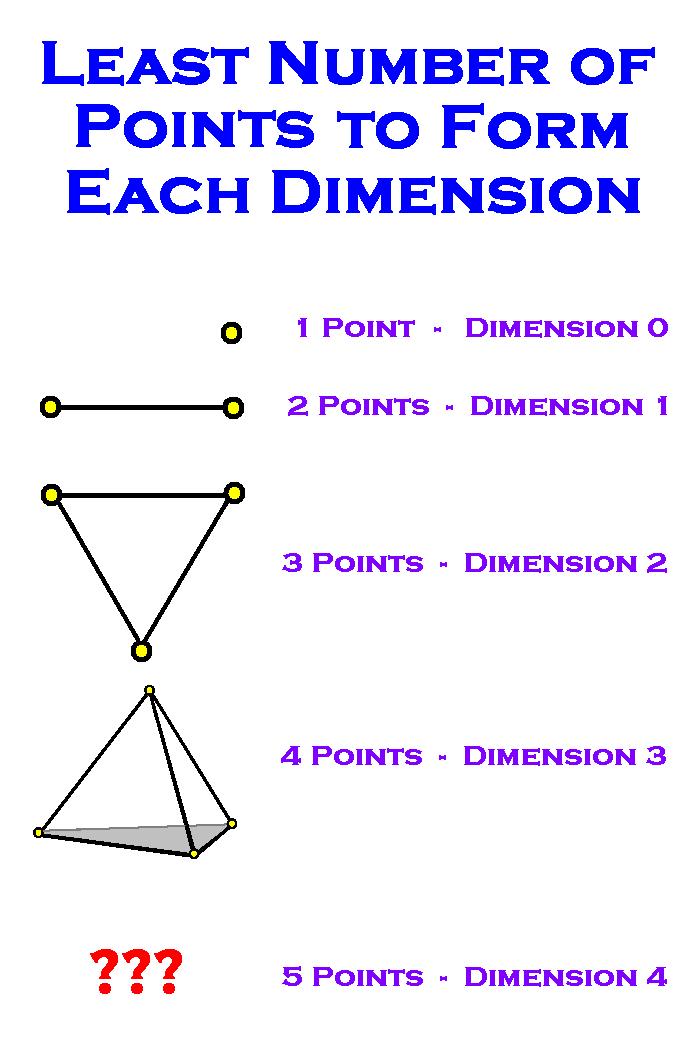


 as an N dimensional “surface”. So,
 is a point,
 is a line,
 is a
square,
is a
square, is
a cube, and so on.
is
a cube, and so on. as the
number of N-dimensional surfaces in a D-dimensional cube.
as the
number of N-dimensional surfaces in a D-dimensional cube. ,
,
 , and
, and
 .
That is, a square (2D cube) has four corners, four edges, and one square.
.
That is, a square (2D cube) has four corners, four edges, and one square. .
Starting with a 0 dimensional cube (a point) you can safely define
.
Starting with a 0 dimensional cube (a point) you can safely define
 .
.
 , where
“!” means factorial. So, without ever having seen a hypercube, you can
confidently talk about its properties! For example; a hypercube has 8
cubic “faces”, 24 square faces, 32 edges, and 16 corners.
, where
“!” means factorial. So, without ever having seen a hypercube, you can
confidently talk about its properties! For example; a hypercube has 8
cubic “faces”, 24 square faces, 32 edges, and 16 corners.


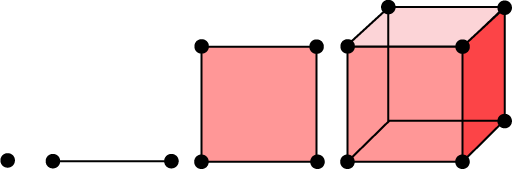


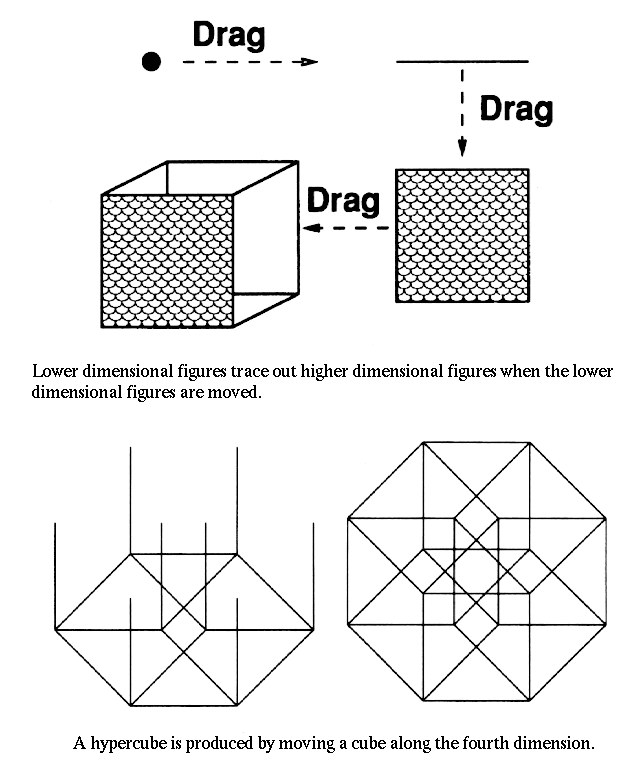
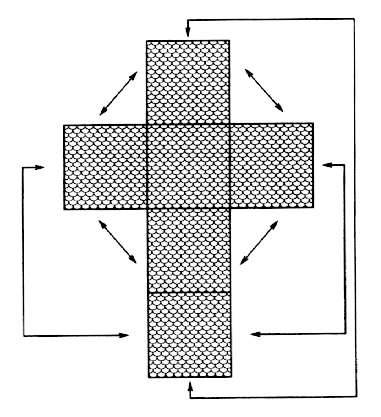


 , podemos verlo
así:
, podemos verlo
así:


 stress-energy
tensor) and the curvature of space-time:
stress-energy
tensor) and the curvature of space-time:
 is
Einstein’s curvature tensor and
is
Einstein’s curvature tensor and
 is the
cosmological constant (which was at first omitted by Einstein in what he
later called the “greatest mistake of his life”).
is the
cosmological constant (which was at first omitted by Einstein in what he
later called the “greatest mistake of his life”).


 of such
conjugated variables
of such
conjugated variables  are connected through Heisenberg’s relations:

 to create
a particle-antiparticle pair that would annihilate shortly after. The
quantum vacuum can then be pictured as being filled with virtual particles
popping into and out of existence :
to create
a particle-antiparticle pair that would annihilate shortly after. The
quantum vacuum can then be pictured as being filled with virtual particles
popping into and out of existence :

 to
dissipate is:
to
dissipate is:




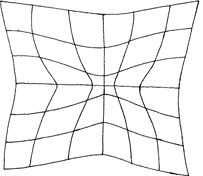






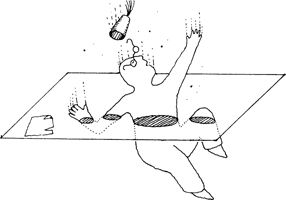
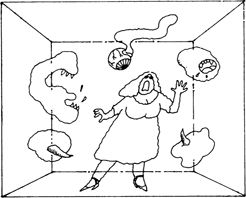


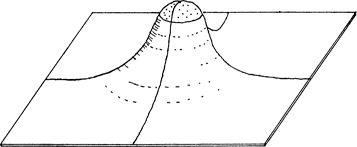


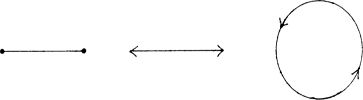


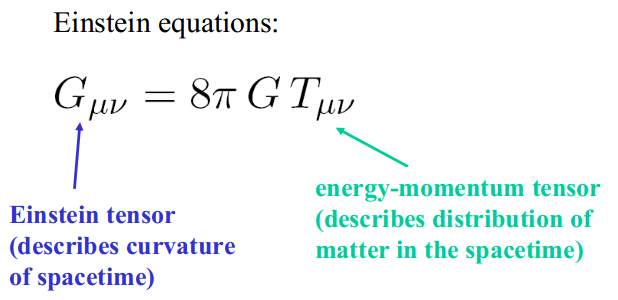


 ,
,



 Also,
energy and matter were two distinct notions in Newton’s mechanics, and
there were separate conservation laws for both: the conservation of matter
and the conservation of energy. Einstein with his famous equation E = mc2
forever changed this notion as well. Matter and energy are interchangeable
with energy being the more fundamental unit. This is one of the most
important new scientific notions in this book that we can apply to new
understandings of the human body; namely that we are primarily energetic
beings and secondarily physical ones!
Also,
energy and matter were two distinct notions in Newton’s mechanics, and
there were separate conservation laws for both: the conservation of matter
and the conservation of energy. Einstein with his famous equation E = mc2
forever changed this notion as well. Matter and energy are interchangeable
with energy being the more fundamental unit. This is one of the most
important new scientific notions in this book that we can apply to new
understandings of the human body; namely that we are primarily energetic
beings and secondarily physical ones!