The Final Flight of TWA 800 Brookhaven-Montauk-Shoreham
by Steven J. Smith
|
Disclaimer: |
Introduction:
What does the Brookhaven national laboratory, Montauk Point state
park, the decommissioned Shoreham nuclear power plant, and the
mid-air explosion of TWA flight 800 have in common?
The primary purpose of this paper is to
delineate the connection between these seemingly unrelated locations and
events. The paper also serves as a practical example of the American covert
underground infrastructure, the methods employed by it's architects, and the
goals of it's workforce.
Overview:
While the Montauk site is at this point, well documented by many different
authors, most fail to fully appreciate it's interrelationship to the other
locations covered in this paper. The central player is the Brookhaven
national laboratory. As we shall see, the other locations and events
exist in relationship to the capabilities and geographic location of this
laboratory.
I have included an aerial photo of eastern Long Island to show the geographic relationships.
Contents
Brookhaven-Montauk-Shoreham Photo
Brookhaven Analysis
Particle Beam Energy Calculations
Shoreham Analysis
Montauk Analysis
TWA Flight 800 Analysis
Brookhaven-Montauk-Shoreham Aerial Photo
Aerial Photo Analysis:
The photo below is a composite image, created from USGS (united states
geological survey) aerial maps, showing the eastern end of Long Island, New
York. This photo illustrates the geographic relationships between the
various facility locations and events.
Brookhaven Analysis
Aerial Photo Analysis:
The photo on the right is an aerial view of the Brookhaven National
Laboratory (BNL). One of ten national laboratories overseen and
primarily funded by the Office of Science of the U.S. Department of
Energy (DOE). The large circular area in the upper middle of the
photo is the 2.4 mile radius RHIC (relativistic heavy ion collider).
Photo Courtesy of USGS
At the time of this photo (august 1994), the RHIC was still under construction. Below and slightly to the left, a second smaller ring called the AGS (alternating gradient synchrotron) is also visible. These devices are collectively known as particle accelerators. The RHIC uses super conducting magnets cooled by liquid helium, and requires 5 million watts of electrical energy just for refrigeration.
While no figures are available for total RHIC
power requirements, a value in the range of 20 to 40 times the refrigeration
load is a safe assumption. This would equal 100 million to 200 million watts
of electrical power. Now we see the true purpose of the Shoreham nuclear
power facility.
Although the actual particle accelerators are buried in underground tunnels,
many of the support structures are above ground. Notice that most
administrative, and research facilities are laid out in a grid pattern, but
some structures are oriented odd angles. In particular, the purple line (image
above) connecting the left hand edge of the RHIC ring and the right hand
edge of the AGS ring, terminates at a group of structures in the lower
middle of the photo.
Photo Courtesy of BNL
In the upper color photo, these structures are located in the lower right
hand corner, and appear to be a row of metal sheds, with the first one set
at a slightly different angle, as if they just happen to follow the road. In
reality, their location and orientation is no mere accident of convenience.
These building house the support equipment for a
first generation particle beam weapon system. It is also no accident
that a line drawn from bottom end of this row of structures intersects the
crash site of TWA flight 800.
The RHIC and AGS rings are used to accelerate packets of subatomic particles
to velocities near the speed of light. These packets are then shaped,
focused, and launched at the target by equipment located under the row of
metal sheds.
Photo Courtesy of BNL
The color image above shows a close-up view of another installation located along this same particle beam alignment, known as the NSLS (national synchrotron light source) also visible in the previous photo. This facility uses an electron (ring) accelerator to produce high power ultraviolet laser light. The laser beam serves two purposes.
At low power, it's used for target acquisition
and tracking. However it's primary (high power) function is to create a
partial vacuum "tunnel" through the atmosphere to the target. This allows
the particle beam to travel without attenuation or scattering by air
molecules.
The facilities listed in this analysis are examples of the "dual use"
doctrine. In other words, these facilities comprise an advanced particle
beam weapon system, disguised as legitimate scientific research
laboratories. The majority of scientists and technicians working at this
site have no idea their efforts are being used to conceal such a sinister
purpose.
To hide this monstrous device behind a facade of
innocent scientific pursuit, is typical of the people and organizations that
have created the covert underground infrastructure in America.
Particle Beam Energy Calculations
Particle beam overview:
The following are direct quotes from a public relations document called "RHIC
by the Numbers", published by the Brookhaven National Laboratory (BNL).
Quote 1:
RHIC's beam travels at 99.995 percent the speed of light (186,000 miles per second, or more than 300,000,000 meters per second).
Quote 2:
RHIC's beam is not continuous - it's made up of 57 separate "bunches," each containing billions of ions.
Quote 3:
RHIC ions are so small that, even at nearly the speed of light, the force of their impact is about the same as the impact of two mosquitos colliding.
From the BNL website, we discover that gold (Au) atoms are used for the particle beam.
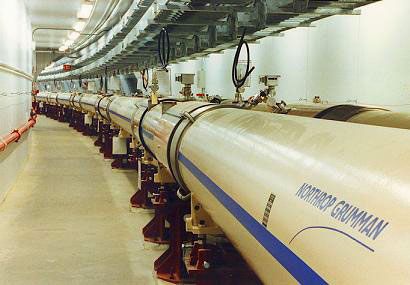
RHIC Tunnel.
Photo Courtesy of BNL
Particle beam energy calculations:
The energy contained in any moving
object, be it a car, snow ball, or particle beam composed of gold atoms is
calculated as follows:

[Eq. 1]
Where:
E = Energy in Joules.
M = Mass in kilograms.
V = Velocity in meters per second.
The mass of a gold atom is 3.2697-21 grams, and the mass of 2 billion gold atoms is 6.5394-12 grams or 6.5394-15 kilograms. Thanks to Einstein's relativity, the effective mass of any object traveling near the speed of light increases by:
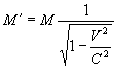
[Eq. 2]
At 99.995% of light speed, the effective mass is slightly more than 100 times the rest mass, therefore our 2 billion gold atoms have an effective mass of 6.5394-13 kilograms. Next, the speed of light is 299,792,458 meters per second in a vacuum, and 99.995% of light speed is 299,777,468 meters per second.
Therefore:
E = 6.5394-13 * 299,777,4862 * 0.5 = 29383.7 Joules
And since the RHIC stores 57 "bunches" or
packets of particles, the total energy is: 57 * 29383.7 = 1,674,871 Joules.
This is nearly 3 times the energy of a 3500 pound automobile crashing
into a wall at 60 miles per hour! And all of this energy concentrated
into 57 packages, each smaller than the period at the end of this sentence,
AND traveling at nearly the speed of light.
It seems quote number 3 (above) tells the truth, but NOT the whole truth...
It should be mentioned that according to BNL, the RHIC did not produce a
particle beam until July, 1999. However, given the covert nature of DOE,
this date is suspect. Furthermore, as the line drawn on the aerial photo of
BNL clearly shows, the AGS ring is also capable of supplying particle beams
to the weapons system buildings.
Shoreham Nuclear Facility Analysis
Aerial Photo Analysis:
The photo on the right is an aerial view of the Shoreham nuclear power
generation facility, owned by Long Island Power Authority (LIPA).
According to LIPA, this facility was decommissioned in June,1987 and the
nuclear fuel removed. This photo was taken in August 1994. Note the parking
lot full of cars, in the upper right hand corner of photo. Also note the
cars parked along left hand edges of buildings in lower left corner of photo.
Another unusual feature is the secluded complex of buildings in the upper
middle of the photo. Notice how a strip of forest was left between the
complex and the beach for concealment. Also, notice the concealed low
traffic road connecting this complex to the road in center of the photo.
One other interesting feature is the trail leading from the beach, to the right hand edge of the complex. When taken all together, this complex has the classic signature of a rural underground access point.
Photo Courtesy of USGS
This facility is fully operational, and being
used to supply electrical power to the covert particle beam weapon system at
Brookhaven national laboratory.
Note: at the time of it's decommissioning Gov. Mario Cuomo,
coerced New York's public-utilities commission into the following agreement
with LIPA: The power authority could pass the cost of Shoreham along to its
customers only if it agreed not to operate the plant. Another example of how
the cost of American underground infrastructure is covertly shifted to an
unsuspecting citizenry.
Montauk Point Analysis
Aerial Photo Analysis:
The photo on the right is an aerial view of Montauk Point state park, and
Camp Hero military reservation, both located at the eastern tip of Long
Island. The loop highway and large parking lot in the upper right hand
corner are adjacent to the Montauk light house (a national monument).
The complex of roads and structures stretching from the left hand edge of the photo, and continuing to the right hand edge comprise the Camp Hero military reservation. For many years there has been a continuing controversy surrounding the Camp Hero military reservation (CHMR).
Photo Courtesy of USGS
According to many accounts, this site has been
secretly used for experiments in mind control, advanced weapons research/testing,
and as a time machine portal. These clandestine endeavors are commonly and
collectively known by the term "Montauk Project".
At first glance, mind control, particle beam weapons, and time travel may
seem to have very little in common. However, all three tasks make use of
high power electro-magnetic energy. The particle beam accelerators at
Brookhaven are used to supply the needed energy (directly in the case of
particle beam weapons, and indirectly in the case of mind control, and time
travel).
The photo above is an enlargement of the bottom center section of the previous photo. Notice the ring shaped artifact measuring approximately 100 yards in diameter. A cross check of the USGS topological survey map indicates the artifact does NOT correspond to any natural land feature.
This artifact is the visible surface signature of an underground structure. Manifestations of this kind are caused by two distinctly different processes.
(1) Disturbance of the natural aquifer by the underground structure.
(2) EM or heat leakage from the underground structure modifying surface vegetation growth.
A 100 yard ring is too small to be a primary
particle beam accelerator, however it is just the right size for an
electron synchrotron of the type used to create a partial vacuum "tunnel"
through the atmosphere to the target (see NSLS, Brookhaven analysis far
above).
Another use for electron synchrotron generated radiation is human
behavior modulation (mind control). While the radiation it self
is pure EM, the electron synchrotron generation process allows access to
parts of the EM spectrum that are not normally available through the use of
conventional RF generators. These wavelengths are particularly useful since
they are of the same scale (size) as certain microstructures within the
human brain.
Furthermore, since the wavelengths in question do not occur in the natural environment, the human brain has no innate immunity. The high power levels that can be achieved with an electron synchrotron allow many subjects to be "treated" simultaneously.
The above photo is another enlargement from a
section of the first photo. Again we see a ring shaped artifact (albeit
better hidden). The artifact is more indicative of aquifer disruption than
direct vegetation disturbance. This ring is located above, and slightly to
the left of the smaller ring shown in the previous photo. Also, once you
know where to look, the ring is actually more noticeable in the large photo
above this one.
With an approximate diameter of 275 yards, the ring is about the same size
as the AGS particle accelerator at Brookhaven. The ring could be a primary
particle beam accelerator, but with the Brookhaven facility so close, a
better use would be as a secondary storage ring for the primary particle
beam accelerator rings at Brookhaven.
This conclusion is supported by the fact that accelerators require considerably more power than storage rings, and a plethora of ancillary equipment that would represent needless duplication of the Brookhaven facilities. Locating the particle beam weapon launch facility is more problematical.
At Brookhaven the dual use nature of the facilities makes the task relatively easy, however the Montauk underground complex is by definition a covert (secret) base and therefore far less clues are available for analysis.
Assuming the particle beam weapon launch facility isn't completely camouflaged, and assuming the two rings connect to the launch facility via straight beam line, the best choice for the particle beam launch line shown in the photo above.
The second photo on the right shows an enlarged
view of the suspect particle beam launch point. It is interesting to note
that ALL of these particle beam weapon components are outside the fenced off
portion of CHMR. A classic example of misdirection, and the "hide it in
plain sight" doctrine.
An analysis of the time portal systems is beyond the scope of this
document. Suffice it to say that experiments involving time displacement are
unbelievably dangerous and therefore an isolated site, located well away
from major population centers and valuable infrastructure (such as
Brookhaven national laboratory) is advisable.
Yet the nature of these experiments also require
access to energy concentrations that can only be achieved by particle
accelerators (such as Brookhaven). Based on this set of requirements,
Montauk point (and CHMR) would seem to be the ideal compromise. However, it
is the authors opinion that if an accident does occur, Montauk will prove to
be entirely too close for comfort...
Support Facilities:
An operation of this magnitude requires considerable above ground support
facilities. In particular, particle beam components are large and cumbersome,
therefore they must be trucked into the site. A line of trucks, waiting to
unload their cargo would be a dead give-away, furthermore truck drivers are
notorious gossip mongers.
Therefore a nearby cargo container staging yard
is needed. Located on old Montauk highway, at the junction with the new
Montauk highway, the area shown in the photo above would make an ideal cargo
container staging yard. The large circular structure near the bottom of the
photo does not cast much shadow, and is most likely an "in ground" tank.
Summary:
The Montauk (and CHMR) site show most of the classic indicators of an
underground access point. Furthermore, the identified artifacts (above) are
commensurate with the alleged facility uses, both in terms of size and shape,
and in terms of geographic relationship to each other.
Therefore, it is the authors opinion the Montauk
point state park, and CHMR are in fact a covert underground facility,
operating under the aegis of the United States government.
TWA Flight 800 Analysis
TWA flight 800 overview:
On July 17, 1996 at 8:31PM (EDT) TWA flight 800, a Boeing 747-100 (registration
N93119) experienced an in-flight explosion just 12 minutes, 51 seconds after
being cleared for take off from JFK international airport. The explosion
took place over the Atlantic Ocean (Location: 72:37.46N, 40:39.52W),
approximately 9 miles south of East Moriches on Long Island, New York. Of
the 18 crew members and 212 passengers on board, none survived.
The ensuing NTSB (national
transportation safety board) investigation was the most thorough and
comprehensive in American aviation history. Yet no definitive cause for the
explosion was ever discovered. In it's final report, the NTSB lists the
probable cause as an explosion in the center wing fuel tank.
The lack of a definitive cause has led some people to theorize that TWA
flight 800 was struck by a surface to air missile. This speculation is
fueled by the reports of several eye witnesses who claim to have seen a
bright point of light ascend upward, intersecting the aircraft at the time
of the explosion. However NO physical evidence of a missile strike was ever
found in the wreckage...
I believe that TWA flight 800 was the victim of a particle beam weapon
attack, launched from the Brookhaven national laboratory in order to test
system effectiveness against air born targets. This would not be the first
time an agency of the American government has used unsuspecting citizens as
experimental test subjects.
One need look no farther than the Tuskegee
syphilis study, or the 1950s nuclear bomb tests on army personnel to
discover how little regard the American government has for the lives of it's
citizens.
The evidence for this theory falls into two broad categories:
1. Flaws in the NTSB probable cause, and certain investigative steps that were performed in a superficial manner.
2. The presence of certain physical and logistical indicators that were completely ignored by the NTSB.
I shall cover each separately, starting with
category number one.
Flaws and superficial performance:
Commercial jet fuel (known as JP4) is a refined variant of kerosene, very
similar to common diesel fuel used in trucks and buses. Unlike gasoline, JP4
has a low vapor pressure. In other words, it does not evaporate quickly. As
anybody who has ever worked around diesel fuel will attest, an open
container of diesel does not evaporate, even over time spans measured in
days.
While kerosene stoves are no longer common,
anybody who has used one will tell you that dropping a lit match into the
fire box does not work. The match is extinguished. You must use a piece of
paper to act as a wick in order to ignite a kerosene fire.
The NTSB claim of an explosion in the center wing fuel tank as the probable
cause, while consistent with much of the physical evidence, leaves the
question of ignition source completely unanswered. This is the fatal flaw in
the NTSB probable cause.
The following are excerpts from the NTSB Medical/Forensic Group Chairman's
Factual Report of the investigation (exhibit 19A).
************ Beginning of Excerpts ************
The first 99 bodies were found floating on the surface of the ocean and were recovered by various civilian, military, and police vessels during the night of July 17, 1996, and throughout the day of July 18, 1996. The majority of the remaining victims were recovered by U. S. Navy divers and local police divers during the next 96 days.
Pertinent data on the location victims were found, when available, and the circumstances of the recoveries of the victims were also recorded. The remains were then placed in a refrigerated trailer and transported to the Suffolk County Medical Examiner's Office (ME) in Hauppage, NY.
At the Medical Examiner's Office, the remains of the victims were:(1) photographed with and without clothing
(2) radiographed
(3) fingerprinted if possible
(4) dentition was photographed and x-rayed
(5) clothing and other personal effects were cataloged
All victims were then autopsied by a forensic pathologist from either the ME or a pathologist temporarily assigned to the ME by the State of New York or a neighboring jurisdiction. The ME had 5 autopsy tables available and during the early recovery efforts, all tables were utilized.
The thoroughness of the forensic post-mortem examinations was highly variable depending primarily upon the pathologist who performed the autopsy and upon case flow. The primary objective of the ME was to identify all remains, and the ME was under constant and considerable pressure to do so with minimal delay.
Consequently, a high priority was not placed on performing a detailed forensic autopsy directed toward elucidating mechanisms of injury.
An effort was not made to relate damage to clothing with wounds on the body. Foreign material removed from the bodies was immediately released to an FBI technician, but autopsy reports did not record whether the material was found loosely within the body bag, in open wounds, or whether the foreign body had penetrated the skin and was found lodged in tissue. Trajectory information was not recorded. No record of the condition of the tympanic membranes of the victims was made.
************ End of Excerpts ************
As the above excerpts show, of the 230
passengers and crew, 99 bodies were recovered in the first 36 hours. The
bodies were stored in a refrigerated truck. The ME had 5 autopsy tables
available, AND all 5 were used.
Assume 4 hours per body to perform a comprehensive autopsy, with two shifts
working 8 hours each. With 5 autopsy tables, 20 autopsies per day can be
performed, and therefore 99 bodies can be autopsied in just 5 days. Yet the
final excerpt paragraph states the ME was under "considerable pressure" to
perform with minimal delay, AND the rest of this paragraph enumerates all of
the procedures that were NOT performed during the autopsies.
Perhaps most telling, is the last sentence which
states that no record of tympanic membrane (ear drum) condition was made.
Such a record would have been conclusive evidence of cabin over pressure (internal
explosion), or abrupt cabin depressurization (external explosion).
To perform autopsies in such a superficial manner, in a situation
where the evidence uncovered by those autopsies may help in determining the
precise cause of an aircraft explosion, boarders on criminal negligence!
Unless of course the true cause is already known, and thorough autopsy
reports would raise questions that could prove even more embarrassing than
apparent negligence.
Physical indicators:
The photo on the right shows TWA 800 Engine No. 2 fan hub and blades. The
blades are made from an alloy of 90% Titanium, 5.6% Aluminum, 4.2% Vanadium,
and 0.2% Iron. Because this alloy is both very strong, and extremely brittle,
the blades are cast in their final shape to minimize the amount of machining
required. Under normal conditions, they will break rather than bend. Yet as
the photo clearly shows, many of the blades are bent, some by as much as 90
degrees.
How do I support this conclusion? Compare this photo to the next photo.
Photo Courtesy of NTSB
The photo shows two views of a typical fan blade failure. In this case, one of the blades suffered progressive fatigue cracking at the root where it connects to the fan hub. The failure occurred on January 31, 2001 on a Boeing 777-300 at Melbourne International Airport, during the take-off run, and the flight was safely aborted.
Notice how many of the remaining blades are
missing portions of their tips, and one blade (adjacent to the missing blade)
broke off at it's mid-section. However, none of the blades show ANY sign of
bending, even though this engine (unlike TWA 800) was operating at full take-off
power when the failure occurred. Clearly, something very odd AND very
extreme took place in the final moments of TWA flight 800.
Furthermore, the TWA 800 photo is intentionally posed in such a manner as to
imply the blades were bent by the weight of the hub/blade assembly, thereby
removing any remaining doubt of complicity on the part of the NTSB. The NTSB
while creating the illusion of great diligence, was in fact, a willing
participant in a cover-up of monumental proportions.
Photo Courtesy of ATSB
Logistical indicators:
The following is a partial transcript from the cockpit voice recorder (CVR)
of TWA flight 800, during the last 6 minutes before the explosion. (NTSB
exhibit 12A)
RDO = Radio transmission from aircraft
CTR = Boston ARTCC Controller (center)
-2 = Voice identified as First Officer (right seat)
CAM = Cockpit Area Microphone sound or source
|
Time |
Source |
Content |
|
2025:31 |
CTR |
TWA eight hundred what's your rate of climb? |
|
2025:34.5 |
RDO-2 |
TWA's eight hundred heavy ah about two thousand feet a minute here until accelerating out of ten thousand. |
|
2025:41 |
CTR |
roger sir climb and maintain flight level one niner zero and expedite through fifteen. |
|
2025:47.1 |
RDO-2 |
TWA's eight hundred heavy climb and maintain one niner zero and expedite through one five thousand. |
|
2026:24 |
CTR |
TWA eight hundred amend the altitude maintain ah one three thousand thirteen thousand only for now. |
|
2026:30.3 |
RDO-2 |
TWA's eight hundred heavy okay stop climb at one three thousand. |
|
2028:13 |
CTR |
TWA eight hundred you have traffic at one o'clock and ah seven miles south bound a thousand foot above you he's ah Beech nineteen hundred. |
|
2028:20.6 |
RDO-2 |
TWA's ah eight hundred heavy ah no contact. |
|
2030:15 |
CTR |
TWA eight hundred climb and maintain one five thousand. |
|
2030:19.2 |
RDO-2 |
TWA's eight hundred heavy climb and maintain one five thousand leaving one three thousand. |
|
2031:05 |
CAM |
((sounds similar to recording tape damage noise)). |
|
2031:12 |
- |
end of recording. |
At 2025:41 Boston center instructs TWA 800 to
climb to 19 thousand feet, and to expedite the climb through 15 thousand
feet. TWA 800 acknowledges 6 seconds later.
Approximately 37 seconds after acknowledgement, at 2026:24 Boston center
amends it's instructions to TWA 800. Instead instructing TWA 800 to climb
and maintain 13 thousand feet. TWA 800 acknowledges 6 seconds later.
Finally, at 2030:15, less than one minute before the explosion, Boston
center instructs TWA 800 to climb to 15 thousand feet. TWA 800 acknowledges
4 seconds later.
Why did Boston center amend it's climb instruction to TWA 800? Was there
other conflicting traffic in the vicinity? The nearest traffic was a Beach
1900, 7 miles away, at TWA 800's 1 o'clock position, heading south. Since
TWA 800 was heading east, this puts the Beach 1900 safely past TWA 800's
flight path.
By keeping TWA 800 at 13 thousand feet, and issuing the climb instruction
just 50 seconds before the particle beam strike, the aircraft would still be
climbing, thereby presenting a greater surface area for target acquisition.
Was Boston air traffic control center involved in this hideous test of a
covert weapons system? The evidence seems substantial.
The plot on the right shows radar data (the blue dots), obtained by the NTSB
from the Islip radar station on Long Island NY. Each dot shows the position
of a an aircraft as the radar beam swept over the aircraft (the solitary,
and closely spaced dots are slow moving water craft). For instance, dot 3 in
each series is the position of that aircraft on the third sweep of the radar
beam. The plot shows the last 9 radar sweeps, before the destruction of TWA
800.
Notice the aircraft labeled "Navy P-3" moving southwest. This is an anti-submarine
patrol craft, equipped with highly advanced electronic surveillance systems.
The aircraft would make an ideal observation platform to record the results
of a covert particle beam weapon test.
The P-3 is also a very robust aircraft (a variant is used for hurricane hunting), likely to survive even if it gets a bit too close to the target aircraft (TWA 800).
Part of exhibit 13A.
Plot Courtesy of NTSB
Coincidently, the P-3 was flying at an altitude
of just over 19 thousand feet, approximately the same altitude as TWA 800
was originally instructed to climb and maintain, before amendment by Boston
air traffic control (see above). Obviously someone was worried about the
surveillance aircraft being a bit too close to the test. According to the
navy, this aircraft was on a "routine training mission"...
Effects of a particle beam weapon strike:
An aircraft struck by a particle beam weapon will suffer two distinctly
different types or classes of damage.
(1) Kinetic damage.
(2) Electro-magnetic damage.
Each class of damage will have a unique
signature, neither of which is likely to be recognized by personnel trained
in common explosives and/or structural failure mechanisms.
The electro-magnetic damage will be the most unusual aspect of a particle
beam weapon strike. The EMP (electro-magnetic pulse) will be
dissipated in the immediate vicinity of the strike point, causing radical
rearrangements in the chemical structure of the material. The material will
momentarily soften, as if subjected to intense heat, but without the normal
indications of thermal stress.
Strikes on a living organism would result in
intense localized cellular disruption, similar to microwave cooking, but
again without the normal indicators of elevated temperature. This effect
would be very noticeable during a thorough forensic autopsy, yet completely
inconsistent with usual surface style heating produced by a conventional
explosion. If a fuel tank were to suffer a direct strike, ignition would be
instantaneous, regardless of vapor pressure and/or combustibility of the
fuel.
The kinetic damage will superficially resemble traditional structural
failure. The primary cause will be violent shockwaves emanating from the
strike point(s), and traveling through structural members. The result will
be fracturing at locations where the shockwaves concentrate, either through
geometric focusing, or through standing waves created by reflections.
The structure will literally fall apart into
thousands of small pieces. The appearance will closely resemble the
recovered fuselage wreckage of TWA flight 800...
[
Ana Sayfa (Home)
|
UFO Technology
|
UFO's
Galleri | Kuantum
Fiziği | Roket bilimi
|
[ Astronomy |
E-Mail
| Index
|