Alcubierre Drive
Ever since the sound barrier was broken, people have turned their attention to how we can break the light speed barrier. But “Warp speed” or any other term for faster-than-light travel still remains at the level of speculation. In 1994, theoretical physicist Miguel Alcubierre published a scientific paper showing that a warp drive could be created without contradicting Einstein’s Theory of General Relativity – which would seem to indicate that faster-than-light travel is impossible. Also, last year, Professor Geraint Lewis, from the University of Sydney, said the idea of warp speed is, in theory, possible but it will take hundreds of years to accomplish. However, he pointed out that sourcing material to create such a machine might prove to be the biggest challenge.
Faster than light hyperdrives
Faster-than-light (FTL) travel is the biggest gulf between reality and
science fiction. As far as scientists know, the speed of light can’t be
surpassed. But according to Harold “Sonny” White at NASA, FTL travel is
theoretically possible – he suggests using a warp drive to distort space-time
around a craft, bending the laws of physics. But with colossal amounts of
energy required, and no tangible results so far, humans will have to stick
to slower spacecraft for now.
-------------------------------------------------------------------------
Here's why we can't travel faster than the speed of light
yet
May 13, 2015
star trek enterprise warp drive
Long before the Empire struck back, before the United Federation of Planets
federated, Isaac Asimov created Foundation, the epic tale of the decline and
fall of the Galactic Empire. Asimov’s Empire comprised 25 million planets,
knit together by sleek spaceships hurtling through the galaxy.
And how did these spaceships cross the vast gulf between the stars? By
jumping through hyperspace, of course, as Asimov himself explains in
Foundation:
Travel through ordinary space could proceed at no rate more rapid than that
of ordinary light… and that would have meant years of travel between even
the nearest of inhabited systems. Through hyper-space, that unimaginable
region that was neither space nor time, matter nor energy, something nor
nothing, one could traverse the length of the Galaxy in the interval between
two neighboring instants of time.
What the heck is Asimov talking about? Did he know something about a secret
theory of faster-than-light travel? Hardly. Asimov was participating in a
grand science fiction tradition: when confronted with an immovable obstacle
to your story, make something up.
You can’t beat the speed of light
The problem is that as far as we know, faster-than-light travel is
impossible, making galactic empires, federations, confederacies and any
other cross-galaxy civilizations impossible. But that’s so inconvenient. To
evade the cosmic speed limit science fiction has created “warp-drives,” “hyperspace,”
“subspace,” and other tricks that have become so ingrained, fans of science
fiction don’t give them a second thought.
Everyone knows what the Enterprise is doing when it does this:
Or when the Millennium Falcon does this:
Or when the Jupiter 2… actually the Robinson family tried to get to Alpha
Centauri without any special effects.
No wonder they got lost in space.
Light sets the cosmic speed limit
Why can’t we really exceed the speed of light? After all, people used to
talk about a “sound barrier” up until the barrier was broken. But the speed
of light is a much tougher barrier to crack. When scientists developed the
theory of light back in the 19th century, it came with a special puzzle:
their theory seemed to show that every observer should measure the same
speed for light, about 186,000 miles per second. But that means if you try
to chase a beam of light, no matter how fast you move, the light beam will
still fly away from you at 186,000 miles per second. And what’s even more
bizarre is that if you are moving at 99% of the speed of light, and your
friend is standing still, both of you will see the light moving away at
exactly the same speed.
Many scientists back then didn’t really believe this odd prediction, and the
American physicist Albert Michelson (along with his collaborator Edward
Morley) set out to measure how the speed of light would change due to the
motion of the earth through space. But their famous Michelson-Morley
experiment found no change at all. The speed of light seemed to be the same
regardless of whether they measured it in the same direction the earth was
moving, or in some other direction – a rare example of a non-discovery that
turned out to be more important than a discovery!
Enter Einstein and relativity
Instead of trying to explain away this bizarreness, Albert Einstein embraced
it. He built an entire theory, called special relativity, around the idea
that the speed of light is the same for everyone who measures it, no matter
how fast they are moving in relation to the light. In order to accommodate
this behavior for light, Einstein’s theory predicted that time and space
would have to stretch or contract as someone traveled with increasing speed.
And out of special relativity popped a cosmic speed limit: nothing could
ever exceed the speed of light.
Relativity is a cornerstone of all of modern physics, and we have no reason
to doubt it – no one has ever observed an object moving faster than light.
There’s actually a minor clarification necessary here: Einstein’s speed
limit is the speed of light in a vacuum. Light slows down when it moves
through a material like water or glass, and then it’s perfectly possible to
exceed this reduced speed of light – up to its speed in a vacuum, of course.
Anything moving faster than light in water or glass produces the luminous
equivalent of a sonic boom, called ?erenkov radiation. It’s what gives
underwater nuclear reactors their attractive blue glow.
But about that warp drive…
Of all of the attempts to wiggle out of Einstein’s speed limit, probably the
most plausible is theoretical physicist Miguel Alcubierre’s “warp drive”.
Alcubierre’s proposal doesn’t violate the cosmic speed limit – it goes
around it. Try filling a greasy frying pan with water and then put a drop of
soap into the pan. The grease will fly away to the sides of the pan.
warp drive science
Alcubierre’s warp drive does the same thing with space itself. Alcubierre
showed that by a suitable distribution of matter, you can shrink space in
front of your spaceship and stretch it behind the spaceship, creating a
small bubble around the ship that moves as fast as you like. Because space
is contracting in front of the ship, the ship wouldn’t officially be moving
faster than the speed of light. In fact, the ship would actually be at rest
relative to the warp bubble, and the people inside the ship wouldn’t even
feel any acceleration. Talk about a smooth ride!
There’s just one tiny problem…. Alcubierre’s space warp can only be
generated by violating something called the “weak energy condition.”
Scientists can’t prove that the weak energy condition is always true, but
any violation would produce a lot of strange things, like negative energy
densities, and possible wormholes or time machines. Cool – sign me up for
that! But we’ve never seen any actual violations of the weak energy
condition. So the Alcubierre warp drive occupies a kind of physics twilight
zone – not absolutely ruled out, but not very plausible, either.
So how will humanity ever reach the stars? The door marked
“faster-than-light travel” has been slammed in our face and welded shut.
We’ll have to sneak in some other way. Get to work!
BBC Science Future Technology - Focus
Published on Sep 20, 2016 - BBC FOCUS - October 2016


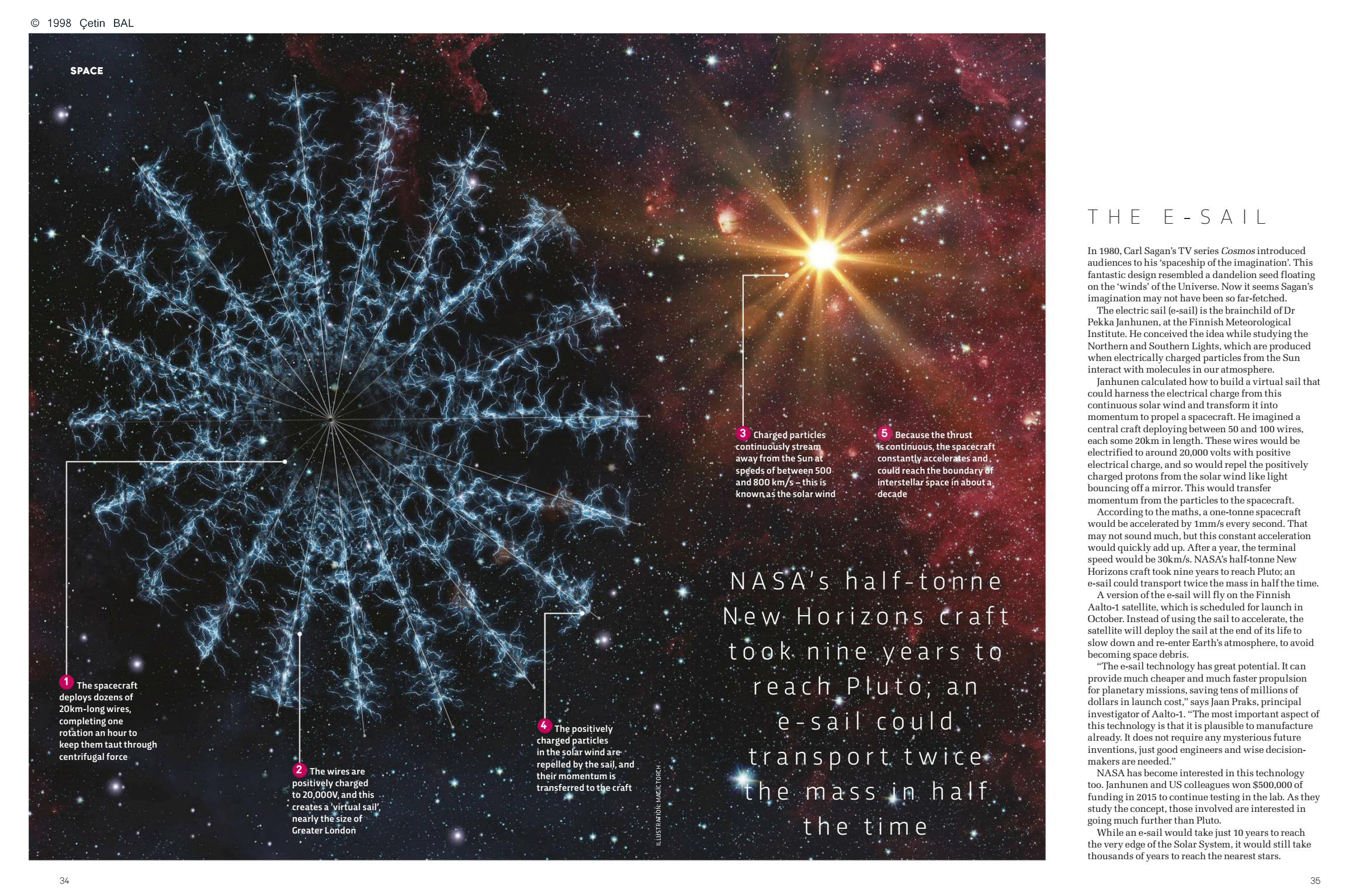
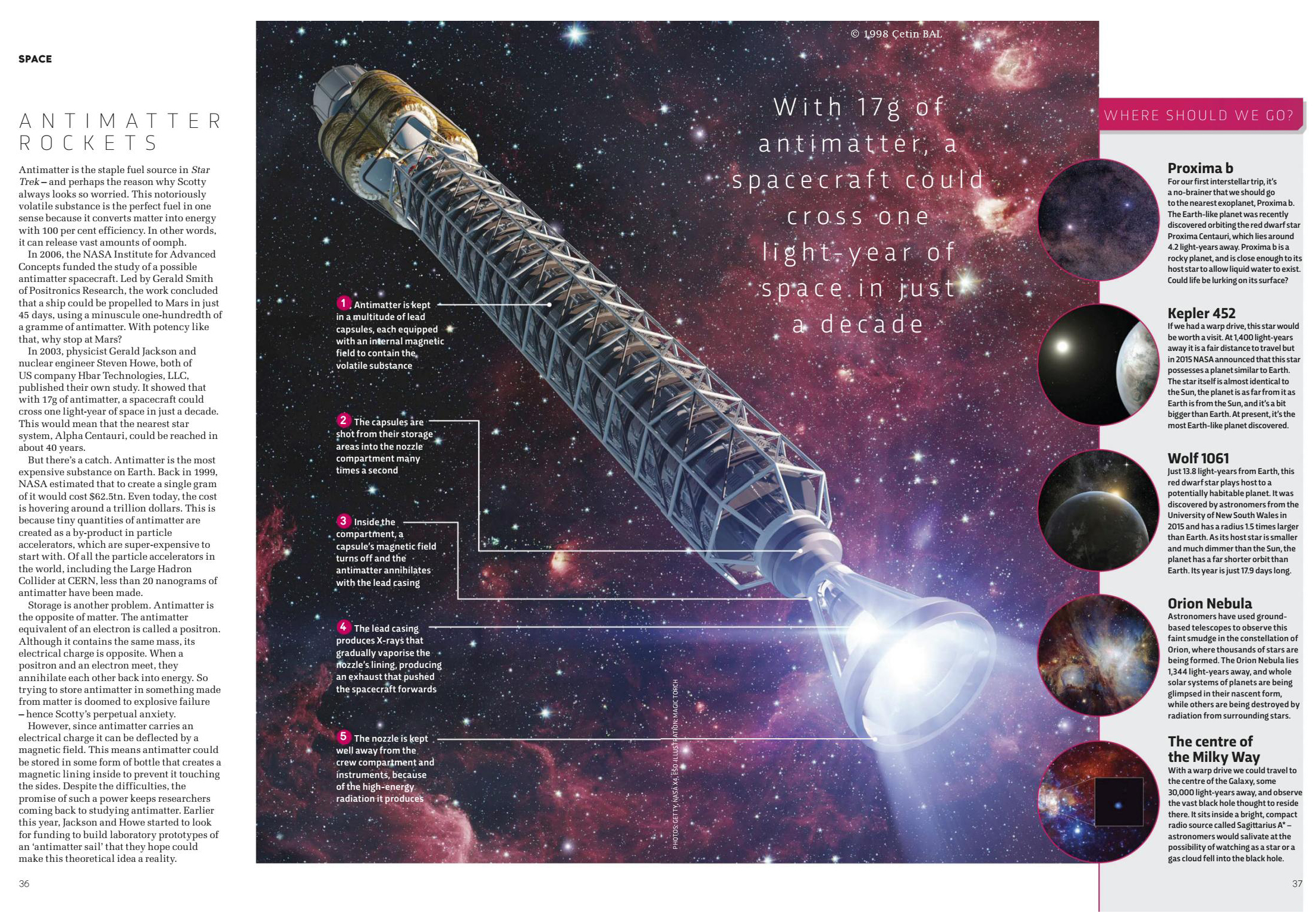

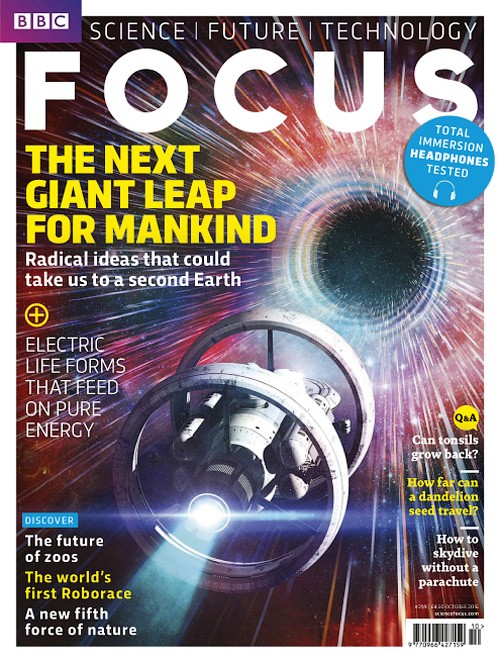
BBC Focus – October 2016 English | 117 pages | True PDF | 32 MB
3D Art Direct – June 2015 - English | Pages 88 | HQ PDF | 19,6 Mb
3D Art Direct specialises with the stories of creativity using 3D digital art applications. We love to share our in-depth interviews of digital artists, industry leaders and content creators, especially in the sci-fi and fantasy genres. Discover fresh content, inspiration, tips and tricks and fascinating biographies of those we talk to.
How It Works - Issue 94 2016 English | 100 pages | True PDF | 92 MB
BBC Earth Singapore – December 2016 English | 100 pages | True PDF | 25,6 MB
[
Ana Sayfa (Home)
|
UFO Technology
|
UFO's
Galleri | Kuantum
Fiziği | Roket bilimi
| Bilimsel
Makaleler |
[ Astronomy |
E-Mail
| Index
|