Time Travel Research Center © 1998 Cetin BAL - GSM:+90 05366063183 - Turkey/Denizli
TESLA’S DYNAMIC THEORY OF GRAVITY
Rotatory Motion and the “Screw Effect”
Wm. Thomson (Lord Kelvin) first asserted that magnetism
possesses a “rotatory” character related to heat or the thermal motions of a
body (Proc. R.S. viii [1856], p. 150). Nikola Tesla made many
references to Wm. Thomson, pointing to his work as a prelude to his own
discoveries and applications which especially intensified in 1892. A review
of the work of the world’s major minds leading up to Tesla’s breakthrough is
necessary to show just what Tesla discovered and what it meant in respect to
ether physics and physics in general.
Around 1870, Thomson had conducted experiments which seemed to indicate that “gravitational action” could be induced by spheroidal bodies oscillated by electrical currents or mechanical pulses (F. Guthrie Phil. Mag. xli [1871], p. 405). The surface pulsations could cause attractions or repulsions in respect to other bodies, as verified by Thomson. Tesla was aware of Thomson’s work during his student days in Graz, Austria, beginning 1875, when he was 19.
Thomson’s work undoubtedly served as the spark of inspiration for Tesla in his early conception of an “ideal flying machine” which would be propelled by electricity acting upon the ether. This explains Tesla’s continual references to Thomson, such as demonstrating during his 1892 London lecture, a ‘luminous wire’ sign powered by a Tesla coil, which said “WILLIAM THOMSON”.
At first, Thomson found that ponderomotive forces act between
two solid bodies immersed in an incompressible fluid, when one of the bodies
is immobilized and made to oscillate with a force which acts along a line
between its center and that of a much larger sphere which is free. The free
sphere was attracted to the smaller (immobilized) sphere, if its density was
greater than the fluid, while a sphere of less density than the fluid was
repelled or attracted, according to the ratio of its distance to the
vibrator in relation to a certain quantity (Phil. Mag, xli [1871], p. 405;
Letter, Thomson to F. Guthrie, p. 427.)
Thomson’s experiments were analogical ones, for which he had evoked praise from his contemporaries even when he was still a teenager, although his refusal to believe anyone’s assertions unless he could build an analogical model to prove them often led to the consternation of those of his contemporaries, such as Maxwell, who relied often on mathematical equations. The sphere experiments were designed to use mechanical and electrical wave methods to construct a model to probe the gravitational, inertial and momentive reactions of solid bodies in the ether.
The Faraday effect—the rotation of the plane of polarization of radiation in
a dielectric medium (such as the atmosphere, space, and certain solid
materials) in a magnetic field—stated that the angle of rotation of
radiation is proportional to the magnetic field strength and the length of
the path in the medium in the field. These early experimenters knew there
was a connection between the rotatory motion and momentum, and sought to
find it.
The rotatory (versus the linear) character of magnetic phenomena was
strengthened by Thomson’s experimentally verified conclusions on the
magnetic rotation of light. This rotatory character not only influenced
Tesla’s discovery of the rotating magnetic field, but is also fundamental to
inertia and momentum, as I will later explain, since movement of a charged
body constitutes a current which creates a magnetic field which creates the
rotatory motion which “bores” through the ether like a drill to create
momentum.
Thomson’s system was later investigated by C.A. Bjerknes between 1877
and 1910. Bjerknes showed that when two spheres immersed in an
incompressible fluid were pulsated, they exerted a mutual attraction which
obeyed Newton’s inverse square law if the pulsations were in phase, while if
the phases differed by a half wave, the spheres repelled. At one quarter
wave difference, there was no action. Where pulses were non-instantaneous at
distances greater than a quarter wavelength, attractions and repulsions were
reversed (Repertorium d. Mathematik I [Leipzig, 1877], p. 268; Proc. Camb.
Phil. Soc. iii [1879], p. 276; iv [1880], p. 29).
The publishing of these researches and experiments in the physical journals
of Europe were available to Nikola Tesla, during his student days at
the Polytechnic Institute in Graz, Austria, and at the University of Prague,
in Czechoslovakia. Tesla could read and understand all these pertinent
journals in their original languages.
Around 1878, George Francis FitzGerald (1851-1901) (Phil Trans. clxxi
[1880], p. 691; FitzGerald’s Scientific Writings, p. 45) compared magnetic
force and velocity in a quasi-elastic solid, based on a model devised
earlier by James MacCullagh (1809-47) (Brit. Assoc. Rep., [1835]),
whose model was the only one which could propagate waves with the properties
of light—obviously analogous to the electromagnetic theory of light—as shown
by MacCullagh’s ether equation of motion and ether theory which made it
feasible to extend ether concepts to represent optical phenomena, along with
magnetic and electric interaction.
An Electrostatic
Charge Carried Around
In 1879, Edwin H. Hall (Amer. Jour. Math, ii [1879], p. 287) a
student in Baltimore, repeated an experiment suggested by H. A. Rowland, his
professor, whose original experiment with a gold-foilcovered ebonite disk in
a magnetic field showed that electric charges on a disk were carried around
with it as it was rotated (Ann, d. Phys, clviii [1876], p. 487). In Hall’s
experiment, a gold leaf strip in which a current was flowing, was placed
into a magnetic gap. This produced an electromotive force at right angles to
the magnetic field and the current, which was proportional to the product of
the two. Called the “Hall Effect”, it was already inherent in the three
previous effects discovered much earlier by Faraday.
Faraday had discovered induction, by forcing a conductor through a magnetic
field, cutting the lines of magnetic force and producing a current in the
conductor. The second of Faraday’s triad was production of a magnetic field
in an unmagnetized iron core, by forcing a current-carrying conductor
through a gap between the poles of a core. Faraday’s third effect was the
generation of a current. Though Hall’s effect was inherent in the fact that
it was the reverse of the force required by Faraday to push the conductor
through a magnetic field. Hall’s work completed the triad of effects, by
bringing it into consciousness. This effect is the basis for MHD (Magneto-Hydrodynamic)
generators, and electropropulsion, through the special means which
would finally be brought into fruition by the work of Tesla.

Since the galvanometer needle in Hall’s experiment was deflected only when the magnetic field arose or collapsed, the physical thrust created was a vector product which had already been expressly suggested in Maxwell’s Treatise (1862), almost 15 years earlier (derived from Maxwell’s analysis relative to Faraday’s work of c. 1845), though Maxwell failed to follow up with experiment (because he died), the equations are still used.
Though it was said by Whittaker that the Hall effect, like the
magnetic rotation of light, occurs only in ponderable bodies and not in the
“free ether”, this statement was patently false, since the effect actually
depends on the conductivity of a medium. This was a definite lie on
Whittaker’s part, probably “required” under the 1951 revision. The fact that
the effect occurs in “ponderable bodies” and “conductive media” however, is
all-important for electropropulsion, since it shows the reaction between
such bodies and media and the underlying “etheric framework” which is
accessed in the process.
Since the “natural media” (the ether and the atmosphere) so often referred
to by Tesla in his patents become conductive under the influence of
electromagnetic radiation of sufficiently high voltage and frequency, the
effects in the free ether, dependent upon proper conditions, can affect the
ether within a ponderable body, so as to move the body through the free
ether.
The most startling proof that the Hall effect works in the free ether, was Tesla’s “transmission” of electrical energy through space by high frequency oscillations, as detailed in his 1892 Lecture before the Institute of Electrical Engineers, London. Since an electric field ‘displaces’ the ether—which is the basis for MHD pumping (especially when pulsed)—the effect actually showed an operable “electromotive force” (“emf”), or “electro-propulsive force”, between ponderable bodies and the ether, by means of electromagnetic action.
The high voltage and high frequency are required by the ether’s great density and ultra-fineness. The moment Tesla had succeeded in transmitting electrical energy by means of high voltage, high frequency currents—“radio waves”—the ether was “accessed”. Tesla’s work at that point had already verified experimentally everything that Maxwell had mathematically analyzed as being the electromagnetic nature of light.
Though it was strongly implied, the literature available to me failed to
explicitly state the idea that inertia and momentum are the products of an
electromagnetic rotatory force which acts within bodies, upon a dense,
incompressible ether which permeates all bodies and all space. Neither was
it specified that a pulsating sphere or other ponderable body can be
electrically propelled through the ether, without the presence of another
sphere or other ponderable body to pull against—except in the statements of
Nikola Tesla and his “flivver”/”model T” electropulsive “ideal
electric flying machine”.
In 1884, the year Tesla discovered the rotating magnetic field, J.J.
Thomson attempted to determine the field produced by a moving
electrified sphere, and the mathematical development of Maxwell’s theory
accelerated. It was naturally easier to solve such problems from the known
behaviors of simple geometric forms—planes, spheres, and cylinders (J.J.
Thomson, Proc. Lond. Math. Soc. xv [1884], p. 197).
The possibility that the ether was composed of stationary positive charges carrying their own ‘sub-electronic’ negative charges which were elastic, and could be displaced, had apparently evaded the thinking of Thomson. Although he had assumed that displacement currents must occur in the ether, he had earlier thought this was due to the magnetic effects of moving charges, though he failed to show how the displacement currents occurred, or what their effects were in terms of inertia and momentum.
There was already a sort of battle brewing between the proponents of
classical electrodynamics, and the proponents led by Maxwell of an
electromagnetic theory of light. To the former, conductivity occurred in
metal wires, etc., while with Maxwell, it occurred in the surrounding
dielectrics and ether-filled space, with the conductors serving only to
“guide” the action. Tesla appeared to fit more into the Faraday/Maxwell camp.
FitzGerald had unified the two views by arguing validly that
Maxwell’s unification was valid because radiation could be generated by
purely electrical means.
Along this line, Thomson (1884) first considered a charged sphere moving
uniformly in a straight line. He assumed that the electric charges were
uniformly distributed, with an electric field the same in all directions, no
matter what position the sphere was in, the same as if it were at rest. This
assumption proved true so long as the velocity of the sphere and the
velocity of light were neglected.
In 1889, Wm. Thomson (Proc. Roy. Irish Acad. i [30 Nov. 1889], p.
340), stated, “Rotational vortex-cores must be discarded; and we must have
nothing but irrotational revolution and vacuous cores.” By this, Thomson
meant that the vacuous “ether”, inside rotating tubes of electromagnetism,
did not rotate, presumably because of its density, but also because, if the
cores rotated along with the rotating tubes of electromagnetic force, it
would neutralize the electro-mechanical action by which momentum is created.
FitzGerald found a purported error in Thomson’s work, saying that the
required “circuital condition” was not satisfied unless the moving charges
on the sphere were considered as current, combined with the displacement and
convection currents due to the motion. In correcting Thomson’s error,
FitzGerald went overboard in concluding that the magnetic force due to the
displacement currents of the moving sphere, had no resultant effect. In this
conclusion, FitzGerald seemed to have forgotten the “Faraday cage” and
“magneto-optical” effects, since a moving charged sphere would constitute a
current by his own admission, and all currents create magnetic fields, which
cause the rotation of electromagnetic radiation and light in the surrounding
ether as a resultant effect.
In 1888, Oliver Heaviside showed that the electrostatic and
electromagnetic units “vanished” inside the sphere. This was the opposite to
Faraday’s experiment in which electrostatic charges placed inside a
stationary, closed vessel, “appeared” on the outside. Apparently, movement
of the sphere—which increases its momentum—appeared to Heaviside to force
the charges back inside. Heaviside’s conception of the “spherical” symmetry
of charges during movement was disproved by G.C.F. Searle in 1896 (Phil.
Trans, clxxxvii [1896], p. 675).
Searle found that a moving “point charge” system is not a sphere, but an oblate spheroid, with a polar axis along its direction of motion. What Whittaker failed to point out, was the importance of this finding, a connection between inertia, momentum, current, surface charges “vanishing” and “reappearing”, and an electromagnetic polarity along the direction of momentum, as well as an electro-mechanical link to the ether, since the displacement of the electric lines and polarity correspond to the movement, consistent to my thinking that the tubules create momentum inside a moving body. The “vanishing” electrostatic/electromagnetic units are ‘occupied’ internally by the microhelices, in perpetuating the movement of the body through the ether.
During this time, Nikola Tesla had not tarried. He had already shown
that the “circuitous condition” could be met in a totally new way. In his
lecture before the A.I.E.E. at Columbia College, N.Y., May 20, 1891, he
demonstrated his years-old technology, and stated that he connected “one
terminal” to a lamp and the other to,
“an insulated body of the required size. In all cases the insulated body serves to give off the energy into the surrounding space, and is equivalent to a return wire.”
In this lecture, Tesla also demonstrated “electromagnetic momentum” which J.J. Thomson was accredited with discovering in 1893 (J.J. Thomson, Recent Researches in Elect. And Mag., [1893],p. 13).
In the same year as Searle’s finding (1896), W.B. Morton (Phil. Mag,
xli |1896], p. 488) similarly showed that the surface density of a charged
body is unaltered by motion, but the lines of force no longer leave the
surface perpendicularly. He also found that the energy of the surrounding
field is greater when in motion than when at rest.
Since greater work is required to create a given velocity for a charged sphere, than for an uncharged one, and since the sphere can even move in a way which lessens the work, a connection between moving charges and an ether was verified.
This was considered true because the charges increased the “virtual mass” of the sphere, and the self-induction of convection currents is formed when the charges are set in motion by movement of the sphere, but neither of these explanations seemed to explicitly note that a force between a moving charged mass and the space through which it moves must have an ether framework to push or pull against, or that a current is caused to flow between matter and the ether due to the movement.
J. Larmor (Phil. Trans, clxxxvi [1895], p. 697) suggested that the
inertia of ponderable matter may be ultimately proven to be of this nature,
since atoms were constituted of systems of electrons. The only objection to
this was an inconsistency with the alleged “indivisibility” of the electron.
This “indivisibility” I believe is due to a deceptive “apparent effect”,
produced by measuring instruments which measure only “whole” electrons,
because they use only “whole protons”, rather than ether particles.
An “undivided electron” is the “equal and opposite” response to a “whole” positive charge. This is similar to Werner Heisenberg’s “uncertainty principle”, in that exact measurement of less than a whole electron is made impossible by the instruments of measurement.
If a greater “virtual mass” effect (W.B. Morton, supra) is created
electrically, which increases or decreases the ease of movement of a body
through the “free ether”, and increases the total energy of the moving
system, then a link between ponderable bodies and the etheric framework was
proven, and the means for creating the imbalance of forces necessary for
electro-propulsion—the use of moving charges in a specific way to synthesize
the currents of a moving system—was just a matter of time and money for
Nikola Tesla.
There were implications in the works of Faraday, Maxwell, Wm. Thomson, J.J.
Thomson, MacCullagh, Morton, Searle, Heaviside, Hall, and FitzGerald, of a
distinct relationship between momentum and the movement of charges connected
to mass, through an interpenetrating gaseous, dynamic, neutral, ultra-fine
ether existing in all space and ponderable matter, upon which
electromagnetic ponderomotive forces act.
Once the equilibrium of the ether and ZPR was “disturbed” by the moving system, the ‘displacement’ could be rectified only by an equal and opposite reaction, which was a flow of current between the moving system and the ether. Thomson had accepted the principle that the ether itself is the vehicle of mechanical momentum. The Hall effect had shown that an electromotive thrust is produced along a third axis as a result of a current and magnetic field at right angles, and though it was alleged that this thrust could not be produced “in the free ether”, but only in ponderable matter, the works of Heaviside, Searle, and Morton showed that the moving charges could either increase or decrease the normal ease of movement of a body, proving the feasibility for electropropulsion.
Since electrical processes are reversible, Tesla’s method consisted of using Hall’s MHD method to cause a flow of current between a ‘stationary’ system (relative to earth) and the ether—as if it were a “dynamic” system—since it mimicked the currents of a moving system, and created a disturbance in the ether which could only be rectified by movement of the system. Once the current commenced to flow, the magnetic fields thus created, imparted the rotatory force which created the micro helical tubes of force which ‘drilled’ their way around the irrotational ether cores, and synthesized the momentum which propelled the system through the ether.
Nikola Tesla’s statement (Lecture before the Institute of
Immigrant Welfare, May 12,1938), that he had his Dynamic Theory of
Gravity “all worked out” by 1893, and some ‘available’ documentation of
Tesla’s work of 1891 or earlier shows that he was already ahead of the
European field led by J.J. Thomson, Searle, Morton, and Larmor, whose
statements dated from the later 1890’s.
As for his 1915 progress, Tesla stated in a Dec. 8,1915 New York
Times article that his electro-propulsive,
“...manless airship...” would travel “...300 miles a second...” (1.08 million mph), “...without propelling engine or wings, sent by electricity to any desired point on the globe...”.
The Sept. 22, 1940 New York Times article by Wm. L. Laurence completed the documentation, by stating that Tesla had already tested his four-part Teleforce system, which included “...a new method for producing a tremendous electrical propelling force...”, as used on his electrical aircraft.
CHAPTER V
TESLA AND THE GOOD OLD BOYS’ CLUB
When Tesla popped into the picture, the British “Good Old Boy’s Club”
had been debating ether theory for quite some time, and the upstart Tesla
must have hurt the pride of their linemen, by making an end run to make a
touchdown.
In 1847, W. Thomson, in discussing the motion of a magnetizable body
in a non-uniform field of force, said a charged body attracts a body having
a greater specific inductive capacity than that of the surrounding medium,
and repels a body with a lower specific inductive capacitance, to afford the
path of best conductance to the lines of force.
Thomson had also stated that an electrode immersed in a fluid insulating medium (an experimental analogy to a body in ether-filled space), at “...sufficiently high frequency”, would cause a gravitation of gases all around toward the electrode, but that the general opinion (of he and his European colleagues) was that it was “out of the question” that such frequencies could be reached.
This last opinion was soon to be disproved by a close follower and admirer of Thomson’s work. In reiteration, another Thomson—J.J. Thomson—had claimed to have mathematically developed the theory of moving tubes of force (Phil. Mag, xxxi [1891], p. 149). For his Recent Researches in Electricity and Magnetism (1893, p. 13), his hypothesis was the “the aether is a storehouse of mechanical momentum”, but was this correct? Isn’t it more likely that the “storehouse” of “mechanical momentum” is in “ponderable matter” which reacts with the ether?
Nikola Tesla’s lecture before the A.I.E.E. at Columbia College in
1891 was based on earlier experiments. He mentioned the “tubes of force” and
disclosed some of his discoveries concerning ether and momentum. His Feb.,
1892 lecture before the Institute of Electrical Engineers, London, at a time
when the Good Old Boys were still debating whether an electromagnetic action
could occur in the free ether, Tesla explained he planned to run motors at a
distance by wireless energy, with equipment he had already built, and to
extract free energy from the environment.
Four years later, Wm. Thomson stated his “inclination” to “speculate” that
“alterations of electrostatic force due to rapidly changing electrification”
are propagated by “condensational waves in the luminiferous aether” (Bottomley,
Nature liii [1896], p. 268). This seemed to indicate that Thomson was just
beginning to take Tesla seriously.
In his 1892 London lecture for the Good Old Boys, Tesla had
stated that the ‘required’ frequencies— which Thomson had said were “out of
the question” to be produced—were “...much lower than one is apt to estimate
at first”, and continued (in pertinent part, emphasis mine):
“We may cause the molecules of the gas to collide by the use of alternate electric impulses of high frequency, and so we may imitate the process of a flame; and from experiments with high frequencies which we are now able to obtain, I think the result is producible with impulses which are transmissible through a conductor.”
“...it appeared to me of great interest to demonstrate the rigidity of a gaseous column”...
”with such low frequencies as, say 10,000 per second which I was able to obtain without difficulty from a specially constructed alternator.”
“...how must a gaseous medium behave under the influence of enormous electrostatic stresses which may be active in the interstellar space, and which may alternate with inconceivable rapidity?”
In this respect, Tesla seemed also to address the omnidirectional ZPR. His statements also show he was attempting to make up his mind as to the characteristics of the ether, such as whether it is rigid or fluidic, and under what circumstances it may change, and its static or dynamic nature, of high or low density, and so fourth:
“What determines the rigidity of a body? It must be the speed and amount of moving matter. In a gas the speed may be considerable, but the density is exceedingly small, in a liquid the speed would be likely to be small, though the density may be considerable; and in both cases, the inertia resistance asserts itself. A body might move with more or less freedom through the vibrating mass, but as a whole it would be rigid.”
This statement reflects Tesla’s prior tests, since, prior to his 1892 lectures in London, he had performed tests between two electrified plates, stating that the “space” between became “solid state” when subjected to “sufficiently high voltages and frequencies”. This addressed the issue of how “solid bodies” can pass through a dense, vibrating, interpenetrating mass of ether which, as a whole is rigid.
This is the essence of how the “inertia resistance” of the underlying ‘ether framework’ can be summoned up by an electrified body which activates the ether with currents of “sufficiently high voltage and frequency”. As the inertial resistance of the ether “asserts itself, the electrified body is propelled through the ether by MHD thrust, which is really the “microhelical drills” at work.
The “specially constructed alternator” of which Tesla spoke was a 32-inch
diameter one, which if similar to the type used on the saucer I saw in 1953,
was probably driven by one of Tesla’s bladeless turbines. In the 1890’s,
Tesla said the alternator had produced up to 10 amps and 30 kilocycles.
Since the alternator would likely have been attached rigidly to the airframe
of the saucer, it could have caused the entire saucer to precess at hovering
power, while the downward acceleration due to gravity was being balanced by
the upward electropulsive acceleration, as the ship hovered in place
above the earth. This phenomenon showed that the precession I observed in
1953 was either due to rotating internal machinery, or to the “virtual”
angular momentum created by the electropulsive effects.
The balanced forces holding the ship in mid-air would have been equivalent
to holding it on “gimbals of air”, so that it precessed freely according to
the speed of the rotating alternator’s angular momentum and mass. This would
have required very little force, because the electropulsive forces reduced
the ships inertia to almost zero.
On the other hand, the rotatory force which a magnetic field imparts to electrical current, to create the microhelices, could be the cause of precession, as an “equal and opposite reaction”, by collective rotatory precessive action imparted to all the atoms of the entire mass of the ship.
Tesla worked out the problem of how to counteract the tendency of the ship to rotate due to the torque of the alternator or turbine, by using two turbines or alternators, turned on parallel axes in the same direction or counter-rotated, as stated in his patent #1,655,114, Apparatus for Aerial Transportation, Jan. 3, 1928. In fact, a single alternator and turbine turning on separate , parallel axes, linked by a gear box, would accomplish the same thing.
As the ship accelerated to full speed and power, its low precessional rate
and high precessional angle became a mere high-frequency wobble, as the ship
shot to infinity in three seconds (which I estimated roughly 7.5 miles).
This was consistent with the alternator being turned at a progressively
higher speed.
The rapid precessive wobble of the ship’s periphery tended to blur its outline, something which has made it more difficult to obtain sharp definitions of the profiles of saucers in photographs and video. Coupled with this physical vibration may be the “Faraday effect” - the “magneto-optical effect” which tends to blur the outlines of objects subjected to intense electromagnetic fields.
The extension of the ship’s electric field also extends its magnetic field, and causes a rotation of the optical plane, so in addition to visual effects of the high frequency precessional oscillations, the optical plane is actually rotated to create the weird magneto-optical effects so often reported, and becomes distorted in the minds of the mystics, who think it is some sort of “time travel” or “interdimensional travel” effect, a “space-warpage” or “wrapping around” of “time and space” by a “rotating body” as it moves through space, ala Einstein, except saucers don’t “revolve”, as proven by my Peiltochterkompass, and Einstein was full of baloney.

The flying saucer may be powered by a Tesla alternator, a Tesla coil, or a combination of the two. Tesla stated that the required currents could be conveyed by conductor, which allows for the instantaneous control of a ship by means of high voltage stepping switches or relays. Since an on-board power generator is usually required anyway, the use of an alternator is more convenient than a spark gap, coil, and condenser combination, since the necessary high frequency alternations can be easily stepped up to higher voltages by several closely linked “extra” coils, placed about the ship.
It is possible that a ball-shaped cockpit was used on some of the German
Kreisel Tellers (“Gyrating Saucers”) of the 1940’s. The ball- shaped cockpit
would have been pressurized, mounted on gimbals, and gyro-stabilized with a
horizontally oriented Meisterkreiselkompass (“Master-gyro-compass”),
which would not only gyro-stabilize the cockpit while the outer saucer
precessed wildly, but would provide the polar compass heading for the slave
compass:
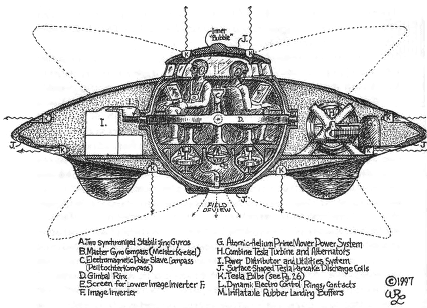
As the outer ship precessed because the alternator was bolted to the outer airframe—the inner cockpit would be gyro-stabilized, so the pilot and crew could have visibility of the outer environment. Even with a precessional angle of 45 degrees, the pilot would still be able to see where he was, and where he was going. I could not see the top of the saucer I saw in 1953, so can’t say what the visibility system was.
TESLA’S DYNAMIC THEORY
OF GRAVITY
According to Tesla’s lecture prepared for the Institute of Immigrant
Welfare (May. 12,1938), his Dynamic Theory of Gravity was one of
two far reaching discoveries, which he “...worked out in all details”, in
the years 1893 and 1894. The 1938 lecture was less than five years before
his death.
More complete statements concerning these discoveries can only he gleaned
from scattered and sparse sources, because the papers of Tesla are
concealed in government vaults for “national security" reasons.
When I specifically asked for these papers at the “National Security
Research Center”—now the “Robert J. Oppenheimer Research Center”- in 1979, I
was denied access because they were classified, even though on that same day
I discovered the plans for the hydrogen bomb on an open shelf, and told a
Harvard graduate student about it later in the day at a Santa Fe restaurant.
The guy went to Los Alamos, copied the plans, and wrote an expose at
Harvard.
In his 1938 lecture, Tesla said he was progressing with the work, and
hoped to give the theory to the world “very soon”, so it was clearly his
intent to “give it to the world”, as soon as he had completed his secret
developments.
The “two great discoveries” to which Tesla referred, were:
1. The Dynamic Theory of Gravity - which assumed afield of force which accounts for the motions of bodies in space; assumption of this field of force dispenses with the concept of space curvature (ala Einstein); the ether has an indispensable function in the phenomena (of universal gravity, inertia, momentum, and movement of heavenly bodies, as well as all atomic and molecular matter); and,
2. Environmental Energy - the Discovery of a new physical Truth: there is no energy in matter other than that received from the environment.
The usual Tesla birthday announcement—on his 79th birthday (1935)—Tesla made a brief reference to the theory saying it applies to molecules and atoms as well as to the largest heavenly bodies, and to
“...all matter in the universe in any phase of its existence from its very formation to its ultimate disintegration”.
Those imbued with relativist theory often refer to “pure energy” in some “form”, but there is no such thing, since "energy" is an abstract "ability" which is always in the future. Who’s to say what “form” is “pure”, and what form is not?
My favorite philosopher, Ayn Rand, said.
“In reality, there are no contradictions. Things are what they are irrespective as to whether we know it or not. Check your premises.”
If the term “energy” is only a convenient abstraction, then it does not exist in physical form, and really describes the potential to perform work as a by-product of matter and electromagnetic radiation in perpetual motion, some of the force of which has been diverted through a path where it performs the desired work, as it goes on its merry way through the universe.
Every change of form of either matter or radiation involves the “work” which induces the change, or the “work” which is induced by the change. Without work there is no change, but all work is ultimately the product of the universe in perpetual, self-sustaining motion, as a rule and not an exception.
As for Tesla’s theory, we have hints, such as, that the earth is the “star of human birth”. In poetic expressions, he hid scientific meanings in statements such as, that using the “thunderbolt of Jove” (the Indo-European sky god), man “annihilates time and space”, an allusion to the use of electro-propulsion (“thunderbolts”), to travel so fast, that time and space are “annihilated”.
Where the government has stolen his papers, we must search for meaning elsewhere. In an article, Man’s Greatest Achievement 1.
1 John J. O'Neill, Prodigal Genius, 1944, pp. 251-252
Tesla outlined his Dynamic Theory of Gravity in poetic form (as paraphrased by me):
-
That the luminiferous ether fills all space
-
That the ether is acted upon by the life-giving creative force
-
That the ether is thrown into “infinitesimal whirls” (“micro helices”) at near the speed of light, becoming ponderable matter
-
That when the force subsides and motion ceases, matter reverts to the ether (a form of “atomic decay”)
John J. O’Neill, Prodigal Genius, 1944, pp. 251-252
-
That man can harness these processes, to:
-
Precipitate matter from the ether
-
Create whatever he wants with the matter and energy derived
-
Alter the earth’s size
-
Control earth’s seasons (weather control)
-
Guide earth’s path through the Universe, like a space ship
-
Cause the collisions of planets to produce new suns and stars, heat, and light
-
Originate and develop life in infinite forms
-
Tesla was referring to unlimited energy, derived from the environment. Several of his major free energy discoveries have been the exclusive stolen property of our Secret Government. The conversion of energy to a stronger force—electropulsion—used to control the much weaker gravity force, would accomplish more work in the same amount of time, and produce “over unity” results.
Some of Telsa’s unusual conceptualization of the ether had been
nonetheless expounded piecemeal, in his preceding 1890’s lectures.2
He later railed against the limited and erroneous theories of Maxwell,
Hertz, Lorentz, and Einstein.
2 T. C.
Martin, Inventions, Researches and Writings of Nicola Tesla, 1894, Chapter
XXV - Introduction - The
Scope of the Tesla Lectures.
Tesla’s ether was neither the “solid” ether with the “tenuity of steel” of
Maxwell and Hertz, nor the half-hearted, entrained, gaseous ether of
Lorentz. Tesla’s ether consisted of “carriers immersed in an insulating
fluid”, which filled all space. Its properties varied according to relative
movement, the presence of mass, and the electric and magnetic environment.
Tesla’s ether was rigidified by rapidly varying electrostatic forces, and
was thereby involved in gravitational effects, inertia, and momentum,
especially in the space near earth, since, as explained by Tesla, the earth
is “...like a charged metal ball moving through space”, which creates the
enormous, rapidly varying electrostatic forces which diminish in intensity
with the square of the distance from earth, just like gravity. Since the
direction of propagation radiates from the earth, the 2 T. C. Martin,
Inventions, Researches and Writings of Nicola Tesla, 1894, Chapter XXV -
Introduction - The Scope of the Tesla Lectures. so-called force of gravity
is toward earth.
Tesla commenced to complete his Dynamic Theory of Gravity at the same
approximate period of time that his experimental results and theories had
been revealed in the three lectures, often illustrated with demonstrations
using Tesla-invented equipment, as revealed in the following eight excerpts,
in pertinent part (emphasis mine):
1. “The most probable medium filling the space is one consisting of independent carriers immersed in an insulating fluid”.
2. “In his experiments he dwells first on some phenomena produced by electrostatic force, which he considers in the light of modern theories to be the most important force in nature for us to investigate.”
3. “He illustrates how mechanical motions are produced by a varying electrostatic force acting through a gaseous medium.”
4. “One of the most interesting results arrived at in pursuing these experiments, is the demonstration of the fact that a gaseous medium upon which vibration is impressed by rapid changes of electrostatic potential, is rigid “
5. “If through this medium enormous electrostatic stresses are assumed to act, which vary rapidly in intensity, it would allow the motion of a body through it, yet it would be rigid and elastic, although the fluid itself might be devoid of these properties”.
6. “...on the assumption that the independent carriers are of any configuration such that the fluid resistance to motion in one direction is greater than in another, a stress of that nature would cause the carriers to arrange themselves in groups, since they would turn to each other their sides of the greatest electrical density, in which position the fluid resistance to approach would be smaller than to receding.”
7. “If in a medium of the above characteristics a brush would be formed by a steady potential, an exchange of the carriers would go on continuously, and there would be less carriers per unit volume in the brush than in the space at some distance from the electrode, this corresponding to rarefaction”.
8. “If the potentials were rapidly changing, the result would be very different; the higher the frequency of the pulses, the slower would be the exchange of carriers; finally, the motion of translation through measurable space would cease and, with a sufficiently high frequency and intensity of the stress, the carriers would be drawn towards the electrode, and compression would result.”
The eight above excerpts are further reducible to the following four statements pertinent to electro-propulsion technology:
1. Mechanical motions can be produced by varying electrostatic force acting through a gaseous (ether) medium, which thereby becomes rigidified, yet allows solid bodies to pass through.
2. Under influence of stress in one direction (under the polarizing influence of light or heat), the carriers may group together, forming tubes of force, creating greater ease of movement in that direction.
3. When a (D.C.) brush is created by a steady potential, a continuous exchange of carriers is created corresponding to ether rarefaction, as the tubes of force are drawn into the conductor.
4. With a sufficiently high frequency and stress intensity in the opposite direction, carrier exchange is blocked by ether compression, forcing the tubes of force to dissolve in the conductors of the ship, imparting electromagnetic momentum. The system, using the two kinds of potentials (D.C. and A.C.), is known as “p2”.
The steady potential of the brush creates the required exchange of carriers, ‘ratifying’ (stretching) the elastic, rigidified medium (composed of the carriers immersed in the insulating fluid) in advance of the ship, as the high frequency A.C. to the rear compresses them, blocking exchange from the rear, dissolving the tubes of force (my “microhelices”), creating instant momentum, normal to the surface (which is at right angles to the electric and magnetic fields).
In 1884, John Henry Poynting’s theorem had been that the flux of energy at any place is represented by the vector product of the electric and magnetic forces, multiplied by C/4*PI. 3 This implied that forces in a conductor could be transformed there into other forms. In 1893, J. J. Thomson stated practically the same thing, saying “...the aether is itself the vehicle of mechanical momentum, of amount (1/4*PI*C) (D*B) per unit volume. 4
(Using e.-s. Units for D and E and e.-m. Units for B and H.)
E = electrical force
D = electrical displacement
H = magnetic force
B = magnetic induction
3 Phil
Trans. clxxv (1884), p. 343.
4 Recent Researches in Elect, and Mag.
(1893), p. 13.
Heinrich Hertz’s theory 5 was
that two systems of varying current should exert a ponderomotive force on
each other due to the variations. Tesla’s disagreement was apparently based
on the fact that he proved that the “ponderomotive force” is due not to mere
“varying currents”, but to rarefaction and compression of the ether carriers,
respectively, produced by different kinds of currents (D.C., A.C., rapidly
varying electrostatic).
J. J. Thomson6 had
extensively developed the theory of the moving tubes of force, both magnetic
and electric, saying that the magnetic effect was a secondary one created by
the movement of electric tubes, and assumed:
-
that tubes exist everywhere in space, either in closed circuits or terminating on atoms
-
that electric force becomes perceivable only when electric tubes have greater tendency to lie in one direction
-
that in a steady magnetic field, positive and negative tubes may move in opposite directions with equal velocity
-
that a beam of light is a group of electric tubes moving at C at right angles to their length (providing a good explanation for polarization of the plane of rotation).
5 Ann. d.
Phys. Xxxi (1887), p. 421; Hertz's Electric Waves, translated by D.E. Jones,
p. 29.
6 Recent Researches in Elect. And Mag.
(1893), p. 13.
Tesla said his “dirigible torpedo” would fly at a maximum 300 miles per second, perhaps since its forward velocity would be some maximum fraction of C. Thomson’s later publishings on this subject followed Tesla’s 1891 lectures before the Royal Society in London, and appear to shed light on Tesla’s work, stating:
-
that a ponderomotive force is exerted on a conductor carrying electric current, consisting of a transfer of mechanical momentum from the agent which exerts the force to the body which 5 Ann. d. Phys. Xxxi (1887), p. 421; Hertz’s Electric Waves, translated by D.E. Jones, p. 29. 6 Recent Researches in Elect. And Mag. (1893), p. 13. experiences it
-
that, if moving tubes entering a conductor are dissolved in it, mechanical momentum is given to the conductor
-
that such momentum must be at right angles to the tube and to the magnetic induction
-
that momentum stored in a unit volume of the field is proportional to the vector product of electric and magnetic vectors. “Thomson’s” Electromagnetic Momentum hypothesis was later developed by H. Poincare7 and by M. Abraham8.
By 1910, it was said9 that the consequence of these pronouncements left three alternatives:
1. Modify the theory to reduce to zero the resultant force on an element of free aether (as with Maxwell, Hertz, and Einstein);
2. Assume the force sets aether in motion (as with Helmholtz);
3. Accept the principle that aether is the vehicle of mechanical momentum of amount [D-B] per unit volume (as with Poynting and J. J. Thomson).
7 Archives
Ne erl (2) v (1900), p. 252.
8 Gott, Nach., 1902, p. 20.
9 Sir Edmund Whittaker, A History of the
Theories of the Aether and Electricity, 1910, Edinborough.
Whittaker’s greatest error was in omitting Tesla’s theory entirely. After Tesla’s experiments verified it, right in front of the esteemed members of the “Royal Academy”, the “three (later) alternatives” were moot, and a new law existed, that of Tesla.
Tesla’s Secrecy
Due to his pacifist sympathies, Tesla originally contemplated giving his
electric flying machine to the Geneva Convention or League of Nations, for
use in ‘policing the world’ to prevent war. Later disillusioned after WWI
with the collapse of the League, he said he’d “...underestimated man’s
combative capacity”.10
10
New York Times, July 10,1934.
In 1919, his reason for increased secrecy emerged in an interview with Frederick M. Kerby, for Resolution magazine, while discussing a “three-hour” airplane between New York and London:
“...we have here the appalling prospect of a war between nations at a distance of thousands of miles, with weapons so destructive and demoralizing that the world could not endure them. That is why there must be no more war”
With the government’s spurning of his defense suggestions, Tesla’s only recourse was to withhold his secrets from the world, and to dissuade discovery in their direction.
In 1929, Tesla ridiculed Heinrich Hertz’s 1887-89 experiments
purportedly proving the Maxwellian “structureless” ether filling all space,
“of inconceivable tenuity yet solid and possessed of rigidity incomparably
greater than the hardest steel”. Tesla’s arguments were to the contrary,
saying he had always believed in a “gaseous” ether in which he had observed
waves more akin to sound waves. He recounted how he had developed a “new
form of vacuum tube” in 1896 (which I call the “Tesla bulb”),
“...capable of being charged to any desired potential, and operated it with effective pressures of about 4,000,000 volts.”
He described how purplish coronal discharges about the bulb when in use, verified the existence of “particles smaller than air”, and a gas so light that an earth-sized volume would weigh only 1/20 pound. He further said sound waves moved at the velocity of light through this medium.11
Tesla mentioned using his special tube to investigate cosmic rays12, saying that when its emanations were impinged upon a target material, radioactive emissions resulted, and that radioactive bodies were simply “targets” continuously bombarded by “infinitesimal bullets projected from all parts of the universe”, without which “all radioactivity would cease.”
His description of these “bullets” was similar to the ZPR. On Apr. 15,193213, Tesla said Einstein’s theory regarding changing matter into force, and force into matter, was “absurd”. He compared this to the difference between body and mind, saying force is a “...function of matter”, and that, just as a mind could not exist without a body, “...without matter, there can be no force.”
11
New York Herald Tribune, Sept. 22,1929, pp. 1,29.
12 Letter,
New York Times, Feb. 6,1932, p. 16, col. 8.
13 Nikola Tesla Papers, Rare Books and
Manuscript Library, Columbia University.
On Sept. 11, 1932 (New York Herald Tribune), Tesla derided the Maxwellian/Hertzian ether, while saying that higher frequency waves “...follow the curvature of the earth and bend around obstacles”, yet in an Apr. 8,1934 New York Times letter, said that short waves for “power purposes” of the ‘wireless art’, were inappropriate, and that power will travel in “long waves”.
His 1929 attack on the Maxwellian/Hertzian ether theory—39 years afterward, during the advent of Relativism—seemed relevant only to his concealed theory, not to disclose it or promote it, but to conceal it.
THE NATURE OF
ELECTRICITY
What were the old ether physicists referring to when they attempted to
describe “an incompressible, perfect fluid”? What would a “perfect fluid”
do? It would be able to “wet” everything it came into contact with, such as
protons, and could flow everywhere without resistance. One “fluid”—the
ether—could flow everywhere, and because of its density and ultra-fineness,
nothing could stop it, and it felt so resistance, but only matter felt
resistance, depending on the circumstances. Another fluid—electricity—could
flow in certain places, and wet only certain things, but often met
resistance.
In order to understand the ether, we must get to know electricity more
intimately. Just like water, a proton will hold only so much
electricity on its surface, but the ‘surface’ of the proton is probably
similar to the outer area of a ball-shaped swarm of hovering mechanical bees,
powered by the ZPR, with a denser agglomeration of “bees” toward the
‘ball’s’ center. If this swarm of bees is subjected to a wave of rainy mist
(the etheric ‘wind’), the bees must all turn to face into the etheric wind
to maintain their formation.
The ‘water’ droplets—electric sub-charges carried by the etheric wind—tend to agglomerate around the front side. Each bee, as he flaps his wings, will get wet only so much, so that excess ‘water’ is thrown off and carried to the next bee, or the next swarm of bees, by the etheric wind, and so forth, so that a ‘current’ of droplets continues to flow through the ball of bees due to its motion through the etheric wind, and transfers momentum between masses. The ‘water’ tends to come off in larger drops, which have formed from smaller droplets accumulated on each bee.
As in fluid mechanics, the ‘drop’ size is the result of cohesiveness of the electric ‘fluid’, the surface area of each ‘bee’, and the space between each bee, all of which influences the final size of each larger ‘drop’ (the “electron”) which accumulates enough to form it. If one were to mathematically analyze the flow of “drops” (i.e., “quanta”) per mass unit, they would have an average rate of the flow of charges/cm3 of etheric wind, for the momentum, as determined by the “current” flow rate.
Much like the bees, as a body (its many electrons, atoms, and molecules,
with plenty of ‘space’ within and between) sits at rest on the earth, it
moves at fantastic speed through the universal ether field, due to the
earth’s revolution, orbit, and other motions.
In his 1891 A.I.E.E. lecture at Columbia College, Tesla said in
pertinent part (emphasis mine):
“What is electricity, and what is magnetism?
“...We are now confident that electric and magnetic phenomena are attributable to the ether, and we are perhaps justified in saying that the effects of static electricity are effects of ether in motion”,
“...we may speak of electricity or of an electric condition, state or effect”,
“...we must distinguish two such effects, opposite in character neutralizing each other”,
“...for in a medium of the properties of the ether, we cannot possibly exert a strain, or produce a displacement or motion of any kind, without causing in the surrounding medium an equivalent and opposite effect.”
“...its condition determines the positive and negative character.” “We know that it acts like an incompressible fluid;”
“...the electro-magnetic theory of light and all facts observed teach us that electric and ether phenomena are identical.”
“The puzzling behavior of the ether as a solid to waves of light and heat, and as a fluid to the motion of bodies through it, is certainly explained in the most natural and satisfactory manner by assuming it to be in motion, as Sir William Thomson has suggested.”
“Nor can anyone prove that there are transverse ether waves emitted from an alternate current machine; to such slow disturbances, the ether, if at rest, may behave as a true fluid.”
In his statements, Tesla was balancing the various arguments in preparation for his decision:
“...Electricity, therefore, cannot be called ether in the broad sense of the term; but nothing would seem to stand in the way of calling electricity ether associated with matter, or bound ether; or, in other words, that the so-called static charge of the molecule is ether associated in some way with the molecule.”
“...It cannot differ in density, ether being incompressible: it must, therefore, be under some strain or in motion, and the latter is the most 76 probable.”
Tesla therefore believed in an ether which was in motion relative to earth, because the earth is in motion.
The thing which Tesla had realized, was that ether possesses electric
charges which are deposited on atoms. In supporting the “dynamic” ether
concept, he was supporting the “stationary ether” concept, since the
“motion” he referred to was “apparent” motion of the ether perceived by an
observer on earth, relative to a stationary ether.
The importance of cosmic motion to the electromagnetic effects of static charges was brought up by Tesla in his lecture:
“About fifteen years ago, Prof. Rowland demonstrated a most interesting and important fact, namely, that a static charge carried around produces the effects of an electric current.”
“...and conceiving the electrostatically charged molecules in motion, this experimental fact gives us a fair idea of magnetism. We can conceive lines or tubes of force which physically exist, being formed of rows of directed moving molecules; we can see that these lines must be closed, that they must tend to shorten and expand, etc. It likewise explains in a reasonable way, the most puzzling phenomenon of all, permanent magnetism, and, in general, has all the beauties of the Ampere theory without possessing the vital defect of the same, namely, the assumption of molecular currents. Without enlarging further upon the subject, I would say, that I look upon all electrostatic, current and magnetic phenomena as being due to electrostatic molecular forces.”
In these statements, Tesla showed he was aware that any “stationary” locale on earth is actually in fantastic motion (“70,000 mph”). The electrostatic charges “carried around” are currents between atoms and the ether, which produce magnetism. The phenomena of ‘permanent magnetism’ or ‘cosmically induced’ magnetism are apparently due to electrostatic charges ‘carried around’ by cosmic motion, in the universal ether field.
Since no one can hold an atom or molecule perfectly still—because it is in
fantastic motion—all atoms and molecules carry currents producing magnetic
fields. Since a magnetic field is the product of a current, no one can
produce a magnetic field without electricity, moving through or along a
conductor, or as electrostatic charges in local or cosmic motion.
Tesla’s Dynamic Theory of Gravity and MHD method of Spacial
Electropulsion brought a cosmic crowning achievement to the works of
Faraday, Wm. Thomson, J. J. Thomson, and Edmund Hall.
Hiçbir yazı/ resim izinsiz olarak kullanılamaz!! Telif hakları uyarınca bu bir suçtur..! Tüm hakları Çetin BAL' a aittir. Kaynak gösterilmek şartıyla siteden alıntı yapılabilir.
© 1998 Cetin BAL - GSM:+90 05366063183 -Turkiye/Denizli
Ana Sayfa / Index / Roket bilimi / E-Mail / Quantum Teleportation-2
Time Travel Technology / UFO Galerisi / UFO Technology/
Kuantum Teleportation / Kuantum Fizigi / Uçaklar(Aeroplane)
New World Order(Macro Philosophy) / Astronomy