A wormhole is a hypothetical hole in space that connects to another point in time. American scientist Kip Thorne first described the idea that wormholes could be used for time travel in 1985. A wormhole consists of an event horizon and a vortex, which leads to the other end of the wormhole.

Any objects that reach the event horizon are pulled into the vortex and across hyperspace. In theory wormholes are very unstable and do not have their ends fixed to a certain point in space. Sometimes two wormhole ends will connect in hyperspace and allow objects to travel through them. The connection between two wormholes is called the Einstein-Rosen Bridge as it was theorised by Albert Einstein and Nathan Rosen in the 1930s.
To use a wormhole for time travel you would have to find a stable wormhole that was connected in hyperspace. Next you would need a ship capable of withstanding intense gravity distortions and that could travel faster than the speed of light.
You would have to travel faster than light to stay ahead of the wormhole collapsing as you passed through it. When an object travels through a wormhole, the wormhole collapses thus if your spacecraft survives the trip through the wormhole you will have no way back. Therefore this is another idea that works on paper but could not be put into practice. Wormholes are small, hard to detect and as of yet no spacecraft could travel through one. Wormholes are still just a part of Startrek
because no one has seen one, no one has detected their effects, and we are still as of yet uncertain if they actually exist.------------------------------------------------------------
Travelling to a
parallel universe via Wormhole
Parallel Universes via Wormholes
Ever thought about how big is our universe?
Best estimates of astronomers indicate 100 billion galaxies; Andromeda
galaxy is closest one to ours and is 2.5 million light years away.
One light year is how much light can travel in vacuum within 365.25 days (1
Julian year)
Which is, distance =speed x time
Distance = (3x10⁸(m/s)) x (365.25x24x60x60(s))
Distance =946728x107kms or 9.467e+12kms =1 light year
You can imagine how gigantic our universe is!
Scientists have a theory that we are living in a multiverse, as per this
theory ours is not the only universe, rather many universes exist parallel
to each other and these are called parallel universes. They are anticipated
to be similar but not same (with very few changes).
We agreed on our universe being enormous (taken into infinity), added to it
are infinite parallel universes. Too Hard to picture!
Wormhole: it is a hypothetical concept (no proves found yet) and is like
a tunnel through the space time or like a short-cut.

White hole: It releases matter outward unlike black hole that sucks
it in. Black hole ends at a singularity and white hole is born from
singularity.
Entering a wormhole can be familiar to black hole (black hole + white hole
could make up worm hole) and exiting it leads to 2 set of predictions
A) Exiting in the same universe you entered but at a completely different
space-time as shown in down imagine. So if there is a wormhole between our
galaxy and Andromeda galaxy, and it is stable enough for interdimensional
travel. I will be able to reach Andromeda galaxy within few minutes or hours(definitely
less than 2.5 million light years) And therefore I even travel in time, that
is travel to future (my friends on earth and I will experience time dilation
due to me passing through wormhole which is warping of space-time)

B) Exiting into a parallel universe as shown in first image. As in case of
Alice in wonderland.
Our universe started off with a ‘Big Bang’ and is expected to end in a ‘Big
freeze’. Few scientists hope that this can be avoided by hopping into a
parallel universe.
The bridge of wormhole connecting two places is called Einstein-Rosen Bridge.
Einstein believed that any communication through the bridge would be
impossible, but recent studies show it hard but perhaps probable.
Amount of matter-energy needed to create wormhole is immensely large and it
would still be highly unstable and disappear in wink of an eye, making it
impossible to use it as an interdimensional travel.
So if you are bored of this universe, you may be lucky enough to travel
through universes for some adventure in a future, if you live long enough by
that i mean few centuries and when these theories turn into laws.
--------------------------------------------------------------
October 13, 2014
Wormholes – those curious portals to the other side of the galaxy or
universe. More formerly known as an Einstein-Rosen bridge, they
theoretically join two regions of space allowing one to traverse great
distances instead of moving along the fabric of space.
The illustrations below shows this very well. Traveling from A to B in the
conventional sense will get you there in time…
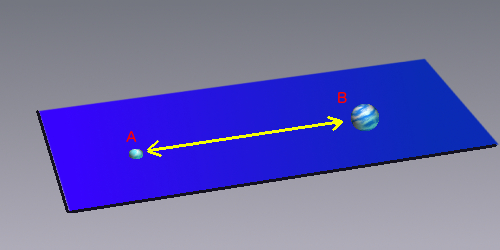
Traveling from planet A to planet B via flat space.
But, fold space by using a wormhole and you now have a much shorter path to
cross to go from A to B.

Traveling from A to B via a wormhole is quicker.
The new wallpaper shows the mouth of an active wormhole from the point of
view of a gas giant and its habitable moon in a nearby solar system.
-------------------------------------------
ER = EPR?
John F. Lindner November 26, 2015
This month is the 100th anniversary of Albert Einstein’s November 1915
discovery of the gravitational field equations of General Relativity, in
which test masses move along the straightest possible paths (called
geodesics) in spacetime curved by the density and flux of energy and
momentum (including mass and pressure). General Relativity allows spacetime
to be topologically doubly connected. In the “wormhole” depicted below (using
two different embeddings), the distance across the flat region may be large
even if the distance through the tube is small. Traversable wormholes, like
the one in the movie Interstellar, might be propped open by exotic matter of
negative energy density and provide shortcuts across the universe. Such
structures are sometimes called Einstein-Rosen bridges, after a 1935 paper
by Einstein and Nathan Rosen.
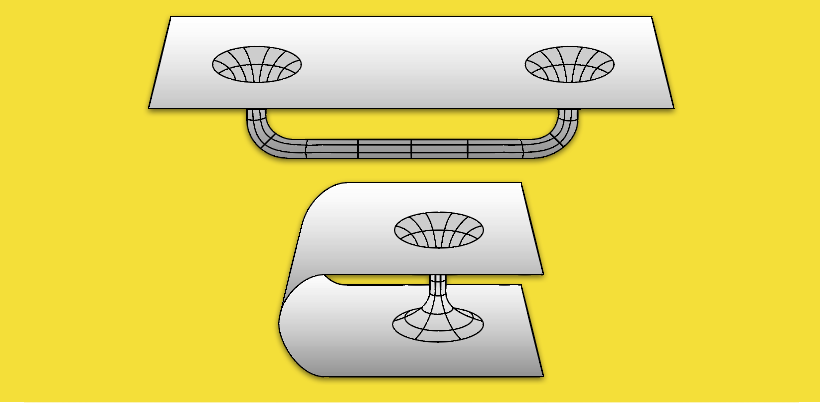
A wormhole is a geometry of four-dimensional spacetime in which two regions
of the universe are connected by a “shortcut” consisting of two “mouths”
connected by a short narrow “throat”
Also this month, several research teams reported the best yet experimental
realizations of quantum entanglement, in which pairs of particles interact
so that each particle cannot be described independently regardless of their
separation. For example, an electron and positron in the ground state of
positronium can annihilate into two oppositely traveling photons whose spins
are completely correlated, so that measurement of one spin determines the
other even if the measurements are spacelike (or so far apart that no signal
could connect them). In the visual metaphor below, a Necker cube outline can
be interpreted two ways, representing a photon in a superposition of two
spins; similarly, a pair of Necker cubes can be interpreted two ways,
representing measurements of its correlated parts. Such “spooky action at a
distance” is sometimes called an EPR correlation after another 1935 paper by
Einstein, Boris Podolski, and Rosen.

Single ambiguous Necker cube is a metaphor for quantum superposition, while
a pair of ambiguous Necker cubes is a metaphor for quantum entanglement
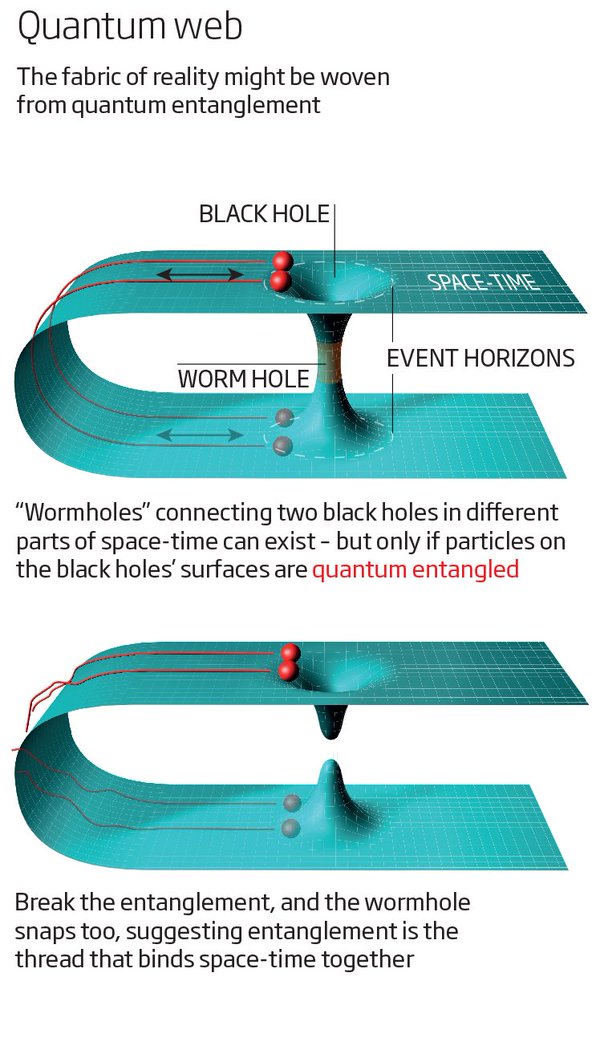
Recent discussions of the black hole information paradox and the holographic
principle in anti-de-Sitter-space model universes suggest a relationship
between wormholes and quantum entanglement that may elucidate the nature of
spacetime itself: Can Einstein-Rosen bridges explain Einstein-Podolski-Rosen
correlations? Is ER = EPR?
H
içbir yazı/ resim izinsiz olarak kullanılamaz!! Telif hakları uyarınca bu bir suçtur..! Tüm hakları Çetin BAL' a aittir. Kaynak gösterilmek şartıyla siteden alıntı yapılabilir.© 1998 Cetin BAL - GSM:+90 05366063183 -Turkiye / Denizli
Ana Sayfa / Index / E-Mail / Kuantum Fiziği / UFO Technology /
Roket bilimi / UFO Galerisi / Astronomy