 |
GRAVITY CONTROL AND
WARP DRIVE FOR SPACE TRAVEL
GENERAL RELATIVITY THEORY AND APPLICATIONS ...
GRAVITATIONAL WARP DRIVE FOR SPACE TRAVEL ...
GRAVITY AND CURVATURE OF SPACETIME ...
TEST FOR FLATNESS OF SPACETIME ...
HOW TO DETERMINE, E = MC2 ...
SPACETIME CURVATURE ...
RESULTS TO DATE ...
Copyright © 1999-2010
John Cipolla/AeroRocket. All rights reserved |
|
(1) GRAVITATIONAL WARP DRIVE FOR SPACE TRAVEL
John Cipolla is performing ground
breaking research in the area of gravitational warp drive technology and
gravity control for faster than light star travel. The illustrations
below show a spacecraft being accelerated while enclosed within an
artificially generated warp bubble.
The following results from the theory of
General Relativity illustrate how a warp bubble uses opposing regions of
expanding and contracting spacetime for propelling a starship at
velocities exceeding the speed of light. This is a work in progress
based on a new method for warping spacetime to generate warp bubble
disturbances without the need for exotic matter or negative energy.
Experiments are being conducted to evaluate the method's capability for
generating the theoretical warp metrics depicted in Figure-2, Figure-3
and Figure-4.
|

Figure-1: Warp bubble traveling
adjacent to the Earth (not to scale)

Figure-2: Warp bubble geometry illustrating how
spacetime compression and expansion
propel a warp bubble and an enclosed starship through space to distant stars


Figure-3 and Figure-4: Warp metrics generated using "new" methods
Starship is located on the flat part of a warp bubble disturbance
RESULTS TO DATE
MATHCAD WARP DRIVE ANALYSIS (10/15/2008)
 _metric.gif)

Figure-5, Figure-6 and Figure-7: Theoretical warp metric derivation using
MathCAD
|
MathCAD results
for the Relativistic analysis of the Alcubierre faster than light
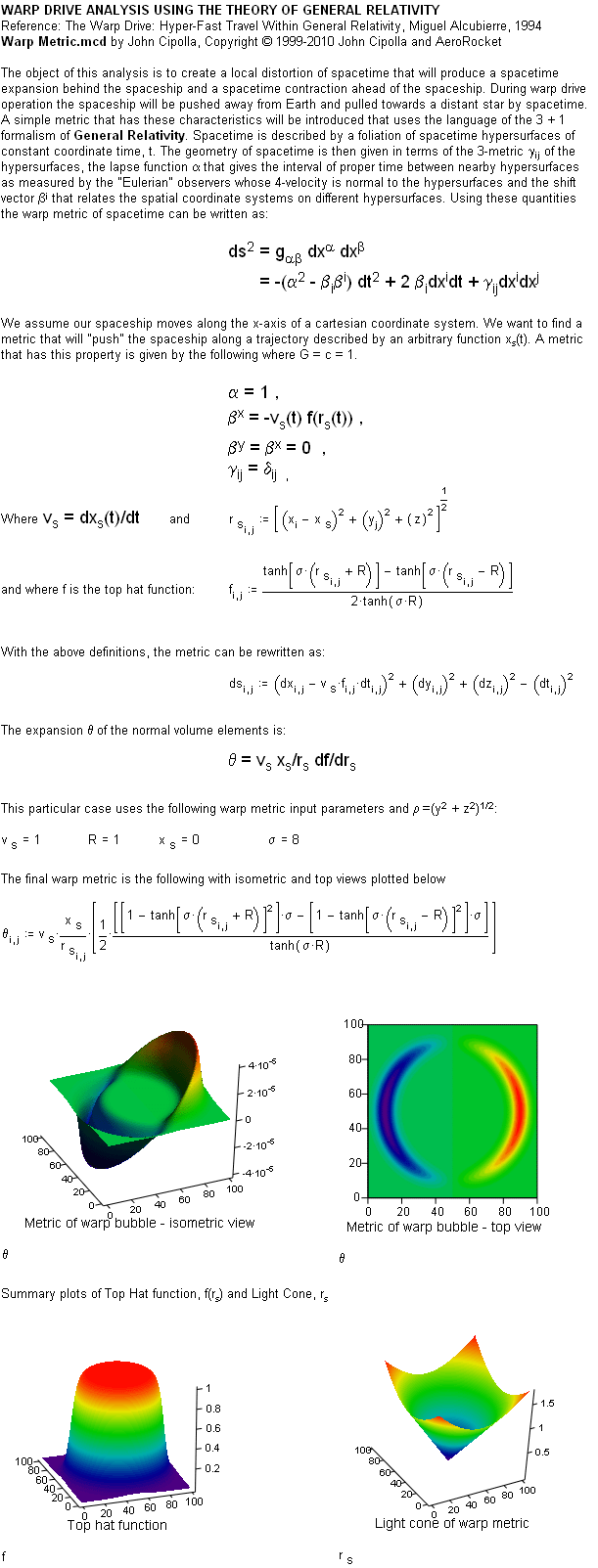
warp metric is illustrated in the above contour plots. Figure-5
represents a light cone where rs(t) = [(x-xs(t))2
+ y2 + z2]1/2. Figure-6 represents the
metric-shape function, f(rs) also called the "top hat"
function and Figure-7 displays the resulting spacetime warp
metric for faster than light space travel. |
WARP METRIC TEST RESULTS (2/12/2009)
 

Figure-8, Figure-9 and Figure-10: Experimental and theoretical warp metrics
|
These results compare the
energy signature of a new method to warp spacetime shown in Figure-8 to
the theoretical Alcubierre warp metric displayed in Figure-9 and
Figure-10. Work continues using a laser to map spacetime around
the experimental warp metric and clocks to measure time dilation within
and around the proposed warp bubble. |
LASER SPACETIME WARP EXPERIMENT
(4/14/2009)

Figure-11: Laser spacetime warp experiment
|
Laser experiment
used to map spacetime around the proposed warp drive
demonstration device. This laser measurement system is mechanically and
acoustically isolated from the system used to warp spacetime. Similar
experiments are being designed using synchronized clocks to measure time
dilation effects. No positive results to date. |
LASER SPACETIME WARP EXPERIMENT
(8/12/2009)

Figure-12: Laser spacetime warp experiment using fog
|
The same experiment
using a fog machine to trace a laser beam around the warp bubble
disturbance. The laser beam was not deflected indicating spacetime
is not being warped to any measurable degree by the proposed warp
generator. Several configurations of the warp generator resulted in the
same null result. The experiments are continuing using conventional
energy sources to affect spacetime... |
WARP METRIC RESULTS (02/15/2010)

Matter-energy tells spacetime how to
curve and spacetime tells matter-energy how to move
|
SPECIAL NOTE: The
aim of these experiments was an attempt to show that a warp bubble
could be generated using electromagnetic energy instead of negative
energy as required by Alcubierre's faster than light warp metric.
The method proposed to warp spacetime seems to match the signature warp
bubble theoretically predicted using negative energy. General Relativity,
Dark Matter and Dark Energy cosmology indicate that a warp bubble is
analogous to expanding spacetime observed to occur between distant
galaxies. In effect, expanding spacetime between galaxies is like a
conveyer belt pushing galaxies apart at a rate of approximately 71 km/sec/mega
parsec. While measuring the warp effect predicted by my method has not
proven successful the paper by Alcubierre states the following, "The
need for exotic matter therefore doesn't necessarily eliminate the
possibility of using spacetime distortion like the one described here
for hyper-fast interstellar travel." Therefore to continue this research,
I have constructed a piezoelectric transducer to more accurately measure
changes in inertial mass caused by spacetime distortion. |
GENERAL RELATIVITY AND
WARP DRIVE THEORY
This Relativistic Warp drive theory uses the concept of a
warp bubble to avoid violating the universal speed limitation which is the
speed of light, c. Basic to the study of General Relativity is the concept
of spacetime curvature embodied by the following statement, "Matter-energy
tells spacetime how to curve and spacetime tells matter-energy how to move".
The concept of spacetime curvature is summarized in the Einstein equation
which is a result of the theory of General Relativity.
According
to the Einstein equation, matter and energy tell spacetime how to curve and
in turn spacetime tells matter and energy how to move. Where, matter and
energy are defined by the stress-energy tensor (T) and spacetime curvature
is defined by the Riemann curvature tensor (R). In summation, the Einstein
equation relates spacetime curvature and accelerated motion of a matter-energy
system and the implication that accelerated motion and the effects of
gravity are not distinguishable. Hence, artificial gravity can be created by
simply rotating a spacecraft to create the effect of gravity on long
journeys into space and a warp bubble can be used to travel to distant
places at many times the speed of light without locally exceeding the speed
of light in the warp bubble.
WARP BUBBLE PHYSICS
According to General Relativity gravity and acceleration are not
distinguishable and are caused by the curvature or warp metric of spacetime.
A warp bubble is a specific warp metric solution of General Relativity and
is a combination of positive and negative energy fields that pushes and
pulls our starship forward to bring our destination to us just like a
conveyer belt. The exotic ingredient required to make a warp bubble is
negative energy which has the unusual property of being able to make
ordinary matter fall up in a gravitational field. According to General
 Relativity
the spacetime in front of a warp bubble is compressed pulling our
destination to us. At the same time the spacetime behind a warp bubble is
expanding pushing us to our destination. The compression and expansion
process happens in an instant and at many times the speed of light making
faster than light travel possible. The combination of positive and negative
energy produces an expansion of space behind the bubble and a contraction of
space in front of the bubble. in other words, creating space behind the
bubble pushes us to our destination and destroying space in front of the
bubble pulls us to our destination. This mechanism allows us to travel many
times faster than the speed of light (see Starship Warp Velocity) relative
to the Earth without exceeding the speed of light in our local frame of
reference, the warp bubble. Relativity
the spacetime in front of a warp bubble is compressed pulling our
destination to us. At the same time the spacetime behind a warp bubble is
expanding pushing us to our destination. The compression and expansion
process happens in an instant and at many times the speed of light making
faster than light travel possible. The combination of positive and negative
energy produces an expansion of space behind the bubble and a contraction of
space in front of the bubble. in other words, creating space behind the
bubble pushes us to our destination and destroying space in front of the
bubble pulls us to our destination. This mechanism allows us to travel many
times faster than the speed of light (see Starship Warp Velocity) relative
to the Earth without exceeding the speed of light in our local frame of
reference, the warp bubble.
 The
warp bubble itself is made of fields of positive energy at either end and a
band of negative energy around the middle. These energy fields create huge
gravitational effects so powerful the warp bubble can distort spacetime
without having to accelerate the traveler to achieve faster than light
velocity. The main requirement, negative energy also called vacuum energy
is a property of a vacuum where subatomic particles smaller than an atom
dart into and out of existence almost instantaneously. According to the
rules of quantum mechanics negative energy creates a negative quantum
pressure that propels the warp bubble and therefore our starship forward. An
interesting observation is that we may already see the effects of negative
energy because astronomers have observed that our universe is expanding due
to the presence of dark energy. It is theorized that dark energy fills the
vacuum of space between the galaxies and is the cause for the expansion and
increasing acceleration of the universe. Therefore, dark energy and negative
energy are probably the same "stuff" required to make a warp bubble possible. The
warp bubble itself is made of fields of positive energy at either end and a
band of negative energy around the middle. These energy fields create huge
gravitational effects so powerful the warp bubble can distort spacetime
without having to accelerate the traveler to achieve faster than light
velocity. The main requirement, negative energy also called vacuum energy
is a property of a vacuum where subatomic particles smaller than an atom
dart into and out of existence almost instantaneously. According to the
rules of quantum mechanics negative energy creates a negative quantum
pressure that propels the warp bubble and therefore our starship forward. An
interesting observation is that we may already see the effects of negative
energy because astronomers have observed that our universe is expanding due
to the presence of dark energy. It is theorized that dark energy fills the
vacuum of space between the galaxies and is the cause for the expansion and
increasing acceleration of the universe. Therefore, dark energy and negative
energy are probably the same "stuff" required to make a warp bubble possible.
General Relativity states the equivalent mass-energy of a planet the size of
Jupiter is required to create a warp bubble. Because producing negative
energy is beyond our capability the objective of this research is to find an
alternate way to create a relativistic warp bubble without the need for
exotic matter or negative energy. It is proposed that a replacement for
negative energy may be possible by using positive energy in unique ways to
generate an energy signature equivalent to the Alcubierre warp
metric displayed in Figure-11 of the
RESULTS TO DATE section.
SPECIAL REFERENCES:
Note-1: 2-D warp bubble from John Cipolla's Warp Drive Notes,
1974.
Note-2: Negative energy composite view based on Sci Fi Science,
How to Explore the Universe: Where Dr Michio Kaku reveals how we could
one day build a warp drive.
Note-3: Sci Fi Science video, warp theory: Traveling at Warp Speed
Note-4: Sci Fi Science video, starship design: Exploring the Universe
using the Warp Drive

Figure-13: MathCAD analysis of a hypothetical flight to a star 4.3 light
years away
WARP DRIVE REFERENCES
The Warp Drive: Hyper-fast
Travel Within General Relativity, Miguel Alcubierre
Breakthrough Propulsion
Physics (NASA)
Warp
Drive, When? (NASA)
|
(2) GRAVITY AND CURVATURE OF SPACETIME
According to Einstein's General Theory of
Relativity gravitation is a manifestation of the curvature of
spacetime. Light and particles of matter travel along geodesics while
the geometry in which travel occurs takes place in spacetime not just
space. A geodesic is the shortest line between two points that lies in a
given surface. In curved space two separate geodesics that start off
parallel will eventually cross or intersect. Because gravity is a
manifestation of geometry this behavior will occur in the motion of
particles on geodesics in spacetime. The intersection of initially
parallel geodesics is an expression of gravitational tidal effects while
traveling within a gravitational field. For example, two particles in
free fall in a gravitational field will initially move parallel to each
other as they approach the ground. However, because the particles are
moving on radial paths to the center of the massive object they will
seem to move toward each other if the distance traveled is great enough.
This is a description of the tidal effects of gravity and the spacetime
effect on particles moving in spacetime. This phenomenon is also called
geodesic deviation.
Figure-2 represents the gravitational field determined using the
Schwarzschild metric solution for the curvature of spacetime outside
any spherically symmetric mass like the Earth, Sun or a black hole. The
tidal effects of gravity on a volume of space as the volume approaches a
massive object is displayed. Changes of space-extension or distortion of
the volume is caused by the curvature of spacetime.
|

Figure-1, Schwarzschild metric or line
element for static, spherically symmetric fields outside spherically
symmetric bodies. This equation describes the metric structure of empty
spacetime surrounding a massive body.
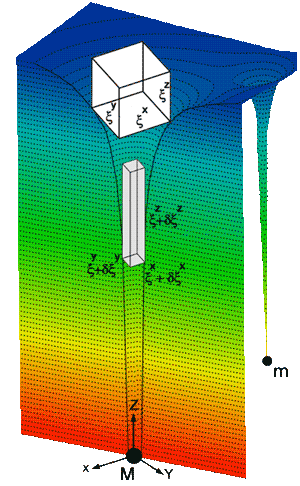
Figure-2, Volume entering the
gravitational field of an object modeled by the Schwarzschild
solution
|
Furthermore, the
curvature of spacetime causes the path of a light ray to bend in
the region around a massive object. A ray of light as it approaches the
gravitational charge of a massive object undergoes a deflection through
the angle, F
when the separation distance, D
is small enough. Using the Schwarzschild metric solution given by the
principle of equivalence the equation for the deflection angle,
F of a ray
of light is illustrated in Figure-3. Several observations for the
deflection of light by the Sun during solar eclipses are in agreement
with this simple light ray deflection equation. |

Figure-3, Deflection of light determined by the
Schwarzschild metric
|
(3) TEST FOR FLATNESS OF SPACETIME
Sometimes it's necessary to determine the
degree to which spacetime is curved. The following test for spacetime
flatness is useful to determine if the influence of a nearby massive
object can be ignored when trying to determine the relative position of
two particles or two space ships in orbit. The following example is
from page 30 of Gravitation by Misner and Thorne.
Statement of the Problem: A region just above the surface of the
Earth, 100 m x 100 m x 100 m (space extension) is followed for 10^6 m of
light-travel time (T ~ 3 seconds). Using the Riemann curvature tensor
determine the uncertainty of measurement for the volume as it traverses
the space around Earth.
|

Figure-4, Example from Gravitation,
page 30
|
(4) SPACETIME CURVATURE
The following is a general method or
procedure to determine the non-relativistic change in the space
extension of a volume, region or object in the vicinity of a massive
object caused by tidal effects of gravity and spacetime curvature. This
example is useful to determine the dimensions of an object as it
approaches a black hole or to determine when spacetime can be considered
Euclidian (flat) or non-Euclidian.
|

Figure-5, Simple application of the
Riemann curvature tensor
|
(5) GENERAL RELATIVITY THEORY AND APPLICATIONS
 The
following series of simple analyses are applications of General
Relativity to the study of Cosmology. Gravity dominates on large
scales making it possible to neglect nuclear and electromagnetic forces
for cosmological approximations. In addition, the universe is to a very
high degree homogeneous and isotropic making the spacetime metric
nearly the same from one point to another over large distances. For more
information please see the references especially Relativity
Demystified. The
following series of simple analyses are applications of General
Relativity to the study of Cosmology. Gravity dominates on large
scales making it possible to neglect nuclear and electromagnetic forces
for cosmological approximations. In addition, the universe is to a very
high degree homogeneous and isotropic making the spacetime metric
nearly the same from one point to another over large distances. For more
information please see the references especially Relativity
Demystified.
|

Figure-6, General Relativity theory and applications
EINSTEIN'S HYPOTENUSE

REFERENCES FOR
GENERAL RELATIVITY
Gravitation, Charles W. Misner, Kip S. Thorne and John A. Wheeler
SPACETIME and GEOMETRY An Introduction to General Relativity, Sean M.
Carroll
Relativity Demystified, David McMahon
Alıntı: http://aerorocket.com/WarpMetrics.html#ANCHOR5
Hiçbir
yazı/ resim izinsiz olarak kullanılamaz!! Telif hakları uyarınca
bu bir suçtur..! Tüm hakları © Çetin BAL' a aittir. Kaynak gösterilmek şartıyla siteden
alıntı yapılabilir.
Ana Sayfa /
index /Roket bilimi /
E-Mail /
Rölativite Dosyası /
Kuantum Fiziği
Astronomi
/
UFO Technology
/
/
Bilimsel Makaleler/
|