




A gauche moteur à flux dérivé classique (RD-107),à droite moteur à flux
intégré (RD-253).(Dessin d'un auteur inconnu 1980)

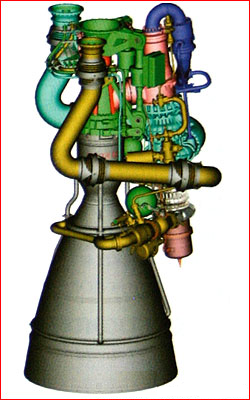
Le moteur Russe RD-180 que l'on retrouve sur des
fusées civiles Est Ouest en 2006. (Doc X)

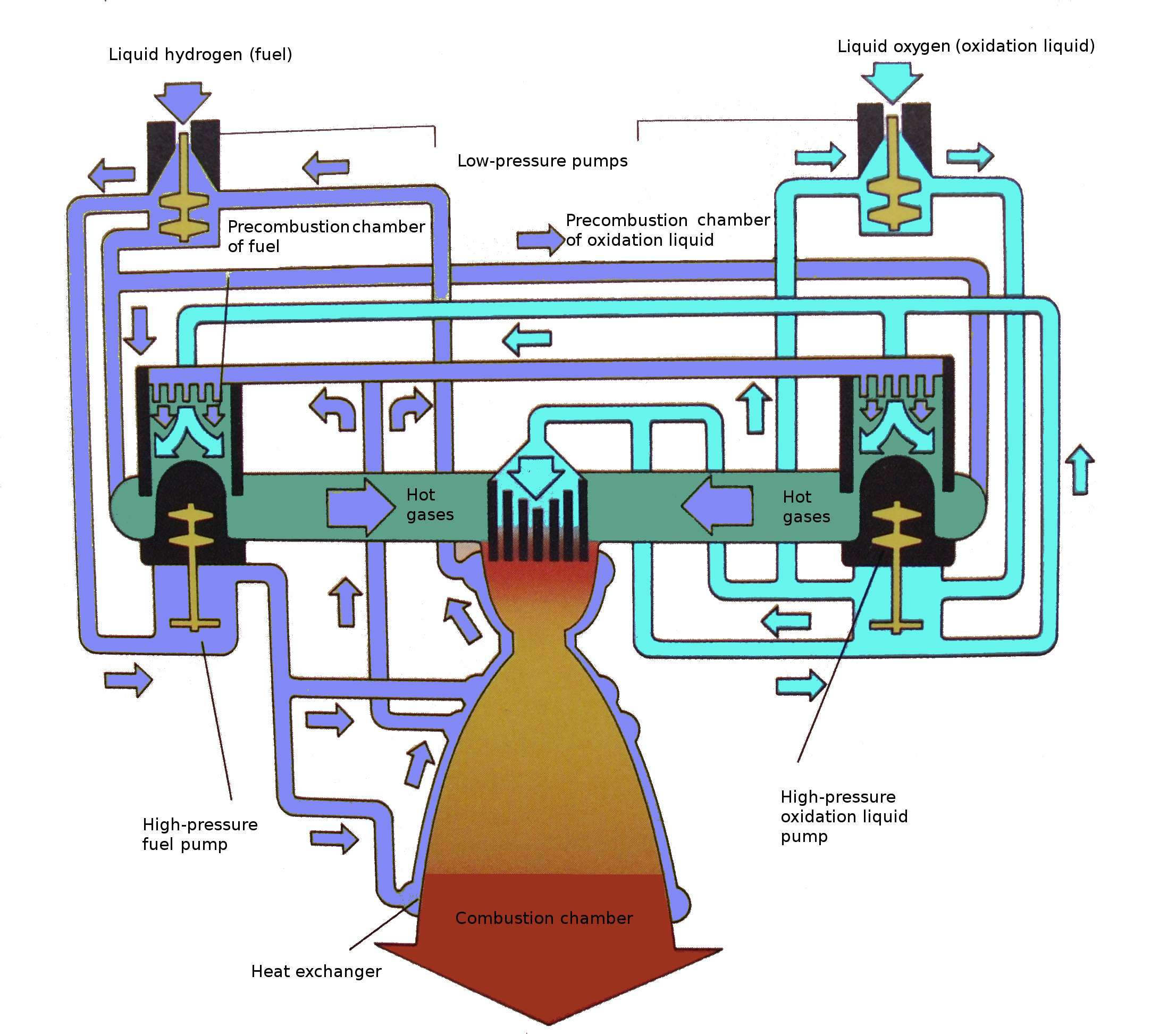
Fonctionnement Viking d'Ariane-1
(Doc SEP)


Fonctionnement Vulcain d'Ariane-V
(Doc SNECMA)


Le moteur Russe de tous les succés
le RD-107 qui a lancé le premier ICBM
en 1957, Spoutnik-1, et qui vole encore
sur les fusées Soyouz-Zemiorka en 2006.
(Doc X)

Sistemi besleyen yakýt ve roket motoru yanma odasýnda oksitleyici: a - inert, b - pompa. 1 - yakýt tanký, 2 - meme karýþtýrma baþkaný 3 - gaz tüpleri yüksek basýnç, 4 - vanalar, 5 - oksitleyici tank, 6 - Soðutma, düþük basýnç 7 - gaz tüpleri, 8 - Pompalar 9 - türbini, 10 sýcak gaz - seçim türbin sürücüye.


Fýrlatma aracý Sputnik:

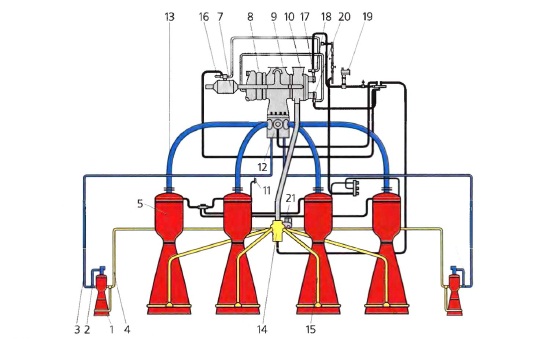
2 - Kavþak açmak kamera direksiyon;
3 - Boru oksidan direksiyon odalarý;
4 - Boru Hatlarý direksiyon yakýt hücreleri;
5 - ana kamera;
7 - buhar-gaz jeneratörü;
8 - Türbin;
9 - Pompa oksitleyici;
10 - Yakýt pompasý;
11 - Basýnç sensörü, çekiþ kontrol sistemi;
12 - ana oksitleyici vana;
13 - Boru oksidan ana odalarý;
14 - yakýt ana vana;
15 - Boru Hattý yakýt ana kamera;
16 - Start-up ve hidrojen peroksit kesme vanasý;
17 - Basýnç azaltýcý;
18 - Pompa hidrojen peroksit;
19 - elektrikli sürücü ile Air diþli;
20 - Sývý azot pompa;
21 - sistemi ile tanklarý boþalma þok elektrik


An Introduction to Rocketry
The first solid-fueled rockets were invented by the Chinese around the year 100. These early rockets worked by burning gunpower in a combustion chamber, and then directing the hot gas released out of a nozzle. In this way, the gas pushed the rocket through the air, like what happens when you blow-up a ballon and let it go. Fifteen-hundred years later, Isaac Newton would explain this with his Third Law of Motion: "For every action there is an equal and opposite reaction."
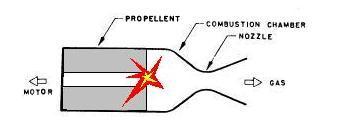
When the Europeans learned about rockets in the 19th century, they were quick to apply ther knowledge of chemistry to rocket design. The Europeans devised fuels more effective than gunpowder. Also, Europeans developed more efficent nozzles to channel the gases of the rocket. The most notable of these is the DeLaval nozzle, which is used in every rocket engine in use today. Gustav DeLaval was a Swedish engineer of French descent. He invented his nozzle design while he was working on steam engines. One of his designs for a steam turbine used jets of hot steam to turn itself. The faster the jets, the faster the turbine would spin, and the more power it would produce. Delaval found that the most effective way to get a high speed jet was with a nozzle that alternately converged and diverged:

The key to the DeLaval nozzle was this: as the nozzle narrowed, the jet's speed would increase. By carefully constructing the nozzle, the jet could be made to go supersonic just as it reached the nozzle throat. Now traveling faster than sound, the jet would move into the divergent section of the nozzle. Because the jet was supersonic, its speed would increase again as the nozzle diverged. However, if the jet was not supersonic by the time the nozzle began to diverge, its speed would decrease and the rocket would lose its thrust. Additionally, if the jet passed the sound barrier before reaching the throat, the narrowing walls would force it to slow down. Obviously DeLaval nozzles needed to be constructed exactly for their best performance.
In 1915, a yound man named Robert Goddard from Worcester MA, began experimenting with rockets. One of the problem that he found with the rockets of the time was that they were not very efficent. Only 2% of the energy released was used to accelerate the exhaust. Since a faster exhaust means more power, Goddard looked for effective ways to channel the exhaust. After reading about DeLaval's work, Goddard made one of the nozzles for a rocket he was building. When he tested it, the rocket had an efficency of 63%. This is far more efficent than any other engine. Steam engines can get up to 21%, and Diesels can reach 40%. Goddard realized that with such high efficentcies, rockets would be instrumental in probing the high atmostshpere and beyond. Goddard was able to get a grant from the Smithsonain to pursue this line of research. Unfortunately, America's entry into the First World War meant that Goddard would have to put his work on hold for awhile in the face of more pressing war problems.
After the war, Goddard returned to his rockets. He continued to experiment with various solid fuels for his rockets, but in 1922 he started designing a liquid-fueled rocket. Liquid-fueled rockets differed from solids in many ways, and posed serious technical challenges. Just by looking at a diagram of a liquid-fueled engine you can see how complex it is:

Looking more closely, you can see the parts of a rocket that we are familiar with: the combustion chamber and the nozzle. Up at the top of the diagram are the tanks which hold the fuel and the oxidizer. Everything else on the diagram is simply there to move the fuel and the oxidizer from their tanks to the combustion chamber. The oxidizer provides the oxygen for burning the fuel. In solid-fueled rockets the oxidizer is mixed in with the fuel. Liquid-fueled rockets, however, have to keep the fuel and oxidizer seperate. Some different types of oxidizers are liquid oxygen and hydrogen peroxide. Liquid-fueled rockets have several advantages over solids. They can vary the amount of thrust, they are reusable, and they can be restarted once they are shut off. Solids, on the other hand, burn completely and at a constant rate once they are lit.
Constructing liquid-fueled rockets is not an easy task. They burn at much higher temperatures than solids, and they require precision machines to keep them operating. It took Goddard four years to build his first flyable rocket. He tested it in March of 1926. For the first twenty-seconds of the test, the rocket sat on the ground, burning off fuel, until it became light enough and took-off to an altitude of 41 feet. It then promptly leveled off and flew into a neighbor's cabbage patch. In total, the rocket had been in the air for only 2.5 seconds. While unimpressive by today's standards, Goddard's test is considered the "Kitty Hawk" of rocketry.
In the years following Goddard's flight, rocketry evolved rapidly. Several designs were studied that moved away from chemical fuel entirely. Engineers looked at everything from ion engines to pulsed-nuclear propulsion. Throughout all of this, chemical rockets continued to get bigger and more powerful. Their development culminated in the first flight of the Saturn V in 1967. The Saturn V generated a million and a half times more thrust than Goddard's first rocket. It could send two Space Shuttle flights worth of payload to the Moon. Unfortunately, when the Apollo Program was canceled in 1972, the Saturn V was retired. No other rocket in operation today can match the performance of the Saturn V.


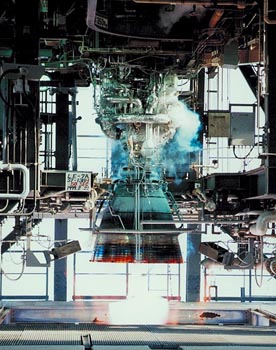
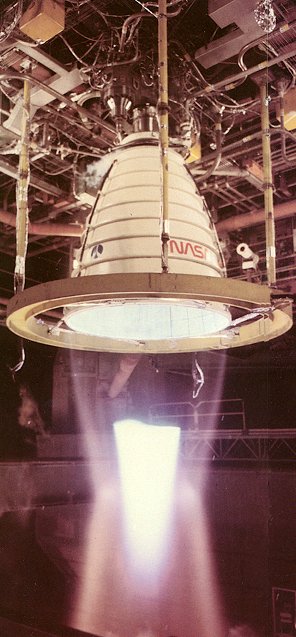
J-2X
A new variant of this engine, called the J-2X, is being designed to support
the upcoming Project Constellation and its Apollo-based Orion Spacecraft,
which will replace the Space Shuttle upon its retirement in 2010. Originally
the plan called for two J-2X engines to be used as the powerplant only for
the Earth Departure Stage (EDS). One J-2X engine will generate 294,000 lbf
for the EDS.
With the expense of converting the SSME from a ground-started engine to an
air-startable engine, along with the expense of constructing and pre-firing
new SSMEs for each mission, NASA decided to also adopt the J-2X engine for
the second stage of the Ares I. This decision, made on February 18, 2006,
would allow NASA to be able to launch the Ares I rocket within 3 years after
the retirement of the Shuttle in 2010 and allow the launching of the Orion
spacecraft by 2014. In addition, the use of the J-2X on both rockets will
allow NASA to simplify Orion support construction. NASA began construction
of a new test stand for altitude testing of J-2X engines at Stennis Space
Center (SSC) on 23 August 2007.[3] Between December 2007 and May 2008, nine
tests of heritage J-2 engine components were conducted at SSC in preparation
for the design of the J-2X engine. [4]
The new J-2X will be designed to be more efficient and simpler to build than
its Apollo J-2 ancestor, and cost less than the SSME. It will use a gas
generator power cycle.
On July 16, 2007 NASA officially awarded Pratt and Whitney Rocketdyne, Inc.
a $1.2 billion dollar contract "for design, development, testing and
evaluation of the J-2X engine that will power the upper stages of the Ares I
and Ares V launch vehicles."[6] On Sept. 8, 2008 Rocketdyne announced
successful testing of a gas generator like those which will be used for J-2X
engines.[7] The first hot-fire test of a J-2X is scheduled to take place in
2010 at SSC.


La propulsion chimique


C'est le système de propulsion actuellement utilisé en majorité : en effet,
c’est le seul système assez développé pour échapper à la gravité terrestre.
La poussée est produite par la réaction entre un carburant et un comburant,
appelés ergols. Cette réaction produit un gaz sous très haute pression, qui
est expulsé par l’intermédiaire d’une tuyère, pour produire la force de
poussée et propulser le vaisseau (La forme de la tuyère est un élément clé
pour la performance du système).
Le principal inconvénient de ce système est le fait qu'il nécessite une
réserve très importante de carburant, car malgré la forte poussée produite,le
rendement est assez faible (beaucoup de carburant consommé pour une poussée
relativement faible). De plus, dans le cas d’une propulsion dans l’espace,
le comburant et le carburant doivent être emportés, puisque l’air (le
comburant utilisé sur Terre) n’est pas présent dans l’espace. Bien que les
ingénieurs en astronautique aient acquis une certaine maîtrise du domaine
lors de la couse à l’espace, le moteur en lui-même reste assez difficile à
réaliser, à cause des contraintes physiques énormes que subissent les
composants (par exemple, la tuyère doit résister à des températures
atteignant 3300°C) ainsi que de l’extrême complexité du système
d’alimentation en carburant (pour que la propulsion soit efficace, le
carburant doit être pressurisé avant d’être injecté dans la chambre de
combustion).


Le premier réacteur
Le moteur fusée est le premier réacteur mis au point. Il semble avoir été
utilisé par les armées chinoises pendant le premier millénaire, son
apparition en europe est beaucoup plus tardive. Ce type de propulseur est
aujourd'hui utilisé essentiellement sur les lanceurs de statellites et les
missiles.
Une fusée utilise un mélange chimique appelé propergol, le propergol brûle
sans utiliser l'oxygène de l'air et produit une grande quantité de gaz
chauds utilisés pour la propulsion. Il existe principalement deux types de
fusée, les fusée à propergol liquide et les fusées à propergol solide. Les
premières sont essentiellement destinées aux engins de petites tailles et
aux accélérateurs de véhicules spatiaux ( boosters ) alors que les secondes
sont utilisées sur des engins plus imposants.
Fonctionnement de la fusée à propergol
solide
La fusée se présente comme un conteneur creux contenant une certaine
quantité de propergol sous forme solide ou pulvérulente ( poudre )
assimilable à un explosif. Ce propergol est brûlé dans une tuyère, une
grande quantité de gaz chauds qui sont éjectés avec force vers l'arrière de
la fusée entraînant sa propulsion vers l'avant.

Très fiable, ne posant pas de problème de stockage et de
mise en oeuvre, ce type de fusée est très utilisé sur les petits engins. De
très nombreux types de propergol sont employés depuis la poudre noire
jusqu'au mélange perchlorate d'ammonium / aluminium des boosters la navette
spatiale ou d'Ariane 5 en passant par les poudres nitrocellulosqiues
fabriquées à partir de coton...
Les fusées de feux d'artifices fonctionnent également selon ce principe.
Fonctionnement de la fusée à propergol
liquide
Ce type de moteur utilise non pas un propergol simple mais un comburant et
un carburant distincts et stockés indépendamment dans deux réservoirs. Le
comburant peut par exemple être du dioxygène liquide, le carburant du
dihydrogène liquide. Les comburants et carburants sont aspirés par des
pompes à haute pression et injectés dans une chambre de combustion où ils
sont brûlés. ils produisent ainsi une grande quantité de gaz chauds éjectés
par la tuyère.

La proximité d'un comburant et d'un carburant présente de
très grands risques d'explosion, l'accident le plus fréquent sur ce type de
moteur est la rupture des réservoirs entraînant rapidement une explosion (
c'est ce qui a causé l'accident de la navette spatiale Challenger en 1987 ).
En général, les réservoirs sont remplis quelques heures avant le lancement
de manière à limiter les risques. Les fumerolles que l'on peut observer à
cette occasion sont dues aux très basses températures des ergols (-253°C
pour l'hydrogène liquide et -183°C pour l'oxygène liquide ). Les
performances des propulseurs à propergols liquides sont très bonnes mais
demandent de très lourdes infrastructures compatibles avec la gamme des
température atteintes.


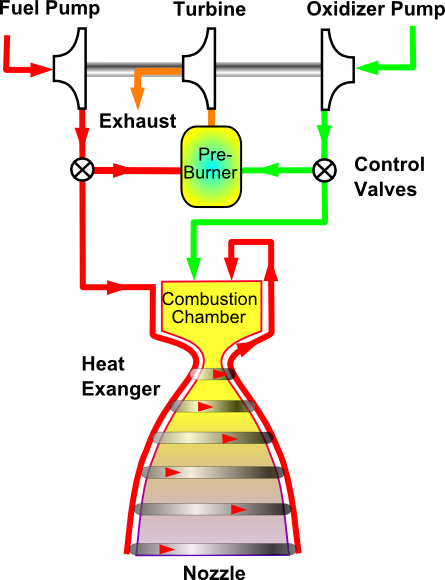




Typical liquid propellant rocket motor (Hill and Peterson, 1992).


A hydrogen-oxygen rocket engine




Hiçbir yazý/ resim izinsiz olarak kullanýlamaz!! Telif haklarý uyarýnca bu bir suçtur..! Tüm haklarý Çetin BAL' a aittir. Kaynak gösterilmek þartýyla siteden alýntý yapýlabilir.
© 1998 Cetin BAL - GSM:+90 05366063183 -Turkiye/Denizli
Ana Sayfa / Index / Roket bilimi / E-Mail / Rölativite Dosyasý
Time Travel Technology / UFO Galerisi / UFO Technology/
Kuantum Teleportation / Kuantum Fizigi / Uçaklar(Aeroplane)
New World Order(Macro Philosophy) / Astronomy