Einstein's Antigravity
by Tim Ventura
January 1st, 2005
with revision by John Dering
Part 1. Nick Cook’s
Mysterious Discovery
During the course of researching his best-selling book, “The
Hunt for Zero Point”, Nick Cook stumbled upon World War II
era evidence for a secret Nazi Weapon that came to be known as the “Nazi
Bell” device. This device was constructed by a scientific team reporting to
SS General Hans Kammler under a veil of secrecy even deeper than that of the
Nazi nuclear research.
|
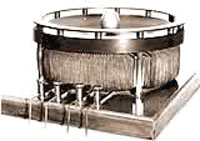
Nazi-Bell: Closeup of a test-platform at the secret Wenceslas Mine facility in Poland. |
While Cook’s research yielded little information about the specific design or application of the Nazi Bell device, his sources indicated that it apparently was able create a variety of startling effects on nearby objects.
It has been speculated that the Bell device
was designed to use high-speed counter-rotating components filled with
specialized materials and energized by electromagnetic energy to induce
“torsion” effects and thus control gravity and other significant effects.
John Dering, a physicist specializing advanced directed energy, nonlinear
electrodynamics and new energy sources has further reported on a “Rhine
Valley” facility and device.
He believes this to have been an actual wartime prototype deployment of a successor to the Nazi Bell experiments, which were carried out in the Wenceslas Mine research lab in occupied Poland.
While the Bell experiment was focused on
developing a radical new propulsion technology, the little-known Rhine
Valley experiment may have been a last-ditch attempt to weaponize the Bell’s
dangerous side effect for use against Allied forces.
|
Nick Cook: Janes Defense Weekly Aviation Editor & investigative author |
Dering speculates that the German WW-II research was intended to create a powerful propulsion effect by engineering application of Einstein’s Unified Field Theory (UFT) equations. Within the 1929 version of the Einstein UFT equations a linkage is found between the “vector magnetic potential” and Torsion. Put simply, in the Unified Field Theory the effects of curved space-time (resulting from a massive body, like the earth) can locally offset by creating Torsion.
Thus electromagnetic interactions are harnessed to induce torsion, which in turn can then null out gravitation.
This astounding possibility for gravity control is not predicted in either
the special or general relativity theories and appears only in the
Unified Field equations. Thus, a sort of counteraction to gravity
or “antigravity” field would be the result.
The heavy-duty concrete construction of the
test-rig at the Wenceslas Mine, complete with heavy steel mounting-rings,
bears witness to the massive scale of the forces that the research produced.
While the full purpose and results of neither experiment is completely known,
it is obvious that Nazi Bell possessed a great deal of value in terms
of secret-weapons – with a range of choices at his disposal at the end of
World War II, Hans Kammler considered only the Nazi Bell experiment as being
valuable enough to save Germany from the encroaching Allied & Russian forces.
The Bell project [whatever its full purpose]
was the only research program in Nazi Germany to carry the designation “War
Decisive”. Not even the German atomic bomb or rocket programs were
considered of such importance!
Historically speaking, the German’s motive for developing the Nazi Bell
device seems apparent. Hitler’s Third Reich had an almost borderline
obsession with secret “wunder” and “uber-weapons” that they felt would give
them an advantage against the Allies.
The wild success of the V-2 rocket program had
emboldened them to undertake the development of even more esoteric weapons
projects – such as the world’s first jet fighter, the ME-262, and a series
of jet-powered Coanda-Effect UFO prototypes (radical disk shaped VTOL
aircraft designs that proved ultimately unsuccessful). The most notable of
these was a design by Andreas Epp, which became an inspiration for the later
AvroCar experiments of the 1950’s.
|
Coanda Effect: A prototype flying disk design by Andreas Epp. |
Neither the ME-262 nor the
Coanda Effect
disk devices were ready in time for use against
the Allies, but nonetheless received the backing of the Third Reich, which
supplied them with trained scientists, materials and research funding, and a
nearly endless supply of slave-labor with which to build the projects.
It’s not known where the true inspiration for the Nazi Bell device &
prior Rhine-Valley experiments originated, but its possible to speculate
that they were trying to leap to a completely electromagnetic propulsion
system after realizing the limited potential in controllability and speed
from their experimentation with the Coanda-Effect saucer technology.
Perhaps some of the more forward-thinking physicists had the ear of Hans Kammler, and suggested to him that the time was right to evolve to a technology so far ahead of aerodynamic propulsion of the day that it would give Germany absolute
|
Hans Kammler: A rare photo of the SS General behind the Bell project. |
supremacy in the air.
Darker possibilities exist, given that the
Bell Device researchers appeared very interested in the dangerous and
lethal side effects created by exposure to the Bell force field.
Assuming that the Nazi’s had decided on a nearly fictional approach to
directly interacting with gravity through electromagnetism, the next logical
step that they would have taken is to find a scientific basis to work from.
As scientists, Kammler’s team would have
quickly realized that this scientific support wouldn’t have come from either
Relativity Theory or Quantum Mechanics, but they wouldn’t have had to search
very far, as the Germans had already reviewed just such a theory to unify
Electromagnetism and Gravitational Forces …
On June 14th, 1928, a paper was published in German that would
have certainly attracted the attention of anyone looking for a quick and
easy way to convert from electricity to gravitational force. The English
translation of the title is:
“New possibility for a Unified Field Theory of Gravitation and Electricity”, and it contains the beginnings of what later became known as Torsion Theory.
Despite the Nazi dislike for Jewish science and
culture, this paper was written by a physicist too renowned to be ignored –
quite possibly the world’s greatest physicist, Albert Einstein!
Starting in the early 1920’s Einstein and others began to speculate that
general relativity, which describes gravitation and space-time, could be
modified to include the laws of Maxwell that describe electromagnetism. In
essence Einstein sought to show that the laws of electricity and magnetism
could be “unified” with the laws of gravitation. In other words such a
theory would imply that all electrical and magnetic effects and all gravity
effects are manifestations of an underlying “unified field”.
By the late 1920’s Einstein’s papers on
Unified Field theory began to be read by physicists interested in
exploring experimental verification of his theories.
John Dering has suggested that in addition to a general familiarity with
Einstein’s Unified Field Theory from written publications, the Nazi’s
may have in fact had “inside information” on the subject. Supposedly,
Gerlach had discussed the foundations of this new Unified Field Theory
at length with Einstein while the theory was being formulated, and had also
collaborated with Einstein during the 1920’s on a search for experimental
verification.
As history tells us, Gerlach was later appointed to the position of “plenipotentiary” for Nazi Fission Research in 1944 by the Reich Research Council – giving him top-level scientific connections throughout Germany’s cutting-edge research programs.
Nick Cook has also highlighted Gerlach’s
connection to the Nazi-Bell project through the testimony of defense
journalist Igor Witkowski, who claims to have been shown documents
identifying Gerlach’s involvement in the project.
Thus, with the driving goal of building an electromagnetically powered UFO
to replace the less than spectacular performance of the Coanda-Effect
flying disks, Kammler’s scientific team would have already been familiar
with Einstein’s work in gravity, and would have had a real basis from the
published UFT tensor equations to begin rapid experimentation with a new
technology for 1940’s era Antigravity!
Part II. The
Philadelphia Experiment
The Nazi’s weren’t the only people interested in utilizing high-power
electromagnetic fields in the development of secret weapons during World War
II. The Allies were also busy in the development of a number of secret
projects, including the well-known Manhattan Project that led to the
development of the atomic bomb, as well as Von Neumann’s work leading to
computer code-breaking for Axis code-encrypted communications.
The mythology gets pretty deep here, as it suggests that Von Neumann was
also involved in setting up another project – the ill-fated “Project
Rainbow” or “Mirage”, which came to be known later as “The
Philadelphia Experiment”.
|
USS Eldridge: Was the DE-173 part of an accidental teleportation & invisibility project? |
The real story behind the Philadelphia Experiment may never be known, and the primary sources of information about it come primarily from a merchant Marine sailor named Carl Allen (a.k.a. Carlos Allende), as well as an anonymous source known only under the pseudonym ‘Dr. Franklin Reno’.
Author William Moore interviewed both Reno and
Allende during research for his book “The Philadelphia Experiment”—while
both men offer different perspectives on the experiment, they agree in
principle of a variety of key points.
The original story about the Philadelphia Experiment surfaced in the form of
three letters from Carlos Allende (later known to be Carl Allen), sent to a
Dr. Morris K. Jessup after the 1955 publication of Jessup’s book entitled, “The
Case for the UFO”.
The rambling, often incoherent writing in the letters described an experiment with the purported goal of making a ship invisible to radar – but in Allende’s words, the ship suffered a mysterious accident, rendering it temporarily invisible but having horrible biological side effects on the ship’s crew.
Carlos Allende claimed to have seen this
experiment from his post on a nearby observational Liberty ship, “The S.S.
Furuseth”, positioned in Philadelphia Harbor.
Dr. Franklin Reno, who apparently had been in hiding for several years when
Moore finally interviewed him, claimed that his role had been as an
assistant to a Dr. Albrecht and ostensibly also to Dr. Von Neumann on some
of the mathematical calculations required to vet the physics for government
buyoff on the project.
Reno described to Moore performing calculations
for a 10% deflection in light, and also mentions working to some degree with
Einstein’s Unified Field Theory, which reinforces the idea that the
Philadelphia Experiment was performed with the intent of making the USS
Eldridge invisible to both radar and visible light. In effect, Reno
described a real-life “Mirage Effect” nearly identical to the fictional
invisibility device later portrayed in the 1987 science-fiction movie “Predator”.
One of the real problems with regard to the Philadelphia Experiment story
has been the amount of mythology surrounding it. In many ways, it
serves as a modern-day extension of the many “ghost ship” tales such as the
story of the Flying Dutchman from earlier eras.
Different retellings of the Philadelphia
Experiment tale always seem to contain a unique twist – in some stories,
the experiment was meant only to produce radar-invisibility to provide the
Navy with a means of avoiding enemy radar while traveling in convoys.
Radar was still a very new and emerging technology in 1943, and one of the
chief complaints about the ‘radar-invisibility’ explanation for the
Philadelphia Experiment is quite simply that German radar had not yet
become a major problem for the Allies. However, another retelling of the
story offers an interesting twist to this “cloaking device” theory,
in the form of making the Eldridge literally invisible to the naked eye.
This alternative claim is that German battleships used very precise
optical sights on the top of tall masts for “over the horizon” range finding,
and that by creating a mirage effect around the hull of the Allied ships, it
would limit the German’s ability to accurately gauge the distance and
elevation for their battleship cannons.
This “mirage effect” has been supposed to come from different possible sources – one idea is that it was accidentally discovered as a by-product of high-frequency resonant coil devices found by Tesla during earlier research.
|
Albert Einstein: Worked for the Navy during WWII. |
Another possibility is that Einstein himself invented the “mirage effect” in
1943, during a consultancy period in which he worked for the US Department
of the Navy by the appointment of Dr. Vannevar Bush. Einstein’s FBI file
places him in the right place at the right time – working for the Navy’s
Bureau of Ordinance on what was officially described as “a device to explode
a torpedo under a ship”.
This has been presumed to suggest that Einstein
at least participated in the Philadelphia Experiment, as his skills would
have otherwise been far more valuable to something like the Manhattan
Project than a simple exercise in mechanical engineering.
The exact goals of the Philadelphia Experiment aren’t known, and could even
have been as mundane as finding a way for the Allies to create EM
interference with torpedoes and mines of the day – however, what is
known about the experiment is that the results were far from what were
anticipated.
By cross-correlating stories from a number of sources, we can ascertain that
the core-theme of these tales revolves around
|
Invisibility: Reports claim that only a ship-sized hole in the water remained. |
the USS Eldridge disappearing at port in Philadelphia Harbor in a fog of “green mist”. Supposedly, the ship faded from view, until the entire ship itself was eventually invisible – leaving in its place only a ship-sized hole in the water to indicate that it was still present.
A neat trick, to be sure, but the side effects tell the more interesting story…
In addition to bending light around itself, the USS Eldridge seems to have
experienced a number of intense anomalistic effects, including teleportation
and/or time-displacement.
It’s difficult to confirm most of these, but
they include men melting into the decks of the ship, and a rumor persists
that in addition to causing insanity in many of the crewmen, the crew also
carried residual field-effects within themselves: a brawl was reported the
night after the test had been conducted with a report that two of the crew
members had literally vanished into thin air in front of a waitress.
The reported side-effects of the
Philadelphia Experiment were are too diverse to completely
describe in this overview, and its difficult to tell which effects really
occurred and which are the product of wishful thinking.
As it turns out, the world would be forced to wait nearly 40 years for any kind of validation about the Philadelphia Experiment …
Part III. An
Accidental Replication?
The connection between the Nazi Bell & Rhine Valley experiments and the
Allied Philadelphia Experiment of World War II may quite possibly come from
a very unexpected source – a Canadian inventor by the name of John
Hutchison.
Hutchison is a rather unique character – he collects and tinkers with a
variety of electronic gadgets at a small apartment that he’s converted into
a laboratory in Vancouver, BC. In addition to a collection of Tesla Coils
and Van De Graaf generators, he
|
John Hutchison: The Canadian inventor who discovered the H-Effect. |
also has several RF-amplifiers and an assortment of surplus Naval electronics equipment that he’s purchased from auctions at the nearby shipyards.
What makes Hutchison unique is that he has an
eye for putting things together, and has been able to produce some rather
spectacular effects simply through adjusting his equipment correctly.
Hutchison seems to be the middle ground between the Antigravity effects
reported from the Nazi Bell experiments and the melting-materials effects of
the Philadelphia experiment. His experimentation with high-voltage
and high-frequency apparatus has produced effects ranging from antigravity
and levitation in a variety of materials, to the melting and jellification
of materials – including substances melting into each other at room
temperature.
The effects range in scope and scale quite profoundly – in some occurrences
the levitation only lifts a few grams, while in
|
Levitation: The H-Effect can levitate objects up to several hundred pounds. |
another instance a several hundred pound cannon
ball was captured on tape hovering in mid-air.
Hutchison has collected an abundance of evidence to support his research –
including hours of video and reels of film, as well as deformed samples of
metals subjected to room-temperature melting and jellification, and enough
other supporting evidence to convince even the most jaded skeptic that these
effects do indeed occur as they’ve been described.
Hutchison has further backed his story by allowing independent scientific
teams to examine these effects as they happen – including at one point a 6-month
study conducted by a CIA research time financed by Col. John Alexander,
which supported the veracity of his unusual experiments, but were unable to
explain the basis for the Hutchison Effect.
Hutchison himself does not work in a theory-based environment – his research,
for whatever the reason, evolved in a hands-on setting, which means that he
understands how to establish the environment that creates the effects that
he’s achieved, but these effects are nonetheless largely random and
difficult to predict.
Hutchison spends most of his time tinkering, and
the biggest challenge remains a fundamental understanding of why and how
he’s able to do what he does.
The scope and complexity of John Hutchison’s work is vast enough that
a number of researchers have speculated on its application to a variety of
alternative-
|
Anomalies: This steel ingot was crushed into powder from the H-Effect. |
science concepts and disciplines. In this
particular case, however, it is the correlation of the effects and side
effects of the Hutchison Effect with the Nazi Bell experiments
and the Philadelphia Experiment that is of the greatest interest.
Hutchison’s work, which has been well recorded and extensively documented,
seems to provide validation for both of these World War II era experiments,
despite their inherent lack of validating evidence.
Hutchison’s work seems more closely related to the Philadelphia Experiment
in practice than it does to the Nazi Bell experiments – after all, both the
H-Effect and Philadelphia experiment seem to have utilized
high-power Tesla equipment, such as resonant coils and rotating fields.
Neither of those experiments seems to have
utilized mechanical rotation to any degree, whereas the Nazi Bell
seems to have been designed specifically to enhance these effects.
There’s a final factor that makes Hutchison’s work especially notable:
his experiments don’t produce negative biological side effects. This
may be the result of the higher-frequencies that Hutchison uses
experimentally – the H-Effect occurs between 10 to 20 megahertz, instead of
working in the kilohertz range like the Bell Device, or the 10 – 125
Hz range that Corum suggested for the Philadelphia Experiment.
Do the higher-frequencies make his device more
efficient, or simply put the field-effects out of the range that damages
living organisms?
Part IV. John Dering’s
Speculation on the Nazi Bell
One of the lessons that the World War II era experimentation with
Einstein’s Unified Field Theory teaches us is that these forces can be
hazardous or downright dangerous if a careless or hasty approach is taken in
developing them.
The crew of the USS Eldridge appears to be
representative of the biological hazards that have become apparent, and it
has been claimed that experimentation with the Nazi Bell also caused
human casualties.
Risks and hazards aren’t new to the process of scientific discovery - many
new technologies carry with them dangerous risks if not handled with care,
and over the last few years several private organizations and individual
researchers have begun a cautious exploration of these effects with an eye
to developing a better understanding of how to harness this technology while
minimizing potential health concerns.
John Dering is one of the primary advocates of renewed support in
experimentation with Einstein’s Unified Field Theory and several
other related approaches to Antigravity and new-propulsion concepts. Dering
works at SARA Inc, a California aerospace & defense contractor
involved with a variety of development projects based on breakthrough
innovations in technology.
Dering is the first to acknowledge that this approach to technology carries
risks – he’s commonly used the phrase “when you pull the cat’s tail you get
the whole cat”, by which he means that since the Unified Field Theory taps
into multiple forces by warping the space-time manifold, tampering with a
single force such as gravity will undoubtedly have side-effects that show up
in unrelated forces as well.
Dering’s concern for the biological risks associated with UFT research is
echoed by Nick Cook’s description of the Nazi-Bell experiment,
“During the tests, the scientists placed various types of plants, animals, and animal tissues within the Bell’s sphere of influence. In the initial test period of November to December 1944, almost all of the samples were destroyed. A crystalline substance formed within the tissues, destroying them from the inside; liquids, including blood, gelled and separated into clearly distilled fractions.”
Cook further described the human cost associated with these experiments,
“People exposed to the program complained of ailments, in spite of their protective clothing. These ranged from sleep problems, loss of memory and balance, muscle spasms and a permanent and unpleasant metallic taste in the mouth.”
Are the reports of these negative side effects inherent to the Unified Field Theory itself, or do were they merely the result of a flaw in the Bell’s design?
Cook seems to suggest that the Germans had made considerable progress towards eliminating these side effects altogether through modifications made to the Bell during testing,
“In a second series of experiments that started in January 1945, the damage to test-subjects was reduced to around 12-15 percent following certain modifications to the equipment. This was reduced even further to two to three percent following a second set of refinements.”
One thing that has become apparent is that whatever side effects may occur are difficult to shield against – they seem to manifest in unexpected ways, and at low power levels they appear not as biological effects but instead as an RF-interference with measuring equipment.
Dering claims that as these experiments begin to
tap into the force of gravity they create a “back-EMF” effect, which he
explains as being gravitationally induced electromagnetic fields that are
impossible to shield against using current technology.
What is the magnitude of these back-EMF effects in an experimental
setting?
“The AG experiments I have done produced a complicated field,” writes Dering, “A torsion field induced by a rotating EM (electromagnetic) wave creates the curvature. The problem is that these fields are manifestations of the underlying unified fields that manifest as the five modes we call the fundamental forces.”
“To induce torsion and make curvature the system is driven at several RF (radio frequency) frequencies with the appropriate modulation—there are lots of time derivatives flying around. The result is that the time varying AG (antigravity) field back induces an EM field that attempts to react against the input pump wave… and that back EM is intense, too! And there are those bloody cross terms this component linked to that one… what a soup.”
We measured minor effects with the gravitational rotor test of the Unified Field relations - but it takes real power, at or above a critical intensity and field strength for at least a minimum amount of time (the nonlinear build up time constant) for powerful AG effects to manifest.
This may have to be done with very good control
on pump frequency bandwidth and phase. Minor weight reduction I have already
seen and done, we did that in 1993-94. It turns out we were probably
reproducing the same sort of experiments that Gerlach and others propped in
the late 1920’s early 1930’s. Even then it took a while before the threshold
dependence of this type of interaction was appreciated.
That in a nutshell is what went “wrong” with the US Navy tests. The small-scale
stuff showed a reduction in RCS due to an easily predicted linear
electrodynamics effect of a magnetically biased ferrite material. When they
scaled up to a ship class test and added the power to create the same field
intensity (for something as big as a DE class ship)… then they
unknowingly crossed a nonlinear threshold and “all hell broke loose”. It was
not obvious what had happened.
So have some people seen AG effects? Yes. Whey are these effects so
difficult to predictably reproduce? Because it requires meeting all of the
conditions I mentioned above. If you are at or just past threshold the
effect will drift in and out as the system drifts slightly through the right
amplitude, power, frequency and phase conditions. Just as nonlinear optical
effects driven by a laser right at threshold intensities will flicker as the
beam and media drift in and out of critical phase matching.
In Dering’s view, the key factor to making Antigravity a reality using the
Unified Field Theory comes down primarily to issues of scale &
intensity. The idea seems to involve crossing a minimum threshold for the
effects to begin occurring, which ties into the concept of these effects
being non-linear in scale.
In essence, at low-power nothing can be observed to happen – but as power is increased various effects begin to appear, beginning first with the unshieldable back-EM effects and progressing at higher-power levels to Antigravity and perhaps other effects.
“The Nazi Bell device consisted two of counter-rotating cylindrical containers. The containers, which were positioned one above the other measured approximately 1-meter diameter, and were filled with cryogenically cooled and frozen Mercury metal. There was a frozen core of a metallic paste, which served as a “high permeability material” for the EMG (electromagnetic-gravitational) field.”
In comparison to the Nazi-Bell design, Dering describes the Rhine Valley experiment as being considerably more straightforward,
“The other large device was mechanically more simple but more elegant in the applied physics and engineering. This was a static device that used a rotating RF wave [not rotating magnetic field but an actual rotating wave*].”
Conceptually, the description of rotation in
the Bell device connects with idea of torsion fields being used to
create a shear-effect on the time-space manifold surrounding the Bell. The
exact nature of this is poorly understood, but the crux of the idea involves
modifying the background properties of time and space in the local vicinity
of the device, which may serve to create a propulsive Antigravity Effect.
Additional speculation has surfaced that one of the primary reasons for the
hemispherical Bell shape in the Nazi design was to create a gravitational
reduction from a non-zero divergence of currents over a planar surface.
Support for this idea comes from the work of Dr. Pharis E. Williams, a
Professor at New Mexico Technical Institute, who has independently
created a Unified Field Theory based entirely on Thermodynamic
Principles that he calls the “Dynamic Theory”. Williams’ research
predicts that a diverging current may lead to a significant reduction in
gravitational force.
Part V. Corum Reverse-Engineers
the Philadelphia Experiment
While John Dering has speculated about torsion fields arising from
rotating RF-waves circulating through frozen Mercury in the Nazi Experiments,
another proposal for implementing Einstein’s Unified Field Theory has
been proposed by Dr. James Corum, a PhD in Electrical Engineering with
expertise in the historical work of Nikola Tesla.
Dr. Corum is a highly regarded engineer with a history includes work for the
National Security Agency (NSA), a faculty teaching position at Ohio
Institute of Technology, and a more recent position as the chief scientist
for the Institute for Scientific Research (ISR) in West Virginia. He’s a
prolific writer, and has authored over 100 papers on a variety of scientific
topics– including a complete a translation of 1929 Einstein’s Unified
Field Theory from German to English, where he first became aware of the
gravitational coupling that Einstein had predicted.
In 1994, Corum was a primary contributor to a 94-page treatise describing
just such an experiment, entitled, “Tesla’s Egg of Columbus, Radar Stealth,
the
|
Tesla’s Egg: Basis for the Mirage Effect experiment? |
Torsion Tensor, and the Philadelphia Experiment.”
As the title suggests, the focus of the paper
was on examining Tesla’s reported contribution to the 1943 experiment, in
the context of his earlier historical analysis of Tesla’s Egg – an
experiment demonstrated at the 1905 World’s Fair in which a copper-clad egg
is made to stand on end through inductive rotation in an AC magnetic field.
The paper itself is sold through Arcs ‘N Sparks – a Tesla historical
society that Corum participated in during the early 1990’s.
Their description of the paper’s contents is not complete, but does offer some insight into the paper’s content:
“By calculation, the magnetic field required to reduce a ship’s radar reflection to less than 1 percent at L-Band (1.5) GHz is in excess of 15,0000 A/m.
Fields of this magnitude would appear to fulfill the requirements of a “Philadelphia Experiment” by creating green mist and cavities in salt water as well as magnetophosphenes and Purkinje patterns in humans, particularly if driven at frequencies in the range of 10-125 Hz, as was available from synchronous generators on WW-II electric-drive ships.”
James Corum has described the paper as being the result of a light-hearted conversation speculating about whether Carlos Allende’s description of the Philadelphia Experiment could be accurate based on what was known about the experiment and the scientists contributing to its development.
The paper emerged as a challenge in reverse
engineering that includes both Einstein’s Unified Field Theory, as
well as a description of the hands-on development of large-scale degaussing
coils & rotating-waveform modified by Tesla to provide a massive, rotating
RF-field surrounding the ship.
While Corum acknowledges Franklin Reno’s statement that the Philadelphia
Experiment was attempting a 10% deflection of light to create a mirage
effect, he also addressed speculation about radar-invisibility component of
the experiment:
“During the war, the Germans had a radar-reduction program underway to reduce the radar-cross section of a ship based on the concept of impedance matching. It was known that magnetic biasing of an iron or steel medium can control the surface impendence, and the use of degaussing coils to achieve this is likely due to heavy experimentation with them during the war to reduce naval ship’s susceptibility to attack by magnetically detonated mines or torpedoes.”
|
James Corum: Reverse-Engineered the Experiment |
Corum elaborated on this, suggesting that
impedance matching by on the hull of the USS Eldridge could have been part
of an Allied attempt at a competitive impendence-matching “stealth” program
for avoiding German radar, and that the magnetic fields required to achieve
this would have been powerful enough to actually liberate chlorine gas from
surrounding salt-water, which would produce the “green mist” that
Carlos Allende describes.
Corum has taken the speculation even farther, however, suggesting that the “teleportation
effect” that many people have described during the Philadelphia
Experiment may have been similar in nature to later experimentation with
photon-gyroscopes.
In essence, the question becomes whether the
high-intensity, rotating magnetic fields could have in fact created a
profound “time effect” through rotating frames of reference that effect that
local space-time manifold.
Part VI. Gabriel Kron’s
Contribution
Dr. James Corum’s research into the Philadelphia Experiment found
evidence to connect Einstein’s Unified Field Theory with the experiment in a
very direct sense in the form of Gabriel Kron, an electrical engineer
who had written extensively on the kind of synchronous electrical machinery
in AC motors and magnetic field equipment.
Kron was born in Hungary in 1901, and immigrated
to the United States in 1921, where he was briefly enrolled at the
University of Michigan before dropping out to pursue a personal quest for
enlightenment.
Electrical Engineer Jack Casazza has provided an excellent history on
Kron’s life, which can be summarized in the following quote:
“He was thrown out of the University of Michigan because he was always fighting with the instructors, at something like sixteen. He decided to work his way around the world, and came to Hollywood. He was very brilliant. He had so many problems because his professors were a couple of light years behind him. He got back to Hollywood, signed a contract for $10,000 or so to work on his new experimental movie camera, and the company that gave him the contract paid him the money up front and went bankrupt.
So he had a year or two with no work to do. He came to New York City. In the public library he started to read books on mathematics and became the inventor of something called tensor analysis. It became quite important but then he worked for GE. He was unusual and was not easy to work with because he was ahead of his time. You have to mention him in the history of electrical engineering because he was a character....”
John Dering has also commented on Gabriel Kron, stating,
“Kron provides—if nothing else—the experimental verification of Einstein’s Unified Field. Kron shows that certain anomalies in synchronous machines can not be accounted for by any physical description except the Unified Field equations.”
It makes sense that both Dering and Corum support Kron’s research, as they had the opportunity to compare notes on this research while they worked together at SARA, Inc in 1997. Corum has since gone on to work as the Chief Scientist at the Institute of Scientific Research in Kentucky.
|
Gabriel Kron: Scientist and Electrical Engineer. |
What makes Kron’s work so valuable in analyzing the Philadelphia
Experiment is that Kron developed a method of tensor analysis for use in
practical electrical engineering – a method that could be rigorously applied
to electrical systems on a practical level that could be used by engineers.
In fact, Kron even went a step further – in the
analysis of complex synchronous electrical systems, he postulated that the
only method by which some of them could be explained was through the use of
Einstein’s Unified Field Theory, which suggests that the elements for
the Philadelphia Experiment and perhaps even
Nazi
Bell technology are lie dormant at some level in even common
household electrical equipment.
This connection between Kron’s work and Einstein’s Unified Field Theory
forms the basis for a real connection between the degaussing coils that
Tesla presumably modified for use on the USS Eldridge and the reported
mysterious effects that occurred during the experiment.
“The scientists on the Philadelphia Experiment would have also been familiar with Gabriel Kron’s work,” says Corum, “It had been around since the 1920’s, and had been taught in GE’s advanced engineering school, as it has a variety of applications to solving problems that occur across multiply-connected electrical systems, such as the North American power-grid.”
Through Kron’s work, Corum is able to describe vacuum-manifold manipulation of space-time, but more importantly, to provide some insight into how it can be engineered for future applications, including potentially Antigravity and space flight.
When reached for comment on whether Kron’s theories would be useful for engineering future Antigravity technologies, James Corum responded,
“Absolutely. Gabriel Kron was the first engineer to use geometric models to solve electromechanical problems.”
Part VII. The End of the
Beginning
Albert ‘s Theory of Relativity, published in 1915, is one of the most
famous ideas in the history of science, referenced in nearly every
scientific textbook ever published, even at the elementary school level.
Books, magazine articles, lectures, and
television shows have all been created to showcase this theory and explain
its application to the public. Why is it that the Theory of Relativity
receives all of the attention and Einstein’s later Unified Field Theory
receives almost none, despite Einstein contributing over 30 years to
developing it?
With the detonation of the world’s first atomic bomb at Alamogordo, Robert
Oppenheimer became “Death” – but Einstein became famous, because his theory
of relativity made the atom bomb possible.
The atom bomb was in turn an enormous validation for the Theory of Relativity, which had shown the unification of mass and energy.
Is this the reason why Einstein’s Unified Field Theory, which unifies electromagnetism and gravity, is still obscure?
Is it because there hasn’t been a grand experiment to confirm his work?
Or has there been?
Is it possible that in the Philadelphia Experiment was a successful confirmation of this theory in 1943, and the Nazi Bell validated these results even further in secret German testing in 1944?
Is it possible that the Hutchison Effect is an even further validation for Einstein’s work – containing documented experimental validation for claims from both the Allied and German research?
William Moore, writing in “The Philadelphia Experiment”, suggests that Einstein had ethical qualms about the initial release of the Unified Field Theory in the 1920’s – but later resurrected the idea for its application after he’d committed himself to the war effort of World War II.
While Einstein claimed in public that he never
felt comfortable that his Unified Field Theory was complete, modern
scientists such as John Dering have suggested that it was complete enough to
provide an engineering-level roadmap for manipulating gravity with
electromagnetic forces.
Dr. Pharis Williams has created the “Dynamic Theory” that seems to
derive the equations for both the Theory of Relativity and an experiment for
gravitational reduction that looks suspiciously similar to the Nazi-Rhine
Valley work – is this an independent confirmation that Einstein was on the
right track with his research, and was simply waiting for a more peaceful
age to make it public?
Einstein was a pacifist at heart, yet lived through two of the greatest wars
in the history of mankind – only to spend the remainder of his life in the
middle of the Cold War, where both sides were pursuing the ultimate
scientific and technological advantage to initiate a crippling “first
strike”.
The book has yet to be written on the real applications for Einstein’s
Unified Field Theory – it appears to have profound implications into
Antigravity and transportation technology, and may even open the door for
travel to other star-systems or even dimensions. While we may not live in
the peaceful age that Einstein may have envisioned, we do have pressing
needs with peaceful goals that this theory may be the key to solving, and
the ethical pursuit of his dream may lead us closer to the age of peace that
we all dream about.
Like all great stories, the tale of Einstein’s Unified Field Theory
and its connection to the Philadelphia Experiment and Nazi Bell &
Rhine-Valley experiments raises more questions than it answers – but it
also does something more.
It begins to give us the real glimmer of hope
that a solution for the key to transportation in the 21st century
may have been found by one of the greatest scientists in history… Albert
Einstein.
Part VIII. Afterward
The consensus opinion seems to be that while Einstein’s Unified Field
Theory isn’t a perfect tool for engineering Antigravity devices, it does
provide a good theoretical foundation to support future research & rapidly
develop new technologies.
While the WW-II era examples cited in this paper
are directly based on the application of Einstein’s UFT, the theory itself
is broad enough to potentially explain a number of anomalous physics results.
Dr. James Corum has indicated that Einstein’s post-1929 versions of the
theory contain the cross-linking information to support AG experimentation.
In addition to Einstein’s work, Corum has compiled a collection of related
theoretical work that he believes both supports and extends Einstein’s
vision – these documents may see the light of day in the near future, as
Corum is seeking publication for both his translation and the related
materials in book form.
John Dering is currently conducting experimentation based on the examples of
the Nazi Bell device, Rhine Valley experiments, and
Philadelphia Experiment. In addition to experimentation with the ideas
that he’s assembled, John has been working on computer-modeling applications
to better illustrate the relationships that occur in Unified Field Theory
physics. His hope is not only to provide definitive evidence to validate
Einstein’s vision, but also to work towards creating engineering tools for
the technology of tomorrow: Antigravity
Nick Cook has continued his research into the Nazi Bell device, and
continues to find new leads on the story that he plans to address in future
publications. Since the publication of “The Hunt for Zero Point” in
2001, he’s traveled to visit the Wenceslas-Mine again – this time to collect
test-samples for further experimentation, and to corroborate the vast amount
of evidence that he’s uncovered from other sources.
The material contained in this story is compelling enough that even during
the course of writing the story, several of the author’s colleagues have
become interested enough in the subject material that they are beginning
serious research on Kron & Einstein with an eye for understanding
gravitational phenomenon as part of a much larger schema in physics.
While Einstein’s dream of peace remains illusive on a global scale, the
spirit of international and scientific collaboration has generated
tremendous results for assembling the diverse knowledge on this subject to
facilitate future research.
It is hopeful that this spirit of friendly
cooperation remains true to Einstein’s vision, and leads to the perfection
of his final masterpiece in a real-world scientific breakthrough –
Einstein’s Antigravity.
Part IX. References
“The Hunt for Zero Point”, Nick Cook, Random House, 2002 http://www.randomhouse.co.uk/minisites/zeropoint/index.html
“The Philadelphia Experiment” William Moore & Charles Berlitz, 1979
“Tesla’s Egg of Columbus, Radar Stealth, the Torsion Tensor, and the Philadelphia Experiment,” by K. L. Corum, J. F. Corum, Ph.D., and J. F. X. Daum, Ph.D., 1994. 94 pp. Illustrated. http://www.arcsandsparks.com/teslapage.html
Einstein’s Unified Field Theory (Online Translation for 1920’s publication, English and German) http://www.lrz-muenchen.de/~aunzicker/ae1930.html
Biographical Information on Hans Kammler http://www.balsi.de/Sonstiges/Personen/K -/Kammler-Hans.htm
Nazi Coanda-Effect UFO & Flying Disk Experiments (Coanda & Epp only) http //www.laesieworks.com/ifo/lib/WW2/Omega.html
http //www.laesieworks.com/ifo/lib/WW2/HenriCoanda.htmlAvroCar Coanda UFO Design: http://www.virtuallystrange.net/ufo/mufonontario/avro/avrocar.html
Walther Gerlach & the Nazi Fission-Pile Research Program http://www-personal.umich.edu/~sanders/214/other/handouts/ChronGer.html
The Hutchison Effect: http://www.americanantigravity.com/hutchison.shtml
Pharis Williams (MIT) – Diverging currents creating gravitational reduction Dynamic Theory Overview: http://www.nmt.edu/~pharis/
Williams’ Current Divergence interaction with gravitational field (Chapter 8.5): http://www.nmt.edu/~pharis/Dynamic/Chapter8.pdf
Gabriel Kron Historical Information http://www.quantum-chemistry-history.com/Kron_Dat/KronGabriel1.htm
Jack Casazza’s Oral-History (IEEE Interview) http://www.ieee.org/organizations/history_center/oral_histories/transcripts/casazza.html
Part VIII. Acknowledgements
Special Thanks is due to John Dering, for the story idea and connecting the pieces for me, Nick Cook for the excellent research in “The Hunt For Zero Point”, James Corum for wonderful background info about the Philadelphia Experiment, Kron, etc, and Eric Davis for vetting this information for general accuracy.
Additional thanks goes out to Paul Murad, who inspired me to finally sit down and write this one up, and Richard Hoagland for inspired insight into this material and in-depth technical advice.
– Tim Ventura
[
Ana Sayfa (Home)
|
UFO Technology
|
UFO's
Galleri | Kuantum
Fiziği | Roket bilimi
|
[ Astronomy |
E-Mail
| Index
|