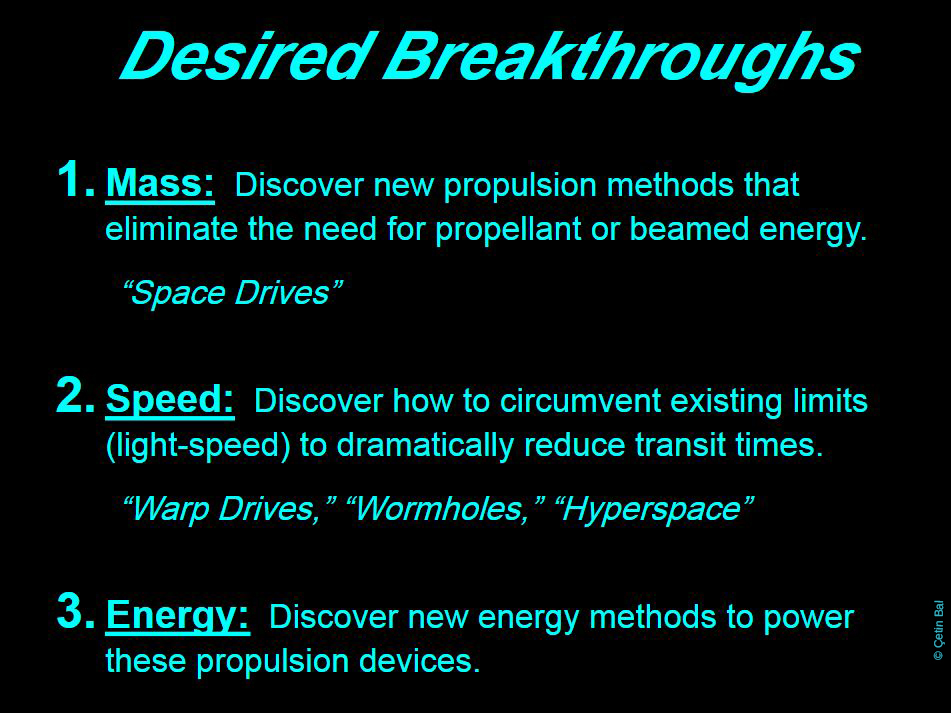
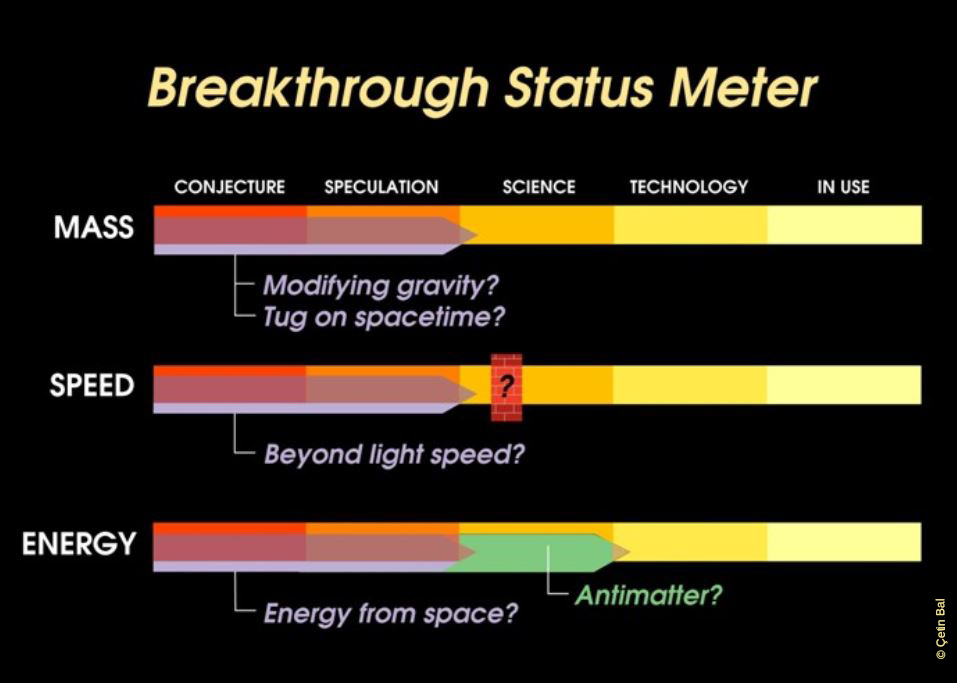
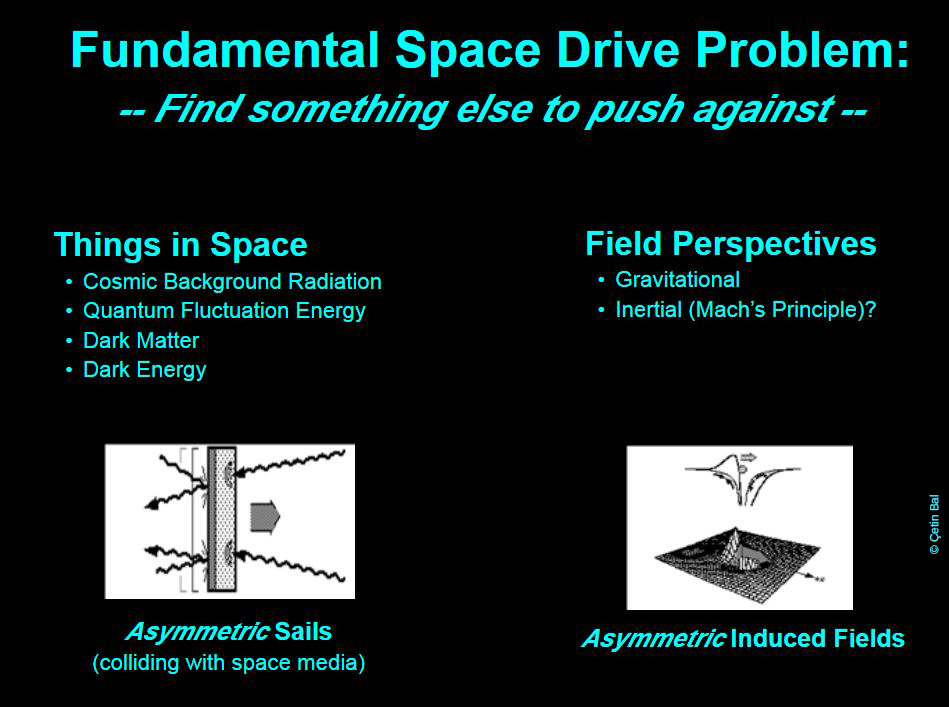
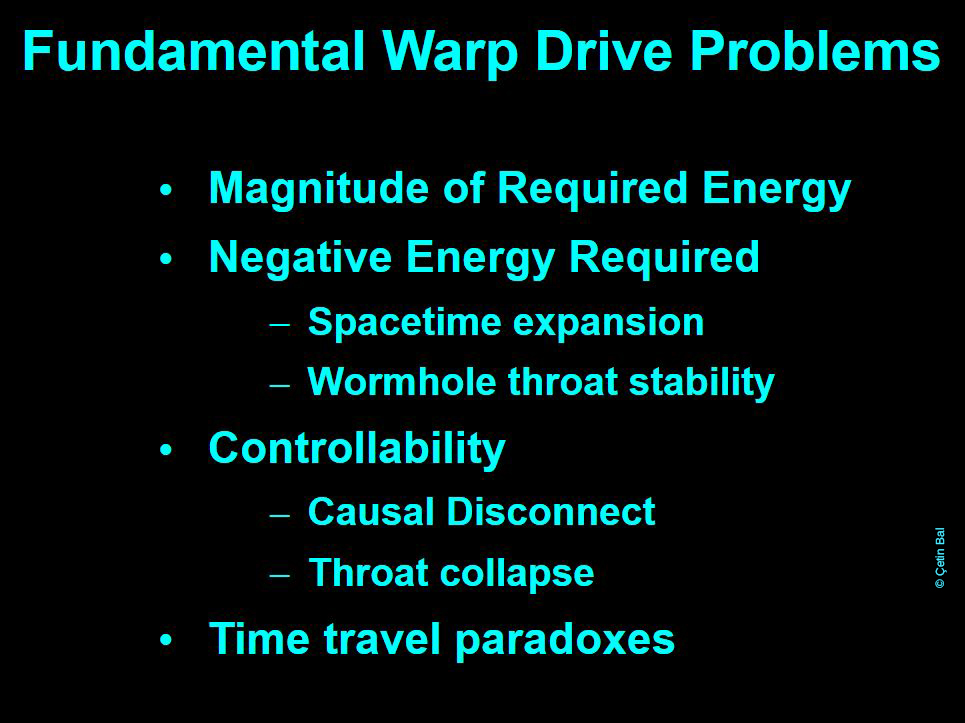
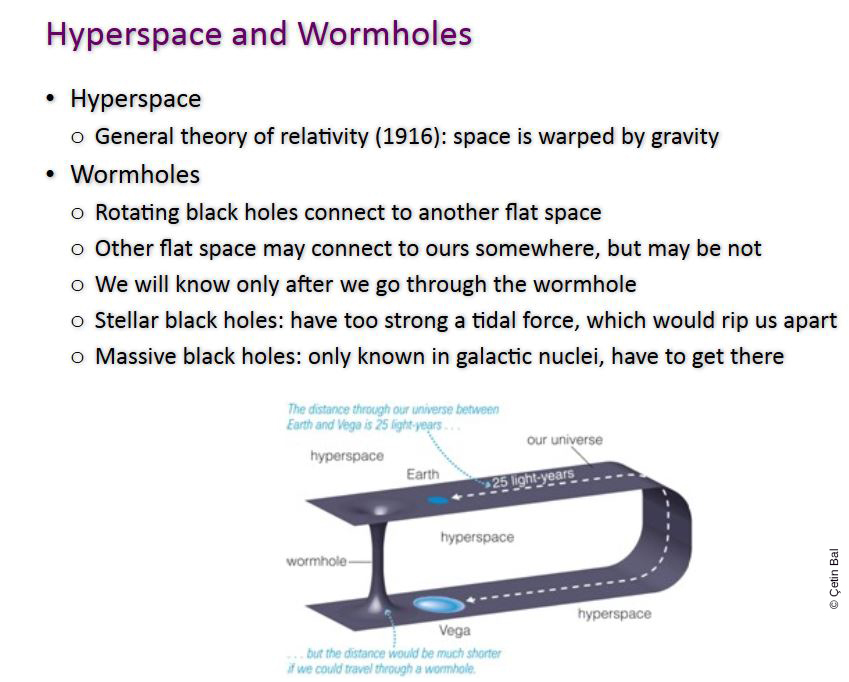
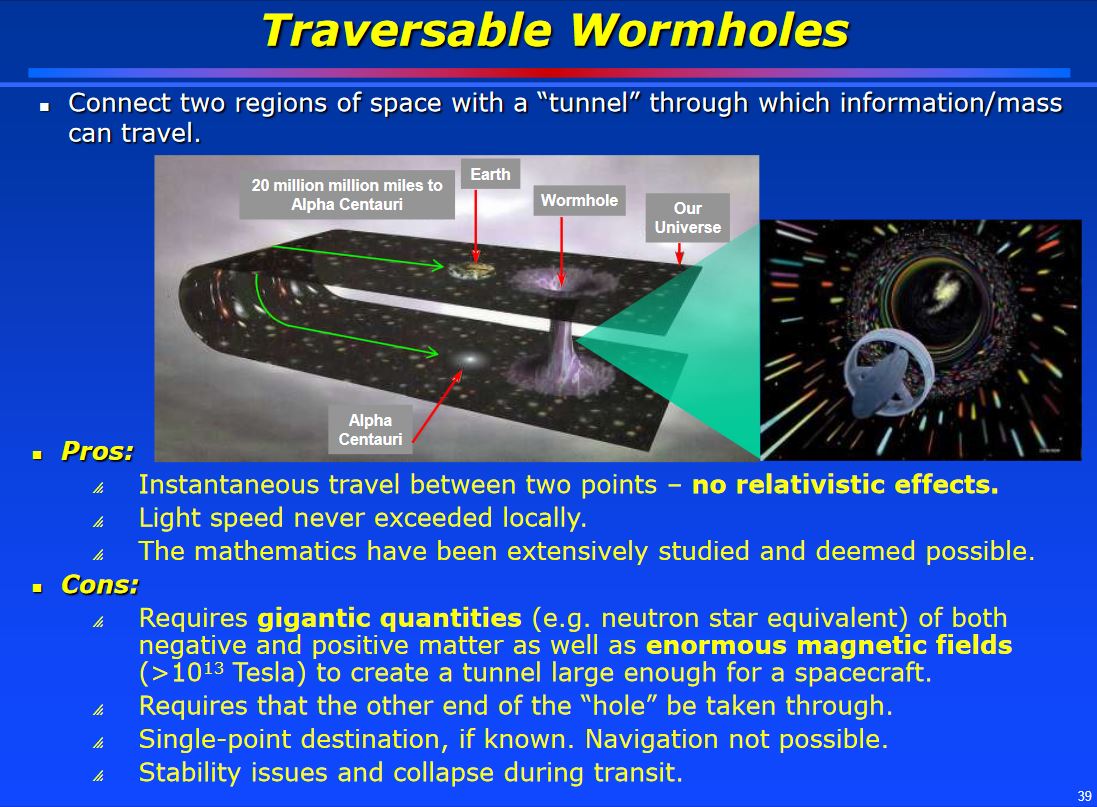
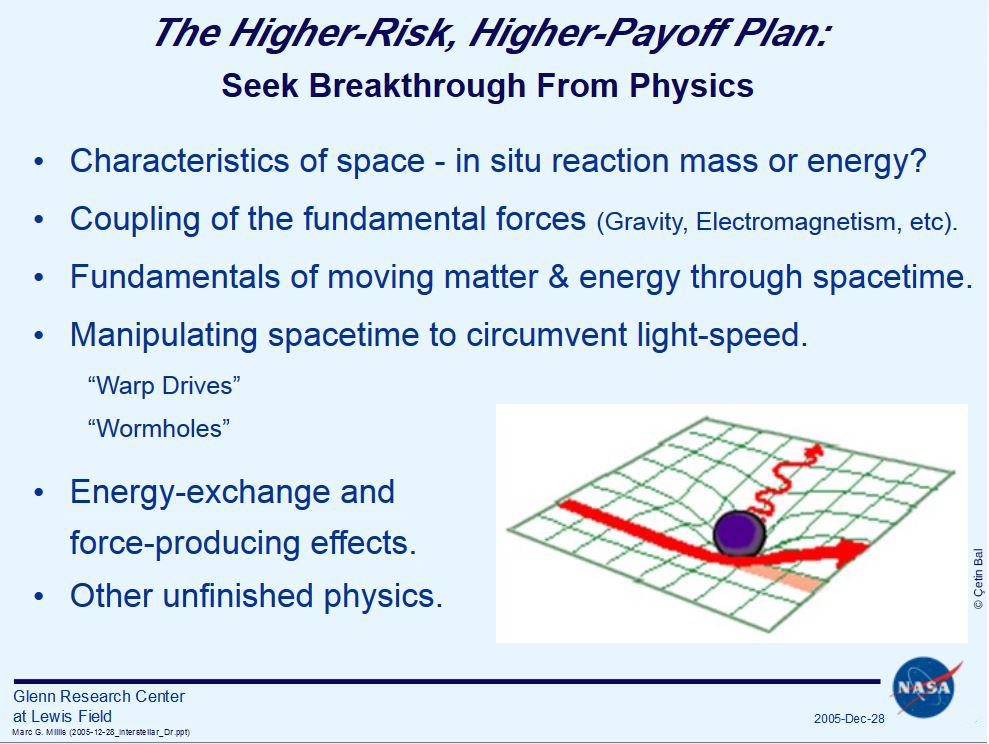
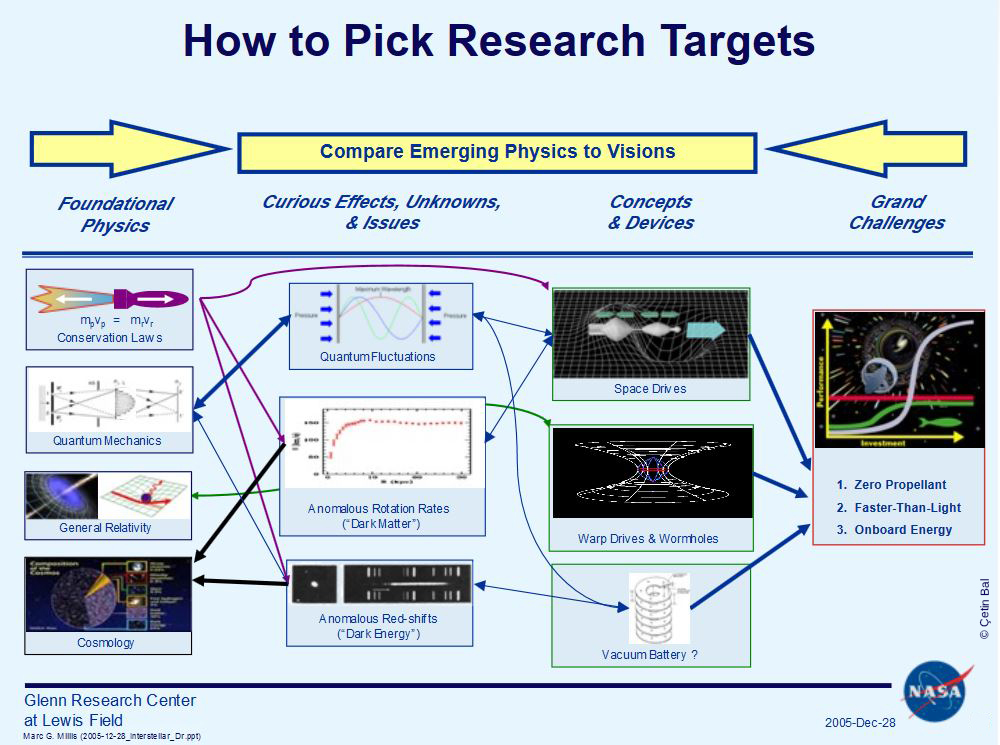
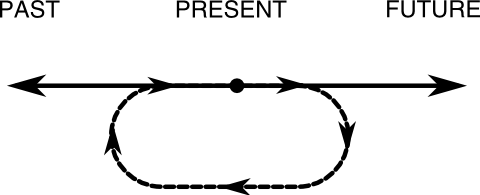
Warp Drive + Wormhole + Hyperspace =
FTL or ‘Faster than Light’ drives
The interstellar drive is a masterpiece of science. For centuries it was
thought that nothing can move faster than light. But the discovery of Exotic
Matter has changed everything and now allows us to visit a large number of
extrasolar Star Systems in a very short time.
Kirk: My friends, the great experiment: The Excelsior. Ready for trial runs.
Sulu: She’s supposed to have transwarp drive.
Scotty: Aye. And if my grandmother had wheels, she’d be a wagon.
Kirk: Come, come, Mr. Scott. Young minds, fresh ideas. Be tolerant.
Dialog from Star Trek III: The Search for Spock
The interstellar drive works like the Alcubierre drive, which was a
speculative idea based on a solution of Einstein’s field equations in
general relativity as proposed by theoretical physicist Miguel Alcubierre,
by which a spacecraft could achieve apparent faster-than-light travel if a
configurable energy-density field lower than that of vacuum (that is,
negative mass) could be created.
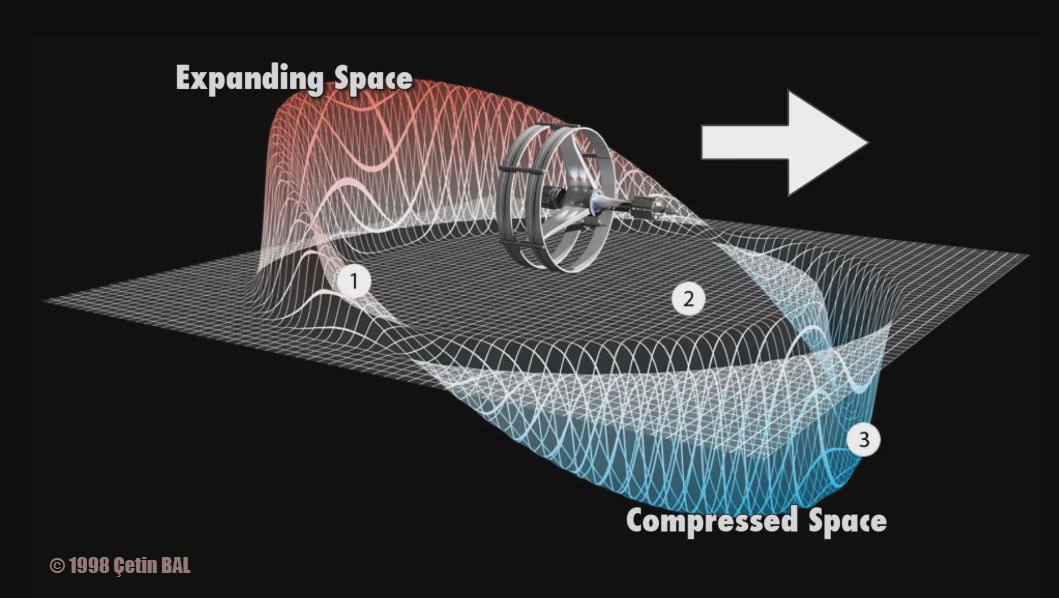
In 1994, Alcubierre proposed a method for changing the geometry of space by
creating a wave that would cause the fabric of space ahead of a spacecraft
to contract and the space behind it to expand. The ship would then ride this
wave inside a region of flat space, known as a warp bubble, and would not
move within this bubble but instead be carried along as the region itself
moves due to the actions of the drive.
Rather than exceeding the speed of light within a local reference frame, a
spacecraft would traverse distances by contracting space in front of it and
expanding space behind it, resulting in effective faster-than-light travel.
Objects cannot accelerate to the speed of light within normal spacetime;
instead, the Alcubierre drive shifts space around an object so that the
object would arrive at its destination faster than light would in normal
space.
The mechanism of the Alcubierre drive implies a negative energy density and
therefore requires Exotic Matter. In Extrasolar Origin, Exotic Matter is
called “Gravium” and can be found and mined on many Planets, but it is a
very rare resource.
Carrying on the Star Trek theme, will we ever truly be able to travel
through space and visit distant planets and stars? Author Giles Sparrow
investigates how close the science of faster than light travel is to the
stuff of science fiction in our aptly named Faster Than Light article.
-----------------------------------------------------------------------
Star Trek Warp Speed closer to reality
21 May, 2013 - By John Black
The revolutionary technology we see in the Star Trek series may not be
science fiction after all as scientists are getting closer to replicating
some of the technology that was dreamed up back in the 1960s. One of the
concepts in the movie is the ‘warp drive’ which made the spaceship able to
achieve speeds faster than the speed of light.
What a warp drive would actually do is to manipulate space and time in order
to move the spaceship. The first concept of a warp drive engine was done in
1994 by physicist Miquel Alcubierre who calculated that the amount of energy
required would make the engine impossible to implement. Miquel suggested
that a WARP drive would manipulate space and time in such a way that it
would create a space-time bubble around the spacecraft making the craft
unaffected by the speed or any kind of g-forces, because in reality the
spacecraft would be stationary inside the bubble and the bubble would travel
at unimaginable speeds of even 10 times the speed of light.
According to a group of students at the University of Leicester, when
traveling at warp speed you wouldn’t be able to see anything apart from
black void – and not those nice elongated stars that you see in Star Trek.
Other scientists suggest that the spaceship would require a shielding
technology to protect it from insterstellar particles that would become
death rays at such speeds. Even some kind of cloaking device that would bend
radiation around the craft would probably be a good start. Of course we need
to clarify that all of this is mere speculation about what would happen if
warp drive were to be achieved.
However, the first step is to solve the energy problem. According to
Miquel’s initial calculations it would require the mass energy of Jupiter as
a minimum! However, recently Sonny White of the Johnson NASA Space Center
has tweaked the design of a warp capable spacecraft and reduced the fuel
down to the mass of a Voyager 1 spacecraft – which of course is still a huge
amount of energy, but more feasible. Johnson works on modelling a
microscopic small scale warp field in order to test the different hypothesis.
But that would be the beginning of an era of Interstellar travelling.
Exciting, isn’t it?
The Impossible Physics of Faster-Than-Light
Travel
Traveling faster than light is impossible. But if it weren't, what would it
look like?
Traveling faster than the speed of light is a staple of science fiction.
Whether it's jumping to hyperspace, engaging the warp drive, or opening the
stargate, most stories about interstellar travel have some hack to get from
point A to point B faster than light.
But here in the real world, we have to obey the laws of physics. And physics
is very strict about nothing moving faster than the speed of light. Or is
it? While the laws of relativity forbid you and I from moving faster than
light, the mathematics of relativity still work even at faster-than-light
speeds. This means we can find out what it would look like if we could break
the universe's speed limit.
Picture two spaceships headed from Earth to a distant star 100 light-years
away. The first ship leaves at 50 percent of the speed of light, so it would
take 200 years to arrive. The second ship has some kind of warp drive and
leaves at twice the speed of light, 100 years after the first. What does
that look like?
This creates a kind of 'sonic boom' made of light
In relativity, the answer depends greatly on perspective. From the Earth, it
looks like one ship leaves and travels a good distance before another ship
moving four times as fast overtakes it. From the perspective of the slower
ship, things look a little different.
The faster-than-light ship is moving so fast that it can outrun any light
that it emits. This creates a kind of 'sonic boom' made of light, which
produces some interesting effects. As the warp-capable ship overtakes the
slower one, and after the two ships pass each other, the light the faster
ship emits is still traveling to the slower one.
The result is that the first time the slower ship can see the faster one is
when they're right on top of each other. From the perspective of the slower
ship, the warp ship will simply appear out of nowhere. Then, the light from
two directions will reach the slower ship all at once, and it will perceive
two versions of the ship moving away in both directions.
From the perspective of the slower ship, the warp ship will simply appear
out of nowhere.
There are all sorts of other strange results that happen when traveling
faster than light, which might be why the universe forbids it. Unfortunately,
it seems likely that warp drives and hyperspace shall forever exist only in
the realm of science fiction.
What Ever Happened to… Breaking the
Speed of Light?
It’s forbidden to go faster than the speed of light. If there is one idea
that’s universally known, even among those of us less well versed in physics,
it’s that there’s a universal speed limit that cannot be broken, because
Einstein said so. Of course this is a big downer because it ruins the
possibility that one day we might have the right technology to spend our
vacations at other stars and meet the possible local inhabitants. But is it
really so? Does Einstein deserve the fame of being the spoilsport who
shattered one of the most cherished dreams of science fiction?
The first hint in modern science that light was not instantaneous, but
rather had a finite speed, is found in the work of the Italian Giovanni
Cassini; however, he had little faith in it. After having proclaimed before
the French Academy of Sciences that the abnormalities observed in the times
of the eclipses of Jupiter’s moons were due “to the fact that light arrives
from the satellites with a delay,” he abandoned this line of thought. Not so
his assistant, the Danish astronomer Ole Rømer, who in 1676 achieved the
first rough measurement of the speed of light.
The credit for having calculated the speed of light with some precision
rests with the American Albert Michelson (19 December 1852 – 9 May 1931),
for which he would receive, in 1907, the first Nobel science prize for his
country. Michelson began his work in 1877 while studying at the Naval
Academy in Annapolis. At that time, scientists believed in the existence of
a luminiferous ether that served to support light waves, just as the air
propagates sound. Since the Earth must move through this fluid, it was
expected that light would have a different speed in the direction of this
“ether wind” and in its perpendicular. In his most famous experiment,
carried out in 1887 along with Edward Morley, Michelson measured the
interference of the phases of light waves in two perpendicular directions.
The result was that there were no appreciable differences, thus the ether
does not exist and light moves at the same speed in all directions.
This conclusion arrived along with the discovery of the photon: particles do
not need a medium through which to move. Michelson’s successive measurements
were refined by others until, in 1975, a final value was adopted:
299,792.458 km/s. This value is no longer modified, since in 1983 it was
used as a constant to define the new value of the metre in the International
System of Units. As for Einstein, what he did was postulate in his special
relativity theory that the speed of light is a constant, the “c” coined
decades earlier by James Clerk Maxwell, and it is independent of the
movement of its source for any observer; in other words, since there is no
ether, there is no fixed reference system in the universe.
Einstein did not forbid an object from moving faster than light, but he
estimated that accelerating it to such a rate would require infinite energy.
However, some scientists say that, in fact, a trip at superluminal speed is
not only a logical impossibility, but also that it wouldn’t offer the
advantages that we think it would. NASA physicist and science populariser
Sten Odenwald explains that the key problem is time dilation, a consequence
of special relativity. For the crew of a ship travelling at close to light
speed, their clocks run much more slowly than for their relatives back on
Earth. When nearing the limit c, from their perspective the trip would be
almost instantaneous. If a photon could think, it would sense that its
flight from one end of the cosmos to the other was immediate, but to an
outside observer it would take the entire age of the universe.
Illustration based on Alcubierre’s idea.
At Warp 37 (a fraction of the speed of light of 0.9999… until there are 37
nines after the decimal point), Odenwald calculates that the trip across the
universe would last 0.2 seconds. “The universe will literally have passed in
and out of existence in less time than it takes you to take a breath,” he
writes. So yes, a traveller could reach the other end of the universe in an
instant, but unfortunately the earth would not exist when he returned. As
for exceeding the speed of light, it’s easy to understand why this is not
possible: a trip cannot be faster than instantaneous, unless the traveller
reaches his destination before he left, which is equivalent to travelling to
the past, and this would violate a basic principle, that of causality.
However, the equations can endure almost any contortion, and some physicists
have proposed theoretical models of superluminal space travel compatible
with special relativity. Perhaps the most famous was devised in 1994 by the
Mexican theoretical physicist Miguel Alcubierre, consisting of a bubble of
space that contracts space in front of the vessel and expands it behind, as
if we were dragging an object on a rubber mat. The trick is that it’s the
destination that is moved closer; in reality the ship doesn’t travel faster
than light. “The object is moved without actually moving; it’s space itself
that does the work,” explains Alcubierre to OpenMind. But the physicist
acknowledges that systems like this are “almost impossible” because they
would require something called negative energy, “and as far as we know that
does not exist.”
Leaving aside objects, another case is the transmission of waves or
particles. If it were possible to send instantaneous signals, we could
communicate with possible civilizations over cosmic distances. In 2011, an
experiment from the international collaboration OPERA claimed to have
detected superluminal velocity in some very light particles called neutrinos,
but it turned out to be a false alarm; it was an experimental error caused
by a fault in a cable and a clock. However, in this case we also find that
the equations are quite permissive. Steven Weinstein of the University of
Waterloo (Canada) has worked on theoretical models of exotic matter in which
disturbances like sound could propagate faster than light. However, he
doubts that such a form of matter exists in our universe.
Supraluminal movement diagram, as envisioned in Star Trek.
One case that does keep physicists busy these days is that of nonlocal
quantum entanglement, the ability of two subatomic particles to stay
synchronized, even if they are separated by great distances. If one particle
is acted on, the other responds instantly. Although this effect has been
corroborated by hard evidence, not everyone is convinced. But according to
physicist and writer John G. Cramer, professor emeritus at the University of
Washington, “special relativity forbids faster-than-light communication at a
definite speed,” he explains to OpenMind. On the contrary, quantum
entanglement operates instantaneously.
However, another question is whether this phenomenon would allow for
communication; when one of the particles is acted on, its status is unknown,
which prevents us from manipulating it at will to send signals. Cramer
acknowledges that, “if the current formulation of quantum mechanics is
correct, nonlocal signalling is impossible.” And if it isn’t correct? Cramer
doesn’t rule it out. And just as long as the physicists don’t abandon this
line of research, we can keep on dreaming.
Why Can’t Anything Go Faster Than The Speed Of Light?
Einstein once called the speed of light “The Universe’s speed limit”. He
claimed that traveling faster than the speed of light would violate the
causality principle. For the layman, that means cause and effect. An example
of this would be a bullet hitting a target before the trigger was even
pulled.
Accelerating to light speed or exceeding it would also violate certain
fundamental energy conditions. It could even allow for time travel.
So why can’t anything go faster than the speed of light?
Before we can dive into that, we have to know what the speed of light
actually is, what it means, and clear up some common misconceptions
regarding this “universal speed limit“.
The speed of light, (or the speed of a photon) in a near-perfect vacuum is
exactly 186,282 miles per second. We perceive photons (light) traveling at
this speed because they are massless, or have no ‘weight’ (but they do have
kinetic energy, more on that in a bit).
Every particle in our universe (including photons) move or ‘swim’ through
what scientists call “the Higgs field”. As a result of this interaction,
particles acquire their mass. Different particles interact with the Higgs
field with different strengths, which is why some particles are heavier (have
more mass) than others. Photons move through, but do not interact at all
with the Higgs field.
What does that mean?
Since photons don’t interact with the Higgs field, it means they aren’t
bound by any speed limit. They’re free to move at the fastest possible speed
– their own “light” speed. Why isn’t the speed of light slower or faster
than 186,282 miles per second? It’s because that exact speed is a
fundamental constant of our universe.
Wondering why light doesn’t travel at a different speed is like wondering
why gravity isn’t reversed or what it would be like if our universe only had
2 spatial dimensions instead of 3 (4 if you include time). Those constants,
along with the speed of light, were set in place when our universe was
created at the moment of the big bang.
Universal Speed Limit
Particles that have mass require energy to accelerate them. The closer to
the speed of light you get a particle, the more energy is required to go
faster. This is because the particles themselves get more massive in
proportion to the increased velocity. In short, the faster you go, the
heavier you get.
Thanks to this inconvenient truth, if you wanted to accelerate a single
electron to ‘light speed’, you would need an infinite amount energy due to
the electron becoming infinitely heavy. There isn’t enough energy in the
entire universe to propel just a single electron to the speed of light.
From A Photon’s Perspective
One of the methods Einstein used to help formulate his theory of special
relativity was to visualize what the universe would look like from the
perspective of a photon. Einstein saw that life as a photon would be quite
bizarre. For instance, if you were a photon, time would have no meaning to
you. Everything would appear to happen instantaneously.
Imagine for a moment that you are a happy little photon created by a star in
another galaxy some 4 billion light years away. From my perspective here on
Earth, it took you exactly 4 billion years to travel from that star till you
reached my retina. From your perspective, one instant you were created and
then the next, you are bouncing off my eyeball. You experienced no passage
of time. Your birth and death happened instantaneously.
This is because time slows for you as your get closer to light speed, and at
it, it completely stops. This is also another reason why nothing can go
faster than light. It would be like slowing down a car to a stop, and then
trying to go slower than completely stopped.
One should think of the speed of light as ‘infinite speed’. A common
misconception is thinking the speed of light is just like any other finite
speed. The speed of light is only finite from the perspective of the outside
observer; from the perspective of a photon, it’s infinite. If you move at
exactly the speed of light you could go anywhere, no matter how far, in
exactly zero seconds.
Can light be slowed down?
Cherenkov Radiation
There is at least one real world example of superluminal (faster than light)
travel. It’s cheating a bit, but it occurs when light passes through water.
Remember, nothing can go faster than 186,282 miles per second, but the
photons that normally travel at that speed can be slowed down. An example of
this can be seen in water where light is slowed to 3/4th of its normal speed.
In nuclear reactors, the charged particles emitted off radioactive rods
through the water they are submerged in exceed this reduced speed.
Because the particles contain an electric charge, they emit energy called
Cherenkov radiation. Any particles they bump into become radioactive, giving
the water an eerie, mysterious blue glow.
So what’s the speed of gravity?
It’s an interesting question that many people may not think about. Does
gravity also have a speed and if so, what is it?
Gravity does in fact have a speed. The speed of gravity is technically the
same as the speed of light. The reason for this speed is the same reason why
light travels at the speed it does. It’s simply a fundamental property of
spacetime itself. If the Sun were to disappear right this instant, the earth
would continue its orbit for 8 minutes (the time it takes light to reach
Earth from the Sun) before the orbit would be perturbed by the Sun’s absence.
So to sum up, nothing can travel faster than light because the speed of
light can be thought of as infinite speed. To match or exceed it would be to
go infinity miles per second/hour. A loop-hole does in fact exist, however.
The loop-hole requires a control or warping of the fabric of spacetime
itself which we’ve touched on in a previous article.
Warp drives, commonly used in science fiction, are propulsion systems which
allow space craft to travel faster than light. The most notable usage of
warp drives is probably in the Star Trek universe. But what are warp drives
and how do they work?
Warp drives, commonly used in science fiction, are propulsion systems
which allow spacecraft to travel faster than light.
The most notable usage of a warp drive is in the iconic science fiction
show “Star Trek”. In the Star Trek universe, they’re used as a plot tool
which allows the characters to explore galaxy.
Ships equipped with these ‘space engines’ can ferry people around the
galaxy, deliver cargo between stars, or can even be used as devastating
tools of war. Interest in the subject caused one reader to ask, “What is a
warp drive and how do they work”?
Could a Star Trek warp drive ever cross the boundary from science fiction
into science fact?
What Are Warp Drives?
Most versions of the warp drive use a loophole in general relativity to
circumvent the universe’s ultimate speed limit – the speed of light.
As you (or anything else with mass) accelerate towards the speed of light,
more and more energy is required to accelerate faster. Because of this
exponential increase in the energy requirements, to accelerate just a single
electron to the speed of light would require more energy/matter than exists
in the entire universe. That’s why it’s called the ultimate speed limit.
A warp drive gets around the problem by not accelerating at all, and
instead, manipulates the region of spacetime around the craft. You cannot
accelerate anything with mass to the speed of light, but spacetime itself
has no mass, and is not bound by this ultimate speed limit under general
relativity. In fact, we believe that spacetime has already been ‘warped’
faster than light once before – during the resulting ‘cosmic inflation’ that
took place just moments after the big bang.
How Does A Warp Drive Work?
The way a warp drive operates is relatively easy to visualize. It simply
compresses the spacetime in front of the ship, and expands the spacetime
behind it – like a surfer riding a wave of water.
This compression and expansion creates a ‘wave’ of spacetime that a ship
could ride on. Since the ship isn’t moving at all, and is instead surfing
this “spacetime wave” (which is now moving much faster than the speed of
light), general relativity remains intact and time dilation is non-existent.
Problems With Warp Drives
How it manipulates spacetime to create the wave is where major problems
arise. The first versions of the warp drive (Alcubierre’s warp drive) call
for theoretical exotic matter and ‘negative energy’ which may or may not
exist, and requires a spacecraft to harness the matter/energy equivalent of
something the size of Jupiter.
Current Status Of Warp Drives
With the recent advances in theoretical physics and string theory,
researchers (Dr. Gerald Cleaver & Dr. Richard Obousy) have calculated how a
warp drive could work under M-theory – and it brings some good news. While
still far beyond our level of technology, a FTL warp drive becomes a bit
more plausible as the requirements become much more manageable by focusing
on the physics of quantum field theory, instead of general relativity.
They worked out that under string theory, a warp drive would no longer
require exotic matter, and the required energy would be roughly 100kg of
antimatter (1019J) to warp the space around a ship the size of
the space shuttle. Their version of the warp drive manipulates spacetime by
shrinking and expanding the tiny, curled up, subatomic spacial dimensions
that theoretically exist in string theory. Their version creates the exact
same spacetime wave described above.
Warp Speed Limit
Interestingly enough, there is a limit to how much spacetime can be
warped under M-theory. These physicists found that the ultimate warp speed
limit (for an Alcubierre warp drive) is 1032C – or roughly 3.3
trillion trillion light years per second. Reaching this speed would require
an incomprehensible 1031J of energy. However, if you could
travel at that speed, you would be able to reach the edge of the visible
universe (14 billion light years) in 4.4 femtoseconds flat.
The warp drive is a theoretical machinery for travelling faster than the
speed of light, which moves at approximately 300,000 km/s. Since the 1960s,
warp drive has been featured in many science fiction stories, especially the
TV series Star Trek, created by Gene Rodenberry. Aerospace engineers use
something called a Technology Readiness ladder to scale technology maturity,
and on this scale warp drive is at a level 1.0, which means conjecture. This
is because currently its just fantasy, and we don’t even have any idea for
the basic principles of physics by which the warp drive effect could be
activated, let alone engineered.
Theoretical Warp Drive from “How to Colonise the Stars” documentary
That said, nature does allow for warp drives. When Albert Einstein wrote his
famous Special and General Relativity papers in 1905 and 1915 respectively
he stated that it was impossible for objects with mass to exceed the speed
of light, this is because the equations showed an exponential increase in
momentum and therefore energy would be required, the closer you get to the
actual number. Any spacecraft that does approach this barrier, will undergo
a form of time dilation, but the vehicle can never exceed the speed of light
through space. What people don’t always realise however, is that it is
perfectly allowed within the laws of physics for space itself to exceed this
speed. This is exactly what happened during the beginning of the Universe
when it underwent a period called inflation; the Universe grew exponentially
in size within a fraction of a second. So, space can expand – can space also
collapse? Indeed it can.
The Alcubierre Warp Drive Metric
Physicist(s) and Astronomers have studied stars and their gravity through
the ages and they have discovered, mainly through Einstein’s revelations,
that space will bend around an object with mass. For a dying star greater
than around 3 times the mass of our Sun, when it gets to the end of its
life, the star will collapse in on itself and create a black hole – an
object with a gravity field so intense, that the escape velocity exceeds
that of light itself – hence not even light can escape and so the object
becomes non-luminous. It is these effects from nature of space expanding (as
in the Big Bang formation) and space collapsing (as in a Black Hole) that is
the principles upon which the warp drive effect may operate, if it could
ever be engineered. The collapse and expansion rate is what determines the
speed of the warp bubble surrounding any vessel. The problem however, is the
requirement for enormous amounts of negative energy in order to induce the
warp drive effect.
In 1994 the physicist Miguel Alcubierre published a paper in Classical &
Quantum Gravity titled “The Warp Drive: Hyper-fast Travel Within
General Relativity”, which showed at least in 1-dimension, a
mathematical formulation for describing the geometry of a warp bubble, and
its negative energy requirements. Although the subject remained conjecture,
this changed the landscape of breakthrough physics research and a flurry of
papers were published thereafter, coming up with new “metric equations”, or
deriving new negative energy requirements, using quantum field theory and
General Relativity. So it was that in 2007 BIS Fellow Kelvin Long organised
a conference dedicated to the Warp Drive titled “Warp Drive:
Faster than Light – Breaking the Interstellar Distance Barrier”.
This may have been one of the first such dedicated events in history and it
showed that even now the British Interplanetary Society was at the forefront
of daring visionary speculation. A symposium took place on 15th November
2007 in which several speakers attended from around the world, all gathered
to review the warp drive. The papers presented and the authors speaking were
as follows:
The Status of the Warp Drive, Kelvin F.Long
Warp Drive: From Imagination to Reality, Jeremy Gardiner
Computer Tensor Codes to Design the Warp Drive, Claudio Maccone
Warp Drive: A New Approach, Richard K. Obousy and Gerald Cleaver
Casimir Energy: A Fuel for Traversable Wormholes, Remo Garattini
Can The Flyby Anomalies Be Explained by a Modification of Inertia,
Mike.E.McCulloch.
The special issue of the Journal of the British Interplanetary Society is
available as Vol.61, No.9, September 2008 and
Alternatively, the individual papers can be ordered direct from the JBIS web
site here: www.jbis.org.uk
Dynamic Warp Drive Metric showing the Expansion and Collapse of Space- time.
During the symposium, the film producer Christian Darkin was present and he
interviewed many of the participants. He also collaborated with Kelvin Long
to produce a credible warp drive machine that “broke as few of the laws of
physics as possible”, based on the large literature review performed and the
list of 19 defined physics and engineering problems from Long’s published
paper “The Status of the Warp Drive”. The end result was only partly
successful, but was shown in the eventual documentary along with the
interviews from the various participants of the symposium. The film “How to
Colonise the Stars” is available for purchase from our shop here.
Star Trek's Warp Drive Might Become A Reality
Sep 8, 2016
The starship Enterprise in the Star Trek: The
Next Generation episode, The Hunted. Season 3, episode 11. Original air
date, January 8, 1990. (Photo by CBS via Getty Images)
Most of us alive today have never known a world where human spaceflight
didn't exist. Yet before we walked on the Moon, had an International Space
Station, sent spacecraft to all the planets and even out of the Solar System,
we had Star Trek, which brought even bigger dreams into the public
consciousness. Instead of rocket fuel, our ships were powered by antimatter
technology. Instead of reaching for the nearest worlds in our own Solar
System, we arrived at new planets around distant stars. And instead of
breaking the sound barrier, we traveled distances of light years in mere
days. While Star Trek brought us a great many technological
advances -- and possibilities for what humanity can be as a civilization --
perhaps it was the invention of warp drive, which itself enabled us to trek
to the stars, that was the most groundbreaking of all.
Powered by antimatter technology, a warp drive
rocket would not only get arbitrarily close to the speed of light, but
could exceed it many times over thanks to bending the fabric of space
itself. Image credit: NASA / Marshall Space Flight Center.
Since even before the inception of Star Trek, the need to defeat
the speed of light seems to be a necessity for human space exploration.
Given that even the nearest star to our own Sun -- and the next nearest
potentially inhabitable world -- is more than four light years away, a
journey to any other star system would mean that multiple years would pass
back on Earth, even if the ship itself took advantage of special relativity
to shorten the journey for the crew. According to Einstein's theory, when
you travel close to the speed of light, the distances in your direction-of-motion
appear shorter (length contraction) and the rate at which time passes
appears to lengthen (time dilation), two of the most counterintuitive and
yet well-studied and confirmed consequences of special relativity. If this
were all there was to traveling through the Universe, then only the
crewmembers traveling at near-light speeds would remain relatively young,
while years would pass both at the origin and destination star systems.
Interstellar travel would be a generational venture for all but the absolute
nearest stars.
The distances between the stars are vast; the
prominent stars shown here are between 4 and 60 light years away, meaning
that even traveling at the speed of light would be more than a human's
lifetime for a round-trip journey. Image credit: Wikimedia Commons user
Andrew Z. Colvin under a c.c.a.-s.a.-3.0 license.
But general relativity offers a possible escape from this constraint:
through the malleability of spacetime itself. We might be unable to travel
through space itself at speeds greater than 299,792,458 m/s, but if we can
lessen the actual distances between two locations (or events), then not only
could we travel there very quickly from the crew's perspective, but from the
perspective of observers at both the source and the destination. Warp drive,
as posited 50 years ago, offered a unique realization of such a solution: by
distorting (shortening) the space along a starship's direction of motion.
A warp field from Star Trek, which shortens the
space in front of it while lengthening the space behind it. Image credit:
Trekky0623 of English Wikipedia.
The distortion of space along the direction of motion (in front) of the
spacecraft was first put forth in a hand-waving sort of fashion by science
fiction writers in the 1960s, with fictitious mechanisms powering it. Sure,
warp drive could effectively shorten a journey across the stars arbitrarily,
limited only by how dramatically one could shorten the space in front of you,
but would it turn out to be physically possible? It was shown, in 1994, that
a solution within General Relativity did in fact exist that led to this
exact spacetime behavior. By shortening the space in front of you and
lengthening the space behind you by an equal-and-opposite amount, while
creating a stable “bubble” of space inside for your starship to reside in,
Miguel Alcubierre showed that warp drive was fully consistent with the laws
that govern the fabric of space and time itself. In one fell swoop 22 years
ago, the physics behind travel at warp speed -- now known as the Alcubierre
drive -- went from science fiction to plausible science.
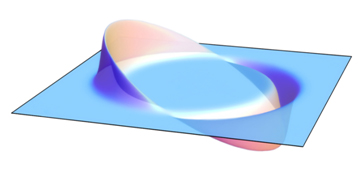
Visualization of a warp field, according to the
Alcubierre Drive. Credit: AllenMcC
A two-dimensional projection of the Alcubierre
spacetime, where space itself is shortened in front of the spacecraft and
lengthened behind it. Image credit: Wikimedia Commons users AllenMcC.,
under a c.c.a.-s.a.-3.0 license.
In order for the Alcubierre drive to become a reality, a great many
practical obstacles still need to be overcome. For one, the most
conservative estimate for the energies required to deform any non-empty
region of space in this fashion equates to at least 20,000 megatons of TNT,
or a ton of mass converted into pure energy via Einstein's E = mc2.
For another, the Alcubierre drive requires the creation of a region of space
with an energy that's less than the zero-point energy of space itself,
requiring the existence of negative mass (or negative energy) in some form.
While that might seem an insurmountable constraint, as only positive masses
and energies are known to exist in this Universe, a setup similar to the
Casimir effect, where parallel conducting plates can reduce the effective
zero-point energy of the space inside, might provide the required energy
conditions. (A solution that was suggested by Alcubierre himself!)
An illustration of the Casimir Effect between
two parallel plates. Image credit: Wikimedia Commons user Emok, under a
c.c.a.-s.a.-3.0 license.
Finally, there isn't a known way to either begin traveling at warp speed
or to end your warp-speed travel once it has begun. Clearly, the ability to
control your starship requires both of these to be in place! As for
practical constraints, if the tremendous tidal forces surrounding the edge
of the warp field could be avoided, the ship would simply travel through
space, along with the rest of the field, at arbitrarily fast speeds as
though it were simply in gravitational free-fall!
An artist's conception of a starship making use
of the Alcubierre drive to travel at apparently faster-than-light speeds.
Image credit: NASA.
If such a technology could be harnessed, it would present tremendous
advances on a number of fronts for humanity. For one, we could ship anything
-- from goods to resources to people -- across arbitrarily large distances
in arbitrarily small amounts of time. Messages could be delivered of
upcoming catastrophes before a light signal could ever arrive, and violating
our traditional notions of causality would become a routine game. But most
importantly, the development of this technology would mean that humans alive
at the time of development would be able to travel across the galaxy,
experiencing other stars, other planets, and, if we're lucky, other
civilizations. In many aspects, this is the most important advance humanity
could strive for in achieving the dreams of Star Trek: the ability
to literally trek across the stars. And thanks to the progress we've made in
understanding one of the deepest laws of physics of all, General Relativity,
we've learned that it might actually be possible. Perhaps, then, there are
other Star Trek dreams that might someday become real, too.
Astrophysicist and author Ethan Siegel is the founder and primary
writer of Starts With A Bang.
A NASA scientist claims to be on the verge of faster-than-light travel: is
he for real?
By Konstantin Kakaes April 1, 2013
NASA physicist Harold G White
Sonny White runs an advanced propulsion lab called Eagleworks at Johnson
Space Center in Houtson.
Last September, a few hundred scientists, engineers and space enthusiasts
gathered at the Hyatt Hotel in downtown Houston for the second public
meeting of 100 Year Starship. The group is run by former astronaut Mae
Jemison and funded by DARPA. Its mission is to "make the capability of human
travel beyond our solar system to another star a reality within the next 100
years."
For most of the attendees at the conference, advances in manned space
exploration have been frustratingly slow in coming. Despite billions of
dollars spent over the last few decades, space agencies aren't capable of
much more than they were in the 1960s. They may be capable of less. 100 Year
Starship intends to accelerate the process of interstellar travel by
identifying and developing promising technologies.
Over the course of several days, attendees could join symposia on such
exotic topics as organ regeneration and organized religion aboard a starship.
One of the most anticipated presentations was titled "Warp Field Mechanics
102," given by Harold "Sonny" White of NASA. A nine-year agency veteran,
White runs the advanced propulsion program at Johnson Space Center (JSC),
down the road from the Hyatt. Along with five others, he recently co-authored
the agency's 16-year "In-Space Propulsion Systems Roadmap," which outlines
NASA's goals for the future of space travel. The plan calls for all manner
of propulsion projects from improved chemical rockets to far-forward systems
like antimatter and nuclear engines. White's particular area of research is
perhaps the most far-forward of them all: warp drive.
Put plainly, warp drive would permit faster-than-light travel. It is, most
assume, impossible, a clear violation of Einstein's theory of general
relativity. White says otherwise. For half an hour at the symposium, he
outlined the physics of a potential warp drive—walking attendees through
things like Alcubierre bubbles and hyperspace oscillations. He explained how
he'd recently computed theoretical results that could pave the way for an
actual warp drive and that he was commencing physical tests in his NASA lab,
which he calls Eagleworks.
It almost goes without saying that functional warp drive would have
tremendous implications for space travel. It would free explorers not only
from Earth's orbit, but from the entire solar system. Instead of taking
75,000 years to get to Alpha Centauri, the star system nearest to our own,
warp-equipped astronauts, White says, could make the trip in two weeks.
In the wake of the shuttle program's termination and given the increasing
role of private industry in low-Earth orbit flights, NASA has said it will
refocus on far-flung, audacious exploration, reaching far beyond the rather
provincial boundary of the moon. But it can only reach those goals if it
develops new propulsion systems—the faster the better. A few days after the
100 Year Starship gathering, the head of NASA, Charles Bolden, echoed
White's remarks. "One of these days, we want to get to warp speed," he said.
"We want to go faster than the speed of light, and we don't want to stop at
Mars."
* * *
Courtesy Campus Party Mexico
Miguel Alcubierre
Physicist Miguel Alcubierre developed the model for warp drive after
watching an episode of Star Trek.
The first mainstream use of the expression "warp drive" dates to 1966, when
Gene Roddenberry launched Star Trek. For the next 30 years, warp existed
purely as a construct of one of science fiction's most enduring series. Then,
a physicist named Miguel Alcubierre found himself watching an episode of the
show. At the time, he was doing his graduate work in general relativity, and
he asked himself what it would take to make warp drive physically plausible.
He published a paper outlining the physics in 1994.
Alcubierre envisioned a bubble in space. At the front of the bubble, space-time
would contract, while behind the bubble, space-time would expand (somewhat
like in the big bang). The deformations would push the craft along smoothly,
as if it were surfing on a wave, despite the tumult around it. In principle,
a warp bubble could move along arbitrarily quickly; the speed-of-light
limitation of Einstein's theory applies only within space-time, not to
distortions of space-time itself. Within the bubble, Alcubierre predicted
that space-time would not change, leaving space travelers unharmed.
Warp drive would free explorers not only from Earth's Orbit, but from the
entire Solar System.
Einstein's equations of general relativity are very difficult to solve in
one direction—figuring out how matter bends space—but going backward is
fairly easy. Using them, Alcubierre determined the distribution of matter
necessary to create such a warp bubble. The trouble was, the solutions
called for an obscure form of matter called negative energy.
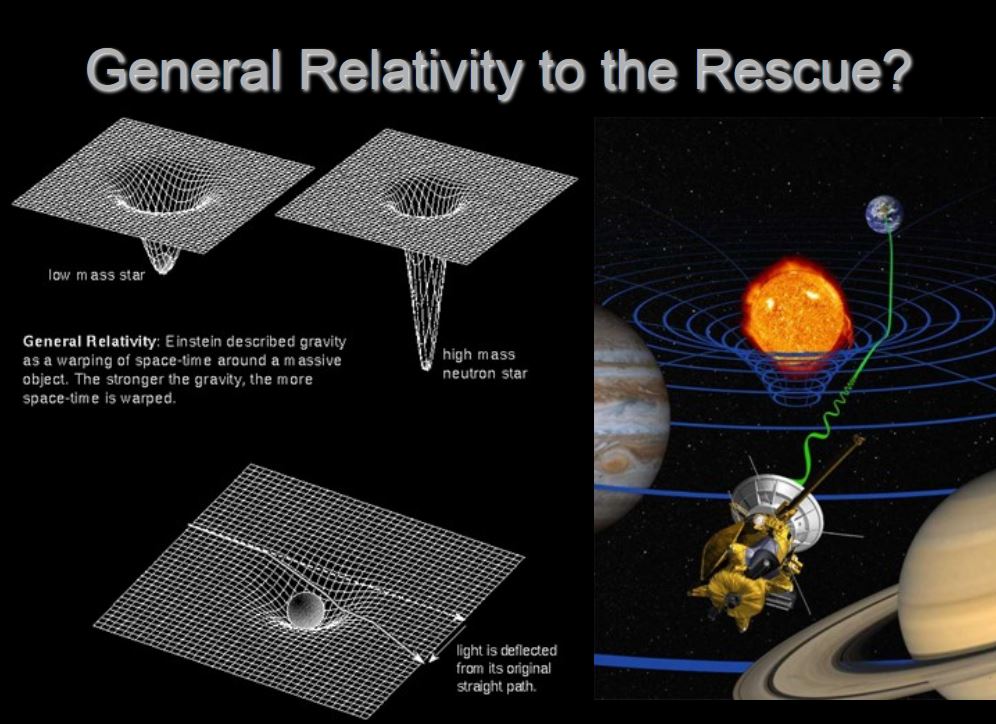
In the most basic of definitions, gravity is the attractive force between
two objects. Every object, no matter how small, exerts some attractive force
on surrounding matter. Einstein's insight was that this force is a curvature
in space-time. Negative energy, though, is gravitationally repulsive.
Instead of drawing space-time together, negative energy would push it apart.
Roughly speaking, for his model to work, Alcubierre needed negative energy
to expand the space-time behind a craft.
Though no one has ever measured negative energy, quantum mechanics predicts
that it exists, and scientists should be able to create it in a lab. One way
to generate it would be through the Casimir effect: Two parallel conducting
plates, placed very closely together, should create small amounts of
negative energy. Where Alcubierre's model broke down is that it required a
vast amount of negative energy, orders of magnitude more than most
scientists estimate could be produced.
White says he's found a way around that limitation. In a computer simulation,
White varied the strength and geometry of a warp field. He determined that,
in theory, he could produce a warp bubble using millions of times less
negative energy than Alcubierre predicted and perhaps little enough that a
space craft could carry the means of producing it. "The findings," he says,
"change it from impractical to plausible."
* * *
Jack Thompson
NASA Engineer
NASA engineer Harold "Sonny" White runs the Eagleworks lab at Johnson Space
Center, where he works on advanced propulsion. White is trying to distort
space-time, research that he says could one day lead to a warp drive.
Johnson Space Center sprawls beside lagoons where Houston gives way to
Galveston Bay. It has the feel of a suburban college campus, albeit one
geared to the training of astronauts. The day I visit, White meets me in
Building 15, the low-rise warren of hallways, offices, and labs that
contains Eagleworks. He is wearing a polo shirt embroidered with the
Eagleworks emblem, which depicts an eagle, mid-swoop, soaring over a
futuristic starship.
White did not start his career in propulsion. He studied mechanical
engineering, and he joined the agency in 2004 as part of its robotics group,
having worked at JSC as a contractor since 2000. Eventually, he took command
of the robot arm on the International Space Station while working on a Ph.D.
in plasma physics. It was only in 2009 that he shifted his responsibility to
propulsion, which had been a long-standing interest of his and the reason he
came to work for NASA in the first place.
"Sonny is a pretty unique person," says his boss John Applewhite, who heads
the Propulsion Systems Branch within the JSC engineering directorate. "He's
definitely a visionary, but he's also an engineer. He can take his vision
and turn it into a useful engineering product." About the time he joined
Applewhite's group, White requested permission to open his own lab,
dedicated to advanced propulsion. He dreamed up the name Eagleworks—a
patriotic riff on the famous Lockheed Martin Skunk Works—and had NASA create
a logo to his specifications. Then he got to work.
White leads me to his office, which he shares with a colleague who is
looking for water on the moon and then takes me down the hall to Eagleworks.
As we walk, he tells me about his quest to open the lab, which he frames as
"a long arduous process of trying to find ways for advanced propulsion to
help human space exploration." He speaks with a slight drawl, a product of
many years spent in the South—first at college in Alabama and then 13 years
in Texas.
White shows me into the facility and ushers me past its central feature,
something he calls a quantum vacuum plasma thruster (QVPT). The device looks
like a large red velvet doughnut with wires tightly wound around a core, and
it's one of two initiatives Eagleworks is pursuing, along with warp drive.
It's also secret. When I ask about it, White tells me he can't disclose
anything other than that the technology is further along than warp drive. A
2011 NASA report he wrote says it uses quantum fluctuations in empty space
as a fuel source, so that a spaceship propelled by a QVPT would not require
propellant.
White's warp experiment is tucked into the back corner of the room. A helium-neon
laser is bolted onto a small table pricked with a lattice of holes, along
with a beam splitter and a black-and-white commercial CCD camera. This is a
White-Juday warp field interferometer, which White named for himself and
Richard Juday, a retired JSC employee who is helping White analyze the data
from the CCD. Half of the laser light passes through a ring—White's test
device. The other half does not. If the ring has no effect, White would
expect one type of signal at the CCD. If it warps space, he says "the
interference pattern will be starkly different."
When the device is turned on, White's setup looks cinematically perfect: The
laser is bright red, and the two beams cross like light sabers. There are
four ceramic capacitors made of barium titanate inside the ring, which White
charges to 23,000 volts. White has spent the last year and a half designing
the experiment, and he says that the capacitors will "establish a very large
potential energy." Yet when I ask how it would create the negative energy
necessary to warp space-time he becomes evasive. "That gets into . . . I can
tell you what I can tell you. I can't tell you what I can't tell you," he
says. He explains that he has signed nondisclosure agreements that prevent
him from revealing the particulars. I ask with whom he has the agreements.
He says, "People come in and want to talk about some things. I just can't go
into any more detail than that."
* * *
Jack Thompson
Saturn V
At Johnson Space Center, White works in the shadow of the Saturn V rocket.
While the theory of warp travel is intuitive enough—deform space-time to
create a moving bubble—it suffers from a few significant obstacles. Even if
White can drastically reduce the amount of negative energy that Alcubierre
required, it may still be much more than scientists can produce, says
Lawrence Ford, a theoretical physicist at Tufts University who has published
dozens of journal articles on negative energy over the last 30 years. Ford
and other physicists say there are fundamental physical limitations—not just
engineering challenges—on the amount of negative energy that can exist in
one place for any length of time.
Another challenge is that in order to create a warp bubble that moves faster
than light, scientists would need to distribute negative energy around a
craft, including ahead of it. White doesn't think this is a problem; when I
ask him about it, he says rather vaguely that a warp drive would work
because of an "apparatus you have that's creating the conditions that you
need." But creating those conditions in front of a ship would mean
generating a distribution of negative energy that travels faster than light,
a violation of the theory of general relativity.
In saying that a warp drive is feasible, White is also saying that he can
create a time machine.
Finally, warp drive poses a conceptual problem. In general relativity,
faster-than-light travel is equivalent to moving about in time. In saying
that a warp drive is feasible, White is also saying that he can create a
time machine.
Those obstacles raise some significant doubts. "I don't think any normal
understanding of physics predicts he's going to see anything in his
experiments," says Ken Olum, a physicist at Tufts University, who served on
a panel debating exotic propulsion at the 100 Year Starship gathering in
2011. Noah Graham, a physicist at Middlebury College who read two of White's
papers at my request, wrote in an e-mail: "I don't see any valid science in
either paper beyond the summaries of previous work."
Alcubierre, now a physicist at the National Autonomous University of Mexico,
is also doubtful. "Even if I'm in a spaceship in the middle and I have the
negative energy, there's no way I can put it where I need it," he told me by
phone from his home in Mexico City. "It's a nice idea. I like it because I
wrote it myself. But it has a series of limitations that I've seen through
the years, and I don't see how to fix them."
* * *
Jack Thompson
Warp Travel
To the left of the main gate at Johnson, a Saturn V rocket lies on its side,
its stages disconnected to show some of its guts. It's massive. Just one of
its many engines is nearly the size of a small car, and, laid on end, the
rocket is a few feet longer than a football field. It is a quiet testament
to the difficulty of space travel. It is also four decades old, and the time
it represents—when NASA was part of a grand national effort to send a man to
the moon—has long passed. Today, JSC feels like a place that once touched
greatness but has since fallen from its orbit.
A breakthrough in propulsion could spell a new age at JSC and NASA, and to a
degree that age is already upon us. Dawn, a probe launched in 2007, is
exploring the asteroid belt using ion thrusters. In 2010, a Japanese team
deployed Ikaros, the first interplanetary craft driven by a solar sail,
another type of experimental propulsion. And in 2016, scientists plan to
test VASIMR, a plasma-based system designed for high-thrust propulsion, on
the ISS. While those systems might one day carry astronauts to Mars, they
still will not be able to send astronauts beyond the solar system. To do
that, White says NASA will need to embrace riskier projects.
Warp drive is perhaps the most far-fetched of all NASA's propulsion efforts.
The greater scientific community says White cannot create it. Experts say
he's working against the laws of nature and physics. Nonetheless, NASA is
behind it. "He's not funded at a very high level in terms of what he's
trying to accomplish," Applewhite says. "I think there's very much interest
within the directorate to continue growing his work. These are the kinds of
theoretical concepts that, if they come to fruition, would be game changers."
In January, White packed up his warp interferometer and moved it to a new
facility. Eagleworks had outgrown its first home. The new lab is larger and,
he says enthusiastically, "It's seismically isolated," meaning it is
shielded from vibrations. But perhaps the best thing about the new lab is
also the most telling. NASA assigned White to a facility that was built for
the Apollo program, the same one that put Neil Armstrong and Buzz Aldrin on
the moon.
Konstantin Kakaes is a Schwartz fellow at the New America Foundation.
This article appeared in the April 2013 issue of Popular Science Magazine.
NASA physicist Harold White proposes "Warp speed ahead!"
in Current Events, Politics, etc | Science and Technology by MegaBearsFan
IXS Enterprise 3-D concept
Concept of the IXS Enterprise
Recently, a NASA physicist Harold G. White made headlines in the science and
technology media by showcasing a 3-D artist's render of a "real life" warp
drive starship (affectionately named the "I.X.S. Enterprise" - not sure what
the "I.X.S." stands for). The starship model poposed is based on
mathametical calculations that suggest that the Alcubierre warp drive could
actually work!
In the 1990's, theoretical physicist Miguel Alcubierre, mathematically
demonstrated that a warp field could be created which could contract the
space ahead of an object and expand the space behind said object, allowing
the warping of space to effectively propel the object faster than the speed
of light. The theory does not violate the "cosmic speed limit" imposed by
relativity, since the object isn't being accelerated past the speed of light.
Instead, the space around it is being manipulated to reduce the distance
between the source and the destination by taking advantage of the fact that
space itself is permeable and its motion is not constrained to the cosmic
speed limit. Best of all: astronauts inside such a ship would not be subject
to relativistic time dilation effects. A one-year trip for the astronauts
would also be only one year for the people of earth!
IXS Enterprise 3-D concept
One of Matt Jefferies' original concepts for Star Trek's starship Enterprise.
Alcubierre freely admitted that his ideas were inspired by concepts from
Star Trek, and considering that no similar theory of warp propulsion existed
at the time of Star Trek, the concept and designs of the show are
surprisingly prophetic. Alcubierre's models were met with early excitement
when they were first proposed, but examinations by other physicists exposed
certain flaws that made the effect impractical for human space exploration
and travel:
The drive would require a tremendous amount of energy ranging from the
equivalent of the total mass of Jupiter to the more mass than is contained
in the observable universe! This, by itself, made the theory a non-starter.
The drive also may not be steerable or controllable from within the ship.
Also, there were concerns that a build-up of particles along the front of
the bubble during travel would be shot forward when the drive slows down or
stops, potentially destroying anything in its path (including the
destination, whether it be a planet, another ship, or a space station).
There were also concerns about whether Hawking radiation inside the bubble
would destabilize the bubble and/or kill the crew.
NASA physicist Harold G White
These early concerns led many scientists to assume that warp drive (based on
the Alcubierre equations) may forever be out of our reach.
But that hasn't stopped physicists from thinking about the possibility. In
2011, Harold White published a paper and gave lectures about how some of the
variables of Alcubeirre's equations could be tweaked to make the drive much
more feasible. Basically, by altering the size and placement of the engine
rings, the energy required to generate the Alcubierre warp bubble can be
substantially reduced. At certain sizes, the drive could require an energy
source equivalent to the reactor used to power the Voyager space probes (which
were launched in the 70s). White is currently undertaking experiments to
show whether or not such a bubble could actually be created. The
mathematical models are encouraging, but the experimental results are still
inconclusive.
Earlier this year, White gave a lecture regarding his experiments in which
he showed an artist's rendering of what a possible Alcubierre starship would
look like if his hypothesis proves correct. The concept is inspired by one
of Matt Jefferies' original designs for the starship Enterprise in the T.V.
series Star Trek.
Don't get too excited though. The I.X.S. is far from being a "real life"
starship, and is still very much just a conceptual model. Although White's
math demonstrates that the Alcubierre drive could be made efficient and
practical enough to be used in a starship using technology that exists today,
his starship design seems to be lacking in several key practical, technical
details:
He doesn't outline the exact power source for the drive.
He doesn't outline how the crew would operate the ship or live within it.
Since the ship does not appear to rotate, it apparently cannot provide
artificial gravity.
The ship would likely have to be assembled in orbit, but White does not
provide any details regarding the materials involved or the cost of
construction and operation.
As far as I know, he has not solved the problem of whether or not the ship
will be steerable from the crew within.
So, for now, the I.X.S. Enterprise - as cool as it is - is merely science
fiction.
When Will We Have Warp DriveThis question has been asked lots of times by
Star Trek enthusiasts and others including myself. In this article we will
try to highlight some possibilities of when will we have warp drive
available to us. Are we close to warp drive in our lifetimes or will we have
to reincarnate?
I mention Star Trek above with good reason, not just for science fiction
fans, but if you look at almost all of the technologies predicted, they have
actually come true. The only, and the most favored concepts, still to
crystallize is warp drive and teleportation of information and objects.
With all these things predicted for the 23rd Century, it looks like we are
already well ahead of schedule. Since such technological concepts are here
in 2016. In fact some items might be considered too primitive for many such
as flip-flop communication devices in the 1960s Star Trek series, as we have
evolved to smart phones.
Not to mention inoculations that are needle free and the medical tricorder.
Plus Google Siri voice assistant software and digital translators into other
languages.
All this is very interesting and impressive. However, if we want to explore
deeper into more exotic technologies such as Warp Drive and Teleportation,
you may find it more harder to observe more compelling insights that we are
on a cusp into a new area of Star Trek type experiences.
Where traveling to not only planets in our solar system but also to
neighboring star systems, is as routine as aviation technologies are today.
Get on a plane in Canada in the evening and in the morning you are arriving
in Scotland.
One would argue that there is a world of difference between travelling
across the Atlantic and travelling to Alpha Centauri. But then that is what
the old mariners would have said before air flight was invented.
Has A New Era Begun?
That all being said, there have been some interesting research and serious
experiments currently being work on by many scientists. In regards to
teleportation there has been some very interesting results from a group of
scientists in the Netherlands, where they were able to teleport information
3 meters apart with 100% accuracy of the data remaining intact at the
receiving end.
Scientists are also taking steps in the realms of the laboratory to develop
the next generation of space propulsion technologies, that would take us
beyond chemical rockets.When Will We Have Warp Drive Space Shuttle
At the moment such rocket technology, while a spectacular tried and proven
system to travel out of the Earth’s orbit, is very inefficient as it
requires 90% of the ships payload to be fuel.
Current propulsion technologies are stuck in low earth orbit. Traveling to
Mars or even to the Moon would require some serious advancements in
innovations.
While it is not impossible to travel to Mars with chemical rocket fuel, it
would be extremely expensive. You would have to factor in not just the fuel
to leave Earth and travel to Mars but also to get back home again. Also you
would need fuel on top to compensate for the mass of fuel required to get
there and back.
So if we want Humans to explore and settle in this solar system, then we
need major upgrades to current propulsion systems and for them to be cheaper.
So are there new potentials on the horizon?
New Propulsion Technologies
Scientists have been looking and researching into a number of different
technologies that could be allow us to achieve regular space flight. These
include Nuclear Fusion, LENR (Low Energy Nuclear Reaction), Anti-Matter, and
Ion Drives to name a few.
We will look at each of these in future articles on what has progressed. I
know that NASA has been looking at a possible Nuclear Fusion Plasma Rocket
this is being researched on that could potentially get to Mars in as little
30 days to 3 months, depending on the Earth’s and Mars’s orbits from each
other.
At the moment under current chemical rocket fuel technologies it would take
around 7 to 18 months and of course would be a lot more expensive. NASA
would be delighted with an alternative assume it would work for its Mars
mission in the early 2030s.
In the Eagleworks Labratories at NASA, Dr Harold ‘Sonny’ White whom leads
research into the next generation of advance propulsions, have been looking
at the EM Drive and Quantum Vacuum Plasma Thrusters, a form of electric
propulsion that surfs on the quantum vacuum.
I will write about these in due course and especially the controversial EM
Drive (Electromagnetic Drive) which has been causing a stir in the news
lately.
White’s team has been researching into Warp Drive Mechanics to manifest and
detect a small instance of a warp bubble (spacetime distortions) using
Quantum Optical Technologies.
Faster Than Light Propulsion
In the Star Trek Universe, warp drive was invented in the early 2060s. It
was at this time that the Vulcans detected a warp field signature and
decided to make contact. The Vulcans had already invented Warp Drive
centuries earlier so they felt it would be good to make contact, build a
relationship with humans and guide them as now they were advancing in
technologies that would allow them to travel beyond the solar system.
When Will We Have Warp Drive Speed Of Light
Warp drive technology progressed in increments just like in the real life,
with the automobiles and aviation, that has advanced and got faster and more
sophisticated.
On Earth, warp drive was invented by the human called Zefram Cochrane. His
developments of the warp drive was gradual over time and in the 22nd Century,
humans were able to travel at warp factor 5 or 125 times the speed of light
as measured on the Cochrane scale.
This is a generation before we meet Kirk’s crew and learn of their
adventures where warp technology had advanced even faster to warp 9. However,
in Cochrane’s period, the less advanced warp drive was efficient enough
allowing humans to travel and settle in the Alpha Centauri system, which is
4.3 light years from Earth and the closest to us.
Having any kind of faster than light travel would be absolutely amazing. But
is warp drive possible?
Warping Of Spacetime
The answer to that is an uplifting Yes! In 1905 Albert Einstein brought
forward the theory of special relativity, that explains that no object with
mass can travel faster than the speed of light.
He then went on to develop general relativity containing different field
equations that solved certain problems. Some of these issues worked out from
Einstein’s field equations, allow for space to be stretched or compressed.
Space itself does not have mass and so it can move at any speed including
faster then light, at least theoretically mathematically so.
This means that space can be warped around us so that it can be squeezed in
front of us and expanded behind us. In this way an object with mass is never
violating the theory of relativity, since it is space itself that is
shifting at those speeds, the object itself is still existing in normal
space without travelling at those speeds.
In 1994, Miguel Alcubierre, who at the time was a Mexican physics student,
wrote up a paper that published the first paper of these field equation
solutions, allowing the warping of space. He was inspired by watching star
trek and wanted to see if it could be supported in anyway within physics.
This warp drive equations have become known as the Alcubierre metric or the
Alcubierre Drive. His professor at the time was so impressed with his paper
that he got it published and peer reviewed.
Of course all this was nice on paper in theory but Alcubierre doesn’t think
it is technologically possible because of the huge energy requirements
needed, which at the time would be all the energy in the universe to bend
space or the energy of a star. In addition you would need an exotic energy
of negative mass, something at least at the time, we are not sure how to
make.
Reducing The Energy Requirements
Around the time of 2010, it was thought that at best guess, the amount of
negative energy needed would be the equivalent size of the mass of Jupiter.
However, at the time, White was invited to give a talk to the 100 Year
Starship Conference. This is a Think Tank setup with initial funding via
NASA and DARPA / The Pentagon, on what it would take to build a starship
capable of interstellar travel over the next 100 years. I will update this
article with links to future articles focusing on the 100 Year Starship
Program.
Different technologies where discussed and White revealed about the concept
of warp drive propulsion. However, instead of just giving an inspirational
talk about future technologies, White highlighted that they had reviewed and
tweaked the Alcubierre metric calculations, resulting in the energy
requirements being vastly reduced, from energy mass of Jupiter to equivalent
of the size of the voyager space probe.
When Will We Have Warp DriveThis means that the concept of a space warp was
much more feasible that originally thought and has the potential to make it
a game changer, worthy of further research and investigation. White pointed
out that they were intending to try and create and measure a microscopic
instance of a warp bubble in the lab.
Basically, the NASA scientists working on this science project feel that
there are warp bubbles that would be simpler to manifest energetically than
the one that Alcubierre used in his initial calculations.
The warp bubble has thickness of on a scale that is termed a Planck length.
If the thickness of the walls are increased then the energy requirements are
reduced.
In addition they observed that if space were to be embedded in higher
dimensions (Hyperspace) then the energy required to warp space would be
considerably less by changing the vibratory frequency rate of matter.
As an example consider a block of wood, if you tried to compress it with
your hands it would be very difficult or impossible. If you could changed
the frequency of the wood’s matter to a more sponge or liquid like state
then the strain rate would be a lot less to compress.
The research teams at NASA’s Johnsons Space Center along with Dakota State
University are aiming to experiment with a number of new different
approaches such as the implications of Brane Theory Cosmology and a redesign
of an energy-density topology. A toroidal positive energy density may
produce a spherical region of negative pressure, perhaps eliminating the
requirement for exotic matter.
Brane Cosmology
Spacetime being embedded in a higher dimensions is a theory supported by
Brane Cosmology that tries to utilize a number of theories in particle
physics and cosmology such as String Theory.
The concept of the Brane is that the visible universe of four dimensions is
restricted to a brane inside a higher dimensional manifold, this is known as
‘bulk’ or ‘hyperspace’. Now if the additional dimensions are compressed then
it would mean that our observable universe contains those extra dimensions,
so no reference point to the hyperspace/bulk is needed.
In other words what would exist as other dimensions actually exist inside
the physical membrane but on a different density and not operating outside
of the observable physical universe. This analysis by scientists into these
concepts would seem to reflect what many mystics and shamans over the
centuries and what I also concluded myself sometime ago, that ‘inner realms
of existence’ or other worlds is a contraction process and not an expanded
state or operating outside of us.
In the hyperspace model some of those extra dimensions either infinite or
extensive, with other branes ‘bleeding’ through the bulk. Thus there would
be interactions with the bulk and it is possible that other branes can
influence each other. So you would see phenomena not seen in the standard
physics cosmological models.
As I mentioned above about changing the frequency or density of physical
matter, space is extremely dense or stiff, and would take an incredible
amounts of energy to try to bend spacetime. However, if you can soften
matter so it becomes more like plasticine then the strain rate to distort
space around yourself would be a lot less.
Warp Drive Research
I will make a follow up to this article as there is a lot of detail just to
go into their warp drive experiments. However, they are thinking extremely
big but taking small incremental steps in their research.
Since running these experiments they imply that they have got a reading of a
possible warp signature but at the moment the results are inconclusive due
to the sensitivity of the equipment and trying to rule out background noise.
Their research is a feasibility study into how difficult it would be to
create such a warp field and also if it is possible.
So are we any closer to warp drive? I would say yes, as its one thing to
write up papers about it. But something else to try and see if you can
generate a warp bubble in the lab! The scientists seem to think they might
be on a verge of a breakthrough in this new kind of physics and take it from
speculation to actual science.
Gene Roddenberry’s classic sci-fi drama, Star Trek, made famous the warp drive, a theoretical concept whereby a spacecraft travels Faster Than Light (FTL).
Figure 1: In the Star Trek TV series and movies the starship USS Enterprise could travel faster than light by engaging its warp drive.
A ‘trekky’ enthusiast once told me that the warp speeds described on
the television shows and in the movies may be calculated as follows.
Warp factor w, from the original Star Trek series, means that the spacecraft travels at w³ times the canonical speed of light (c ≅ 300,000 km/s or 186,000 miles/s).3 Therefore warp factor w = 7 means the spacecraft travels at 7 = 343 c. It would be unusual to hear that the starship the USS Enterprise (see Figure 1) had exceeded warp factor 9, which is about 729 times the speed of light.
It is a highly speculative mathematical model, which specifies how space, time and energy interact.
To travel even around the local neighbourhood of our galaxy warp
factor 9 (from the original TV series) just won’t do it. The nearest
star to our solar system is about four light-years away. So travelling
at warp 9, you would take two days to get there. Not too bad. But what
about going to other star systems?
To travel 50 light-years, which is a very small distance in the
galaxy and which includes very few stars—only 64 sun-like stars—would
take you 25 days at this speed. Within a distance of 100 light-years
from Earth there are known to be only 512 stars of the same spectral
class as our sun1 and very few of those might be candidates for a solar system that could potentially support life.2
So it would be much better to be able to travel 100 light-years quite
quickly; but that would take you 50 days. However in the TV shows they
often arrive in just a matter of hours.
Years later, the next TV series—Star Trek: the Next Generation—solved
this problem by introducing a new formula that increased the warp speed
in a highly non-linear fashion, such that a warp factor of 10 meant
infinite speed across the galaxy. Thus distances were no longer a
roadblock to get around the universe in the 40 minutes or less available
in a TV episode. For example, warp factor w = 9.9999 is equal to nearly 200,000 c.3 At that speed you could hypothetically travel right across the galaxy in only six months.
Alcubierre Warp Drive
But that is all science-fiction. What about a real warp drive?
In 1994, a Mexican physicist by the name of Miguel Alcubierre came up
with a proposal for stretching the fabric of space-time in a way which
would, theoretically, permit FTL travel.
Alcubierre found a theoretical solution of Einstein’s field equations producing what has been called Alcubierre Warp Drive. Needless to say it is a highly speculative mathematical model, which specifies how space, time and energy interact.
To put it simply, this method of space travel involves
stretching the fabric of space-time in a wave which would (in theory)
cause the space ahead of an object to contract while the space behind it
would expand. An object inside this wave (i.e. a spaceship) would then
be able to ride this region, known as a “warp bubble” of flat space.4
The
spacecraft hypothetically generates the warp bubble in its bow wake and
collapses it behind the craft as it travels through space-time. See
Figure 2. The speed of light within the bubble remains the same
speed of light, c. The spacecraft undergoes no local acceleration—no huge g-forces are experienced by the craft.5 Thus Captain James T. Kirk, or anyone else on board, would not spill his/her coffee even as they go to warp 9.9999.
But the idea of warp drive presents a few problems.
For one, there are no known methods to create such a warp
bubble in a region of space that would not already contain one. Second,
assuming there was a way to create such a bubble, there is not yet any
known way of leaving once inside it.4
That’s a problem. Once you enter hyperspace, or “subspace” as they called it in the original Star Trek series, you are stuck there, never to leave it again. That would have been a good story for an episode in the series.
Figure 2: Visualization of a warp field, according to the Alcubierre Drive.
In 2012, NASA’s Advanced Propulsion Physics Laboratory (aka
Eagleworks) even announced that they had begun conducting experiments
to see if a “warp drive” was possible. The team lead scientist, Dr
Harold Sonny White, described their work in a NASA paper titled Warp Field Mechanics 101.
In 2013, White and members of Eagleworks published the results of their
19.6-second warp field test under vacuum conditions. These results,
which were deemed to be inconclusive, were presented at the 2013 Icarus
Interstellar Starship Congress held in Dallas, Texas. I cannot find any
report of any progress after that time.6
Real physical evidence also suggests that FTL space travel is impossible.7
It is a problem of energy, which is well understood by physicists. Alcubierre’s theory requires the use of large amounts of a never
observed type of “exotic matter” that violates known physical laws. It
is needed to produce a negative type of energy to fold space into the
warp bubble. This hypothetical negative energy involves either tachyons
(which travel faster than light speed) or a naked singularity (which is a
black hole without the event horizon).
Still, one of the most dubious is Dr. Alcubierre himself.
He listed a number of concerns, starting with the vast amounts of exotic
matter that would be needed. “The warp drive on this ground alone is
impossible,” he said. “At speeds larger than the speed of light, the
front of the warp bubble cannot be reached by any signal from within the
ship,” he said. “This does not just mean we can’t turn it off; it is
much worse. It means we can’t even turn it on in the first place.”8
When the spaceship reaches its destination it has to stop, and that’s when the problems begin.
But even if such a drive could be developed it has some serious
problems to overcome. When the spaceship reaches its destination it has
to stop, and that’s when the problems begin. Metaphorically hell breaks
loose!
Researchers from the University of Sydney have done some
advanced crunching of numbers regarding the effects of FTL space travel
via Alcubierre drive, taking into consideration the many types of
cosmic particles that would be encountered along the way. Space is not
just an empty void between point A and point B… rather, it’s full of
particles that have mass (as well as some that do not.) What the
research team—led by Brendan McMonigal, Geraint Lewis, and Philip
O’Byrne—has found is that these particles can get “swept up” into the
warp bubble and focused into regions before and behind the ship, as well
as within the warp bubble itself.
When the Alcubierre-driven ship decelerates from superluminal speed,
the particles its bubble has gathered are released in energetic
outbursts. In the case of forward-facing particles the outburst can be very energetic—enough to destroy anyone at the destination directly in front of the ship.9
Anyone waiting at the destination would be blasted
into oblivion by a beam of gamma rays resulting from the extreme
blue-shifted particles released from the forward region of the warp
bubble as the spaceship comes out of warp drive. But this is all
theoretical anyway.
Why even consider FTL travel?
The galaxy is enormous in size (about 100,000 light-years in
diameter) and those who believe that life evolved on Earth see no
distinction between our home planet and any other planet out there that
might support life. Like many others, Gene Roddenberry imagined a
universe full of creatures that have evolved along different
evolutionary paths, producing all sorts of strange creatures not seen on
Earth. Among them are many different forms of alien intelligent life.
There are those who imagine either that mankind will one day travel
out there and meet intelligent aliens, like Klingons or Vulcans, or,
that those alien civilisations have evolved to such an advanced state
that they may have already invented warp drives and the ability to
travel across the vastness of space to Earth.
This is pure fiction, which is evidenced by the plethora of sci-fi
TV shows and movies that incorporate warp-drive-powered spacecraft. The
alternative in the movies for sub-light-speed spacecraft is sleep chambers
where the travellers are put into “hyper-sleep”—a form of suspended
animation—for a 100 years or more to make the enormous journey, even to
just one of those nearby stars.
Recently astrophysicist Paul Davies acknowledged the rarity of life
in the universe. He admitted that Earth may be the only place where life
exists.10 Certainly Earth is the
only planet in the universe known to support life. This admission makes
nonsense of belief in alien intelligent life on other planets outside
our solar system. The question here for the Christian believer is: Did
God create life on other planets? And if not, why did He create such a
large universe?11
Warp drives are really just about a type of faith—a blind faith.
That type of faith posits that intelligent life is ‘out there’ (contrary
to all evidence to the contrary12,13)
and that mankind will eventually break the seemingly impossible barrier
of the vastness of space and break out into the galaxy.
To conclude that the alien races are so much more advanced than we
are, and therefore they must have conquered the problem of warp drive,
is pure storytelling based on evolution. It is a substitute for the Creator God.
Darwinian evolution is assumed to have increased the brain power of
some putative alien race to the point where they teach tensor calculus
in nursery school. Thus their adults are more godlike than we are and
find manipulation of space, time and energy a trifling matter. With
their machines they can create space and time and manipulate energy and
gravity to make safe intra-galactic, even inter-galactic, travel
possible. Hence they can visit distant places in the galaxy at will.
This article started out with science fiction and now it ends with
science fiction. Believe me; it is more fiction than science because the
starting premise—Darwinian evolution—is pure fiction. Prof. Richard
Dawkins once famously said:
“Evolution has been observed. It’s just that it hasn’t been observed while it’s happening.”14
It
has never been observed but that is what science requires—observation
of evidence. What Dawkins is really referring to is historical science,
not operational science. The latter can be observed while it is
happening.15 The former cannot. As the famous evolutionary biologist Ernst Mayr admitted,
“For example, Darwin introduced historicity into science.
Evolutionary biology, in contrast with physics and chemistry, is a
historical science—the evolutionist attempts to explain events and
processes that have already taken place. Laws and experiments are
inappropriate techniques for the explication of such events and
processes. Instead one constructs a historical narrative, consisting of a
tentative reconstruction of the particular scenario that led to the
events one is trying to explain.”16
Perhaps
the main reason NASA even considered conducting “warp drive”
experiments is the entrenched belief in Darwinian evolution and the
implied existence of aliens from other star systems. Hence the need to
go out there and meet them.
Some even believe they have already made the trip there (Roswell, New Mexico17), while others say only interdimensional
travel is possible. The latter folk communicate with ‘aliens from other
stars systems’ using meditation and other New Age psychic practices.
They have bypassed the impossibility of FTL travel and claim thought is
not so limited. Hence, some say that they are in daily communication
with ‘little green men’. It makes you wonder where this will lead!
References and notes
G stars within 100 light-years, solstation.com, accessed January 2017. Return to text.
Hartnett, J.G., Life on Earth 2.0—Really?, August 2015; creation.com. Return to text.
See Warp Speed Calculators, anycalculator.com, accessed January 2017. Return to text.
Williams, M., What is the Alcubierre “Warp” Drive?, universetoday.com, January 2017. Return to text.
Without the warp bubble around the spacecraft the occupants would
experience enormous acceleration or deceleration while moving up to or
down from speeds near the speed of light. Return to text.
One 2014 paper (Lee, J.S., and Cleaver, G.B., The Inability of the
White-Juday Warp Field Interferometer to SpectrallyResolve Spacetime
Distortions, arvix.org, accessed January 2017) claims that the
White-Juday Warp Field Interferometer is incapable of detecting any spacetime distortions from the NASA group’s electrically charged plate
experiments. Return to text.
In principle, FTL warp drive experiments (not sci-fi stories) fall
into the category of operational science. The repeated failure of such
experiments to produce any warp effect exemplifies the power of
operational science. Return to text.
NASA—“Is It On the Verge of Discovering 'Warp Bubbles' Enabling
Dreams of Interstellar Travel?”, dailygalaxy.com, accessed January 2017.
Return to text.
Major, J., Warp drives may come with a killer downside, universetoday.com, accessed January 2017. Return to text.
Hartnett, J.G., Aliens are all around us, 20 December 2016; creation.com. Return to text.
Bates, G., Did God create life on other planets?, Creation29(2):12–15, March 2007. Return to text.
SETI (Search for extra-Terrestrial Intelligence) searches must now
have been going on for 50 years with absolutely no success. See
Hartnett, J.G., SETI really?, BibleScienceForum.com, 29 September 2016. Return to text.
Hartnett, J.G., Wow! Communications from little green men?, April 2016; creation.com. Return to text.
‘Battle over evolution’ Bill Moyers interviews Richard Dawkins, Now, pbs.org, accessed January 2017. Return to text.
Operational science involves repeatable measurements that yield consistently reliable results. Return to text.
Mayr, Ernst (1904–2005), Darwin’s Influence on Modern Thought, based
on a lecture that Mayr delivered in Stockholm on receiving the Crafoord
Prize from the Royal Swedish Academy of Science, 23 September 1999;
published on scientificamerican.com, accessed January 2017. Return to text.
Bates, G., Alien Intrusion, Creation Book Publishers, pp.66–69, 2015. Return to text.
A Quick Rundown of the Alcubierre “Warp Drive”
Science fiction often serves as a curiosity catalyst for a lot of
technological innovation. One such example is this Alcubierre Warp Drive,
that would absolutely revolutionize the capability of humans to traverse the
stars.
It’s always a welcome thing to learn that ideas that are commonplace in
science fiction have a basis in science fact. Cryogenic freezers, laser guns,
robots, silicate implants… and let’s not forget the warp drive! Believe it
or not, this concept – alternately known as FTL (Faster-Than-Light) travel,
Hyperspace, Lightspeed, etc. – actually has one foot in the world of real
science.
In physics, it is what is known as the Alcubierre Warp Drive. On paper,
it is a highly speculative, but possibly valid, solution of the Einstein
field equations, specifically how space, time and energy interact. In this
particular mathematical model of spacetime, there are features that are
apparently reminiscent of the fictional “warp drive” or “hyperspace” from
notable science fiction franchises, hence the association.
Background:
Since Einstein first proposed the
Special Theory of
Relativity in 1905, scientists have been operating under the
restrictions imposed by a relativistic universe. One of these restrictions
is the belief that the speed of light is unbreakable and hence, that there
will never be such a thing as FTL space travel or exploration.
Visualization of a warp
field, according to the Alcubierre Drive. Credit: AllenMcC
Even though subsequent generations of scientists and engineers managed to
break the sound barrier and defeat the pull of the Earth’s gravity, the
speed of light appeared to be one barrier that was destined to hold. But
then, in 1994, a Mexican physicist by the name of Miguel Alcubierre came
along with proposed method for stretching the fabric of space-time in a way
which would, in theory, allow FTL travel to take pace.
Concept:
To put it simply, this method of space travel involves stretching the
fabric of space-time in a wave which would (in theory) cause the space ahead
of an object to contract while the space behind it would expand. An object
inside this wave (i.e. a spaceship) would then be able to ride this region,
known as a “warp bubble” of flat space.
This is what is known as the “Alcubierre Metric.” Interpreted in the
context of General Relativity, the metric allows a warp bubble to appear in a
previously flat region of spacetime and move away, effectively at speeds
that exceed the speed of light. The interior of the bubble is the inertial
reference frame for any object inhabiting it.
Since the ship is not moving within this bubble but is being carried
along as the region itself moves, conventional relativistic effects such as
time dilation would not apply. Hence, the rules of space-time and the laws
of relativity would not be violated in the conventional sense.
Artist’s concept of a
spacecraft using an Alcubierre Warp Drive. Credit: NASA
One of the reasons for this is because this method would not rely on
moving faster than light in the local sense, since a light beam within this
bubble would still always move faster than the ship. It is only “faster than
light” in the sense that the ship could reach its destination faster than a
beam of light that was traveling outside the warp bubble.
Difficulties:
However, there is are few problems with this theory. For one, there are
no known methods to create such a warp bubble in a region of space that
would not already contain one. Second, assuming there was a way to create
such a bubble, there is not yet any known way of leaving once inside it. As
a result, the Alcubierre drive (or metric) remains in the category of theory
at this time.
Mathematically, it can be represented by the following equation: ds2=
– (a2 – BiBi) dt2 + 2Bi dxi
dt + gijdxi dxj, where a is the lapse
function that gives the interval of proper time between nearby hypersurfaces,
Biis the shift vector that relates the spatial coordinate
systems on different hypersurfaces and gij is a positive
definite metric on each of the hypersurfaces.
Attempts at Development:
In 1996, NASA founded a research project known as the Breakthrough
Propulsion Physics Project (BPP) to study various spacecraft proposals and
technologies. In 2002, the project’s funding was discontinued, which
prompted the founder – Marc G. Millis – and several members to create the
Tau Zero Foundation. Named after the famous novel of the same name by Poul Anderson, this
organization is dedicated to researching interstellar travel.
Granted one little scene in a movie isn't typically enough to write the
whole process off as entirely safe… however.
The practice of associating Star Trek's warp drive with Alcubierre is at
once easy and incorrect. Apart from the implicit "science is magic" effect
of faster-than-light travel anyway, Alcubierre's theory didn't exist to
influence the creation of warp drive, so while it's fun to associate it to
warp drive it isn't really useful for these 'what-if' situations.
Given what we do know about the average space-worthy ship in Star Trek -
they're capable of FTL via warp drive and they use deflector technology to 'clear
the path' in front of them - it's feasible that even if the 'planet killer'
aspects of Alcubierre's theory play into ST warp drive, the deflector
politely scoots particles out of the way.
That's a guess of course, but then again, Kirk didn't accidentally the
whole Sun by dragging the Earth's atmosphere with it during a slingshot
maneuver, so.
Why Warp Drives Aren't Just Science Fiction
June 25, 2013
The iconic starship from 'Star Trek,' the U.S.S.
Enterprise. Depiction from the Star Trek: The Video Game. - Credit: Namco
Bandai
Astrophysicist Eric Davis is one of the leaders in the field of faster-than-light
(FTL) space travel. But for Davis, humanity's potential to explore the
vastness of space at warp speed is not science fiction.
Davis' latest study, "Faster-Than-Light Space Warps, Status and Next Steps"
won the American Institute of Aeronautics and Astronautics' (AIAA) 2013 Best
Paper Award for Nuclear and Future Flight Propulsion.
TechNewsDaily recently caught up with Davis to discuss his new paper, which
appeared in the March/April volume of the Journal of the British
Interplanetary Society and will form the basis of his upcoming address at
Icarus Interstellar's 2013 Starship Congress in August. [Super-Fast Space
Travel Propulsion Ideas (Images)]
"The proof of principle for FTL space warp propulsion was published decades
ago," said Davis, referring to a 1994 paper by physicist Miguel Alcubierre.
"All conventional advanced propulsion physics technologies are limited to
speeds below the speed of light … Using an FTL space warp will drastically
reduce the time and distances of interstellar flight."
Warp speed: a primer
Before delving into Davis' study, here's a quick review of faster-than-light
space travel:
According to Einstein's theory of special relativity, an object with mass
cannot go as fast or faster than the speed of light. However, some
scientists believe that a loophole in this theory will someday allow humans
to travel light-years in a matter of days.
In current FTL theories, it's not the ship that's moving — space itself
moves. It's established that space is flexible; in fact, space has been
steadily expanding since the Big Bang.
By distorting the space around the ship instead of accelerating the ship
itself, these theoretical warp drives would never break Einstein's special
relativity rules. The ship itself is never going faster than light with
respect to the space immediately around it.
Davis's paper examines the two principle theories for how to achieve faster-than-light
travel: warp drives and wormholes.
The difference between the two is the way in which space is manipulated.
With a warp drive, space in front of the vessel is contracted while space
behind it is expanded, creating a sort of wave that brings the vessel to its
destination.
With a wormhole, the ship (or perhaps an exterior mechanism) would create a
tunnel through spacetime, with a targeted entrance and exit. The ship would
enter the wormhole at sublight speeds and reappear in a different location
many light-years away.
In his paper, Davis describes a wormhole entrance as "a sphere that
contained the mirror image of a whole other universe or remote region within
our universe, incredibly shrunken and distorted."
Sci-fi fans, for warp drives, think "Star Trek" and "Futurama." For
wormholes, think "Stargate."
[See also: Warp Drive and Transporters: How 'Star Trek' Technology Works (infographic)]
Mirror, mirror on the hull
The next question is: how to create these spacetime distortions that will
allow vessels to travel faster than light? It's believed — and certain
preliminary experiments seem to confirm — that producing targeted amounts of
what's called "negative energy" would achieve the desired effect.
Negative energy has been produced in a lab via what's called the Casimir
effect. This phenomenon revolves around the idea that vacuum, contrary to
its portrayal in classical physics, isn't empty. According to quantum theory,
vacuum is full of electromagnetic fluctuations. Distorting these
fluctuations can create negative energy.
According to Davis, one of the most promising methods for creating negative
energy is called the Ford-Svaiter mirror. This is a theoretical device that
would focus all the quantum vacuum fluctuations onto the mirror's focal line.
"When those fluctuations are confined there, they have a negative energy,"
said Davis. "You could have types of negative energy that could make a
wormhole that you could put a person through and, if you make a bigger
mirror, put a starship through. The [mirror] is scalable … that's the beauty
of it."
Davis described a theoretical configuration of Ford-Svaiter mirrors that
could enable FTL spaceflight: "For a traversable wormhole, it'll have to be
separate Ford-Svaiter mirrors [arranged] in an array to create the wormhole
and then a ship with mirrors attached to it to extend the wormhole to the
destination star."
The concern there is how to target the wormhole's exit.
"We don't know the answer to that question yet," said Davis. "Einstein's
theory of general relativity doesn't answer it."
That's the difference between the fields of physics and engineering, Davis
explained. According to our current understanding of physics, targeting the
wormhole's exit is possible, but engineers have yet to figure out how to
achieve it. [See also: NASA Turns to 3D Printing for Self-Building
Spacecraft]
"On screen, Number One."
Another issue addressed in Davis' paper is how to navigate an FTL starship.
"If you're in a wormhole, you don't go faster than light — you're going at
normal speeds, but your visualization and stellar navigations are all gone [because]
… there are no stars to navigate by."
The iconic image of stars streaking by a spaceship viewscreen popularized by
franchises like "Star Trek" and "Star Wars" simply isn't accurate, said
Davis. "The light that goes through the wormhole gets distorted … you're
going to have a very weird visual display."
This is because the negative energy necessary to create a wormhole or warp
drive creates a repulsive gravity that distorts light around the ship.
So ships moving at faster-than-light speeds will not be able to observe
their surroundings to calculate their location. Astronauts will have to rely
on sophisticated computer programs to calculate their probable location. "You'll
need something on the order of a supercomputer equipped with parallel
processing," said Davis. "[The computer is] going to have to do all the
figuring out … [using] input data from the last position and estimating."
This is more of a concern with warp drives, which are actively reshaping
space as they travel, but not as much with traversable wormholes, whose
entrances and exits will probably be preset before flight. "You can only go
one way through the wormhole, so it's not like you're going to get lost,"
said Davis
It's also important for the computer to be able to produce some kind of
visual representation of its flight plan and spatial location. These images
would then be rendered and displayed in the starship's cockpit or bridge for
the crew to see and study. "It'll help the human psychological need for
understanding, in real time, what the position changes of the stars are
going to look like," said Davis.
Where no one has gone before
At the heart of Davis' paper is the principle — supported by rigorous
scientific theory — that faster-than-light travel is a real and even
tangible possibility. The last section of the paper proposes nine "next
steps" that would push the field toward engineering prototypes and other
practical tests of faster-than-light theories.
These steps include creating computer simulations to model the structure and
effects of space warps. Davis also calls for more rigorous exploration of
the Ford-Svaiter mirror, which is still a largely theoretical device. The
mirror is just one possible way to generate negative energy; further study
is needed to determine whether there are any other practical methods of
achieving the same effect. [See also: Hypersonic 'SpaceLiner' Aims to Fly
Passengers in 2050]
Davis describes the development and implementation of space-warp travel as "technically
daunting" in his paper, but in conversation, he said he has no doubt that
faster-than-light travel will someday be not only possible, but necessary.
"The Earth is subjected to natural and outer space and ecological disasters,
so life is too fragile, while the planets in the solar system are not very
hospitable to human life. So we need to explore extrasolar planets for
alternative homes," Davis said.
The first civilizations to create the
hyperdrive did so by harnessing the energy of the Force, which apparently
amongst all its other tricks, can send spaceships into hyperspace.
The USS Enterprise entering warp. (STNV: "To Serve All My Days")
Warp drive is a technology allowing faster-than-light travel through space,
creating warp fields and forming a subspace bubble surrounding a starship,
which, in turn, forms a distortion in space-time and allows the starship's
movement to exceed the speed of light. The rates of movement above the speed
of light are known as warp factors.
Technology
As different manifestations of the same general force, gravitational forces
can be manipulated by applying precisely-controlled electromagnetic forces.
Electromagnetic forces, therefore, can alter spacetime's geometry as gravity
is simply a curvature of the latter. Warp drive alters spacetime's fabric,
allowing the vessel to attain warp velocities.
In most known starships, a matter-antimatter reaction creates high-energy
plasma. The plasma, in turn, flows through several warp coils, which are
comprised mostly of verterium cortenide, an artificial material. This
material bridges gravitational and electromagnetic forces, and, when shaped
correctly, high-energy plasma can flow through it and create a "warp field".
The interaction between the two can alter spacetime's geometry near and
around the warp nacelles, creating multilayered waves of warped timespace,
allowing the ship to jump to "warp" and cruise at a velocity greater than
the speed of light. The ship itself, within the "warp bubble", does not
travel faster than the speed-of-light as the area within the bubble is a
pocket of "normal" space; therefore, the laws of physics are not broken. [1]
With the starship stationary within the warp bubble, exceeding the speed of
light is possible, with spacetime itself (surrounding the warp bubble)
moving. The occupants and starship do not experience any alteration to the
normal passage of time, as time within and outside the bubble are the same (under
normal circumstances).
A reaction between deuterium and antideuterium, tempered through a dilithium
crystal assembly, allows 24th century Federation vessels to travel at warp
speeds. Dilithium does not react with antimatter when high-frequency
electromagnetic fields come into play. The reaction between the deuterium
and antideuterium creates electro-plasma, a highly-energetic plasma.
Magnetic conduits deliver the electro-plasma to the plasma injectors via the
electro-plasma system (EPS). Once at the plasma injectors, the plasma flows
into a series of field coils; these coils are usually housed in the warp
nacelles aboard the ship.
Other civilizations, like the Romulans, utilize other power sources. In the
case of the Romulans, this is an artificial quantum singularity. Overall,
the basic process remains very similar amongst all warp-faring nations.
Some Federation Starfleet starships, like the Intrepid-class and Aotearoa-class
have nacelles whose geometry can be altered via moveable pylons, allowing
these types of starships to travel faster and damage subspace less (or not
at all). Newer Starfleet ships, like the Sovereign-class, have had this
issue addressed through redesigned nacelles, eliminating the variable-geometry
pylons while allowing the faster velocities.
Parts of the system
antimatter containment
antimatter relay
deuterium cartridges
electro-plasma
magnetic conduit
magnetic interlock
nacelle
nullifier core
phase inducer
plasma conduit
plasma injector
plasma intercooler
plasma coolant
plasma regulator
power transfer conduit
power transfer grid
warp plasma conduit
warp coil
warp core
Development
Cultures throughout the galaxy discover warp drive at different times. The
Vulcans are known to have utilized warp drive as early as Earth's 3rd
century; however, the Vulcans lost this ability during a planetary civil war,
and they did not gain the capability again until several centuries later. By
2151, Vulcan warp drives could reach warp 7. (ENT: "Kir'Shara") Klingons, on
the other hand, could travel at warp 6 in the same year, although not much
is known about when they first became warp capable. (ENT: "Judgement")
Humanity's gaining warp capability in the 21st century fostered a
renaissance of exploration in the Milky Way Galaxy and fostered the
formation of the United Federation of Planets.
Warp drive makes interplanetary trade and exploration possible. For example,
Vulcan is approximately 16 light years from Earth. At 2270's top impulse
speeds (warp factor 0.8), this journey would take 20 years between the two
planets. At warp speeds, this same journey could take as little as 4 days.
(Star Trek: The Motion Picture)
Under the Federation's Prime Directive, Federation personnel are not to
contact or openly interfere with a warp-incapable society or culture. (TNG:
"First Contact")
21st century
Earth's Zefram Cochrane developed warp drive on the planet in the years
following the disastrous planetary war, World War III. With hardship amongst
the planet's people and the lack of advanced materials being generally
available, he converted a Titan V missile to contain his warp-capable ship,
the Phoenix. On 6 April 2063, Cochrane and a flight crew successfully tested
the Phoenix, getting a passing Vulcan exploratory vessel's attention. This
event was the catalyst for first contact between Earth and the Vulcans.
(Star Trek: First Contact)
Cochrane's original design used fission, inc-orporating materials from the
Titan V. Later developments of matter-antimatter reactors in later years
would create more stability amongst the systems and allow humans to utilize
it to its full potential.
At least one account asserts that a parallel effort to develop warp drive
took place in the Eastern Coalition during the 2050s and 60s. A successful
launch from the Baikonur Cosmodrome occurred in January, 2063 -- three
months before Zefram Cochrane's -- but remained unknown to the world outside
the Coalition. (Advanced Starship Design Bureau: Journal of Applied
Treknology: "Molniya Class")
22nd century
Despite humanity's great leaps and bounds in warp technology during the
middle of the 21st century, the next 80 years brought very few changes.
During the 2140s, Henry Archer created a warp engine able to break the "warp
2 barrier". Commanders A.G. Robinson and Jonathan Archer tested the engine
in the second NX prototype, achieving warp 2.5 during the test. (ENT: "First
Flight")
By 2151, some human starships could achieve warp 5: the starship Enterprise
was one. (ENT: "Broken Bow") After its initial launch, Enterprise could only
reach a maximum of warp 4.7, but, on 9 February 2152, it gained the ability
to travel warp 5. (ENT: "Fallen Hero")
In at least The Starfleet Museum continuity, Earth's early warp-driven
starships were powered by nuclear-fusion reactors. In 2152, the SSWR-IA
matter/antimatter reactor was certified for use aboard starships. (The
Starfleet Museum: Museum Timeline)
During the year of the Federation's founding, newer Starfleet vessels could
reach warp 7 with their newly-configured warp drives. (ENT: "These Are The
Voyages...")
23rd century
Between 2236 and 2254, the Federation made a major breakthrough in warp
technology, breaking the "time barrier". This allowed Starfleet ships, such
as those of the Constitution-class, a warp 6 cruising speed and emergency
speeds up to warp 8. In some rare circumstances, vessels could even reach
warp 9. (TOS: "The Cage")
Alien interventions or dangerous malfunctions saw warp speeds increase. The
Kelvans modified the USS Enterprise's warp drive to achieve warp 11 in 2268,
and, a few months later, an alien entity named Losira sabotaged the
Enterprise, nearly tearing the ship apart at warp 14.1. (TOS: "By Any Other
Name", "That Which Survives")
Starfleet redesigned the warp engine, and the Corps of Engineers replaced
the cylindrically-shaped warp nacelles with a flatter, more rectangular
design aboard Constitution-class refits during the 2270s. These new designs
allowed for standard speeds of warp 8 and higher. (Star Trek: The Motion
Picture)
Starfleet also experimented with a new type of warp drive called transwarp
during the 2280s. The theories behind this drive included greater efficiency
and attaining higher warp velocities. Starfleet tested this failed
technology aboard the USS Excelsior but deemed them unsuccessful. (Star Trek
III: The Search for Spock) The Excelsior gained a conventional warp drive
and continued to serve Starfleet. (Star Trek VI: The Undiscovered Country)
24th century
Sometime between the 23rd and 24th centuries, a new warp factor scale was
created and used. With the original design based on a cubic power scale, the
new scale worked exponentially, with warp 10 allowing a ship to be at
infinite places and infinite times. (TNG: "Encounter at Farpoint"; VOY: "Threshold";
TNG novel: Indistinguishable From Magic)
By 2364 and the launch of the Galaxy-class USS Enterprise-D, warp drives
could sustain warp 9.6 for 12 hours; however, many engineers believed warp
9.2 was the "red line". (TNG: "Encounter at Farpoint")
The Federation Council set a speed restriction of warp 5 after Hekaran
scientist Serova revealed warp drive damaged spacetime. The limit could be
broken in extreme emergencies. (TNG: "Force of Nature", "Eye of the Beholder")
The Corps of Engineers came up with a solution within eight months, adapting
all vessels' warp drives to once again utilize maximum warp velocities. Some
ships, like the Intrepid-class, were outfit with variable-geometry warp
nacelles, while other ships, like the Sovereign-class, were fit with new
nacelle designs from their launch. (VOY: "Caretaker"; Star Trek: First
Contact)
25th century
Another new warp technology utilized in the 25th century was multiple field
warp drive which utilized many small incomplete warp fields paired with a
stable one. (Journal of Applied Treknology)
Multiple field warp coil
Yet another warp technology was the extragalactic warp drive which allowed
travel between galaxies. This technology was utilized by STAG. (Adventures
of STAG)
Non-propulsion uses
A starship could use its warp drive at sublight speeds to reduce the effects
of time dilation such as that produced by the gravity of a black hole. (Bait
and Switch: "A Changed World")
Avid fans of Gene Roddenberry’s Star Trek will know that Warp Drive is a
concept of fast travel over vast distances.
Warp drive is a faster-than-light (FTL) spacecraft propulsion system in many
science fiction works, most notably Star Trek. A spacecraft equipped with a
warp drive may travel at speeds greater than that of light by many orders of
magnitude. In contrast to other FTL technologies such as a jump drive or
hyper drive, the warp drive does not permit instantaneous (or near
instantaneous) travel between two points but involves a measurable passage
of time which is problematic to the concept. Spacecraft at warp velocity
theoretically continue to interact with objects in “normal space”. The
general concept of “warp drive” was introduced by John W. Campbell in his
1931 novel Islands of Space…
We know that Warp Drive is currently an imaginary concept, but what are some
of the physical problems associated with it? Will the problems of traveling
at super-light speeds ever be solved? How does the Warp Drive idea relate to
God, evolution and the evolutionist’s search for life on other planets?
Physicist John Hartnett discusses some of these issues:
A ‘trekky’ enthusiast once told me that the warp speeds described on the
television shows and in the movies may be calculated as follows. Warp factor
w, from the original Star Trek series, means that the spacecraft travels at
w³ times the canonical speed of light (c 300,000 km/s or 186,000 miles/s).
Therefore warp factor w = 7 means the spacecraft travels at 7 = 343 c. It
would be unusual to hear that the starship the USS Enterprise had exceeded
warp factor 9, which is about 729 times the speed of light.
To travel even around the local neighbourhood of our galaxy warp factor 9 (from
the original TV series) just won’t do it. The nearest star to our solar
system is about four light-years away. So travelling at warp 9, you would
take two days to get there. Not too bad. But what about going to other star
systems?…
--------------------------------------------
FTL ( Faster Than Light ) - Işıktan hızlı
Let’s start with the most obvious and glamorous – faster than light flight.
The first scientific paper about FTL wormholes appeared in 1988 [2],
followed 7 years later with an extensive scholarly book on the topic [3].
Alcubierre’s “warp drive” paper appeared in 1994 [4] and a recent progress
report on FTL approaches is available here [5].
In short, FTL is now a theoretical possibility, anchored in Einstein’s
general relativity, even though daunting challenges remain. Instead of
violating the lightspeed limit through spacetime, these theories are about
manipulating spacetime itself – which is an entirely different situation. A
significant next-step challenge is to find a way to create bare negative
energy – and a lot of it. While negative energy can be created now (such as
within Casimir cavities), the catch is that it is still contained inside of
a greater amount of normal positive mass-energy. The first experimental
demonstration of bare negative energy would be a pivotal moment.
A few other lessons followed: Wormholes are likely to be a more energy-efficient
way of achieving FTL than warp drives. The previously touted time-travel
paradoxes that seemed to prevent FTL have been found to be non-issues (You
cannot use FTL flight to go back in time and kill your grandfather before
your father is born). And the last lesson is that better theoretical tools
are needed. Many of the FTL investigations have been limited to 1-dimensional
analysis rather than full-up 3D spacetime. The theory for FTL flight is
there, but still in its infancy.
For fun, I calculated how fast we would need to fly to get as much action as
Captain Kirk. In their 5-year mission (of 3 seasons) they seemed to
encounter a new civilization almost every episode – 79 episodes. Combining
that with a provisional estimate of 1900 light-years between civilizations
[6], yields a required speed of 30,000 times lightspeed. That’s about 300
million times faster than today’s spacecraft.
Recall that, on interstellar scales, lightspeed is slow. At lightspeed, our
closest neighboring star, Proxima Centauri, is over 4.2 years away. Our next
nearest 10 stars are within about 10 light years away. To reach Proxima
Centauri within a person’s career span (say 42 years), we have to get our
spacecraft up to 10% lightspeed. That’s over 1000 times faster than we’ve
done before.
----------------------------------------------
Is faster-than-light travel possible?
Alcubierre warp drive
Engineers at NASA Johnson Space Center are designing instruments to find out,
by slightly warping the trajectory of a photon and measuring the distance it
travels, The New York Times reports.
Inspiration for the research came from Mexican physicist Miguel Alcubierre,
who proposed in 1994 a method of stretching space in a wave which would in
theory cause the fabric of space ahead of a spacecraft to contract and the
space behind it to expand... The ship would ride this wave
inside a region known as a warp bubble of flat space.
“Dr. Alcubierre’s paper was purely theoretical, and suggested insurmountable
hurdles. Among other things, it depended on large amounts of a little
understood or observed type of “exotic matter” that violates typical
physical laws,” says the Times.
However, “Dr. White believes that advances he and others have made render
warp speed less implausible. Among other things, he has redesigned the
theoretical warp-traveling spacecraft — and in particular a ring around it
that is key to its propulsion system — in a way that he believes will
greatly reduce the energy requirements.”
Engage warp drive! Nasa reveals latest designs for a Star
Trek-style spacecraft that could make interstellar travel a reality
-A Nasa scientist in Houston worked with an artist to create the concept
-The interstellar spacecraft builds on previous designs that thoeretically
allow distant travel by bending space-time
-Called IXS Enterprise, it is similar to the Star Trek ship of the same name
-Dr White said the spacecraft could reach Alpha Centauri in two weeks
-Warp travel is the focus of Christopher Nolan's 2014 movie Interstellar
By Jonathan O'Callaghan
11 June 2014 | Updated: 23 October 2014
Last month, Dark Knight director Christopher Nolan unveiled his next science-fiction
blockbuster.
Called Interstellar, it envisages a future where travel to other stars is
not only a possibility but a necessity, and tasks actor Matthew McConaughey
with leading the main mission.
But a Nasa scientist claims such a mission isn’t necessarily just something
reserved for science fiction - and has revealed a Star Trek-style ship that
could make interstellar travel a reality.
Pictured is an illustration of Dr White's IXS Enterprise, an interstellar
ship drawn by artist Mark Rademaker that could be an accurate representation
of what the first mission beyond the solar system will look like. The IXS
Enterprise is a theory-fitting concept for a faster than light (FTL) ship.
Dr Harold White is famous for suggesting that faster than light (FTL) travel
is possible.
THE 100-YEAR STARSHIP PROJECT
The 100-year Starship Project is a joint endeavour run by Darpa, Nasa,
Icarus Interstellar and the Foundation for Enterprise Development.
Announced in January 2012, the project has an overall goal of achieving
manned interstellar travel by 2112.
To do so it is evaluating a number of different techonolgies, including
‘warping’ space time to travel great distances in short time frames at
faster-than-light speeds.
The project is also considering building ‘generation ships’ that move slowly
but have a self-sustainable long-term population.
To date Nasa has contributed $100,000 (£60,000) to the project and Darpa $1
million (£600,000).
Using something known as an Alcubierre drive, named after a Mexican
theoretical physicist of the same name, Dr White said it is possible to
‘bend’ space-time, and cover large distances almost instantly.
This, in essence, would allow a spaceship to travel almost anywhere in a
tiny fraction of the time it would take a conventional spacecraft.
The ship in Nolan’s Interstellar movie, as well as those in Star Trek,
employ a warp engine.
And, in a series of new renders, Dr White reveals how a real spacecraft
dubbed the IXS Enterprise could do the same thing.
The images are based on the artist who created the original look for the
famous USS Enterprise ship from Star Trek - Matthew Jeffries.
To make the latest renders Dr White employed the help of artist Mark
Rademaker and graphic designer Mike Okuda.
The ship has a number of features that make interstellar travel possible.
This includes the two rings surrounding the central spacecraft - these are
known as an Alcubierre drive and are used to 'warp' space-time and travel
many light years in a matter of days
The engine for Dr White's ISX Enterprise is based on something known as the
Alcubierre drive. As shown in the illustration above this stretches space-time
in a wave that causes the fabric of space-time ahead to contract while
expanding the space behind, theoretically allowing 'faster than light'
travel
Although the speed of light is seen as an absolute, Dr White was inspired by
Miguel Alcubierre, who postulated a theory that allowed for faster than
light travel but without contradicting Einstein.
Alcubierre's theory was published in 1994 and involved enormous amounts of
energy being used to expand and contract space itself - thereby generating a
'warp bubble' in which a spacecraft would travel.
Allowing space and time to act as the propellant by pulling the craft
through the bubble would be like stepping on an escalator.
Despite Dr Alcubierre stating his theory was simply conjecture, Dr White
thinks he and his team are edging towards making the realm of warp speed
attainable.
This illustration shows Dr White's design in its entirety. Struts around the
spacecraft show how it would be directly attached to the rings. At the front
is the 'bridge' where the crew would conduct operations on the spacecraft.
Towards the back is the cargo area where so-called exotic matter for fuel
would be stored.
According to Gizmodo, their engine could get to Alpha Centauri in two weeks
as measured by clocks on Earth.
The process of going to warp is also one that is smooth, rather than using a
massive amount of acceleration in a short amount of time.
'When you turn the field on, everybody doesn't go slamming against the
bulkhead, which would be a very short and sad trip,' Dr White said.
However, Dr White admits his research is still small-scale and is light
years away from any type of engine that could be constructed into a
spaceship like the USS Enterprise.
In Christopher Nolan's upcoming film Interstellar, due for release in
November, a team of astronauts undertake a mission beyond the stars to save
humanity. To get there they use an Alcubierre drive, shown above in a clip
from the film - the same engine envisaged by Dr White of Nasa for his Star
Trek-style spacecraft
The ship at the centre of Dr White's IXS Enterprise would need to be small
enough to fit inside the rings and it would need to not stick out too much.
This is because when the rings are activated they will create a 'warp bubble',
and anything outside of this will be cut off when the jump is made,
according to Dr White
Look familiar? Dr White's design for the IXS Enterprise bears a striking
similarity to the USS Enterprise as seen in various Star Trek TV shows such
as Star Trek: The Next Generation, seen here. In the show this science
vessel was used to 'explore strange new worlds' and 'seek out new life and
new civilisation'
To make the dream a reality Dr White has laid out a road map with important
milestones that will need to be met along the way to achieving true
interstellar travel.
This begins with tests on Earth to prove the technology is possible.
These initial experiments are very crude and very basic - but, if proved,
there is, in theory, no limit to how it can be applied.
The next step will be to use the warp technology on a spacecraft and
complete a short trip to the moon, followed by a trip to Mars.
This would ultimately test the technologies that would be necessary to
complete ‘jumps’ beyond the solar system and reach destinations in a matter
of months, weeks or even days.
Illustrated here is a previous design from Dr White and Rademaker. This
concept had a number of flaws. First, the rings were too thin, meaning they
would have needed too much energy for warp travell. Second, part of the ship
extends out of the rings, which would have been cut off when the 'warp
bubble' was created.
Illustrated here is a previous design from Dr White and Rademaker. This
concept had a number of flaws. First, the rings were too thin, meaning they
would have needed too much energy for warp travell. Second, part of the ship
extends out of the rings, which would have been cut off when the 'warp
bubble' was created
The main limitation is energy - previously it was thought mass equivalent to
a planet would be necessary to provide the energy required for a warp jump.
But revised suggestions suggest mass similar in size to a car might be more
realistic.
The research has done enough to pique the interest of Nasa and other
agencies.
The Defense Advanced Research Projects Agency (Darpa), for instance, is
currently carrying out the 100-year-starship project with a view to sending
humans outside the solar system at the turn of the next century.
The rings around the spacecraft (shown) would actually shift the surrounding
space. The drive would require something known as exotic matter to work,
hypothetical particles that violate the known laws of physics (possibly such
as dark matter), but as of yet none have been found or created.
The rings around the spacecraft (shown) would actually shift the surrounding
space. The drive would require something known as exotic matter to work,
hypothetical particles that violate the known laws of physics (possibly such
as dark matter), but as of yet none have been found or created
The main limitation of the concept, (pictured) is energy - previously it was
thought mass equivalent to a planet would be necessary to provide the energy
required for a warp jump. But revised suggestions claim mass similar in size
to a car might be more realistic.
Warp travel is the focus of the 2014 movie Interstellar. A scene from the
Christopher Nolan film, Interstellar, is pictured here. In the film lead
character Cooper, played by Matthew McConaughey, is tasked with joining a
team for an interstellar mission aboard an Alcubierre-inspired spacecraft to
save humanity
NASA Making the “Warp Drive” – Faster than Light Spaceship…
July 14, 2015
NASA Scientists are all set to challenge the light speed barrier. Warp Drive
spaceship is being working on to move faster than he speed of light. They
have taken a challenge to bring Star Trek into reality. NASA scientist
Harold White announced that he and his team are working to build warp drive
spaceship that could travel at a speed faster than light. The idea went
shocking the world as it disobeyed the laws of physics. It is like going
against the very established physics principles and accepted theories of
scientists including Albert Einstein!
The theory of Special Relativity does not allow objects to move faster than
the speed of light within spacetime. Light speed barrier is hence termed. It
requires energy to increase speed of moving objects. And to match the speed
of light, it would need infinite amount of energy. Existence of negative
energy is already a topic of debate and here we require a great amount of
negative energy environment around a moving spaceship.
NASA explains the idea of Alcubierre’s Warp drive through a simple example
moving sidewalks at airports. The concept is made analogous to walking on a
moving sidewalk, provided that the sidewalk moves faster than one’s walk.
This can be executed by contracting spacetime in front of the ship and
expanding spacetime behind the ship.
What is All to OverCome?
The requirement of negative energy is the major issue. The problem arising
would be controlling an environment of negative energy and its effect which
is separate to the
ship’s working. The situation in which ship would move is completely unknown
i.e. warp bubble exceeding speed of light. Warp drive also recalls the time
travel issues as in
case of Worm Hole transportation.
Mark Rademaker, artist, who worked with White in designing Warp drive ship
explains that craft consists of main ship settled between two massive rings
of negative energy which would develop the warp bubble. This new version of
the ship is more compact and chunkier. According to Harold White, the design
accounts for the predictions made according to mathematics of an Alcubierre
warp drive currently.
NASA considers the warp drive and faster-than-light travelling spaceships
projects at an ‘speculation’ stage. The development cycles of NASA describe
this to be an early stage for warp drive. It has only passed the initial
‘conjecture’ stage of development. The whole concept of warp drive seems
impossible to many, however, works of White have grabbed the attention of
scientists across the globe. Criticism and research may lead to a positive
results. Comment and debate on possibilities of this project.
Dual micro black holes form macroscopic Casimir cavities, able to create
INERTIAL acceleration (A) on a mass (B) located asymmetric at the mutual
black hole axis.
According to Quantum FFF theory.
( For system principels, see Flickr nr: 348. Vajra antenna for creation and
housing of the system)
------------------------------------------
The FTL capable Alcubierre Drive (Status: Speculative)
The idea originated from the Mexican scientist "Miguel Alcubierre",
somewhere around 1994.
Basically, it's this:
If the speed of light (c) is indeed the maximum speedlimit at which
information may travel "through" space-time, then why don't we alter, or
modify, space-time itself?
Indeed, for example, a gravitational "wave" may bend, or "ripple" space.
Similarly, the idea which Alcubierre formulated, was also based on the
theories of Einstein and especially on the Friedmann equations.
If you could compress space in front of your spacecraft, and
expand it behind, you could travel "through" space without violating the
speedlimit "c". Your "bubble" of space, moves (as it were), by itself, just
"along the expansion".
The machine is actually sort of "surfing" space-time.
That's why I made a mistake (in the former sentence) by saying "through
space": It should have been "along space".
"The Alcubierre Drive" was put forward as a "faster than light (FTL)"
machine.
Since space itself might expand superluminously fast (that's the
hypothesis), and given the fact that the drive
"floats" along that same expanding space, Alcubierre proposed it to be a FTL
capable machine.
However, it must be noted that FTL is the point where most physicists will "exit
this idea", mainly because FTL breaks down "causality".
We must understand that in this model, space itself expands rapidly "behind"
the drive, therefore no Field, or particle, exceeds "c".
It effectively says that your private "bubble" has its own local frame of
reference, and space around it is completely warped.
Inside your local "bubble" however, remains a portion of flat space-time.
The inhabitants of "the bubble" (people, probes?) will not notice any
inertial effects.
As to "how" you could modify space to such an extend (compress in front,
expand behind), various approaches exist.
- Altering the "state of the vacuum" is one, and this is where many
physicist will probably "close the door" quite rapidly.
- Another line of thinking is to use "negative mass" or "exotic matter",
which corresponds to "negative energy" (many folks don't like the "negative
energy" phrase).
This is how Alcubierre orginally visualized how it could hypothetically work.
The point is then, that "negative energy" (repulsive pressure) works "repulsive"
in the sense to force "space" to expand.
(Note that the idea also resembles some ideas of creating a "wormhole".)
As to why "repulsive pressure" or "negative pressure" might expand space,
you might take a look at the following (partial Friedmann) equation which
usually applies for the Universe as a whole, under certain conditions.
If we "just" apply it to some local region, then that's actually not so
"nice". But, if we do, at least we see some relation about "expansion"
(a) and "negative pressure". Read the following explanation:
Here, "ρ" (rho) corresponds to density, and "p" corresponds to pressure.
(a) is a "measure" for the "expansion".
Now, if we have indeed have negative pressure "p", we then might get ρ +
3p/c2 < 0, which makes the upper equation for "a" positive, so
then it follows that we have a positive expansion.
Ok, the argument and usage of the equation is not "completely healthy", but
my sole purpose was to make clear, that relations exists between "pressure"
and space expansion. But maybe you are a physicist and now you just planned
to pay me a visit and punch me on the nose.
However, unfortunately, in the Alcubierre concept, it seems that an abnormal
amount of energy is required, ranging from the order of a solar mass, to
something like the energy equivalent of Jupiter (depending on the
calculation).
While we still have no way to create negative mass (or energy), it's not
looking very good for the drive...
As another obstacle, from a more practical viewpoint, many engineers say
that such a device cannot be controlled, and the tidal forces and radiation
close to the spacecraft would be so immensly great, that absolutely no "thing"
in nature can survive it.
Therefore, almost all physicists view the "The Alcubierre Drive" as a nice
theoretical exercise, but no more than that. Note: That the concept is truly a good exercise, is the fact that the
concept in relation to "causality", yields facinating ideas, on which (I
hope) you "google" further.
Interestingly, and quite recently, a researcher at Nasa (Harold White) is
performing (let's say) small scale investigations. The aim is to construct a
practical experiment to investigate the existence of Alcubierre drive
effects (warping space). If you want, you can find some of his ideas
here (pdf file).
Some theoretical work continues too. So, the concept is certainly not dead,
and who knows? Maybe the future holds some surprises for us...
Figures on the left-side: A ring, or donut shaped band of "negative
energy" shapes space, so the spacecraft effectively
rides along the expansion of space, therefore (as it was assumed) not
violating Einstein's Relativity Principles.
Since man's first notice of UFOs, two key questions have been brought to
the surface of man's thought.
What are UFOs?
How do they move the way they do?
We will not look at the first question in this article but will focus
specifically on the second one. Science has concluded that if in fact UFOs
are visitors from outer space they would have to defeat several obstacles to
accomplish a trip to Earth. They would have to deal with the severe time
restraint and the massive amount of distance that must be traveled. Also how
do we explain the amazing acrobatics displayed by UFOs in flight?
Accomplishing the feat of defeating time and space
Space is large, so large that the human mind can not really perceive the
distance that it contains. We would not even be able to visit each of our
planets if it were possible to do so in our life time merely because the
time to travel those distances is more than the human life span. This has
led some researchers to assume that aliens, unlike humans have enormously
long life times and that time is not an issue with them. Some have gone as
far as to say thousands of years, but I am not one to buy that story to
easily. That leaves a very difficult question to answer. If aliens do not
pocess these long life spans than how do they accomplish space travel? One
theory is one that has been on the minds of scientist and paranormal
researchers for some time in regards to the possibilities of time travel and
that is wormholes. This theory basically states that a wormhole could act as
a shortcut from one point to another and even in some theories create the
ability to travel back or forward in time. Let's look at how a wormhole
could be used as a shortcut within two separate points. First we have point
A, a galaxy in the far reaches of space. My target is point B, a small
planet in the Milky Way galaxy called Earth. We will roughly estimate the
distance to be in excess of 1 billion light years. No human could make that
travel, in fact several generations would even be an impossible task. This
is how we would see that travel in terms of a simple illustration.
Sometimes we get a bit hung up on the classic phrase of the shortest
distance between two objects is a straight line. What a worm hole does is
eliminate that idea completely and creates a variation to that rule. This
Hitchhikers Guide to the Galaxy. They make use of an improbability drive
that opens all "doors" of the galaxy at the same time and travels each route
possible simeltaniously to reach a certain point. The worm hole does this
but without opening all "doors", it simply opens the ones you need to have
access to.
As you can see the wormhole severely shortens the distance between point
A and B. An easy way to think of this is imagine you are playing Super Mario
Brothers and you just went down a warp zone and now you go from level 1 to
level 4 instantly without any real delay. The wormhole in terms is a warp
zone. Armed with a knowledge of wormholes or even possibly the ability to
create them, an alien craft would have unlimited access to the universe and
any location within it. This would make our 1 billion light year journey
take possibly as few as a couple of hours. While wormholes are still just
theories this explanation works very well to show just how a UFO could make
time and distance nothing more than words.
Another very old and very unproven theory is that of what I have come to
call the "beam me up Scotty" theory. This is just has it sounds. The entire
theory is based on the Star Trek TV series and the technology used to beam
up crew members. It is in a sense simular to the wormhole theory but more
technical. The alien would simply type in a coordinate and within the blink
of an eye they are hovering over the location they desired. This would
dramatically improve time and distance and even wear and tear on the alien's
craft. Despite no real information to go on this has been a very commonly
discussed theory among the UFO community. This has also been used to explain
how aliens can appear within a person's bedroom without entering through a
door or window. They could even in theory type the coordinates of a human
being into the device and within seconds an abduction has occurred. I can't
say I put to much faith behind this theory but it is an interesting thought.
The strangest and least likely to be true theory is that there is no great
distance to travel at all. The aliens simply reside on nearby planets or
moons. They get to Earth by way of super speed excellerators. This would
mean Earth is not the only inhabited planet in the solar system or universe
for that matter. That is anything but a new thought, in fact that has been
the thought of billions of people for ages. Mars, of course is the planet a
great deal of those who follow this theory that houses the aliens. The
thought that Mars was an alien home planet had faded for some time but when
NASA released images of the Mar's surface that seemed to reveal pyramids,
and the face of the sphinx the interest in life on Mars grew as rapidly as
it did in the 50s.
We now have looked at several possible ways that the complication of
distance and time could be made simple or even removed from the picture
entirely. Each theory in some way makes sense and does not make sense. We
have tackled that issue but what about the advanced maneuverability these
craft display in flight, even the way they allude radar and the naked eye.
UFOs have been seen hovering silently, flying at break neck speeds and even
looping about as a car doing doughnuts in a vacant parking lot. When looking
for explanations to explain how they moved like they do when we have no
grasp of the technology or design ability it would take to accomplish such
areal acrobatics I did not have to look very far. I had already been
familiar with the testimonies of Bob Lazar and the work he had claimed to be
a part of with alien crafts. Lazar was supposedly called in to back engineer
UFOs in hopes of learning just how they worked.
A look at UFO propulsion
Bob Lazar was a propulsion expert and when called to work for the US
military he had no idea just what he would be working with. Bob worked at
the top secret military base S4. While at S4 he worked on several projects
but the most important in terms of UFO research is the work he did looking
at the propulsion system that allowed the UFO craft to fly the way it did.
He was permitted to view a very close up session of a test flight of what he
would call a flying saucer. That within itself would be an amazing
experience but that was not the end of the fantastic work Bob would do. He
saw several UFO craft in the hangers at S4, and to each he gave a nickname.
One was a top hat shaped ship while one he claimed resembled a jell-o mold.
The one of most interest was a sleek craft he dubbed the sports model. This
was the craft Bob was allowed to enter in hopes of better understanding the
mechanics of flight within the craft.
He had to hang upside down to view the bottom section of the UFO. Inside he
saw what he described as three small pipes attached to larger pipes. these
three objects were what he referred to as gravity amplifiers. This alone
explains why UFO craft seem to hover within their own gravity while ignoring
the gravity of Earth. Before I advance on the flight capabilities of the
UFO, let's return for a moment to our earlier topic of time restraints.
Gravity in essence is closely related to time, and space. Time is in theory
confined to gravity. In other words gravity controls, even creates time.
Think of the Earth spinning on it's axis. The gravitational pull is what
gives us each rotation and that in turns is what we base time on. With it's
own gravity system a UFO could in a sense control the time frame within that
gravitational pull. This would easily explain the time loss and gain
abductees mention. Gravity also bends light and space. We can see the stars
that are behind the sun because of the extremely strong gravitational pull
the sun has. It bends space and light to make what is behind it visible.
This would be a great way of explaining the UFO ability to remain undetected
by radar and in a good deal of cases the naked eye. A great UFO example of
this is the famous Phoenix Lights. These triangular craft would block out
the light from the moon yet onlookers could see right through the craft at
the stars. What they were seeing is the shifting of light as a result of the
three gravitational amplifiers within the lower region of the craft.
That alone makes these advanced pieces of technology priceless. Imagine the
maneuverability a craft with these devices would be capable of. Below is an
image of what Bob Lazar claims to have seen within the confines of the lower
section of the sleek craft he called the sports model.)
Each amplifier can be moved independently. This gives the
craft an unlimited option of moving patterns and flight paths. We often
think of propulsion in terms of jets which expel force outward to provide
forward movement. According to Lazar these three devices work in an opposite
fashion. Think about gravity. It is a force that pulls us downward and also
pulls every thing within it toward the center point. To move forward Lazar
says the craft simply puts an amplifier aimed forward to create a
gravitational pull at the front of the craft. That is why we see UFOs moving
at a slight slant. They are chasing a gravitational pull being generated to
the front lower region of the ship. Depending on the force of the gravity
the ship can move at slow speeds or mind numbing speeds not even thought of
by the aviation experts of Earth. Lazar claims that many configurations work
and of those he mentioned 2 specifically. The Omakron configuration which is
to use one amplifier for take offs and the Delta position which makes use of
all three of these powerful devices. The delta position is used for space
travel.
An amazing feature is also that this system is remarkably
quite and expels no waste as do our planes and aircraft. The craft simply
has a static charge on takeoff and a halo of light that surrounds it do to
the massive use of energy. Lazar goes on to say seeing these craft at night
would basically look like a glowing ball.
If we are to believe Mr. Lazar and in all truth what he says
seems to make sense and he does seem to be a very sincere. If his statements
are true than we now have a great understanding of the inner workings of a
UFO. I will leave you to decide for yourself. Happy Hunting
Thanks to Einstein, my starships can break interstellar
speed laws
Catherine Asaro - November 25, 2015
Space craft in outer space, Illustration by Victor Habbick Visions/Science
Photo library
Traveling to galactic empires presents a challenge for science fiction
writers. Catherine Asaro used Einstein’s relativity to design a workaround.
Relativistic physics imposes one of the most frustrating limitations
predicted by science. It tells us that an inescapable speed limit exists in
the universe: we can’t go faster than the speed of light. What does that
mean?
Light moves fast. To get an idea of how fast, let’s make a few comparisons.
A car on the interstate might go 60 miles an hour. A ship in orbit could
travel at 17,000 miles per hour. In contrast, light travels at 670,000,000
miles per hour. That hardly seems like a limitation. However, it all depends
on the distances involved. If we wanted to travel to other star systems,
they are far enough away that even if we could go at almost the speed of
light, it would still take years, decades or centuries to reach them.
This raises problems for science fiction writers. Galactic empires are a
staple of space adventure stories. Suppose you want to write about
civilizations that span many star systems or even the galaxy. If it takes
hundreds of years to travel from place to place, that rather drastically
limits your storyline.
Suppose you want to write about civilizations that span many star systems or
even the galaxy. If it takes hundreds of years to travel from place to place,
that rather drastically limits your storyline.
Some writers embrace the challenge. They work within a framework where, say,
sending a message across the stars takes decades or longer. The government,
culture, economy, military and lives of the characters would be dramatically
different than on modern-day Earth, where communication is almost
instantaneous. Other writers posit starship drives that allow faster-than-light
travel, but the writers don’t give scientific details. The drive just exists.
Yet other writers, such as myself, start with known physics and extrapolate
the equations into the realm of, “What if?”
As a scientist as well as an author, I didn’t want to ignore the physics of
relativity, but I also didn’t like the constraints it imposed on my stories.
So I used math to get around the relativistic speed laws. I came up with the
idea in graduate school when I was procrastinating on doing my homework for
an applied math class. I was studying complex variable theory, which is
about imaginary numbers; that is, numbers that involve the square root of
negative one. Such numerical beasts have no physical analog in our real
universe; hence, the name “imaginary.”
Rather than doing my homework, I decided to design a starship drive for my
novels (at least that’s a more unique excuse than “the dog ate my homework.”)
I did eventually get back to the problem set, and I even earned an A on it,
but I also had a boatload of fun along the way by applying complex variable
theory to the equations of special relativity, which applies for objects
that travel really, really fast.
I eventually wrote a paper about those ideas, “Complex speeds and special
relativity,” which was published in the American Journal of Physics. A
complex speed has no physical meaning, so my paper was a thought experiment,
a math game without a physical analog. As a science fiction writer, however,
I found the idea a gold mine. I now had a framework based on relativistic
physics that I could use to let my starships break the interstellar speed
laws. I called the process “inversion” because if you are going faster than
light, relativity predicts the constellations you see will be flipped around
(inverted) from their positions as seen at slower than light speeds.
Rather than doing my homework, I decided to design a starship drive for my
novels
Suppose we are on a starship. As we approach light speed, observers on Earth
notice some bizarre effects. To them, our time slows down, our length
contracts (in one dimension), and our mass increases. At the speed of light,
if we could ever reach it, our mass and energy would become infinite, our
length would shrink to nothing, and time would stop. That’s why it’s
impossible to travel at light speed. You can imagine it as an infinitely
tall tree blocking our path. We can’t reach the other side of the tree —
faster than light speeds — because it would take an infinite amount of
energy to get over the top of the tree.
Making our speed complex is like leaving the path and going around that
oversized tree. Once we’re traveling at faster than light speeds, our mass
decreases, time contracts, and length dilates. Now we have a lower speed
limit! We can’t go slower than light. The possibilities for the science
fiction writer are wonderfully entertaining. I describe the ideas in more
detail in an essay that appears in my anthology, Aurora in Four Voices.
In the real world, scientists have never found evidence that anything can go
faster than the speed of light. But then, a lack of evidence doesn’t prove a
lack of existence. Also, if it is possible to circumvent that pesky speed
limit, it’s unlikely the physics would be the same in the faster-than-light
realm as in the slower-than-light universe, no more than the physics of
relativistic space travel is the same as what we experience day-to-day in
our much slower existence. Someday new scientific developments will
undoubtedly revolutionize our understanding of the universe just as
Einstein’s theories changed our world. We’ve barely scratched the surface of
what the cosmos has to teach us. In another hundred years, scientists may
chuckle at our quaint ideas about the speed of light, but getting to that
day is going to be one thrill of a ride.
How can the space between the stars be so full of stuff? So commented a
friend who chanced upon this site, reading our discussion of interstellar
gas and dust and the troubling fact that moving through it at high speeds
bathes a spacecraft in radiation. Not an issue for our current generation of
spacecraft, dust and gas rise in significance as we reach velocities that
are an appreciable fraction of the speed of light, creating the need for
various kinds of shielding. So what exactly is that stuff in outer space?
Break down the interstellar medium and you get almost 90 percent hydrogen,
with ten percent or so helium and trace elements like carbon, oxygen,
silicon and iron accreted in dust particles. Oleg Semyonov, in his recent
Acta Astronautica paper, examines all this, noting that the concentration of
interstellar gas varies greatly between 104 cm-3 in galactic clouds to less
than 1 cm-3 in the regions between the clouds. Our own Solar System lies in
a cavity of low-density gas, with the nearest ‘wall’ located about 170 light
years out in the direction of the galactic core.
From Relativistic Dust to FTL
So much for empty space, in regions which, if we produced them in a
laboratory here on Earth, we would consider the hardest of vacuums. Writing
about anything is always serendipitous, but never more so than when looking
at interstellar matters. Had it not been for the Semyonov paper, I wouldn’t
have gotten to Stefano Finazzi’s study of warp drive theory as quickly as I
did. Both Larry Klaes and Adam Crowl discussed the Finazzi paper in comments
to the interstellar dust story. Adam wrote the matter up on his Crowlspace
site and Larry pointed to this squib in Technology Review.
Then a note from Kelvin Long pointed to discussion of warp drive instability
at the recent interstellar session at the Charterhouse conference in the UK,
and suddenly problems at superluminal speed were filling my hard disk. And
rightly so, for it turns out that dangerous radiation isn’t simply an
external issue, a matter of shielding a spacecraft from matter it encounters
while at relativistic speeds. If warp drive is carried through to its
logical conclusions, we may well run into something even worse when going
superluminal — a devastating radiation that would destroy our fragile human
payload.
Alcubierre’s Theory, and a Problem
Let’s look more closely. Warp drive as envisioned by Miguel Alcubierre
relied on the concept that although nothing could move faster than the speed
of light through spacetime, spacetime itself is not so restricted. We do
not, in fact, have any notion of a limit to the ‘stretching’ of spacetime, a
fact brought home by inflation theory, which posits an immense expansion of
the early universe in a mere flicker of time. Contract the spacetime in
front of a vehicle while expanding it behind and the spacecraft itself never
exceeds the speed of light even though the ‘warped’ spacetime delivers it to
its destination faster than would otherwise be possible.
All of which calls for immense supplies of energy, and negative energy at
that, so that recent work has been (more or less unsuccessfully) devoted to
understanding how to reduce those requirements to something remotely
manageable. Now Finazzi and team have folded quantum mechanics into their
consideration of warp drive theory, with the result that warp drive is shown
to be untenable for the hapless crew. The inside of the ‘bubble’ housing the
spacecraft, in fact, becomes filled with Hawking radiation, emitted by black
holes due to these very quantum effects.
The Ultimate Show-Stopper?
Thus we’ve gone from shielding the vehicle from external radiation to coping
with a radiation phenomenon arising from the drive itself. And in this
context it’s pretty much of a show-stopper. Let me quote Adam Crowl’s
treatment of this in Crowlspace, since it’s so much clearer than what I was
able to come up with:
…a somewhat more serious difficulty arises because of the horizons that the
warp-metric creates. These horizons act just like black-hole Event Horizons
and so they produce Hawking radiation. Hawking radiation is normally quite
benign as most horizons are pretty large – for example, a collapsed star’s
horizon is typically 10 km across. But in a warp-metric there are two
horizons – forward and aft, contracting and expanding – and to produce them
very thin shells of “negative energy” are needed. And because they’re so
very thin (~10-35 metres) the Hawking temperature is very, very
high – i.e. a large fraction of the Planck Temperature (1032 K.)
Ouch!
Ouch indeed. Add to this the other problem noted by the Finazzi team, that
the bubble of spacetime we are manipulating seems itself to be unstable, too
much so for our spacecraft, sitting in its zone of flat spacetime, to take
advantage of the warp drive effect. Possible use of warp drive design at
subluminal speeds does not seem to be ruled out, but is a definite come-down
when compared to the ease with which we hoped warp drive might span the
stars.
Is this the end of Alcubierre-style warp drive theory? Surely not, but it’s
now up to the next round of investigators to look hard at the Finazzi
results to see whether there are ways around the quantum challenge. The
paper is Finazzi et al., “Semiclassical instability of dynamical warp drives,”
available online.
Mention the term ‘warp drive’ and the name Miguel Alcubierre immediately
comes to mind. But it was only recently that the Mexican physicist’s
connection to the idea arose. His 1994 paper, written while he was at the
University of Wales, took what had been a science fiction concept (most
famously, I suppose, in Star Trek) and extended it into the realm of serious
science. Not that Alcubierre put forth a realistic proposal for building a
starship that could travel faster than light. What he was doing was the
essential first step in such study, trying to demonstrate that FTL travel
times could be achieved within the context of General Relativity.
You would think that flying to Alpha Centauri in, say, a few days would be a
gross violation of Einstein’s laws, but this may not be the case. What
Alcubierre proposed was that warp drive could function not by acceleration
through space, but by the acceleration of space itself. Interestingly, while
there is a seemingly iron-clad prohibition against superluminal movement
through space, the movement of spacetime itself is not restricted. A warp
drive could theoretically expand spacetime behind the ship while contracting
it in front, allowing the vehicle to reach its destination far faster than
the speed of light limitation would otherwise allow. Space itself moves
around the craft while vehicle and crew remain motionless within a bubble of
transient spacetime.
Warp drive diagram
(Space-time bubble is the closest that modern physics comes
to the "warp drive" of science fiction. It can convey a starship at
arbitrarily high speeds. Space-time contracts at the front of the bubble,
reducing the distance to the destination, and expands at its rear,
increasing the distance from the origin (arrows). The ship itself stands
still relative to the space immediately around it; crew members do not
experience any acceleration. Negative energy (blue) is required on the sides
of the bubble.)
Kelvin Long, an organizer of the British Interplanetary Society’s mid-November
symposium on warp drive, presented a background paper on Alcubierre at the
session. He’s been kind enough to pass along a synopsis of the meeting along
with an article of his that just ran in the BIS publication Spaceflight.
It’s helpful to see exotic concepts like these related to more
‘conventional’ cosmology, and there is in fact a link. The accelerated
expansion of the early universe — inflation — would have vastly exceeded the
speed of light, and inflation, while still under active study, does offer a
powerful explanation of the universe’s evolution.
Image: An Alcubierre warp drive would use negative energy to
expand spacetime behind the starship while contracting it in front. Credit:
David Darling/Internet Encyclopedia of Science.
The problem with warp drive in the Alcubierre manner, as Long notes, is that
it seems to demand negative energy, something we know all too little about
harnessing. The Casimir effect is is under scrutiny, apparently the
manifestation of negative energy between two neutral, parallel conducting
plates — the force attracts the plates to each other. But the effect is tiny,
and the amounts we are talking about defy the imagination. Early studies of
Alcubierre’s concept indicated that forming the necessary warp bubble would
demand more mass/energy than was available in the visible universe, although
lately things have gotten a bit more optimistic.
Long looks at calculations showing that a 100-meter warp bubble of the sort
that might hold a reasonably sized starship could be achieved with a
negative mass equivalent of 1065 grams. Much recent work on warp drive
theory has explored how to reduce that requirement further, with an
interesting 1999 paper by Van Den Broeck suggesting a way of keeping the
surface area of the warp bubble microscopically small, while expanding the
volume of the space inside. As the theorizing continues, Long ponders how
the warp effect would be created:
If warp drive was ever possible, how one would actually create the space-time
warping effect is an open issue at this time. Several ideas exist such as
‘mining’ the Zero Point Energy field or manipulating the hypothetical extra
dimensions [an article in the same issue by Richard Obousy based on his own
presentation at the symposium discusses this possibility]. In the end, if
warp drive is ever possible, it would likely rely upon the use of massive
external static structures in space to generate and shape the required
negative and positive energy pulses to form the disturbed geometry. The ship
would then somehow have to maintain and control this geometry whilst giving
rise to the expansion and contraction effects.
All this is a tall order, but the exciting thing is that in the fourteen
years since Alcubierre’s paper, work on reducing the energy requirements has
continued. In fact, a robust cottage industry is beginning to spring up
around warp drive study as we attempt to define what mechanism might be used
for generating such a drive. These studies may well take us into the realm
of as yet unknown physics — and here Long cites the elusive coupling of
gravity and electromagnetism as one possibility — to show us how negative
energy could be synthesized and controlled.
The papers from the warp drive symposium are slated for publication in a
special edition of the Journal of the British Interplanetary Society, and I
want to discuss several of them here when they run later this year,
especially Richard Obousy’s attempt to link quantum vacuum energy with the
cosmological constant in the context of supersymmetry. Obousy’s overview of
that concept, “Creating the Warp in ‘Warp Drives,'” appears in the same
April, 2008 issue of Spaceflight as Long’s article “A Theoretical Proposal
for Interstellar Travel.” Those who aren’t BIS members can find Spaceflight
at a good library, but here’s hoping the BIS investigates a much broader
online presence for its papers!
Science Fiction or Fact: Is Faster-Than-Light Travel
Possible?
By Adam Hadhazy | March 5, 2012
In this weekly series, Life's Little Mysteries explores the plausibility of
popular science fiction concepts.
Stars are very, very, very far apart. Science fiction writers have proposed
any number of super-fast propulsions to make interstellar trips about as
time-consuming as flying an airplane to another country.
In "Star Trek," the technology that allows the U.S.S. Enterprise to zip
about the quadrant is called a warp drive. In the "Halo" video game
franchise, starships enter slipspace via a translight engine. In "Star Wars,"
hyperspace is accessed by a ship's hyperdrive.
"Battlestar Galactica" is best at acknowledging the problem posed by physics
to interstellar travel: its ships' aptly named "FTL drive" stands for faster-than-light
travel.
Nothing, so far as we know, can travel faster than light, according to one
of the pillars of modern physics, Einstein's general theory of relativity.
Light moves at quite a good clip – about 186,282 miles per second, which
works just fine for our everyday phone and Internet communications, in which
data are carried as light pulses over fiber-optic cables. But even hurtling
along at the speed of light, a space ship would take more than four years
just to reach the nearest star system, Alpha Centauri. (So much for a United
Federation of Planets, or a Galactic Empire.) [What Would It Be Like to
Travel Faster than the Speed of Light?]
Will humans ever get to hop between the stars? Scientists do have a few
intriguing areas of study that someday could yield a way to skirt or even
overturn general relativity.
"I'm excited by what we’re exploring on the edge of theoretical physics,"
said Robert Obousy, president of Icarus International, a nonprofit
foundation dedicated to achieving interstellar flight by 2100. "Certain
discoveries could lead to exciting technology in the future."
Universal speed limit
Most works of science fiction have it right in implying that traveling
through "normal space" at superluminal velocities appears impossible.
According to general relativity, as an object accelerates toward the speed
of light, its mass increases and eventually becomes infinite. As a result,
one would need infinite energy to keep chugging along at light speed, Obousy
said.
Another showstopper: For a ship traveling at near-light speeds, stray, rare
atoms of hydrogen gas permeating space would become hull-busting missiles.
(Ever clever, "Star Trek" writers got around this issue with a path-clearing
"deflector dish.")
Prepare to go to warp
A possible solution to the mass, energy and gas-missile issues might be to
take space "with" you rather than try to plow through it.
General relativity says objects cannot travel faster than the speed of light
as measured in local surrounding space. But the theory "places no limits on
the speeds at which space itself expands or contracts," said Gerald Cleaver,
a professor of physics at Baylor University.
In a nutshell, that's the general relativity-beating concept behind a lot of
sci-fi starships. "It's one of the little loopholes we think we may have in
circumventing the relativity of Albert Einstein," said Obousy. [The Funniest
Theories in Physics]
A "warp bubble" around a ship, for instance, could make space-time itself
contract in front of the ship and expand behind it.
"The warp bubble is a volume of space that might be able to move at speeds
faster than light as measured by space surrounding the bubble," said Cleaver.
"Objects inside the warp bubble would be at rest with regard to the warp
bubble but would also be moving faster than the speed of light with regard
to the surrounding space outside the bubble."
As wild as moving space-time faster than light sounds, it may have happened
before. As the Big Bang unfolded, the universe is thought to have undergone
a period of "inflation," when space rapidly ballooned, an event that helps
explain the cosmic structure we see today.
"It is generally believed that for a minuscule fraction of a second at the
beginning of the universe, all of space did indeed expand much faster than
the speed of light," said Cleaver.
Still, building a warp drive remains a distant dream. According to
calculations by Obousy and Cleaver, generating a cubic-kilometer warp bubble
might require incredible amounts of energy; essentially, you would need to
convert all of Jupiter into pure energy.
That kind of energy-making ability is not likely to be within our grasp this
century as the "Star Trek" universe would have it. If we ever develop warp
drive, "I would not expect it for a significantly long time – on the tens-of-thousands-of-years
time scale," said Cleaver.
Pursuing ludicrous speed
Would-be space travelers need not abandon all hope. Other hints of the
physics beyond our current paradigms could yet unlock the secret to FTL.
Obousy pointed to dark energy, the mysterious force discovered in the late
1990s that is accelerating the expansion of the universe.
"If we understand dark energy to a deeper level, perhaps it could be re-created
or simulated artificially in a lab," Obousy said. Harnessing dark energy in
some manner could allow us to manipulate space-time, as with warp, rather
than be at its mercy.
Another out-there concept is learning to exploit the Higgs field, said
Obousy. This field endows matter with mass through the theoretical Higgs
boson, which physicists continue to hunt for at the Large Hadron Collider.
Light travels at its eponymous speed because its constituent particles,
called photons, are massless. Perhaps stripping a starship of its mass (without
destroying it or its passengers) could permit swift stellar voyaging.
Or perhaps we'll just have to settle for puddle-jumper flights to Mars.
Plausibility Score: Faster-than-light travel will almost certainly require
new physics, as well as mind-boggling feats of engineering at incredible
cost. It is not very plausible, and so it earns one out of a possible four
Rocketboys.
Going Faster Than Light
Posted on September 6, 2016 by Chris McMahon
Going faster than light is the Holy Grail of space travel, and is often
depicted in science fiction. It seems as easy as flicking the switch to jolt
the ship into Hyperspace. I mean, it worked for Han Solo, right?
It was Einstein who first postulated the idea that the speed of light is
constant in any “frame of reference”. Basically, no matter how fast you were
going, light would always be moving away from you at the same speed. As
counter-intuitive as this was, his theories of special relativity and
general relativity have been borne out by direct observation and experiment.
Just about all of us use GPS data on a daily basis, with signals pinging
from our smart phones through our networks to global satellites. The clocks
on those GPS satellites all run slower than those on Earth, a direct
prediction of relativity, and corrections are used on a routine basis to
bring them into line with their “stationary” counterparts. Astronomers also
routinely use Einstein’s predicted ‘gravity lensing’ to make observations of
the universe, and have used this technique to pin down the enigmatic ‘dark
matter’ that makes up so much of our universe.
So if Einstein’s predictions tell us we can’t go faster than the speed of
light, is that it for our desire to go speeding through the Universe in our
faster-than-light spaceship? Interestingly enough, not necessarily. . .
There are two potential loopholes than emerge from Einstein’s work, and both
of them have to do with the way spacetime can fold up. The ‘warp drive’ and
the more familiar idea of wormholes.
The warp drive, originally a concept from science fiction, is familiar from
just about every episode of Star Trek. The idea for the warp drive is that
spacetime would be expanded behind the spaceship, and compressed in front of
it, to such a degree that the ship would seem to flash through vast
distances in moments. The ship itself would not actually be moving, but be
inside a ‘warp bubble’. This is a pretty exotic solution of Einstein’s
equations, but physicists have shown that it is possible – at least
mathematically. Despite moving so fast, the astronauts would not be subject
to any inertial effects because they are not actually moving. They would,
however, be in a state of ‘free fall’, due to the angle of folded space in
front of them. Some people have questioned whether our warp drive pilots
would get cooked by intense, blue-shifted light, but the jury seems to be
still out on that one.
The warp drive has been dubbed the Alcubierre drive, after the physicist who
first proposed this solution. Believe it or not, the theory was evolved by
Alcubierre in response to the use of the warp drive on Star Trek. The
travellers on the warp drive capable ship would be cut off from the outside
universe, riding on a ‘wave’ of compressed space, along a corridor or warped
space-time that would probably have to be constructed in advance, like some
sort of cosmic superhighway. Alcubierre himself muses “We would need a
series of generators of exotic matter along the way, like a highway, that
manipulates space for you in a synchronized way”.
The graphic below gives a 2-dimensional representation of the spacetime
around the ‘warp bubble’, stretched to create a gradient pushing the ship
forward. Just don’t try to leave the bubble – you would get ripped apart.
(Alcubierre space time)
To make the Alcubierre drive work we need a pretty exotic fuel – either
negative matter or negative energy to be precise. Now that’s negative matter
– as apposed to dark matter (which is invisible but has weight) or
antimatter (positive energy but reversed charge). Both dark matter and anti-matter
have been proven to exist. So far there is no proof that negative matter
exists. If it did, it would fall up rather than down, and would have left
any solar system long ago (being repelled by ordinary matter) and be
drifting out in the middle of nowhere somewhere. So finding negative matter
is going to be hard, but perhaps possible using gravity lensing techniques.
Negative energy, though – believe it or not – has been demonstrated by
experiment.
In the experiment, two plates in a vacuum, positioned very close together,
experience a net movement toward each other because of the ‘pressure’
difference of virtual particles being created at the quantum level around
and between the plates. These are electron-antielectron pairs that burst out
of nowhere for incredibly brief periods of time, then disappear as they
collide (preserving the average energy stat). As brief as their appearance
is, the particles create a real effect. That ‘pressure’ causes the predicted
movement in the plates, and that equates to a net amount of energy. Since
that energy is coming from ‘nowhere’ (and energy must be conserved) to make
the whole system balance the plates have a net negative energy left between
them. And how much? The effect, called the Casimir effect, was measured in
the laboratory in 1996 at Los Alamos. The attractive force is the equivalent
to 1/30,000 of the weight of an ant. We would need a lot more than that!
As a civilization, we are a long way from any faster than light travel, even
if it is possible. It’s true that Einstein’s equations give solutions that
show the possibility of both the warp drive and even wormhole travel, but
are these real possibilities, or mere mathematical curiosities? If it is
possible, we would need an awesome amount of energy. It’s estimated that to
keep a transversable wormhole open wide enough to allow human travellers to
pass through, you might need as much as a Jupiter mass of negative energy.
That’s clearly well beyond us now.
That doesn’t mean we can’t reach the stars, just that we can’t get there
quickly!
Fusion drives, or even antimatter drives, or a combination of the two, will
enable us to construct starships that could travel at respectable fractions
of the speed of light.
In my novel, The Tau Ceti Diversion, the starship Starburst uses a fusion
drive, assisted by an antimatter ‘burst’ to reach a new solar system and
look for planets to colonize. Much of the action in the book takes place on
planet tidally locked to Tau Ceti, some 12 lightyears away.
What is light?
Light is a phenomenon that has particle and wave characteristics. Its
carrier particles
are called photons, which are not really particles, but massless discrete
units of
energy.
What is the speed of light?
The speed of light is 299,792,458 m/s in a vacuum. The symbol used in
relativity for
the speed of light is "c", which probably stands for the Latin word "celeritas",
meaning swift.
Is the speed of light really constant?
The speed of light is constant by definition in the sense that it is
independent of the
reference frame of the observer. Light travels slightly slower in a
transparent
medium, such as water, glass, and even air.
Can anything travel faster than light?
No. In relativity, c puts an absolute limit to speed at which any object can
travel,
hence, nothing, no particle, no rocket, no space vehicle can go at faster-than-light
(=superluminal) speeds. However, there are some cases where things appear to
move
at superluminal speeds, such as in the following examples: 1. Consider two
spaceships
moving each at 0.6c in opposite directions. For a stationary observer, the
distance
between both ships grows at faster-than-light speed. The same is true for
distant
galaxies that drift apart in opposite directions of the sky. 2. Another
example:
Consider pointing a very strong laser on the moon so that it projects a dot
on the
moon's service and then moving the laser rapidly towards earth, so that it
points on
the floor in front of you. If you accomplish this in less than one second,
the laser dot
obviously traveled at superluminal speed, seeing that the average distance
between
the Earth and the Moon is 384,403 km.
What is matter?
The schoolbook definition would be: Matter is what takes up space and has
mass.
Matter as we know it is composed of molecules, which themselves are built
from
individual atoms. Atoms are composed of a core and one or more electrons
that spin
around the core in an electron cloud. The core is composed of protons and
neutrons,
the former have a positive electrical charge, the latter are electrically
neutral. Protons
and neutrons are composed of quarks, of which there are six types: up/down,
charm/strange, and top/bottom. Quarks only exist in composite particles,
whereas
leptons can be seen as independent particles. There are six types of leptons:
the
electron, the muon, the tau and the three types of neutrinos. The particles
that make
up an atom could be seen as a stable form of locked up energy. Particles are
extremely
Spacetime, small, therefore 99.999999999999% (or maybe all) of an atom's
volume is just empty
space. Almost all visible matter in the universe is made of up/down quarks,
electrons
and (e-)-neutrinos, because the other particles are very unstable and
quickly decay
into the former.
How fast does an electron spin?
An electron in an hydrogen atom moves at about 2.2 million m/s. With the
circumference of the n=1 state for hydrogen being about 0,33x10⁻⁹ m in size,
it
follows that an n=1 electron for a hydrogen atom revolves around the nucleus
6,569,372 billion times in just one second.
Are quarks and leptons all there is?
Not really. Fist of all, quarks always appear in composite particles, namely
hadrons
(baryons and mesons), then there is antimatter, and finally there are the
four
fundamental forces.
What is antimatter?
The existence of antimatter was first predicted in 1928 by Paul Dirac and
has been
experimentally verified by the artificial creation of the positron (e+) in a
laboratory in
1933. The positron, the electron's antiparticle, carries a positive
electrical charge. Not
unlike a reflection in the mirror, there is exactly one antimatter particle
for each
known particle and they behave just like their corresponding matter
particles, except
they have opposite charges and/or spins. When a matter particle and
antimatter
particle meet, they annihilate each other into a flash of energy. The
universe we can
observe contains almost no antimatter. Therefore, antimatter particles are
likely to
meet their fate and collide with matter particles. Recent research suggests
that the
symmetry between matter and antimatter is less than perfect. Scientists have
observed a phenomenon called charge/parity violation, which implies that
antimatter
presents not quite the reflection image of matter.
What are the four fundamental forces?
The four fundamental forces are gravity, the electromagnetic force, and the
weak and
strong nuclear forces. Any other force you can think of (magnetism, nuclear
decay,
friction, adhesion, etc.) is caused by one of these four fundamental forces
or by a
combination of them.
What is gravity?
Gravity is the force that causes objects on earth to fall down and stars and
planets to
attract each other. Isaac Newton quantified the gravitational force: F =
mass1 * mass2
/ distance2. Gravity is a very weak force when compared with the other
fundamental
forces. The electrical repulsion between two electrons, for example, is some
10^40
times stronger than their gravitational attraction. Nevertheless, gravity is
the
dominant force on the large scales of interest in astronomy. Einstein
describes
gravitation not as a force, but as a consequence of the curvature of
spacetime. This
means that gravity can be explained in terms of geometry, rather than as
interacting
forces. The General Relativity model of gravitation is largely compatible
with Newton,
except that it accounts for certain phenomena such as the bending of light
rays
correctly, and is therefore more accurate than Newton's formula. According
to
Spacetime,General Relativity, matter tells space how to curve, while the
curvature of space tells matter how to move. The carrier particle of the
gravitational force is the graviton.
What is electromagnetism?
Electromagnetism is the force that causes like-charged particles to repel
and
oppositely-charged particles to attract each other. The carrier particle of
the
electromagnetic force is the photon. Photons of different energies span the
electromagnetic spectrum of x rays, visible light, radio waves, and so forth.
Residual
electromagnetic force allows atoms to bond and form molecules.
What is the strong nuclear force?
The strong force acts between quarks to form hadrons. The nucleus of an atom
is hold
together on account of residual strong force, i.e. by quarks of neighboring
neutrons
and protons interacting with each other. Quarks have an electromagnetic
charge and
another property that is called color charge, they come in three different
color
charges. The carrier particles of the strong nuclear force are called gluons.
In contrast
to photons, gluons have a color charge, while composite particles like
hadrons have
no color charge.
What is the weak nuclear force?
Weak interactions are responsible for the decay of massive quarks and
leptons into
lighter quarks and leptons. It is the primary reason why matter is mainly
composed of
the stable lighter particles, namely up/down quarks and electrons.
Radioactivity is
due to the weak nuclear force. The carrier particles of the weak force are
the W+, W-,
and the Z particles.
How are carrier particles different from other particles?
Carrier particles, such as the photon, gluon, and the graviton are
hypothetical. They
are thought to be massless and having no electrical charge (except W+ and
W-). Force
carrier particles can only be absorbed or produced by a matter particle
which is
affected by that particular force. They allow us to explain interactions
between
matter.
How old is the universe?
Today's most widely accepted cosmology, the Big Bang theory, states that the
universe is limited in space and time. The current estimate for the age of
the universe
is 13.7 billion years. This figure was computed from the cosmic microwave
background (CMB) radiation data that the Wilkinson Microwave Anisotropy
Probe
(WMAP) captured in 2002.
What came before the Big Bang?
The Big Bang model is singular at the time of the Big Bang. This means that
one
cannot even define time, since spacetime is singular. In some models like
the
oscillating universe, suggested by Stephen Hawking, the expanding universe
is just
one of many phases of expansion and contraction. Other models postulate that
our
own universe is just one bubble in a spacetime foam containing a multitude
of
Spacetime, universes. The "multiverse" model of Linde proposes that multiple
universes
recursively spawn each other, like in a growing fractal. However, until now
there is no
observational data confirming either theory. It is indeed questionable,
whether we
will ever be able to gain empirical evidence speaking in favor these
theories, because
nothing outside our own universe can be observed directly. Hence, the
question can
currently not be answered by science.
How big is the universe?
The universe is constantly expanding in all directions, therefore its size
cannot be
stated. Scientists think it contains approximately 100 billion galaxies with
each galaxy
containing between 100 and 200 billion star systems. Our own galaxy, the
Milky
Way, is average when compared with other galaxies. It is a disk-shaped
spiral galaxy
of about 100,000 light-years in diameter.
What is the universe expanding into?
This question is based on the popular misconception that the universe is
some curved
object embedded in a higher dimensional space, and that the universe is
expanding
into this space. There is nothing whatsoever that we have measured or can
measure
that will show us anything about the larger space. Everything that we
measure is
within the universe, and we see no edge or boundary or center of expansion.
Thus the
universe is not expanding into anything that we can see, and this is not a
profitable
thing to think about.
Why is the sky dark at night?
If the universe were infinitely old, and infinite in extent, and stars could
shine
forever, then every direction you looked would eventually end on the surface
of a star,
and the whole sky would be as bright as the surface of the Sun. This is
known as
Olbers's paradox, named after Heinrich Wilhelm Olbers [1757-1840] who wrote
about
it in 1823-1826. Absorption by interstellar dust does not circumvent this
paradox,
since dust reradiates whatever radiation it absorbs within a few minutes,
which is
much less than the age of the universe. However, the universe is not
infinitely old,
and the expansion of the universe reduces the accumulated energy radiated by
distant
stars. Either one of these effects acting alone would solve Olbers's paradox,
but they
both act at once.
If the universe is only 13.7 billion years old, how can we see objects
that
are 30 billion light-years away?
This question is essentially answered by Special Relativity. When talking
about the
distance of a moving object, we mean the spatial separation now, with the
positions of
us and the object specified at the current time. In an expanding universe,
this
distance is now larger than the speed of light times the light travel time
due to the
increase of separations between objects, as the universe expands. It does
not mean
that any object in the universe travels away from us faster than light.
Biology on planet earth is driven by the evolution and Adaptation of life
forms to an environment in order to secure survival of the next generation.
While the Human race has only been around on this planet for a tiny fraction
of it’s entire history, we have continually grown into an apex species like
none seen on this planet previously. All great inventions and innovations of
the human mind have been in the pursuit of breaking bonds with our current
surroundings in order to maximize survival. This insurance of survival for
our Species lies in breaking the bonds of our solar system and making
interstellar space travel achievable within the next 100 years.
-The space in between stars are on the order of light years, which makes
travel between them by current means nearly impossible. One light year is
the distance light travels in one year, with a single photon moving at
186,282 mi/s, and the nearest star system 4.3 light years away Voyager 2
would take 500 years to arrive by conventional means.
-Only by achieving a significant fraction of the speed of light will manned
travel between the stars become attainable in a single human lifespan.
However due to time dilation predicted by Einstein’s Theory of relativity
the closer an object approaches to luminal speed the slower its clock moves
relative to another slower object.
Distances in the
Universe and Space Travel
Earth and Moon
Diameters: DEarth = 12,700 km DEarth = 4 x DMoon Average distance from the Earth to the Moon:384,400 km30 x DEarth1.28 light seconds
Earth and Sun Diameters: DEarth = 12,700 km DSun = 1,400,000 km = 110 x DEarth
Average distance from the Earth to the Sun:
150,000,000 km11,800 x DEarth8.3 light minutesdefined as 1
astronomical unit (AU)
The Nearest Stars (4 light years)
Beyond the Nearest Stars Distance to center of Milky Way:
25,000 light years
Diameter of Milky Way:100,000
light years
Distance to nearest large galaxy (Andromeda):2 million light years
Most distant parts of the known Universe:45 billion light years
Cosmology via Spaceflight? Less ambitious goal Utilitarian Recasts phenomena…
Distances to Stars The nearest star system (Alpha Centauri) is 4 light-years
away (40 trillion km) The nearest star system (Alpha Centauri) is 4 light-years
away (40 trillion km) At 60mph, this would take… 44 million years At 60mph,
this would take… 44 million years At 17,000mph, this would take just 160,000
years At 17,000mph, this would take just 160,000 years At this speed, it
would take a billion years to reach the center of our Galaxy
Interstellar travel In 4-5 billion years or so, the sun will go supernova
and will destroy the earth and every thing on it. The only way to save the
human race is to go to the stars. For that we need to perfect interstellar
travel.
The Big Bang theory is the prevailing cosmological model for the
earliest known periods of the universe. It states that the Universe was in a
very high density state and then expanded. ORIGIN OF THE UNIVERSE
- A huge cluster of stars and their planets and diffuse gas between the
stars. The earliest galaxy was born when the universe was a few hundred
million years old.
• Number of galaxy in universe = roughly 1 trillion
• Largest galaxy contain a few trillion stars (1 million light year across)
• Smallest galaxy contain about 10 million stars (1000 light year across)
GALAXY Abell 1689; A rich cluster of galaxies and many other distant
galaxies, as photographed by the Hubble Space Telescope
- Earth resides in galaxy called Milky Way
• Nearest galaxy to Milky Way is Andromeda (2.5 million light-years from
Earth).
• Distance across Milky Way is about 100,000 light year cross.
- SOLAR SYSTEM . Our Sun is a relatively powerful star in Milky Way. Eight
planets including Earth travel around the Sun in elliptical orbit along with
many dwarf planets. 12 billion kilometres in diameter (11 light year across)
Distance to nearest star, Proxima Centauri = 4.24 light years
To Infinity, and Beyond! These new technologies allow light-weight space
craft to reach very high speeds with very little fuel. These new
technologies allow light-weight space craft to reach very high speeds with
very little fuel. In order to go faster we just need to run the engine for a
longer time In order to go faster we just need to run the engine for a
longer time
A Maximum Speed The speed of light in a vacuum is always a constant with
respect to any observer. The speed of light in a vacuum is always a constant
with respect to any observer. This speed, c, is This speed, c, is 300,000
km/s 186,000 miles/s 1.8 terra furlongs/fortnight Nothing can travel faster
than light Nothing can travel faster than light
THE PROBLEM WITH INTERSTELLAR SPACE TRAVEL STARS ARE VERY VERY FAR AWAY! –THE
NEAREST STAR BEYOND THE SUN (ALPHA CENTAURI) IS ABOUT 4 LY AWAY, OR 100
MILLION TIMES FARTHER AWAY THAN THE MOON. A SPACESHIP CAN’T TRAVEL FASTER
THAN THE SPEED OF LIGHT (c = 1 LY/year). –IN FACT, NOTHING CAN TRAVEL FASTER
THAN THE SPEED OF LIGHT. THIS IS AN ISSUE OF FUNDAMENTAL PHYSICS, NOT
TECHNOLOGY!
-INTERSTELLAR TRAVEL EXAMPLE CONSIDER A STAR 5 LIGHT YEARS AWAY. (THIS IS A
VERY NEARBY STAR!) AT THE SPEED OF LIGHT, IT WOULD TAKE 5 YEARS TO TRAVEL
THIS DISTANCE. AT THE SPEED OF A SPACESHIP THAT WE CAN BUILD WITH CURRENT
TECHNOLOGY (10 KM/SEC), IT WOULD TAKE 150,000 YEARS TO TRAVEL 5 LY.
- COMPARISON OF TRAVEL TIMES METHODSPEED (KM/S)TIME (IN YEARS) NEEDED TO
TRAVEL A DISTANCE OF 1 LY CAR0.0310,000,000 JET PLANE0.31,000,000
VOYAGER1225,000 SPACECRAFT FUSION 3000100 SPACECRAFT (DOESN’T YET EXIST)
PHOTONS300,0001
Special Relativity All motion
is relative All motion is relative Many weird effects will happen when
special relativity is applied, but I’ll only mention a few: Many weird
effects will happen when special relativity is applied, but I’ll only
mention a few: Moving clocks run slower as seen by a stationary observer
time dilation Moving clocks run slower as seen by a stationary observer
time dilation Distances are contracted along the direction of motion of a
moving object length contraction Distances are contracted along the
direction of motion of a moving object length contraction.
Special Relativity
At 99.99% of c, to go to Vega (25 light-years away) and back: At 99.99% of
c, to go to Vega (25 light-years away) and back: Space ship frame: 8 months
Space ship frame: 8 months Earth (stationary) frame: 50 years Earth (stationary)
frame: 50 years But light takes 50 years to travel 50 light-years, yet you
do this in 8 months: But light takes 50 years to travel 50 light-years, yet
you do this in 8 months: Length contraction: you travel 0.4 light-year
rather than 25 light-year Length contraction: you travel 0.4 light-year
rather than 25 light-year
General Relativity
to the Rescue?
Wormholes A highly curved
region of space could intersect another region of space and form a hole
between them A highly curved region of space could intersect another region
of space and form a hole between them These wormholes are unstable and
collapse if anything goes through them These wormholes are unstable and
collapse if anything goes through them
Rockets = Newton’s 3 rd Law For every action, there is an equal and opposite
re-action! For every action, there is an equal and opposite re-action!
Rocket Science Current rockets use chemical fuels Current rockets use
chemical fuels These can be solids, liquids, or gases These can be solids,
liquids, or gases Efficiency of a rocket measured with the mass ratio =
Efficiency of a rocket measured with the mass ratio = Mass with fuel / Mass
without fuel Mass with fuel / Mass without fuel
THEORETICAL INTERSTELLAR PROPULSION SYSTEMS In order for interstellar travel
to be possible new and exotic ways of travel must be proposed that are
practical and efficient. Three possible interstellar propulsion systems are
the
• Fusion Drive
• Solar Sail
• Warp Drive All of which present their own advantages and disadvantages
Antimatter is like regular matter but with opposite charge Antimatter is
like regular matter but with opposite charge When antimatter and matter meet,
they completely annihilate each other producing energy When antimatter and
matter meet, they completely annihilate each other producing energy
Antimatter Engines
Propulsion 4 7. Fusion rockets
•Wikipedia: A fusion rocket is a theoretical design for a rocket driven by
fusion power which could provide efficient and long-term acceleration in
space without the need to carry a large fuel supply. The design relies on
the development of fusion power technology beyond current capabilities, and
the construction of rockets much larger and more complex than any current
spacecraft. A smaller and lighter fusion reactor might be possible in the
future when more sophisticated methods have been devised to control magnetic
confinement and prevent plasma instabilities. Fusion power could provide a
lighter and more compact alternative.
•We don’t have the tech to control it. In fact, we are not even near. 8.
Antimatter rockets
•Wikipedia: An antimatter rocket is a proposed class of rockets that use
antimatter as their power source. There are several designs that attempt to
accomplish this goal. The advantage to this class of rocket is that a large
fraction of the rest mass of a matter/antimatter mixture may be converted to
energy, allowing antimatter rockets to have a far higher energy density and
specific impulse than any other proposed class of rocket.
•Even more futuristic than fusion. Big tech challenges both in the
production of the fuel and its containment.
What can we do? We need to go faster! We need to go faster! It’s all a mater
of getting higher efficiency from our fuel It’s all a mater of getting
higher efficiency from our fuel I can make 0.5 past light speed!
Science Fiction Inspirations Antigravity Space Drives Warp Drives Wormholes
& Star Gates Hyperspace Image courtesy of Paramount Pictures
Hyperspace, Wormholes, and Warp Drives.
Fundamental Warp Drive Problems Magnitude of Required Energy Negative Energy
Required- Spacetime expansion - Wormhole throat stability Controllability
Causal Disconnect - Throat collapse - Time travel paradoxes
Methods of Interstellar Travel Variance between the proximity of the inner
planets of the Solar System and the challenges of reaching extra-solar
spheres is extreme. Four Methods: –Faster than light speed (warp drive or
wormholes). –Multigenerational spaceships. –Suspended animation. –Extremely
long-lived species.
ARTIFICIAL BLACK HOLE The artificial black hole would emit Hawking radiation
that could be focused to provide thrust for rocket propulsion
Propulsion 5 9. Black Hole ship
•Wikipedia: Theoretical idea for enabling interstellar travel by propelling
a starship by creating an artificial black hole and using a parabolic
reflector to reflect its Hawking radiation. (2009, Louis Crane and Shawn
Westmoreland)
•Their study argues on a number of advantages of this concept versus
antimatter, fusion or fission.
•It is also futuristic as today we have technology only to create very small
black holes for fractions of seconds. 10. FTL (Faster than light)
•A number of theories/options around faster than light travel are mostly
speculative at this stage
•Warp Drive
•Alcubierre Drive or warp drive was theorized as a particular solution of
the Einstein equations in 1994 by Miguel Alcubierre.
•FTL travel is achieved by warping space contracting it before the spaceship
and expanding it after while the center of the bubble remains in normal
space.
•Exotic matter (matter with negative mass) is required for this concept to
work.
Fundamental Space Drive Problem: -- Find something else to push against --
Things in Space Cosmic Background Radiation Quantum Fluctuation Energy Dark
Matter Dark Energy Field Perspectives Gravitational Inertial (Mach’s
Principle)? Asymmetric Sails (colliding with space media) Asymmetric Induced
Fields
" SPACE DRIVES " Millis, "Challenge to Create the Space Drive,” AIAA Journal
of Propulsion & Power, V.13, N.5, pp. 577-582, (Sept.-Oct. 1997) Graphics
courtesy of Popular Science Magazine, John MacNeill illustrator, jwmacneill@mindspring.com
Desired Breakthroughs 1. Mass: Discover new propulsion methods that
eliminate the need for propellant or beamed energy. “Space Drives” 2. Speed:
Discover how to circumvent existing limits (light-speed) to dramatically
reduce transit times. “Warp Drives,” “Wormholes,” “Hyperspace” 3. Energy:
Discover new energy methods to power these propulsion devices.
How about a short-cut? Hyperspace and Wormholes Hyperspace Hyperspace o
General theory of relativity (1916): space is warped by gravity Wormholes
Wormholes o Rotating black holes connect to another flat space o Other flat
space may connect to ours somewhere, but may be not o We will know only
after we go through the wormhole o Stellar black holes: have too strong a
tidal force, which would rip us apart o Massive black holes: only known in
galactic nuclei, have to get there
Wormholes During class we discussed little of wormholes, and know that they
are rips or bends in time or space that allow you to get from one place to
another in a very short amount of time. One type of wormhole is actually a
black hole. The only reason we cant travel through these is because these
collapse to quickly for anything to cross from one end to another. These
wormholes would allow us to achieve interstellar travel in a fraction of the
time it would take with regular space travel. The theory suggest that
certain parts of space and time are allowed to be negative to ordinary
energy. This also supports the idea of Alcubierre Drive, being able to
travel faster than the speed of light by bending space and time around you
to propel yourself with a wave of the space time fabric.
-A wormhole, also known as Einstein-Rosen bridge is a hypothetical
topological feature that would fundamentally be a shortcut through spacetime
much like a tunnel with two ends, each in separate points in the universe.
Wormholes are predicted to exist in nature but in submicroscopic level,
about 10-33 centimetres in diameter... But this predicted
wormholes collapse very quickly even when single atom passing through
without addition of exotic matter (particle with negative mass that exerts
negative pressure eg. -5 kg)
- Our four-dimensional universe can be thought of as a flat membrane (or "brane")
resides in a higher dimensional void called "‘the bulk“. The presence of
mass distorts the membrane as if it were a rubber sheet.
1-Testing General Relativity Hyperspace, Wormholes, and Warp Drives
2- We’ve seen that GR describes gravity as masses warping spacetime, and
other masses moving in as straight a line as possible through that warped
space Interesting idea – but is it real? Is there any evidence supporting
this weirdness?
3- Precession of Mercury’s Orbit 43 seconds too much, according to Newton’s
model of gravity Mercury’s orbit precesses. The semimajor axis revolves
around the Sun just a little faster than Newton’s laws can account for.
Einstein’s general relativity predicts the excess exactly.
4- Stars near the Sun appear to move “Warped spacetime” suggests that
starlight should also follow a bent path. Light has no mass, and so Newton’s
laws predict it is not affected by gravity. But in fact, starlight is bent
when it travels near a large mass like the Sun.
5- Gravitational Lensing The right geometry should allow that bending to
create multiple images of a distant object…
6 - Einstein rings Einstein cross Warping by a galaxy cluster
7 -Gravitational Time Dilation – time runs slower in a stronger
gravitational field Radar signals bounced off Venus or Mercury just before
or after occultation show time dilation GPS satellite clocks are adjusted to
account for both special and general relativistic effects Specific atomic
transition frequencies were compared between the attic and the basement of
this science building at Harvard. Gravitational redshift has been observed
in light from our Sun and other stars
8- As two neutron stars in a close binary pair orbit each other, relativity
predicts they should radiate away energy in the form of “gravitational waves”.
Data gathered since 1974 shows the decrease in orbital period of just such a
pair. It agrees with relativity’s prediction extremely well. Gravitational
Waves
9- LIGO, Hanford, WA, showing 4 km long arms “Laser Interferometer
Gravitational-wave Observatory” Right now light is all we have from the
stars and galaxies. That may soon change.
10- The “Twin Paradox” Tim and Jim are twins. Tim boards a spaceship and
travels to Vega, 25 ly away, and back at 0.995c. 50 years goes by for Jim
before Tim returns. Meanwhile, Jim observes Tim’s clocks moving slower than
his own, so he says Tim is aging slower.
11- The “Twin Paradox” Tim and Jim are twins. Tim boards a spaceship and
travels to Vega, 25 ly away, and back at 0.995c. 50 years goes by for Jim
before Tim returns. But Jim observes Tim’s clocks moving slower than his own,
so he thinks Tim is aging slower. On the other hand, Tim sees Jim moving,
and would say that Jim is aging slower. When Tim returns, which one will
really be younger?
12- The “Twin Paradox” Upon Tim’s return, the twins find that Jim has aged
50 years while Tim has only aged 5 years. How can we say this for sure?
What’s the real difference between their reference frames? Acceleration Also,…
13- The “Twin Paradox” From Tim’s perspective, it’s the universe that’s
moving at 0.995c, so he sees the distance from Earth to Vega shrink to 2.5
ly. According to Tim’s clocks only 5 years go by for the whole trip. 2.5 ly
0.995c
14- Hyperspace, Worm Holes, and Warp Drive A trip from Brazil to Indonesia
is about 20,000 km around the surface of the Earth If you could go through a
tunnel through the center of the Earth, the trip would only be 12,800 km 8
15- Hyperspace, Worm Holes, and Warp Drive In the same way, since the 4-dimensional
spacetime of our universe is curved, it’s possible that in some places a
shortcut could exist through a fifth dimension – hyperspace – that would
make our trip much shorter. This is called a wormhole. GR does NOT say that
these exist. But it doesn’t say that they can’t exist. Remember that we’re
talking about warped spacetime, so being able to jump through hyperspace to
other places implies an ability to jump to other times. Most physicists
believe that time travel will one day be proven to be impossible, due to
serious paradoxes that it involves.
FTL drive is feasible, says NASA scientist
A Starship Enterprise-style warp drive could be a real possibility,
according to a non-profit group of scientists and engineers.
Computer models have shown that it's theoretically possible to achieve
faster than light travel by warping spacetime in a bubble around a starship
- exploiting a loophole in Einstein's Theory of Relativity.
In essence, such a ship would expand space behind it and shrink it in front,
so that it could cover huge distances very quickly without actually going
faster than light.
"The loopholes, amazingly, can be found in mathematical equations. Those
equations are tested using an instrument called the White-Juday Warp Field
Interferometer," says Harold 'Sonny' White of Icarus Interstellar, advanced
propulsion theme lead for NASA's Engineering Directorate.
"At [The Johnson Space Center] JSC, Eagleworks has initiated an
interferometer test bed that will try to generate and detect a microscopic
instance of a little warp bubble. Although this is just a tiny instance of
the phenomena, it will be existence proof for the idea of perturbing space
time."
Until now, though, it's been believed that the amount of energy required to
operate a warp drive would be prohibitive. However, White says that his
recent work shows that it's possible to greatly reduce the energy
requirement by optimizing the warp bubble thickness, as well as by
oscillating the bubble intensity to reduce the 'stiffness' of spacetime.
Instead of requiring a Jupiter-sized amount of exotic matter, he says, as
little as 500kg could give a 10-meter bubble an effective velocity of ten
times the speed of light.
"The math would allow you to go to Alpha Centauri in two weeks as measured
by clocks here on Earth. So somebody’s clock aboard the spacecraft has the
same rate of time as somebody in mission control here in Houston might have,"
he says.
"There are no tidal forces inside the bubble, no undue issues, and the
proper acceleration is zero. When you turn the field on, everybody doesn’t
go slamming against the bulkhead, which would be a very short and sad trip."
16- Hyperspace, Worm Holes, and Warp Drive However, until it’s proven
impossible, it remains a possibility that science fiction writers love to
make use of. “Warp Drive”?
17 Astro-Cash Cab! Pauline Merlin Tabitha Connor J.
18- - What evidence been found that the predictions of general relativity
are true? a)We've seen gravitational lensing caused by the Sun, stars, and
galaxies. b)The spectrum of white dwarf stars shows a redshift due to time
slowing down. c)The perihelion of Mercury's orbit precesses according to
general relativity. d)all of the above e)A and C
19 - Are there such things as gravitational waves? a)Yes, they are like
electromagnetic waves except made by accelerating masses rather than
accelerating charges. b)Yes, they are ripples in spacetime c)No, we have
never seen evidence of them, although they are theorized to exist. d)A and B
e)none of the above
20 - True or False? When one of a pair of twins travels near the speed of
light and then returns to Earth, the traveling twin and the twin on Earth
both agree that the traveling twin is the older of the two.
21 - True or False? Einstein’s General Theory of Relativity predicts /
explains the existence of Einstein Rings.
Warp drive To go to the stars, we need warp drive. To accomplish warp drive,
you need to warp/bend space and time. You compress space in front of you and
expand it behind you. Since you cant go the speed of light, you have to be
in a bubble of still space around your ship. For example, if point A and
point B are 5 light years apart, warp drive will make them, in words, touch.
- WARP DRIVE?? SCIENCE FICTION “TRICK” FOR GOING FASTER THAN SPEED OF LIGHT
(c). THE IDEA IS TO BEND OR WARP SPACE SO AS TO MAKE A “SHORT CUT” BETWEEN
DISTANT OBJECTS. WE KNOW THAT MASSIVE OBJECTS BEND SPACE AROUND THEM: –STARS
DO THIS A LITTLE –BLACK HOLES DO IT A LOT (THEY WARP SPACE SUFFICIENTLY TO
“PINCH OFF” THE INTERIOR OF THE BLACK HOLE FROM THE REST OF THE UNIVERSE)
- WARP DRIVE?? HOWEVER, WE CAN’T VERY WELL CARRY ALONG A BLACK HOLE WITH OUR
SPACESHIP. –THE NEAREST BLACK HOLES ARE HUNDREDS OF LIGHT YEARS AWAY. –THE
BLACK HOLE WOULD BE MUCH MORE MASSIVE THAN THE SHIP ITSELF. –WE COULDN’T
SURVIVE NEAR A BLACK HOLE. (TIDAL FORCES WOULD RIP US APART.) WORMHOLE:
HYPOTHETICAL CONNECTION BETWEEN BLACK HOLES (“SHORT-CUT” TO PATH THROUGH
NORMAL SPACE) –IF THESE EXIST, PERHAPS WE COULD USE EXISTING ONES. –GETTING
TO AND FROM THEM WOULD STILL BE A PROBLEM (NEAREST ONES HUNDREDS OF LY AWAY).
–TIDAL FORCES WOULD STILL BE A PROBLEM.
- WARP DRIVE?? IF WARP DRIVE IS POSSIBLE, IT WILL DEPEND ON BASIC LAWS OF
PHYSICS THAT HAVEN'T BEEN DISCOVERED YET! –IT'S NOT JUST A MATTER OF
IMPROVING TECHNOLOGY. –IT'S NOT ANALOGOUS TO “BREAKING THE SOUND BARRIER.”
WARP DRIVE • Completely Theoretical form of Faster than light travel but
plausible and within the laws of physics.
• Nothing can move faster than light however shortly after the big bang
space itself expanded faster than light travels
• The drive would work by contracting the space in front of the craft
and expanding the space behind it the ship would then ride this wave of
space-time
• Because the ship itself is not moving but space is moving around the ship
faster than light no acceleration or extreme tidal forces are felt by the
crew
• This drive could theoretically reach the nearest stars in mere weeks
however this faster than light travel may leave the door open to time travel
to the future
• This technology would require a truly exotic fuel either dark matter that
has properties of negative mass or by harnessing the “dark energy” that has
been accelerating the expansion of the universe since the big bang.
Hyperspace, Worm Holes, and Warp Drive In the same way, since the 4-dimensional
spacetime of our universe is curved, it’s possible that in some places a
shortcut could exist through a fifth dimension – hyperspace – that would
make our trip much shorter. This is called a wormhole. GR does NOT say that
these exist. But it doesn’t say that they can’t exist. Remember that we’re
talking about warped spacetime, so being able to jump through hyperspace to
other places implies an ability to jump to other times. Most physicists
believe that time travel will one day be proven to be impossible, due to
serious paradoxes that it involves.
Hyperspace, Worm Holes, and Warp Drive However, until it’s proven impossible,
it remains a possibility that science fiction writers love to make use of.
“Warp Drive”?
1- Orbital Mechanics & Other Fun Stuff Part II Gravity Assist and Relativity
Tom Rudman Thursday Morning Space Odyssey Crew
2- Those Were the Easy Ones, Now We Go Beyond Mars NASA Cartoon The gravity
assist technique was championed by Michael Minovitch in the early 1960s,
while he was a UCLA graduate student working during the summers at JPL. Ref
NASA JPL Gravity Assist & Jupiter Photo NASA JPL
3- 1 st Venus Fly-by 2 nd Venus Fly-by Earth Fly-by Jupiter Fly-by Arrival
at Saturn In Orbit around Saturn Example, How Cassini Made it to Saturn
Photo NASA
4- Up to Now, Newton was close enough for our engineering problems However,
Albert Einstein Showed that Newton was all wrong (or at least not quite
right) Now we have to worry about that Einstein guy Only took you 200 yrs
Nay We can mostly ignore Relativity for basic orbital mechanics, Newton was
close enough Three Examples where it is important –Mercury’s precession of
perihelion –GPS navigation accuracy –Traveling Faster then Speed of Light
5- Relativity Effects on Orbits Mercury’s precession of perihelion –Kepler’s
Laws would say the elliptical orbits are closed and the same –Newton showed
other planet’s gravity cause the orbits to rotate very slowly –Neptune was
discovered in 1846 because of this affect on Uranus’ orbit The centuries of
observations showed there was a ~43” of arc per 100 yrs error –Newton’s Laws
predicted 8.85’/100 yrs –Nothing could explain it, even postulating a planet
near the Sun (Vulcan, 1859) –Einstein’s General Relativity finally provided
an explanation –Einstein’s theory agreed with the observed 9.56’/100 yrs
Mercury’s precession of perihelion –Kepler’s Laws would say the elliptical
orbits are closed and the same –Newton showed other planet’s gravity cause
the orbits to rotate very slowly –Neptune was discovered in 1846 because of
this affect on Uranus’ orbit The centuries of observations showed there was
a ~43” of arc per 100 yrs error –Newton’s Laws predicted 8.85’/100 yrs –Nothing
could explain it, even postulating a planet near the Sun (Vulcan, 1859) –Einstein’s
General Relativity finally provided an explanation –Einstein’s theory agreed
with the observed 9.56’/100 yrs Simple Elliptical Orbit Elliptical Orbit -
Relativity
6- Relativity Effects on GPS GPS uses its location and time to determine
position of an observer on Earth, accuracy is in nano seconds GPS orbits at
20,200 km at a speed of 3.9 km/sec Special Relativity predicts that the
speed of the satellite decreases the frequency of its atomic clock – or -7.2
μsec General Relativity predicts that the orbit height of the satellite
increases the frequency of its atomic clock – or +45.8 μsec These sound
small, but without a correction to the clock frequency, they would cause a
10 km a day error
7- Warp Drive *Miguel Alcubierre, University of South Wales (now Max Planck
Institut fur Gravitationsphysik) “The warp drive: hyper-fast travel within
general relativity” Michael Okuda's warp scale. Warp 9.2 = 1630 x speed
light Warp 9.2 (max) Warp 6 (nom) W f 10/3 Wf3Wf3 Velocity & Power No
science so we’ll use Star Trek’s estimate 1 billion Megawatts/Cochrane Warp
9.2 is 1630 Cochranes, ~2 trillion MW ~100,000 times the world power
consumption Matter/Anti-matter reaction, dilithium crystals control Warp 6
is about 1 ly/day (5.9 trillion miles/day) Warp 9.2 is about 4.5 ly/day
Source: wikipedia.org Theory of Relativity says we can’t go faster than the
speed of light Is there some way in the future we maybe able to travel
faster? The Alcubierre* concept, which does not have wide acceptance –Moves
Space-time in a “Warp’ field –Expanding space-time behind the ship –Contracting
space-time in front of the ship –Actual velocity within the field is less
than the speed of light –It would be like airport moving sidewalks. What
would this Warped space-time field do to near by planets and other
spaceships?
Warp Drive Demo Moving Through SpacetimeMoving Spacetime
Space Drive Energy Benefit Mission: 5000 kg sent 5 light-years in 50 years (non
relativistic) Assessment Method (100% efficiency assumed for both) –Space
Drive: Kinetic energy –Rocket: I sp = 17,200 s (highest record found) [Byers
1969] EnergyRocketSpace DriveImproved Fly-by10 91 J10 18 J≈ 10 73
Rendezvous10 168 J10 18 J≈ 10 150 RocketSpace Drive
Glenn Research Center at Lewis Field Marc G. Millis (2005-12-28_Interstellar_Dr.ppt)
2005-Dec-28 44 NASA Breakthrough Propulsion Physics Project GOAL: Exceed the
fundamental limits of existing propulsion by further advancing physics to
discover the breakthroughs that could revolutionize spaceflight and enable
interstellar voyages. Programmatic Conduct visionary research in a credible
manner. Technical Target the greatest challenges of deep- spaceflight.
Space-Time Newton and others believed that the universe was uniform and
infinite. Einstein reasoned that space and time are two parts of a whole
called space-time “ When you stand still, then all your traveling is through
time. When you move a bit, then some of your travel is through space and
most of it is still through time. If you were somehow able to travel through
space at the speed of light…all your traveling would be through space, with
no travel through time!” (p. 213-214)
The Speed of Light How fast does light travel? 300,000 km/sec or 186,000
miles/sec At this speed you would make 7.5 trips around the earth in one
second! However, space is vast and distances are very large. The time it
takes for light to travel from our sun to the earth is about 8 minutes.
Light takes 4.2 years to travel from the nearest star (Alpha Centauri) to
the earth.
Matter/Antimatter Annihilation Combination of matter and antimatter yields
energy via E=mc 2 100% of matter is converted to energy 100 times more
energy released compared to hydrogen fusion Problems with manufacturing of
antimatter and containment of antimatter
Conclusion: Every imaginable propulsion system has a monumental fuel problem
Antimatter annihilation is most efficient If 99% light speed is desired ~200
x (mass of final payload) is necessary as fuel Roundtrip requires 40,000 x (mass
of final payload) is necessary as fuel Skylab would have required 12 million
tons of fuel for such a journey!
Faster Than Light Travel? The General Theory of Relativity suggests
dimensions beyond time and 3 dimensional space. 1. Warp Travel 2. Worm Holes
Warp Travel Compress space in front of your spacecraft… expand space behind
your spacecraft Relativity suggest it might be possible… Outside observers
would see the spacecraft move “faster than light” Inside observers would not
feel an acceleration Nullifies relativistic time dilation effects
Worm Holes Rotating black holes create a distortion in spacetime Complete
Schwartzchild geometry allows for a black hole, a white hole and a worm hole
in-between Severe distortions of spacetime allow multidimensional travel
“Predicted” by Einstein’s General Relativity… however seems unlikely to
exist If they exist, Relativity suggests they would be highly unstable and
unpredictable
Glenn Research Center at Lewis Field Marc G. Millis (2005-12-28_Interstellar_Dr.ppt)
2005-Dec-28 1 Contemplating Breakthrough Spaceflight Marc G. Millis "Space
drives," "Warp drives," and "Wormholes:" these concepts may sound like
science fiction, but they are being written about in reputable journals and
have reawakened consideration that human voyages to other star systems might
someday become possible. While such utilitarian ambitions might seem
irrelevant to the lingering mysteries of cosmology, this perspective changes
the way we look at the same phenomena. Curiosity-driven physics aims to find
the simplest underlying laws that govern everything. Interstellar flight, on
the other hand, seeks only a propulsion breakthrough - a means of moving
spacecraft more efficiently across vast interstellar distances. In the first
step of the scientific method where one defines the problem, the initial
problem statement affects how subsequent data and hypotheses are formed. The
Cosmic Background Microwave Radiation, Dark Matter, Dark Energy, and the
very meaning of inertial frames and spacetime take on a different meanings.
With this change of perspective, additional paths toward solutions are
opened. By pursuing new ways to move through the cosmos, we might very well
improve our understanding of the cosmos.
Desired Breakthroughs 1. Mass: Discover new propulsion methods that
eliminate the need for propellant or beamed energy. “Space Drives” 2. Speed:
Discover how to circumvent existing limits (light-speed) to dramatically
reduce transit times. “Warp Drives,” “Wormholes,” “Hyperspace” 3. Energy:
Discover new energy methods to power these propulsion devices.
" SPACE DRIVES " Millis, "Challenge to Create the Space Drive,” AIAA Journal
of Propulsion & Power, V.13, N.5, pp. 577-582, (Sept.-Oct. 1997) Graphics
courtesy of Popular Science Magazine, John MacNeill illustrator, ....
We discuss the possibility of exploring the galaxy,
energy requirements, antimatter, FTL travel and warp drive. Can we ever
travel to the stars?
Nuclear Propulsion
Ion Drive
Solar Sail
Antimatter
FTL Drives
Antimatter
This is the most powerful fuel currently known to man. A gram of matter
and gram of antimatter colliding would be equivalent to the bomb that was
dropped on Hiroshima. Which makes it the best candidate as an energy source
to go sightseeing in our galaxy. It’s nearly 100% fuel efficient, and the
amount of fuel required to take us to our closest stars within a human
lifetime would only be the size of a few sugar cubes. The way it works is
relatively simple. Antiprotons are shot out the back of a ship which strikes
a uranium coated sail which produces enormous thrust.
The drawback is scarcity and storage. We currently only have the
technology to create a few atoms of antimatter at a time in particle
accelerators. These require massive amounts of energy to run. According to
researchers at the LHC, it puts the going rate for antimatter at $24
thousand trillion dollars an ounce. And how do you store something that is
destroyed when it contacts normal matter? Researchers are optimistic,
they’re currently experimenting with magnetic fields and liquid nitrogen
which has been semi-successful. They have been able to store a tiny amounts
for short periods of time.
FTL Drives
FTL or ‘Faster than Light’ drives are seen in many science fiction TV
shows and movies. From Star Trek to Battlestar Galactica, they offer
tantalizing alternatives to conventional space travel. But is it just
science fiction? Will we ever discover technology which allows us to travel
faster than light?
Maybe, maybe not. One such way is a warp drive. Normally the stuff of
science fiction, it may one day be science reality. In 1994, Mexican
physicist Miguel Alcubierre proposed a method of stretching space in a wave
which would in theory cause the fabric of space ahead of a spacecraft to
contract and the space behind it to expand. A loophole in the laws of
physics.
This means you wouldn’t actually be traveling faster than light, the
space around you would be. You would be riding inside a bubble of space that
is zipping through the galaxy at speeds that are faster than light. We’ve
all learned that nothing can travel faster than light, but there are no laws
against space itself traveling faster than light. In fact, it already has.
During the Big Bang.
However, there are some serious problems with wanting to build a warp
drive. The most glaring is energy. The power that is required to warp space
around a spaceship is equivalent to the mass of Jupiter. You would have to
contain and harness the power of our largest gas giant in your spaceship. We
are thousands of years (or more) away from attaining or inventing that kind
of technology.
Also, exotic “negative energy” is required to maintain the bubble. The
existence of this exotic energy is currently only theoretical, but the
Casimir effect and the accelerating universe both lend support to the
proposed existence of such energy or force. Though, even if it existed,
harnessing it and using it would still be an issue.
So will we ever explore our galaxy?
Maybe one day we will, but not anytime soon without radical advancements
in technology and science. Our biggest current limitation is energy and we
simply don’t have the capability yet to harness the amount required to
explore our galaxy. But that doesn’t mean we shouldn’t stop dreaming.
Stephen Hawking said, “The human race shouldn’t have all its eggs in one
basket, or on one planet.” Which is all the more reason we should leave our
cradle.
Good evening, toastmaster of the evening, fellow toastmasters and
distinguished guests. I am Sandip and I’ll be embarking on my Project 3 with
a speech titled – The speed of time. Before I begin, I’d like to have a show
of hands on how many here have watched the movie, Interstellar? How many
understand the concepts that were shown in the movie?
The purpose of my speech today will be to introduce a theory called Time
Dilation, so that when you either watch or re-watch it, you can appreciate
how scientifically sound the movie really is! For those who have not watched
Interstellar, it is about space explorers looking for a new planet to
inhabit as the Earth is near death. And for those who have no background in
astrophysics, fear not, I will be staying away from the complicated
mathematics that’s needed to explain the theory. I’ll try to introduce Time
Dilation with 3 simplified concepts.
Concept 1: Space and Time are related.
We always think of space and time as independent but it’s not. For
example tomorrow, I’m going to meet my friends at Dhoby Ghaut MRT (space) at
730pm (time). Space and time always go together – one is meaningless without
the other. Same in astrophysics, space and time are treated as one and it is
represented as Space-Time. Space-time is an imaginary rubbery fabric where
astronomical events take place. Having introduced this seemingly simple
concept, now we move on to bigger things!
Concept 2: Objects bend Space-Time.
Our Sun, the stars, planets everything exists and interacts on the fabric
of Space-time. And what happens when we put a planet like our Earth on the
rubbery fabric? The surface of Space-Time bends! What happens if we replace
the Earth with the Sun? Space-Time bends more – simply because the Sun is
more massive. Now we put our Sun and our Earth into our space time fabric.
Something interesting happens.
Both of them bend space time proportional to their masses – but due to
the Sun’s larger effect, the Earth, rolls in towards it. This phenomenon is
called – Gravity – and it depends on the mass of objects. Simply put, the
more massive the object, the more it warps space-time and the greater its
gravitational pull. Now it’s no wonder we are all attracted towards Clement
so much because he can bend Space-Time so much more! Anyway, now things are
getting more complicated but let’s get a little bit deeper into the rabbit
hole and take a look at an extreme case scenario with concept number 3.
Concept Number 3.Speed of time is not constant.
Who agrees with me that we reach our destination earlier if we drive
faster? So does time slow down as we go faster? Yes, but in the millionth of
the billionth of a second – makes no difference to us. But time slows down
measurably only when you are about to reach a critical speed – the speed of
light. This phenomenon is predicted near Black Holes.
A black hole is simply a dead star. When a star 20 times the mass of the
Sun dies and is compressed to the size of a pin head, it forms a black hole,
essentially a pit of infinite gravitational pull. The force of gravity is so
strong that not even light can escape – thus giving it the color and the
name – a Black Hole. But how does our Space-time fabric look like near a
black hole? Not only there is a curving of space-time but it is stretched
beyond recognition. Now if we have a planet A which is near a Black Hole,
what happens?
It’s the same as what happens when you drop a ball into an infinitely
deep hole; it picks up speed towards the speed of light. And what happens to
time on the planet? It slows down! This effect is called Time Dilation. So,
we see that an incredible amount of gravity can actually slow time down.
In Interstellar, when the space explorers went to an alien planet which
was under the gravitational pull of the nearby Black Hole, it was in their
best interest to get in, do what they needed to and get out as soon as
possible – because 1 hour of the time in the alien world, was equivalent to
7 years on Earth. Now try to imagine yourself spending one hour at work to
go home to realize that your family has grown by older by 7 years! I shall
leave this here so as not to spoil the movie for those who intend to watch
it!
In summary, I have introduced 3 concepts that are needed to get an
inkling of how Time Dilation happens near Black Holes – just like what
happens in Interstellar. The concepts, to recap, are, Space and Time are
always related, gravity bends Space-Time and the speed of time is never
constant. Putting these 3 together, we saw that higher the force of gravity,
slower the speed of time. So if you want to slow time down to beat that
timer’s bell in your next toastmasters’ speech and you had a choice to
either give your speech either on Earth or Mars, it’s always do it on Earth
because time runs slower here!
If space-time can be bent far enough by objects with large mass, it can
bend to form a closed timelike curve.
Entering a closed timelike curve tomorrow means you could end up at today.
The source of time travel speculation lies in the fact that our
best physical theories seem to contain "no prohibitions on traveling
backward" through time. The feat should be possible based on Einstein's
theory of general relativity, which describes gravity as the warping of
spacetime by energy and matter. An extremely powerful gravitational field,
such as that produced by a spinning black hole, could in principle
profoundly warp the fabric of existence so that spacetime bends back on
itself. This would create a "closed timelike curve," or CTC, a loop that
could be traversed to travel back in time.
Hawking and many other physicists find CTCs abhorrent, because any
macroscopic object traveling through one would inevitably create paradoxes
where cause and effect break down. In a model proposed by the theorist David
Deutsch in 1991, however, the paradoxes created by CTCs could be avoided at
the quantum scale because of the behavior of fundamental particles, which
follow only the fuzzy rules of probability rather than strict determinism. "It's
intriguing that you've got general relativity predicting these paradoxes,
but then you consider them in quantum mechanical terms and the paradoxes go
away," says University of Queensland physicist Tim Ralph. "It makes you
wonder whether this is important in terms of formulating a theory that
unifies general relativity with quantum mechanics."
When someone creates a time machine, he is actually creating a time loop (closed
timelike curve or CTC) between past and future. And one can't go back to
past where there is no time loop (CTC). Hence creating and stabilizing a
time loop or closed time like curve presents an important role in building
time machine.
Suppose a time machine build in 2015 than a future visitor can come back to
maximum farther past is 2015. a visitor from future can't come back to 2014
or 2000 as at that time there are no time machine present. Hence, no time
loop or CTC can be generated at that time. So we can't see a time traveler
as no one has built a time machine yet.
There are many other factors also, those are affecting time travel or the
time traveler’s journey like Parallel or Alternate Timelines, Chronology
Protection Conjecture etc. we can discuss them later.
Different ways we can conceptualize time: linear versus closed causal
loop.
Instead of using rockets or thrusters, a craft equipped with warp drive
would move by distorting space.
By Konstantin Kakaes April 1, 2013
Kris Holland, based on Enterprise Design by Matt Jeffries
The Warp Drive
The warp drive proposed by Miguel Alcubierre would achieve faster-than-light
speeds by distorting space-time. The device would generate a field of
negative energy that would squeeze or stretch space-time, creating a bubble.
The bubble would ride the distortions like a surfer on a wave. As evidenced
in the big bang, space-time can expand so quickly that objects move faster
than the speed of light.
1) The vertical dimension represents how much a given volume of space-time
expands or contracts in Alcubierre's model. Positive values [red] imply an
expansion. When space-time expands behind a craft, it propels the ship
forward.
2) Inside the warp bubble, neutral space-time would leave the ship
undisturbed. Passengers would experience a gravitationally calm zero-G
environment.
3) Negative values [blue] imply a contraction in space-time. The contraction
balances the expansion of space-time as the bubble moves forward.
THE OBSTACLES
Negative Energy: Creating a warp drive requires negative energy—a mysterious
form of matter that repels rather than attracts. While predicted to exist,
it has never been measured in a laboratory, and known methods for creating
it are extremely limited; they would generate so much positive (normal)
energy that any negative energy effects would likely be drowned out.
Faster-Than-Light Limitation: If scientists could generate a powerful field
of negative energy, they would need to position some of it in front of the
craft. "The problem," says Alcubierre, "is that you wouldn't be able to make
this field reach the region you need." In other words, to get the energy in
front of the craft, it would need to move at faster-than-light speeds, which
is impossible.
Destabilization: Even if scientists could generate and position a field of
negative energy, there is little reason to think the integrity of the field
would hold. A group of Spanish and Italian researchers wrote a paper in 2010
arguing that quantum mechanical radiation, analogous to the Hawking
radiation that appears at the event horizon of black holes, would show up
and "inevitably lead to [the warp bubble's] destabilization whenever
superluminal speeds are attained."
Watching Warp
If a ship with warp drive zipped past a stationary observer, according to a
simulation by German researchers, he or she would see the drive's effect on
space, pinching as it approached [top], transitioning as it passed [middle],
and dilating as the ship moved away [bottom].