| |
Nothing is Impossible
Friday 23rd October 2009
Submitted by Rhiannon Buck
Time travel, telepathy, free energy… science-fiction pipe dreams,
right? Not according to scientists who are stretching the laws of
physics to the brink. Paul Parsons says to hell with the horizon.
That’ll never work. We’ve all heard it. A few of us have probably even
said it. That disparaging adage was once uttered about endeavours that today
have become almost routine – such as brain surgery, flight and sending
people into space.
But human ingenuity and determination make a formidable combination. So
much so, that we’ve almost made a habit of achieving the seemingly
impossible.
And we’ve already got our teeth into the next wave of amazing scientific
possibilities – breakthroughs-in-waiting like artificial intelligence,
invisibility, telepathy and even time travel. According to scientists, there
are monumental discoveries to be made that could see us holding
conversations with machines, living forever, beaming about in Star Trek-style
teleporters and extracting energy from empty space.
The only problem is cash. We know that when governments stump up the
readies, results follow. America went from never having launched a human
into space to landing one on the Moon in about eight years. But only after
coughing up $25.4bn – nearly three per cent of the country’s 1969 GDP and
around $150bn in today’s currency.
So, given the intent, the motivation and the money, what are the
impossibilities that science could make possible over the years to come?
Teleportation
Just flip a switch and go anywhere – in an instant.
Will we ever be able to leave our cars at home once and for all, and
teleport from A to B like Captain Kirk?
Various theoretical schemes have been suggested, and some even tested out
experimentally, with scientists successfully beaming individual subatomic
particles from one side of a lab to the other. But there’s a gaping chasm
between sending subatomic particles and sending people.
In 2007, a team from the University of Queensland, Australia, proposed a new
method of teleportation that could transmit thousands of particles of matter
in one go –a big step in the right direction.
“We showed a scheme that was able to turn the whole quantum state from one
system of matter into light, and then back again,” says team member Dr
Joseph Hope.
“We feel our scheme is closer in spirit to the original fictional concept,”
adds his colleague Dr Simon Haine.
Researchers at the Australian National University, in Canberra, plan to
test the idea over the coming years. Though full-on teleportation of people
is still a lifetime away.
Prediction: 2150
Time Travel
The first time machine might already be with us…
Ronald Mallett was 10 years old when his father died of a massive heart
attack, aged just 33. He was devastated. A year later he read The Time
Machine by HG Wells, and resolved, there and then, to build a time travel
device so he could go back and prevent his father’s premature death.
That was over 50 years ago. Mallett is now Professor of Physics at the
University of Connecticut, but his childhood ambition to travel into the
past burns as bright as ever.
“Early on, I didn’t tell people what I was doing because I didn’t want it to
affect my career – so I studied black holes as a cover story,” he says.
“But, on the side, I was always trying to understand more about time and how
you might go about building a time machine.”
Over the years, Mallett has perfected what he now believes is a valid design
for his device. It works using circulating beams of light to drag space and
time around into closed loops, like coffee stirred around in a mug. The idea
is that as time spins in a closed loop, some of it has to whirl into the
past.
Mallett is now working with an experimental physicist – Professor Chandra
Roychoudhuri, also at the University of Connecticut – to test the design.
They plan to use an elaborate set-up of lasers to create circulating loops
of light, which they hope will be powerful enough to send subatomic
particles briefly back through time. They propose to measure the effect by
using particles that decay naturally over a well-defined timespan. For
example, pion particles have a lifetime of just 26 billionths of a second.
If these particles are made to travel back through time then their observed
decay lifetime should get shorter. The researchers are now seeking funds for
the work, which Mallet estimates will take around 10 years to complete.
Subatomic particles are one thing, but what about sending people back? “That
would require international cooperation,” he says. “But I think if we were
given unlimited funds we could see this machine in action within this
century.”
Mallett’s story is currently being adapted for the screen by Spike Lee.
Prediction: 2100
Intelligent robots
Fluent in over six million forms of communication… well, not quite
How soon will it be before machines can think on our level?
In 1950, British computing pioneer Alan Turing set out a way of gauging a
machine’s intelligence by literally having a chat with it. The idea is that
you hold a conversation with both the machine and a real person. You aren’t
told which is which, and if you can’t figure it out from the conversation
then the machine is considered to have demonstrated human intelligence. This
has since become known as the ‘Turing test’.
In 1990, the annual Loebner Prize began, where computer scientists come
together to apply the Turing test to their conversational software creations.
Each year, the best of these ‘chatterbots’ receives a small cash prize, with
$100,000 set aside for the first machine that is able to fool at least four
of the contest’s 12 judges.
To date, nobody has scooped the big money yet. However, the 2008 winner,
Elbot (www.elbot.com), developed by Hamburg-based programmer Fred Roberts,
convinced three of the judges – just one shy of the main prize.
“I believe that the Turing test will be passed regularly by 2015,” says
British programmer Rollo Carpenter, whose chatterbots won the Loebner Prize
in 2005 and 2006. “We will genuinely be talking to machines, and think they
understand.”
Will these machines really be intelligent? Probably not. “They will be
imitating thought,” says Carpenter. “But can we really say where imitation
ends and intelligence begins?”
Prediction: 2015
Invisibility
Now you see it, but soon you won’t
It’s the ultimate in camouflage technology – an invisibility cloak that
makes anything placed under it literally vanish from view. And it was
recently demonstrated by researchers at the University of California,
Berkeley.
The cloak, developed by UC Berkeley’s Professor Xiang Zhang and colleagues,
consists of a piece of silicon that’s been engineered on tiny scales to give
it some unusual optical properties. By perforating the silicon with a
carefully designed pattern of holes – each just 110 nanometres in diameter,
about one 10,000th of a millimetre – the team were able to reflect light in
just the right way to conceal the bulge created by objects beneath it. The
cloak can still be seen, but shining a beam of light on it produces a
reflection identical to the reflection you would see from a flat surface.
For the time being Prof Zhang’s cloak only works in two dimensions, meaning
that it can conceal objects placed on flat surfaces, but not something
floating mid-air. “In this experiment, we have demonstrated a proof for the
concept of optical cloaking that works well in two dimensions,” says Zhang.
“Our next goal is to realise a cloak that works in all
three dimensions.”
This will require developing a new cloak that can deflect light around a
three dimensional object – rather like water flowing around a rock in a
stream. Zhang’s colleague Dr Jensen Li, also at UC Berkeley, thinks this
could happen very soon. “We expect invisibility to be demonstrated by
coating a small object with a bulk, three-dimensional metamaterial,
hopefully within a few years,” he says.
Prediction: 2012
Telepathy
One day soon, we’ll all have voices in our heads
Imagine being able to communicate with anyone, simply by the power of
thought. This is the promise of telepathy. But while many entertainers and
self-proclaimed psychics claim telepathic abilities, there’s little evidence
to support them. Now though, some technologists believe humans could become
telepathic using artificial brain implants.
Dr Robert Freitas, Senior Research Fellow at the Institute of Molecular
Manufacturing in California, imagines a swarm of microscopic nanorobots that
could sit inside the human brain, monitoring neural activity. “10 billion
two-micron-wide nanorobots – one to monitor each neuron – would add just
200mg to the brain’s overall weight, and add two Watts to its heat output,”
says Dr Freitas. That’s small beer compared to the 1.4kg weight of an
unmodified brain and the body’s 90W nominal rate of heat loss.
The nanobots then transmit their data as ultrasound to a hub, also within
the skull, where any signals intended for transmission are converted to
radio and beamed out. The reverse process allows signals to be received.
Users would have to train themselves to use the technology, much like
paraplegic patients who successfully use brain interface technology to
control a computer.
Telepathy would then play out like a Skype call that exists only in your
head. You’d select somebody to ‘call’ from a mental address book, and the
technology would interpret your desire to speak with them. “As the
nanorobots manipulate cochlear nerves directly, the recipient would
experience a ‘voice inside their head’ that nobody else could hear,” says Dr
Freitas. “Or a video signal could be retinally displayed in their field of
view, like a heads-up display.”
He estimates that with suitable funding, so-called synthetic telepathy could
be a reality within 40 years.
Prediction: 2050
Force fields
Shields up!
The idea of an invisible shield to protect a spacecraft from the dangers
of life on the final frontier is a dream that’s been immortalised in science
fiction. Now a team of scientists at the Rutherford Appleton Laboratory in
Oxfordshire have figured out how it could be done.
Team leader Dr Ruth Bamford proposes to surround a spacecraft with a
magnetic field that can bat away electrically charged proton particles from
the Sun. These particles spew from the solar surface in outbursts that can
occur as often as twice a day when the Sun is at its most active. And they
pose a deadly threat to astronauts.
“If a solar proton storm were to pass through a spacecraft the astronauts
would be unlikely to survive it with current technology,” she says. This is
a real problem if, ultimately, we want to send humans to Mars and beyond –
where the journey time is months or even years.
Dr Bamford’s deflector shield works by wrapping the spacecraft in a
protective magnetic bubble, much like the magnetosphere that surrounds the
Earth. This isn’t a new idea, but it was always believed to be impractical.
“It was thought that the magnetic bubble surrounding a spacecraft had to be
around 20km across, making the magnet on the spacecraft massive and
requiring megawatts of power,” says Dr Bamford. “What we have now found, in
theory, computer simulation and lab experiment, is that a magnetic bubble
just 100m across would be sufficient to protect the spacecraft.” And the
magnet required is small enough to fit inside an astronaut’s hand luggage.
All of the technology required to build Dr Bamford’s deflector shield exists
today. “There is still much to be done before we’d risk a human life on it,”
she says. “But we have the start of
a solution.”
Warp drive
Are we about to make the jump to light-speed?
May 1994 saw Trekkies celebrating. Why? Because a young physicist called
Dr Miguel Alcubierre at the University of Cardiff had published a serious
outline for a warp drive – a spacecraft engine that could, in principle, be
faster than light.
The idea centred on Einstein’s general theory of relativity, in which the
structure of space can be manipulated according to the matter and energy it
contains. Alcubierre showed that by surrounding a spacecraft with the right
kind of matter it’s possible to shrink the space in front of it and expand
the space behind it – sweeping the vessel along to its destination.
But the celebrations were short-lived. Alcubierre knew that his warp engine
relied on a strange kind of matter with negative mass. And subsequent
calculations suggested the amount needed was greater than the mass of the
entire Universe.
Now, the Trekkies could be due another celebration. Two US researchers think
this negative-mass material could be mined from hidden dimensions of space.
The cosmos is already known to be filled with negative mass ‘dark energy’,
which astronomical studies have shown is causing the expansion of the
Universe to accelerate. Gerald Cleaver and Richard Obousy at Baylor
University, Texas, say that dimensions beyond the three we know about could
be huge stores of dark energy, which we can tap into.
They say that by altering the energy density in the three dimensions we can
see, it’s possible to change the size of the higher dimensions. “By
adjusting the size of the higher dimensions you could locally adjust the
dark energy density and gain control over the expansion and contraction of
space,” says Dr Obousy. He adds that the idea could be tested in large
particle accelerators, such as the Large Hadron Collider at CERN.
Prediction: 2050
Free energy
Meet the nanobots that will leave the Energizer bunny standing.
Building a device that can conjure energy from thin air is a problem
that’s taxed the great thinkers for centuries. But now a physicist in
Germany has come up with a free-energy machine that actually works.
Dr Thorsten Emig’s idea is based on the so-called Casimir effect. Here, two
parallel metal plates a tiny distance apart experience a force that pulls
them together. That’s because empty space isn’t really empty; it’s a
seething mass of subatomic particles zipping in and out of existence.
We can also think of these particles as waves. Outside the plates, waves of
all wavelengths can exist. However, inside there can only be waves that fit
between the plates (think of the waves on a string – you can’t have any with
a half-wavelength longer than the string). Converting back to particle
language, this means there are more particles jiggling about outside than
inside, creating a net force that pushes the plates together.
Emig has designed a ‘Casimir ratchet’ that can extract useable motion from
this effect. Substituting smooth plates for corrugated ones introduces a
lateral force that makes the Casimir plates slip past one another. And by
making the corrugations asymmetric, Dr Emig keeps this slipping motion in
one direction so that it generates a turning force that can be harnessed. “A
lateral Casimir force between a corrugated plate and a sphere has been
measured already by a team at the University of California, Riverside,” says
Emig.
He believes his Casimir ratchet could be used to power tiny nanorobots,
which have a host of applications in medicine. Sadly, the same technology
can’t yet be scaled up to power cars, factories or cities.
Prediction: 2009
Immortality
Live forever, but possibly in another universe…
Scientists have long sought the secret of living forever. Now, some
believe they may have found it. And it’s got nothing to do with diet,
exercise or miracle drugs. The key to eternal life may instead be buried
deep in the laws of fundamental physics – quantum theory, to be precise.
In the quantum world of subatomic particles, nothing is certain. Everything
happens at random, according to the probabilities that quantum theory
predicts. Philosophers are still arguing about what these quantum
probabilities really mean. But one increasingly popular school of thought is
the so-called ‘many worlds interpretation’. This suggests the existence of a
huge number of parallel universes. When quantum physics predicts that, say,
an atom will decay with a probability of 50 per cent, it means that in half
the universes the atom decays, while in the other half it remains intact.
Probability no longer governs whether the atom decays or not (it does both,
just in different universes). Instead, probability determines which universe
you find yourself in.
Physicist Max Tegmark, of MIT, has devised an experiment that takes
advantage of this. Tegmark imagines a rifle with an automatic mechanism to
pull the trigger every second. The mechanism is linked to a quantum
randomisation device that determines whether it will either fire a live
round or click harmlessly with 50/50 probability.
“You start off just observing the rifle and you find it goes off randomly –
click-click-bang-click-bang-bang, and so on,” he says. “After you’ve watched
for a while you put your head in front of the barrel, and it just keeps
going click-click-click-click…”
Amazingly, you never find yourself in a universe where you die. The reason
is that all parallel universes are equally real. Copies of you exist in all
of them – and, after the trigger is pulled, half of these copies are left
alive. The other half simply cease to exist. Since there is no way for you
to experience the copies of you that are dead, Tegmark says you must end up
in one of the universes where you remain alive.
He envisages a number of twists on the idea. For example, you can imagine
future technology that monitors the state of every DNA molecule in your
body, and is then rigged to kill you the moment it detects a cancer-causing
mutation. Because the mutation of a molecule is a quantum event, you’d
therefore always find yourself in a universe where you never got cancer.
For the time being, Tegmark’s idea is just a mind-melting thought experiment
– no-one’s actually tried it. Even Tegmark himself has no immediate plans to
give it a go. “Though maybe if I found out when I’m 102 that I have a
terminal illness then it might be interesting,” he says.
The trouble with time travel...
Wednesday 21st October 2015
Submitted by Alexander McNamara
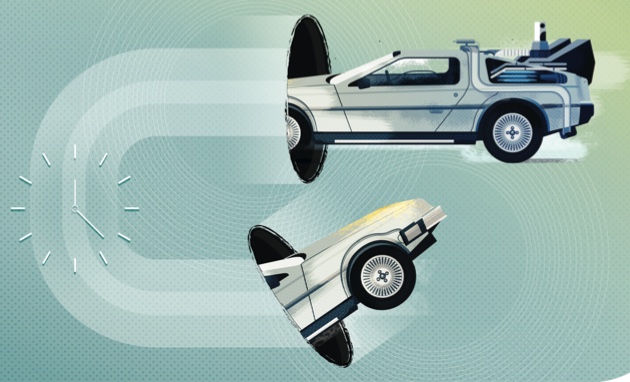
In Back to the Future, Marty McFly faces some mind-warping time
travel paradoxes. John Gribbin explains the science behind time
travel in the movies and whether travelling through time is
possible.

The Grandfather Paradox
Time travel theory
A time traveller goes back in time and either accidentally or
deliberately (if you are in a macabre mood) kills his own grandfather,
before the time traveller’s father has been conceived. So the time
traveller is never born, so he never goes back in time, so his grandad
never dies, so the time traveller is born. And so on.
In the movies
If Marty McFly accidentally prevents his own parents falling in love
and marrying, he will not exist. But as the science fiction writer
Robert Heinlein put it, “a paradox can be paradoctored.” Marty does
change the past, but in a positive way. He comes home to a different,
better future than the one he left.
Is it possible?
An idea loved by sci-fi writers, and with some basis in scientific
fact, is that all possible realities exist in some sense side by side.
These ‘many worlds’ are like the branches of a tree, each with its own
version of history. If you went back in time, into the trunk of the tree,
and then forward again, you might go ‘back’ up a different branch from
the one you came down. You go back in time and stop your parents meeting,
then forward in time up the branch in which they never met and you were
never born.
There would, though, be one timeline in which the traveller had
vanished, never to return (as in HG Wells’s original time travel story,
The Time Machine) and another with a person who has no parents.
Complicated, but not paradoxical.

The Bootstrap Paradox
Time travel theory
An item or a piece of information is passed from the future to the
past, becoming the same item that is passed from the past to the future.
In the movies
In Back To The Future, at the dance in 1955, Marty McFly gets on
stage and sings “an oldie” where he comes from: Chuck Berry’s Johnny B.
Goode. Chuck’s cousin, Marvin, is present at the dance and holds up a
phone so Chuck can listen in. Inspired by the sound, Chuck later
releases the song and Marty would then hear it in the future. But who
wrote it?
Where did this idea come from?
This theory was popularised in Robert Heinlein’s 1941 short story, By
His Bootstraps (hence the paradox's name), where a notebook is found by
the main character in the far future. He takes it, then travels to an
earlier point in the future and uses the useful translations within the
book to help establish himself as a benevolent dictator. When the
notebook becomes worn and dog-eared, he copies the information into a
fresh notebook and discards the original. Towards the end of the novel,
he muses that there were never two notebooks – the new one is the one
that was found by him when he arrived. Mindbending!
Polchinski’s Paradox
Time travel theory
If a billiard ball is rolled into the mouth of a wormhole at just the
right speed and angle, it will come out the other end just in time to
cannon into its younger self and prevent the younger self going into the
tunnel.
Is it possible?
This is one theory that is taken very seriously by scientists, and
has been discussed in research papers published in respectable journals.
Their interest is fired by the fact that there is nothing in General
Relativity that forbids time travel, and that closed time-like curves (CTCs),
or a path through space-time that ends up back where it started, at the
same point in space and time, are allowed.
Is that the full story?
Not exactly, there are also self-consistent CTCs. If the billiard
ball is approaching the mouth of the tunnel, its older self can emerge
from the second mouth and give its younger self a glancing blow exactly
right to send it through the wormhole in such a way that it will emerge
to give itself a glancing blow that does the same thing. There are many
possible consistent trajectories of this kind. In the most extreme case,
the ‘second’ ball emerges from the tunnel and knocks the ‘first’ ball
completely away, but in turn it gets deflected into the wormhole, where it
then takes the place of the ‘first’ ball.
A bunch of rather hairy calculations showed that there is never a
system like this where there are no self-consistent trajectories, and
that in some cases there can be an infinite number of self-consistent
solutions to the equations.
All of this lends weight to Russian physicist Igor Novikov’s
conjecture, sometimes more grandly referred to as Novikov’s Self-Consistency
Principle, which states that time travel is allowed, but paradoxes are
forbidden. This could resolve the Grandfather Paradox – if you go back
and try to kill your grandfather, something will always go wrong. Take a
gun to shoot him, and the bullet will misfire; poison his wine, and
someone else will drink it, and so on.

The Twin Paradox
Time travel theory
If one member of a pair of twins goes on a journey at a sizeable
fraction of the speed of light, he or she will age more slowly than the
twin who stayed at home. And when the travelling twin returns home, he
or she will be younger than the twin who stayed behind. Literally
younger, in biological terms.
In the movies
In Planet of the Apes, astronaut George Taylor, played by Charlton
Heston, and his crew spend 18 months in hibernation at near-light speed
before landing back on Earth some two thousand years into the future.
Is it possible?
This is the most scientifically sound and least paradoxical of all
time travel theories. Special Relativity tells us that moving clocks (including
biological clocks) run slow. This has been tested by experiments in
accelerators like the Large Hadron Collider. Particles with a known
lifetime when stationary in the lab ‘live’ longer when they are moving
close to the speed of light.
But hang on...
Special Relativity says that all observers are equivalent, doesn’t
it? Why can’t the travelling twin say that they are at rest, while the
Earth and the other twin go on a journey into the future? All inertial
observers, those in straight lines at constant speed relative to each
other, are equivalent. Acceleration changes the rules of the game, and
in order to get home the traveller has to decelerate and then accelerate
back in the opposite direction.
In the extreme example often used by paradoxers, this turnaround is
instantaneous. Cosmologist Hermann Bondi says that if you give each twin
a paper bag full of eggs to hold, at the end of the experiment you will
find the traveller covered in egg, while the stay at home twin is clean.
They are not ‘equivalent’. All of this can be described accurately using
equations, and the result is the same.
This kind of time travel is solid science, and it works. One snag:
unless you can find a handy wormhole, there is no way to get back from
the future. But that is a great idea for a film title…
(This article has been edited for the web. The full version of
this article appears in the Summer 2015 issue of BBC Focus magazine)
JOHN GRIBBIN is a science writer,
astronomer and astrophysicist. His books include Einstein’s Masterwork
and Timeswitch.
Return (Geri dön)
Hiçbir
yazı/ resim izinsiz olarak kullanılamaz!! Telif hakları uyarınca
bu bir suçtur..! Tüm hakları Çetin BAL' a aittir. Kaynak gösterilmek şartıyla siteden
alıntı yapılabilir.
© 1998 Cetin BAL - GSM:+90 05366063183 -Turkiye/Denizli
Ana Sayfa /
Index
/
Roket bilimi /
E-Mail /
Rölativite Dosyası
Time Travel Technology /
UFO
Galerisi / UFO Technology /
Kuantum Teleportation /
Kuantum Fizigi
/ Uçaklar(Aeroplane)
New World Order(Macro Philosophy) /
Astronomy
|
|