| |
"Our Star-Trek Future" --NASA
Scientists Engineering a Warp-Drive Solution for Faster-Than-Light Space
Travel (Today's Most Popular)
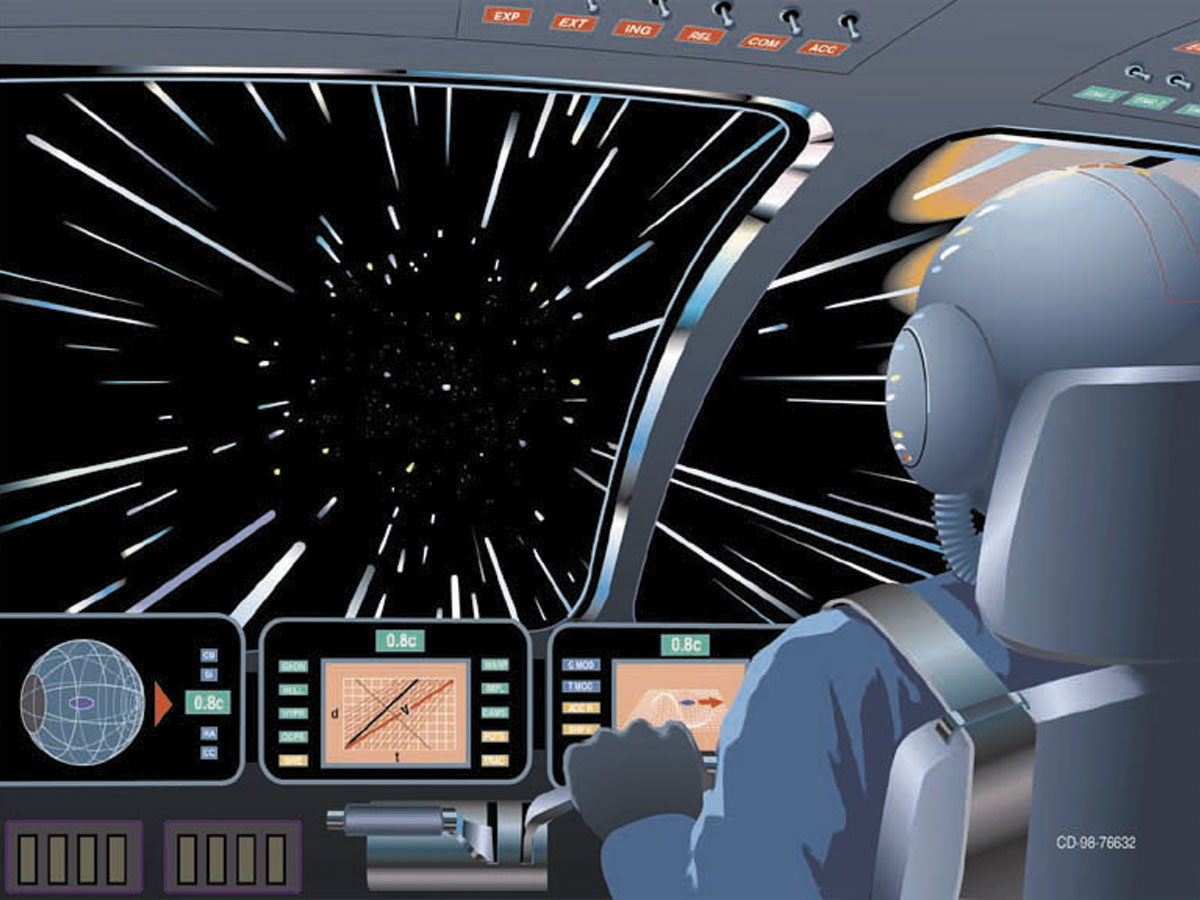
Move over Star Trek! According to state-of-the
art theory, a warp drive could cut the travel time between stars from
tens of thousands of years to weeks or months. Harold G. White, a
physicist and advanced propulsion engineer at NASA and other NASA
engineers are trying to determine whether faster-than-light travel —
warp drive — might someday be possible. The team has attempting to
slightly warp the trajectory of a photon, changing the distance it
travels in a certain area, and then observing the change with a device
called an interferometer.
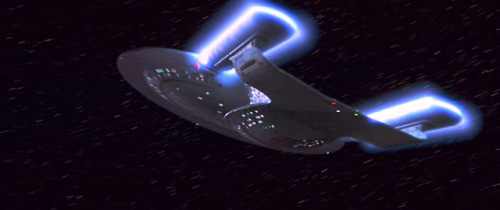
“Space has been expanding since the Big Bang 13.7
billion years ago,” said Dr. White, 43, who runs the research project
told the New York Times. “And we know that when you look at some of the
cosmology models, there were early periods of the universe where there
was explosive inflation, where two points would’ve went receding away
from each other at very rapid speeds. Nature can do it,” he added. “So
the question is, can we do it?”
In 1994, a Mexican physicist, Miguel Alcubierre,
theorized that faster-than-light speeds were possible in a way that did
not contradict Einstein by harnessing the expansion and contraction of
space itself. Under Dr. Alcubierre’s hypothesis, a ship still couldn’t
exceed light speed in a local region of space. But a theoretical
propulsion system he sketched out manipulated space-time by generating a
so-called “warp bubble” that would expand space on one side of a
spacecraft and contract it on another.
An Alcubierre Warp Drive stretches spacetime in
a wave causing the fabric of space ahead of a spacecraft to contract and
the space behind it to expand. The ship can ride the wave to accelerate
to high speeds and time travel. The Alcubierre drive, also known as the
Alcubierre metric or Warp Drive, is a mathematical model of a
spacetime exhibiting features reminiscent of the fictional "warp drive"
from Star Trek, which can travel "faster than light/"
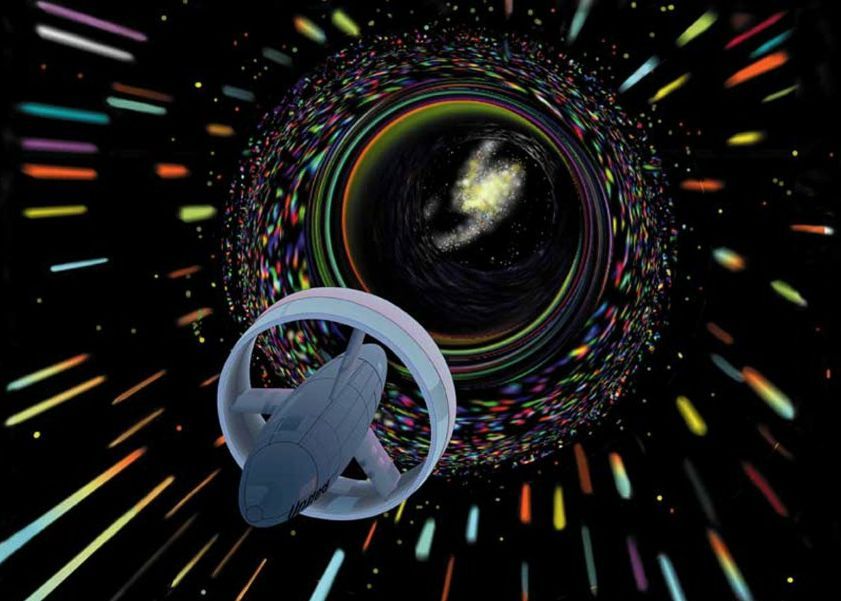
“In this way, the spaceship will be pushed away
from the Earth and pulled towards a distant star by space-time itself,”
Dr. Alcubierre wrote. Dr. White, the NYT reports, has likened it to
stepping onto a moving walkway at an airport.
Alcubierre’s theory, however, depended on large
amounts of a little understood or observed type of “exotic matter” that
violates typical physical laws.
In general relativity, one often first
specifies a plausible distribution of matter and energy, and then finds
the geometry of the spacetime associated with it; but it is also
possible to run the Einstein field equations in the other direction,
first specifying a metric and then finding the energy-momentum tensor
associated with it, and this is what Alcubierre did in building his
metric. This practice means that the solution can violate various energy
conditions and require exotic matter. The need for exotic matter leads
to questions about whether it is actually possible to find a way to
distribute the matter in an initial spacetime which lacks a "warp bubble"
in such a way that the bubble will be created at a later time.
Yet another problem according to Serguei
Krasnikov is that it would be impossible to generate the bubble without
being able to force the exotic matter to move at locally FTL
speeds, which would require the existence of tachyons. Some methods have
been suggested which would avoid the problem of tachyonic motion, but
would probably generate a naked singularity at the front of the bubble.
Dr. White believes that advances he and others
have made render warp speed less implausible. Among other things, he has
redesigned the theoretical warp-traveling spacecraft — and in particular
a ring around it that is key to its propulsion system — in a way that he
believes will greatly reduce the energy requirements. But ”We’re not
bolting this to a spacecraft,” he said of the technology.
Richard Obousy, a physicist who is president of
Icarus Interstellar, a nonprofit group composed of volunteers
collaborating on starship design, said “it is not airy-fairy, pie in the
sky. We tend to overestimate what we can do on short time scales, but I
think we massively underestimate what we can do on longer time scales.”
Dr. White likened his experiments to the early
stages of the WW11 Manhattan Project, which were aimed at creating a
very small nuclear reaction merely as proof that it could be done.
“Routine travel among the stars is impossible
without new discoveries regarding the fabric of space and time, or
capability to manipulate it for our needs,” says Neil deGrasse Tyson,
astrophysicist at the American Museum of Natural History, said “By my
read, the idea of a functioning warp drive remains far-fetched, but the
real take-away is that people are thinking about it — reminding us all
that the urge to explore continues to run deep in our species.”
Still, one of the most dubious is Dr.
Alcubierre himself. He listed a number of concerns, starting with the
vast amounts of exotic matter that would be needed. “The warp drive on
this ground alone is impossible,” he said. “At speeds larger than the
speed of light, the front of the warp bubble cannot be reached by any
signal from within the ship,” he said. “This does not just mean we can’t
turn it off; it is much worse. It means we can’t even turn it on in the
first place.”
Warp Drive May Be More Feasible Than Thought,
Scientists Say
by Clara Moskowitz, SPACE.com Assistant Managing
Editor | September 17, 2012
HOUSTON — A warp drive to achieve faster-than-light
travel — a concept popularized in television's Star Trek — may not be as
unrealistic as once thought, scientists say.
A warp drive would manipulate space-time
itself to move a starship, taking advantage of a loophole in the laws of
physics that prevent anything from moving faster than light. A concept for a
real-life warp drive was suggested in 1994 by Mexican physicist Miguel
Alcubierre; however, subsequent calculations found that such a device would
require prohibitive amounts of energy.
Now physicists say that adjustments can be made to
the proposed warp drive that would enable it to run on significantly less
energy, potentially bringing the idea back from the realm of science fiction
into science.
"There is hope," Harold "Sonny" White of NASA's
Johnson Space Center said here Friday (Sept. 14) at the 100 Year
Starship Symposium, a meeting to discuss the challenges of
interstellar spaceflight.
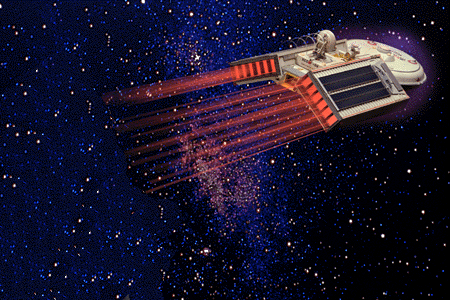
Warping space-time
An Alcubierre warp drive would involve a football-shape
spacecraft attached to a large ring encircling it. This ring, potentially
made of exotic matter, would cause space-time to warp around the starship,
creating a region of contracted space in front of it and expanded space
behind.
Meanwhile, the starship itself would
stay inside a bubble of flat space-time that wasn't being warped at all.
"Everything within space is restricted by the speed
of light," explained Richard Obousy, president of Icarus Interstellar, a non-profit
group of scientists and engineers devoted to pursuing interstellar
spaceflight. "But the really cool thing is space-time, the fabric of space,
is not limited by the speed of light."
With this concept, the spacecraft would be able to
achieve an effective speed of about 10 times the speed of light, all without
breaking the cosmic speed limit.
The only problem is, previous studies estimated the
warp drive would require a minimum amount of energy about equal to the mass-energy
of the planet Jupiter.
But recently White calculated what would happen if
the shape of the ring encircling the spacecraft was adjusted into more of a
rounded donut, as opposed to a flat ring. He found in that case, the warp
drive could be powered by a mass about the size of a spacecraft like the
Voyager 1 probe NASA launched in 1977.
Furthermore, if the intensity of the space warps
can be oscillated over time, the energy required is reduced even more, White
found.
"The findings I presented today change it from
impractical to plausible and worth further investigation," White told SPACE.com.
"The additional energy reduction realized by oscillating the bubble
intensity is an interesting conjecture that we will enjoy looking at in the
lab."
Laboratory tests
White and his colleagues have begun experimenting
with a mini version of the warp drive in their laboratory.
They set up what they call the White-Juday Warp
Field Interferometer at the Johnson Space Center, essentially creating a
laser interferometer that instigates micro versions of space-time warps.
"We're trying to see if we can generate a very tiny
instance of this in a tabletop experiment, to try to perturb space-time by
one part in 10 million," White said.
He called the project a "humble experiment"
compared to what would be needed for a real warp drive, but said it
represents a promising first step.
And other scientists stressed that even outlandish-sounding
ideas, such as the warp drive, need to be considered if humanity is serious
about traveling to other stars.
"If we're ever going to become a true spacefaring
civilization, we're going to have to think outside the box a little bit,
we're going to have to be a little bit audacious," Obousy said.
From Warp Drives to
Cloaking Devices: Star Trek Cosmic Queries Sunday
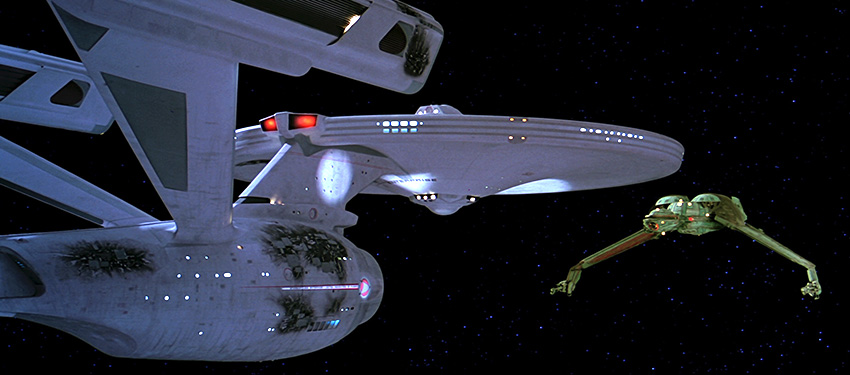
The USS Enterprise vs. a Klingon
Bird of Prey from “Star Trek III: The Search for Spock.” © 2015 CBS Studios
Inc All Rights Reserved. STAR TREK and related marks are trademarks of CBS
Studios Inc.
Star Trek warped into our public consciousness on September 8, 1966 when The Man Trap aired on NBC.
That means for many of us, we’ve been talking about
warp drives and transporter beams and phasers for most of our lives. Alien races
like the Klingons and Romulans became more familiar to some of us than actual
foreign cultures here on our home planet.Here at Star Talk, we’ve explored Star
Trek in more than a couple of episodes. In Season 1, Episode 4, Neil explored
The Science of Star Trek with guest physicist Lawrence Krauss. In Season 2, Neil
had A Conversation with Nichelle Nichols, who played Lt. Uhura on Star Trek,
which he continued in NASA and Nichelle Nichols. Later that season, Neil also
had A Conversation with Whoopi Goldberg who played Guinan on Star Trek: The Next
Generation. In Season 3, Neil spoke to Whoopi’s fellow ST:TNG actors Brent
Spiner and LeVar Burton in The Best of Both Worlds.
Leighann Lord was the comic co-host for The Best of Both Worlds, where we found
out that she is a self-proclaimed “geek-girl” and Trekker. Well, Leighann is
back this week to help Neil deGrasse Tyson answer your Cosmic Queries about all
things Trek.
For some of you, these questions may have waited nearly 50 years to be answered.
Questions like how do cloaking devices work, and how come the Romulans and the Klingons have them but the Federation doesn’t?
Or, how could the body that gets reassembled on the destination end of a transporter beam ever possibly be the real you, complete with all your thoughts, and dreams, and memories?
Or, if the Klingons are so warlike, how did they ever even survive to make it off planet to become one of Captain Kirk’s biggest enemies?
Or, if Geordi La Forge’s multi-spectrum visor is so superior to human sight, why don’t more people in the future use one?
Or, if the Alcubierre Warp Drive… well, you get the point.
You’ve got questions. Neil’s got answers. Join us Sunday, February 22 at 7:00 PM ET on our website, iTunes, Stitcher, TuneIn and SoundCloud.
(And to answer one of your questions myself: this show is prerecorded, so there is no place to send your Cosmic Queries now for this episode. We asked our fans to provide these questions a while back, on Twitter, Facebook and Google Plus.)
That’s it for now. Keep Looking Up!
–Jeffrey Simons
Warp Drive - could such a thing actually be built?
The "Warp Drive" is quite a well-known concept,
chiefly because of the sci-fi series "Star Trek", with Captain Kirk
frequently calling out things like, 'Warp factor eight, Mr Chekov'. But,
could such a thing ever be built in reality?
Well, first of all, let's examine the science
behind the USS Enterprise's "hyperdrive", as it was called in the pilot
episode. Apparently, the huge amounts of energy required for the warp drive
was generated by bringing together amounts of deuterium and anti-deuterium
in a reaction controlled by dilithium crystals. This energy then generated
an area of "subspace", containing the ship in a bubble of normal space.
Within subspace, the constraints of normal space didn't apply, enabling the
Enterprise to exceed light speed by many factors (the different warp speeds).
All well and good, but lets hold this up against real science.
One, it is true that the mutual annihilation of
matter and antimatter would result in tremendous amounts of energy, but the
problem is, antimatter would be very difficult to produce in the large
quantities required.
Two, there is no such element as "dilithium",
whether crystal or not (although two atoms of lithium bonded together are
known as a dilithium molecule.)
Three, there is no such thing as "subspace".
So, is an honest-to-goodness warp drive possible in
reality?
The Alcubierre Drive
In 1994, Mexican physicist Miguel Alcubierre (who
was also an avid Star Trek fan) decided to look into the possibility of
building a real "warp drive" - that didn't violate Einstein's general theory
of relativity.
This states that matter cannot be accelerated up to,
and beyond, the speed of light. So Alcubierre had the idea that, like in
Star Trek, the spaceship would be contained within a bubble, around which
space itself would be manipulated.
It is known that space can be affected by gravity
and that it can be stretched (as the Universe expands, so does space).
Alcubierre proposed that, if space can be compressed in front of the bubble
and expanded behind it, then the bubble would be carried along by the
resultant "wave", reaching its destination in less time than a beam of light
would. It doesn't flout Einstein's theory, because, within the bubble, the
ship is isolated; it is not travelling faster than light because it is space
itself that is moving (and space can travel faster than light).
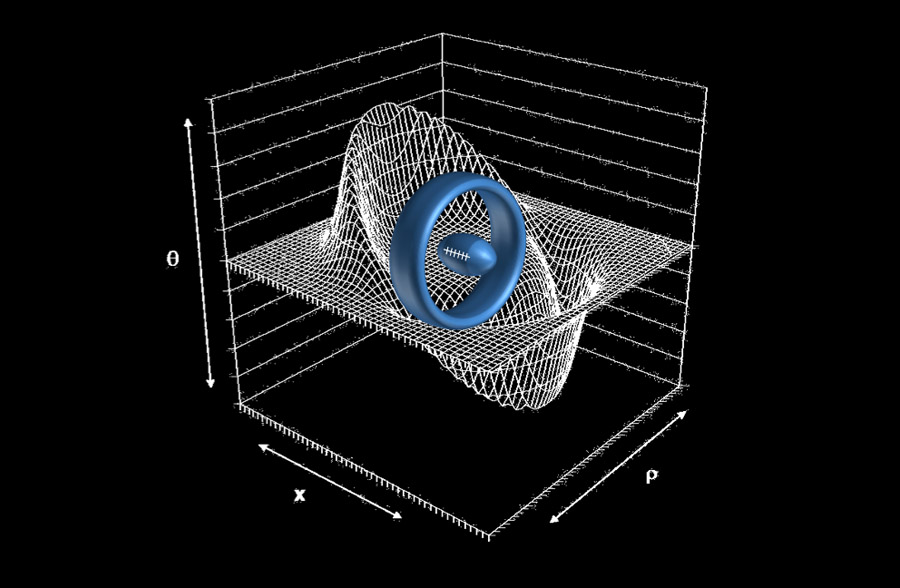
Here you can see a NASA depiction of the Alcubierre
drive, showing the lattice of space-time in three dimensions, instead of the
actual four. The raised portion is the expanded space and the lowered
portion the compressed. Any object residing within the circular bit between
them doesn't experience any feeling of motion, yet is being carried along
from left to right by the wave. Space is being "warped"!

Can It Actually Be Done?
Alcubierre envisioned a spaceship surrounded by a
flat ring, which would have to consist of "exotic" matter, something like
this:
Here we have the first problem. "Exotic matter"
consists of particles that deviate from known properties of standard
particles and are, in many cases, theoretical. The goal of the Alcubierre
drive is to produce negative energy, however, and physicists are currently
conducting experiments to create this type of energy.
But then, we have the second problem. One estimate
of the energy required to enable a vessel to go gallivanting across the
Galaxy is the mass-energy equivalent of the whole of the observable Universe.
Alcubierre was a little more conservative, suggesting that the mass-energy
equivalent of something like the planet Jupiter would be required. When you
consider how much energy (explosive power) is released by a nuclear weapon
with a plutonium core with a diameter of a matter of inches, you'll realise
what sort of energy amounts we're looking at.
Bringing The Dream Closer
In 2012, NASA physicist Harold White returned to
Alcubierre's equations and calculations and had a "eureka" moment. He
realised that, if the flat ring round the spacecraft was altered in shape,
to more resemble a donut, then the energy required would be greatly reduced
- to something that was within the realms of possibility.
He is leading a NASA team to create a warp drive!
Experimentation is very much in its infancy. An
instrument called an interferometer is being used to measure minute
anomalies in spacetime. Lasers are being used to affect these anomalies,
producing a microscopic Alcubierre drive.
Another test involves a ring of ceramic capacitors
that are charged to tens of thousands of volts. The aim is to create
negative vacuum energy.
So, as NASA is now on the case, a warp drive may
one day become a reality.
To Put Things In Perpective
Before you think that a warp drive will allow a
spacecraft to dash about the Galaxy in hours, consider this:
According to the Star Trek encyclopedia, warp
factor 9.99, in the original series, is 997 times the speed of light.
It would take a ship travelling at that warp factor
over 100 years to cross the Galaxy.
Physics uses warp theory to look beyond relativity
14 December 2015
By Chris Edwards

The Destroyer is capable of hyperspace
travel, overcoming the constraint of lightspeed
Experiments to examine the possibility of making a
real-life warp drive may fail, but they teach us a lot more about the
limits of the universe and the physics that describes it.
Is there a way past the light barrier? The signs
have not been good for more than a century. The experiments that led up to
Einstein’s publication of the theory of special relativity 110 years ago in
his 'annus mirabilis' seemed to rule it out completely for anything made out
of normal matter.
Jules Henri Poincaré worked on predecessors to
Einstein’s theories. He remarked on the apparent “conspiracy of dynamical
effects” which caused apparent time and distance to alter according to the
speed of an object following an 1887 experiment performed by Albert
Michelson and Edward Morley that failed to obtain the results anyone at the
time expected.
Under conventional Newtonian physics, light
travelling in the direction of the Earth’s rotation around the Sun should
have appeared to have a different speed from that of light travelling at
right angles. It remained resolutely, suspiciously constant. Distances
compress and time slows enough to make the velocity of light stay constant.
Einstein’s later paper on general relativity only
served to seal the prohibition on travelling faster than light (FTL).
Developed upon special relativity, the general theory built in the effects
of gravity with the result that mass, time and energy are so intertwined
that any attempt by normal matter to get even close to the speed of light
will be stymied. Increasing velocity to relativistic levels sees most of the
energy used going disproportionately to the mass part of the equation that
governs momentum. Only truly massless particles can travel as fast as a
photon in a pure vacuum.
Bending the dimensions
Space opera science fiction like Star Wars hand-waves
the problem away, but not without a nod to the impossibility of FTL travel
under Einstein’s laws. Science-fiction writers tried to conceptualise ways
around the light barrier that did not fly in the face of modern physics.
They did so in a way that mirrors the approach some physicists are taking to
consider the problem today.
John Campbell first used the name ‘hyperspace’ in
‘Islands of Space’ in 1931, where he advanced the idea that there was a
fourth spatial dimension able to support much faster travel than the three
to which we are normally limited. It became the model for representations of
faster-than-light travel for most writers since then, whether it is Star
Wars, Star Trek or a thousand other mythical scenarios.
Theories of physics that attempt to reconcile the
quantum world with relativity have postulated the existence of additional
spatial dimensions: the mathematics of superstring theory gave spacetime a
total of ten. However, these theories cause the extra dimensions to wrap
themselves up in such a way that they are microscopic - which is not a great
help to FTL travel. An alternative is to bend the dimensions we do have.
For his proposal for a faster-than-light drive that
might just work 21 years ago, Miguel Alcubierre, a researcher at the
National Autonomous University of Mexico (UNAM) took inspiration from the
mechanics of the early universe and came up with an idea that, despite being
termed a ‘warp drive’ - akin to that used by ships in Star Trek, was closer
to the description of ‘folding space’ used by Frank Herbert in his 1965
novel ‘Dune’.
The rapid expansion of space shortly after the Big
Bang, known as inflation, resulted in parts of what was then a tiny universe
flying apart at speeds much faster than that of light. They were not moving
that fast by conventional measures; space was simply pushing them apart.
Making a bubble
“The idea was inspired by inflation, but it didn’t
need to be. It is also a thought experiment about what is possible or not in
general relativity. It shows that moving ‘faster than light’ in the sense of
space expanding is not in contradiction with relativity,” Alcubierre says.
Alcubierre’s idea was to consider how the expansion
and collapse of space could be harnessed by a craft trying to travel to a
distant star. His ‘warp bubble’ concept puts the craft in a region of normal
spacetime that has, in front of it, some way of collapsing space. Behind it,
a reverse process re-expands space behind the craft. The craft itself does
not move across space at all - it is the space in which it sits that moves.
As well as moving faster than light, the craft and
its occupants would not experience the time dilation effects that would
affect any craft travelling at relativistic, sub-light speeds. Thus,
astronauts turning round and coming back the other way would not find
themselves meeting the grandchildren of their long-dead siblings on
returning. If the journey to Alpha Centauri took a year, a year would elapse
in ‘spacecraft time’.
Yet there is a catch. As time has moved on since
Alcubierre presented his idea, he, together with other scientists, has
described a number of potentially insurmountable problems. The most
immediate is getting space to collapse and expand in a controlled way around
the craft. To get any appreciable effect, the curvature of spacetime has to
be dramatic - on the scale of a black hole. Plus the bubble needs to bend
space dramatically the other way - approximating the effects of a white hole
complete with effects that reverse those of gravity.
To form the bubble and make it move, we do not just
need the equivalent of negative mass, we would need negative energy - or at
least a way of generating a negative energy density in a region of spacetime.
That seems impossible knowing what we do today, but it might be possible to
find both.
The universe could reveal the presence of both
negative mass and energy. Quantum theory makes tiny amounts of negative
energy density possible through the Casimir effect, although Alcubierre
points out that it is not clear that the effect is usable on any practical
scale. Some theories of the inflation of the early universe call for a
negative energy density that could have been the result of a separation of
the strong nuclear force from other fundamental forces. This led to the
universe being many, many times larger than what we can observe today.
Negative mass that displays the properties of anti-gravity may also have
played a role in the expansion of the universe.
Even if it becomes feasible to synthesise negative
mass and negative energy, there is a further problem with the Alcubierre
drive according to our current understanding of physics, which Alcubierre
calls the ‘horizon problem’. The craft cannot reach the front of the bubble
with any signal - it has to be set up by something else moving ahead.
Models of time travel
Compressing space on its way to another star at
superluminal speed, the bubble would encounter highly blue-shifted radiation.
The craft inside might escape the immediate results while travelling because
the radiation slamming into the bubble head on would wind up stored inside -
until the bubble is collapsed to let the craft fly to a nearby planet. The
energy released as the spacetime bubble collapses would sterilise - if not
destroy - nearby planets. In effect, you would not only have a method for
travelling quickly between the stars, you would get the power of a Death
Star thrown in.
“When the spacecraft decelerates to stop at its
destination, the particles collected at the front of the spacecraft are
released with such high energy that they would destroy anything they came in
contact with,” says Professor Geraint Lewis of the University of Sydney. He
and graduate students Brendan McMonigal and Philip O’Byrne calculated the
effects for a paper published in 2012.
There is at least some good news: you can put
anything you like inside the bubble. The amount of mass inside the bubble
has no effect on how much exotic matter might be needed to form the bubble
in the first place. You might as easily pack a fleet of Imperial Star
Destroyers into one as a Millennium Falcon.
More good news arrived in 2010 when Igor
Smolyaninov of the University of Maryland showed it should be possible to
simulate in a model universe analogous behaviour to that of an Alcubierre
warp. He proposed that some newly developed magnetoelectric metamaterials
should be able to show, at least in a one-dimensional ‘space’, that the warp
concept is workable at sublight speeds.
The magnetoelectric subsceptibilities of
conventional magnetics are too small to be useful by two orders of magnitude,
but metamaterials make the values reachable.
Smolyaninov says: “At the heart of transformation
optics you find equations that are almost the same as those in relativity.”
Experiments performed to test general relativity
suffer from the limitations of what we can discern in normal spacetime with
conventional matter and energy. “When you start with optical models, your
limitations are much less strict,” says Smolyaninov. “You can achieve
parameters that go beyond general relativity.”
In Smolyaninov’s models, properties such as
magnetic permeability and permittivity as modelled by Maxwell’s equations
replace those used to predict the behaviour of masses and energy in general
relativity. Those properties are normally positive. However, thanks to
metamaterials, it is possible to create situations where permeability as
well as permittivity can be negative. “So you can design quite unusual
spacetimes and go beyond general relativity,” he adds.
As a result, the use of metamaterials can extend well beyond determining
whether a highly theoretical warp drive might have a shot at success. The
approach can potentially tell us much more about the construction of the
universe.
Although funding was not available to test the
behaviour of Alcubierre’s proposal on a metamaterial analogue, Smolyaninov
has worked on other experiments designed to use electromagnetic behaviour as
way of investigating what might happen at the extremes of relativity in the
universe.
In one experiment, Smolyaninov worked with Yu-Ju
Hung to build a metamaterial model designed to test the idea of whether time
travel might be possible. They built a metamaterial in which one of the
spatial coordinates could be considered to have timelike behaviour. In
normal spacetime, the time dimension is represented using complex numbers
rather than real numbers. Many electromagnetic properties follow the same
timelike pattern.
Originally, the researchers had attempted to use
the metamaterial to create closed timelike curves - circular paths in
spacetime that allow particles to return to the point in time where they
started. These are allowed by one solution to the equations of general
relativity, but they found restrictions on the way that light rays can move
through a metamaterial such that even closed paths were not truly timelike.
The result suggested that, based on the optical model, time travel is
unlikely.
Simulating relativity
The work with metamaterials may reveal clues to the
beginnings of our own universe and even its existence within a larger
multiverse. The spreading of mass and energy across the universe continues
to puzzle scientists as it is difficult to reconcile with the classic Big
Bang model. One possibility is that a Big Flash happened soon after the
initial expansion that changed spacetime as a whole. The proto-spacetime may
have exhibited not just one temporal dimension, but two. In the Big Flash
theory, however, a ‘metric signature’ transition occurred that provided us
with the familiar spacetime we know today.
Smolyaninov’s aim is to work with ferrofluids that
have optical properties that show similar effects to a metric signature
change as nanostructures inside them ‘melt’.
“Your metamaterial divides into chunks of [conventional]
spacetime, separated by regions of other types of space. That’s similar to
some models of the multiverse,” Smolyaninov says. “We don’t really know if
the observations of these optical systems are related to our own life. But
it is quite instructive to look at what happens in these experimental
systems that we can probe directly and then see what matter does.”
Metamaterials experiments may help shed light on
whether antimatter exhibits anti-gravity rather than normal gravity, but
still have positive inertial mass. The existence of matter with both
negative inertial and gravitational mass can cause problems for the models
of motion suggested by general relativity. Large negative and positive
masses brought close to each would not just repel each other; they could
potentially chase each other around the universe and yet exhibit zero total
momentum. By working on analogues of negative matter, it might be possible
to see whether other behaviour might be expected and what to look for in the
observations of the real universe.
Alcubierre, among others, is working on other
aspects of the impact of relativity on astrophysics using computer
simulations. “Numerical relativity models violent events such as supernova
core collapse and collisions of compact objects - neutron stars and black
holes. It predicts the emission of gravitational waves that have so far not
been detected, but this can change in the next couple of years,” he says.
Telescopes such as the BICEP2 instrument close to
the South Pole have been built to watch for the remnants of massive
gravitational waves.
At the same time, scientists are looking for anti-gravity
in the physical universe. The GBAR experiment at CERN aims to perform a
direct experiment on atoms of anti-hydrogen made in the particle accelerator
- by trying to gauge whether the particles tend to fall up instead of down
in Earth’s gravity.
Although the warp drive looks extremely improbable
from the perspective of today’s physics, it may not be completely impossible.
Experiment at the microscopic scale coupled with observations at the
astronomical scale could find out which is the case.
Polarisation Diagram: Gravitational Wave
Scientist Miguel Alcubierre has suggested that
Star Wars spacecraft could reach distant stars by sitting in a ‘warp
bubble’ while space collapses and expands around it.
Astrophysicists believe that in the real universe
examples of such movements in space might exist in the form of
gravitational waves discernible in the polarisation patterns of the so-called
cosmic microwave background (CMB), which is the oldest light in the
universe and is observed as a ‘glow’ that has tiny temperature
fluctuations. Gravitational waves would predate the CMB, originating from
a period of very rapid cosmic inflation thought to have occurred shortly
after the Big Bang.
The diagram shows how a gravitational wave would
stretch and squeeze space perpendicular to its direction of travel to
produce a polarisation pattern.
Scanning for signals from the dawn of time
The BICEP2 telescope is one of a series of
instruments that have been deployed at the Amundsen-Scott South Pole
Station by a group of mostly North American institutions to study the
cosmic microwave background (CMB).
BICEP2 operated from 2010 to 2012, and in 2014
researchers analysing the data announced that they had found curly
‘B-modes’ in the observed polarisation pattern, which could have been
caused by gravitational waves originating from very early in the history
of the universe. This discovery attracted great attention.
However, interstellar dust also emits polarised
light, which can affect CMB polarisations. In September 2014, observations
from the European Space Agency’s Planck satellite showed that polarised
emissions from Galactic dust were much higher than expected, and
significant even in the ‘clean’ South Pole sky, casting doubt on the
earlier report.
The Planck and BICEP2 teams then combined their
space and earth-based observations, along with South Pole data from the
more recent Keck Array. Their conclusion: gravitational waves may exist,
but we haven’t found them yet.
5 Faster-Than-Light Travel
Methods and Their Plausibility
Science tells us that it is impossible for an object to travel at light
speed, let alone faster than that. But so many of our favorite
science-fiction movies, games, and TV shows rely on faster-than-light
travel to craft their interplanetary adventures.
Let's take a look at five means of FTL found in
sci-fi that don't break the rules of relativity and examine how
plausible they are based on the science behind them.
1. Hyperdrive
Popularized by Star Wars and used
extensively in fiction, a hyperdrive enables a spaceship to travel at
FTL speeds by entering another dimension known as "hyperspace." The
spaceship isn't actually traveling faster than the speed of light, but
rather is making use of hyperspace as a shortcut, and the hyperdrive is
the mechanism that shunts the spaceship into and out of this parallel
dimension.
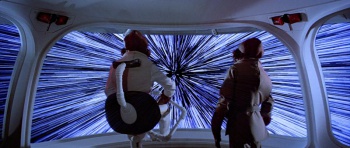
Specific coordinates within hyperspace have
corresponding coordinates in normal space, but the distance between
those two points will be shorter in hyperspace, allowing for a faster
journey. Before making a "hyperspace jump," calculations must be made to
find the matching coordinates between hyperspace and normal space in
order to know when and where to exit hyperspace at the desired normal
space destination.
Is it plausible?
Physicist Bukrhard Heim proposed a theory in
1977 that FTL travel may be possible by using magnetic fields to enter
higher-dimensional space. The theory uses a mathematical model that
calls upon six or more dimensions in an attempt to resolve
incompatibilities between quantum mechanics and general relativity, but
Heim's ideas have not been accepted in mainstream science. Still, the
fact that a theoretical physicist devoted a large portion of his life in
pursuit of a theory that could lead to a means of space travel lends the
concept of hyperspace a little more credibility than if it were simply
the fancy of a sci-fi writer.
2. Jump Drive
Seen in such works as Battlestar Galactica,
a jump drive allows for instantaneous teleportation between two points.
Similar to a hyperdrive, coordinates must be calculated to ensure a safe
jump; the longer the desired travel distance, the more complex the
calculation. In theory, there is no limit to how far a jump can take a
ship, but an incorrect calculation may result in a catastrophic
collision with a planet or space debris.
The Dune universe's FTL, based on the
fictional "Holtzman effect," can also be considered a jump drive.
Is it plausible?
Master of hard sci-fi Isaac Asimov was the
first to suggest the idea of a jump drive in the Foundation
series, which lends some credibility to the idea. However, most fiction
doesn't clearly explain the principles of physics that allow for this
teleportation, making it impossible to claim a jump drive as plausible.
However, if it functions by opening a wormhole...
3. Wormholes
A wormhole, as seen in the Stargate
franchise, allows for near-instantaneous travel across vast distances.
Wormholes may be naturally-occurring or man-made, but are almost always
temporary and serve as tunnels through spacetime.

Imagine our universe as a piece of paper, and
an ant walking on that piece of paper as a spaceship. If the ant wants
to walk from one end of that piece of paper to the other, the fastest
way to do so would be to travel in a straight line. But paper, like
space, bends. If you bend the paper into a U shape, the ant's journey
goes largely undisturbed - it still has to traverse the same distance
along that line. However, in 3D space, the two ends of the paper are
very close to each other now. Cut off a piece of a drinking straw and
let the ant use it as a bridge or tunnel between the two ends of the
paper, and the journey is suddenly much shorter.
Is it plausible?
While we have never directly observed any
evidence for one, wormholes are theoretically possible. Albert Einstein
and his colleague Nathan Rosen first discovered wormholes in 1935 as
solutions to equations within Einstein's general theory of relativity -
the math says they can exist.
Since then, other scientists, including Stephen
Hawking, have argued that it may be possible to traverse a wormhole,
under the right circumstances. The debate surrounding wormholes isn't
about their plausibility, but rather how they may be created and
sustained.
4. Slipstream
The concept of slipstream can be found in such
works as Star Trek, Doctor Who, and the Halo
video game franchise, but there is no widely-agreed upon definition of
what slipstream is or how it works beyond it being a means of FTL. We'll
consider the slipstream seen in Gene Roddenberry's Andromeda,
where it is "not the best way to travel faster than light, it's just the
only way," as per the show's protagonist.
Slipstream is a form of interdimensional
highway in which ships ride a series of slipstream "strings" - the
unseen connections between all objects in the universe. These strings
are in constant flux and form a tangled mess of intersections and
divergent paths. Any time a pilot reaches a fork in the road, he has to
guess which is the correct path to take to continue along toward his
desired destination. Before the pilot makes that decision, both paths
are simultaneously the correct and incorrect route, and it is the act of
choosing a path that forces one to be correct and the other to be
incorrect - if this made you think of Shrödinger's cat, that does seem
to be the basis for this concept. A computer selects the "correct" path
50% of the time, but due to intuition, a human picks the correct path
99.9% of the time.
Is it plausible?
There are no mainstream scientific theories
that support this idea of slipstream. Reading the "lore" of this means
of FTL evokes fantastical interpretations of string theory, quantum
entanglement, and other concepts in modern physics, but the ideas are
supported only through their internal consistency rather than actual
fact, much like a well-explained magic system that allows fictional
wizards to cast spells.
5. Warp Drive
Popularized by Star Trek, a warp drive
distorts space around a ship while leaving the ship itself inside a "bubble"
of normal space. The space in front of the ship is contracted, while the
space behind it is expanded, and the ship "rides" the distortion wave at
FTL speeds. Technically, it is not the ship that is moving, but rather
space itself, which is how we avoid breaking any laws of physics.
Imagine a surfer slowly paddling back to shore.
When a wave comes, it will lower the water level in front of him and
raise the water level behind him, and he can ride the downward slope all
the way to shore. Relative to the wave, the surfer isn't moving - he's
staying between the crest and the trough, and it is instead the wave
that is moving.
Surfing doesn't quite work like that,
but it's a simplification that we can all visualize. In a similar manner
to how a wave will distort water to propel a surfer, a warp drive will
distort space to propel a ship.
Is it plausible?
In 1994, the Alcubierre drive was proposed as a
theoretical means of FTL travel and is based on a mathematical solution
to equations within Einstein's general theory of relativity. Just like a
warp drive, the Alcubierre drive would contract space in front of a
spaceship and expand space behind it.
NASA has been actively researching this
technology since 2012, and the lead researcher even worked with a 3D
artist to develop a model of what a warp-capable ship might look like.
As far as real-life FTL goes, warp is the current front-runner to
becoming reality.
As far as real-life FTL travel goes, the
fictional favorites can be found in Star Trek and Stargate:
the warp drive, and wormholes. Both are theoretically possible; however,
both require further scientific breakthroughs before practical testing
can begin. In either case, we need to discover "exotic matter" -
hypothetical particles with negative mass - to get these mechanisms to
work. "Element zero" from the Mass Effect series, the rare
material that is essential to FTL travel in that universe, doesn't quite
fit the description, but the lore is at least scientifically sound in
suggesting that some new, rare form of matter is required to make this
technological leap.
The good news is that scientists don't believe
this is a matter of if, but rather when. There will be a time
in the future when a stately, bald man in uniform will sit back in a
command chair and relay the order, "Engage."
Hiçbir
yazı/ resim izinsiz olarak kullanılamaz!! Telif hakları uyarınca
bu bir suçtur..! Tüm hakları
Çetin BAL' a aittir. Kaynak gösterilmek şartıyla siteden
alıntı yapılabilir.
© 1998 Cetin BAL - GSM:+90 05366063183 -Turkiye/Denizli
Ana Sayfa /
Index
/
Roket bilimi /
E-Mail /
Rölativite Dosyası
Time Travel Technology /
UFO
Galerisi /
UFO Technology /
Kuantum Teleportation /
Kuantum Fizigi
/ Uçaklar(Aeroplane)
New World Order(Macro Philosophy) /
Astronomy
|
|