
In theory, Star Trek-style warp drives are possible – but they could come with a bit of a downside. Illustration: Ben Gilliland
In the 20th and 21st centuries, when people wanted to traverse the country in comfort and style they took their trusty VW Camper van. Powered by a 1.6-litre air-cooled engine, the vehicle transported its occupants from London to Cornwall in a matter of hours. But, by the 23rd century, travellers were no longer content with pasties and cream teas – and they were aiming for the stars.
They soon realised the VW’s trusty petrol engine wasn’t up to the job (it would take millions of years just to reach the nearest star) so someone invented the ‘warp drive’, fitted it to their VW, and the ‘interstellar’ camper van was born.
We are all familiar with Star Trek’s version of the space-cruising camper, the USS Enterprise, that allows Kirk and Spock to zip between stars, but surely warp-driven VWs are the stuff of science fiction?
If you want to travel between different star systems (without dying of old age along the way) you need to move faster than the speed of light.
Unfortunately, Einstein proved that you can’t do this because, as an object approaches light speed, it requires more and more energy until the energy that is needed becomes infinite.
However, in 1994 a theoretical physicist called Michael Alcubierre came up with a theoretical faster-than-light propulsion method called the Alcubierre drive.

Using this, the fabric of space is manipulated to expand behind the camper and contract in front of it.
Safe inside a bubble of stationary space, the camper van would be able to traverse the universe at faster-than-light speeds without ever physically moving.
Everything was looking good for the future of the interstellar camper van (leaving aside the practicalities of ‘warping’ space and time) – until now.
Researchers from the University of Sydney have been using super computers to simulate a faster-than-light journey made using an Alcubierre drive and have come to a disturbing conclusion: when the camper van stops, it will destroy everything at its destination.
They found that, as the ‘warp bubble’ travels through space, it creates a shock wave ahead of it.
Tiny particles get ‘swept up’ and trapped in the shock wave where they build up unlimited amounts of energy. When the camper van comes to a stop, all that energy is in a ‘death’ beam that would obliterate everything in front of it.
Graphic: How a warp drive could become a doomsday machine.

...to warp spacetime and make biggerer
Of course, the fact that warp drive could turn out to be the ultimate doomsday device is the least of its problems.
Alcubierre’s original design called for the creation of a ‘negative energy’ bubble that would distort the fabric of space time around it – just as a massive object like the Earth does but in a much more extreme fashion.
Unfortunately, an impossible amount of energy would be required to make such a bubble.
It would also require some sort of ‘exotic matter’ (which exists only in theory and, by definition, violates the laws of physics), and would require an amount of this exotic matter equal to 10billion times the total mass of the observable universe – that’s a lot of matter, by the way.
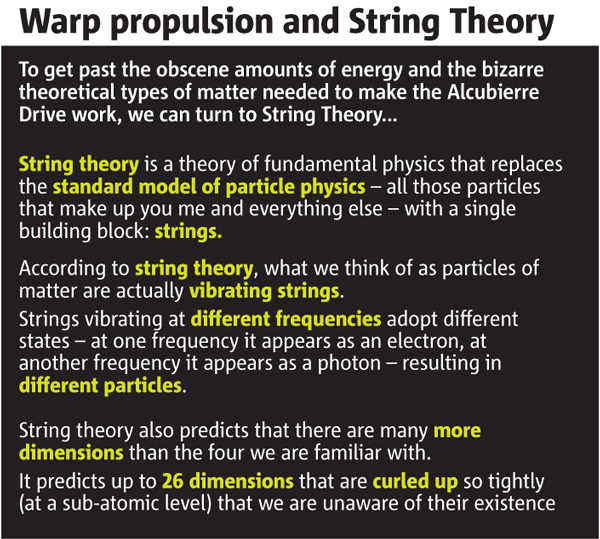
In theory, you can get round this by taking advantage of an area of physics called string theory (see graphic above) – but it will probably be some time until you can swap your petrol engine for a warp drive and go where no camper van has been before.
