Gravity Probe B gets heavy with gravity
It has taken 52 years, but one of Nasa’s longest-running projects
has helped confirm Einstein’s genius once again.
The Gravity Probe B experiment used four perfectly engineered
gyroscopic spheres to put two of Einstein’s key predictions about
the nature of gravity to test.
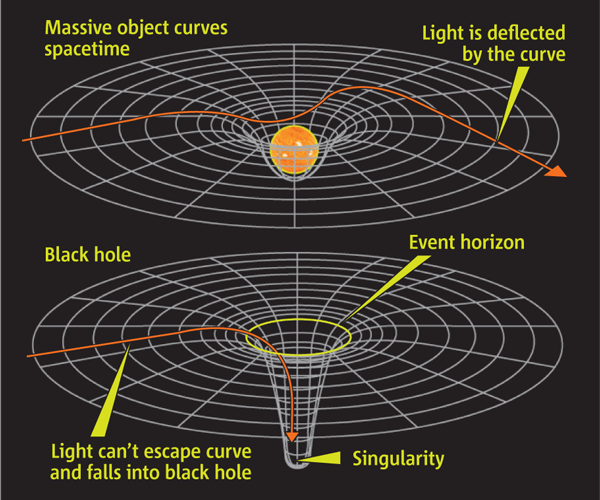
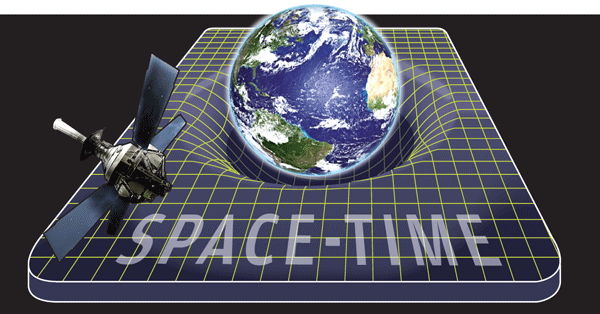
His theory of relativity predicted that a massive object, such as
Earth, would bend and twist the four-dimensions of space-time (three
dimensional space merged with time) around it.
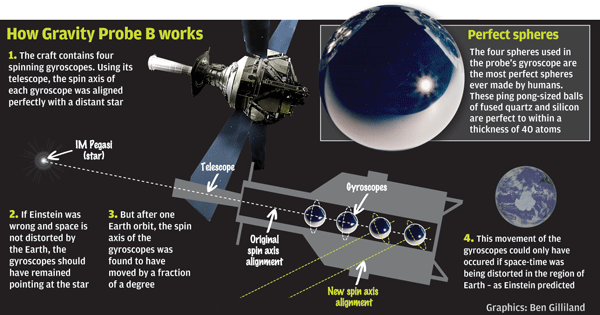
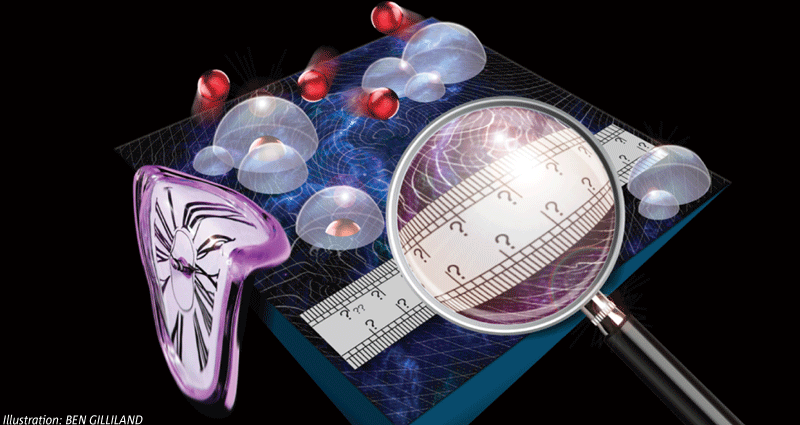
[Gravity Probe B was designed to make ultra-precise
measurements of the Earth gravitational effect on space-time – ]
Gravity Probe B was launched in 2004, but its development started
way back in 1964 and faced colossal technological challenges. The
craft had to have the most precise star trackers and gyroscopes ever
built and had to operate free from the effects of drag, magnetism
and variations in temperature.
This level of precision was required because it was looking for
shifts in the alignment of its gyroscopes that equate to the width
of a human hair seen from 100 miles away.
The findings are published in the journal Physical Review Letters.
The trouble with gravity
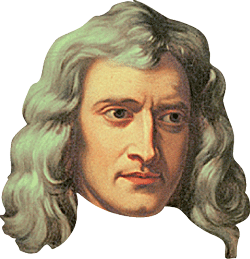
 For
more than two hundred years, Isaac Newton’s law of gravity reined
supreme. According to Newton’s theory, the force of gravity acts
instantaneously – if the Earth were to become suddenly heavier, then
every other object in the solar system would feel the change in the
same instant.
For
more than two hundred years, Isaac Newton’s law of gravity reined
supreme. According to Newton’s theory, the force of gravity acts
instantaneously – if the Earth were to become suddenly heavier, then
every other object in the solar system would feel the change in the
same instant.
But, in 1906, Einstein came along and published his theory of
‘special relativity’, which showed that nothing can travel faster
than the speed of light.
The instantaneous nature of Newton’s gravity was incompatible
with special relativity’s universal speed limit.
In 1916, Einstein published his theory of ‘general relativity’.
According to Newton, space was just the stage on which the laws of
physics played their parts. In his general theory, Einstein showed
that space and time are also players on the stage. Mass causes space
to curve and space causes mass to move.
What is ‘Einstein’s’ gravity?
According to Newton, all objects with mass have a gravitational
influence on each other – a heavy object pulls lighter objects
towards it; a light object is pulled toward a heavy object.
But, according to Einstein, massive objects have no direct
influence on each other at all. Instead, gravity is caused by a
massive object bending space-time.
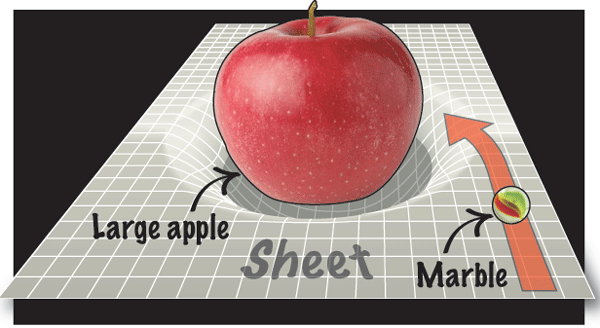
Imagine the fabric of the universe to be like a bed sheet (but
with more dimensions). If you place a large apple on that sheet, it
will make a depression in the fabric of that sheet. Now, if you roll
marbles along that sheet they will roll into the depression made by
the apple.
Any massive object like a star, or planet, ‘bends’ the ‘fabric’
of the universe (known as space-time) and all less-massive objects
travelling through space-time will be drawn into the depression
caused by the mass of that object.
All objects with mass (even you and me) distort space-time to a
greater, or lesser degree and all things in motion are subject to
the influence they exert on space-time. The name we give to this
influence is ‘gravity’.
What was Gravity Probe B looking for?
Gravity Probe B was designed to test two of Einstein’s
predictions regarding the effect that a rotating massive object (like
the Earth) has on space-time:
Geodectic effect:
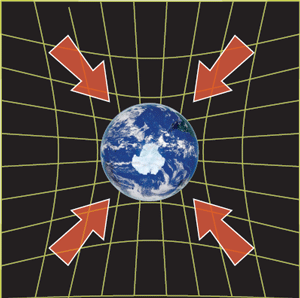
This is the warping effect that a massive object has on space and
time around it (like the depression made by the apple on the sheet)
Frame dragging:
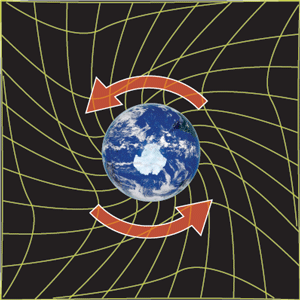
This is the amount that a spinning object pulls space and time
with it as it rotates (imagine that the apple on the sheet has a
sticky surface – if you were to twist the apple, it would pull the
fabric around with it)
Three Totally Mind-bending Implications of a Multidimensional
Universe
10 Dec 2014
Nearly a century ago, Edwin Hubble’s discovery of red-shifting of
light from galaxies in all directions from our own suggested that
space itself was getting bigger. Combined with insights from a
handful of proposed non-Euclidean geometries, Hubble’s discovery
implied that the cosmos exists in more than the three dimensions
we’re familiar with in everyday life.
That’s because parts of the cosmos were moving further apart, yet
with no physical center, no origin point in three-dimensional space.
Just think of an inflating balloon seen only from the perspective of
its growing two-dimensional surface, and extrapolate to four-dimensional
inflation perceived in the three-dimensional space that we can see.
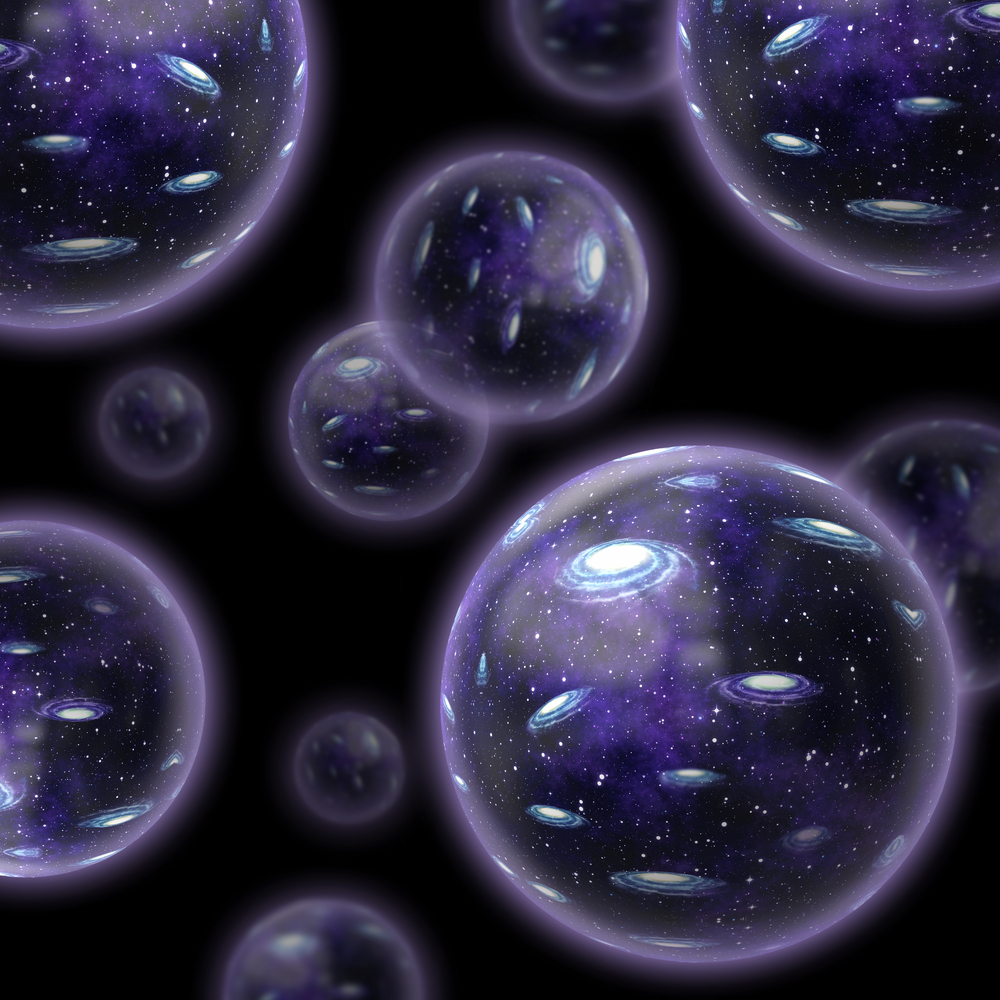
That perspective suggests that three-dimensional space could be
curved, folded, or warped into a 4th dimension the way that the two
dimensional surface of a balloon is warped into a 3rd dimension.
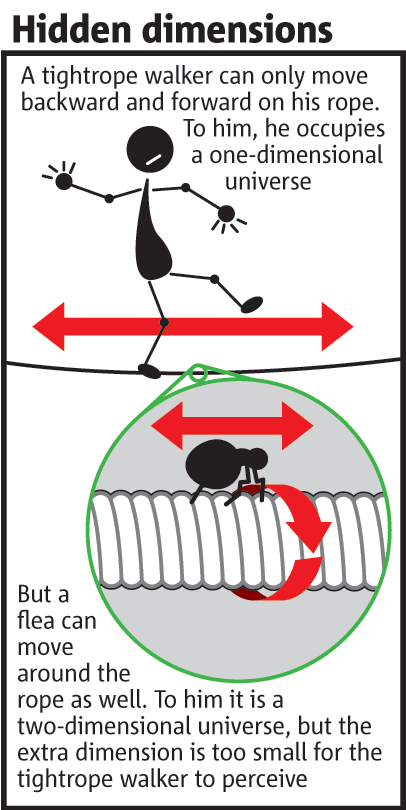
We don’t see or feel more dimensions; nevertheless, theoretical
physics predicts that they should exist. Interesting, but are there
any practical implications? Can they become part of applied physics?
1. Warp Drive
Teaching about the 4th dimension, physicists have used analogies,
like drawings of something called a hypercube, and even the 19th
century novella Flatland by Edwin Abbott Abbott. The book imagines
two-dimensional beings living on a planar world that has only length
and width. Unable to perceive a third dimension, the Flatlanders see
only one plane of three-dimensional visitors, kind of like how
computed tomography or magnetic resonance imaging shows the body in
slices. Two slices through a leg, one a few millimeters up from the
other, look almost the same, but a slice through the waist or chest
gives a very different picture. We can relate to this analogy,
imagining our three-dimensional environment as just one of an
infinite number of slices of a four-dimensional environment.
But moving beyond four dimensions, it gets even weirder, and very
hard to visualize. The main theory here is called M theory, which is
a theory in physics that unites various types of what’s called
superstring theory. In M theory there are a bunch of dimensions,
either 10 or 11, depending on who explains it to you. In addition to
the three we’re familiar with there are compact dimensions. It’s all
related to phenomena called branes that vibrate like strings, but
what’s most relevant to this discussion is that the extra or compact
dimensions don’t necessarily have to remain compact. Like a jack-in-the
box, it might be possible to unpack the extra dimensions, says
Richard Obousy, director of Icarus Interstellar, a non-profit
organization promoting starship research.
“If an advanced civilization learns how to manipulate higher
dimensions, they might use them for technology, including warp drive,”
Obousy noted to me, the idea being that some kind of controlled
decompacting of extra dimensions could have the effect of squeezing
or expanding one of the three big dimensions that we know. Engage
the compacting effect in front of a starship and the expansion
effect to the rear, and you’d have warp drive, like I discussed in a
previous post.
But don’t start packing for your Alpha Centauri vacation just
yet, because there’s one tiny little complication, which Obousy is
the first to admit. So far, we don’t have a shred of evidence that
the hypothesized extra dimensions even exist. Someday, soon, we
might get some evidence from the Large Hadron Collider, but even
then it’s anyone’s guess whether that would lead to a warp drive
technology.
2. Time Travel
Time is usually considered a dimension, even if not a spatial
dimension, and we’re certainly moving along the time axis just fine.
We don’t possess technology to go backward and change history. If we
could find a way to go through other dimensions, the balloon analogy
tells us it should allow a kind of tunneling to locations that look
distant from the perspective of the three dimensions that we
perceive.
It is far less clear, however, whether we could tunnel into other
time periods, future or past. Any fans of Star Trek know that the
philosophy of time travel into the past is mind-boggling, because
you could change history, prevent the series of events that caused
your existence in the first place, yada, yada, yada. But time travel
to the future – accelerating from the usual move into the future of
one minute per minute, one year per year – requires no philosophy.
Moreover, we know how to do it.
It’s called time dilation, it’s predicted by Einstein’s theory of
special relativity, and it will happen, if we accelerate a
spacecraft to a significant fraction of the speed of light. Travel
very close to the speed of light (c), and time slows down from your
perspective and the slowing is quantified by a variable known as the
gamma factor. On a ship moving just under 0.87c, the gamma factor =
2; thus, from the perspective of Earth-bound observers, the traveler
moves 2 minutes into the future for each minute that seems to go by
aboard the ship. At 0.94c, gamma = 3, and it increases more
dramatically as the ship approaches light speed asymptotically. At
0.9992c, for instance, gamma reaches 25, which can advance you
noticeably into the future if you stay at that speed long enough.
Make a round-trip to the star Vega, located 25 light-years away, and
two years will pass by for you and your friends aboard the ship (you’ll
age two years and accumulate two years of memories), but arriving on
Earth you’ll find that you’ve jumped ahead by a half-century.
It really would happen; we’re certain, because time dilation has
been proven with subatomic particles in accelerators. We can’t do it
right now with people, but the capability for relativistic
velocities is only a matter of time (excuse the pun), since it could
happen with technology that may be just over the horizon, namely
nuclear fusion.
3. Traversable Wormholes
Another means of transport made possible by a multidimensional
cosmos is wormholes. When Carl Sagan needed a realistic way for
humans to travel interstellar distances for his story Contact, he
consulted theoretical physicist Kip Thorne. Working with a couple of
his best graduate students at the California Institute of Technology,
Thorne worked out the equations showing that, indeed, there was a
way: a stable, traversable wormhole, or even a system of such
tunnels linking different areas of space-time.
This was more than a decade before Miguel Alcubierre would
demonstrate that Einstein’s general relativity theory allowed for
Star Trek-style warp drive, so Sagan saw the wormhole concept as the
only scientifically-valid means by which his protagonist, Ellie
Arroway, could be shuttled through the galaxy quickly enough to meet
storyline demands.
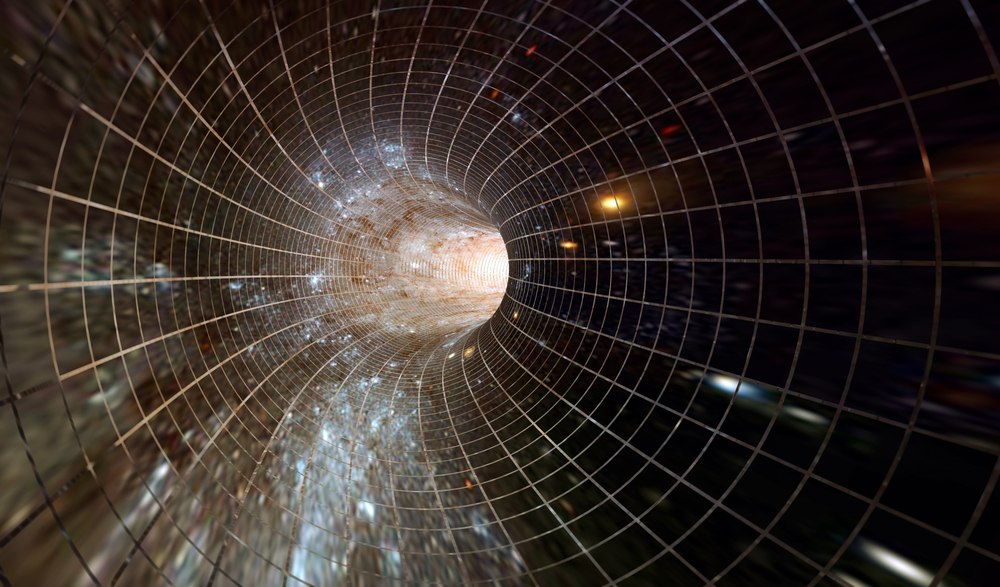
An advanced civilization could build a system of wormhole-dependent
tunnels connecting different points of the space-time fabric,
essentially drawing the departure and arrival points in the fabric
into close proximity to one another through a 4th dimension. If we
could do it, we could have an entry portal nearby, somewhere in the
inner Solar System, that leads to an exit point at our destination,
for instance a nearby star system with an Earth-like planet. In
science fiction, it’s the concept of a star gate.
Because of mathematically complex findings derived from equations
in general relativity known as the Einstein field equations,
technology that can warp space, whether for warp drive or
traversable wormholes, would require a phenomenon called negative
energy. Intuitively it is difficult to visualize what negative
energy is, but its existence is consistent with a well-established
area of physics known as quantum field theory. In fact, using the
technology of quantum optics and a phenomenon called the Casimir
effect, physicists have actually produced a kind of negative energy
already in tiny quantities (negative vacuum energy). Nature produces
it in big quantities, but only by using huge concentrations of
gravity, which we can’t produce artificially. According to Eric
Davis, Senior Research Physicist at the Institute for Advanced
Studies at Austin, Texas, who is an expert on faster-than-light
propulsion concepts, the most promising way to do this is with a
quantum optic device called a Ford-Svaiter mirror. It’s not
something that anyone has built yet, but it can be built. It would
concentrate the negative vacuum energy. If you do it with a small
Ford-Svaiter mirror, it would produce a mini-wormhole, but Davis
says that the device could then be scaled up to make wormholes
bigger and bigger, eventually big enough for a spaceship to enter.
Navigation to find an exit point would be tricky at first, but it’s
theoretically possible to place the Ford-Svaiter mirrors in
different points to create a kind of tuner, for instance from
somewhere near Earth to a point near an Earth-like planet in a
nearby star system. Once the first wormhole is built with stable
entry and exit points we’d have a way to go back and forth between
Earth and our first interstellar destination. We could explore that
star system, and no doubt we would do so particularly if it contains
a habitable planet that we could colonize, but we could also use it
as a staging point to go further. Thus, little by little, we could
create wormhole network of sorts, in our little corner of the galaxy.
Or, perhaps, at some point, our tunneling might tap into an already
existing network similar to what Sagan imagined. In that case, we’d
better make sure to learn the rules, for there might be traffic.
Via Discover Magazine
Was our universe born in a wormhole in another universe?
Has science found
its first white hole?
Now, five years later, a theory has emerged: it could be a white
hole.
A white hole is a theoretical beastie that exists as a set of
equations that were a by-product of Einstein’s theory of relativity.
It is basically a black hole in reverse. If a black hole is an
object from which nothing can escape, then a white hole is an object
into which nothing can enter – it can only radiate energy and matter.
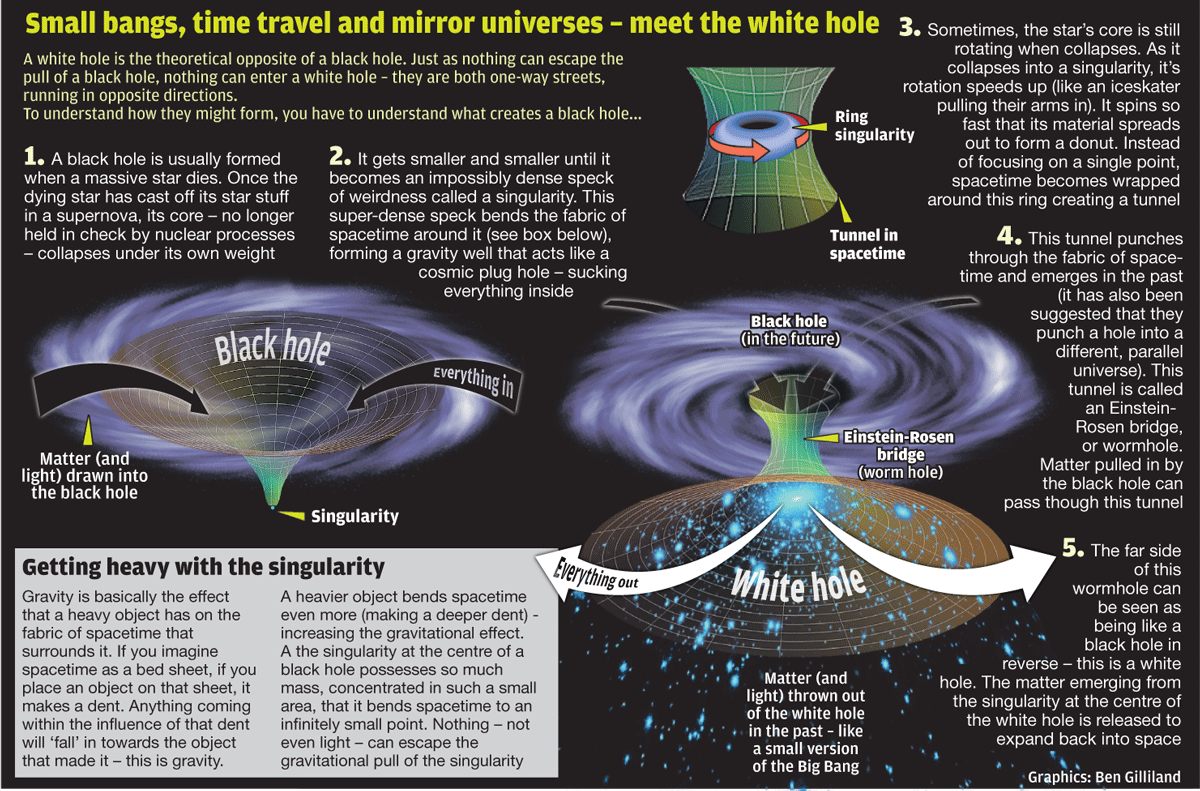
[Graphic: How white holes (might) be formed – click to bend
spacetime and magnify]
It is relativity that makes white holes super-weird. A black hole
represents a pinch in the fabric of the universe (spacetime) where
everything is dragged into a single infinitely small point known as
a singularity.
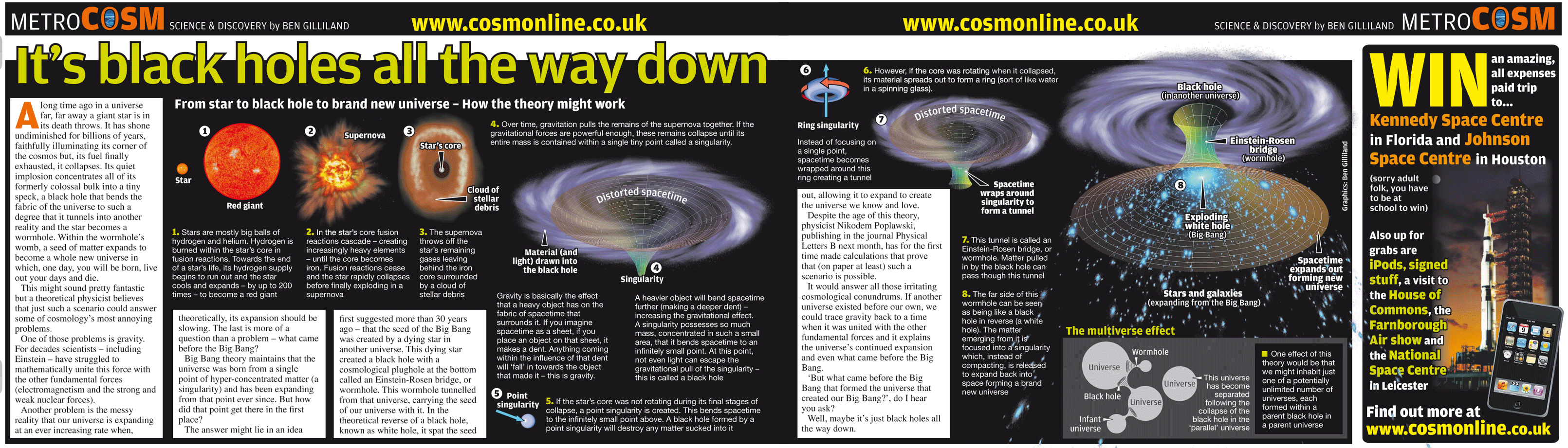
Relativity suggests the universe shouldn’t be allowed to get all
pointy like this but should always continue in an infinite curve.
The solution to this was to suggest that instead of terminating
spacetime at a point, a black hole creates a funnel, or worm hole,
which feeds out into a white hole in the universe’s past (don’t
forget, spacetime is an amalgam of space and time, so if you can
bend space, then you can also bend time).
Whether Ralph proves to be the first observed white hole remains
to be seen. Many physicists would argue strongly it will not but,
until then, it’sexciting to believe that it might be.
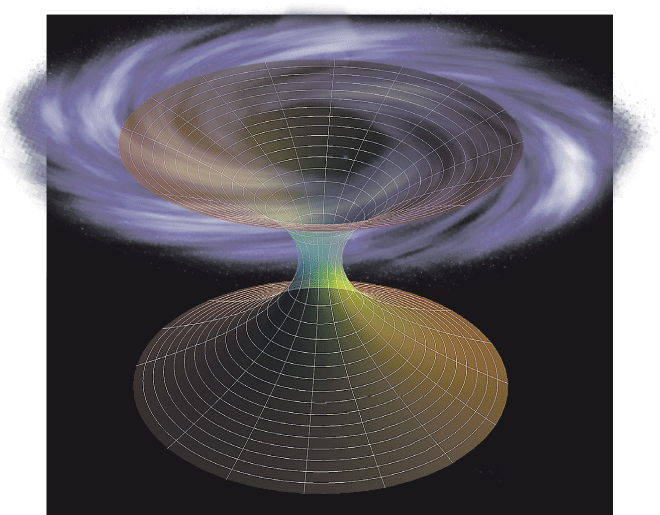 (excuse
me Sir, my brain is full!)
(excuse
me Sir, my brain is full!)
A long time ago in a universe far, far away a giant star is in
its death throws. It has shone undiminished for billions of years,
faithfully illuminating its corner of the cosmos but, its fuel
finally exhausted, it collapses. Its quiet implosion concentrates
all of its formerly colossal bulk into a tiny speck, a black hole
that bends the fabric of the universe to such a degree that it
tunnels into another reality and the star becomes a wormhole. Within
the wormhole’s womb, a seed of matter expands to become a whole new
universe in which, one day, you will be born, live out your days and
die.
This might sound pretty fantastic but a theoretical physicist
believes that just such a scenario could answer some of cosmology’s
most annoying problems.
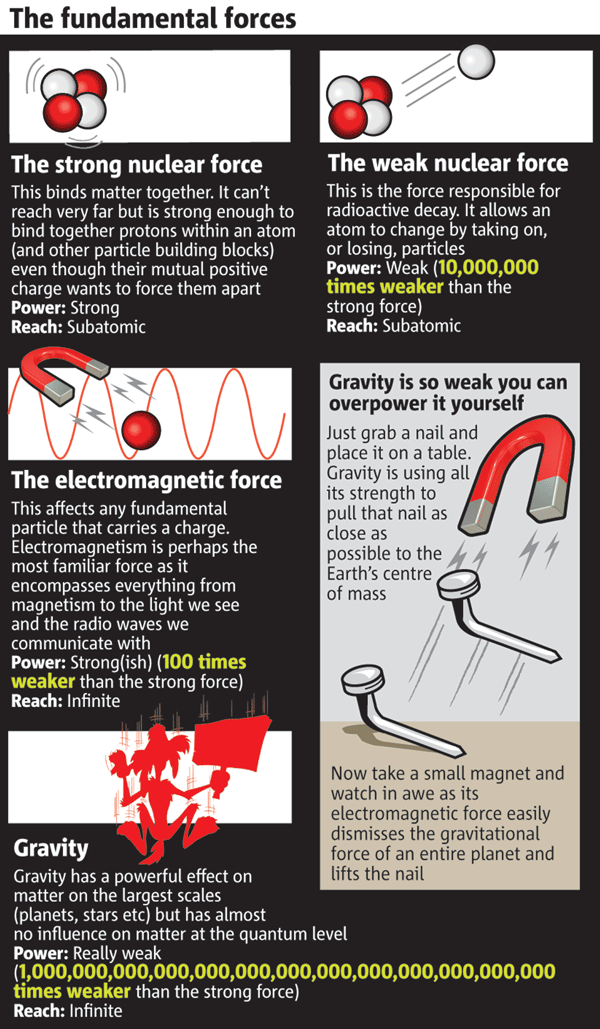
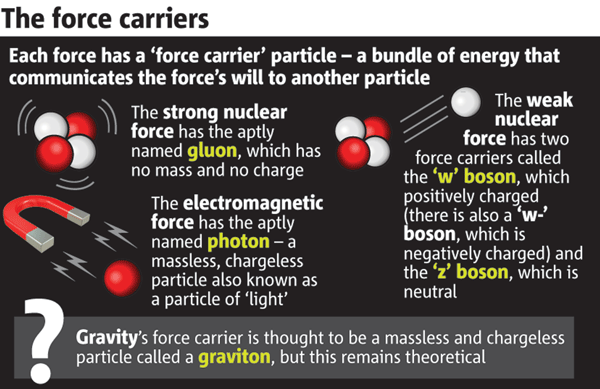
One of those problems is gravity. For decades scientists –
including Einstein – have struggled to mathematically unite this
force with the other fundamental forces (electromagnetism and the
strong and weak nuclear forces).
Another problem is the messy reality that our universe is
expanding at an ever increasing rate when, theoretically, its
expansion should be slowing. The last is more of a question than a
problem – what came before the Big Bang?
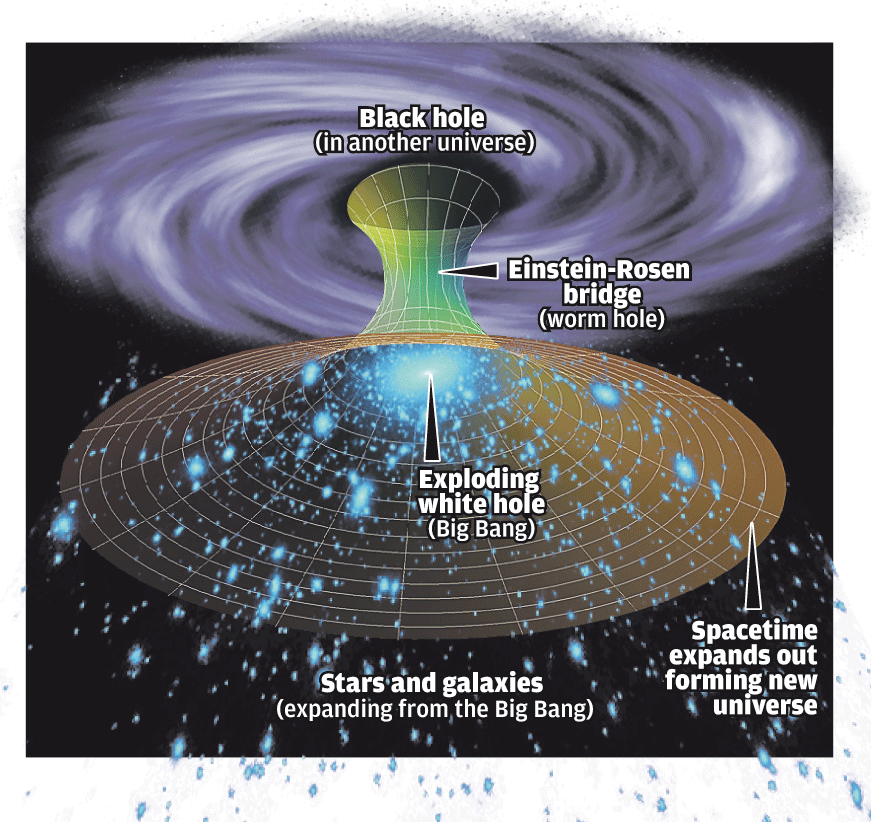 Big
Bang theory maintains that the universe was born from a single point
of hyper-concentrated matter (a singularity) and has been expanding
from that point ever since. But how did that point get there in the
first place?
Big
Bang theory maintains that the universe was born from a single point
of hyper-concentrated matter (a singularity) and has been expanding
from that point ever since. But how did that point get there in the
first place?
The answer might lie in an idea first suggested more than 30
years ago – that the seed of the Big Bang was created by a dying
star in another universe. This dying star created a black hole with
a cosmological plughole at the bottom called an Einstein-Rosen
bridge, or wormhole. This wormhole tunnelled from that universe,
carrying the seed of our universe with it. In the theoretical
reverse of a black hole, known as white hole, it spat the seed out,
allowing it to expand to create the universe we know and love.
Despite the age of this theory, physicist Nikodem Poplawski,
publishing in the journal Physics Letters B next month, has for the
first time made calculations that prove that (on paper at least)
such a scenario is possible.
It would answer all those irritating cosmological conundrums. If
another universe existed before our own, we could trace gravity back
to a time when it was united with the other fundamental forces and
it explains the universe’s continued expansion and even what came
before the Big Bang.
‘But what came before the Big Bang that formed the universe that
created our Big Bang?’, do I hear you ask?
Well, maybe it’s just black holes all the way down