
by Michael E. Salla, PhD
May 21, 2005
Bob Lazar - Element 115 - Massive Stars - Heavy Metals
I wish to focus on some recent scientific advances that vindicate some of the information that Bob Lazar provided from his alleged experiences at S4, and respond to some of his critics.
The most important criticism concerned Lazar’s initial claim in 1989 of the existence of a stable form of element 115. The existence of such an element was initially dismissed by some of his critics and became a factor in Lazar not being taken seriously.
For example Stanton Friedman wrote in 1997:
"There is no evidence that any 115 has been created anywhere. Based on what we know about all other elements over #100, it would certainly have been radioactive with a short half life, and 500 pounds could not have been accumulated. His scheme sounds good, but makes no real sense especially in view of how difficult it would be to add protons to #115."
However, in February 2004 scientists announced that they were able to reproduce an isotope of 115 in a laboratory, and said that a stable isotope is possible.
Dr Joshua Patin, one of the creators of the 115 isotope, confirmed in an interview with Linda Moulton Howe that with sufficient technological advances, the creation of a stable form of 115 is possible:
"[Howe:] Could there be an element 115 isotope that is solid and can be held in the hand?
[Dr Patin:] "Some day down the road, I think so. If it’s true that we find something that is long enough lived. To hold something in your hand, you would need a significant quantity of these atoms. We’ve produced four atoms of Element 115 in a month. It would take you don’t have enough time in the rest of the universe to create enough that you could hold in your hand through these same kinds of production methods (that we are using).
That’s why I say a future technology might allow us advances in terms of how much can be produced and the target material, maybe a better way of producing but somewhere down the road, there might be a possibility, sure.
More info HERE
As to how element 115 is formed, Lazar claimed it is formed in massive stars. In an article he wrote:
"[M]any single star solar systems have stars that are so large that our Sun would appear to be a dwarf by comparison. Keeping all this is mind, it should be obvious that a large, single star system, binary star system, or multiple star system would have had more of the prerequisite mass and electromagnetic energy present during their creations.
Scientists have long theorized that there are potential combinations of protons and neutrons which should provide stable elements with atomic numbers being higher than any which appear on our periodic chart, though none of these heavy elements occur naturally on earth."
Lazar’s idea that element 115 is formed in stars led to more criticism this time by astronomers and physicists that Lazar was incorrect since stars could not produce heavy metals with atomic numbers greater than iron (atomic number 26) in stable stars.
This criticism was raised by Dr David Morgan in 1996 whose critique was kindly sent to me by Stanton Friedman.
Dr Morgan says:
"[Lazar] SEEMS to be suggesting that his element 115, the alien fuel source, which doesn’t exist on the Earth, should be present in those solar systems that were more massive at their inception. The implication here is that a star system which condensed out of a more massive primordial cloud should have a greater abundance of heavier elements.
This is quite incorrect. Heavy elements - all elements heavier than iron - are not formed during the normal life cycles of stars. The only time when these nuclei are "cooked" is during the collapse and subsequent explosion of supernovae.
The supernova explosion then spreads heavy elements throughout the galaxy. For this reason, the abundances of heavy elements in any particular star system depend NOT upon the properties of the current star, but on the properties of the nearby stars of the PREVIOUS GENERATION!
Therefore, all of the star systems in a particular region of the galaxy will have essentially the same abundances of heavy elements, regardless of the mass of star. If element 115 is STABLE, as Lazar claims it to be, then it should be created in supernova explosions and it should exist EVERYWHERE!"
Dr Morgan’s criticism of Lazar is not supported by recent breakthroughs in understanding the formation of heavy metals in stars.
It has been discovered for example that heavy metals with higher atomic numbers than iron (26) can and are found in stars in their normal cycle rather than just through supernova which was the ’old understanding’.
A NASA astronomer reflecting on this new theory answers a question concerning the existence of heavy metals with higher atomic metals forming in massive stars and answers:
"it does not require a supernova to create elements heavier than iron. Heavy elements can also form in the cores of massive stars before they go supernova".
This new theory has been recently confirmed with the recent discovery of three massive stars that have ’lead’ (atomic number 82) in them:
"The theory has now been supported by data from the three binary, or "double" stars, studied by French and Belgian astronomers using the European Southern Observatory 3.6 meter telescope at La Silla, Chile.
Each star, which is otherwise light in metal, contains an amount of lead weighing the same as the Moon.
The process by which some stars develop high concentration of heavy metals such as lead towards the end of their lives is called the ’slow fusion’ or ’s-process’ and is described as follows:
"The high abundance of Lead in these otherwise low-metallicity stars also provides detailed clues on how the s-process operates inside the AGB stars. When a Carbon-13 nucleus (i.e. a nucleus with 6 protons and 7 neutrons) is hit by a Helium-4 nucleus (2 protons and 2 neutrons), they fuse to form Oxygen-16 (8 protons and 8 neutrons).
In this process - as can be seen by adding the numbers - one neutron is released. It is exactly these surplus neutrons that become the building-blocks for making heavier elements via the s-process."
It is estimated that half of all metals heavier than iron are caused by supernova explosions where these are rapidly formed through nuclear fusion (r-process) and the other half in stable stars with low metallicity that slowly build up heavy metals in a more gentle fusion process.
The new understanding of the formation of
heavy metals in stars and discovery of large quantities of lead in some
stars basically negates Dr Morgan’s criticism and shows that Lazar’s idea
that some massive stars in the normal stellar cycle may have element 115
developed in them is a very real possibility.
What are the exopolitical implications of this given Lazar’s claims that
extraterrestrials use 115 for their propulsion systems?
If element 115 is naturally formed in the core of some massive stars and element 115 is used in the propulsion system of extraterrestrial races, then it would be fair to assume that some extraterrestrials may have discovered how to mine stars of their heavy elements to use as a propulsion fuel.
Indeed, extraterrestrials with sufficient knowledge in mining suns of element 115 and other elements may be using this as part of an interstellar trade. Indeed, such knowledge and possession of large quantities of 115 and other elements may lead to interstellar conflicts over certain star systems.
Indeed, the Earth’s sun or nearby stars may have heavy elements that may attract extraterrestrial races who seek to mine these precious natural resources. We are now slowly moving to an understanding of how certain star systems might be highly prized by extraterrestrial races that seek to gain control and mine stars of heavy elements such as element 115.
With new advances in physics and astronomy, Bob Lazar’s information so widely dismissed in the early 1990’s appears to have more relevance than ever.
The Unofficial Area 51
by Dave Cosnette and Andy Lloyd
2006
This enigmatic air-base has become a pivotal piece in the UFO jigsaw.
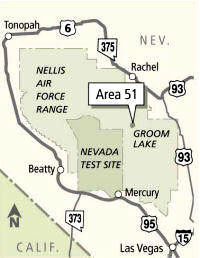
Area 51 is located in Nevada, taking up
the kind of acreage that a small country would be proud of, and in fact is
the size of Switzerland. Until recently, according to official U.S.
statements, it didn’t actually exist. Unofficially it is an operational
testing range for the cutting edge technological developments of America’s
armed forces. The facilities centered around the Groom Lake area are
amongst the most secretive in the world, requiring a level of security so
remarkable that Area 51 has become a modern day myth in its own right.
Access to the base is by authorized personnel only, via a daily shuttle
where at least 500 people arrive at the guarded terminal owned by EG&G on
the northwest side of McCarran Airport in Las Vegas, Nevada. Here they board
one of a small fleet of unmarked Boeing 737-200s. Using three digit numbers
prefixed by the word "Janet" as their call signs, the 73s fly off North
every half hour. There is no perimeter fence, just a vast mileage of desert
in all directions inaccessible to the public.
This ‘no man’s land’ around Groom Lake is patrolled constantly by infamous
camouflaged guards, (nicknamed cammo dudes) who travel in Cherokee Jeeps to
monitor the borders and stop any unwanted visitors getting inside of the
base. They are supported by electronic surveillance systems, including
motion sensors and other monitoring equipment that is said to have the
ability to pick up human sweat. Military units and air support are also
present. Warning signs on the edge of Area 51 tell of heavy penalties for
intruders, including the authorization for the deadly use of force.
No one denies that the U.S. Government aims to keep this site secure at all
costs. No one gets in. Period. Recently, some very good aerial satellite
images of the area have been available through Google Earth (far
below images), which is an amazing 3D map of Earth that has most areas
mapped down to a resolution of just a few thousand feet. Most of the
pictures on this page in fact were
 captured
from the program because they are the most up-to-date satellite imagery
taken of the base.
captured
from the program because they are the most up-to-date satellite imagery
taken of the base.
We highly recommend you to download the program
because it can show you the vast area of the base in great detail.
It is known that a huge hangar is housed within one of the mountains, the
doors of which are closed when satellites pass overhead. The astronaut
Gordon Cooper recently disclosed that the reason why film taken by him,
whilst orbiting in Gemini 5, was confiscated was because he had been
inadvertently travelling over Area 51 at the time.
The base boasts one of the world’s longest
runways, although the need for this is not clear unless landings from sub-orbital
vehicles are necessitated. None of this is visible to the public, as the
surrounding vantage points in nearby mountains have been bought up and
included within the perimeter of the vast site. So, given the total paranoia
surrounding its activities, what exactly goes on here?
According to Bob Lazar, a free-lance physicist and engineer, its
activities include reverse-engineering extra-terrestrial
craft! He first came forward with these claims in March 1989, when
appearing on George Knapp’s news programme on Channel 8, based in Las
Vegas. He described his brief time at a facility known as S-4, where he
worked on back-engineering exotic craft built
to accommodate small beings.
Although his credibility has since been questioned by many, notably the nuclear physicist Stanton Friedman, supporting evidence indicates that Lazar did indeed work at S-4, as well as other scientific establishments who initially denied all knowledge of him. It seems that somebody within the Government wanted to remove all evidence of Lazar working at the base, but his name can be found in one of the on-site phone books which dates back to the time that Lazar said he was working there.
His academic credentials remain in doubt,
although his scientific knowledge is undeniable. It seems that his free-lance
working pattern makes him a lower security risk to places like Area 51,
simply because he is so difficult to authenticate as a scientist.
Other individuals have since come forward to corroborate a lot of what Lazar
claims, although, most of them choose to remain anonymous. As a result,
Area 51 is now an intrinsic part of UFO folklore and has done much to
support the extra-terrestrial hypothesis. One thing is for sure, many
bizarre, seemingly exotic craft have been witnessed, photographed and filmed
in the immediate area. The question is, are they the result of
extraterrestrial technology or simply our own independent development?
Skeptics point to the emergence of stealth aircraft as a possible example of
why Area 51 exists. Although they first saw action during the Gulf War,
Lockheed Martin had been secretly developing the technology at “Skunkworks”
for many years. The assumption, then, is that the more advanced, exotic
vehicles will emerge in the near future when required by the next military
enterprise.
The problem with this stance is that these
vehicles have been witnessed for many, many years and have never been seen
to be used. Their advanced capabilities would certainly be of immeasurable
benefit to Allied armed forces, but they remain closeted away.
This fuels speculation that the craft are indeed recovered UFOs, or at least
our best efforts at emulating the alien technology. After all, the billions
of dollars clearly spent on these black projects must produce pragmatic
hardware, so their obvious absence from the theatres of war can only be
attributed to their sensitive, indeed paradigm-shifting, nature.
To use these craft is to admit to their
existence, is to admit to the Big Secret. So the whole house of cards
is at stake. Even worse, The American public would then realize that
billions of their tax-dollars have been covertly spent on
reverse-engineering UFOs, with no material
benefit to themselves.
The late Colonel Corso would then have claimed that the use of alien
technology was indeed seeded into American industry over several decades,
but surely this can only be the tip of the ice-berg. Consider the potential
uses of advanced propulsion, anti-gravity and alternative energy sources
inevitably involved in alien technology. How would the voters react if they
were aware that the U.S. Government and military has had access to this
potential technology for decades, especially considering the damage to our
planet inflicted by the misuse of our current energy resources?
The potential ramifications of this discovery are enormous. What President in their right mind would let the cat out of this bag?
Ikonos Satellite Imagery
Some of the best aerial photographs of Area 51 were taken by the Ikonos satellite, which was launched in September 1999,and the resulting high-definition pictures were released to the Federation of American Scientists (FAS) who commissioned the images.
The images offered by the Denver-based company Space Imaging are able to resolve objects down to one meter across, and the satellite’s digital camera can be pointed anywhere on the surface of the Earth.
The company offers mass-produced space images
for as little as $10, but will also provide images of targets commissioned
by private individuals or organizations for several hundred dollars. Many of
the images on this page were released in April, 2000.
Ikonos was launched as a $700m venture by Lockheed Martin and Rayathon. The
company counts the US Government as one of its clients. The inclusion of
Lockheed Martin as one of the founding organizations is ironic, considering
its involvement in sensitive defense contracts in cutting edge aerospace
technology. It is also widely understood that Area 51 closes down its
operations whenever it is flown over by satellites, but the images will
nevertheless be of tremendous interest to all UFO buffs.
The FAS campaigns against government secrecy,
and have included Area 51 amongst a list of other military
installations in North Korea, Iran, Pakistan and India. Their aim is to
provide evidence of the spread of sophisticated weaponry around the world.
Area 51 Through The
Ages
New Imagery of Area 51 was released on 17
April 2000. The Aerial Images were acquired by Russia's Space Information
KVR-1000 satellite system. We have reproduced them here so you can compare
how this site has enlarged over the past few years.
New Runway
One of the most obvious changes from 1968 to 1998 is the construction of a
new 11,960 foot runway replacing the older 12,400 foot runway 32 Left to the
west. Runway 32 Right. The Southern end of Runway 32R is blackened with
about twice the tire skid marks than at the north end of the runway
suggesting that the prevailing winds are from the north throughout most of
the year. It is not clear how far on to the dry lake the Runway 32 Right
overrun extends.
At the south end of 32R there are six final
flight check spaces on the runway apron. At each end of the runway there is
a runway barrier net and arresting cable
|
28 August 1968 |
15 March 1998 - SPIN-2 2-meter |
02 April 2000 - IKONOS 1-meter |
|
|
|
|
North Base
The four large hangars at the north of the base, present in the 1968 image,
have evidently been enlarged by the time of the 1998 image. In addition, the
housing complex for base personnel -- the large array of smaller buildings
to the south of the hangars, has been entirely rebuilt between 1968 and
1998, with the additional of new support facilities.
A B-52 aircraft is visible in the 1968 image. No
aircraft are visible in the 1998 image or the 2000 scene.
|
28 August 1968 - USGS Aerial imagery |
15 March 1998 - SPIN-2 2-meter |
|
|
|
|
02 April 2000 - IKONOS 1-meter |
|
|
South Base Hangars
Perhaps the most significant expansion in operational capabilities is noted
in the southern part of the base. The half dozen hangars present in the 1968
image are all evident in the 1998 image, but the total number of hangars in
this area has doubled during the intervening three decades.
The most noteworthy addition is the hangar with
the high peaked roof visible in the top of the 1998 image.
|
28 August 1968 - USGS Aerial imagery |
15 March 1998 - SPIN-2 2-meter |
|
|
|
|
02 April 2000 - IKONOS 1-meter |
|
|
Tank Farm - South Base
The tank farm visible in the 1968
image, consisting of seven large storage tanks and three smaller tanks,
remains visible in the 1998 image. The wide separation of the larger tanks
is suggestive of fuel for aircraft.
The 1988 imagery shows a large asphalt plant,
that was used to construct the new 11,960 foot runway.
|
28 August 1968 - USGS Aerial imagery |
15 March 1998 - SPIN-2 2-meter |
|
|
|
|
02 April 2000 - IKONOS 1-meter |
|
|
New Construction - South Base
Ikonos imagery has revealed that this
32 acre facility is a small weapons storage area with three small igloos and
two larger igloos.
|
28 August 1968 - USGS Aerial imagery |
15 March 1998 - SPIN-2 2-meter |
|
|
|
|
02 April 2000 - IKONOS 1-meter |
|
|
Area 51: Up Close And
Personal
San Francisco Bay Guardian News May
4-10, 2005
Spying on the Government
A UC Berkeley geographer maps the secret military bases of the American West – where billions of dollars disappear into creepy clandestine projects
by A. C. Thompson
IT STARTED WITH an e-mail inviting me to join an expedition to Area 51, the secret military site in the Nevada backcountry."Let me be clear about this," wrote Trevor Paglen, the 30-year-old geographer leading the trek. "The trip will not be easy. It might not even be that fun, depending on your attitude, how well-prepared you are, and what you consider fun. The weather is unpredictable – it could be really hot or really cold, or (most likely) both.... If you are not in reasonable shape, or are without proper equipment, you will die. Seriously."
Despite the less-than-inviting invitation, I was intrigued. For five decades Area 51 has been the military's heart of darkness, the core of its "black world" of classified research and development, a place that appears on no maps, and, officially, has no name. The U.S. government will divulge nothing about the site, except that it's an "operating location" overseen by the U.S. Air Force. Everything else – including the most seemingly mundane facts – is classified in the name of national security.
The territory in question sits deep in a colossal, small country-size, 3.1 million acre Air Force base northwest of Las Vegas. Built on Groom Lake, a dry lake bed, Area 51 is bisected by a 27,000-foot runway, studded with massive hangars and communications towers (which look something like offshore oil rigs topped by giant scoops of vanilla ice cream), and patrolled by a platoon of camouflage-clad private security personnel with orders to kill intruders.
Despite the government's omerta-like code of silence, aerospace experts have concluded the isolated, mountain-ringed rectangle of desert served as an incubator for some key cold war machinery, aircraft like the U-2 spy plane and the black-winged, radar-deceiving F-117A stealth fighter.
UFO-heads, of course, have other ideas. For them, Area 51 is the focus of fevered, conspiratorial speculation, a remote and incredibly well-guarded location where the government has hidden a fleet of alien spacecraft. According to this line of thinking, the mysterious lights sometimes spotted blipping across the night sky over Nevada are hot rods from another planet.
After doing a little reading on the place, I knew I had to see it for myself.
Paglen is steeped in the lore surrounding Area 51, the twin currents of secrecy and weirdness that swirl around the place like powdery desert dust. Clandestine military installations are the subject of his doctoral dissertation in geography at UC Berkeley, an endeavor that's propelled him across the American West, mapping the archipelago of bases that dot the landscape."The whole thing is about getting people to see the world around them differently," Paglen says. "The amount of land devoted to this stuff is gigantic."
To Paglen, a good-humoured Air Force brat with a Woody Woodpecker-ish laugh, Area 51 is many things. It's a pop-culture trope, served up by the X-Files and the 1996 flick Independence Day. A testament to the supremacy over American life of the Pentagon and the Central Intelligence Agency and their corporate pals. A fount of disinformation.
One tactic used to shroud zones like Area 51, he argues,
"is to make those places very visible in the wrong way – all the UFO stuff at Area 51, for example. Area 51 is far from secret. It's a cliché. But the fact that it's a cliché also hides it."
Declassified CIA documents, Paglen notes, suggest Langley fomented UFO rumours during the 1950s and '60s as a way to deflect attention from the very real flights of experimental aircraft, including the U-2 and A-12 Blackbird spy planes.
I met Paglen about 10 years ago when we were both hanging out at East Bay punk gigs. He's still got a punkish edge, favouring dark jeans and cowboy boots and punctuating many of his comments with slang and obscenities. All this camouflages, to some degree, his eclectic braininess: Before pursuing geography, Paglen earned degrees in religious studies (with a minor in musical composition) and art.
As you read this, the Lab, a San Francisco gallery, is displaying Paglen's solo show "Recording Carceral Landscapes," a chilling commentary on California's leviathan prison system.
In addition to his academic explorations, Paglen also gives informal tours of classified America, journeying to places like,
the Tejon Ranch Radar Cross Section range (where Northrop tests bleeding-edge aircraft)
the headquarters of Science Applications International Corp. (the no-profile defense contractor tapped to set up a TV propaganda network in Iraq)
the San Diego docks that are home to the Sea Shadow (a classified Naval watercraft)
the Classic Bullseye listening station (a heavily guarded collection of National Security Agency eavesdropping equipment)
He's posted graphics, reports, and pics from all these expeditions on his Web site, paglen.com.
In mid-March I spent three days probing the dark side with Paglen and a crew of 10 other sightseers."Uh, guys, we need to be up there," Paglen says, gesturing to the snow-encrusted peak looming above us, "and we're heading downhill."
We're somewhere near the base of Tikaboo Peak, a treacherous 8,000-foot-tall pile of prehistoric rock stippled with scrubby trees. To get to Tikaboo, the vantage point closest to Area 51, we've driven about 120 miles north from Vegas, following a dirt road through the desolate yet gorgeous Nevada wilds, surrounded by an ocean of scrubby vegetation and grainy, sunburned soil.
So far, getting up the mountain has been quite a task – on top of our, ahem, navigational issues, one member of our crew has already vanished (apparently he took off to take a dump), and we've lost any trace of the trail we're supposed to be following. The conditions on this frigid afternoon aren't especially favourable, either. The temperature is dropping rapidly, daylight is dwindling, and three-foot-deep swatches of snow speckle the mountain.
I've managed to pull a Homer Simpson move, leaving my heavy, waterproof coat back in San Francisco. Plus, I'm wearing DC skate shoes, which are already soaked thanks to the snow."Have you ever seen any people out here?" one of the expeditioners asks Paglen. "Only once, and it was really crazy," replies Paglen, a charming character with an expansive sense of humour. "We ran into this group of cops from Waco, Texas. They had all these telescopes and high-tech gadgetry."
Cops from Waco, the nexus of myriad conspiracy theories springing from the carnage-laden Branch Davidian debacle, descending on Area 51, the hub of UFO conspiracy theories? Yeah, that's a tad weird.
We tromp on, and by 5:01 p.m. we hit our first stopping point, a peak several hundred feet below the summit. Robby Herbst, the guy who disappeared to make like a bear in the woods, has resurfaced. He's weary from the ascent. "I'm ready for the aliens to take me," says Herbst, an itinerant art professor from Los Angeles, clad in an amazing pair of '70s-era striped jeans.
From here the trek gets totally Lord of the Rings, as we traverse an exposed ridgeline punctuated with boulders and begin a steep ascent. At this elevation we're encircled by sky, not trudging beneath it.
After a two-hour scramble up the mountain, we hit the summit with the sun hanging low and look out over a vast plain lined by a few unpaved roads. Dust billows up from one of the roads. Paglen figures it's a government van ferrying Area 51 workers around the base.
Unfortunately, we can't see much more. Our view of Area 51 – which would've been limited anyway – is further obscured by charcoal-coloured clouds pregnant with rain and a thick layer of floating dust. "Can the government make haze?" jokes one guy who flew out from Chicago for the trip.
Paglen has lugged a powerful telescope up with him, so we take turns peering through it, able to make out a handful of structures on a mountainside about 25 miles away. He snaps a digital camera onto the scope and shoots some photos.
The whole deal is fairly anticlimactic; we drove hundreds of miles and dragged ourselves up a fucking mountain, only to be thwarted by Mom Nature? Shit.
Until 1995 you could get substantially closer to Area 51 by ascending White Sides Mountain or Freedom Ridge. Then UFO freaks and stealth-plane watchers began circulating detailed photos of hangars, fuel tanks, runways, and radio towers they'd shot from the two mountains, and the Air Force decided to annex more acreage around Area 51, pushing tourists like ourselves further away. From our perch atop Tikaboo, Paglen dives into the history of Area 51, a locale lacking an official name but endowed with an abundance of enigmatic nicknames including Dreamland, the Dark Side of the Moon, the Box, the Container, and the Ranch.
By any name, the site is testimony to the cozy relationship between the U.S. government and its corporate contractors."It was originally called the Ranch, and it was started by Lockheed in 1955 because they were developing the U-2 spy plane," Paglen says. "Francis Gary Powers" – the ill-fated pilot shot down by the Soviets in 1960 – "trained here to fly the U-2."
Lockheed (now Lockheed Martin) had been blueprinting and building new planes at the Skunk Works, the company's covert Burbank R&D lab, and testing the experimental craft at Edwards Air Force Base, in the Mojave Desert near Palmdale. But the U-2, a joint project of the CIA and the Air Force, demanded a more private proving ground. The vehicle was an international incident waiting to happen: a camera-equipped aircraft capable of going to the upper regions of the stratosphere (up to 74,000 feet) and bringing home snapshots of the evil empire.
From the start, everything was cloak-and-dagger. The Agency bankrolled the base by writing $1 million in checks to Skunk Works director Kelly Johnson and mailing them to his Encino home. Johnson in turn made sure Lockheed's fingerprints wouldn't be on the project by creating a phony front company, C and J Engineering, which hired builders who erected the basic Area 51 infrastructure in a matter of months.
The next radar-eluding craft developed at Area 51, Paglen explains, owed its existence to a set of 1870s-vintage physics formulas. Those formulas, devised by Scottish physicist James Clerk Maxwell and known simply as Maxwell's equations, predict how a surface will reflect electromagnetic waves.
In the 1970s they became the basis for the F-117A stealth fighter when Lockheed engineers used state-of-the-art computers to tweak and extrapolate the equations, hunting for shapes that would scatter and diffuse radar waves. The result was a chunky, flat-angled, Star Wars-esque vehicle, weighing 52,500 pounds (loaded) and measuring nearly 63 feet from nose to tail. It had the "radar signature" of a small bird.
Paglen says,"The stealth fighter became the most secret project since the Manhattan Project. Ronald Reagan was particularly interested in magic-bullet technology" like stealth planes and Star Wars missile defence.
In Paglen's estimation, the historic road to Area 51 goes through the labs of Los Alamos, N.M., where J. Robert Oppenheimer and company begat the A-bomb. The Manhattan Project, Paglen writes in an essay for a forthcoming book, was the,
"first highly-classified, multi-billion dollar [military research] effort.... The Manhattan Project had to manage the thousands of people working on the weapon at any given moment, while restricting the knowledge of the project's true purpose to a very small number of people."
The strategies devised in New Mexico were transplanted to Area 51 and further refined, he says. In some ways the connection between Oppenheimer and Area 51 is even more direct: Area 51 abuts the Nevada Test Site, where, between 1945 and 1992, the government detonated 1,021 nuclear weapons, sprinkling radiation across a vast swath of the Southwest.
Enough about the past. What the hell is going on out here now? Even the experts have few clues.
John Pike directs GlobalSecurity.org, a Beltway think tank, and has been scrutinizing the Pentagon for 25 years. He says that during the Reagan years, analysts could figure out – in broad terms – what the key classified projects were, despite all the secrecy."Twenty years ago, when there was a big increase in classified spending, we pretty much knew what the programs were," Pike says. "We knew there was a stealth fighter. We knew there was a stealth bomber."
In 1990, he notes, a New York Times reporter was able to pen a 273-page book on the "black budget," the money funneled into clandestine military and spy programs with little congressional oversight.
These days, Pike admits, he's baffled. The military is far more successful at keeping things under wraps. Whatever is going on at Area 51 and similar spots is truly a mystery at this juncture."It's certainly a testament to Rummy's ability to keep a secret – that they've been able to spend this money without anybody noticing," Pike says.
And they're spending plenty. The black budget is blimping out to new dimensions. Estimates by the Center for Strategic and Budgetary Assessments (CSBA), another non-partisan Washington, D.C., think tank, put the total spending for classified weapons programs at $26.9 billion for 2005; for 2006 the Department of Defense has asked for $28 billion.
That's up from a comparatively paltry $11.7 billion a decade ago.
Pike figures a chunk of the increase can be attributed to surging spending on hardware for the intelligence agencies. "You can probably explain half of that from growth in the intelligence budget," he contends, explaining that spook outfits like the CIA and the National Reconnaissance Organization disguise their spending by sticking it in the Air Force's budget.
And at least some of the loot is going into Area 51. Pike was one of the first people to post overhead satellite photos of Area 51 on the Web, paying a Russian company for pics of the territory shot in 1998 and 2000 and comparing them to some rare 1968 pics taken by the U.S. Geological Survey. (Apparently, all images captured by U.S. satellites after 1972 have been deleted from the National Archives.)
From looking at the photos, it's obvious there's been massive expansion at the site, with new runways and a gaggle of new buildings doubling the size of the installation.
At the Federation of American Scientists, Steven Aftergood has a couple of ideas about what kind of toys the government is blowing our money on.
"To start burning up lots of money, you have to be building hardware, and if it's space-based, that's a plus," he says sarcastically.
He points to the outburst of West Virginia senator Jay Rockefeller, who in late 2004 publicly shredded an unnamed covert R&D effort, describing it as "totally unjustified and very wasteful and dangerous to national security." Intelligence analysts quickly connected the dots, theorizing that Rockefeller was pissed about a stealth spy satellite project, an eavesdropping device that, like the F-117A, can avoid detection.
"I think it was mainly supposed to be stealthy in regards to radiation and ground-based detection," says Aftergood, director of the FAS's Project on Government Secrecy.
An earlier project, code-named MISTY, apparently relied on a shield that would "make it difficult or impossible for hostile enemy forces to damage or destroy satellites in orbit." Analysts uncovered that language when the Defense Department stupidly decided to patent the invention in 1994.
In this time of ballooning black budgets, Aftergood says, "first and foremost" we need Congress to watchdog the spooks and warriors."I think there are legitimate reasons to classify advanced military research. But if they classify it, they need to receive more, not less, scrutiny, even if it's behind closed doors."
Herbst, the art professor, has a burning question for Paglen.
"What's up with the alien shit, man? C'mon, give it up."
Paglen responds, "In 1989 this guy named Bob Lazar came out and said he'd been working at Area 51 reverse-engineering alien spacecraft. And this story became incredibly popular."After giving interviews to local TV and radio in Vegas, in which he claimed to have wrenched on flying saucers stashed near Area 51, Lazar became something of a guru to UFO believers. There was just one problem. His yarn was demonstrably bogus. Lazar wasn't, as he alleged, a physicist. And there were no records of him attending the schools he claimed to have graduated from, Caltech and MIT. Lazar couldn't even keep himself out of trouble with the Vegas cops, who busted him in 1990 for his role in a prostitution ring.
Darkness drops on the mountain. In the distance, down at Area 51, a grid of lights becomes visible. At this point, everyone's ready to go. Unfortunately, most of us have forgotten to bring flashlights, me included. And as the temp has declined, the slushy snow we waded through on the way up has hardened, becoming slick and icy. Getting down isn't gonna be fun.
Twenty minutes into the descent, I'm sliding uncontrollably on my ass down a giant sheet of snow, already bruised from stumbling – "cartwheeling" is more accurate – over rocks and boulders I can't see. I'll be happy if I get out of here without snapping a bone.
After a cryogenically cold night, I stagger from my tent, filthy, sore, and sleep-deprived, but, for some reason, excited to forge ahead. Our first stop is the "front door" of Area 51, located on the unmarked stretch of dirt road we spied last night from Tikaboo. We blast down the road at 60 mph in a convoy of a behemoth Dodge Ram pickup and two SUVs. In front of us the mountains look like giant chunks of coal.
Paglen tells us sensors are buried in the road. On a knoll to our right, a security guard sits in a white truck. He doesn't move or approach us, but it looks like he's surveilling us through binoculars.
Area 51 isn't surrounded by a tall, electrified razor wire-topped fence or any other visible barrier. The front door consists merely of an agglomeration of signs posted on either side of the road. The signs, however, are pretty distinctive.
One screams in capital letters, "PHOTOGRAPHY OF THIS AREA IS PROHIBITED."
Another notes, "Use of deadly force authorized."
We head toward the Little A'Le'Inn, a restaurant-shrine to extraterrestrial visitors, located in the nearby town of Rachel (population 65), a huddle of small houses and trailers. Lunch is greasy but good. Two men, obviously tourists, walk through the door. One is wearing a black T-shirt with a Day-Glo image of a bug-eyed, big-headed alien. The guy has a shaved head and an outsize cranium. He looks a little like an alien himself.
At 9:25 the next morning we lay eyes on the Tonopah Test Range, a second classified installation just down the road from Area 51. Standing atop a butte, I press my eye to Paglen's telescope, focused on a collection of structures jutting up from the plain below, probably 20 miles away. There in the eyepiece are a phalanx of beige-colored aircraft hangars. I can see their sliding doors and get a sense of their enormity. I feel like Indiana Jones.
Paglen goes into tour guide mode. Tonopah, he says, was originally built to "test nuclear triggering devices and delivery devices, any sort of vehicle that would deliver a nuclear payload." When the stealth fighter went operational, Tonopah became the home base for the planes, which retailed at $43 million apiece."All of those structures you see were created for the stealth fighters. They flew from here to Panama to drop the first bombs in 1989."
In recent years the stealthies have relocated to New Mexico, but Tonopah remains active, and Paglen speculates the Air Force and intelligence services may be perfecting remote-controlled UAVs, or Unmanned Aerial Vehicles, updates of the Predator drones currently plying the skies of the Middle East.
By zooming in on the most exotic zip codes in Pentagonlandia, Paglen runs the risk of overlooking the wider forces at work, the political dynamics fattening the war machine and starving the schools. A month after our return from Nevada, I ask him about this as we cruise 580 in his battered '91 Acura, headed toward Lawrence Livermore National Laboratory."I think you're right," he replies. "And that's the trick with this project: to use the places to represent this bigger picture."
Signposts of the garrison state are everywhere, Paglen continues, noting that his office at UC Berkeley is housed in McCone Hall, named after John McCone, a hawk who, during the '50s and '60s, served as undersecretary of the Air Force, chair of the Atomic Energy Commission (the agency chiefly responsible for nuke blasts at the Nevada Test Site), and director of the CIA. "A lot of this stuff is invisible in our daily lives."
Lawrence Livermore is one of those invisible places. While the 53-year-old lab is owned by the Department of Energy and run by the University of California, its primary mission is to build and maintain terrible things that kill people in terrible ways. Here we are, neck-deep in blue-state America, in the über-progressive Bay Area, and aside from a handful of gadflies, nobody gives the Strangelovian bunch at the lab much grief.
You can thank the lab's crafty 22-employee P.R. team for that. They generate a constant stream of press releases about the lab's marginal civilian science effort – researchers who "detect mysterious neutrinos" and explore "diverse ecosystems." Meanwhile, the press flacks don't say a hell of a lot about the arms programs that provide 80 percent of the lab's budget.
Paglen and I pull up at the lab's Discovery Center, a mini-museum with Smithsonian-quality exhibits, which turns to out to be pretty revealing. The prefab brown-and-beige building is stuffed with creepy-ass displays proudly boasting about the facility's starring role in the creation of at least 14 nuclear missiles and bombs, including the charming and obviously Gandhi-esque W87 "Peacekeeper" intercontinental ballistic missile. In the middle of the center is a Death Star-looking mock-up of the lab's National Ignition Facility, a $5 billion laser-equipped nuke-design center.
At the moment, federal budget documents show, the lab is also seeking $4 million for a bunker-busting bomb known as the Robust Nuclear Earth Penetrator."This is a big deal," says Marylia Kelley, director of Tri-Valley CARES, an antinuke group. "The Bush administration is explicitly requesting money to go ahead with a new nuclear weapon. It's irresponsible and enormously provocative."
Paglen and I drive off the grounds of the lab, and as the complex recedes from view, our talk turns to topics other than bullets, bombs, missiles, and warplanes. We relish the sun-laden spring afternoon.
As we drive, the old X-Files mantra comes to my mind: The truth is out there. Some of that truth is locked away, far, far out of public view, at Area 51 and Tonopah. And some of it's right out in the open, just a few miles down the road at Lawrence Livermore, where, in the middle of a placid suburb, lab coat-wearing men and women spend their lives devising world-wrecking machines.
Have a nice day.
Area 51 Insider Speaks Out
Everyone has a theory to what the US military are keeping under wraps at
Area 51, but few can claim to have gained first hand knowledge from the
inside. One such person is Edgar Fouche, who, during his 25 years of
service with the US Air Force and Department Of Defense, was
stationed at top-secret sites such as Groom Lake Air Base, the Nellis Test
Range and the Nevada Test Site.
Fouche has worked in areas such as intelligence, electronics and communications as well as a whole range of other black projects.
Fouche claims that he was working at
Nellis Air Force Base in 1979 when he was told of a reassignment. He and 30
others boarded a blue bus with blacked out windows. Two guards armed with
M16 rifles told them not to speak unless spoken to. When they got off the
bus he realized he was at the Groom Lake facility. He says conditions
were rather oppressive. He was issued heavy glasses, like welders' goggles,
which had thick lenses that prevented him seeing further than 10 meters
ahead, as well as blocking peripheral vision.
Security was so tight that he could not go anywhere, not even to the
bathroom, without an armed guard at his side. A key card and code was needed
for every door in the facility, in fact he finds it very hard when so-called
former employees of Area 51 claim to have 'stumbled into a hanger full of
UFOs'
During the years 1967-1974, he was stationed or worked at many Tactical Air
Command, Air Training Command, and Pacific Air Command Air Forces bases.
During the Vietnam conflict, he was assigned to special projects at Kadena
AFB Okinawa; Udorn AFB Thailand; Ben Hoi AFB Vietnam, and spent anywhere
from a day to a month at many other South East Asian military bases.
With his training and experiences with intelligence equipment, special
electronics, black programs, and cryptological areas, he received other
government opportunities. He filled positions as Major Command Liaison,
Headquarters manager, and DoD factory representative for TAC, SAC, ATC, and
PACAF following the Vietnam war. Later in his career, as a manager of
defence contractors, he dealt with classified "black" programs developing
state-of-the-art Electronics, Avionics, and Automatic Test Equipment.
Other research and development programs he
worked on as far back as the 70s which are still classified Top Secret. He
received over 4,000 hours of technical training from the military and
government, of which about half was classified training.
He has found out from sources that an area called the Defense Advanced
Research Centre (DARC) exists at Papoose Lake. DARC was
apparently built in the early 1980s with Strategic Defense Initiative money.
It is 10 storeys underground, and is the control centre for what is called 'Foreign
Artifacts', meaning alien artifacts.
Research into crashed or recovered alien technology, back-engineering and
the analysis of Extraterrestrial Biological Entities (EBEs)
allegedly take place at DARC.
Fouche has recently written a book called 'Alien Rapture - The Chosen',
with co-author Brad Steiger. Brad is the author of 143 published
works including the Best Seller Project Bluebook. Fouche's first job
was as a machinist, making bombs for the USAF at R. G. Le Tourneau
Industries in Longview, Texas. For the next 25 years he would be involved
with the Department of Defense in one way or another. After being drafted
into the Vietnam conflict, he initially went through a year of electronics,
communications, intelligence, and cryptological schools.
He wrote 'Alien Rapture - The Chosen' during 1994 and 95, after a
trip to California, New Mexico, and Nevada. He undertook this trip to do
research for the book, which included a meeting with five close friends who
had agreed to release confidential information, and discuss their closely
guarded personal experiences.
Fouche also interviewed other contacts who had worked classified programs or flown classified military aircraft to gather information about UFO sightings and contact. The five friends who had remained close following the Vietnam War, met in the spring of 1990 in Las Vegas
-
The First friend, Jerald, was a former National Security Agency TREAT Team member. TREAT stands for Tactical Reconnaissance Engineering Assessment Team. He worked for the Department of Energy as a National Security Investigator. That was his cover, but he really worked for the NSA.
His job required him to ‘watch employees’ with Top Secret and "Q" clearances at the Nevada Test Site and the Nellis Range which includes Area 51. Area 51 is where the most classified aerospace testing in the world takes place. The base is also know as Groom Lake Air Base, Watertown, the Ranch, or Dream-Land. He was found dead of a heart attack a year after their last meeting.
-
The Second friend, Sal, was a person who had worked directly for the NSA with Electronic Intelligence (E lent) and became a Defense Contractor after his retirement.
-
The Third friend, Doc, was a former SR-71 spy plane pilot and a USAF test pilot at Edwards Air Force Base.
-
The Fourth friend, Dale, was in the services with Fouche during the Vietnam conflict, and had known him since the early 70s.
-
The Fifth friend, Bud, was a DoD Contractor and Electronics Engineer. He had worked on Top Secret development programs dealing with Electronic Counter Measures, Radar Homing and Warning, ECM Jammers, and Infrared Receivers. He retired as a Program Manager and later died of a brain tumour within 30 days after his symptoms appeared.
Fouche also received input from four
other SR-71 pilots, two U-2 pilots, a TR-1 pilot, and about two dozen bomber
and fighter jocks. He got the picture of the TR-3B (see picture below) from
a person in this latter group.
At the time, he had no intention of writing about programs he was involved
with due to the Secrecy Act and classification documents he had signed.
However, it bothered each of them that they'd had experiences with unusual
phenomena, extremely advanced technology, and witnessed Unidentified Aerial
Contact, that had not been previously reported.
They agreed to get together again the next year
with the understanding that Fouche would contact each of them to set up the
meeting. In the meantime, each member of the group, including Fouche, was to
write down as much information as he could remember about unusual phenomena
and personal sightings.
Many of the things the group revealed to Fouche were startling, and he used
this information to piece together the book 'Alien Rapture - The Chosen.'
Warning - The Alien Agenda Revealed
by Art Greenfield 2001
Chapter 17:
BOB LAZAR’S UFO INFORMATION
Bob Lazar claims he was employed by our government to work as a physicist and back-engineer the reactor of a captured alien spacecraft. He said he had been hired to replace another physicist who had been killed in an accident while opening one of the alien reactors while it was running at full power. There are several UFO researchers who have discredited him because they found he might have stretched the truth about his background to give himself a better chance of being believed and selling his expert knowledge. What no one has been able to explain away is his W-2 form showing he was being paid by Naval Intelligence.
My take on this is that he had enough of a technical background to get hired. Since the government was now considering this employment slot a hazardous “cannon fodder” position, by hiring Lazar, they would not risk losing any more “real” physicists in the examination and back engineering of the alien reactor. The other factor that made me believe his description was correct of how a UFO functions is that I have seen a movie showing a UFO functioning exactly as he describes.
This movie was made more than 20 years ago. It wasn’t until after Lazar’s revelation that the movie was examined frame by frame to confirm his story. I am the person who examined it. You can too. A UFO was inadvertently filmed during the making of the movie “Jaws.” I describe it in detail further on in this chapter. Lazar could not have known about it.
Bob’s report of the alien craft’s power and capabilities left me awestruck.
Bob worked on a 52-foot diameter craft that was referred to as “the sport
model.” Access to the interior was gained through a small entry port on the
underside of the craft. It led into a middle deck control area.
The low ceiling required a man to stoop over, being barely high enough for 4 foot tall Grays. In the center of the control room, three control consoles were laid out in a half circle arc, a seat behind each one. There were 3 arches built into the walls around the control room area.
They were part of the ships structural framework. The half circle arc of the
three consoles was faced toward one particular arch on the wall. When the
propulsion system was engaged, a large holographic window with an outside
view would appear in that arch. Just to its right, a vertical screen one-foot
wide from floor to ceiling appears. Symbols that look like Korean writing
scroll down its length. The top surfaces of the consoles light up while in
use. All interior walls and surfaces are the same color, a pewter silver.
There are no angles or seams anywhere in the craft’s construction. The entire inside of the craft has a look and texture of injection molding. This type of construction is a sign of mass production. Thousands of these craft could be cranked out quickly by an advanced assembly line factory. There is a six-sided hatch in the control room deck that gives access to the lower deck. The hatch folds up and out of the way, collapsing like a pop up take out tray at a fast food restaurant. The reactor and field generators are on this lower deck.
The reactor is a metal box 2 foot square and 6 inches high. The base is thicker than the other sides. Inside is a cyclotron that accelerates protons at 220 grams of element 115. One fifteen is an artificially created element. When the protons combine with it, element 116 is formed. This is highly unstable and degrades back to 115 giving off huge amounts of energy. There is no throttle on this reactor. It runs constantly at full power, generating gigawatts of electricity. It’s reported to be fifty times more powerful than the Hoover Dam Hydroelectric plant when the dam is running at full output.
The reactor supplies power to 4 field generators by means of flexible copper colored tubes. Three field generators, mounted in a circle around the reactor, form a toroid [donut] shaped field with the craft in the hole. This field counteracts gravity and time. Centered under the reactor is the fourth field generator on a flexible mount. Earth craft move by propulsion. This system works in just the opposite way. For directional travel, the movable field generator is pointed in the desired path. When power is fed to it, a field forms in front of the craft which pulls the craft through it, like sliding down hill. When the craft travels between the stars, it faces the bottom surface in the direction of travel.
All four field generators form a field that pulls the craft through the
fabric of space-time. It folds space around itself and can travel at
hundreds of times the speed of light. When Bob Lazar back-engineered the
craft, other scientists showed him several fascinating characteristics of
the drive units. When the craft is in hovering mode, a black fist sized dot
forms in the air a few feet under each field generator. If a lit candle is
lifted up inside the dot, the flame stops flickering and looks like it is
frozen in time.
Bob Lazar once worked inside of the craft with the field on for 2 hours. When he came out no time had passed for him. Bob was told it was because the craft was time shifted. The toroid field is so strong it can bend light completely around the craft. If it is hovering 25 feet over your head and you look up, you can’t see it. All you see is blue sky. There are certain other angles of view from which it can’t be seen.
When the craft is in the interstellar travel mode it makes many small jumps.
The reactor cycles every few milliseconds. When a craft enters Earth’s
atmosphere at high speed, it throws a field out behind the craft to slow
itself down. There is no reentry friction on the hulls of the type craft
that use gravity waves as a propulsion system. The body of the craft is
completely surrounded by a strong antigravity field that pushes against any
surrounding matter (like our atmosphere). It is the field that makes contact
on reentry to or exit from the atmosphere, not the hull. Think of it as
magnetizing the nearby air and then applying a repulsing force to the hull
that pushes the air away.
The hull is repulsing the atoms in the air so strongly, they glow white near the craft when the energy is applied to them and they bleed off the energy as photons. You may already have a videotape of this phenomenon in your possession. If you have a copy of the movie “Jaws” there is a beautiful example of a UFO in slow down mode streaking across the screen. It looks kind of like a shooting star until you play it frame by frame in stop motion on a good 4-head VCR. If you have “Jaws” on a DVD, you can see it even more clearly.
When the movie was in production, this particular night scene on the boat was one of the last to be shot. When the film was developed, the UFO was noticed during editing. Steven Spielberg was very upset that the UFO was in his shark movie and thought it would be too distracting. He and his staff debated for 10 days about cutting the scene, but it would have left a gap in the movie that they could not reshoot unless the crew flew back to Massachusetts, and built another boat.
The studio would not increase the budget, so Spielberg decided to leave it in. He recently said he has received hundreds of letters about it over the years. When you run the tape frame by frame, you will notice that about every seventh frame the craft throws its energy field out behind it, and the ionized trail it has left behind lights up like a lightning flash, then goes out. That is the reactor cycling every few microseconds.
When “Jaws” was filmed, the reactor function and gravity field information wasn’t public knowledge. The craft passes from the upper right to lower left screen. A few seconds later another one goes from left to right. That one is still glowing white but going a lot slower. Since no “track” is visible behind the second one, it can be deduced that the directional field is not visible in the forward speed mode because the gravitational wave is directed in front of the craft where there is no “ionized trail” to light up. It is thrilling to watch! Bob Lazar got the information right.
Hiçbir yazı/ resim izinsiz olarak kullanılamaz!! Telif hakları uyarınca bu bir suçtur..! Tüm hakları Çetin BAL' a aittir. Kaynak gösterilmek şartıyla siteden alıntı yapılabilir.
© 1998 Cetin BAL - GSM:+90 05366063183 -Turkiye/Denizli
Ana Sayfa / Index / Roket bilimi / E-Mail / Rölativite Dosyası
Time Travel Technology / UFO Galerisi / UFO Technology /
Kuantum Teleportation / Kuantum Fizigi / Uçaklar(Aeroplane)
New World Order(Macro Philosophy) / Astronomy