Focus - Science & Technology Magazine
Wormholes, warp drives and other ways to beat the cosmic speed limit
Focus Science And Technology ISSUE 274 / November 2014: BBC Focus Magazine
Interstellar travel is a common theme in sci-fi movies, and this November
the movie Interstellar will see astronauts exploring deep space in a bid to
find new habitable worlds. But if we're ever going to make this a reality,
we'll need to travel faster than light. Inside this month's Focus, we look
at wormholes, warp drives, and other ways to beat the cosmic speed limit.


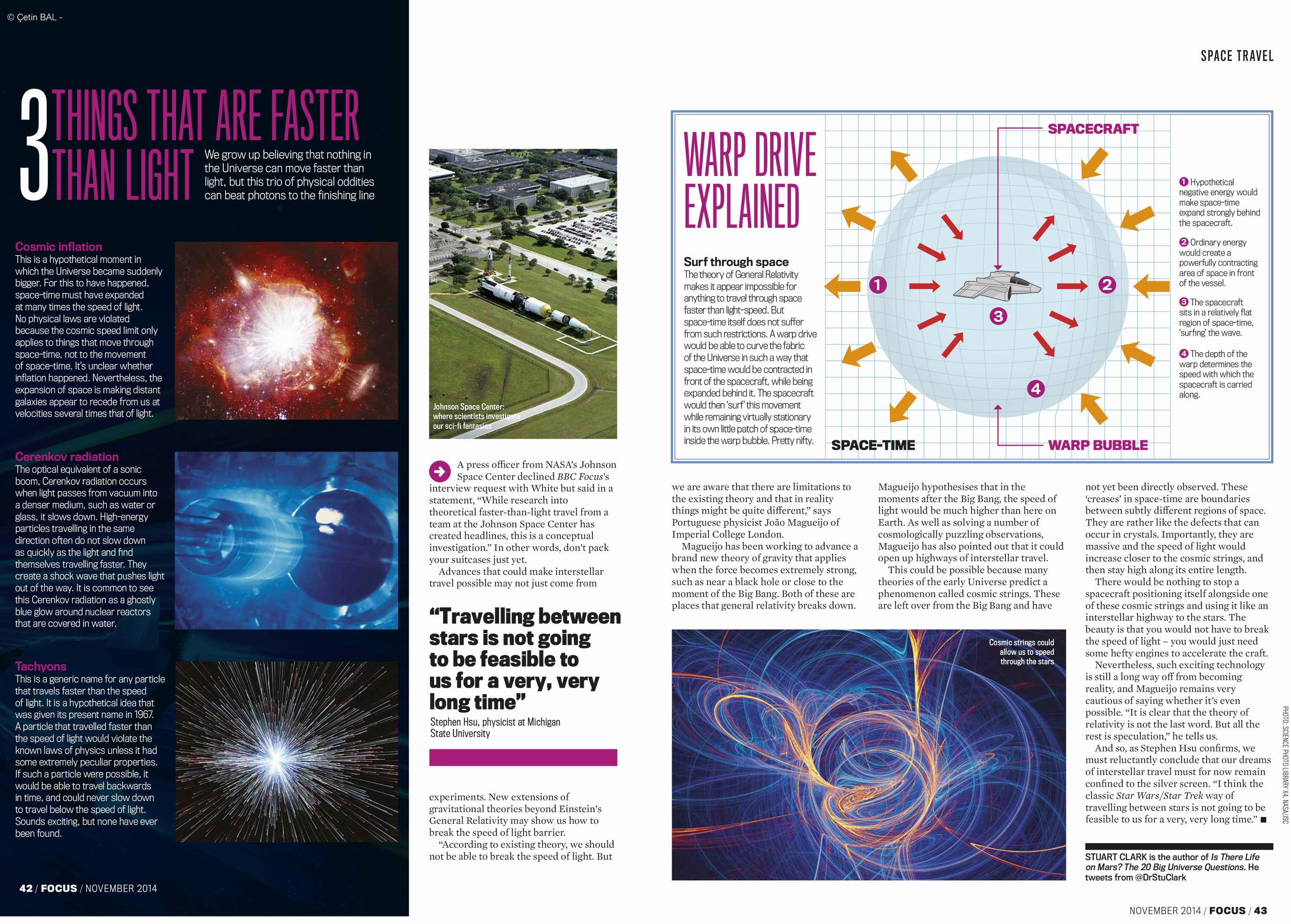
Popular Science Magazine - May 2008 - Science Of Warp Speed

The Warp Drive
In a rush to flee the solar system? Scientists have an interstellar travel
plan, but it entails a brief stint outside the known universe
By Gregory Mone May 1, 2006
by Kris Holland
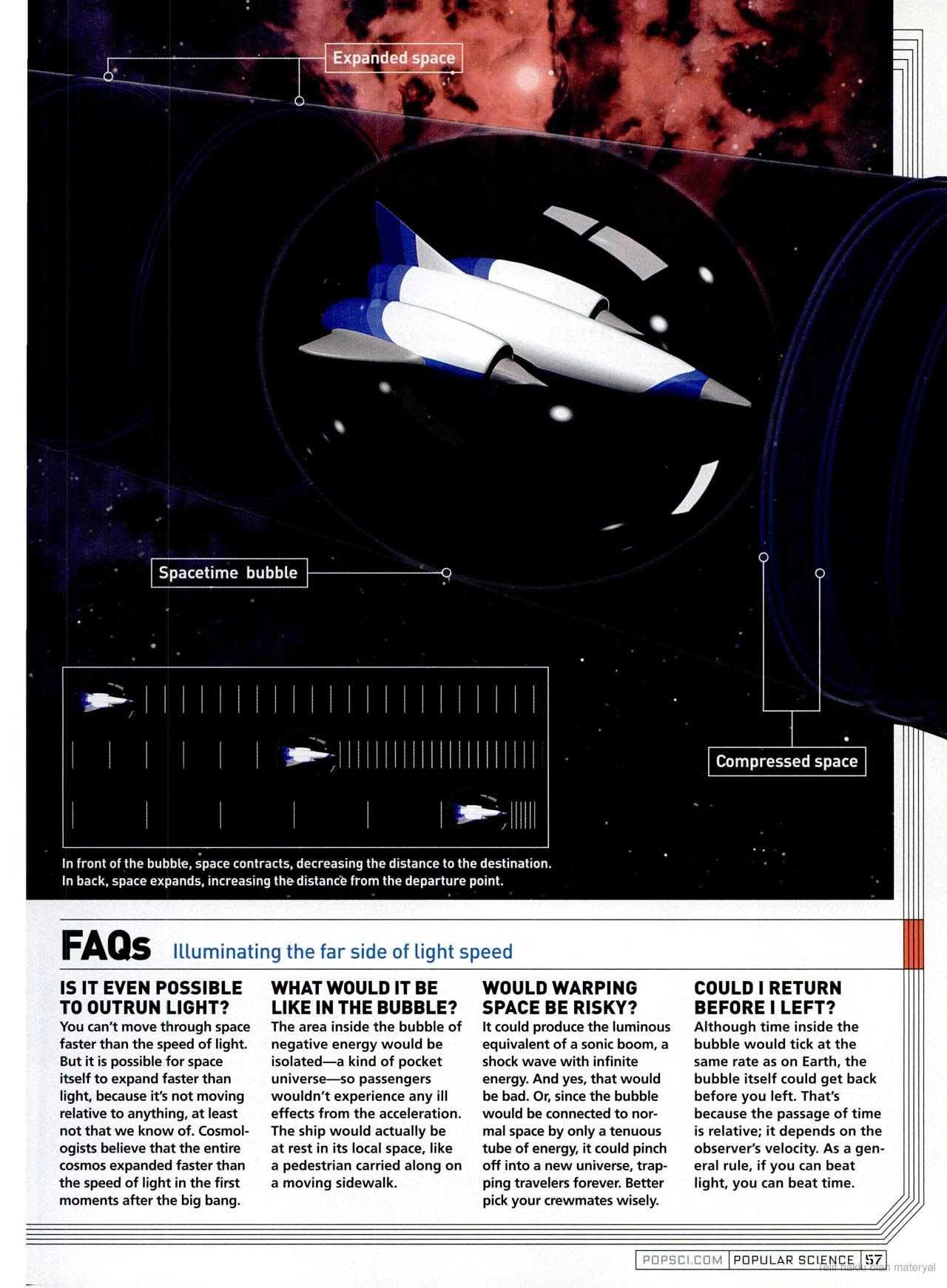
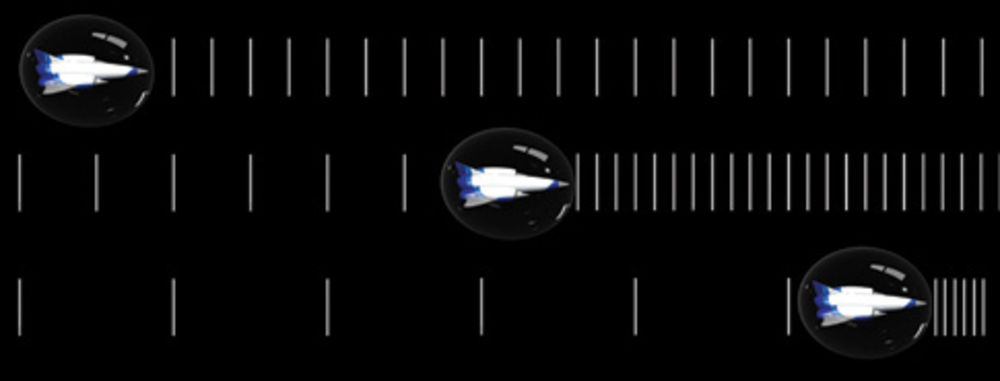
In front of the bubble, space contracts, decreasing the distance to the
destination. In back, space expands, increasing the distance from the
departure point.
What: A spacecraft that travels at faster-than-light speeds by distorting,
or "warping," the fabric of spacetime. Instead of trying to move through
space, the warp drive moves space itself. The ship sits inside a bubble of
spacetime bound by a negative energy field that races across the cosmos.
Why: Chemical and nuclear propulsion, solar sails and ion thrusters all are
too slow to reach the nearest star systems within a human life span. At
faster-than-light speed (more than 186,000 miles per second), a warp-drive
ship would travel 4.5 light-years to Alpha Centauri, the closest sun to our
own, in about four years.
Who: This warp-bubble model is based on thought experiments conducted by
theoretical physicist Miguel Alcubierre of the National Autonomous
University of Mexico, theoretical physicist Chris Van Den Broeck of Cardiff
University in Wales and, most recently, by mathematician Jos Natrio of the
Higher Institute of Technology in Lisbon, Portugal.
Where: For now, warp drive exists only in science fiction.
When: Figure on some point between the distant future and never. Theoretical
research continues to advance, but there´s no launch date in sight.
How To Pilot a Warp Ship:
1-Fuel Up:
Start beyond Earth's immediate gravitational pull. Convert matter into
negative energy (particles with negative mass that are repelled by gravity
rather than attracted to it).
Curve Spacetime:
Emit pulses of negative energy to curve spacetime. Form a sphere around the
ship with the energy, insulating passengers in their own private spacetime
bubble.
2-Drop Out:
The bubble warps spacetime so drastically that it actually slips out of the
visible universe. Only a narrow tube of negative energy keeps it tied to our
world.
3-Expand Space:
Now that the craft is protected in its spacetime bubble, the real work can
begin: Expand space behind the bubble at faster-than-light speed, and shrink
the space in front.
The Warp Drive To-Do List
A few not-so-minor challenges you'll need to tackle before takeoff
-Discover Negative Energy:
There are no known particles with negative mass. The closest scientists have
come is a phenomenon called the Casimir effect, wherein empty space between
two conducting plates behaves as if it contains negative energy.
-Devise a Way To Manipulate It:
Even if scientists could transform matter into negative energy, they would
still have to find a way to focus it and create an infinitesimally thin, yet
extraordinarily stable, bubble of the stuff around the spaceship.
-Harness Dark Energy:
In recent years, cosmologists have been studying a mysterious force called
dark energy that they think is accelerating the expansion of the universe.
If scientists could generate it at the back of the bubble, it might move, or
expand, space.
-Build Bubble Brakes:
Because the spacetime carrying the ship would be completely cut off from the
outside of the bubble, there would be no way to send a signal to turn off
the warp drive. The signal would never get there, and the ship would never
stop.
FAQs
Illuminating the far side of light speed
Is it even possible to outrun light?
You can't move through space faster than the speed of light. But it is
possible for space itself to expand faster than light, because it's not
moving relative to anything, at least not that we know of. Cosmologists
believe that the entire cosmos expanded faster than the speed of light in
the first moments after the big bang.
What would it be like in the bubble?
The area inside the bubble of negative energy would be isolated–a kind of
pocket universe–so passengers wouldn't experience any ill effects from the
acceleration. The ship would actually be at rest in its local space, like a
pedestrian carried along on a moving sidewalk.
Would warping space be risky?
It could produce the luminous equivalent of a sonic boom, a shock wave with
infinite energy. And yes, that would be bad. Or, since the bubble would be
connected to normal space by only a tenuous tube of energy, it could pinch
off into a new universe, trapping travelers forever. Better pick your
crewmates wisely.
Could I return before I left?
Although time inside the bubble would tick at the same rate as on Earth, the
bubble itself could get back before you left. That's because the passage of
time is relative; it depends on the observer's velocity. As a general rule,
if you can beat light, you can beat time.
-----------------------------------------------
The Warp Drive _ Popular Science
FYI: What Would It Feel Like To Travel At Warp Speed?
It wouldn’t feel like much of anything.
By Daniel Engber April 10, 2013

Warp Speeding
If it were really possible to build a warp drive, using it wouldn't make you
fly back into your seat as in a science-fiction movie. "Inside the spaceship,
it would feel absolutely normal," says physicist Dave Goldberg of Drexel
University. "You would be weightless, of course, because you wouldn't have
any acceleration on you at all."
That assumes you're on the inside of what's known as an Alcubierre Bubble—a
hypothetical construct that could allow a patch of space to travel at many
times the speed of light [see "Warp Factor"]. The crew of a spaceship that
had entered such a bubble probably wouldn't have any sense of traveling at
warp speed—"once you're in there, it's the most blasé thing in the world,"
says Goldberg—but crossing the bubble's border would be gut-wrenching. It
could be as violent as falling into a black hole: The space-time deformation
at the edge of the bubble would create an enormous tidal effect, one strong
enough to rip your bones apart.
[ | Bilimsel
Makaleler |
How To Travel Faster Than Light - November 2014 BBC Focus (pdf)
Interstellar Travel - New plans to get humankind to the stars
Hiçbir yazı/ resim izinsiz olarak kullanılamaz!! Telif hakları uyarınca bu bir suçtur..! Tüm hakları Çetin BAL' a aittir. Kaynak gösterilmek şartıyla siteden alıntı yapılabilir.
© 1998 Cetin BAL - GSM:+90 05366063183 -Turkiye/Denizli
Ana Sayfa / Index / Roket bilimi / E-Mail / Rölativite Dosyası
Time Travel Technology / UFO Galerisi / UFO Technology /
Kuantum Teleportation / Kuantum Fizigi / Uçaklar(Aeroplane)
New World Order(Macro Philosophy) / Astronomy