

 bulunur.


Physics
- Source
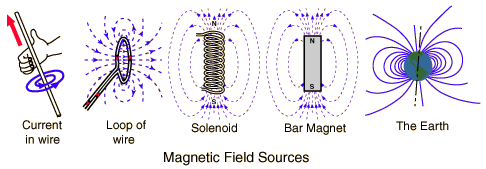
- Magnetism is caused by moving charged electrical particles
(Faraday, 1830s). These particles can be the current of electrons
through an electric wire, or the movement of charged particles
(protons and electrons) within an atom. These charged particles move
much like planets in a solar system:
- nucleus spin around its own axis, causing a very weak magnetic field.
- electrons orbit around the nucleus, causing a weak magnetic field.
-
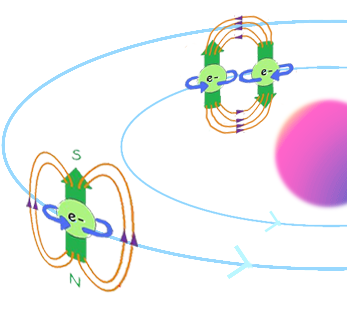 electrons
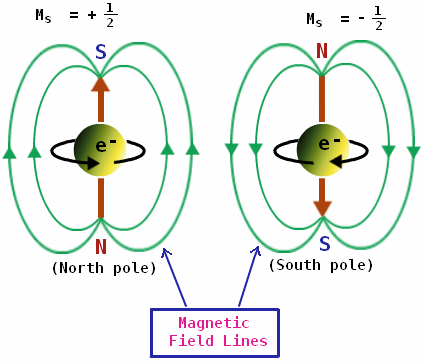
spin around their own axis at the speed of light, causing a
significant magnetic field (Goudsmit and Kronig, 1925).
electrons
spin around their own axis at the speed of light, causing a
significant magnetic field (Goudsmit and Kronig, 1925).
- Spinning electrons generate the bulk of the magnetism in an atom.
- Within each orbit, electrons with opposite spins pair together, resulting in no net magnetic field.
- Electrons in an orbit are filled up first by a + spin. Once all
the orbitals are filled with unpaired + spins, the orbitals are then
filled with the – spin. (see
Spin direction)
:
- Magnetism is caused by moving charged electrical particles
(Faraday, 1830s). These particles can be the current of electrons
through an electric wire, or the movement of charged particles
(protons and electrons) within an atom. These charged particles move
much like planets in a solar system:
- Characteristics
- The electron configuration in an atom determines a the magnetic
characteristics:
- In diamagnetic material, such as copper (Cu), all electrons are paired together. There is no net magnetic field from unpaired the electrons.
- In paramagnetic material, such as magnesium (Mg), there are some unpaired electrons. The electron paths align to an external magnetic field. It becomes magnetized for as long as the external field is present.
-
 In
ferromagnetic material, such as iron (Fe) Co Ni, there are
some unpaired electrons also. But in this case, not only the
electron paths align, but also the atoms orient parallel to each
other. Thus, even when the applied field is removed, the electrons
maintain in a parallel orientation.
In
ferromagnetic material, such as iron (Fe) Co Ni, there are
some unpaired electrons also. But in this case, not only the
electron paths align, but also the atoms orient parallel to each
other. Thus, even when the applied field is removed, the electrons
maintain in a parallel orientation.
- experiment: use a magnet to stroke a ferromagnetic bar, such as iron, several times in the same direction. The magnetic force from the north pole of the magnet causes the unpaired electrons to align themselves. The iron will stay magnetic.
- See also Electron spin, How atoms work, and Goudsmit’s lecture.
- added challenge
- MIT lectures 8.02,
- NDT article,
- Relativity tells us that what looks like a pure magnetic ¯eld in one frame of reference looks like an electric ¯eld in another frame of reference.
- The electron configuration in an atom determines a the magnetic
characteristics:
Properties
- Magnetics
-
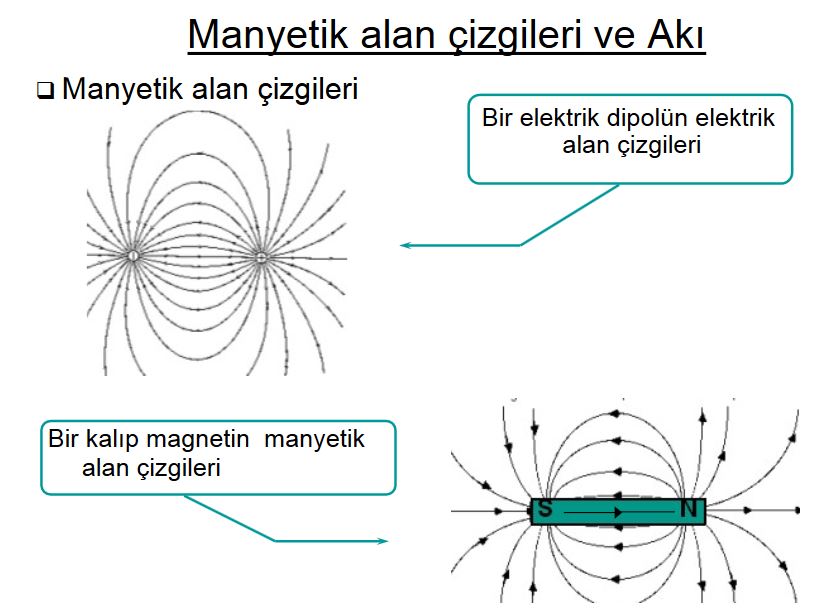
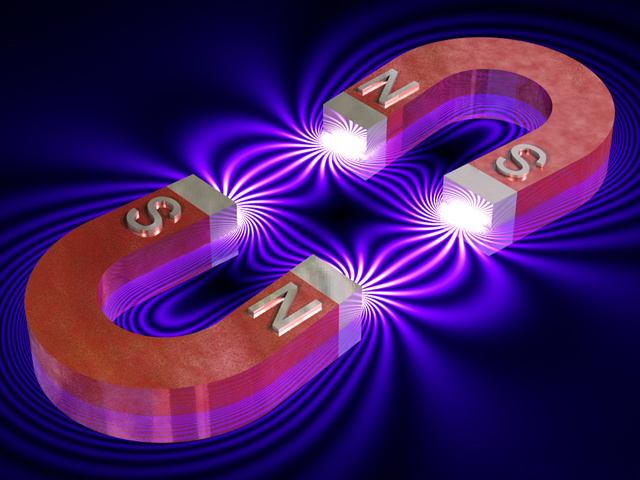
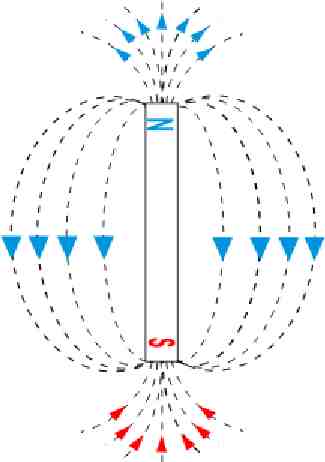
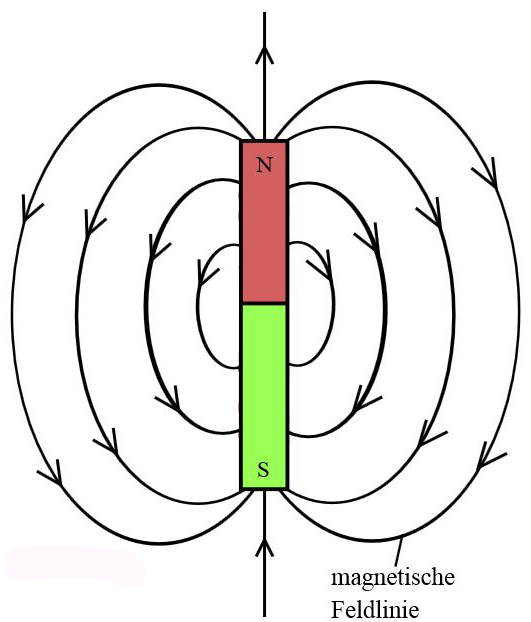
 The
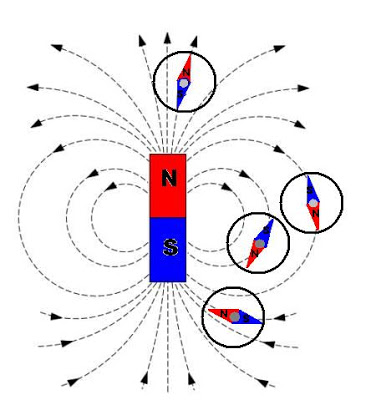
magnetic field (B) is very strong at the poles and weakens as the
distance to the poles increases.
The
magnetic field (B) is very strong at the poles and weakens as the
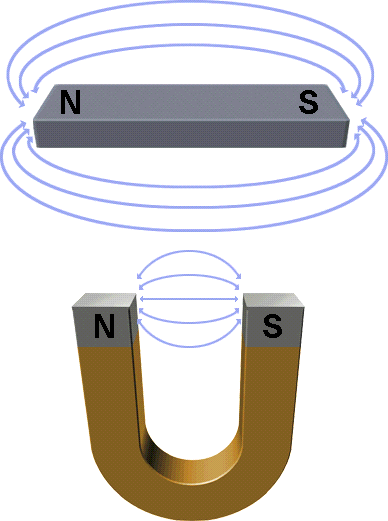
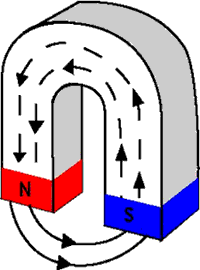
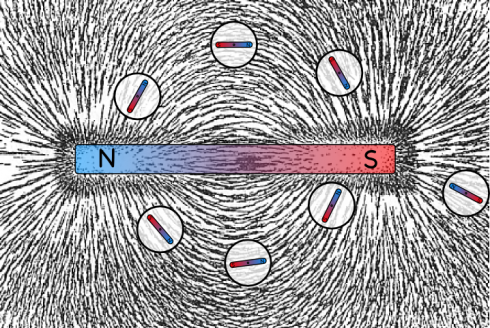
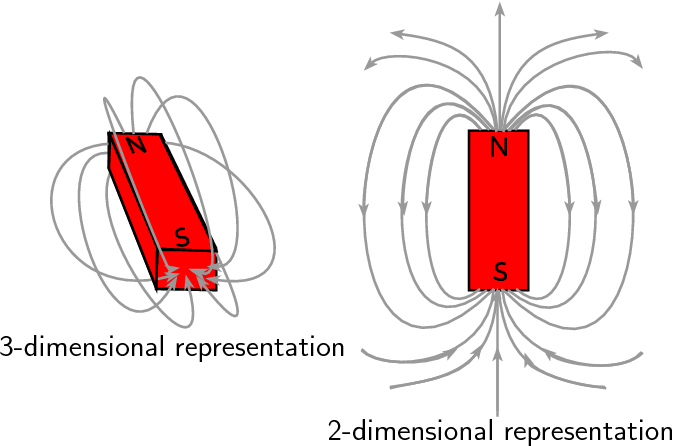
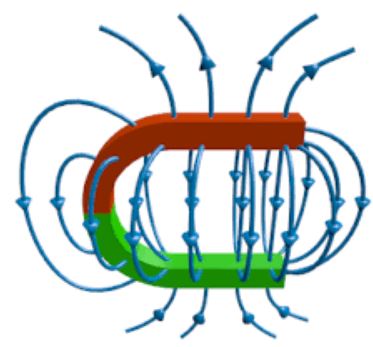
distance to the poles increases. - A magnetic field line (Faraday) is a theoretical line that loops
through the north pole of a magnet, passing through surrounding space,
enter the southing pole and going through the magnet back to the north
pole. A higher density of nearby field lines indicates a stronger
magnetic field. Field lines are a visual and conceptual aid only and
are no more real than the
contour lines (constant altitude) on a topographic map.
- simulation: move compass and bar magnet using Faraday’s Lab.
- experiment: visualize magnetic field using iron filings on
paper/glass with bar magnet underneath.
:
-
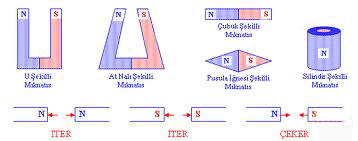
- Two magnets

- Interaction
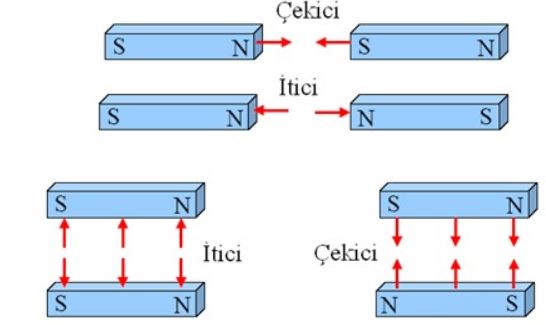
- Opposites attract.
- Same poles repel.
- The force between the two poles is directly proportional to the product of the pole strengths and inversely proportional to the square of the distance between the poles.
- A compass is tiny magnet balanced on a pivot. It will rotate to point toward the opposite pole of a magnet.
- Experiment: suspend a magnet from a string. It will
align with the earth’s magnetic field, so that its S-pole points to
the Earth’s N-pole.
:
- Interaction
- Induction
- A material that is attracted by a magnet becomes a magnet itself.
- As an iron nail is brought close to a bar magnet, some flux
lines emanating from the north pole of the magnet pass through the
iron nail in completing their magnetic path. Since magnetic lines of
force travel inside a magnet from the south pole to the north pole,
the nail will be magnetized in such a polarity that its south pole
will be adjacent to the north pole of the bar magnet. There is now
an attraction between the two magnets.
- experiment: move an iron nail to a bar magnet. Touch another nail to the end of the first nail. The magnetic field from the bar magnet will align the unpaired spins. First the ones closest to the bar magnet. This process can be repeated until the strength of the magnetic field weakens with the distance from the bar magnet. As soon as the first nail is pulled away from the bar magnet, all the nails will fall. Each nail had become a temporary magnet, but once the magnetizing force was removed, the unpaired spins once again assumed a random distribution
- See also …..
Electromagnetism
-
 Wire
Wire

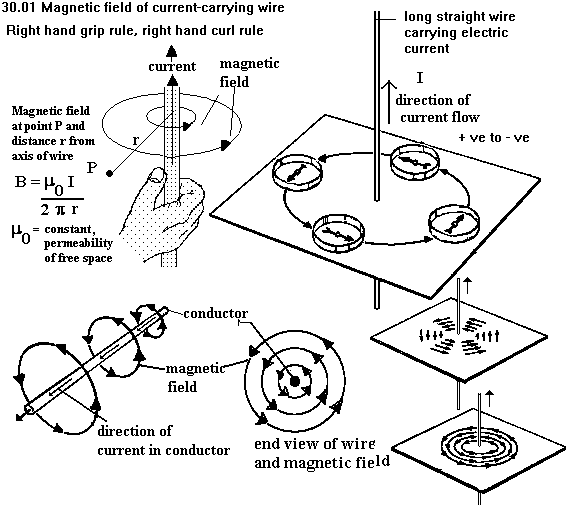
- A moving charge (current) through a wire produces a magnetic field (Ørsted 1819, Ampère 1820).
- The magnetic field lines form concentric circles around the wire.
- The strength of the magnetic field: |B| = μ0.|I| /2Πr, where μ0 is the permeability of free space, I is the current, r is the distance from the wire.
- The direction of the field follows the right-hand rule convention for vectors. In this case, the corkscrew rule, where the thumb points in the direction of the current, and the fingers point in the direction of the magnetic field lines.
- Experiment, paper with iron filings, wire perpendicular to this paper and few seconds of strong current (100 A) through the wire.
- See also the lecture
Magnetic field and Lorentz Force, MIT.
:
- Wire in magnetic field experiences force
-
 A
charge moving through a magnetic field experiences a force FB→
= q . (v→ × B→), where v is the
speed of the charge, q is the value of the charge and B→
is the magnetic field (Lorenz, 1892).
A
charge moving through a magnetic field experiences a force FB→
= q . (v→ × B→), where v is the
speed of the charge, q is the value of the charge and B→
is the magnetic field (Lorenz, 1892). - The direction of FB→ is perpendicular to both the direction of the charge and the magnetic field. The direction is the cross product of v→ and B→, and as such defined according to the right-hand rule for vectors. With the thumb, index, and middle fingers at right angles to each other (with the index finger pointed straight), the first (index) finger represents the first vector in the product (v→); the second (middle) finger represents the second vector (B→); and the thumb represents the product (FB→).
- Animation, Lorenz force, Univ. of Florida.
- Experiment, current perpendicular to magnetic field. Thin wire (50 cm) suspended in between strong magnets. Connect wire to switch and two D-cell batteries.
- Experiment, wire in between two poles demo as part of the lecture Magnetic field and Lorentz Force, MIT.
- Experiment,
Homopolar motor. (see also
Homopolar)
:
-
- Coil in magnetic field
- make one, http://science.howstuffworks.com/how-to-make-electromagnet.htm
- Rotor in magnetic field
- Eddy currents. Two equal masses slide down two identical aluminum tubes. Since one of the masses is magnetic it will induce eddy currents according to Lenz’ Law. This damps the motion of the mass causing the magnetic mass to take much longer to fall through the tube