| |
INTERSTELLAR
(YILDIZLARARASI) SPOILER ALERT: The purpose of this article is to provide explanations
about the real, theoretical scientific concepts presented in the film,
Interstellar (2014) so that people can have a greater understanding of this
unusually complex film. If you haven't watched the film and you do not wish
to know the specific details of the film, please stop reading and come back
here later if you're interested to know more.
The following explanations are provided based on my understanding of
the film after watching it the first time on November 5, 2014 and what I
know about the basics of quantum mechanics and Einstein’s Theory of
Relativity. Note that these are highly complex theories with lots of
mathematical calculations and formula. I've tried my best to make them as
short, simple and concise as possible for easier understanding without the
maths.
If there are any mistakes found in this article, please kindly
provide any comments below so I can rectify it.
- Saturday, 8 November 2014 -

Murphy's law
It's a saying that states:
Anything that can go wrong will go wrong.
It originally comes from Murphy's Original Law, which states that:
If there are two or more ways to do something, and one of those ways
can result in a catastrophe, then someone will do it.
However, Murphy's law doesn't mean that something bad will happen. It
means that whatever can happen, will happen.
Cryosleep/Hypersleep

The process of freezing and storing the body of a person for
preservation to prevent tissue decomposition during long periods of
interstellar travel so that at some future time the person can be awakened
with minimal effects of aging due to gravitational or relative velocity
time dilation. (will be explained later)

Differences between Classical Physics and Quantum
Physics
Quantum and classical physics are based on
different conceptions of physical reality.
Classical physics – Any
theory of physics in which the Universe is assumed to have a single,
well-defined history. Objects move on well-defined paths and have definite
histories. We can specify their precise position at each moment in time.
Since classical physics mainly deals with the macroscopic world of
daily life, they are successful enough for everyday purposes. In
essence, these are the ideas that existed before the development of
quantum theory.
Law of Thermodynamics, Classical
Electromagnetism, non-linear dynamics and Chaos Theory, Einstein’s Theory
of Relativity (special and general), Classical Mechanics (Newton’s law of
motion and law of universal gravitation, Lagrangian and Hamiltonian
mechanics) are all classical physics.
However, it was found out in the 1920s that classical
physics could not account for the bizarre behaviour observed on the atomic
and subatomic (microscopic) scales of existence. Therefore, quantum
theories were developed, which will be discussed later on.
Now, let me first start on explaining what Einstein's
Theory of Relativity is about:
Einstein’s Theory of Relativity – General and
Special
Before explaining Einstein's theory, it is best to
first explain what dimensions are.
Dimensions – The
number of coordinates required to specify a position or location.
These can range from one (a vibrating ‘string’, from String Theory) to
three (in space) to 11 (in M-Theory), which will be explained later on.
Space-time – A mathematical space. Its points
must be specified by space and time coordinates. It is four
dimensional, with three spatial coordinates and one time.
The three macroscopic space dimensions are: (1) left
and right; (2) up and down; (3) backward and forward.
Einstein’s Theory of General Relativity
A theory of gravitation that was developed by Albert
Einstein (1907 – 1915). It states that accelerated motion and motion
without acceleration but with gravity (standing still in a
gravitational field of a given strength) are physically identical
(equivalence principle).
Because no special force is required to create inertial
effects in an accelerating object, Einstein proposed that we should think
the same way about gravity, forgoing the classical notion of gravitational
force and instead conceiving of gravity as curves in space-time.
This explains phenomena like why light bends in the presence of a
gravitational field even though it lacks mass.
According to general relativity, the observed
gravitational attraction between masses results from their warping
(distortion) of space and time, allowing frame-dragging to
occur, whereby a massive rotating object would alter space and time,
dragging a nearby object out of position. The shape of space responds to
objects in the environment. Therefore, time is a dimension (4) past,
present and future; gravity distorts time.
Note: As space contracts, time expands.
Einstein’s description of gravity:
- The more massive an object is, the greater the distortion (gravitational
influence) it causes in the surrounding space.
- The distortion becomes weaker (amount of spatial warping decreases) as
the distance between objects becomes larger.
Examples:
- In our solar system, the presence of mass (the sun) causes the
fabric of space and time around it to warp (distorted). This
distortion causes other surrounding objects (planets) to move around the
sun and their motion is determined by the shape of the warp (elliptical
orbit).
- Earth, being a massive object,
also warps the fabric of space and time, but far lesser than the
sun. This is how the Earth keeps the moon in orbit and each of us bound
to its surface.

Earth causes the fabric of space and time to warp, the moon is
kept in orbit around the Earth because it rolls along a valley in the
warped spatial fabric. In more precise language, it follows a “path of
least resistance” in the distorted region around the Earth.
The theory states that time goes
more slowly in the presence of a gravity field (Gravitational
time dilation) and that the
universe is expanding, in some
cases faster than the speed of light, because it’s the space itself
that’s expanding, not objects within it.
Artificial Gravity

The effects of zero gravity in space is normally the big problem that we,
as humans will face with long-term interstellar space travel. We were
born on Earth and therefore our bodies are adapted to survive under
gravity, but when we’re in space for long periods of time, our muscles
will degrade.
To prevent this from happening, scientists have created different
designs of installing artificial gravity on spaceships. One such way is
to rotate the spacecraft, as shown in the film. The rotation creates
a centrifugal force that pushes objects to the outer walls of the
spacecraft. This push acts similar to how gravity would, but just in an
opposite direction.
You experience this same form of artificial gravity when you’re driving
around a tight curve and feel like you’re being pushed outward, away
from the central point of the curve. For a spinning spacecraft, your
wall becomes the floor on which you walk.
Gravitational Time dilation
In the film, Cooper tells his weeping 10-year-old daughter, Murph,
before he flies off to space, “When I get back, we may be the same
age.”
To understand time dilation, one must first understand the concept of a
reference frame.
A reference frame is an imaginary coordinate
system that specifies the location and time measurements of events with
respect to a fixed origin. It can also be thought of as an imaginary
map.
In space-time physics, every person (or observer) has
his or her own reference frame in which he/she is the origin. Therefore,
a person assigns spatial and time coordinates to events based on his or
her position.
Time dilation is the difference between time
measurements of two reference frames that are moving at different
velocities with respect to one another. Two of the time dilations in
Einstein’s Theory of Relativity have been experimentally proven. (the
other one is Relative velocity time dilation)
According to Einstein’s Theory of General
Relativity, time differs from place to
place or time runs more quickly (the actual time speeds up) at
higher altitudes because of a weaker gravitational force.
The effect of time passing at different rates in
regions of different gravitational potential is called Gravitational
time dilation. The lower the gravitational potential (closer to
the centre of a massive object), the slower time passes.
Note: The gravitational potential at a location is equal to
the work (energy transferred) per unit mass that is done by the force
of gravity to move an object to a fixed reference location. As we go
closer to the centre of a massive object, the gravity gets stronger,
meaning the gravitational potential needed to move an object becomes
lesser.
In 2010, gravitational time dilation was measured at
the Earth's surface with a height difference of less than 1 meter (12
inches), using optical atomic clocks. The clock at a higher altitude was
found to be running faster than the other.
It means that your head ages more quickly than your
feet and that people living on the top floor of a tower block age more
quickly than those on the ground floor. However, the effect is so small
(negligible) that it would add just 90 billionths of a second to a
79-year life span.
In general relativity, the time dilation effect is not
reciprocal: an observer at the top of a tower will observe that
clocks at ground level tick slower and observers on the ground will
agree about that. Gravitational time dilation is agreed upon by all
stationary observers, independent of their altitude.
Einstein’s Theory of Special Relativity
A theory of the structure of space and time developed
by Albert Einstein in 1905, which states that:
All the laws of
physics are equally valid for all observers in uniform motion (velocity)
relative to one another. In other words, the speed of light
and the relationship between force (energy), mass, and acceleration are
the same for all observers (or reference frames) moving at constant
velocity.
The speed of light from a uniformly moving source or in a vacuum is
always the same for all observers; regardless of how fast (or slow) the
light source or its observer is moving.
The consequences that follow from the special theory
of relativity are:
Relativity of simultaneity - simultaneity
is not absolute, but dependent on the observer's reference frame. It
is impossible to say whether two events occur at the same time if those
events are separated in space. So,
the perception of Time is relative (dependent on the individual’s or
observer’s point of view).
Things that appear to happen at the same time to
stationary observer A may appear to happen at different times to moving
observer B.
Example: Two plane crashes that happened at
the same space. All observers in the same space will agree that both
planes arrived at the point of impact at the same time. But where the
events are separated in space, such as one plane crash in London and
another in Chicago, the question of whether the events are simultaneous
is relative: in some reference frames the two accidents may happen at
the same time, in others (in a different state of motion relative to the
events) the crash in London may occur first, and in others the Chicago
crash may occur first.
Length contraction -
the physical phenomenon of a decrease in length detected by an observer
in objects that travel at any non-zero velocity relative to that
observer. This contraction is usually only noticeable when objects are
moving near the speed of light; to the direction in which the observed
body is travelling.
Example:
At a speed of 13,400,000 m/s, the length is 99.9% of
the length at rest; at a speed of 42,300,000 m/s, the length is still
99%.
Mass-energy equivalence
energy and mass are essentially the same thing,
and transmutable into each other (neither one appears without the other).
Energy always exhibits mass in whatever form the energy takes. The law
of conservation of energy is relative to the law of conservation of
mass.
The total internal energy, E of a body at rest is
equal to the product of its rest mass, m (E = mc2).
Since c2 is a big number, a little mass
goes an extremely long way in producing energy.
Relativistic mass, m = E/c2 for
all particles moving at the speed of light.
Einstein’s formula explains that nothing can
travel faster than the speed of light. Nothing outruns
electromagnetic radiation – photons (light, radio waves, microwaves,
ultraviolet radiation, X-rays, gamma rays, infrared radiation). The
faster something moves the more energy it has and from Einstein’s
formula we see that the more energy something has the more massive it
becomes.
Therefore, a slower-than-light particle with non-zero
rest mass needs infinite (or vast amounts of) energy to
accelerate to the speed of light; although special relativity does
not forbid the existence of particles that travel faster than
light at all times (tachyons - hypothetical).
Relative Velocity Time dilation
Time runs at different rates, depending on the
relative velocity between two observers (clocks moving near the speed
of light operate more slowly than stationary clocks).
However, the only way this can happen is if an
observer’s space and time measurements of a system depend on the
system’s velocity relative to that observer. This means that two
observers can measure the time interval between the same two events and
come up with different time measurements for these events, as long as
one of the observers is moving at constant velocity with respect to the
other. The faster the relative velocity, the slower time passes.
Therefore, when two people synchronize their clocks
to read the same time, this synchrony remains as long as the two people
remain at rest with respect to one another. However, if one person
boards an airplane and flies a certain distance, that person’s clock
will run at a slower rate than the person on the ground. This is called Relative
velocity time dilation.
When a particle moves horizontally, the total speed
of the constituent particles with respect to the rest frame is still
equal to the speed of light. The difference, though, is that when the
particle is moving horizontally, the total speed of the particle is made
up of “orbital speed” and “horizontal speed” components, rather than
just an orbital speed component as is the case when the particle is at
rest.
The Standard Model of elementary particles shows that
every particle consists of smaller particles that orbit each other at
the speed of light. That is, each of these particles has an “orbital
speed” that equals the speed of light.
Examples:
- Researchers in the 1970s used atomic clocks to test the theory. One
clock remained on the ground, and the other clock flew on a jet at 600
miles per hour. As predicted by Einstein’s Special Theory of Relativity,
the clocks ran at different rates. The airplane clock ran billionths of
a second slower than the ground clock. (Atomic clocks are known to be so
accurate that they lose or gain less than 1 second every 3.7 billion
years.
- In 2010, relative velocity time dilation was observed at speeds of
less than 10 meters per second using optical atomic clocks connected by
75 meters of optical fibre.
- In special relativity, the time dilation effect is reciprocal:
as observed from the point of view of either of two clocks which are in
motion with respect to each other, it will be the other clock that is
time dilated. (This presumes that the relative motion of both parties is
uniform; that is, they do not accelerate with respect to one another
during the course of the observations.)
It is to note that special and general relativistic effects can combine:
Imagine for any two civilizations with an enormous
distance between them (light years apart) and they communicate by
transmitting radio waves that travel at the speed of light, the sender
will be millennia ahead of the recipient by the time the message reaches
the recipient.
Example:
The satellite clocks are moving at 14,000 km/hr in orbits that circle
the Earth twice per day, much faster than clocks on the surface of the
Earth, and Einstein's theory of special relativity says that rapidly
moving clocks tick more slowly, by about 7 microseconds per day.
(relative velocity time dilation)
Also, the orbiting clocks are 20,000 km above the Earth, and experience
gravity that is four times weaker than that on the ground. Einstein's
general relativity theory says that gravity curves space and time,
resulting in a tendency for the orbiting clocks to tick slightly faster,
by about 45 microseconds per day. (gravitational time dilation)
The net result is that time on a GPS satellite clock advances faster
than a clock on the ground by about 38 microseconds per day. At
38 microseconds per day, the relativistic offset in the rates of the
satellite clocks is so large that, if left uncompensated, it would cause
navigational errors that accumulate faster than 10 km per day! GPS
accounts for relativity by electronically adjusting the rates of the
satellite clocks, and by building mathematical corrections into the
computer chips which solve for the user's location. Without the proper
application of relativity, GPS would fail in its navigational functions
within about 2 minutes. (James S. McDonnell)
Sources:
- Wikipedia
- Relativity: The Special and the General Theory – Albert Einstein
- Einstein’s Theory of Relativity – Max Born
- Simply Einstein: Relativity Demystified - Richard
Wolfson
http://physicscentral.com/explore/writers/will.cfm
Things to know about
Interstellar (2014) Explained - Part 2
Now, let's proceed to explain what
quantum theory is about:
Quantum
mechanics/quantum physics/quantum theory
Any
theory of physics in which the Universe has no single history or even
an independent existence and objects do not have single definite
histories.
It seeks to explain the
Universe from a subatomic (microscopic)
point of view. It is a branch
of physics that provides a mathematical description of much of the
dual particle-like and wave-like behaviour and interactions of energy
and matter. It states that matter
can be both a particle and a wave. It
departs from classical mechanics primarily at the atomic and subatomic
scales, the so-called quantum
realm.
At quantum level, matter doesn't exist at a fixed state; instead it
exists in a cloud of ‘probability’ called the ‘wave function’ where it
exists in all states and in all locations. Only by
‘looking/observing’ at the particle, we collapse the ‘wave
function’ and force it to exist in a certain location and in a certain
state. Example: Light is made up of packets of
energy called photons.
Quantum uncertainty/Heisenberg uncertainty
principle (Copenhagen interpretation)
A finding in quantum physics by Werner Heisenberg
that states that one cannot know both the exact position
and exact momentum (or velocity) of a single particle
at the same time (certain pairs of physical properties
cannot be known simultaneously to arbitrary precision). You can only
measure the position of a particle or measure its movement but you
can never find out both.
In order to know where something is, you must be
able to see it – and to see an object you must shine light on it.
Light is made up of packets of energy called photons which although
tiny, do possess some mass. Because particles are so small, the
photons that you have used to see where it is will cause it to move.
So, although you have measured its position, you can no longer know
its velocity. The very act of observing a particle changes its
physical attributes, so we can never know anything about it.
Quantum superposition
The quantum mechanical property of a particle to occupy its entire
possible quantum states simultaneously. Due to this property, to
completely describe a particle one must include a description of
every possible state and the probability of the particle being in
that state.
Example: In quantum physics, any living thing could exist
simultaneously in various states, from completely alive to dead
and all stages in-between. All of these states, known as
superposition are possible outcomes before observation is performed
on the living thing.
Note: Time is a dimension which isn't linear. At quantum level,
every moment, past, present and future, exist simultaneously.
Therefore there is no paradox. It's just that 3-dimensional beings
like us don't/can't experience time in this way. We experience it in
a linear fashion.
Quantum non-locality/Quantum entanglement
This phenomenon means that once two particles
interact together, they become forever ‘entangled’ and that whatever
affects one will instantly affect the other – no matter the
distances involved, even if they are separated by light-years of
space. So by affecting the properties of the first particle, you
instantly affect the properties of the second, making measurement of
the second particle meaningless.
“All things are made of atoms — little particles that move around in
perpetual motion, attracting each other when they are a little
distance apart, but repelling upon being squeezed into one another.” –
Richard Feynman
In particle physics, an elementary particle is a
particle with no measurable internal structure; that is, it is not
made up of smaller particles. Elementary particles are fundamental
objects of quantum field theory.
- Proton – A positively charged atomic particle that, along with the
neutron, forms the nucleus of an atom.
- Neutron – An electrically neutral atomic particle that, along with
the proton, forms the nucleus of an atom.
- Electron – An elementary particle with a negative charge that
surrounds the nucleus of an atom and defines its chemical properties.
Protons and neutrons are each composed of three
quarks.
Note: We tend to visualize an electron
to be a tiny ball, in orbit around a larger cluster of balls
representing protons and neutrons. That isn't what it is like. They
don’t look like little balls. They are not like anything we recognize
at all.
In Superstring Theory, each elementary particle
is composed of a single string (each particle is a string),
all strings are absolutely identical. Differences between
particles arise because their respective strings undergo different
resonant vibrational patterns. (Brian Greene)
All elementary particles are either bosons or fermions (depending
on their spin). Spin is the intrinsic angular momentum of a
subatomic particle. It is an important part of a particle’s quantum
state.
All the particles of the Standard
Model have been observed (experimentally verified), except Higgs
boson ("tentatively confirmed") and graviton (theoretical).
Fermions:
- 6 ‘flavors’ of Quarks — up,
down, charm, strange, top, bottom.
- 6 ‘flavors’ of Leptons —
electron neutrino, electron, muon neutrino, muon, tau neutrino, tau.
Bosons:
- 12 Gauge bosons (force
carriers) — eight gluons of the strong force, three W and Z bosons of
the weak force, photon of electromagnetism.
- Other bosons — Higgs boson,
graviton.

Standard Model of Particle Physics
The Standard Model shown above explains
the subatomic composition of the Universe and describes how three
of the four forces stuck together (gravity is not included as
graviton is not yet discovered). It explains how the Universe works at
the subatomic level and is the basic understanding of matter for
physicists.
Higgs boson and Higgs field
The Higgs Field is an energy field that exists everywhere in the
universe. The Higgs field is not considered a force. It cannot
accelerate particles, it doesn't transfer energy. The field is
accompanied by a fundamental particle called the Higgs Boson, which
the field uses to continuously interact with other particles. As
particles (except the massless ones) pass through the field they are "given"
mass. Different particles interact with the Higgs field with different
strengths, hence some particles are heavier (have a larger mass) than
others. (The Higgs particle does not interact with massless particles,
such as a photon or a gluon. Since these particles don't interact with
the Higgs field, the Higgs boson also doesn't interact with them.) The
process of giving a particle mass is known as the Higgs Effect.
Elementary particle interactions
Note: Mass itself is not generated by the Higgs field - the
creation of matter or energy would conflict with the laws of
conservation. However, mass is "imparted" to particles from the Higgs
field, which contains the relative mass in the form of energy. Once
the field has endowed a formerly massless particle the particle slows
down because it has become heavier.
Note: The Higgs particle, like many other elementary particles,
is not a stable particle. Once the Higgs particle has been created, it
will eventually decay. Since it interacts with all kinds of other
massive particles it can be created in collisions. If the Higgs field
did not exist, particles would not have the mass required to attract
one another, and would float around freely at light speed.
Four fundamental forces-mediating fields
- Strong Nuclear Force – Holds together the protons and
neutrons inside the nucleus of an atom – and the protons and neutrons
themselves. The strong force is the energy source for the Sun and
nuclear power.
- Weak Nuclear Force – Causes radioactivity and plays a vital
role in the formation of the elements in stars and the early Universe.
We don’t come into contact with this or the strong force in our
everyday lives.
- Electromagnetic Force – The long-range force much stronger
than gravity, but acts only on particles with an electric charge.
Electric forces between large bodies cancel each other out but
dominate atoms and molecules.
- Gravity – The weakest of the four, but a long-range force
that acts as an attraction on everything in the Universe. For large
bodies, the gravitational forces add up and can dominate all others.
The four fundamental forces of
nature
The following theory is important to
understand the third act of the film, Interstellar.
Unified Field Theory (UFT) -
coined by Einstein, who attempted to unify the general theory of
relativity with electromagnetism, hoping to recover an approximation
for quantum theory and to bring four fundamental force-mediating
fields (Electromagnetism, Strong and weak nuclear force and gravity)
together into a single framework (a single field). In short, the
theory attempts to reconcile quantum mechanics and Einstein’s general
relativity.
Our preoccupation with matter itself is
incredibly skewed. We have this tendency
to think that only solid, material ‘things’ are ‘really’ things at
all. ‘Waves’ of electromagnetic fluctuation in a vacuum seem ‘unreal’.
Most people think that waves had to be waves ‘in’ some material
medium. Unfortunately, no such medium was known or discovered.
We are more like waves than permanent ‘things’.
For example: An experience from your
childhood. Something you remember clearly, something you can see,
feel, maybe even smell, as if you were really there. After all, you
really were there at the time, weren't you? How else would you
remember it? But the reality is: you weren't there at all.
Not a single atom that is in your body today was
there when that event took place…Matter flows from place to place and
momentarily comes together to be you. All your body cells at that time
are dead and replaced by newly-formed body cells every day. Therefore,
whatever you are now, you are not the stuff of which you are made
in the past.
Humans live in ‘macroscopic levels’ of space-time dimensions
that are bound by the four fundamental forces. They travel
relative to one another at slow speeds, generally unaware of
the distortions in the passage of time and perceive time linearly.
Before quantum mechanics, it was
generally thought that all knowledge of the World could be obtained
through direct observation, that things are what they seem, as
perceived through our senses. But, quantum mechanics have shown that
this is not the case, by remarkably accurate at predicting events on
microscopic scales, while able to reproduce the predictions of the old
classical theories when applied to events on macroscopic scales.
Sources:
- Wikipedia
- The Elegant Universe: Superstrings, Hidden
Dimensions and the Quest for the Ultimate Theory – Brian Greene
- The Grand
Design – Stephen Hawking and Leonard Mlodinow
- The Brief
History of Time - Stephen Hawking
- The Fabric of the Cosmos: Space, Time and the
Texture of Reality – Brian Greene
Hyperspace: A Scientific Odyssey through Parallel Universes, Time
Warps, and the Tenth Dimension – Michio Kaku
http://www.fnal.gov/pub/science/inquiring/questions/higgs_boson.html

Things to know about
Interstellar (2014) Explained - Part 3
Now, let's explain what a wormhole and a black hole is:
Einstein-Rosen Bridge/Wormhole
A wormhole is a hypothetical space-time topology, a
‘shortcut’ that would allow travel between two points at apparently (closer
to) faster-than-light speeds . The impossibility of faster-than-light
relative speed only applies locally.
In reality, movement through a wormhole would not be faster-than-light,
but rather moving at normal speed through folded space. Wormholes allow
superluminal (faster-than-light) travel by ensuring that the speed of
light is not exceeded locally at any time. While travelling through a
wormhole, subluminal (slower-than-light) speeds are used.

To explain what is a wormhole in simple terms, we have to first
visualize space as a two-dimensional (2D) surface, let's say a paper.
The normal route from Point A to Point B would be a straight line. But
what if, we have something that generates a sudden enormous amount of
energy strong enough to bend the paper (warp the fabric of space and
time)?
A wormhole can be pictured as a hole in that surface that leads into a
3D tube (the inside surface of a cylinder). This tube then re-emerges at
another location on the 2D surface (paper) with a similar hole as the
entrance. An actual wormhole would be analogous to this but with the
spatial dimensions raised by one - 4th dimensional space. For
example, instead of circular holes on a 2D plane, a real wormhole's
mouths are spheres in 3D space (perfectly round geometrical and circular
object in three-dimensional space).
A wormhole as shown in Interstellar
If two points are connected by a wormhole, the time taken to traverse it
would be less than the time it would take a light beam to make the
journey if it took a path through the space outside the wormhole (e.g.
running around to the opposite side of a mountain at maximum speed may
take longer than walking through a tunnel crossing it). However, light
beam travelling through the wormhole would always beat the traveller.
Wormholes may connect an infinite series of parallel universes. Parallel
universes may be graphically represented by two parallel planes.
Normally, they never interact with each other. However, at times
wormholes may open up between them, perhaps making communication and
travel possible between them. Wormholes may connect a universe with
itself, perhaps providing a means of interstellar travel. Since
wormholes may connect two different time eras, they may also provide a
means for time travel.
A wormhole may connect two regions that exist in different time periods.
Thus, the wormhole may connect the present to the past. Since travel
through wormhole is instantaneous, one could use the wormhole to go
backward in time. It is not possible to travel to the future. However,
vast amounts of energy may be required to generate a wormhole, which is
beyond what will be technically possible for centuries to come. (Kip
Thorne)
Note: Relative velocity time dilation takes place when travelling
within a wormhole - time passes slowly when moving near speed of light
(in a wormhole) compared to time on Earth.
Einstein's theory of relativity predicts that if traversable
wormholes exist, they could allow time travel. This would be
accomplished by accelerating one end of the wormhole to a high velocity
relative to the other, and then sometime later bringing it back;
relativistic time dilation would result in the accelerated wormhole
mouth aging less than the stationary one as seen by an external observer.
However, time connects differently through the wormhole than outside it,
so that synchronized clocks at each mouth will remain synchronized to
someone travelling through the wormhole itself, no matter how the mouths
move around. This means that anything which entered the accelerated
wormhole mouth would exit the stationary one at a point in time prior to
its entry.
In short, Einstein’s theory states that time passes more slowly for a
highly accelerated body. If one end of a wormhole were accelerated to
close to the speed of light while another was stationary, a traveller
entering into the stationary hole would emerge in the past from the
accelerated hole. This type of wormhole would be called a closed time-like
curve (a closed loop in space-time is formed) or a timehole.
Example of interstellar time travel:
- Suppose a traveller need to attend a 2-hour meeting at a
different galaxy or universe. The traveller is from Universe 1/Galaxy
1. Consider two clocks at both holes both showing the date as 2004.
After being taken on a trip at relativistic velocities, the
accelerated hole reached Universe 2/Galaxy 2.
- The clock at the accelerated hole mouth of Universe 2/Galaxy 2
reads 2005 (assuming it takes 1 year for hyperspace travel due to
extremely long distances between galaxies or universes) while the
clock at the stationary hole mouth of Universe 1/Galaxy 1 reads 2010
(due to relative velocity and gravitational time dilation).
- The traveller attended the meeting for 2 hours and travel back
to go home. The clock at the accelerated hole mouth of Universe 3
reads 2006.
Question arises: Is Universe 3 the same
universe as Universe 1? Are Universe 1 and 3 two of the many universes
in a quantum multiverse? The ‘original’ universe where the traveller
comes from is actually Universe 1, which should be at least 2016 after
the travel has taken place. If the two universes are the same and
belongs in the same quantum multiverse, this means that the traveller
had travelled back in time.
Infographics taken from
Black Hole
Note: Although solid mathematical calculations predict that black
holes do exist, no one can ever confirm that it's the case until they
really observed it in front of their eyes. The closest known black
hole to Earth is thousands of light years away, making it impossible
to travel into space (with our current technology) to 100% confirm
that they do exist. Even if you have the chance to do so, would you
dare enough to get near it? Despite the existence of multiple
scientific theories to study and understand the nature of black holes,
even today, what happens inside a black hole is still not completely
known or understood by many physicists.
The theory of general relativity predicts that a sufficiently compact
mass will distort space-time to form a black hole. General Relativity
is essential in modern astrophysics and provides the basis for the
current understanding of black holes - regions of space where
gravitational attraction is so intense that not even light can escape.
The mass of a neutron star cannot exceed about 3 solar masses.
If a core remnant is more massive than that, nothing will stop its
collapse, and it will become smaller and smaller and denser and denser.
Once the gravitational collapse of the neutron core begins, there is
no force known which is strong enough to stop the collapse. The
collapse will continue forever.
Will our Sun become a black hole?
No. Stars like the Sun just aren't massive enough to become black
holes. At the very minute, it is slowly expanding as the nuclear
reactions in the core use up the hydrogen (converting it to helium -
nuclear fusion) to generate energy. In several billion years, the Sun
will cast off its outer layers, and its core will form a white dwarf -
a dense ball of carbon and oxygen that no longer produces nuclear
energy, but that shines because it is very hot. It will stay for
billions of years longer before finally cooling down and fades away. A
typical white dwarf is about as massive as the Sun, but only as big as
Earth, which is one percent of the Sun's present diameter.
Stationary black hole
From what is known about neutron stars, it is clear that a stellar
black hole should be rotating very rapidly. However, the structure of
a stationary black hole will be considered first. How rapid rotation
affects the structure of a stellar black hole will then be considered.
A stationary black hole has three regions of interest:
- Gravitational Singularity - General relativity predicts
that no force can stop the gravitational collapse of a black hole.
Mathematically, all of the mass is predicted to reside in an
infinitely small point (infinite density) at the black hole's center. The
gravitational field at the centre of a black hole would be infinite
and any material object would be crushed. The electrons would be
ripped off from atoms, and even the protons and neutrons within the
nuclei themselves would be torn apart.
- Event Horizon - Gravity is infinitely strong at the
singularity. Gravity becomes weaker at distances further from the
singularity. If a 3 solar mass black hole is considered, light (fastest
elementary particle known to us) has no chance of escaping unless it
is more than 9 km from the singularity. This location in the black
hole is known as the event horizon. Karl Schwarzschild first
calculated the size of the event horizon in 1916 using the General
Theory of Relativity; therefore, the event horizon is also known
as the Schwarzschild radius - the radius of a sphere such that,
if all the mass of an object is compressed within that sphere, the
escape speed from the surface of the sphere would equal the speed of
light. Once a stellar remnant collapses below this radius, the
singularity is no longer directly visible. Schwarzschild calculated
that the size of the event horizon is directly proportional to the
mass of the black hole. General relativity predicts that: At the
event horizon of a black hole, the deformation of space-time caused
by the singularity is so strong that there are no paths that can
lead away from the black hole.
- Photon Sphere - A spherical region of space where gravity
is strong enough that photons (light) are forced to travel in orbits. The
photon sphere corresponds to a distance at which light would orbit
about the center of the black hole. The photon sphere is 1.5 times
larger than the event horizon.
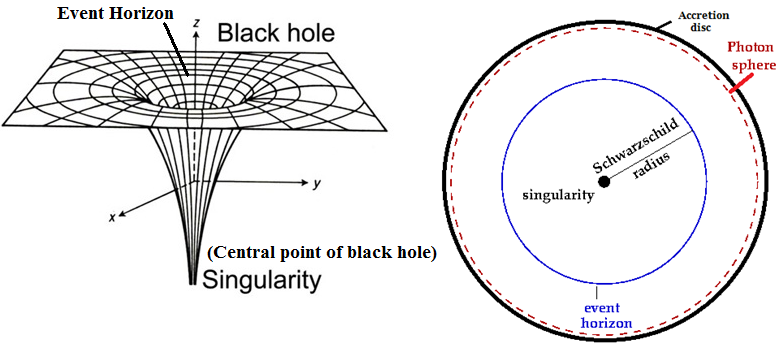
Note: Relativistic effects are strong in the vicinity of a black
hole, so phenomena like length contraction and gravitational time
dilation take place. As space contracts, time expands. To
a distant observer, clocks near a black hole will appear to tick
more slowly than those further away from the black hole. An
object falling into a black hole appears to slow down as it
approaches the event horizon, taking an infinite time to reach it. Eventually,
at a point just before it reaches the event horizon, the falling
object becomes so dim that it can no longer be seen.
Note: The gravitational effects of a black hole are unnoticeable
outside of a few Schwarzschild radii...black holes do not “suck in”
material any more than an extended mass would.
Spinning black hole
Spinning neutron stars, that are dense enough, produce spinning
black holes, which astronomers have observed, albeit indirectly.
What you need to know about spinning black holes is that they warp
the space around them differently than stationary black holes. This
warping process is called frame dragging, and it affects the way a
black hole will look and distort the space and, more importantly,
the space-time around it.
As a black hole begins to spin, its event horizon becomes smaller
because the inward force of gravity is diminished to some extent by
the outward force cause by the spinning.

- Stationary limit - The boundary around a spinning black
hole. At the poles of a spinning black hole, the stationary limit
boundary touches the new (smaller) event horizon. At the equator of
a spinning black hole, the stationary limit boundary is the size of
the (bigger) event horizon of a stationary black hole.
- Accretion disks - A spinning disk of extremely hot matter
(gas and dust) surrounding an object with an intense gravitational
field. It is formed of matter that's in the process of falling into
the black hole. It is important to know that the photon sphere is
inside the radius of the accretion disk and outside of the
radius of the event horizon.
- Ergosphere - The region between the stationary limit and
the event horizon of a spinning black hole. Whether or not light can
escape from the ergosphere depends on the direction in which it is
traveling.
Penrose process - The process wherein energy can be
extracted from a spinning black hole. That extraction is made possible
because the rotational energy of the black hole is located not inside
the event horizon of the black hole, but in the ergosphere. All
objects in the ergosphere become dragged by a rotating space-time. Although
matter has to rotate in the same direction as the black hole within
the ergosphere, particles can escape from it through this process.
In the film, Cooper and Amelia used this process to extract momentum
from the black hole's spin to escape from it and give them a further
boost to Edmund's planet.
Penrose Process works by extracting the energy from a black hole
through use of a intermediary particle. This particle entering the
spinning black hole breaks apart by some means sending one piece
into the event horizon and the other out of the ergosphere with more
energy than it originated with.
Gravitational lensing - An effect of Einstein's theory of
general relativity – mass bends light. The gravitational field of a
massive object will extend far into space, and cause light rays
passing close to that object (and thus through its gravitational field)
to be bent and refocused somewhere else. The more massive the
object, the stronger its gravitational field and hence the greater the
bending of light rays.
Note: General Relativity predicts that mass bends light. In strong
gravitational fields, light will be significantly bent back towards
the mass. A black hole is like a black body that reflects no light. So
black holes cannot be observed directly.

Moreover, quantum field theory in curved space-time predicts that
event horizons emit Hawking radiation, with the same spectrum as a
black body of a temperature inversely proportional to its mass. This
temperature is on the order of billionths of a kelvin for black holes
of stellar mass, making it all but impossible to observe.
Despite its invisible interior, the presence of a black hole can be
inferred through its interaction with other matter and with
electromagnetic radiation such as light. Matter falling onto a black
hole can form an accretion disk heated by friction, forming some of
the brightest objects in the universe. If there are other stars
orbiting a black hole, their orbit can be used to determine its mass
and location.
Note: The shape of the event horizon of a black hole is always
approximately spherical. In four dimensions, Hawking proved that the
topology of the event horizon of a stationary black hole must be
precisely spherical while for rotating black holes the sphere is
somewhat oblate.
Some theorists have proposed that the warped or curved spaces in
spinning black holes form bridges to other parts of the Universe or
other Universes.

A new model of a spinning black hole for the movie Interstellar,
with an accretion disk comprising detritus, is based on new
discoveries by theoretical physicist Kip Thorne. At the center of
every black hole is an extremely dense, massive, compact star called a
neutron star. Astronomers have known for decades that certain neutron
stars spin — some at a rate of thousands of times per second.
The stunning rendition is the most scientifically accurate image of a
spinning black hole ever created.
"This is the first time the depiction began with Einstein’s general
relativity equations," - Kip Thorne
Note: Kip Thorne, had never known black hole in more realistic terms
than the theoretically conceived one (through mathematical
equations). It is said that no scientist really knows what a real
black hole actually looks like.
A black hole warps the surrounding space-time fabric so severely that
anything comes within its event horizon, can’t escape from its
gravitational grip. No one knows exactly what happens at the
deepest interior point of a black hole (Brian Greene)
Observers falling into a Schwarzschild black hole (i.e., non-rotating
and not charged) cannot avoid being carried into the singularity, once
they cross the event horizon. When they reach the singularity, they
are crushed to infinite density and their mass is added to the total
of the black hole. Before that happens, they will have been torn apart
by the growing tidal forces.
In the case of a charged (Reissner–Nordström) or spinning (Kerr) black
hole, it is possible to avoid the singularity. Extending these
solutions as far as possible reveals the hypothetical possibility
of exiting the black hole into a different space-time with the black
hole acting as a wormhole. The possibility of traveling to
another universe is however only theoretical, since any perturbation
will destroy this possibility. It also appears to be possible
to follow closed timelike curves (going back to one's own past) around
the Kerr singularity, which lead to problems with causality like the
grandfather paradox. It is expected that none of these peculiar
effects would survive in a proper quantum treatment of spinning and
charged black holes.
The appearance of singularities in general relativity is commonly
perceived as signaling the breakdown of the theory of relativity.
This breakdown, however, is expected; it occurs in a situation where
quantum effects should describe these actions, due to the extremely
high density and therefore particle interactions. To date, it has
not been possible to combine quantum and gravitational effects into a
single theory, although there exist attempts to formulate such a
theory of quantum gravity. It is generally expected that such a theory
will not feature any singularities.
Sources:
Wikipedia
http://www.phyast.pitt.edu/~hamilton/astro89/unit12.htm
http://people.hofstra.edu/Brett_Bochner/PowerPoint_Lectures--AY12/AY12_Lec14--Black_Holes.pdf
http://www.businessinsider.my/interstellar-black-hole-physics-discovery-2014-11/#.VFw2__mUfON
http://www.businessinsider.my/crazy-physics-to-understand-interstellar-2014-11/?utm_content=buffer0110b&utm_medium=social&utm_source=facebook.com&utm_campaign=buffer#.VFw3cPmUfON
Relativity: The Special and the General Theory – Albert Einstein
Einstein’s Theory of Relativity – Max Born
The Brief History of Time - Stephen Hawking
Lewis, G. F.; Kwan, J. (2007). "No Way Back: Maximizing Survival Time
Below the Schwarzschild Event Horizon". Publications of the
Astronomical Society of Australia 24 (2): 46–52.
Carroll, Sean M. (2004). Spacetime and Geometry. Addison Wesley
Poisson, E.; Israel, W. (1990). "Internal structure of black holes".
Physical Review D 41 (6): 1796.
http://large.stanford.edu/courses/2011/ph240/nagasawa2/
Things to know about
Interstellar (2014) Explained - Part 4

Note: Although Theory of Relativity (general and special) able to
explain the world on a massive scale (vast universe), but it breaks
down when it came to explain the world of the infinitesimally small (quantum
realm). There are contradictions between Theory of Relativity and
Quantum Theory. This is the reason why Superstring Theory,
Supersymmetry Theory, M-Theory, Supergravity Theory, Unified Field
Theory were proposed.
String/Superstring (Supersymmetric string)
theory is a developing unified theory of
the Universe in particle physics, proposing that fundamental
ingredients of nature are not zero-dimensional point particles but
patterns of vibration that have length but no height or width – like
infinitely tiny one-dimensional filaments called strings.
The theory attempts to reconcile quantum mechanics and Einstein’s
general relativity. Each of the five superstring theories requires
10 space-time dimensions (instead of the usual four), forces and
matter are supersymmetrical, no tachyons (hypothetical particle that's
faster than the speed of light), but have different size and shape of
the extra spatial dimensions.
Note: The existence of more than four dimensions would only make a
difference at subatomic (quantum) level.

The theory suggested that the entire Universe was made up of tiny
vibrating strings (The electrons and quarks within an atom are
not 0-dimensional objects, but made up of 1-dimensional strings).
Each particle took a separate form and had specific properties because
its string or strings vibrated in a different way, equating the
universe to a ‘cosmic symphony of superstrings’.
These strings can oscillate, giving the observed particles their
flavor, charge, mass and spin. Among the modes of oscillation of the
string is a massless, spin-two state—a graviton. The existence of this
graviton state (remain unproven, theoretical) and the fact that the
equations describing string theory include Einstein's equations for
general relativity mean that string theory is a quantum theory of
gravity. Since string theory is widely believed to be mathematically
consistent, many hope that it fully describes our universe, making it
a theory of everything.
Through mathematical equations, it shows that
the way we had previously thought of particles as “points” or “little
balls” of energy was inaccurate. Brian Greene explains that
strings are so small that if a single atom were the size of our solar
system, a string would only be the size of a tree. Strings make up all
matter from the quantum level up.
The five different string theories are just different ways of
curling up the extra dimensions and describing the same phenomena in
four dimensions. Physicists found that adding an
eleventh dimension mathematically explained all of the seemingly
different string theories as different aspects of the same theory.
Compactification
In string theory, more dimensions are bound up in other ways.
Space-time is viewed as a smooth "fabric" that can be bent and
manipulated in various ways. It is suggested that the universe has
an inherent curvature (the universe as a whole is curved in
strange ways). The normal approach to string theory's extra dimensions
has been to wind them up in a tiny, Planck length–sized shape.
This process is called compactification. In the 1980s,
physicists showed that the extra six space dimensions of superstring
theory (other than the 4 dimensions we presently live in, 3 space and
1 time) could be compactified into Calabi-Yau spaces.
At large distances, a two dimensional surface with one circular
dimension looks one-dimensional
Example: Think of a garden hose. If you were an ant living on the
hose, you would live on an enormous (but finite) universe. You can
walk very far in either of the length directions, but if you go around
the curved dimension, you can only go so far. However, to someone very
far away, your dimension — which is perfectly expansive at your scale
— seems like a very narrow line with no space to move except along the
length.
If we got close enough to the garden hose, we'd realize that something
was there, but we can't "get any closer" to explore extra
compactified dimensions of the universe. We can't see the extra
universes because they're so small that nothing we can do can ever
distinguish them as a complex structure.
M-Theory predicts that these multiple
universes were created out of nothing and arise naturally from
various different physical laws and constants. It involves 11
space-time dimensions (a world of 10 dimensions, plus one for
Time), which allows different Universes with different laws to
exist; depending on how the internal space is curled. M-Theory has
solutions that allow for many different internal spaces,
perhaps as many as 10500 different universes, each
with its own laws, which effectively supports The Multiverse
Theory. Some of the universes, unlike ours, are quite
unsuitable for the existence of any form of life. Only some would
allow creatures like us to exist. (Stephen Hawking)
Example: Think of black holes as points in the four dimensions we
experience - three of space and one of time. These become "black
strings" when extended into a fifth dimension of space. The
researchers predict that braneworld black holes are about the size of
an atomic nucleus but have masses similar to that of a tiny asteroid.


Brane/Bulk/Hyperspace
In String Theory, the extra dimensions are curled up into what is
called the internal space, as opposed to the 3-dimensional
space that we experience in everyday life. The
extra dimensions are highly curved, or curled, on a scale so small
that we can’t see them. These internal spaces (hidden
dimensions) have important physical significance. The exact shape of
the internal spaces determines the values of physical constants, such
as the charge of the electron, and the nature of the interactions
between elementary particles.
The forces
of Nature governing electricity, magnetism, radioactivity and
nuclear reactions are confined to a 3-dimensional brane whilst
gravity acts in all the dimensions and is correspondingly weaker.
This offered a new depiction of strings whereby,
given enough energy, a string could stretch to become an extremely
large floating membrane, or a brane for short.
Branes can have different dimensional properties and grow as large
as a universe. In fact, according to the theory, our entire
universe exists on a floating brane - just one of several floating
branes that each supports their own parallel universe.
Each brane represents one slice of a higher dimensional space
or bulk.
Just think that our four-dimensional space-time continuum as a type
of membrane, or "brane," embedded in a "bulk" that takes in even
more dimensions (also known as "hyperspace"). In the bulk model, at
least some of the extra dimensions are extensive (possibly infinite),
and other branes may be moving through this bulk. Interactions with
the bulk, and possibly with other branes, can influence our brane
and thus introduce effects not seen in more standard cosmological
models.
For example, a point particle can be viewed as a brane of dimension
zero, while a string can be viewed as a brane of dimension one.
The Randall-Sundrum braneworld model, named after
the scientists who created it, states that the visible universe is a
membrane embedded within a larger universe. Unlike the universe
described by General Relativity-which has three dimensions of space
and one of time-the braneworld universe contains an extra fourth
dimension of space for a total of five dimensions.
Strings moving in the fifth dimension are represented in the
everyday world by their projection onto the four-dimensional
boundary of the five-dimensional space-time. The same string located
at different positions along the fifth dimension corresponds to
particles of different sizes in four dimensions: the further away
the string, the larger the particle. The projection of a string that
is very close to the boundary of the four-dimensional world can
appear to be a point-like particle.
String theory predicts that strings can be open
or closed.
- Open-ended strings have at least one
endpoint ‘attached’ to the brane on which they reside, keeping
matter contained within that brane. Strings can move
through the brane but cannot leave it, explaining why we can't
physically see, reach into or interact with other dimensions. The
atoms that make up our bodies are composed of open-ended strings
that have attached endpoints to our 3-D membrane.
- Close-ended strings are like tiny rings, unattached to
their brane and able to “leak” away from it.
Another way to look at it is to consider a movie
screen. People on a screen appear to be three-dimensional, but they
cannot actually reach off the screen into our 3-D world. They are
stuck in their 2-D world, just as we are stuck in our 3-D world and
cannot reach into neighbouring dimensions.
Ever wonder why a tiny magnet can lift a paper clip, even though
gravity is pulling it in the opposite direction?
The Standard Model already united three of the four forces in a
unified theory, but gravity could not be reconciled with the three
quantum forces. This is because gravity was
such a weak force relative to the others. But, what
if gravity on a parallel brane is as strong as the other forces, but
is weaker here because it is only leaking into our dimension?
String theory mathematically predicts that gravity is weak
because it is only leaking here from a parallel universe. In
other words, gravitons are leaking across the bulk into our own brane
from an extra-dimensional brane nearby.
As a closed string or loop without attached endpoints, the other
three forces (electromagnetism and the weak and strong nuclear forces)
are localized on the brane, but gravity has no such constraint and
propagates on the bulk. Much of the gravitational attractive power "leaks"
into the bulk. As a consequence, the force of gravity should appear
significantly stronger on small (subatomic or at least sub-millimetre)
scales, where less gravitational force has "leaked". This would
explain why gravity is many times weaker than the other forces.

The collision between two subatomic particles embedded in our
3-D universe (or "brane"). The collision produces other particles,
including a graviton that escapes from our brane into the
extradimensional "bulk" that lies beyond.
If the graviton, a massless theoretical particle responsible
for transmitting gravity exists at the quantum level as a closed
string, this would present a direct gravitational link to the
theory of superstrings.
If our universe is a massive 10-brane, there might be other
branes existing in a higher dimensional space. Brian Greene
illustrates this by saying that it is as if the branes are slices of
bread, and a multiverse is the loaf of all the slices together. He
is saying that if branes are actually universes, then this might
possibly imply the existence of a multiverse, called the braneworld
scenario. However, there is no experimental evidence for this
hypothesis.
Note: If they are present, why don’t we
notice these extra dimensions?
According to string theory, they are curved
up into a space of very small size.
Imagine a 2-dimensional plane. The plane is called two
dimensional because the horizontal and vertical coordinates are
needed to locate any point on it.
Another 2-dimensional space is the surface
of a straw. To locate a point on that space you need to know the
point along the straw’s length and the point along its circular
dimension. If the straw is very thin, you can get a very good
approximate position with only the coordinate that runs along the
straw’s length, so the circular dimension might be ignored. If the
straw were 1030 of an inch in diameter, the circular
dimension is not noticeable at all.
Note: The String Theory’s biggest obstacle is
that much of it is not provable through observation. It is currently
beyond the methodology of scientific investigation to confirm or
disprove that other dimensions (floating branes and parallel
universes) exist. Physicists can’t test other dimensions, study
migrating gravitons, or observe the collision of floating branes to
witness a Big Bang event.
For this reason, some scientists believe that
without the ability to prove the theory, it is not true science at
all. However, string theorists seem confident that proof of various
sorts will come with technological progress and time.
4-dimensional Tesseract
A tesseract is the four-dimensional equivalent of a cube. It would
only be a five-dimensional object if you're counting time as a
dimension.
- a)
A 3-dimensional cube appears 2-dimensional when seen in
projection.
- b)
A 4-dimensional cube appears 3-dimensional when viewed in
projection and can be drawn in perspective on the page.
- c)
Unfolding a cube.
- d)
Unfolding a 4-dimensional cube.
The space we're familiar with has three dimensions all at right
angles to another.
For example: up/down, forwards/backwards and left/right.
You can specify the location of any point in our 3D space by giving
its coordinates in those directions. However, when you go to four
dimension you've got another direction that is at right-angles to
all three of the original ones.
To draw a cube on paper, which is a projection of a 3-d object (cube)
onto 2-d space (square), what you have to do is lay one square flat.
Then put another square and hover it above the first one. The second
square is separated from the first along the vertical direction, which
you can see is at right angles to any line you can draw within the
square. Now just connect the corners of one square and the corners of
the other with lines. Make sure that the lines are the same length.

To draw a tesseract in 3-d space, it's the same. Get two cubes,
separate them along the fourth dimension (which is at right angles to
any line you can draw on a cube) and join the corners with lines.
This is a tesseract formed from a blue outer cube and a red inner
cube. The corners are joined by more lines. The interesting
thing is that the internal bits that look like pyramids with the
tops cut off (highlighted yellow) are also cubes in four dimensional
space, and all the new faces are squares. It's just
because we can't properly represent a four-dimensional object in
three dimensions that these cubes and squares look distorted.
Sources:
- Wikipedia
- http://news.discovery.com/space/black-holes-on-a-string-in-the-fifth-dimension.htm
http://www.newscientist.com/article/mg21328474.500-naked-blackhole-hearts-live-in-the-fifth-dimension.html#.VFyQT_mUfON
http://blogs.discovermagazine.com/cosmicvariance/2011/03/04/fractal-black-holes-on-strings/#.VF2t3fmUfoE
http://www.nbcnews.com/id/13070896/ns/technology_and_science-science/t/physicists-probe-fifth-dimension/#.VFyCUfmUfOM
http://screenrant.com/interstellar-ending-spoilers-time-travel/
- The Elegant Universe: Superstrings, Hidden
Dimensions and the Quest for the Ultimate Theory – Brian Greene
- The Grand Design
– Stephen Hawking and Leonard Mlodinow
- The Fabric of the
Cosmos: Space, Time and the Texture of Reality – Brian Greene
- Hyperspace: A
Scientific Odyssey through Parallel Universes, Time Warps, and the
Tenth Dimension – Michio Kaku
Things to know about
Interstellar (2014) Explained - Part 5
Update: After a 2nd viewing on November 16, 2014, minor corrections
are made to the answers provided below.

Q&A for Interstellar
1. What happened to Earth in the near future?
In the near future, Earth is too polluted and no longer able to sustain
humanity. Earth's food supply is dwindling and crops are dying due to an
unknown pathogenic organism (blight). However, a recently discovered
wormhole provided hope for humanity to search and find a new habitable
planet in a new galaxy. Humans need to leave the Earth or face the
consequences: starve to death or slowly suffocate due to changes in the
Earth's atmosphere due to blight (increase of nitrogen and lack of
oxygen).
2. What the US government and NASA been trying to do in the past few
years in the film?
US government has been secretly funding a NASA project (Lazarus Mission)
to find a planet capable of sustaining human life by sending 13
astronauts through the wormhole. Each of the astronauts were required to
set up a beacon upon arrival at their planet to indicate that their
chosen planet was habitable or die at that planet alone without setting
off the beacon. NASA has been tracking their beacons for nearly a decade,
but only 3 beacons are active - Miller, Mann and Edmunds.
3. Cooper finds the secret NASA facility and it appears like the next
day he blasts off into space with barely any training and preparation at
all?
NASA had no money or resources and they're desperate. Humanity is at the
brink of extinction. Cooper was the best astronaut NASA had ever had so
they immediately signed him up.
4. What is the Endurance team's (Cooper, Amelia, Romilly and Doyle)
mission?
To travel through the wormhole, visit all 3 planets and decide which
planet (Miller, Mann or Edmunds) is suitable for human colonization and
report back to Earth before it's too late.
5. What are the planets' proximity with each other?
Miller's planet (the first planet visited by the Endurance team) is the
closest among the 3 promising planets, it's also the closest planet to
Gargantua (black hole).
Mann's planet (the 2nd planet visited by the Endurance team) is the 2nd
closest to the team after the exit from the wormhole. It's also quite
close to Gargantua, but to a lesser extent compared to Miller's.
Edmunds' planet (the 3rd planet visited by Amelia) is the furthest among
the 3 and quite far from Gargantua.
6. What are NASA's plans for survival of humanity?
Plan A - While the Endurance team is looking for habitable planets,
Professor Brand will continue to work on unifying Einstein's Theory of
Relativity and Quantum Theory that allows humans to manipulate gravity
to build a colony in space. The NASA facility found by Cooper and Murph
at the beginning of the film is actually a construction site for
humanity's space-time traveling ark. If Brand succeeds at solving the
equations and Cooper managed to find a habitable planet, humanity's
survival is secured.
Plan B - If Brand failed in solving the equations, the 3 planets deemed
uninhabitable or the Endurance team takes too long to secure a habitable
planet to live in, NASA has collected a bank of fertilized human embryos
to ensure humanity’s survival on board the Endurance, just in case
everyone on Earth is wiped out. To ensure genetic diversity (to prevent
genetic diseases), NASA collected sperms and eggs from a wide range of
sources. Once the Endurance team managed to find a habitable planet, the
team would settle down and raise the first generation of embryos, with
each generation helping to raise a new set of embryos and reproduce
naturally as well.
7. Why after the first mission, when the crew receives video messages
from back home and we see that Cooper’s children, Tom and Murph have
aged significantly and become full grown adults?
When the Endurance team travelling in a wormhole, relative velocity time
dilation takes place. Due to close proximity with a black hole, the time
spent on Miller's planet is significantly slower due to gravitational
time dilation effect. Both of these time dilation cost the team a total
up to 23 Earth years.
8. It was revealed later on that Plan A was a lie. Why Professor
Brand choose to do so?
Professor Brand has solved the equations many years back, but it was
incomplete due to the lack of necessary quantum data which can only be
collected from the singularity of a black hole. He was trying to ensure
the survival of our species by convincing the world leaders to work
together to build the necessary infrastructure to make Plan B succeed.
He needed them to believe that there's still hope for their own survival.
9. Upon learning that Plan A was a lie, what did Cooper and Amelia
decide to do?
They commit to Plan B on their final planetary option, where Amelia’s
lover, Edmunds, who reports a positive beacon few years back. However,
Cooper remains unconvinced that Plan A is impossible, so they use the
nearby black hole to slingshot Endurance toward Edmunds’ planet (the
Endurance sustained heavy damage after Mann chooses to open the airlock),
Cooper sends TARS into the center of the black hole - in the hopes that
it might able to translate the necessary quantum data that could help
NASA to apply Professor Brand’s derived gravitational equations (or fix
any miscalculations) on Earth.
10. In the film, the movement of the spaceship docking was way too
fast to be believable. It didn't look like a several ton spacecraft
moving in zero gravity.
The spaceship doesn't have to move slowly. It's zero gravity so it has
no weight. So once the thrusters kick in, it will start to move faster
and faster unless reverse thrusters are activated.
11. Why Cooper choose to sacrifice himself?
Cooper and Amelia both decided to use the Penrose process to extract
energy from the rotation of the black hole's spin to escape from it.
Cooper sacrifices himself to reduce weight on the Endurance (reduce mass
to increase acceleration), allowing the ship to leave the black hole so
that Amelia can make it to Edmunds’ planet and enact Plan B should TARS
fail. However, instead of dying alone in the black hole, Cooper is
pulled inside the Tesseract that was created by the extra-dimensional
beings.
Note: Newton's Third Law of Motion - For every force, there's a
reaction force that is equal in size, but opposite in direction.
Whenever an object pushes another object it gets pushed back in the
opposite direction equally hard.
12. Who actually created the wormhole and Tesseract within the black
hole?
In Interstellar's third and final act, it was revealed that the extra-dimensional
beings responsible for creating the wormhole near Saturn and Tesseract
within the black hole are '5-dimensional beings' or 'bulk beings'
mentioned by TARS. Cooper was convinced that these beings are in
fact a future form of humanity who have evolved to live in higher
dimensions and have come back in time to ensure humanity's survival.
They've built the Tesseract to allow Cooper to locate the precise and
suitable moment to deliver the quantum data collected by TARS in the
singularity to Murph to solve the equations that allow humanity to
manipulate gravity.
13. Black holes are regions of space where gravitational attraction is
so strong that not even light can escape. Then why Cooper is not
immediately teared apart by the black hole's strong gravitational pull?
The gravitational singularity of a black hole is a 'place' where the laws
of space and time become infinite - all spatial dimensions of size zero,
infinite density, infinite temperature and infinite space-time curvature (from
the viewpoint of an observer outside the black hole, time stops as
gravity becomes infinitely strong). When Cooper sacrifices himself
to ensure Plan B, he is caught in the black hole’s gravitational pull
but, instead of dying, he ejects from his ship and actually landed
inside The Tesseract, a 5-dimensional place preventing Cooper
from experiencing spaghettification. However, it is unknown to us
as to how the extra-dimensional beings manage to construct the Tesseract
within the black hole. It is also revealed that the source
that creates the wormhole near Saturn is actually from the gravitational
singularity of Gargantua.
Note: Spaghettification - the effect of extreme gravitational
pressure on any particle or body of matter, in particular when exposed
to the extreme forces of the black hole.
14. What happened actually when Cooper enters the black hole?
At some point near the climax of the film, TARS said that "The
bulk beings are closing the Tesseract..." The black hole
leads Cooper to what TARS refers to as the bulk. The bulk
is a higher-dimensional space (within the black hole, space-time is
bending into a different dimension). TARS calls the beings living
there 5-dimensional beings. Cooper seems convinced that these
beings are humans from the future who have evolved to live in higher
dimensions (rather than the 4 dimensions we presently live in, 3 space
and 1 time).
Inside the bulk, these beings have constructed what TARS calls a
Tesseract, the thing that allows Cooper to communicate with Murph. The
film showed how Cooper was able to interact with multiple dimensions
of space-time (limited only to Murph's room) inside the Tesseract near
the centre of the black hole. After they close the Tesseract, Cooper
is sent back near Saturn through a wormhole (which allows Cooper to "shake"
Amelia's hand during the initial travel within the wormhole). A black
hole is not a wormhole. In the movie, Thorne and Nolan both hypothesize
that the black hole leads to the bulk.
The Tesseract is a 5-dimensional object that has 3-dimensional
visibility specifically tuned to Murph's room, allowing Cooper to
visit his daughter at any point in time. It has 3-dimensional
structures specifically tuned to Murph's room (as TARS explains to
Cooper) that the beings of the bulk have made so that Cooper could
comprehend it, since at that point Cooper is in a 4-dimensional space
and we cannot visualize things in more than 3 spatial dimensions.
There is also one dimension of time, which is why TARS calls them 5-dimensional
beings.
Note: Time is relative. Time is a dimension which isn't linear.
Every moment exist simultaneously. Cooper is not there to change the
past. Whatever happened, happened and couldn't have happened any other
way. Therefore there is no paradox. It's just that 3-dimensional beings
like us experience time in a linear fashion.
15. Why Cooper was sure that Murph will soon realize that the 'ghost'
that has been communicating with her in the past is actually him and
know the data needed to solve the equation is found in the watch that he
gave her?
Love transcends space and time. If everything in the universe is
simply information, then love does transcend time and space by
facilitating the preservation of information. When you love someone, you
never forget them, even after they've died. Even after all those years,
Murph still loves her father enough to remember the memories of him and
her together. Sooner or later, she will able to connect the dots
together and realize the answer lies within the watch that Cooper gave
to her years ago. It's possible that information can travel through
space-time.
She made a detailed recording of the timeline of her and her father's
life, which is shown in the beginning of the film. This recording is
passed onto future generations so that humans in the future able to
construct the Tesseract that's specifically tuned to Cooper and allows
him to transmit the necessary data back to Murph through Morse Code. It
is only Cooper who can do it because he was heavily tangled with his
daughter's timeline. The bond shared between Cooper and Murph allows him
to locate the precise, suitable moment in time to provide Murph the data
needed to solve the equations.
16. How Cooper managed to save humanity in the end?
When inside the Tesseract, gravity "leaks" through all the other
dimensions in space-time, allowing Cooper to spell out a message
(“S-T-A-Y”) by pushing books off of Murph’s shelf in the past,
communicate map coordinates to the past version of himself by
spreading dust across the floor (in binary language) using
gravity and the 5th-dimensional communication through gravity (made
visible by 3-dimensional objects back on Earth) enables Cooper to gently
manipulate the hands on Murph’s watch – transferring the data that TARS
acquired with morse-coded watch ticks. Subsequently, translating that
coded data gives Murph all the information she needs to drastically
advance humanity’s understanding of space and time – as well as to
complete Plan A.
17. Were any of the 3 planets (Miller, Mann or Edmunds) habitable?
Miller's planet is considered uninhabitable due to the constant strong
tidal waves generated by the black hole gravitational pull and no land
was found in sight after landing. Mann's planet is also considered
uninhabitable as well due to extreme cold temperatures, toxic gases in
the air and the lack of food resources. It was revealed at the end of
the film that Edmunds' planet was habitable (due to existence of sun,
land and water) but Edmunds didn't survive in the end, leaving Amelia
alone at the planet.
18. How Cooper survives his time inside the Tesseract, and how he
intends to reunite with Amelia?
Time moves slower near the gravitational pull of the black hole.
Cooper’s ejection from the Tesseract and entering through the wormhole
to reach Saturn should not take long for him (time stops due to strong
gravity near the centre of the singularity), but over half a century for
the rest of humanity (around 80-90 years since Cooper is said to be 124
years old and Murph is estimated to be over 120 years old) when Cooper
wakes up from bed.
Cooper survived and finally reunited with Murph, who was living on the
faster moving side of the wormhole. However, knowing that Cooper has
nothing left for him to live for here (his son, Tom is probably dead by
now and Murph will join him soon), Murph reminds her father that,
through the wormhole (if it still exists), Amelia is just beginning to
set-up Plan B on Edmunds' planet and Cooper should join her to start a
new life.
Even though around 80-90 years have passed since the Endurance first set
out, time on the other side of the wormhole is moving much slower
compared to our solar system – meaning that his trip through the
wormhole again should allow him to reunite with Amelia on Edmunds'
planet in only a short time after Cooper first sacrificed himself and
dropped into the singularity. We don’t actually see the reunion, but
it's quite clear that Cooper will eventually manage to reach Amelia and
helps her to ready the colony.
Note: It is unknown whether the wormhole at Saturn still exists
or not, after the bulk beings closed the Tesseract. It's unsure whether
the construction of the Tesseract affects the creation of the wormhole
or not. Let's just hope for Cooper's sake, it's still exists.
19. What does the poem mentioned by Professor Brand means?
"Do not go gentle into that good night,
Old age should burn and rave at close of day; Rage, rage against the
dying of the light."
It was taken from the poem, Do Not Go Gentle Into That Good Night,
written by Dylan Thomas. It means that do not give up, do not surrender,
do not let go without a fight, live and fight for survival, against the
coming change, even in the midst of dire circumstances.

Infographic taken from
INTERSTELLAR TIMELINE

Such an ambitious and risky movie will inevitable create a lot of
questions, these answers aren't definite and will progress as the community
comes up with more interpretations and a better understand.
Q. When does the soundtrack come out?
A. 18th of November, Hans Zimmer wanted the audience to experience the score
for the first time, during the movie. Movie scores are usually released 2
weeks prior.
The two only released tracks at the moment is the Main theme from the teaser
trailer, and a bonus track called Day One Dark (this one is slightly
different from the docking scene, a bit less epic). All other tracks on
youtube are trailer songs or fakes.
Q. What was that Cylinder world at the end, where the baseball hits the
ceiling?
It's called an O'Neill cylinder, it's a space settlement design proposed by
American physicist Gerard K. O'Neill. It would rotate so as to provide
artificial gravity via centrifugal force on their inner surfaces.
Q. Who are 'They'?
A. Cooper assumes “They” are future humans who have mastered the laws of our
universe - allowing them to manipulate time and space. Brand thinks “They”
have laid out a series of rudimentary breadcrumbs (binary messages) and
advanced technology (the wormhole) for humans to follow – in order to save
ourselves from annihilation.
Q.What is the Event Horizon?
A. The point at which the gravitational pull becomes so great as to make
escape impossible, aka The point of no return.
What is Singularity?
A. term used to describe the center of a black hole where the gravity is
thought to be infinite. What happens inside black holes is still not
completely known or understood. This gives filmmakers some leeway.
Q.How did Cooper not die when going into Event Horizon?
A. When he flew into the black hole and reached the Singularity, he was
transported by "They" into a 5 dimensional world ("tesseract") where, after,
with the help of TARS, sends a message to his daughter in the past,
afterwards he ends up going back through the wormhole located near the orbit
of Saturn. Where he is found.
Q. Did Love save Humanity?
A. No, It is explained that the Tesseract is simply a creation of 5D beings
who are using the faith and motivation that Coop has, fueled by love, to
complete this time loop. The bookcase is important because it is his most
vivid and strong connection he has to his daughter, and she is the key to
solving everything. From there, the idea that gravity is the only thing that
can transcend time and space become a key point, a concept that is very much
rooted in current physical theories and understanding. Love, an evolutionary
drive, was the motivation for Cooper to keep desperately trying to find a
way to save Humanity and his daughter Murph.
What is a Tesseract?
A. It's a four-dimensional cube, 'They' custom build the Tesseract that
Cooper falls into so that he can communicate with his Daughter, time is non-linear
in 5 dimensions, this allows Cooper to visit his daughter through the
bookcase at any point in time.
Q. Could Cooper have just died when detached near the black hole, and dreamt
up the Tesseract scene?
A. Some claim this, Dr. Mann says that Cooper will see his Kids when dying.
Q. What was the key equation that allowed Humans to survive in the end?
A. It was an advanced equation, that if solved, will allow humans to harness
fifth-dimensional physics – specifically gravity. Should Brand succeed, NASA
will be able to defy our traditional understanding of physics and launch an
enormous space station (carrying the remainder of Earth’s surviving
population) into space. The very facility that Cooper and Murph stumble upon
at the beginning of the film isn’t just a NASA research station – it’s a
construction site for humankind’s space-traveling ark.
What's the message of the movie?
A. There are many, but here's what the script Writer Jonah Nolan wrote in an
interview with IGN:
Question: What are some things that you'd like audiences to take away from
the film?
Jonah Nolan Answer: "The paradoxical aspect of human beings. We love with
such an intensity: our children, our parents, our families -- and yet all of
us, to different degrees, make choices that take us away from those people,
because of our curiosity or our ambition; all these warring, paradoxical
desires. I don't have an answer for that. I don't think anyone has an answer
for that. What's more important: your career, your kids -- we all struggle
with that every day, and that paradox is at the center of this film. Human
organisms are forged by natural selection to want to continue to explore,
even in the most unlikely ways -- standing on the shores of a tiny island
and imagining that there might be another island a thousand miles hence over
the ocean, and then going and looking for it. Human beings are incredible
survivors on that level, but we're also very connected to our children and
our loved ones. Those things are so often in conflict with each other"
Q. Isn't there a time travel paradox? How did future humans first survive to
make a Tesseract – given that there would have been no Tesseract to save
them?
A. Here is a possible explanation apart from the common 'What comes first?
The chicken or the egg' explanation.
'At the end of the movie we see that the third planet, on which Brand lands
on, is habitable. She puts Plan B into action; the fertilized human embryos.
It's possible that Brand and the human embryos are “They” (future race of
humans who created the wormhole and placed the tesseract inside the black
hole for Cooper). Only human to know that Cooper had went into the black
hole would be Brand. Meanwhile they found a planet habitable like Earth.That
is where Nolan’s non-linear style comes into play because the very end of
the movie (last shot of Brand) is actually the beginning for it all.
“Murphy’s law means whatever can happen, will happen” So not only did they
find a habitable planet but they were also able to travel back in time to
ensure that present human race’s survival.' (Credits: Rashonxxx from
Screenrant)
This can be explained by this flow:

Interstellar:
inside the black art
By Mike Seymour
Artists are often asked to produce images of things never seen
before, and often times asked to make them look real when no one is quite
sure how they would actually exist. In Christopher Nolan’s Interstellar,
visual effects supervisor Paul Franklin and the team at Double Negative
were asked to produce images of things that aren’t even in our dimension,
and furthermore have them accurate to not only quantum physics and
relativistic laws but also our best understanding (guess) of quantum gravity.

Luckily, amongst the key team at Dneg was chief scientist
Oliver James. James has a first from Oxford in optics and atomic physics and
a personal understanding of Einstein’s relativity laws. He worked, as did
Franklin with the film’s executive producer and scientific advisor Kip
Thorne. Thorne would work out complex equations in Mathematica and send them
James to recode into IMAX quality renderings. To meet the needs of the film
and to solve the visual problems involved, James had to not only visualize
equations describing the arcing and bending trajectory of light but also
equations that ended up describing how a cross section of a beam of light
changes its size and shape during its journey past the black hole.
Even then James’ code was only part of the solution – he
worked hand in hand with the artistic team lead by CG supervisor Eugenie von
Tunzelmann which would add say an accretion disc and create the background
galaxy and all its stars and nebulae, that get warped as their light rays
are bent past a black hole. But as complex as it is to for the first time
show a black hole scientifically correctly in a film, the team also had to
show someone entering a four-dimensional tesseract, which also extrudes or
shadows into the three dimensions of a little girl’s bedroom – all in a way
an audience could follow.
In this article we describe some of the key sequences created
by Double Negative, and the scientific research behind them.

Building a black hole
Perhaps the single most stunning results of Nolan’s quest for
realism in the film is the depiction of the black hole Gargantua. After
input from Thorne, the filmmakers strove to properly show the behavior of a
black hole and a wormhole, right down to the lighting or lack of it. For
Double Negative, this even necessitated the writing of a whole new vastly
physically complex renderer.
Above: view from a camera in a circular, equatorial orbit around a
black hole that spins at 0.999 of its maximum possible rate. The camera is
at radius r=6.03 GM/c^2 , where M is the black hole’s mass, and G and c are
Newton’s gravitational constant and the speed of light. The black hole’s
event horizon is at radius r=1.045 GM/c^2.
“Kip was explaining to me the relativistic warping in space
around a black hole,” recalls Paul Franklin. “The gravity being bent in
space/time deviated the light around it producing this thing called the
Einstein lens which is this gravitational lens all around the black hole. I
was thinking about how we might go about creating that image and I was
thinking about ways or references we could look at and see if there was an
existing VFX process.”
“I saw some very basic simulations that had been done by the
scientific community,” adds Franklin, “and I thought, well, the movement of
this thing is so complex, maybe there’s something we can do ourselves and
implement our own version of this. Kip then worked very closely with the R&D
at Double Negative, particularly with Oliver James, our chief scientist, to
take Kip’s equations that he’d worked out to calculate all of the light
paths, the ray tracing paths around the black hole and then Oliver worked
out how to implement that in a new renderer we called DnGR which stands for
Double Negative General Relativity.”
That approach allowed Double Negative to set all the necessary
parameters for their digital black hole. “We could set its rate of spin, its
mass and its diameter,” explains Franklin. “Really, those are the only three
parameters you have to play with with a black hole – that’s all we can have
to measure with black holes. They spent a lot of time working out how to
calculate the paths of ray bundles around the black hole. It was pretty
intense – it was a good six months of work – those guys putting the software
together. We had an early version of it running by the time we finished pre-production
on the movie.”
Above: The black hole, initially non-spinning, gets spun up to 0.999
of the maximum; then the camera zooms in from radius 10 GM/c^2 to near the
black hole, r=2.60 GM/c^2, and then moves along a circular equatorial orbit.
The hole’s enormous shadow is distorted into a boxy shape due to mapping the
camera’s spherical sky onto a flat display.
The spacecraft in Interstellar were also imagined as practically
as possible, with miniatures of The Endurance, The Ranger, and The Lander
constructed by New Deal Studios under the supervision of Ian Hunter.
That early imagery was in fact used on set as projections
outside the windows of the spacecraft onto giant screens, providing actors
with something to look at while filming. No greenscreen was used during
production on Interstellar. Later, Double Negative would replace
selected views and also fix up some star fields. “Quite a lot of the stuff
you see in the finished film where you’re looking over the shoulder of an
astronaut and looking out the window,” notes Franklin, “quite a lot of that
is straight in-camera. We had a whole bunch of shots which don’t get into
the VFX shot count but there’s a whole bunch of stuff which is in-camera
visual effects done in this way.”
Those in-camera shots were made possible via a collaboration
between Dneg, DOP Hoyte Van Hoytema and LA-based Background Images, which
employed new 40,000 lumen projectors on set. “We had two of them converged
onto the space,” says Franklin, “so we were overlaying the images one on top
of the other to boost the exposure just a stop. We found that we had to be
really careful not to make the images too large otherwise we lost exposure.”
Above: Close up of this same simulation, showing the complex
fingerprint-like structure of gravitationally lensed starlight near the left
edge of the black hole’s shadow, the edge at which the hole’s horizon is
moving toward us at near light speed due to its spin.
“We had to re-position and re-converge the projectors from
setup to setup,” continues Franklin. “Normally the guys like to have a good
week to get a projector in place, converge it properly, get it all finely
tuned. But we got that process down to in some cases 15 minutes. They were
working so hard. The projectors are big hunky objects – each one weighs 600
pounds. We had two in a specially built cage mounted on a big heavy duty
reach lift, with a special pan and tilt head so we could basically use this
thing to position the projectors. I’d be on the radio directing content,
getting playback working, talking to the projector guys to calibrate the
projectors, and also talking to the teamster who was driving our forklift to
dance this thing around an extremely crowded stage.”
Making waves
In the film, Cooper (Matthew McConaughey), Amelia (Anne
Hathaway), Doyle (Wes Bentley) and the AI robot CASE visit a water-covered
planet that also experiences enormous tidal waves, given its close proximity
to the gravitationally dense Gargantua. Audiences are perhaps used to seeing
waves that can get to be a few hundred feet in films, but due to the story,
that wasn’t even close to what was required, the waves needed to be 4,000
feet tall. To help sell the scale of the waves, Double Negative had to re-think
the usual approach to making water. “When you take something that large,”
explains Franklin, “all of the characteristics you associate with a wave
like breakers and a big curl at the top, they just go away because they’re
tiny in relation to the mass of water, because it’s more like a moving
mountain of water. So we spent a lot of time in previs working out how we
can use the one scaled reference we did have which is the Ranger spacecraft,
the white shuttle that gets swept up. The key moment of that sequence is
when the wave hits the Ranger and sweeps it up the face of the wave. And you
see it travel up and become lost and it becomes a tiny little speck and
disappears in the face of the wave. That was a key moment for the scale.”

Anne Hathaway as Amelia on the water planet.
Double Negative artists controlled the waves with animation
deformers, sculpting them effectively with keyframes. “That gave us the
basic shape of the wave,” says Franklin, “but then obviously to sell it as
real you’ve got to create the surface foam, interactive spray, wavelets and
tiny breakers on the surface. For that we used an in-house tool called
Squirt Ocean. It’s been in development for quite a while, and then there was
a lot of additional Houdini work over the top of that.”
The shots were being completed in high enough resolution to
work for IMAX, a requirement that limited the amount of time Double Negative
had to do iterations. “I would see the layout of the wave sequence and say
great let’s get the wavelets onto it and everything else,” says Franklin,
“and I’d have to wait about a month and a half to actually see this stuff
come back – it was that long a process since we were doing all this IMAX
resolution. So we didn’t have that many goes at it. Normally you would
expect to have multiple iterations but we really only had three goes at it.”
CASE ultimately rescues Amelia from the tidal wave. CASE and
its counterpart TARS were actually 200 pound metal rob puppets operated on
set in Iceland by actor Bill Irwin, again the result of Nolan’s push to have
as many practical elements as possible. Double Negative carried out
performer and rod removal for many shots. “The early shots in that sequence
consist of the CASE robot walking through the water,” explains Franklin.
“That’s the physical puppet and we just removed the performer from behind
it.”
When CASE reconfigures himself into the water wheel and spins
his way through the water and picks up Amelia and runs off with her, the
shot was completed with a practical and digital solution. “What special
effects gave us was,” says Franklin, “they built a little water rig attached
to a quad bike we could drive through the water and derive interactive
splashing. We had another rig again built off a quad bike which essentially
had a forklift on the front of it, so that carried our stunt performer. We
had the arms of the robot holding the stunt double for Anne Hathaway. The
thing would churn up the water and then we got rid of the quad bike and then
replaced it with the digital robot.”
Double Negative limited digital robot moments to those of TARS
or CASE doing ‘extraordinary things’, such as running through the water,
climbing up into the spaceship at the end of the water sequence, running
across the ice and some zero gravity freefall shots. “What we’ve always
found with these things is that you can really make that digital moment work
if you bookend with reality,” suggests Franklin. “So that sequence he runs
up to the spacecraft and climbs inside it, as he comes up through the
hatchway inside the spacecraft, that’s the practical robot – the physical
prop. It finishes it off with a moment of reality and it helps sell all the
digital parts of the sequence.”
Inside the tesseract
In the film ‘they’ turn out to be us, advanced enough to help
Cooper communicate with his daughter on Earth, years earlier in her life. As
time travel is impossible in an Einsteinium universe of quantum and
relativistic laws, the story solved this by having Cooper leave our
dimensions and move into the ‘bulk’ or hyperspace of higher dimensions. If
our universe was depicted as a 2D disc or membrane then the bulk or
hyperspace would be the box surrounding it in three dimensions. A way to
think of this is every dimension is dropped one level to image it. Thus 3D
space is drawn as a 2D disc (albeit sagging around the black hole) and the
3D environment around this disc or the brane (physicists use brane not
membrane) is the higher dimension or the bulk.

An image, taken from Kip Thorne’s black board imagery, showing the brane
and bulk. Source: http://interstellar.withgoogle.com
In the film Michael Caine’s character Professor Brand is
trying to understand gravitational anomalies. The black boards in the film
clearly show him trying to solve gravity in four and five dimensions with
diagrams of our brane in the bulk. The film says that if Brand can
understand these anomalies then they could be used to change gravity on
Earth and lift huge mankind-saving craft into space.
While leaving our three dimensions and entering the fourth
does not solve the time travel issue, in the film it does allow for Cooper
to send gravity waves back in time. He can see all of time, but he can only
cause ripples in those threads of time – gravity ripples that Cooper’s
daughter, Murphy, comes to understand as vital information.
The job of Dneg’s team was to visually show a fourth
dimensional tesseract, that some future ‘us’ provides for Cooper to cause
these gravity waves. It would have been possible for this to be done
symbolically or in some white dream sequence but instead Dneg set to trying
to actually visualize the four dimensional tesseract in some meaningful way,
noting of course, that such concepts are just educated speculation. Here’s
where Thorne was again involved. For him, such speculations “will spring
from real science, from ideas that at least some ‘respectable’ scientists
regard as possible,” to quote from his new book The Science of Interstellar.

A further black board image depicting Kip Thorne’s explanation of gravity
in four and five dimensions. Note that ‘our brane’ is sandwiched between
two alternative realities or other branes. Source: http://interstellar.withgoogle.com
To understand the Dneg solution one has to understand the
nature of higher dimensions. If an object is at rest – say a ball – to a
flat table it is a dot. If the ball could move through the table – much like
an apple being sliced thinly – the ball would appear as ever increasing
bigger circles and then ever reducing circles until it passed all the way
through the table. From the flat surface point of view the circle makes
sense…and a circle is not a bad approximation to a ball when drawn on paper.
This example moves from 3D to 2D. But how do we move to 4D and beyond? One
theory that is common even in every day CGI is to think of the fourth
dimension as time. Thus that same ball bouncing is only seen at one instant
as a ball – but over time its path defines a tube. From a 4D view the ball
is a tube and the sphere we know is just a 3D slice of that 4D world. Now
there is some question over time as the fourth dimension, but if we assume
it is, then the 5th dimension is the stuff in the bulk, the stuff outside
our universe.
If a 4D/5D tesseract was made vastly in the future it would
represent a box that grows to be a bigger box, and can animate and change
‘form’, as seen in this short video below.
In this is a box, over time having its timeline varied. If you
entered the tesseract by the film’s logic – as this tesseract touched 3D
space, you would see all the timelines (4D extrusions of objects) and all
the paths forward and backward in time. Furthermore, as the physics of today
predicts that there are a vast number of separate realities (sandwiching our
flat brane) you would see these lines shooting off in multiple directions.
It is in this conceptual space that one can start to see the graphical
solution that DNeg came up with, based on the direction of Nolan. The
’threads’ of time that Cooper seems to influence are like strings and his
attempts at hitting them causes vibrations that ripple back up the timeline
and thus communicate with his daughter Murphy. It really is a brilliant
piece of artistic scientific visualization.
But how to film it?
Nolan’s determination to give the actors something physical to
interact with applied also to the tesseract sequence. Cooper enters a black
hole and emerges inside a multi-dimensional space in which he can see
objects and their timelines, including the childhood bedroom of Murphy.
“Chris said,” relates Franklin, “‘It was a very abstract concept, but I’d
really love if we could build something that we could film. I want to see
Matthew interacting physically with these timelines. I want to see him in
that space, I don’t want to see him hanging against a greenscreen – that
feels like a cop-out compared to everything else we were planning to do in-camera.’”
This led Franklin to consider how the tesseract should look.
“I spent a bunch of time thinking about how to make time visible as a
physical dimension,” he says, “how to show timelines of all the objects in
the room in a physical way that would be comprehensible. Because the danger
was it would get so cluttered that all you would see is these timelines and
you would have to work out what they came from. Also, it was important from
a story point of view that Cooper see the timelines and see the way it’s
affecting the objects back in the room and would be interacting with what is
going on inside the room.”
The final ‘open lattice’ look was, notes Franklin, inspired by
the concept of a tesseract itself. “A tesseract is a three-dimensional
shadow of a four-dimensional hyper cube. It has this beautiful lattice-like
structure, so that partially informed what we were doing there with that. I
also spent a lot of time looking at slit-scan photography and the way that
slit-scan allows you to record a single point in space across a whole range
of moments in time. So the photograph itself turns time into an axis in the
final image. A combination of those two things together gave us these
physically extruded three-dimensional timelines, streaming off from the
object. The rooms are snapshots, moments in time, embedded in this lattice
of timelines that Cooper can then navigate backwards and forwards along the
timelines to find specific moments in space.”
Since Nolan wanted some kind of physical presence for the
tesseract to shoot with, the visual effects and art departments would
exchange information in terms of models and lighting designs and studies.
“We ended up building one section of that as a physical set with four rooms
around it,” states Franklin. “Then digitally we extended that off into
infinity so everywhere you look it’s going off forever. We also used a lot
of in-camera projection on set. We overlaid the active timelines onto the
physical set using the projectors. That gave us a sense of trembling,
febrile energy – all the information streaming along the timelines in and
out of the rooms. But every single image of the final sequence has huge
amounts of digital work overlaid onto it. A very fine lattice of threads
that Cooper encounters when he is actually trying to push up against it – he
can’t penetrate the rooms. Every object in the room had to be connected with
its own faint moving timeline threads that went in and out of the objects.”
Still, certain moments required fully digital Double Negative
backgrounds such as when Cooper moves through the ‘tunnels’ of the tesseract.
“We didn’t have enough sets to do that travel,” says Franklin, “so we shot
Matthew against a projection screen and we projected the previs of those
sequences onto the screens around him, so he had something to ground himself
against. The actors all loved that because they had something to look at
rather than just having greenscreens and working it out later on. We then
replaced that material with the more developed version of the tesseract.
There are a couple of moments where we kept the previs because the depth of
field was so shallow that the background was out of focus.”
Franklin also notes that layers of digital work, and
significant amounts of roto and rig removal was required to complete the
scenes. There were some challenging CG requirements too, including when the
tesseract closes and begins to break down. “We actually took the CG geometry
of the tesseract and put it through a hypercube rotation. The guys worked
out how to implement the transforms for the hypercube rotation and apply it
directly to the geometry of tesseract set that we’d actually created. That’s
a particularly special moment for me. When I saw what the guys had done I
thought that’s just perfect, that’s exactly what I want.”
Another challenging section, says Franklin, involved the
moment when Cooper interacts with the dust and draws out a binary pattern in
the floor during the dust storm. “We had to work out the moves that Matthew
was miming on set and make that work with something that could actually
drive those shapes appearing on the floor of the room below him.”

'Interstellar' Black Hole is Best Black Hole in
Sci-Fi
The black hole as seen in the movie 'Interstellar' -- the most
scientifically accurate black hole envisaged on film.
Christopher Nolan’s movie ‘Interstellar’ will be an epic space adventure
encapsulating humanity’s need to explore the Universe, but it’s the visual
effects for the movie that are garnering early attention.
By combining the help of one of the world’s leading black hole physicists
with a cutting-edge visual effects (VFX) team, ‘Interstellar’ will depict
the most scientifically accurate black hole in science fiction history. And,
during production, some new discoveries were made as to how a black hole
would appear if we could view it up close.
ANALYSIS: ‘Interstellar’ Feeds off our Exoplanet and Wormhole Dreams
“Neither wormholes or black holes have been depicted in any Hollywood movie
in the way they actually would appear,” said Caltech physicist Kip Thorne in
a behind-the-scenes video released by Paramount Pictures (featured below).
“This is the first time that the depiction (of a black hole) began with
Einstein’s general relativity equations.”
General relativity describes the nature of gravity. How a black hole, being
the most gravitationally dominant object in the known Cosmos, would look to
an observer can therefore be described by Einstein’s equations — except for
when tangling with the Black Hole Information Paradox, then you’ll need some
quantum equations to boot.
Thorne is a lifelong friend of fellow black hole guru Stephen Hawking and
between both of the theoretical physicists, our modern understanding of how
these singularities work has flourished. So with the help of Thorne, Nolan
has done something very smart; he’s been able to provide the movie-viewing
public with a rare sci-fi look into the actual science of a black hole while
maintaining an artistic representation that we can easily comprehend.
OPINION: Interstellar Earth: The Future We See In Our Stars
“The visual effects department under Paul Franklin and everybody at
Double Negative took Kip’s mathematical data and they created real visual
representations of what a black hole is meant to look like,” said
‘Interstellar’ producer Emma Thomas.
Warped Spacetime
While crunching the mathematics and arriving at graphical representations
of Einstein’s famous equations, Thorne and the movie’s VFX team realized
that if a star is positioned behind the black hole, the starlight may become
trapped in the warped spacetime close to the black hole’s event horizon.
Known as gravitational lensing, this spacetime effect can be used by
astronomers to detect exoplanets, for example. But during the production of
‘Interstellar,’ the team realized a spacetime subtlety.
Intuitively, light from a star behind a black hole may circle the event
horizon several times before being released in the direction of the observer
(in this case the ‘observer’ is the camera). Visually, the edge of the black
hole will be stunning — several different images of the same star will be
created at the event horizon’s edge.
This produces “a strange sort of funnel in the sky,” with a black disk
surrounded by gravitationally warped starlight, said VFX supervisor Paul
Franklin.
The Matter of an Accretion Disk
Of course, no black hole would be complete without the addition of a
radiating accretion disk. But how would that appear on film?
As matter falls toward the spinning black hole’s event horizon, the gas
collects into a hot accretion disk, shining brilliantly. By adding the disk,
“we found that if you then render this whole thing and you visualize it all
through this extraordinary gravitational lens, the gravity twists this
glowing disk of gas into weird shapes and you get this extraordinary
‘rainbow of fire’ across the top of the black hole,” said Franklin.
ANALYSIS: Alpha Centauri Bb: An Interstellar Target?
“When I saw this disk wrap up over the black hole and under the black
hole, I’d known it intellectually, but knowing it intellectually is
completely different from seeing it,” said Thorne.
It’s all very well having a scientifically accurate black hole, but if
the visual interpretation of a black hole’s mathematics makes no sense,
Nolan was under no illusions that he may have had to take some artistic
liberties to make the black hole appear more familiar to the viewing public.
“But what we found was as long as we didn’t change the point of view too
much … we could get some very understandable, tactile imagery from those
equations. They were constantly surprising,” said Nolan.
Now Thorne and the VFX team are preparing some technical papers about
their findings for the astrophysical and computer graphics communities. The
publications will say: “Here are some things that we’ve discovered about
gravitational lensing by rapidly spinning black holes that we never knew
before,” added Thorne.
ANALYSIS: What Would an Interstellar Spaceship Look Like?
Science fiction movies are produced to entertain, first and foremost. But
as computer graphics become more sophisticated and the science fiction-viewing
public becomes more savvy, there is a growing motivation by filmmakers to
make space phenomena as ‘real’ as possible. And often that will mean
employing the help of scientists to make our most extreme space fantasies as
scientifically accurate as possible to maintain a credible storyline.
‘Interstellar’ is shaping up to be one of those rare movies that will
combine science and fiction, exciting the viewing public, potentially
engaging us with astrophysics in a way we’ve never experienced before.


The Science Of
Interstellar
by Kip Thorne
---------------------------------------------------------
Science, and Interstellar
November 20, 2014
I have tried hard the past week to keep myself from writing about
Interstellar, but it’s come to the point where I give up, and will indulge
myself. I consider it indulging myself since I have never actually written a
blog entry about a single sample movie, using just one case as a subject.
The only time I have come close is a spectacularly ill-received rant two
years ago where I related Christopher Nolan’s depiction of Batman to the
role of the United Nations in international relations (if you didn’t like
that, you sure as hell won’t like this!). Interstellar is another Nolan
movie, and that is no coincidence.

Rather surprisingly, his big-budget movies resonate long after the credits
roll, and the fact that they are blockbusters makes it all the more powerful,
since you don’t really expect to see any meaningful ideas put forward in
this type of loud, effects-heavy movie. Interstellar indeed had some idea
that linger in the brain and that I have ended up liking rather a lot. By
saying that I like these ideas of course really means that I agree with the
line of thinking, and consider it close to my own ideas and opinions, and
naturally I am a big fan of those (they are my favourite). Just to clarify,
this blog is about the ideas put forward in Interstellar, rather than
actually the quality of the movie, which has proved quite divisive: some
people love it, some people hate it. I am not discussing here whether it was
a good movie or a bad movie, nor am I ranting about the scientific
legitimacy of the theoretical physics writ large that dominate the movies’
dramatic beats. This isn’t about the science of Interstellar, it is about
Interstellar and Science. That’s because Interstellar is all about the idea
that science, specifically the pursuit and accumulation of knowledge, makes
us immortal.

The importance of science dominates the early earthbound portion of
Interstellar, where Matthew McConnaughey struggles to give his children a
scientific education in the face of opposition from their school teachers,
who don’t see the value in overeducating people in this different, desperate
post-World War III world of theirs. Similarly, NASA has had to go into
hiding in order to continue working, as the US government fears public
revolt if tax money that could be spent on food production is wasted on far-flung
theoretical research. As the plot moves into the second phase and the
astronaut crew leaves earth, this theme is subtly reinforced by the constant
stream of technological and theoretical achievements that enable the mission
to travel between galaxies. The power of science is so great that in all the
worlds visited, the protagonists never encounter anything that truly
surprises them: all has been predicted using generations of cumulated
knowledge. The team failed to predict Matt Damon’s demons, which is
something we can all understand, as it is human nature to be unpredictable
and selfish. The only other event that catches them off guard are giant,
crushing waves caused by an immensely strong gravitational pull. This is
explained by a simple calculation error in applying Einstein’s Theory of
General Relativity to an actual physical world: bad science. Even the mind-bending
events of the movies third act are predicted and explained by Anne Hathaway
(who explains the idea of a plane of existence where time can be transcended)
and the giant Swiss army knife that is the TARS robot, who, using his
computer brain filled with the entirety of human knowledge, can predict
possible outcomes of travelling too close to a black hole.
This leads us of course to The Tesseract. McConnaugheys character is pulled
into the theoretical realm that transcends space and time. He can here see
various stages of his daughters childhood through the shelves of books on
her wall, and eventually learns to communicate his experienced knowledge
using gravity to manipulate the clock hands of a watch into storing Morse
code. Yes, a man, completely outside of any sense of space or time,
communicates with the next generation of humanity through a library filled
with books and the knowledge contained within. He can travel to any point in
time, but can only look out through the library in his daughters room,
through the books he has helped her accumulate. To question the theory
behind this extra-dimensional encounter completely misses the point.
Although this time transcendence tesseract is actually a perfectly viable
scientific theory (many astrophysicists argue that it is actually more real
than anything we perceive in our everyday existence), its inclusion here
serves as the climax and central metaphor in Nolan’s message for
Interstellar. It’s a long aul movie, and an hour before The Tesseract, we
have Anne Hathaway, in her function as Expositioner General, batting away
the idea that time is a constant thing in the universe, and all in existence
is subject to its laws. On some dimensional plane, she explains, it may be
possible to walk through time just as we can climb a mountain. Again, this
idea is theoretically sound: it just does not matter to us because time is
just such a powerful force in our plane of existence. In a similar way, I
don’t think too much about surface tension in water: our bodily mass makes
it quite irrelevant to us, but it sure as hell matters a lot to billions of
tiny water-dwelling insects. That world of walking on water is all these
insects know of, yet a person could go through their whole lives quite
easily without ever knowing that surface tension exists: it’s irrelevant to
everyday existence. So don’t think too much about extra dimensions, they
probably will never affect you.

McConnaughey floating in the inter-dimensional tesserect
But Nolan does go there, and his human version of a time transcendence
dimension involves a man shouting at his daughter through the books on her
shelf. The protagonists here are important, as from a biological point of
view, procreation is simply a mechanism to transfer DNA from one generation
to the next, ensuring its survival ad infinitum. Because we experience time
so profoundly, we experience our own lives as if they are something very
profound and specific, but in the grand scheme of things we are just a link
in a long unbroken chain of DNA transfers. We can do what we wish in our
lives, but there will always be that urge to shuttle our DNA through to
another generation before it dies with us. That’s quite a depressing idea,
implying that all existence is meaningless, we are merely passenger vessels
for directionless DNA that only cares about surviving. But there is a way
that we can transcend our mortal existence, which is by using our short
years on this earth to discover and accumulate knowledge, knowledge that is
passed down and used by generations to come. Nolan’s tesseract represents
the science, art, literature and accumulated knowledge of humanity, and
argues that as well as preserving the immortal DNA, we are also transfer
vessels of something more profound, we are vessels of humanity. And this
humanity, this long, unbroken chain of the existence of humanity can
communicate with us from any bookshelf, in any place, at any time. Science
therefore, is our tesseract.
Now I can well understand if I have lost a few readers in this past thousand
words. As I explained, it was an indulgence, and one that should have been
much shorter. After much deliberation, I finally decided to write it because
I realised that this interpretation was hidden in a movie that had key
elements from the Theory of General Relativity as major plot points, and has
inspired public debate in popular culture about the validity of these
scientific claims. That’s not bad from a $170m Hollywood Blockbuster. If
every big budget Hollywood movie contained half the level of intellectual
consideration that Nolan injects into his projects, popular culture would no
doubt be in a better place. My last blog entry was concerned with the coming
domination of megafranchises within the Hollywood movie studios, and this
provides much to contrast with the movies of Christopher Nolan. No $170m
Marvel Cinematic Universe movie is concerned with more than expanding the
plot to facilitate more and more characters that can later launch their own
$170m movie, and there is no reason to believe any of the other
megafranchises will be any less derivative.
The megafranchise era also signals the end of one of my favourite eras in
the history of Hollywood Blockbusters, that of the existential superhero.
The shining example in this era was Christopher Nolans Dark Knight Trilogy,
an interpretation of Batman that some eminent scholars argue relates the
morose superhero to prominent supra-national organisations.
This era is gone however, and now superheroes are simply employees of some
giant corporate-controlled universe, one whose only purpose is to expand. By
the looks of Interstellar however, it still seems like there is solid
financial backing to the movies of Christopher Nolan, and I hope this
continues into the future for probably the most ambitious filmmaker ever to
be given over $100m to make a movie.
Giriş Sayfası -
Anasayfa
|
|


