Magnetron

Magnetron birçok radar
cihazında kullanılan gönderme tüpüdür.
Magnetron 1921 yılında Albert Wallace tarafından güçlü bir mikrodalga gönderici
tüpü olarak geliştirildi. Fakat ilk kullanımı 1940 yılında gerçekleşti.
Magnetron, kendiliğinden uyartımlı gibi osilatördür, diğer Yürüyen Dalga
Tüpleri ya da klistron doğrusal ışınım yapan tüpler
gibi çalışır. Magnetronda, radar cihazına in yüksek gönderim gücünü üretmek için
birbirine dik (çapraz biçimli) bir elektrik ve kuvvetli bir manyetik alan
oluşur. Bu nedenle eski yayınlarda magnetron "çapraz alan üreteci” veya "çapraz
alan osilatörü” olarak adlandırılmıştır.
Magnetronun günümüzdeki en yaygın kullanımı, mikrodalga fırınlardadır.
Mikrodalga fırınlarda 2450 MHZ'lik bir EMD üreten birkaçyüz Watt'lık
magnetronlar kullanılır.
Microwave tubes
For extremely high-frequency applications (above 1 GHz), the interelectrode capacitances and transit-time delays of standard electron tube construction become prohibitive. However, there seems to be no end to the creative ways in which tubes may be constructed, and several high-frequency electron tube designs have been made to overcome these challenges.
It was discovered in 1939 that a toroidal cavity made of conductive material called a cavity resonator surrounding an electron beam of oscillating intensity could extract power from the beam without actually intercepting the beam itself. The oscillating electric and magnetic fields associated with the beam "echoed" inside the cavity, in a manner similar to the sounds of traveling automobiles echoing in a roadside canyon, allowing radio-frequency energy to be transferred from the beam to a waveguide or coaxial cable connected to the resonator with a coupling loop. The tube was called an inductive output tube, or IOT:

Two of the researchers instrumental in the initial development of the IOT, a pair of brothers named Sigurd and Russell Varian, added a second cavity resonator for signal input to the inductive output tube. This input resonator acted as a pair of inductive grids to alternately "bunch" and release packets of electrons down the drift space of the tube, so the electron beam would be composed of electrons traveling at different velocities. This "velocity modulation" of the beam translated into the same sort of amplitude variation at the output resonator, where energy was extracted from the beam. The Varian brothers called their invention a klystron.

Another invention of the Varian brothers was the reflex klystron tube. In this tube, electrons emitted from the heated cathode travel through the cavity grids toward the repeller plate, then are repelled and returned back the way they came (hence the name reflex) through the cavity grids. Self-sustaining oscillations would develop in this tube, the frequency of which could be changed by adjusting the repeller voltage. Hence, this tube operated as a voltage-controlled oscillator.

As a voltage-controlled oscillator, reflex klystron tubes served commonly as "local oscillators" for radar equipment and microwave receivers:
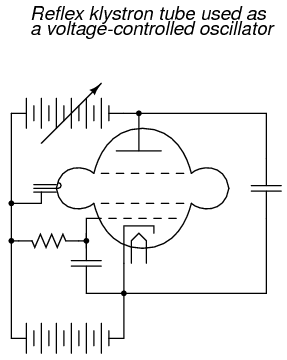
Initially developed as low-power devices whose output required further amplification for radio transmitter use, reflex klystron design was refined to the point where the tubes could serve as power devices in their own right. Reflex klystrons have since been superseded by semiconductor devices in the application of local oscillators, but amplification klystrons continue to find use in high-power, high-frequency radio transmitters and in scientific research applications.
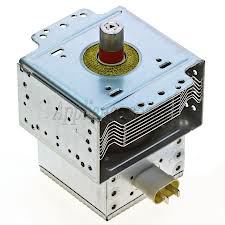
One microwave tube performs its task so well and so cost-effectively that it continues to reign supreme in the competitive realm of consumer electronics: the magnetron tube. This device forms the heart of every microwave oven, generating several hundred watts of microwave RF energy used to heat food and beverages, and doing so under the most grueling conditions for a tube: powered on and off at random times and for random durations.
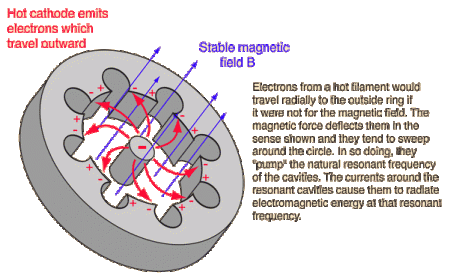
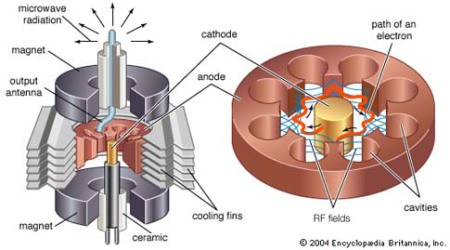
Magnetron tubes are representative of an entirely different kind of tube than the IOT and klystron. Whereas the latter tubes use a linear electron beam, the magnetron directs its electron beam in a circular pattern by means of a strong magnetic field:

Once again, cavity resonators are used as microwave-frequency "tank circuits," extracting energy from the passing electron beam inductively. Like all microwave-frequency devices using a cavity resonator, at least one of the resonator cavities is tapped with a coupling loop: a loop of wire magnetically coupling the coaxial cable to the resonant structure of the cavity, allowing RF power to be directed out of the tube to a load. In the case of the microwave oven, the output power is directed through a waveguide to the food or drink to be heated, the water molecules within acting as tiny load resistors, dissipating the electrical energy in the form of heat.
The magnet required for magnetron operation is not shown in the diagram. Magnetic flux runs perpendicular to the plane of the circular electron path. In other words, from the view of the tube shown in the diagram, you are looking straight at one of the magnetic poles.
Elektromanyetik Dalgalar – Mikrodalga ve Mikrodalga Fırın

Küçük dalgaların büyük enerjisi....
Saniyede yaklaşık 2,5 milyar kez titreşen mikrodalgalar,
yiyeceklerdeki su moleküllerinde, bunun iki katı titreşim
oluşturur. Bu yoğun titreşimden kaynaklanan ısı enerjisi
yemeklerin pişmesini sağlar.
Mikrodalgalar, aslında günlük yaşantımızın her alanında
ihtiyaç duyduğumuz pek çok cihazın çalışmasını sağlayan bir
enerji kaynağıdır. Cep telefonu, televizyon, radyo gibi
cihazlar mikrodalgaları kullanarak çalışır. Konumuz olan
mikrodalga fırınlarsa, oldukça yeni bir teknoloji ve çoğu icat
gibi tesadüfen keşfedilmiş.
1946 yılında radarla ilgili bir araştırma projesinde görevli
olan Dr. Percy Spencer, magnetron denilen vakum tüpü üzerinde
çalışırken cebindeki çikolataların eridiğini fark etmiş. Bu
duruma şaşıran Dr. Spencer, bir deney yapmak istemiş ve mısır
tanelerini magnetronun yanına koyduğu zaman mısır tanelerinin
kısa bir süre sonra patladığını gözlemlemiş. Bir buluş
yaptığını hisseden bilim adamı çiğ bir yumurtayı magnetronun
yanına koyarak arkadaşları ile heyecanla beklemeye
başlamışlar. Yumurta da çok kısa bir süre içinde pişmiş ve
patlamış. Bu keşif sayesinde yemeklerinin de kısa sürede
pişeceğini fark eden bilim adamları, bugün kullanmakta
olduğumuz mikrodalga fırının prototipini yaratmışlar.
Mikrodalga nedir?
Mikrodalgalar ışık hızında hareket eden, çok kısa dalga boyuna
sahip elektromanyetik dalgalardır. Elektromanyetik dalgaları
bir örnekle basit olarak açıklayalım: Durgun bir su
birikintisine bir taş attığınızda suyun üstünde ufak dalgalar
oluşur. Bu dalgalar genişleyerek tüm yüzeye dağılır. Bu tip
dalgalara enine dalgalar denir ve mikrodalga da bir çeşit
enine dalgadır.


Mikrodalga fırın nasıl çalışır?
Mikrodalga fırınlar elektrik enerjisiyle çalışır. Fırının
içinde bulunan magnetron isimli cihaz, elektrik enerjisini
mikrodalga enerjisine dönüştürerek 2.450 MHz frekansında
mikrodalgalar üretir. Üretilmiş olan bu mikrodalgalar, dalga
kılavuzu vasıtasıyla fırının içine ulaştırılır ve pişirmek
istediğimiz yiyecek tarafından emilir. Saniyede 2,45 milyar
kez titreşen mikrodalgalar yiyecek maddesinin içinde bulunan
su moleküllerinde titreşim oluştururlar. Mikrodalgaların
etkisiyle su molekülleri yaklaşık olarak saniyede 5 milyar kez
titreşir. Bu yüksek hızdaki titreşmeden dolayı birbirine
sürtünen su molekülleri, ısı enerjisi üretirler ve ortaya
çıkan bu ısı enerjisi yemeklerin pişmesini, ısınmasını sağlar.
Bu bağlamda içinde daha fazla su molekülü olan yiyecekler daha
hızlı pişer.


Mikrodalga fırınlarla ilgili merak edilen konular
Çelik tenceremle mikrodalga fırında yemek pişirebilir miyim?
Hayır, çünkü mikrodalga ışınlar metal malzemelerden yansırlar,
içlerinden geçemezler. Ama cam, seramik, plastik ve hatta
kâğıt kapta bile yemeğinizi pişirebilirsiniz.
Mikrodalga ışınlar zararlı radyasyon yayar mı?
Mikrodalga ışınlar iyonize olamayan ışınlar grubuna dâhildir.
Maddenin ve canlı hücrelerin yapısını değiştirmezler ve
radyoaktif olarak zararsızdırlar.
Mikrodalga fırında pişen yemek zararlı mıdır?
Hayır değildir. Mikrodalga fırınlar sadece, elektrik
enerjisini mikrodalga enerjisine; mikrodalga enerjisini de ısı
enerjisine çevirir. Fırının içinde kimyasal veya radyoaktif
bir işlem gerçekleşmez.

Elektromanyetik dalga; elektrik alanı ve manyetik alanı
içerir. Elektrik (E) ve manyetik (B) alanları dalganın
hareketine ve birbirlerine dik, enine salınım (osilasyon)
gösterir.


Elektromanyetik dalgalar, belirli elektromanyetik işlemlerden
sonra oluşan enerji saçılımı gösteren dalga türleridir. X-ray’den
radyo dalgaları ve ışıklara kadar geniş bir çeşitliliğe
sahiptirler.
(Not: Foton içeren dalgaların dalga boyu yükseldikçe
gidebileceği mesafe artar; ancak gücü azdır. Bu yüzden dalga
boyu yüksek olan radyo sinyalleri uzak mesafeleri gidebilmekte
ancak X-ray UV gibi güçlü dalgalar uzun mesafelere
taşınamamaktadır. Bunu ise aşağıdaki formülden çıkarabiliriz:
v=f*λ (1)
Denklem 1’de v dalganın hızını (m/s), f dalganın frekansını
(1/s) ya da gücünü, λ ise dalganın dalga boyunu (m)
göstermektedir.)
Elektromanyetik dalgalar, dalga boyuna göre aşağıdaki şekilde
sınıflandırılırlar:
Elektromanyetik spektrum (Görünebilir ışığın dalga boyları ile
birlikte)
Bu yazımızda mikrodalga spektrumu ve bu dalga ile çalışan
mikrodalga fırınlardan bahsedeceğiz. Mikrodalga frekansı 1 GHz
ile 300 GHz, dalga boyu ise 1 m ile 1 mm arasında olan
elektromanyetik dalga sınıfıdır. Kullanımı aşağıdaki
alanlardadır:
İletişim: GSM, GPS, wi-fi ve bluetooth’lar ve amatör
radyolarda (düşük frekanslarda, radyo dalgalarına yakın);
uydularda (yüksek frekanslarda)

Hız radarlarının çalışma prensibi. Arabaya gönderilen ve
yansıyan dalgalardan arabanın hızı bulunur.
Radarlar cisimlerin yerini ve hızını algılayan aletlerdir.
Otomatik kapı algılayıcılardan askeri uygulamalara kadar geniş
bir uygulama alanına sahiptir. Radarlar mikrodalganın en sık
kullanıldığı alanlardan biridir. Yüksek hassasiyet isteyen
uygulamalarda yüksek frekanslar; hava durumu veya hız
belirleme radarları gibi düşük hassasiyet içeren uygulamalarda
düşük frekanslar kullanılır.
Radyo teleskoplarda güneş sistemini incelerken mikrodalga
kullanılır.


Mikrodalga ısıtma prensibi
Ev tipi mikrodalga fırınlarda (2.45 GHz) ise amaçlanan işlem
mikrodalga radyasyon ile besinlerin içerisindeki suyun
ısıtılmasını, dolayısıyla besinin pişmesini sağlamaktır.
Prensip ise basittir: Mikrodalga ısıtılacak madde ile
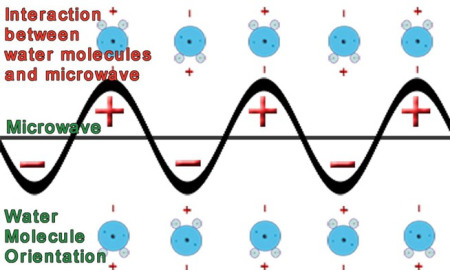
etkileşime geçince maddenin içindeki polar moleküller oluşan
elektromanyetik alana göre kendini konumlandırır.
Elektromanyetik dalganın içindeki elektrik ve manyetik
alanları sürekli salınım halinde olduğu için polar moleküller
sürekli kendini konumlandırmaya çalışır. Bu rotasyon ise
moleküllerin hareketine ve birbiriyle çarpışmasına;
dolayısıyla maddenin ısınmasına sebep olur. Apolar maddelerde
ise ısınma nispeten daha zordur; çünkü polar maddelerdeki gibi
hareket edebilecek serbest elektronlar yoktur. Dolayısıyla
mikrodalga fırında suyun ısınması, yağ ve şekerin ısırmasından
daha kolaydır.
Mikrodalga ısıtma ile doğrudan ısıtma
Mikrodalga ısınmanın normal ocakta (konveksiyonel) ısıtmaktan
en önemli farkı mikrodalga ısıtmada ısınma içeriden dışarıya
doğru olurken, konveksiyonel ısıtmada ısınma dışarıdan içeriye
doğru olur. Dolayısıyla mikrodalga fırından çıkardığınız bir
yemeği ya da herhangi bir cismi elinize hemen almayın veyahut
illa alacaksanız bile ısıya dayanıklı bir fırın eldiveni
kullanın, çünkü ilk başta ısınmadığı sandığınız cisim kısa bir
süre sonra kor gibi sıcak olacaktır.

Elektromanyetik Dalgalar – Mikrodalga ve Mikrodalga Fırın
Mikrodalganın temel parçaları
Mikrodalga fırınlarda mikrodalga radyasyonu,
Magnetron adı verilen yüksek vakumlu tüpte elektronların
hızlandırılması ve hızlanan elektronların bir seri metal
boşluklardan (multi-mode cavities) geçmesiyle oluşur.
Son olarak mikrodalga fırın kullanacaklara tavsiyeler:
– Tek bir seferde uzun calıştırmayın (tavsiyem maksimum 5 dk)
– Mikrodalganın çalışırken kapağının kapalı olduğundan emin
olun. Kapağı ya da herhangi başka bir aksamı kırılmış
mikrodalgayı kesinlikle kullanmayın.
– Asla ve asla mikrodalgada su pişirmeyin. Aksi takdide suyu
fırından aldığınızda ani bir buhar patlaması yüzünüze
gelebilir.
– Mikrodalga fırına asla alüminyum folyo koymayın, çünkü
kıvılcım çıkarmaya sebep olabilirsiniz. Eğer fırınının içinde
yangın olursa fırının kapağını açmadan fırını doğrudan fişten
çekin.
– Pişirme kabı ya da tabağı seramik olabilir. Fırında pişirmek
için kullanılan özel aparatlardan alın.



Mikrodalga Işınlar
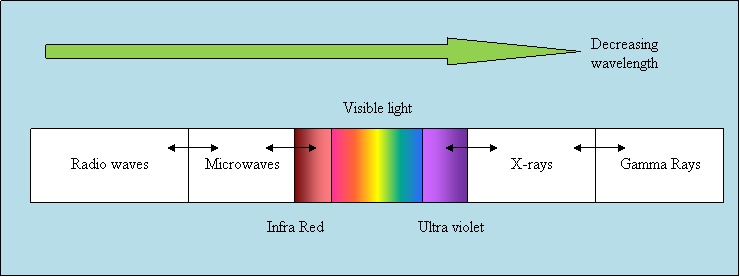
Elektromanyetik spektrum
Mikrodalgalar, dalga boyu çok kısa olan, ışık hızında hareket
eden elektromanyetik bir enerjidir. Elektromanyetik dalgaların
103MHz-106MHz arasındaki frekans grubu mikrodalga bandı olarak
belirlenmiştir. Bu frekans grubu ise radyo dalgaları ile kızıl
ötesi ışık arasında yer almaktadır. Ulusal Haberleşme
Komisyonu mikrodalganın, radyo yayınlarında kullanılan
dalgalarla etkileşimini önlemek için, gıdalarda ısıl işlem
amacıyla kullanılacak mikrodalga frekanslarını belirlemiştir.
2450 MHz ev tipi mikrodalga fırınlarda, 915 MHz ise
endüstriyel mikrodalga fırınlarda kullanılan frekanslardır.
Frekans düzeyi mikrodalganın etki derinliğini
değiştirmektedir. Mikrodalgalar 2450MHz’de 10 cm’ye kadar,
915MHz’de ise 30 cm’ye kadar etki derinliği
oluşturabilmektedir.
Mikrodalga fırın temelde içinde dalgaların duvarlardan
yansıdığı ve yankılı bir sistem oluşturduğu metal bir kutudur.
Mikrodalganın materyal ile teması sonucu değişik şekilde
etkileşimler oluşmaktadır. Metaller dalgayı yansıtırken, su ve
gıda maddeleri tarafından absorbe edilmekte, cam, kağıt,
plastik ve tahtadan hiçbir değişikliğe uğramadan
geçebilmektedir.

Fırın içerisinde mikrodalgalar üretmek için magnetron denilen
araçtan yararlanılır. Bu araç elektrik fişinden aldığı
enerjiyle mikrodalgalar oluşturur. Oluşan mikrodalgalar bir
anten yardımıyla dalga kılavuzu denilen boş bir tüpe
yöneltilir. Bu tüp tarafından vantilatör gibi bir
karıştırıcıya aktarılan dalgalar fırının içerisine dağıtılır
ve fırın duvarlarından yansıyan ışınlar gıda içindeki su
molekülleri tarafından emilirler.


Mikrodalga Fırının Çalışma Prensibi
Mikrodalganın Gıda Maddesi ile Etkileşimi
Mikrodalgayı absorbe eden gıda maddesinde ısınma, moleküler
sürtünme sonucunda oluşmaktadır.
Su moleküllerinin bir ucunda hafif pozitif bir yük, diğer
ucunda da hafif negatif bir yük vardır. Emilme sürecinden önce
bu yükler gıda içerisinde rastgele dağılmışlardır. Fırın
duvarlarından yansıyan mikrodalgaları emen moleküller,
dalgaların elektrik alanına göre düzenli bir yapıya geçme
eğilimi gösterirler. Elektrik alan saniyede milyarlarca (~
2,45 milyar) kez salınır ve su moleküllerini etkileyerek
konumlarını değiştirir. Bu sırada meydana gelen sürtünmenin
etkisiyle ürünün her bölgesi eşit düzeyde ve aynı anda ısınır
ve böylece gıda, pişirilir, kavrulur, kurutulur veya sterilize
edilir.

Mikrodalga uygulanabilmek için bir ürünün dielektrik kaybına
sahip olması gerekmektedir. Yani değişken bir elektromanyetik
alan uygulandığında madde içinde dipolar elektrik yüklerinin
oluşması gerekmektedir. Su molekülleri kolaylıkla dipolar
elektrik yükleri oluşturabildiğinden, su içeren yapıda her
ürün, mikrodalga ile ısıtmaya uygundur.

Introduction to Microwave
Microwave is one of radio wave, and radio wave is one of electromagnetic wave.
Since the electromagnetic wave is spread by the interaction of electric field and magnetic field, it can also be spread in a vacuum.
Electromagnetic wave is a wave that has two elements, such as wavelength and frequency. Wave length is about the length of top to top of the wave, frequency is number of waves that appears in a second.
The velocity of electromagnetic wave in a free space, such as vacuum and air, is constantly 300,000km per second regardless of frequency. Wave length equals to this divided by frequency.
As shown in Figure 1, electromagnetic wave is called differently depends on frequency. It is used in various applications according to their characteristics. Light is also a kind of electromagnetic wave. The electromagnetic waves that are less than 3000GHz, is classified as radio wave. Radio wave that has frequency of 300MHz to 300GHz(wave length of 1m to 1mm) is known as microwave.
Microwave has been applied to communication, radio telescope for astronomy, radar surveilance system, and also to GPS positioning system known as car navigation system. Heating is another application of microwave.

Figure 1: Application and classification of electromagnetic wave
2: About the frequencies that can be used for Microwave heating device
ITU (International Telecommunication Union) would assign the available frequencies of radio wave that depends on use. It is finally decided by the laws of each countries.

Regarding microwave that has frequency of 300MHz to 300GHz (wave length of 1m to 1mm), ITU has allocated frequencies for the purpose of industrial, scientific, medical use, as shown in Table 1.
433.92MHz has been recognized as ISM frequency in some countries, in the first region (Europe).
915MHz has been recognized as ISM frequency in the second region (North and South America)
ISM frequencies that can be used worldwide is the ISM frequency of 2450MHz or higher.
Table 1: ISM frequency of microwave band

On the other hand, there is a law with strict limits to regulate leakage of radio waves in order to
avoid interference with telecommunication failure. However, for example, the Radio Law doesn't
regulate the limit of radio leakage for the ISM frequency of 2450MHz band.
Therefore, microwave device that uses this frequency band (called ISM equipment) better be designed to meet the safety limits.
In contrast, devices that use radio frequencies other than the ISM frequency need a large-scale
countermeasurement for radio leakage to meet the regulation of Radio Law, such as, radio wave
shields for equipment installation room, or for entire building.

| This is why various industrial heating equipment is
using ISM frequency, including microwave oven at
home.
The 2450MHz is the most popular among ISM frequency bands due to not only being usable in any countries in the world, but also existence of a microwave oscillator tube shown in Figure 2. The relatively inexpensive magnetron (Output: 300W to 10kW) that is compact built, light weight, and permanent magnet attached, is also a huge contribution to market expansion of the 2450MHz band. |
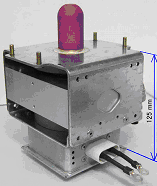 Figure 2 2450MHz band Magnetron (output 2kW water-cooled type) |

3: The principle of microwave heating
You may have experienced that you could not have seen the BS broadcasting TV channel when it is raining hard. The most efficient frequency of the microwave absorption of water is said to be around 18GHz.

The frequency of microwave oven is 2.45GHz (2450MHz). And the frequency of BS broadcasting TV is around 12GHz. You can probably understand the reason for not being able to see the BS broadcasting TV in hard rain by now. It is that BS airwaves have been absorbed by the rain. Power of BS airwaves is weak, so rain will not be heated. But in principle, rainwater is heated by the absorbing power from BS airwaves.

In this chapter we explain about, "The principle of microwave heating", "Microwave power absorbed by the dielectric", "The depth of microwave penetration into the dielectric", and "Dielectric properties of the dielectric".
IEC(International Electrotechnical Commission) defines, Microwave heating is to heat dielectric materials through mainly their molecular motion and their ionic conduction by the action of electromagnetic waves of 300MHz to 300GHz.
The principle of the microwave heating is very difficult. And it's not easy to explain, but the following will give you a rough idea.


"For the vibration of microwave field, for example, when permanent electric dipole in the dielectric materials follows the oscillation of the microwave field slightly later, i.e., to the change of microwave field, in case permanent electric dipole changes with phase lag, this phase delay is the resistance to change of microwave field. Then, the permanent electric dipole will be heated by this resistance." Briefly, "The permanent electric dipole is forced to vibrate while resisting and genarates heat by this action."
Followings are explanation with figures:
Figure 3 shows the structure of water molecules that are discussedas representatives of the permanent dipole.
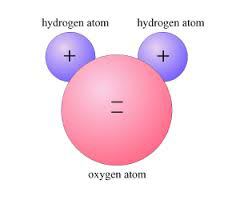
Water consists of two hydrogen atoms and one oxygen atom. It doen't have electric charge as a whole, a oxigen atom is bounding with two hydrogen atoms at an angle of 104.5°. Those atoms take a little charge of each minus(-) and plus(+) to form a dipole.
 Figure 3 The structure of water molecules (left) and Image of permanent dipole (right) |
Then as shown in Figure 4, when there is no external electric field, it has set a balance. But when placed in external electric field, dipole will turn towards the electric field.
 1) When there is no external electric field |
 2) When there is an external electric field |
| Figure 4 Direction of dipoles influenced by external electric field | |
For example, when the water is irradiated with radio wave, it means to give a electric field for alternating. In case of microwave oven, vibration of 2450 million times plus and minus to be replaced per second.
Figure 5 shows a case where a too much lower frequency of radio wave is irradiated to the permanent dipole of water. In this case, the permanent dipole will immidiately follow the directions of electric field. So in this case, water doesn't generate heat.
On the other hand, Figure 6 shows a case where a too much higher frequency of radio wave is irradiated to the permanet dipole. In this sice, since electric field changes its direction too fast, dipole won't be able to follow. Then, water does not genarate heat in this case also.
Microwave penetrates into the object at the speed of light. And the object to be heated generates heat on their own. So it allows rapid response. For examle, you can start and stop the heating instantly. In addition, by the adjustment of microwave output, you can control the amount of heat energy generated inside the heated object. Therefore as shown in Figure 13, you can instantly respond to the temperature changes of the object to keep the temperature setting.
 Figure 13: Rapid response and temperature control |
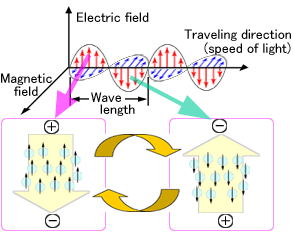 Figure 5 At too lower frequency of radio wave |
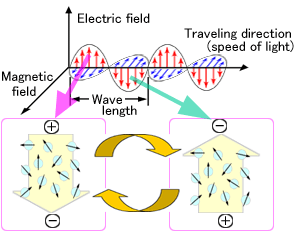 Figure 6 At too higher frequency of radio wave |
In contrast to these, Figure 7 shows a case where moderate frequency of radio wave is irradiated to the permanet dipole. In this case, the permanent dipole changes a little behind the electric field. During the time delay, water is absorbing energy from radio wave and genarates heat. And, this moderate frequency is the microwave.
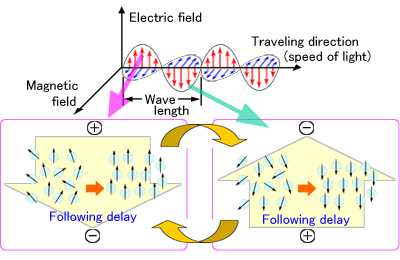 Figure 7 At moderate frequency of radio wave (microwave) |
From the above description, you might think that microwave can only heat dielectric materials. However, metal such as stainless steel, metal oxides such as iron sand can also be heated in microwave.
And, even for metal powder, microwave penetrates inside while heating. However, for the metal plate, most of microwave will be reflected instead of penetrating.
In this chapter, instead of explaining about the metal, "The microwave power absorbed by the dielectric", "The depth of microwave penetration into the dielectric", "Dielectric properties of the dielectric" are explained.
Microwave heating, as shown in Figure 8, there is a difference in microwave power absorption depending on the material.
For example in Figure 8, a borosilicate glass is sold as microwavable glass container. When this glass is heated with water in it, only water gets heated. That's because microwave power absorption of the glass is ignored since there is only 3000/1 of water.
Therefore, as shown in Figure 12, when a good material of container is selected, microwave can only heat the object and heat efficiency improves substantially.
 Figure 12: Selected heating |
In Figure14, shows the basic structure of microwave power application apparatus. Microwave that is generated by magnetron built inside the Generator ①(Oscillator), Transferring Waveguide⑥, Isolator②, Power Monitor③, Waveguide⑥, EH-Tuner④, then reaches the Applicator⑤ to heat the object to be heated inside the Applicator.
In here, microwave that is oscillated by the Generator is called the traveling wave (or incident wave). On the other hand, microwave that is reflected by the Applicator is called the reflected wave (or reflection wave) And the microwave power consumed within the Applicator, is same value as reflected wave deducted by the traveling wave. ( Strictly speaking, micorwave power consumption from EH Tuner to the Applicator )
 Figure 14 The basic structure of microwave power application apparatus |
①Generator (Oscillator): A device that oscillates microwave. Generator is connected to a waveguide (the waveguide standard: WRJ-2/WRI-22, Flange:BRJ-2/FUDR22) has opened nozzle. The microwave which is generated by magnetron propagates in waveguide to be emitted from the nozzle.
Therefore, as shown in Figure 14, operating tests must be done after the connection of microwave devices to the Applicator. Otherwise, it is dangerous.
②Isolator: A device, sends traveling wave directly to the Applicator, and absorbs reflected wave by built-in dummy load to avoid returning back to the Generator.
Reflected wave which occurs by rotation of the Turntable and the Stirrer. Isolator can reduce the influence of reflected wave fluctuation. Without this fluctuation, magnetron can continue stable operation. In other words, Isolator functions to protect magnetron
③Power Monitor: A device that monitors traveling and reflected waves of microwave power propagating through the rectangular waveguide. Must be careful when reflected wave becomes large, there is an increase in error.
Micro Denshi's Power Monitor has been devised to show the power accurately, even when magnetron is driven by other power supply.
④EH-Tuner: There are two kinds of tuners, which are three stub and EH. EH-Tuner is recommended for easy adjustment. By adjusting E- or H-tuner, changes the phase and magnitude of microwave reflection at the tuner section It is also adjustable to set the display value of reflected power to zero by adjusting E- or H- tuner.
This means that, by adjusting E- or H- tuner, generates a same magnitude reverse phase wave to counter the reflected wave. And as a result, the reflected wave has been denied.
When the reflected power wave value is zero on the display of Power Monitor, power consumption of after tuner to inside applicator is maximized. This condition is called "The matching"
⑤Applicator: A heating tank that heats the object placed inside by irradiation of microwave. Depending on the application, ther are a variety of shapes, such as batch type, conveyor type, waveguide type, etc.
Micro Denshi's applicator has been devised to minimize the reflection caused at the junction of waveguide.
⑥Waveguide: Microwave (electromagnetic wave) propagates in the interaction of electric and magnetic fields. Microwave is transmittable when metal pipe with cross section is used.
In general, for the microwave heating equipment, 2GHz standard rectangular waveguide of rectangular cross section is used. ( Standard waveguide: WRJ-2/WRI-22, Flange: BRJ-2/FUDR22)
Microwave Ovens
Microwave ovens are one of a few electric methods of cooking.
The microwave oven evolved from research on Doppler radar
technology by accident when a researcher (Percy Spencer at
Raytheon) found a chocolate bar in his pocket had melted when
he was exposed to microwave radiation.
1.) How it Works
1.a) The Magnetron
2.) High Frequency Power Supply
3.) Notes on the History
1.) How it Works:
The microwave oven uses a magnetron to generate microwave
energy. The microwave energy travels through a waveguide and
is distributed into a metal cavity where the food is cooked.
The waves are absorbed by the food and excite water molecules
in the food. This heat then transfers throughout the food
cooking it.

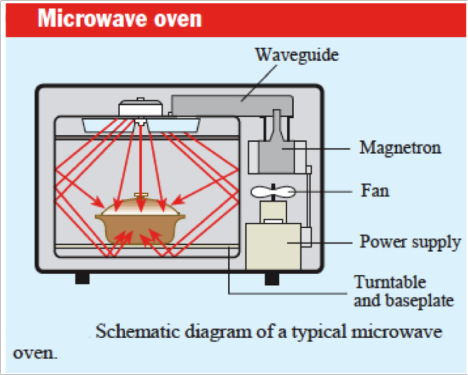
The microwave oven is faster than a conventional oven because
the microwaves can penetrate into the food and heat the food
from the inside out. In a conventional oven heat comes from
the outside and slowly works its way into the food through
standard slow heat transfer processes.
1.a) The Magnetron

The cavity magnetron is the main component of a microwave. The
magnetron is an oscillator where electrons are emitted from a
hot cathode and whirl past resonant cavities which are part of
the anode at speeds that generate microwave energy. This
microwave energy is coupled out of the vacuum via a probe
which is connected to a waveguide to deliver the energy to the
oven (see our video below for a motion graphic illustrating
this whole procedure). The magnetron is a high powered vacuum
tube.
The concept of the magnetron was invented by Dr. Albert W.
Hull in Schenectady in the 1930s. His designs were for more
power control and a few oscillators were also devised for
generating energy in the 100s of MHz.

How microwaves work
Microwaves are a form of electromagnetic radiation, like radio
waves. They are generated by a device called a magnetron, and
they pulse rapidly back and forth inside an oven at a
carefully calibrated frequency.
A Magnetron is connected to a high voltage source. This
magnetron directs the microwaves into the metal box where our
food is placed. These waves bounce off the oven’s interior
metal walls and pass through paper, glass, and plastic, but
they get absorbed by the food. More specifically, these waves
are absorbed by the food’s water content. This absorption
makes the molecules oscillate back and forth, creating heat
and cooking the food from the inside out, the outside in, or
uniformly, depending on where the water lies.
--------------------------------------

Microwaves cook food using the heating effect of high-frequency
radio waves. The oven produces these microwaves at intervals
during the cooking process, the number and length of the
pauses is dictated by the power level you choose.
Control panel - Cooking time and power level are set using the
control panel. Your oven may also have presets for common
tasks like defrosting and reheating.
Microwave cooking
Power supply - 230V mains power supply passes through safety
systems designed to cut the power in the event of overheating
or the door being opened.
Making waves - The mains voltage is stepped up by a
transformer and a capacitor to around 3000V, to power the
magnetron, which generates the microwaves.
Wave guide - Microwaves are conducted through the wave guide
into the cooking chamber. Here they are reflected from the
walls and door, and penetrate the food from the sides and
above.
Turntable - A turntable rotates the food slowly to give even
cooking. Some ovens achieve this by using a microwave stirrer
instead, and this is positioned inside the roof of the chamber.
How Microwaves Cook Food:
Microwave ovens use high-frequency radio waves (microwaves),
oscillating at approximately 2.5GHz, to cook your food. At
this frequency microwaves are absorbed by water, certain fats
and sugars – the primary constituents of most foods.

moleculesIn a water molecule, the two hydrogen atoms (shown in
red) carry a small positive charge, and the oxygen atom (blue)
carries a negative charge. The oscillating electric field of
the microwave interacts with these charged atoms to cause the
molecule to twist. This rotation causes friction, producing
heat to cook food or boil fluids.
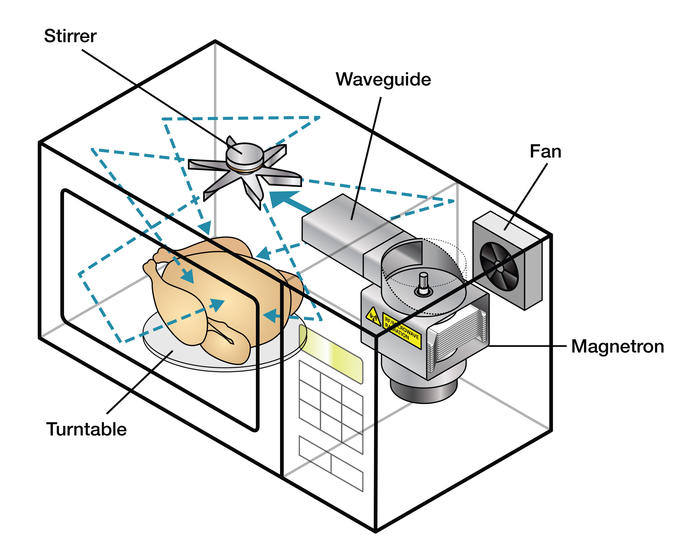
The powerful voltage would then be dynamically convert the
high voltage in to undulating waves of electromagnetic cooking
energy through magnetron tube.

The microwave energy is transmitted into a metal channel
called a waveguide , which feeds the energy into the cooking
area where it encounters the slowly revolving metal blades of
the stirrer blade . Some models use a type of rotating antenna
while others rotate the food through the waves of energy on a
revolving carousel.
Microwave oven for preparing food: (1) glass plate on which the food is placed; (2) fan whose blades, by rotating, reflect the microwaves in all directions in order to heat the food on all sides; (3) wave guide; (4) magnetron; (5) timers
Mikrodalga Fırın
Mikrodalga fırını (MD), yiyeceği ısıtmak için mikrodalgaları,
yani radyo dalgalarını kullanan bir fırın çeşididir.
Mikrodalgalarla pişirme fikri ilk kez Percy Spencer
tarafından, radar olarak kullanılması planlanan "magnetron"un
keşfedilmesiyle 1945'li yıllarda başlamıştır. 1947'de bu
buluşunun patentini almış ve ilk mikrodalga fırını 1,8 metre
boyunda ve 340 kg ağırlığında olarak tasarlamıştır. Mikrodalga
fırın, 1947'de mutfak eşyaları üreticisi olan Raytheon
şirketince "Radarange" adıyla kamuoyuna duyurulmuş olsa da,
gerek fiyatının çok yüksek oluşu gerekse büyükçe bir buzdolabı
boyutlarında olması nedeniyle ticari olarak pek ilgi görmedi.
Evlerde kullanılan ilk mikrodalga fırınlar, 25 Ekim 1955'te
Tappan şirketi tarafından satışa çıkarılmış olup günümüzde
ABD'de yaklaşık olarak 80 milyon mikrodalga fırının olduğu
tahmin edilmektedir. Bu sayının yarısı son yıllardaki
satışlara aittir.
Çalışma Şekli
Mikrodalgalar, elektromanyetik spektrumun radyo dalgaları ile
kızıl ötesi ışınlar arasındaki bölümde kalırlar. Frekansları 1
GHz ila 1000 GHz arasında, dalga boyları 0,1–100 cm olan
elektromanyetik dalgalardır.
Dalgaların frekansları ile dalga boyu arasında; yüksek
frekanslı dalgaların kısa dalga boyu, alçak frekanslı
dalgaların ise uzun dalga boyu yayması ilişkisi ya da tam
tersi durum vardır. Normal fırınların kapağında bulunan küçük
delikler, ışık dalgalarının geçmesine izin verirler ve bu
nedenle fırının içi görülür. Çünkü ışığın dalga frekansı
oldukça yüksek, dalga boyu da çok küçüktür, mikrodalga
fırınların yemeği ısıtmak için kullandığı elektromanyetik
dalgaların ise frekansı düşük ve dalga boyları daha uzundur.
Bu yüksek dalga boyuna sahip dalgalar kapaktaki deliklerden
geçemez ve tekrar içeri yansırlar.
Mikrodalga fırınlarda 2,45 GHz’lik bir frekans kullanılır. Bu
frekansın kullanılmasının önemli bir sebebi vardır. 2.54 Ghz,
su moleküllerinin rezonans frekansıdır. Bunun sonucu olarak
2.54 Ghz'lik mikrodalga ışıma en çok su tarafından
emilecektir. Çoğu yiyecek de su içerdiğinden ısınacak,
mikrodalga fırına uygun tabaklar ise su içermediğinden
ısınmayacaktır.
Bu rezonans sayesinde de su molekülleri ısınacak, maddenin
kendisi de pişecektir. Az su içeren yemeklerin mikrodalga
fırınlarda ısıtılması uygun değildir.
Mikrodalga, bu özel fırınların içindeki "magnetron" adı
verilen vakum tüpünden üretilir. Magnetron, Doğru akılmlı
elekrik enerjisini "mikrodalgalar"a dönüştürür, mikrodalga
fırın bu şekilde çalışır.
Bu frekanstaki dalgalar, başlıca su olmak üzere bazı maddeler
tarafından emilirler, dalgalar, bu maddelerin moleküllerini
atomik devinime uğratarak mikrodalga enerjiyi ısıya
dönüştürürler. Bu nedenle içinde daha çok su molekülü taşıyan
besinler daha hızlı pişer.
Bu mikrodalgaların özellikleri şöyle
sıralanabilir:
Su, şeker ve yağlar tarafından emilir,
Emildiği ilk anda atomik ısıya dönüşür,
Çoğu plastik, cam ve porselen tarafından emilmez,
Metaller tarafından yansıtılırlar.
Mikrodalga fırınlarına metal malzemeler koyulmamasının nedeni
de bundan kaynaklanmaktadır.
Mikrodalga ile pişirme, geleneksel pişirme yöntemlerinden hem
daha hızlıdır hem de pişirme sürecinde yalnızca besin pişer,
fırın ve ortam ısınmaz.
Mikrodalgaların enerjileri, besin içinde ısıya dönüştüğü için,
besin içinde bir radyasyon oluşması vb. bir durum genellikle
söz konusu değildir.
İçten dışa pişirme hakkında
Mikrodalga fırının çalışmasındaki en önemli özelliklerinden
birinin, yemeği normal fırınlar gibi "dıştan içe" değil,
"içten dışa" doğru pişirmesi olduğu söylense de bu bir mantık
hatasıdır. Diğer pişirme yöntemlerinde ısı dıştan içe doğru
yayıldığı için, mikrodalgaların etkisi "içten dışa" olarak
algılanmakadır; aslında mikrodalga fırınlarda pişirme, "heryere
aynı anda etki etme şeklinde" dir.
Diğer fırınların "dıştan içe" pişirme yönteminin avantajlı
olmadığı ve bazen kötü sonuçlara sebebiyet vereceği açıktır.
Örneğin fırında pişen keke normal olarak 350 °C ısı
vereceğimize 600 °C verirsek, kekin dış kısmı kısa bir sürede
yanacaktır, ayrıca kekin iç kısmı da pişmeyecektir. Bunu
etkileyen bir diğer faktör de fırının verdiği kuru sıcaktır,
kuruluktan ötürü yemeğin suyu kolayca buharlaşır ve verimsiz
bir şekilde pişmiş olur.
Mikrodalgalarda kullanılan radyo dalgaları ise yemeğin içine
nüfuz eder, hatta bunu yaparken yemek dışında kalan hava
moleküllerini de ısıtmaz, böylece enerjisini verimli kullanmış
olur. Ayrıca mikrodalga fırın içerisindeki yemeğin katmanları
arasında sıcaklık farkı yoktur. Çünkü ısı yemeğin tüm
moleküllerini aynı anda ısıtır ve enerjilerini artırır. Isının
iletim yoluyla dıştan içe doğru gitme zorunluluğu yoktur.
Ayrıca mikrodalga fırınların iç sıcaklığı oda sıcaklığına
eşittir. Yani yemeğin kabuk tutmasına imkân yoktur.
Tabii ki radyo dalgalarıyla ısıtmanın da bir sınırı vardır,
örneğin kalın yiyeceklerde ısının içe ulaşması daha zor
olmakta, bazı yiyeceklerde ısının toplandığı noktalar
olmaktadır. Ancak bu dezavantajlar, fırının sağladığı
faydaların yanında küçük ölçekli olarak kalır.
Sonuç olarak mikrodalganın pişirme yöntemi her bölgeye eşit
şekilde ve tüm atomları hareketlendirerek olmaktadır,
mikrodalga iletim yoluyla ısıtma yapmamaktadır, büyük bir
buluş olmasını da bunlara borçludur.
Dikkat edilmesi gerekenler
Mikrodalga fırında herhangi bir mikrodalga kaçağı olmadığından
emin olunmalıdır, böyle bir durum söz konusuysa yetkili servis
çağırılmalı, sorun düzeltilinceye kadar fırına yakın
bulunulmamalıdır.
Mikrodalga fırında metal eşyaların kullanılmadığından emin
olunmalıdır.
Et ve sebzeler eşit parçalar halinde koyulmalıdır, böylece
hepsi aynı derecede ısınır.
Kağıt tabaklar, porselen kupalar, peçeteler koyulabilir. Ancak
folyo içeren kâğıt (süt kutusu), naylon ve sentetik içeren
ürün, gazete kağıdı koyulmamalıdır.


Enerji
Mikrodalga fırınlar normal fırınlara oranla 4'te 3 daha az güç
harcamaktadırlar. Örneğin elektrikli bir fırın 1000-1500
Watt’lık elektrik enerjisi harcarken, mikrodalga fırınlar
yalnızca 300-500 Watt’lık bir enerjiyle çalışırlar. Yani çok
daha verimlidir.
Mikrodalga Nedir?
Ortamdan gıdaya aktarılacak veya gıdadan ortama aktarılacak
ısı bilindiği üzere kondüksiyon, konveksiyon ve radyasyon
olmak üzere 3 farklı mekanizma ile gerçekleşebilir.
Elektromanyetik dalgalar ile aktarılan enerjiye radyasyon
denmektedir.
Elektromanyetik dalgalar salınım halinde birbirine ve yayılma
yönüne dik elektrik ve manyetik alandan oluşmaktadır.
Elektromanyetik radyasyon, dalga boyu 10-16 m’den daha az
kozmik ışınlarla 10 km’den daha büyük elektriksel güç
dalgalarını da içerisine alan çok geniş bir aralığı
kapsamaktadır. Elektromanyetik spektrumda ayrıca gama
ışınları, X-ışınları, mor ötesi ışınları, görünür ışık, kızıl
ötesi ışınları, mikrodalgalar ve radyo dalgaları yer alır.
Elektromanyetik radyasyonla ısıtma Mor ötesi, görünür ışık ve
kızıl ötesi ışınlarını içerisine alan termal radyasyon
bölgesinde veya mikrodalga ve radyo dalgalarını içerisine alan
dielektrik ısıtma bölgesinde yapılabilir (Sekil 1).

Mikrodalga, 300 MHz ile 300 GHz aralığında frekansa sahip,
nükleer veya iyonize olmayan bir ışın şekli olup, TV ve FM
radyo dalgaları gibi elektro manyetik dalgalar şeklinde
yayılan bir enerjidir.

Şekil-1: Elektromanyetik Spektrum
Dielektrik Isıtma
Mikrodalgalar veya yüksek frekanslı radyo dalgaları
kullanılarak yapılan ısıtma işlemine dielektrik ısıtma
denmektedir. Elektromanyetik spektrumda frekansları 100 Hz ile
300 MHz arasında değişen dalgalara radyo dalgaları,
frekansları 300 MHz ile 300 GHz arasında değişen dalgalara da
mikro dalgalar denilmektedir.
Mikrodalgalar ve radyo dalgaları frekansa ve materyalin
dielektrik özelliklerine bağlı olarak yansıtılabilir, absorbe
edilebilir veya materyal tarafından absorbe edilmeden
geçirilebilir. Biyolojik materyaller elektromanyetik dalganın
elektrik alan enerjisini absorbe ederken manyetik alan
enerjisini absorbe edemezler. Cam ve ısıya dayanaklı plastik
maddeler gibi ambalaj materyalleri genelde dielektrik ısıtma
frekanslarındaki elektromanyetik dalgaları çok az veya hiç
absorbe etmeden geçirirler.
Termal Radyasyon
Termal radyasyon sıcaklığı 0°K üzerinde olan bütün maddeler
tarafından yayılmaktadır. Termal radyasyon bir maddedeki
molekül, atom veya elektronların titreşimsel ve döngüsel
hareketleri sonucunda oluşmaktadır. Maddenin sıcaklığındaki
artışla birlikte yaydığı termal radyasyon oranı da
artmaktadır.
Termal radyasyonla dielektrik ısıtma arasındaki temel fark
termal radyasyon bölgesindeki elektromanyetik dalgaların dalga
boyu materyal içerisine nüfus edemeyecek kadar küçüktür. Bu
nedenle termal radyasyon ile ancak gıda yüzeyi ısıtılabilir.
Isının iç bölgelere iletilmesi gıdanın termal iletkenliğine
bağlıdır. Ancak dielektrik ısıtma bölgesindeki mikrodalgalar
ve radyo dalgaları gıda içerisine, frekansına bağlı olarak
belli bir miktar nüfuz etmekte ve elektromanyetik enerji gıda
içerisinde ısı enerjisine dönüşmektedir. Yine termal radyasyon
ile transfer edilebilecek ısı miktarı cisimler arasındaki
sıcaklık farkına bağlıdır. Dielektrik ısıtmada ise cisimler
arasındaki sıcaklık önemli değildir.
Mikrodalga Dalganın Üretilmesi
Geleneksel ısıtma metotlarında ısı, gıda maddesine kondüksiyon
ve konveksiyon ile transfer olur. Tersine mikrodalga ısıtmada
enerji direkt olarak gıda maddesinin içine girer. Mikrodalga
ısıtmada malzeme içindeki moleküllerin titreşmesi sonucu
meydana gelen ısı sonucu geleneksel ısıtmaya göre daha hızlı
bir ısı artışı gözlenmektedir. Mikrodalga fırının ısıtma
etkisi aynı süre içinde elektrikli ısıtıcıya göre daha
fazladır[2].
Mikrodalgalar magnetron veya klystron gibi özel elektron
tüplerinde elektrik enerjisi belli bir dalga boyundaki
elektromanyetik radyasyona dönüştürülerek elde edilmektedir.
Mikrodalgaları üreten sistemlerde elektromanyetik enerjiye
dönüşen elektrik enerjisi gıdalar tarafından emilerek iç
enerjiye dönüşmektedir.
Mikrodalgalar elektronik devrelerde elektronların
hızlandırılmaları ile elde edilir. Yüksek güçteki
mikrodalgalar vakum tüpleri ile üretilmektedir. Elektronik
devrelerde, elektrik enerjisinin elektromanyetik yayılmaya
dönüşüm veriminin yüksek olması ve bu devrelerin kolay kontrol
edilebilmesi nedeniyle, mikrodalga ısıtma uygulamalarında
magnetron veya klystron sürekli mikrodalga üreticisi olarak
kullanılırlar.
Mikrodalgalar temas ettikleri madde ile etkileşime girerler.
Örneğin, absorbe edilir, yansıtılır veya hiçbir değişikliğe
uğramadan yollarına devam ederler. Mikrodalgalar gıda
maddeleri tarafından absorbe edildiği zaman mikrodalga ışının
pozitif ve negatif merkezlerinin yön değiştirmelerine paralel
olarak, üründe bulunan polar moleküller yön değiştirirler.
Saniyede milyonlarca kez oluşan bu hareket sonucu moleküler
sürtünme ısısı açığa çıkar ve madde ısınır. Yani mikrodalga
enerjinin ısı enerjisine dönüşümü bu dalgaların bazı
mikroskobik emme sistemleri tarafından emilmesi ve daha sonra
emici madde moleküllerinin ısı titreşimlerine değişimi
şeklindedir[2].
Mikrodalga ve Radyo Dalgalarının Isıtma Mekanizmaları
Radyo ve mikrodalga frekanslarındaki elektromanyetik dalganın
etkisi elektromanyetik dalganın elektrik alanı bileşeni ile
gıdaların kimyasal bileşenlerinin etkileşimi sonucu ortaya
çıkmaktadır[1].
Dipol Dönmesi
Gıdalar basta su olmak üzere çeşitli polar moleküller
içermektedir. Bu moleküller gıda içerisinde gelişigüzel bir
şekilde bulunurlar. Elektrik alanı uygulandığında gıda
içerisindeki elektriksel olarak asimetrik ve polar moleküller
frekansa bağlı olarak polaritesi hızla değişen elektrik alanı
nedeniyle dönme eğilimi (dipol dönmesi) göstermektedir.
Örneğin 2450 MHz de çalışan ev tipi mikrodalga fırınlar da
elektrik alanın yönü saniyede 2.45 milyar kez değişmektedir.
Hızla değişen elektrik alanının polaritesine uyum sağlamak
için dönen polar moleküllerin, birbirleri ile ve ortamdaki
diğer moleküllerle sürtünmelerinden dolayı ısı açığa
çıkmaktadır.

Şekil-2: Malzemenin mikrodalga ile etkileşimi
Pozitif yükler kısmi olarak hidrojen atomları ve negatif
yükler de kısmi olarak oksijen atomu üzerinde toplandığı için
su molekülü polar bir moleküldür. Su bu özelliği sayesinde
elektriksel enerjiyi pek çok molekülden daha iyi absorbe
edebilmektedir
İyonik Polarizasyon
Ayrıca gıda içerisinde ki çözülmüş tuzların iyonik
bileşenleri, üzerlerindeki elektriksel yük nedeniyle uygulanan
elektrik alanının polaritesine zıt istikamette hızlanarak
hareket etmeye başlamaktadır. İyonların birbirleriyle
çarpışması hareket eden iyonların kinetik enerjilerinin termal
enerjiye dönüşmesine neden olmaktadır .
Magnetrons
by Chris Woodford. Last updated: August 12, 2015.
Want to cook a dinner in five minutes or make an airplane
safer to fly in bad weather? You'll be needing some microwaves,
then. Those are the invisible, super-energetic, short-wavelength
radio waves that travel at the speed of light, doing the
important stuff in microwave ovens and radar-navigation
equipment. Making microwaves is easy if you have the right
equipment—a handy gadget called a magnetron. What is it and
how does it work? Let's take a closer look!
Photo: The CV64 cavity magnetron, developed in Birmingham in
1942, was small enough to fit inside an airplane. Devices like
this made it possible for planes to use radar defenses for the
first time. An exhibit at Think Tank (the science museum in
Birmingham, England). Sorry about the slightly poor quality of
the image: the exhibit is inside a glass case and hard to
photograph.
How does a magnetron work?

Magnetrons are horribly complicated. No, really—they're
horribly complicated! To understand how they work, I find it
helps to compare them to two other things that work in similar
ways: an old-style TV set and a flute.
A magnetron has quite a lot in common with a cathode-ray (electron)
tube, the sealed glass bulb that makes the picture in an old-style
television set. The tube is the heart of a TV: it makes the
picture you can see by firing beams of electrons at a screen
covered in chemicals called phosphors so they glow and give
off dots of light. You can read all about that in our main
article on television, but here (briefly) is what's happening.
Inside the TV, there's a negatively charged electrical
terminal called a cathode that's heated to a high temperature
so electrons "boil" off it. They accelerate down the glass
tube, attracted by a positively charged terminal or anode and
reach such high speeds that they race past and crash into the
phosphor screen at the tube's end. But a magnetron doesn't
have the same purpose in life as a TV. Instead of making a
picture, it's designed to generate microwaves—and it does that
a little bit like a flute. A flute is an open pipe filled with
air. Blow across the top in just the right way and you make it
vibrate at a specific musical pitch (called its resonant
frequency), generating a sound you can hear that corresponds
directly to the length of the pipe.
A magnetron's job is to generate fairly short radio waves. If
you could see them, you could easily measure them with a
school ruler. They're usually no shorter than about 1mm (0.04
in; the shortest division on a metric ruler) and no longer
than about 30cm (12in; the length of a typical school ruler).
The magnetron does its stuff by resonating like a flute when
you pump electrical energy into it. But, unlike a flute, it
produces electromagnetic waves instead of sound waves so you
can't hear the resonant energy its making. (You can't see that
energy either, because your eyes aren't sensitive to short-wavelength,
microwave radiation).
Artwork: Right: One of the drawings of the high-energy
magnetron developed in the 1940s by Percy Spencer, who went on
to perfect the microwave oven while working at Raytheon. (I've
colored it in to match my own artwork below.) You can see a
bigger version of this drawing and read the full technical
details via Google Patents. Artwork courtesy of US Patent and
Trademark Office.
How does a magnetron make microwaves?
How does a magnetron resonate? It works a bit like a TV set:
- There's a heated cathode (a solid metal rod) at the center of the magnetron. Here it's colored orange.
- A ring-shaped anode surrounds the cathode (colored red).
- If you switched on a simple magnetron like this, electrons would boil off from the cathode and zip across to the anode in straight lines (shown by the black arrow) much like the electron beam in a TV set. But there are two added extra bits in a magnetron that change things completely.
- First, the anode has holes or slots cut into it called cavities or resonant cavities. Second, a powerful magnet is placed underneath the anode to generate a magnetic field along the length of the tube (parallel to the cathode and, in this diagram, going directly into the computer screen away from you).
- Now when the electrons try to zip from cathode to anode, they are traveling through an electric field (stretching between the anode and cathode) and a magnetic field (produced by the magnet) at the same time. So, like any electrically charged particles moving in a magnetic field, they feel a force and follow a curved path (blue circle) instead of a straight one, whizzing around the space between the anode and the cathode.
- As the electrons nip past the cavities, the cavities resonate and emit microwave radiation. Think of the electrons passing energy to the cavities, making then resonate like someone blowing on the open end of a flute—only producing microwaves instead of sound waves.
- The microwave radiation that the cavities produce is collected up and channeled by a kind of funnel called a waveguide, either into the cooking compartment of a microwave oven or beamed out into the air by an antenna or satellite dish in radar equipment.
In reality, it's all a bit more complicated than that—of course. But think of a TV set and a flute sort of merged together to produce microwaves instead of flute sounds or TV pictures and you'll get the basic idea!
Abrief history of magnetrons
- 1920s: American engineer Albert W. Hull invents the first magnetron while working for General Electric.
- 1934: Arthur L. Samuel of Bell Telephone Laboratories invents the cavity magnetron.
- 1939: Two physicists, John Randall and Harry Boot, working at the University of Birmingham, England develop a much more powerful magnetron that is compact enough to fit into ships, planes, and submarines.
- 1940s: American engineer Percy Spencer accidentally discovers that microwaves produced by a magnetron have enough power to heat and cook food. He patents the microwave oven in the 1950s.
Technical support to the Oven manufacture
We are offering synthetic technical support, such as design evaluation, performance improvement evaluation, etc. of a microwave oven, based on abundant experience and technology.


Although microwave ovens today have advanced since the very first designs, at their core they still use the same cavity magnetron tube harnessed so effectively for WWII radar.

How a microwave oven works

Inside the Magnetron: Large magnets impose a field that causes the outward-flowing cloud to revolve (left). As it does, it forms spokes that pass each cavity between the plates (right). A passing spoke provides negative charge to the cavity, which then falls off until the next spoke arrives. The rise and fall creates an electromagnetic field in the cavities that oscillates at 2.45 gigahertz. Image: GEORGE RETSECK
The microwave oven is quite a feat of physics and engineering. At its core, the oven exploits the polarity of water molecules which tend to rotate themselves into alignment with their positive ends in the direction of an electric field. With each rotation the water molecule’s electrostatic potential energy is transferred into thermal energy. An analogy would be a very crowded room, when everyone is told to turn and face the stage. In doing so, people brush up against one another as they turn and friction causes the conversion of some of their energy into thermal energy. The magnetron reverses its electric field very fast, so water molecules flip back and forth at a rate of billions of times per second.


Magnetron High voltage is sent to the cathode filament. After it heats up, it emits electrons that the positively charged anode plates attract. The attached antenna resonates at 2.45 gigahertz and emits microwaves from its tip–just like a radio-transmission antenna. Image: GEORGE RETSECK
This heat is what actually cooks food in the oven. Because all particles in the food are vibrating and generating heat at the same time, food cooked in the microwave cooks much more swiftly than food cooked in a conventional oven where heat must slowly travel from the outside surface of the food inward. The same radio waves that cook your food pass harmlessly through plastics, glass, and ceramics. It is this characteristic that keeps plastic plates from melting and glasses from exploding. It is also this feature of microwaves that makes them so energy efficient; they heat only the food and nothing more.
Oven Transformer, diode and capacitor raise household electricity from 120 to 3,000 volts or more and deliver it through a wire to a magnetron. The magnetron generates microwaves, sent by an antenna through a waveguide into the cooking chamber, where the waves reflect off metal walls. A platter rotates food through the waves for uniform heating. Models without a platter have a small spinning blade (not shown) at the end of the guide to thoroughly distribute the microwaves. Image: GEORGE RETSECK
As you might have learned from experience (ouch!), metals reflect microwaves which is why they line the walls of the microwave such that no waves escape and cook anyone in the kitchen!
Source: Scientific American

| How Things Work |
|---|
|


Fundamental Function of the Magnetron
From the book "Microwave Oven Repair," by Homer Davidson
In a microwave oven, the magnetron tube generates the microwaves. They are transmitted to the oven cavity, reflected by the sides of the oven area, and then absorbed within the food that is in the oven cavity.
The magnetron's cathode is located in the center of the magnetron and is a filament that boils off electrons when it is hot. The cathode is connected to the negative side of the power supply, which has a potential of approximately 4,000 volts with respect to the anode, which is connected to the positive side. The 4,000 volts potential is produced by mean of the high-voltage transformer and doubler action of the capacitor and diode.
The electrons are negative charges, which means they are strongly repelled by the negative cathode and attracted to the positive anode. The electrons would travel straight from the cathode to the anode if the 4,000 volts potential were the only force acting in the magnetron (Figure 1). However, the magnetron is a type of diode with a magnetic field applied axially in the space between the cathode and anode by means of two permanent magnets (Figure 2).
Figure 1 - The electrons travel from cathode to anode.
Figure 2 - The two permanent magnets are found between cathode and anode.
If a magnetic field of sufficient strength is applied between the cathode and the anode, an electron would travel in a path almost at right angles to its previous direction, resulting in a circular motion of travel to the anode (Figure 3). Eventually, it would reach the anode.
Figure 3 - The electrons travel in a circular motion to the anode.
This circular motion by the electrons induces alternating current in the cavities of the anode. When an electron is approaching one of the segments between the two cavities, it induces a positive charge in the segment (Figure 4). As the electron goes past and draws away, the positive charge is reduced, while the electron is inducing a positive charge in the next segment. This inducing of alternate currents in the anode cavities can be thought of as a lumping together of the resonant circuits (Figure 5).
Figure 4 - When the electron approaches one of the segments between two cavities, it induces a positive charge.
Figure 5 - Lumping the resonant circuits.
In the actual operation of the magnetron, the electrons crowd together as they go around and, influenced by the forces of high-voltage and the strong magnetic field, form a spoke-wheel pattern (Figure 6). This crowd of electrons, which has much stronger energy than a single electron, revolves around the anode and eventually reaches the cavities, resulting in the continuous oscillation of the resonant circuits. The high-frequency energy, produced in the resonant circuit (cavities), is then taken out by the antenna and fed into the oven cavity through the waveguide (Figure 7).
Figure 6 - The strong magnetic field from a spoked-wheel pattern.
Figure 7 - The magnetron tube found in all microwave ovens.
High-Voltage Circuits
In most of the microwave ovens, the high-voltage is generated by the action of the diode and the charging of the high-voltage capacitor. This circuit is called a half-wave voltage doubler circuit. This circuit is commonly used because it is economical as a smaller transformer and capacitor can be used to produce the high-voltage.
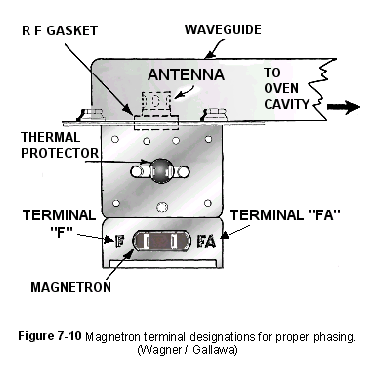
The typical half-wave voltage doubler circuit with the capacitor and diode are connected in the high-voltage transformer secondary (Figure 10). Generated from the filament winding on the high-voltage transformer, 3.3 VAC is applied to the magnetron filament through noise suppression chokes and capacitors. Two chokes and capacitors, enclosed within the magnetron shielded case, prevent microwaves from affecting radios and television sets.
The AC voltage of approximately 2,000 volts or more (depending on the output power of the microwave oven) is generated from the secondary winding of the high-voltage transformer. The capacitor charges through the diode during the first positive cycle of the AC from the transformer (Figure 8). The charge path of the capacitor is shown by the dashed lines. During the capacitor charging time, the magnetron is off because the diode shunts it. The capacitor charges to approximately 2,000 volts or more.
Figure 8 - The capacitor charges through the diode during the first positive cycle.
During the negative half-cycle, the voltage on the capacitor and the voltage across the transformer secondary winding are combined and applied across the magnetron's anode, shown by the solid lines (Figure 9). The resultant potential of approximately 4,000 volts is used to oscillate the microwaves from the magnetron. Notice that the magnetron is pulsed on and off at a rate of 60/50 Hz, depending on the line rate used.
Figure 9 - During the negative half-cycle, the voltage on the capacitor and the voltage on the transformer secondary winding are applied across the magnetron.
Figure 10 - The large power supply transformer supplies high-voltage to the voltage doubler circuit and low-voltage to the filament on the magnetron.


microwave radiation

Electromagnetic radiation with wavelengths between 30
centimeter and 1 millimeter, corresponding to frequencies
between 1,000 MHz and 300,000 MHz (1GHz to 300 GHz).
Microwaves occupy that portion of the electromagnetic spectrum
between short-wave radio waves and infrared radiation.
Microwaves are used today for such purposes as radar, radio
and television broadcasting, cellular telephones, and
microwave heating (see below).


Microwave heating
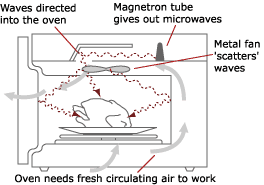
A microwave oven (see diagram) exploits the presence of water
in food to cook things from the inside. A microwave oven
generates microwaves in a magnetron (1). When the microwaves
penetrate the food, they cause water molecules (2), which have
a positive side and a negative side, to rotate (3) generating
heat through friction with the food. The oven is heavily
insulated (4) to prevent leakage of microwaves. A rotating
plate (5) and paddles (6), which ensure an even distribution
of microwaves and that the food cooks evenly. To dissipate the
hot air, generated by cooking and by the magnetron, a fan (7)
pushes cold air around the oven.

Abb. 1 Mikrowellenofen
(1) Deckplatte, (2) Reflektorflügel, (3) Hohlleiter, (4) Magnetron, (5) Koppelstift, (6) Bodenplatte, (7) Gehäuse, (8) Garraum, (9) Elektronik, (10) Kühlgebläse


Magnetron


Çoğu kimseler tarafından pek
güvenilmemesi ile birlikte sağlıksız ve tehlikeli olarak
görülen bu cihazları oluşturan parçalara bakacak olursak
bunlar pişirme bölümü, kontrol paneli, dalga kılavuzu, döner
tabla, dönüştürücü, kondansatör ve magnetrondur. Kontrol
paneli elektrik akımının dönüştürücüye iletilmesini sağlar.
Dönüştürücü ve kondansatör elektriği şarj ederek magnetrona
gönderir. Magnetron kondansatör ve dönüştürücü tarafından
üretilen 4000 volt elektriği alır ve elektromanyetik pişirme
enerjisine dönüştürür. Bunlara da mikrodalgalar adı verilir.
Mikrodalga fırın bu özellikleriyle can bulur mutfaklarda.
İçinde boş bölümleri olan bir vakumlu tüp olarak
gösterebileceğimiz magnetronun her iki ucunda da boş birer tüp
vardır. Elektrik akımı magnetrona gelir. Mıknatıslar manyetik
bir alan oluşturur. Akım bakır tellerden geçerek elektron
ışınlarına dönüşür. Bu ışınlar manyetik alanda dairesel bir
yol alır ve tüpün bölme duvarlarına çarparak geri dönerler. Bu
döngü inanılmaz büyük bir hızla gerçekleşir. Bu derece yüksek
hıza ulaşan elektrik akımları mikrodalgalar üretmeye
başlarlar. Magnetronun içine yerleştirilen bir anten
mikrodalgaları dalga kılavuzuna gönderir. Dalga kılavuzunun
görevi mikrodalgaları pişirme bölümüne dağıtmaktır. Bu bölümü
oluşturan metal malzeme bir ayna gibi yansıtır. Dönen tabla
sayesinde bu dalgalar yiyeceğin her alanına ulaşır. Yüksek
hızda titreşen dalgalar su moleküllerinin birbirine sürtmesine
sebep olur. Bu sayede açığa çıkan ısı enerjileri de yiyeceğin
pişmesini sağlar. İçinde daha çok su molekülü bulunan
yiyecekler daha hızlı pişerler.

Mikrodalga fırın nasıl çalışır?
Mikrodalga fırınlar elektrik ve manyetik alanların birleşimi
ile ortaya çıkan ve boşlukta hareket edebilen enerjiyi içeren
elektromanyetik dalga boyuna ait araçlardır. 1970’lerden sonra
mutfaklarda yer almaya başlayan bu teknoloji cihazlar,
günümüzde vakit darlığı sorunu ve beslenme ihtiyaçları için
çok önemli bir cihaz halini almıştır. Fazla yer kaplamayan
hatta ankastre modüller sayesinde neredeyse bir dekor halini
alan mikrodalga fırınlar kompakt birer ev eşyası olarak bile
düşünülebilir.
Mikrodalga fırın çalışma prensibi açısından bakıldığında;
spektrum genelde dalgaların farklı dalga boyları (frekans) ve
emisyon, transmisyon davranışlarına göre alt başlıklara
ayrılmıştır. En uzundan en kısa spektrum elektrik ve radyo
dalgaları, mikrodalga, kızılötesi ışınım, görünür ışın,
morötesi ışınım, X ışınları, gamma ışınları ve elektromanyetik
kozmik ışınları kapsar. Mikrodalga frekansları yaklaşık olarak
0.3 ile 30 cm arasındadır.
Mikrodalgalar kendine özgü özellikleri sayesinde yemek pişirme
de kullanım imkanı sağlayan teknoloji ürünleridir. Mikrodalga
fırın işleyişinin temel öğesi olan elektromanyetik dalgalar,
plastikten, camdan ve kağıt maddelerden geçebilirler;
metallerden yansır ve gıdalar (özellikle sıvılar) tarafından
emilirler. Geleneksel fırına konan yemek, etrafında ısınan
havayı emerek yavaşça ısınır. Mikrodalgalar, öte taraftan,
yiyeceği çok daha çabuk ısıtırlar çünkü bütün katmanlara aynı
anda nüfuz ederler. Herhangi bir yiyecekteki ya da bir kaptaki
sıvı moleküllerini hareketlendirerek ısıtırlar. Mikrodalga
fırın satışlarında Arçelik, Türkiye’nin en çok tercih edilen
mikrodalga fırın üreticilerinden biri olarak dikkat
çekmektedir.
Mikrodalga fırını (MD), yiyeceği ısıtmak için
mikrodalgaları, yani radyo dalgalarını kullanan bir fırın
çeşididir.
Tarihçe
Mikrodalgalarla pişirme fikri ilk kez Percy Spencer
tarafından, radar olarak kullanılması planlanan "magnetron"un
keşfedilmesiyle 1945'li yıllarda başlamıştır. 1947'de bu
buluşunun patentini almış ve ilk mikrodalga fırını 1,8 metre
boyunda ve 340 kg. ağırlığında olarak tasarlamıştır.
İlk mikrodalga fırınlar 1950'li yıllarda kulanılmaya başlamış
olup günümüzde Amerika'da yaklaşık olarak 80 milyon mikrodalga
fırının olduğu tahmin edilmektedir. Bu sayının yarısı son
yıllardaki satışlara aittir.
Çalışma prensibi
Mikrodalgalar, elektromanyetik spektrumun radyo dalgaları ile
kızıl ötesi ışınlar arasındaki bölümde kalırlar. Frekansları 1
GHz ila 1000 GHz arasında, dalga boyları 0.1-100 cm. olan
elektromanyetik dalgalardır.
Dalgaların frekansları ile dalga boyu arasında; yüksek
frekanslı dalgaların kısa dalga boyu, alçak frekanslı
dalgaların ise uzun dalga boyu yayması ilişkisi ya da tam
tersi durum vardır. Normal fırınların kapağında bulunan küçük
delikler, ışık dalgalarının geçmesine izin verirler ve bu
nedenle fırının içi görülürdür. Çünkü ışığın dalga frekansı
oldukça yüksek, dalga boyu da çok küçüktür, mikrodalga
fırınların ise frekansı düşük ve dalga boyları daha uzundur.
Bu yüksek dalga boyundaki dalgalar kapaktaki deliklerden
geçemez ve ve tekrar içeri yansırlar.
Mikrodalga fırınlarda genellikle 2,5-3 GHz'lık frekanslar
kullanılır. Bu frekansta çalışan bir fırının içerisine konan
maddenin molekülleri saniyede 2,5-3 milyar kez titreşir. Bu
titreşim sayesinde de maddenin molekülleri ısınır dolayısıyla
maddenin kendisi ısınır ve pişer.
Mikrodalga, bu özel fırınların içindeki "magnetron" adı
verilen vakum tüpünden üretilir. Magnetron, 60 Hz'lik elekrik
enerjisini "mikrodalgalar"a dönüştürür, mikrodalga fırın bu
şekilde çalışmaya başlar.
Özellikleri
Bu frekanstaki dalgalar, başlıca su olmak üzere bazı maddeler
tarafından emilirler, dalgalar, bu maddelerin moleküllerini
atomik devinime uğratarak mikrodalga enerjiyi ısıya
dönüştürürler. Bu nedenle içinde daha çok su molekülü taşıyan
besinler daha hızlı pişer.
Bu mikrodalgaların özellikleri şöyle sıralanabilir;
Su, şeker ve yağlar tarafından emilir,
Emildiği ilk anda atomik ısıya dönüşür,
Çoğu plastik, cam ve porselen tarafından emilmez,
Mikrodalga ile pişirme, geleneksel pişirme yöntemlerinden hem
daha hızlıdır hem de pişirme sürecinde yalnızca besin pişer,
fırın ve ortam ısınmaz.
Mikrodalgaların enerjileri, besin içinde ısıya dönüştüğü için,
besin içinde bir radyasyon oluşması vb. bir durum genellikle
söz konusu değildir.

Başka bir kaynak bilgisi...
Mikrodalgalarla pişirme fikri ilk kez Percy Spencer
tarafından, radar olarak kullanılması planlanan "magnetron"un
keşfedilmesiyle 1945'li yıllarda başlamıştır. Percy Spencer,
radar dalgaları ile deney yaparken cebindeki çikolatanın
erimesi ile mikrodalga enerjisinin yiyecekleri ısıtabildiğini
keşfetti. 1947'de bu buluşunun patentini almış ve ilk
mikrodalga fırını 1,8 metre boyunda ve 340 kg ağırlığında
olarak tasarlamıştır. Mikrodalga fırın, 1947'de mutfak
eşyaları üreticisi olan Raytheon şirketince "Radarange" adıyla
kamuoyuna duyurulmuş olsa da, gerek fiyatının çok yüksek oluşu
gerekse büyükçe bir buzdolabı boyutlarında olması nedeniyle
ticari olarak pek ilgi görmedi.
Evlerde kullanılan ilk mikrodalga fırınlar, 25 Ekim 1955'te
Tappan şirketi tarafından satışa çıkarılmış olup günümüzde
ABD'de yaklaşık olarak 80 milyon mikrodalga fırının olduğu
tahmin edilmektedir. Bu sayının yarısı son yıllardaki
satışlara aittir.
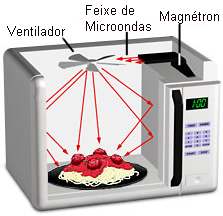
Mikrodalga fırınlar yiyecekleri mikrodalga adı verdiğimiz
elektromanyetik dalgalarla ısıtıyor
.
Peki ama mikrodalga fırın nasıl çalışır?
Mikrodalga fırının temel parçalarını sıralayalım.
Metalden yapılmış pişirme bölümü, (neden metalden yapıldığını
ve mikrodalga fırınlarına neden metal bir cisim koyulmasının
tehlikeli olduğunu açıklayacağız) kontrol paneli, dalga
klavuzu, döner tabla, dönüştürücü, kondansatör ve mikrodalga
fırının kalbi magnetron.
Kontrol paneli elektrik akımının dönüştürücüye iletilmesini
sağlar. Dönüştürücü ve kondansatör elektriği şarj ederek
magnetrona gönderir. Magnetron, kondansatör ve dönüştürücü
tarafından üretilen 4000 volt elektiriği alır ve
elektromanyetik pişirme enerjisine dönüştürür yani
mikrodalgalara.
Magnetronu daha yakından inceleyelim. Magnetron her iki ucunda
da mıknatıs olan boş bir tüp. Elektrik akımı magnetrona gelir.
Mıknatıslar manyetik bir alan oluşturur. Akım bakır tellerden
geçerek elektron ışınlarına dönüşür. Işınlar manyetik alanda
dairesel bir yol alır ve tüpün bölme duvarlarına çarparak geri
dönerler. Bu döngü çok hızlı olur. Saniyede 5 milyar kez
titreşecek kadar hızlı. Elektrik akımı bu kadar hızlı bir
şekilde çarpıp geri döndüğünde mikro dalga üretir.
Magnetronun içine yerleştirilmiş bir anten mikro dalgaları
dalga kılavuzuna gönderir. Dalga kılavuzunun görevi
mikrodalgaları pişirme bölümüne dağıtmaktır.
Dalga kılavuzu metalden yapılmıştır. Metal mikrodalgaları bir
ayna gibi yansıtır. Dönen tabla sayesinde mikrodalgalar
pişirmek istediğimiz yiyeceklerin her yanına ulaşır. Yüksek
hızla titreşen dalgalar su moleküllerinin birbirine
sürtünmesine sebep olur. Böylece ısı enerjisi açığa çıkar ve
ısıyla da yiyecek ısınmış olur. İçinde daha fazla su molekülü
olan yiyecekler daha hızlı ısınır.


Mikrodalga Metaller tarafından yansıtılırlar. Mikrodalga
fırınlarına metal malzemeler koyulmamasının nedeni de bundan
kaynaklanmaktadır.
Mikrodalga fırınlarda 2,45 GHz’lik bir frekans kullanılır. Bu
frekansın kullanılmasının önemli bir sebebi vardır. 2.54 Ghz,
su moleküllerinin rezonans frekansıdır. Bunun sonucu olarak
2.54 Ghz'lik mikrodalga ışıma en çok su tarafından
emilecektir. Çoğu yiyecek de su içerdiğinden ısınacak,
mikrodalga fırına uygun tabaklar ise su içermediğinden
ısınmayacaktır.
Mikrodalga fırınlar normal fırınlara oranla çok daha az enerji
harcamaktadırlar. Örneğin elektrikli bir fırın 1000-2000
Watt’lık elektrik gücü tüketirken, mikrodalga fırınlar
yalnızca 300-500 Watt’lık bir güçle çalışırlar. Mikrodalga
fırnın az enerji harcamasının sebebi, kullanılan neredeyse tüm
enerjinin ısıtılacak nesnede absorbe edilmesidir. Elektrikli
fırında ise fırının içi ve yiyeceğin konduğu kap da
gerekmediği halde ısıtıldığından gereksiz enerji harcanır.


How does a microwave turn electricity into heat? Like this!

1- Inside the strong metal box, there is a microwave generator
called a magnetron. When you start cooking, the magnetron
takes electricity from the power outlet and converts it into
high-powered, 12cm (4.7 inch) radio waves.
2- The magnetron blasts these waves into the food compartment
through a channel called a wave guide.
3- The food sits on a turntable, spinning slowly round so the
microwaves cook it evenly.
4- The microwaves bounce back and forth off the reflective
metal walls of the food compartment, just like light bounces
off a mirror. When the microwaves reach the food itself, they
don't simply bounce off. Just as radio waves can pass straight
through the walls of your house, so microwaves penetrate
inside the food. As they travel through it, they make the
molecules inside it vibrate more quickly.
5- Vibrating molecules have heat so, the faster the molecules
vibrate, the hotter the food becomes. Thus the microwaves pass
their energy onto the molecules in the food, rapidly heating
it up.

Dış bağlantılar
- Radar Anten Tekniği..................
- Klystron.................
- Elektronik.................
- Radyo Vericileri...................
- Frekans...................
- Gama Işını..................
Hiçbir yazı/ resim izinsiz olarak kullanılamaz!! Telif hakları uyarınca bu bir suçtur..! Tüm hakları Çetin BAL' a aittir. Kaynak gösterilmek şartıyla siteden alıntı yapılabilir.
© 1998 Cetin BAL - GSM: +90 05366063183 - Turkiye / Denizli

